15 Thanksgiving Tablescape Ideas That Aren’t Basic
15 Thanksgiving Tablescape Ideas That Aren’t Basic
The default Thanksgiving table has become so predictable it’s practically a template: an orange runner, a bowl of mini pumpkins, a scatter of fall leaves, and a candle or two. None of it looks bad, exactly. It just looks like every other Thanksgiving table, assembled from the same seasonal aisle at the same store.
A tablescape that avoids that default isn’t necessarily more expensive or more work — it’s usually just built from a different set of decisions. A darker, more unexpected colour palette instead of the standard orange-and-cream. Mismatched vintage pieces instead of a matching set. A low, horizontal centerpiece instead of a tall bowl blocking every sightline across the table. The materials can still be entirely seasonal; the arrangement of them is what changes.
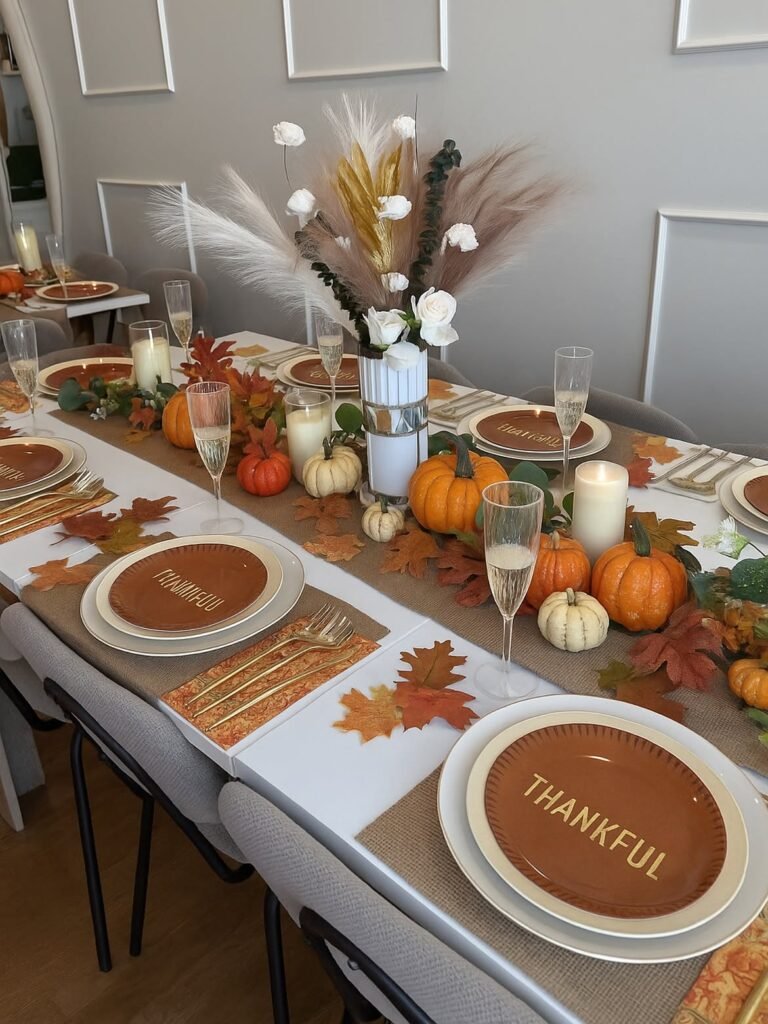
This list treats the table as a full composition — place settings, linens, and centerpiece together — rather than just the bowl in the middle. Here are 15 ways to build a Thanksgiving table that doesn’t default to the same look everyone else’s does.
Why Most Thanksgiving Tables Look the Same
The single-palette problem:
Without a considered palette:
- Orange, cream, and brown, applied in roughly equal measure to every element
- No deeper or more saturated tone anywhere on the table
- The result: a table that reads as generically “fall,” indistinguishable from a dozen others
With a considered palette:
- One dominant, more specific tone — deep plum, burgundy, charcoal, or moody green — with warm neutrals in support
- Orange, if used at all, appears in a single accent rather than across every element
- The result: a table with a clear identity, rather than a template filled in with seasonal defaults
The centerpiece-only problem:
- All of the design effort concentrated in a single centerpiece bowl at the table’s centre
- Place settings, napkins, and glassware left as an afterthought, straight from the everyday cabinet
- The result: a beautiful centerpiece surrounded by a table that doesn’t match its level of effort
The height-blocking problem:
- A centerpiece tall enough to block sightlines and conversation across a table people will sit at for hours
- The result: guests moving the centerpiece mid-meal, which undoes the table’s careful styling exactly when it matters most
The Five Non-Basic Tablescape Principles
Before choosing any individual idea below, these five principles separate a distinctive table from a default one:
A specific, non-default colour anchor:
- One deliberate tone (plum, charcoal, deep green) rather than the standard orange-cream-brown default
- Everything else on the table supports that one anchor color
Design effort spread across the whole table, not just the centre:
- Place settings, napkins, and glassware get the same consideration as the centerpiece
- A table is judged as a whole composition, not one bowl surrounded by ordinary plates
Low and horizontal over tall and vertical:
- Nothing above 14 inches at the table’s centre
- A tablescape needs to survive three hours of actual conversation, not just photograph well for the first five minutes
Mixed materials and eras:
- Vintage glassware beside modern flatware, mismatched china stacked deliberately
- A collected, layered look reads more considered than a single matching set
Texture as a design element, not just colour:
- Linen, raffia, brass, and unglazed ceramic doing as much visual work as any specific hue
- A table built entirely from smooth, matte, single-texture pieces reads flatter regardless of the colour choice
1. The Moody Dark Palette
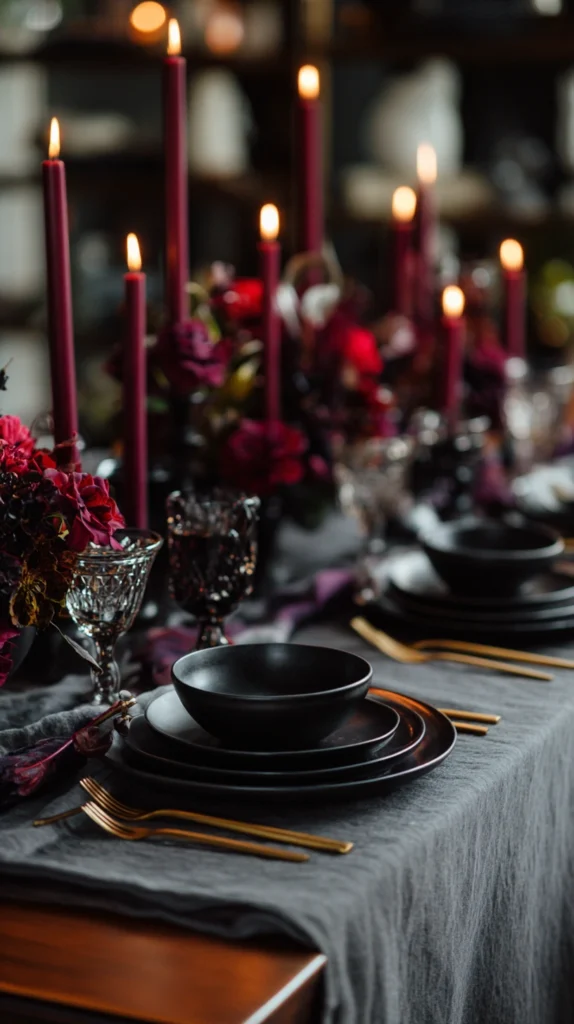
A tablescape built around deep plum, burgundy, or charcoal as the dominant tone, with warm neutrals in support and orange used sparingly, if at all.
Why a darker palette reads as more sophisticated
Deep, saturated tones photograph and feel more formal than the pastel-adjacent orange and cream most Thanksgiving tables default to. A moody palette signals the meal is being treated as a genuine occasion, closer to a formal dinner party than a casual seasonal gathering.
Building the palette
- Linens: deep plum or charcoal, rather than orange or rust
- Florals: burgundy dahlias or deep red chrysanthemums, rather than orange or yellow mums
- Candles: cream or deep burgundy tapers, avoiding orange entirely
Cost breakdown
- Plum or charcoal table linens: $30–55
- Burgundy or deep red florals: $30–60
- Total: $60–115
2. The Mismatched Vintage China Stack
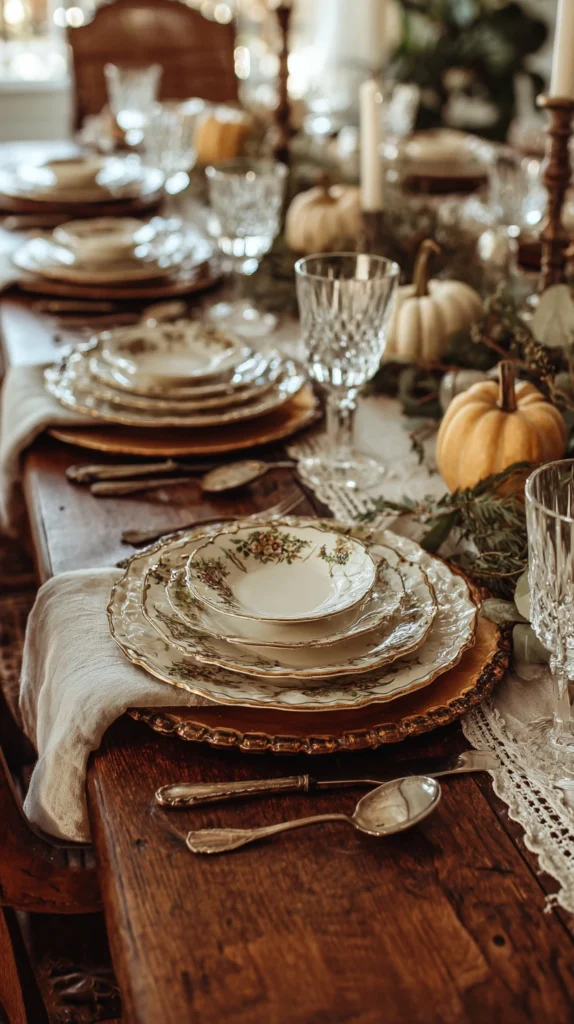
Place settings built from intentionally mismatched vintage or secondhand china, rather than a single matching set, layered in stacks of two or three plates per setting.
Why mismatched china reads as curated, not accidental
A single matching set, however nice, reads as a purchased collection. Vintage pieces gathered from different sets — different patterns, different eras, unified only by a shared colour family — read as a table assembled with real personal taste, the same collected quality that works in a gallery wall or a shelf styled with varied objects.
Assembly guidance
- Stack a larger base plate, a smaller salad or bread plate, and (if using) a patterned charger, choosing pieces that share at least one colour or tone in common
- Aim for variety in pattern but consistency in overall colour family, so the mismatch reads intentional rather than random
Cost breakdown
- Secondhand or thrifted china (per place setting, 2–3 pieces): $8–20
- Total (8 place settings): $64–160
3. The Layered Linen Runner
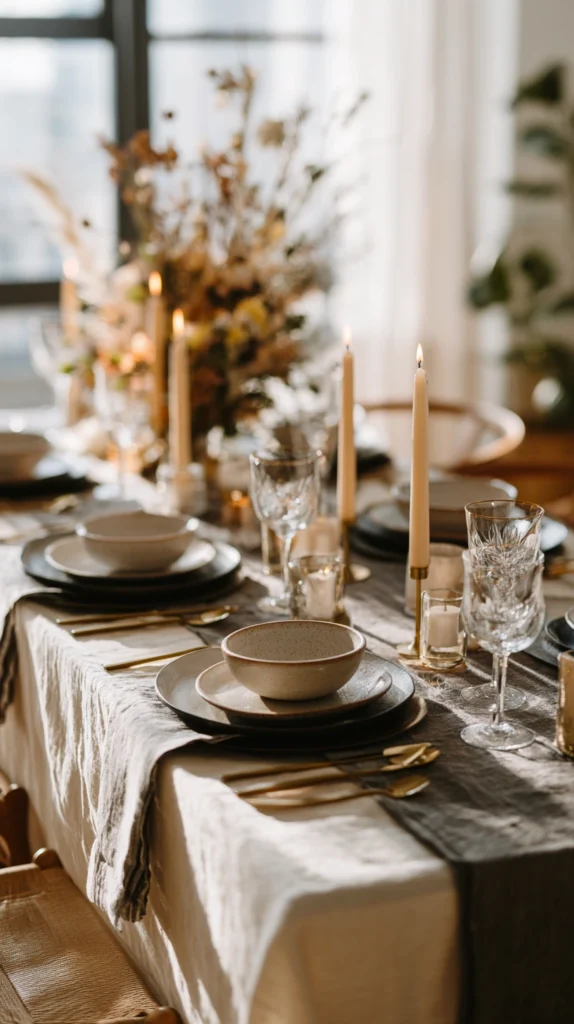
A textured linen runner, layered over a solid tablecloth in a complementary tone, rather than a single flat runner used alone.
Why layering linens adds depth a single runner can’t
A single runner on a bare table reads as one flat decision. The same runner layered over a tablecloth in a slightly different but related tone creates visual depth before a single place setting or centerpiece element is added, the same layering principle that works with a base and top rug in a living room.
Material and colour pairing
- Base tablecloth: a solid, warm neutral (cream, oatmeal, or a deep charcoal for the moody palette)
- Top runner: a textured linen or waffle-weave fabric in a complementary but distinct tone
Cost breakdown
- Tablecloth: $30–50
- Textured runner: $25–45
- Total: $55–95
4. The Taper Candle Cluster
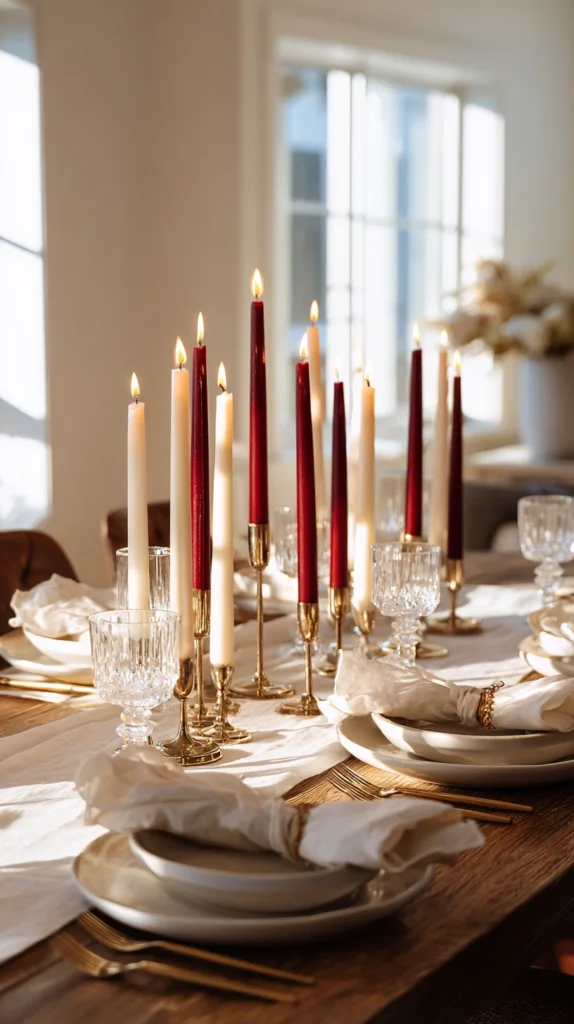
A cluster of taper candles in varying heights, positioned along the table’s centre line rather than a single tall centerpiece bowl, kept low enough to preserve sightlines across the table.
Why a candle cluster outperforms a single centerpiece for a long dinner
Tapers, especially at varied heights rather than a uniform row, create movement and visual interest along the table’s length without concentrating all the height in one central, sightline-blocking spot. Guests can see and talk to each other across the table for the entire meal, which a tall centerpiece bowl often makes difficult by the second course.
Placement and safety
- Space tapers in small clusters of 3–4 every 18–24 inches down the table’s centre line, rather than one continuous unbroken row
- Use dripless tapers or wide-based holders to avoid wax on the linens, particularly for a meal expected to run several hours
Cost breakdown
- Taper candles (12–16, mixed heights): $20–35
- Taper holders (4–5 clusters): $40–80
- Total: $60–115
5. The Fresh Herb Place Setting Accent
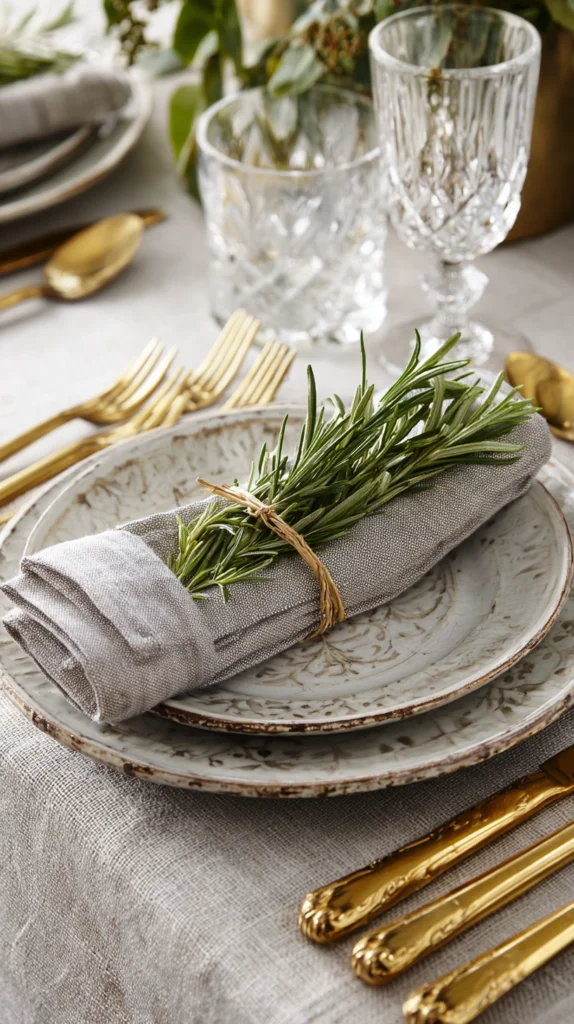
A small sprig of fresh rosemary or sage tied to each napkin, rather than a folded napkin left plain — a place-setting-level detail extending the table’s styling to every seat.
Why a per-setting detail matters more than another centerpiece element
Spreading design effort to the place settings themselves, rather than concentrating everything at the table’s centre, is one of the clearest signals that the whole table was considered, not just the one bowl in the middle. A single herb sprig is a small, low-cost way to extend that consideration to every single guest.
Assembly
- One sprig of rosemary or sage per napkin, tied with a small length of twine or a thin ribbon matching the table’s palette
- Tucked under the napkin’s fold or tied around a rolled napkin, rather than laid loosely on top where it can slide off
Cost breakdown
- Fresh rosemary or sage (enough for 8–10 settings): $10–18
- Twine or ribbon: $5–10
- Total: $15–28
6. The Hand-Lettered Leaf Place Card
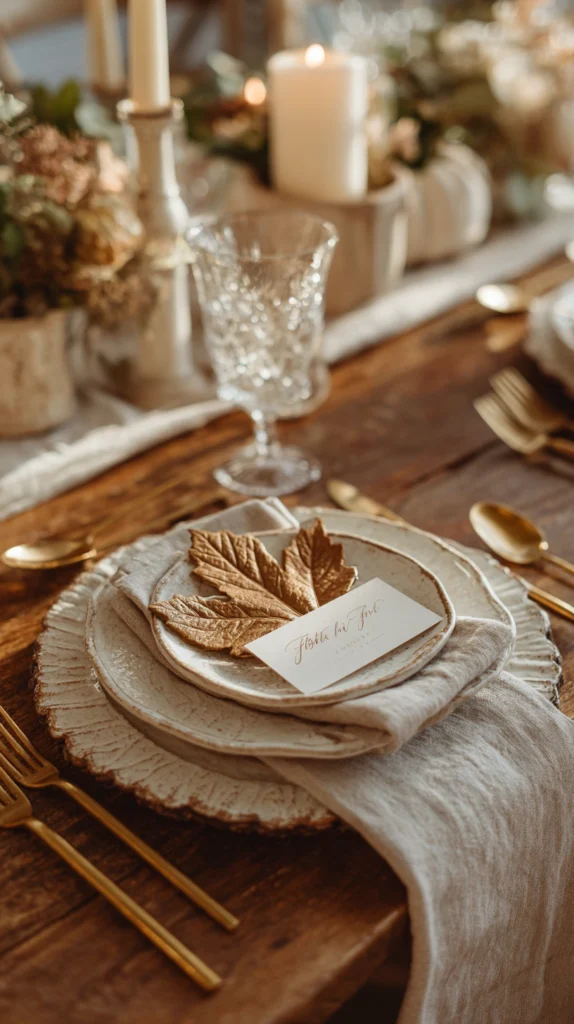
A guest’s name hand-lettered directly onto a pressed or faux leaf, used as a place card in place of a standard paper card.
Why a botanical place card reads more considered than paper
A paper place card, however nicely printed, is a purely functional object. A name lettered onto a leaf ties the place card directly into the table’s seasonal material palette, turning a functional necessity into another styled detail rather than an afterthought added at the last minute.
Materials and technique
- Pressed real leaves, or high-quality faux leaves for a sturdier, reusable option
- A fine-tip paint pen or metallic marker in gold or cream, depending on the table’s overall palette
Cost breakdown
- Pressed or faux leaves (8–10): $8–16
- Paint pen: $6–10
- Total: $14–26
7. The Unexpected Floral Choice
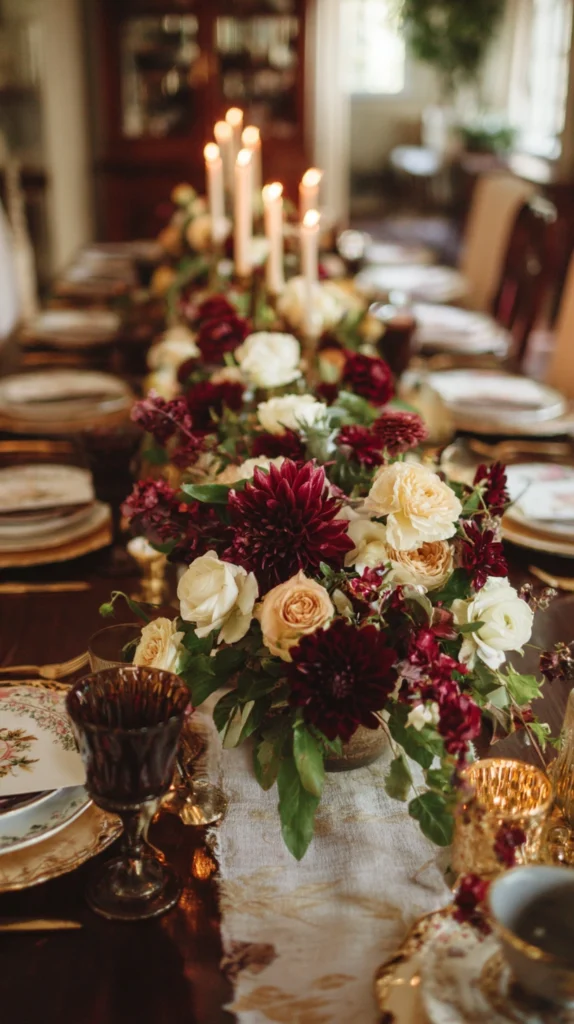
Dahlias, ranunculus, or garden roses in deep, saturated fall tones, used in place of the standard chrysanthemum most Thanksgiving florals default to.
Why moving beyond mums changes the table’s entire feeling
Chrysanthemums are so closely associated with the standard Thanksgiving centerpiece that their presence alone can make a table read generic, regardless of how well everything else is styled. Dahlias and garden roses, in the same warm autumn tones, deliver the same seasonal colour without the visual shorthand for “basic fall arrangement.”
Selection and arrangement
- Choose 2–3 varieties in a related colour family (deep burgundy dahlias, rust ranunculus, cream garden roses) rather than a single flower type
- Arrange low and loose in a horizontal vessel, avoiding a tightly packed, uniform round shape
Cost breakdown
- Mixed dahlias, ranunculus, or garden roses: $40–75
- Total: $40–75
8. The Layered Brass Charger
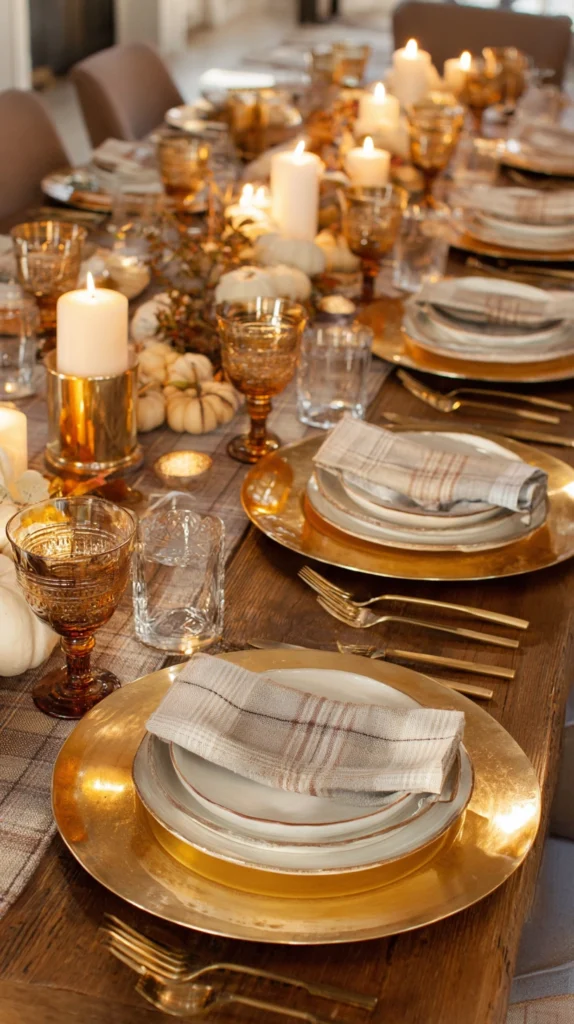
A brass or antiqued gold charger plate beneath each place setting, adding a metal foundation layer at every seat rather than relying on the centerpiece alone for metallic accent.
Why chargers extend the metal palette to every guest
A single brass centerpiece vessel or candle holder introduces the metal accent only at the table’s centre. A charger at every place setting extends that same warm metal tone to each individual seat, reinforcing the palette consistently across the whole table rather than concentrating it in one spot.
Styling with mismatched china
- Works particularly well underneath the mismatched vintage china from Idea #2, providing one consistent unifying element beneath the varied plates
- Choose an antiqued or brushed brass finish over a bright polished gold, for the same reasons a brushed finish suits any other room’s metal accents
Cost breakdown
- Brass or gold chargers (8–10): $60–120
- Total: $60–120
9. The Raffia-Tied Napkin
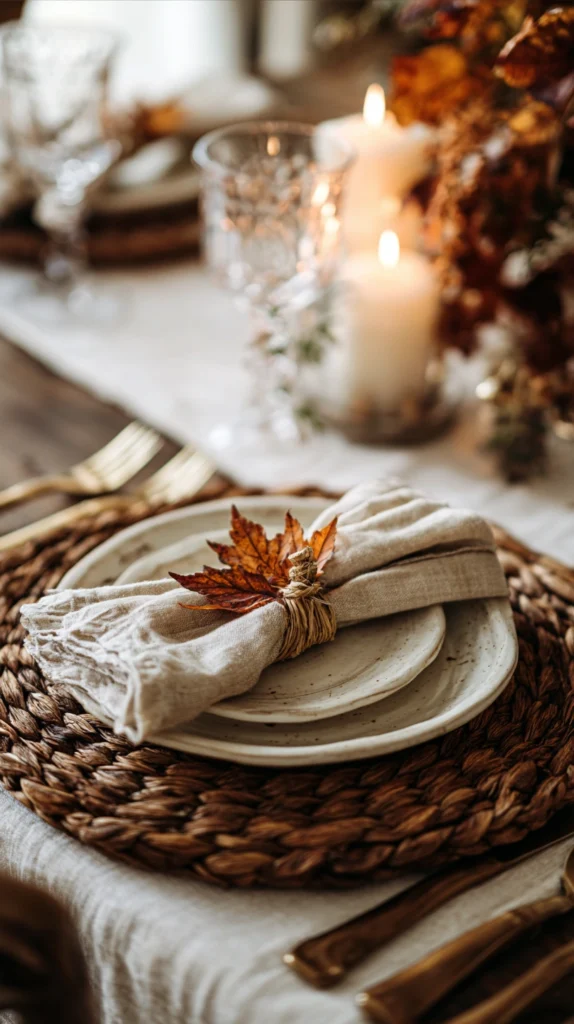
Cloth napkins rolled and tied with natural raffia or a strip of dried husk, rather than folded flat or tied with standard ribbon.
Why raffia adds texture a folded napkin alone can’t
A flat-folded napkin, however crisp, is a purely functional shape. Rolling the napkin and tying it with raffia adds both texture and a slight, organic irregularity that reinforces the table’s natural, seasonal material palette in a small but consistently visible detail at every place setting.
Assembly
- Roll each napkin loosely rather than tightly, so the raffia tie has some visible give rather than looking overly precise
- Tuck a small sprig or leaf under the tie for an additional detail, if not already using the herb accent from Idea #5
Cost breakdown
- Cloth napkins (8–10, if not already owned): $30–60
- Raffia: $6–10
- Total: $6–70 depending on existing napkin ownership
10. The Low, Long Horizontal Centerpiece
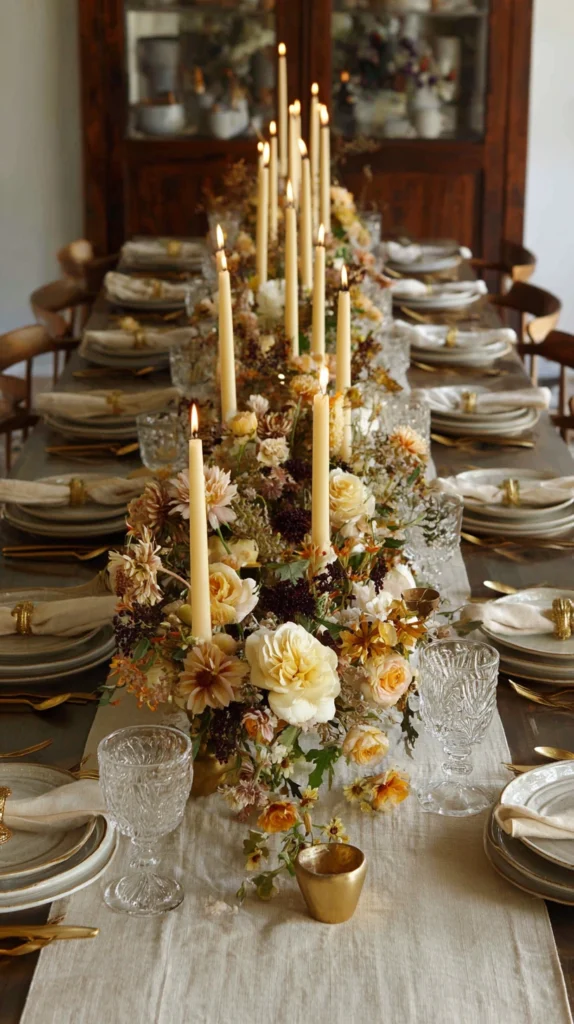
A centerpiece built in a long, shallow trough vessel rather than a round bowl, running most of the table’s length at a height under 6 inches.
Why horizontal scale suits a long dining table better than a round centerpiece
A round centerpiece bowl, sized appropriately for a small table, often looks under-scaled and isolated on a long Thanksgiving table built for a larger gathering. A long, low trough arrangement uses the table’s actual length, providing visual presence along the whole surface without ever rising high enough to block sightlines.
Building the arrangement
- A shallow trough or a series of 2–3 low rectangular dishes lined up end to end
- Filled with a low mix of florals, greenery, and a few gourds, kept consistently under 6 inches in height throughout
Cost breakdown
- Long trough vessel or 2–3 low dishes: $30–60
- Low floral and greenery fill: $35–65
- Total: $65–125
11. The Mismatched Vintage Glassware
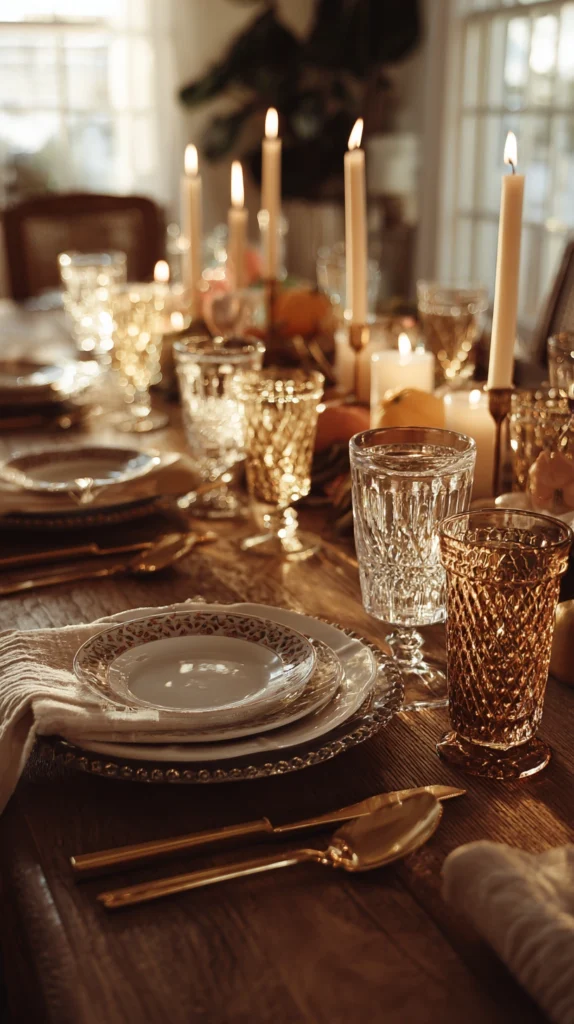
Water and wine glasses in varied vintage or secondhand patterns, rather than a matching modern set, following the same collected principle as the mismatched china.
Why glassware deserves the same treatment as the plates
Glassware is often the last element considered in a table setting, typically pulled straight from the everyday cabinet regardless of how much effort went into the plates and centerpiece. Applying the same intentional mismatch used for the china to the glassware extends the table’s collected, curated feeling to every visible surface at each place setting.
Sourcing and pairing
- Secondhand shops and estate sales are the most reliable source for varied vintage glassware at low individual cost
- Pair by stem colour or general shape family (all coloured-glass stems, for instance) even when the specific pattern varies, to keep the mismatch feeling curated rather than completely random
Cost breakdown
- Vintage or secondhand glassware (per place setting, 2 glasses): $6–15
- Total (8 place settings): $48–120
12. The Individual Menu Card
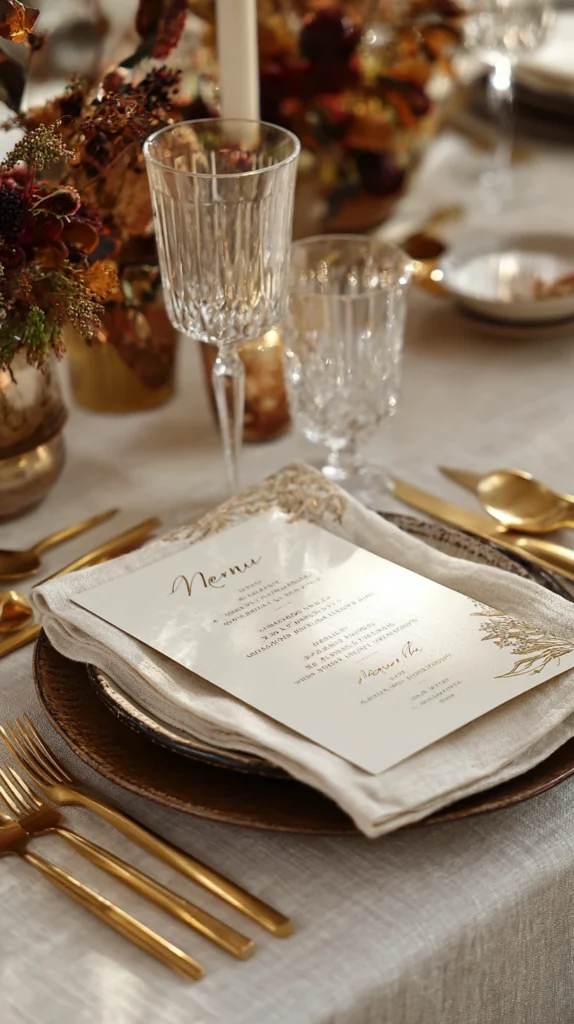
A small printed or hand-lettered menu card at each place setting, listing the meal’s courses — a detail borrowed from formal restaurant and event styling, uncommon at a home Thanksgiving table.
Why a menu card signals occasion in a way few other details do
A menu card is rarely seen outside of formal dinners and special events, which is exactly why its presence at a home Thanksgiving table reads as a clear, deliberate elevation of the meal’s importance. It also gives guests something small and personal to look at and discuss before the meal begins.
Design and production
- A simple card, hand-lettered or printed on cardstock in a tone consistent with the table’s palette
- Positioned on top of the folded napkin or leaned against the water glass at each setting
Cost breakdown
- Cardstock and printing, or hand-lettering supplies: $10–20
- Total: $10–20
13. The Dried Citrus Garland Runner
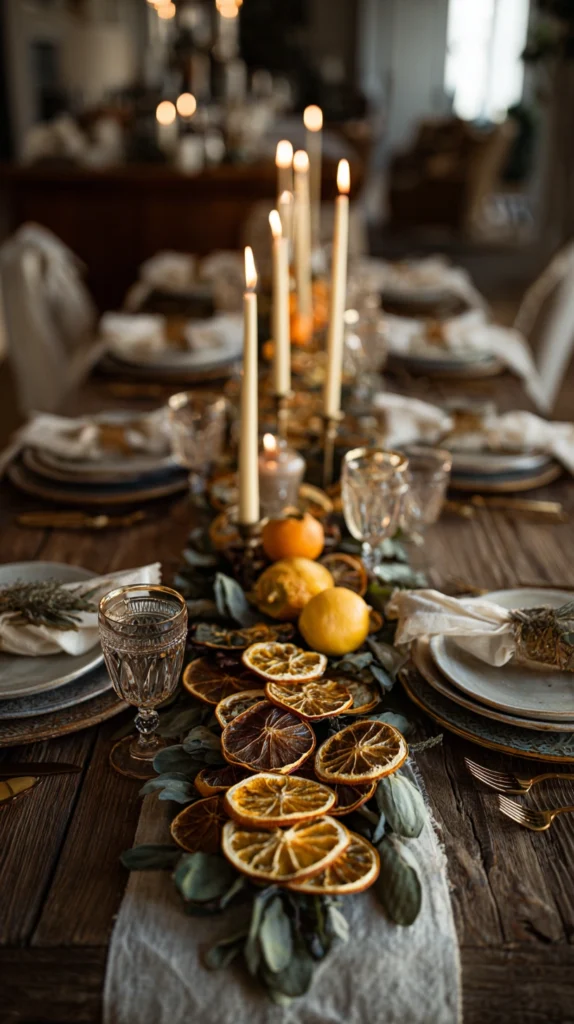
A garland of dried orange and lemon slices, strung or wired together, laid flat down the table’s centre as an alternative or companion to a floral centerpiece.
Why dried citrus adds a different visual and sensory note
Dried citrus slices bring a warm, translucent, stained-glass-like quality when light passes through them, along with a subtle scent that fresh florals don’t provide. Laid flat as a garland rather than piled in a bowl, they add texture along the table’s full length without competing for centre-of-table space with a floral or candle arrangement.
Assembly
- String dried citrus slices onto twine using a needle, alternating with small sprigs of dried greenery
- Lay the finished garland down the table’s centre, either alone or woven alongside the taper candle cluster from Idea #4
Cost breakdown
- Dried orange and lemon slices: $15–25
- Twine and needle: $4–8
- Total: $19–33
14. The Color-Blocked Table Zones
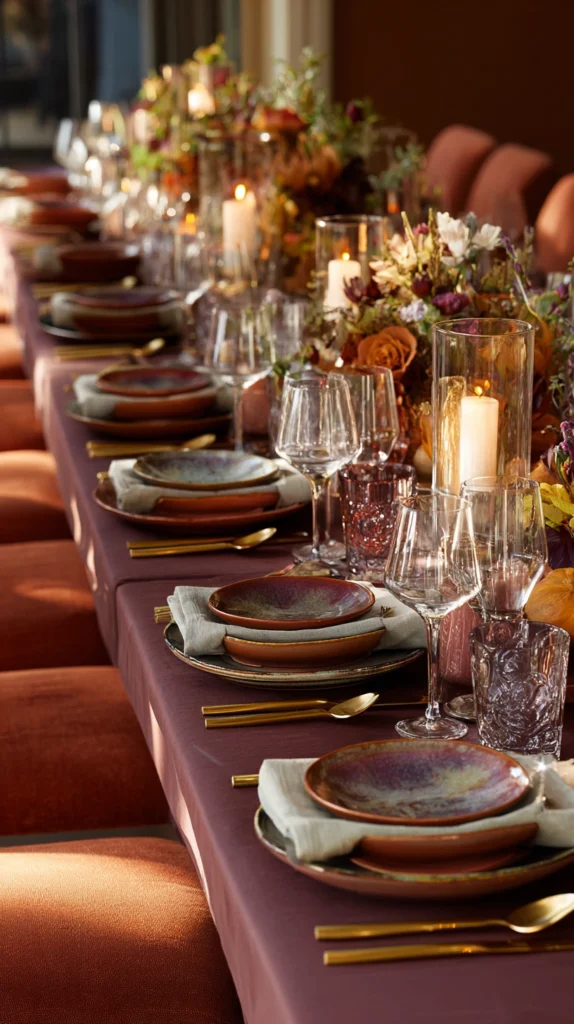
A single long table styled in two or three distinct but related colour zones along its length, rather than one uniform palette repeated identically from end to end.
Why zoning adds interest to a long Thanksgiving table specifically
A long table, seating a larger gathering than an everyday dinner, benefits from some visual variation along its length the way a shorter table doesn’t need. Zoning the palette — deeper, richer tones toward one end, lighter, warmer tones toward the other — gives the table a sense of movement and avoids the slightly repetitive look of the exact same arrangement repeated down its full length.
Building the zones
- Choose two or three related tones within the same overall palette (deep plum transitioning to warm rust, for instance)
- Shift the floral and linen tones gradually rather than in an abrupt halfway split, so the transition reads intentional rather than like two different tables pushed together
Cost breakdown
- Additional floral tone variation (beyond a single uniform arrangement): $20–40
- Total: $20–40 in addition to the base floral cost
15. The Complete Non-Basic Thanksgiving Table
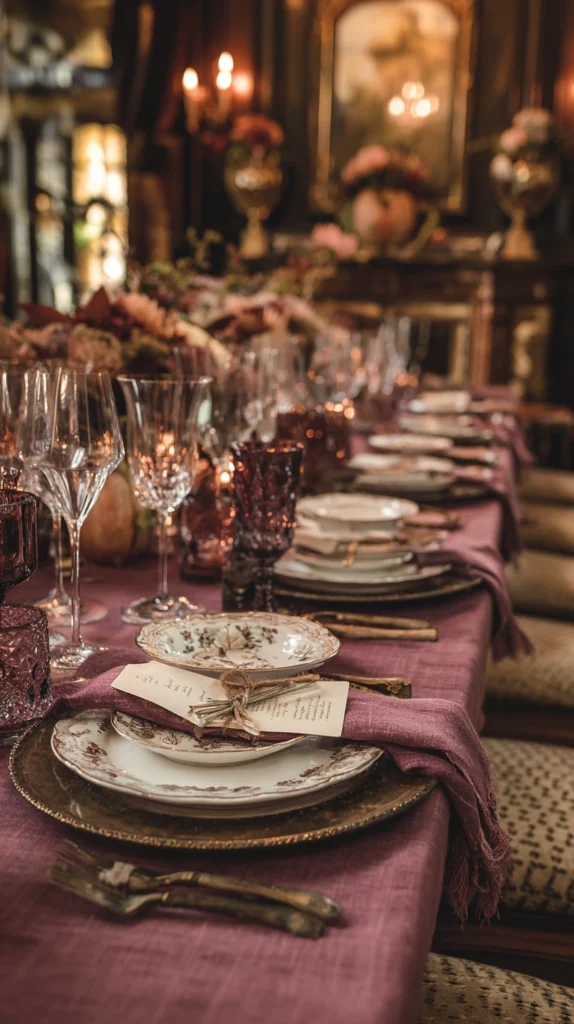
A tablescape built with every principle above applied together — the definitive version of a Thanksgiving table that reads as a genuine departure from the standard orange-and-pumpkin default.
What separates the complete table from a few distinctive touches
A table with one striking centerpiece but plain white plates and everyday glassware still reads mostly conventional, just with a nicer bowl in the middle. The complete version applies the same intentional, non-default thinking to every layer at once — palette, place settings, glassware, and centerpiece — so the whole table reads as a considered departure rather than a standard table with one upgraded element.
The elements of the complete table
The palette and linens:
- A moody, non-orange colour anchor (deep plum, burgundy, or charcoal) (Idea #1)
- A layered linen runner over a base tablecloth (Idea #3)
The place settings:
- Mismatched vintage china, stacked per setting (Idea #2)
- Brass chargers beneath each stack (Idea #8)
- Mismatched vintage glassware (Idea #11)
- Raffia-tied napkins with a fresh herb sprig (Idea #9 and #5)
The centerpiece:
- A low, long horizontal floral arrangement using dahlias or garden roses rather than mums (Idea #10 and #7)
- A taper candle cluster running alongside it (Idea #4)
- A dried citrus garland woven through, if additional texture is wanted (Idea #13)
The personal details:
- Hand-lettered leaf place cards at each setting (Idea #6)
- An individual menu card at each place (Idea #12)
The table on Thanksgiving afternoon:
Guests find their seat by a name lettered on a leaf, sit down to a stack of mismatched vintage china on a brass charger, and read a small menu card while the taper candles burn low and steady along the table’s centre. Nothing about the table reads as the standard orange-and-pumpkin default — every layer, from the plates to the palette to the centerpiece’s actual height, was a deliberate departure from it.
Cost breakdown for the complete table
Assuming a starting point of a bare table for eight to ten guests:
- Linens (tablecloth and runner): $55–95
- Mismatched vintage china: $64–160
- Brass chargers: $60–120
- Mismatched glassware: $48–120
- Napkins and raffia: $36–70
- Herb accents: $15–28
- Floral centerpiece: $65–125
- Taper candles: $60–115
- Citrus garland: $19–33
- Place cards: $14–26
- Menu cards: $10–20
Total: $446–912
Phased for a first-time versus fully built-out table:
First-time version ($150–300):
- Linens
- One floral centerpiece with an unexpected flower choice
- Taper candles
- Herb-tied napkins
Fully built-out version ($300–900):
- All of the above, plus mismatched china, chargers, glassware, and the personal detail layer (place cards and menus)
The complete non-basic Thanksgiving table: not a single striking centerpiece, but every layer of the table — down to the napkin ties and the flower variety — making the same deliberate choice to skip the default.
The Question Before Any Thanksgiving Tablescape Project
Before buying a single item:
Is the goal a fully new table, or a meaningful upgrade to what’s already owned?
If the answer is: starting mostly from scratch — build the palette and linens first, then layer in place settings and the centerpiece, since the colour anchor guides every other decision.
If the answer is: upgrading an existing table setup — swap the florals away from mums and add the herb-tied napkin detail first; both changes are inexpensive and immediately shift the table away from the standard look.
If the answer is: a smaller, more casual gathering — a few of these ideas (the floral choice, the candle cluster, one place-setting detail) are enough; the full mismatched china and charger system suits a larger, more formal gathering better.
If the answer is: budget is the primary constraint — the colour palette shift and the flower choice cost nothing extra over a standard arrangement and do the most to change how the table reads overall.
The approach follows what’s already available and how formal the actual gathering will be, not the most elaborate table on this list. A well-chosen palette and one unexpected floral choice will do more to avoid the basic default than a fully matched, expensive table set in the wrong colour scheme.
Getting Started This Weekend
The immediate non-basic table upgrade:
Choose one non-default colour anchor and commit the linens to it.
The single decision that shapes how every other element on the table gets chosen afterward.
Swap chrysanthemums for dahlias, garden roses, or ranunculus in the same tones.
The fastest way to avoid the most immediately recognizable “basic” signal.
Lower the centerpiece height to under 6 inches, or split it into a candle cluster instead.
Confirms the table will actually function for a long, conversation-filled meal.
Add one detail at every place setting — a tied napkin, an herb sprig, or a place card.
Extends the table’s styling beyond the centerpiece to the whole composition.
The rest of the design: the elaboration of this weekend.
The departure: the beginning. The non-basic Thanksgiving table: what a few deliberately different choices become once they’re all made the same way, together.