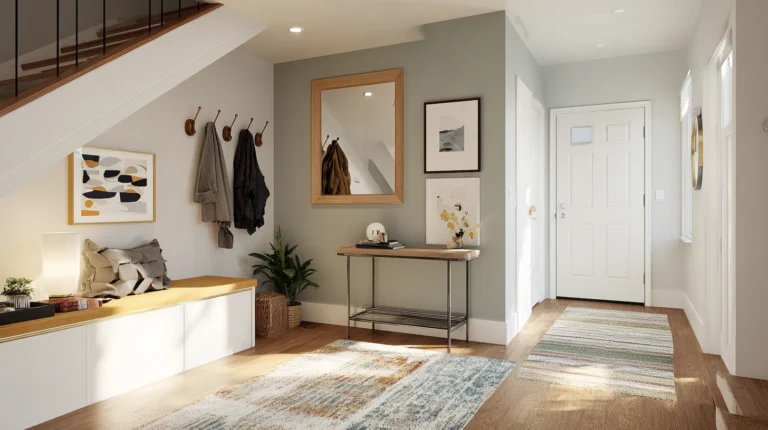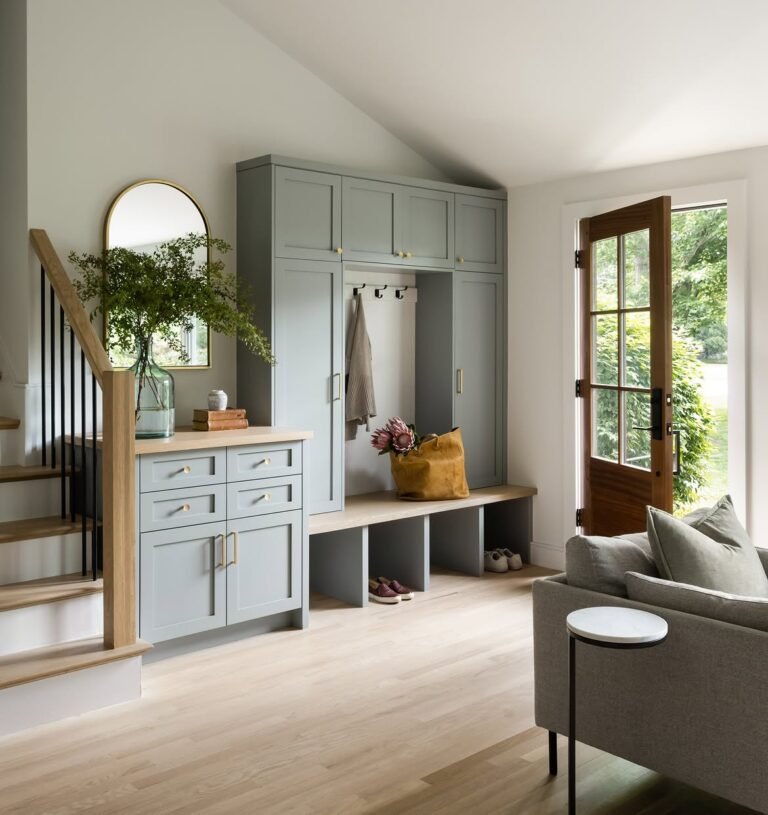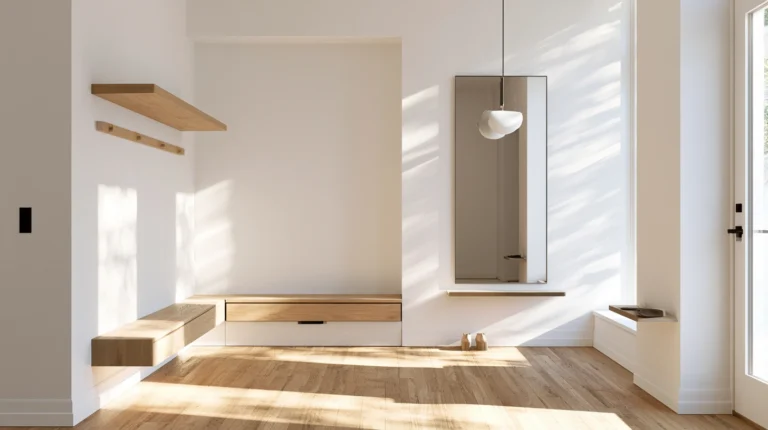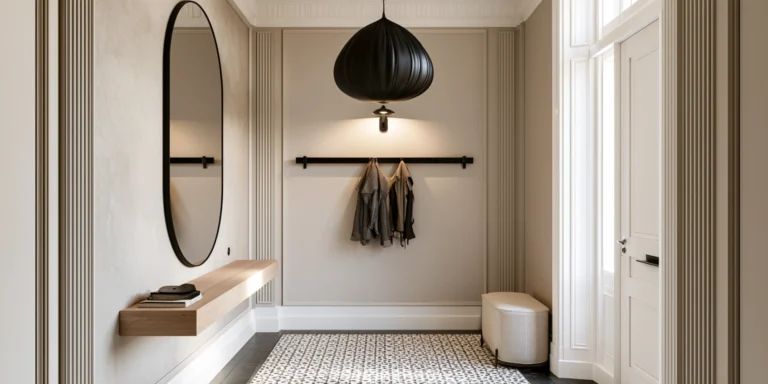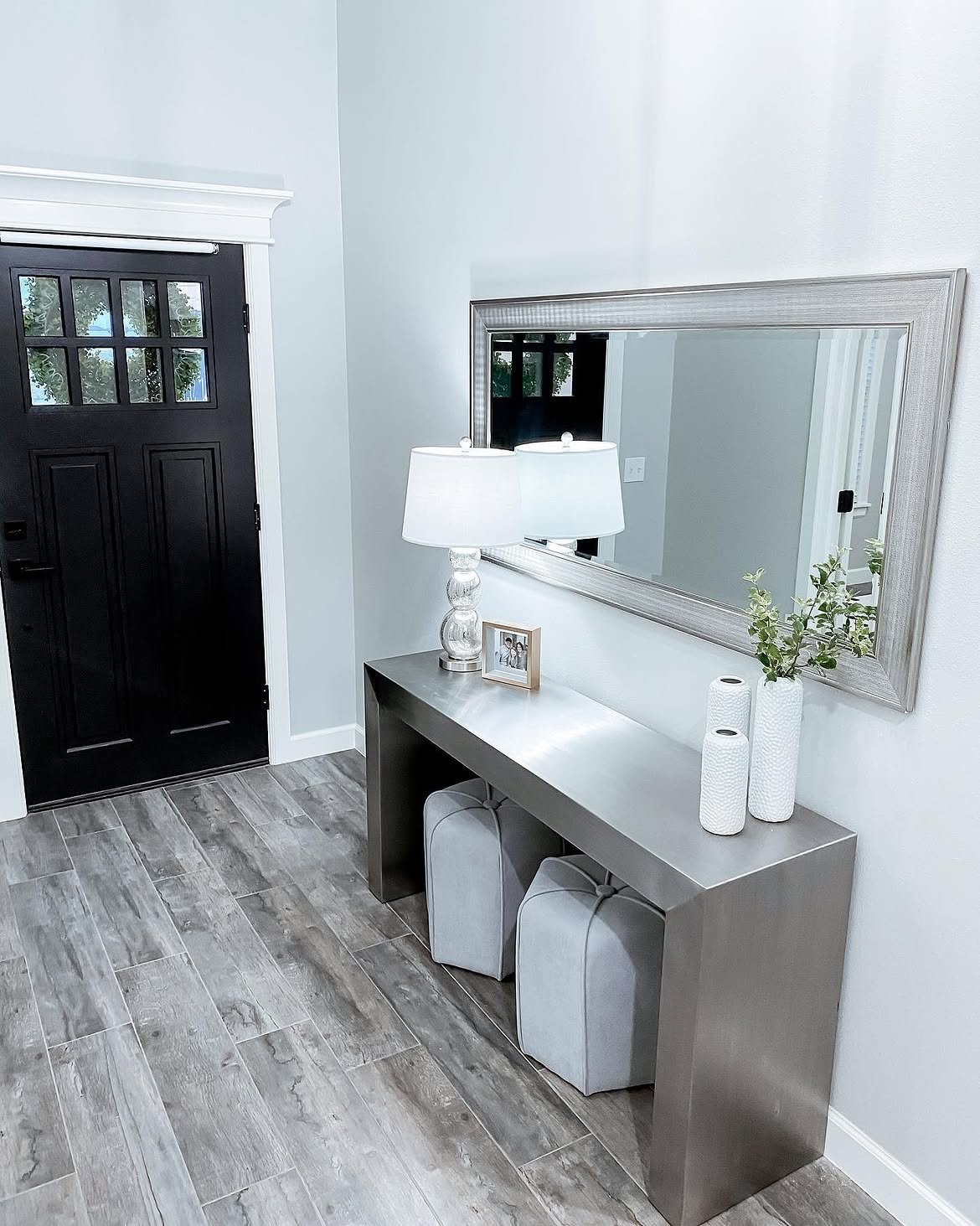
13 Entryway Mirror Ideas That Brighten and Expand Your Space
13 Entryway Mirror Ideas That Brighten and Expand Your Space
A mirror is the single piece of decor doing double duty in almost every entryway that has one. It’s a design object — a frame, a shape, a focal point on an otherwise plain wall — and it’s also a light management tool, bouncing whatever natural or lamp light exists back into a space that, in most homes, is one of the smallest and dimmest rooms in the house.
Entryways are disproportionately narrow, low on windows, and high on foot traffic, which makes them harder to light well than almost any other room. A mirror doesn’t add light on its own, but it redistributes what’s already there, and in a hallway-sized space, that redistribution can be the difference between a room that feels like a corridor and one that feels like an actual room.
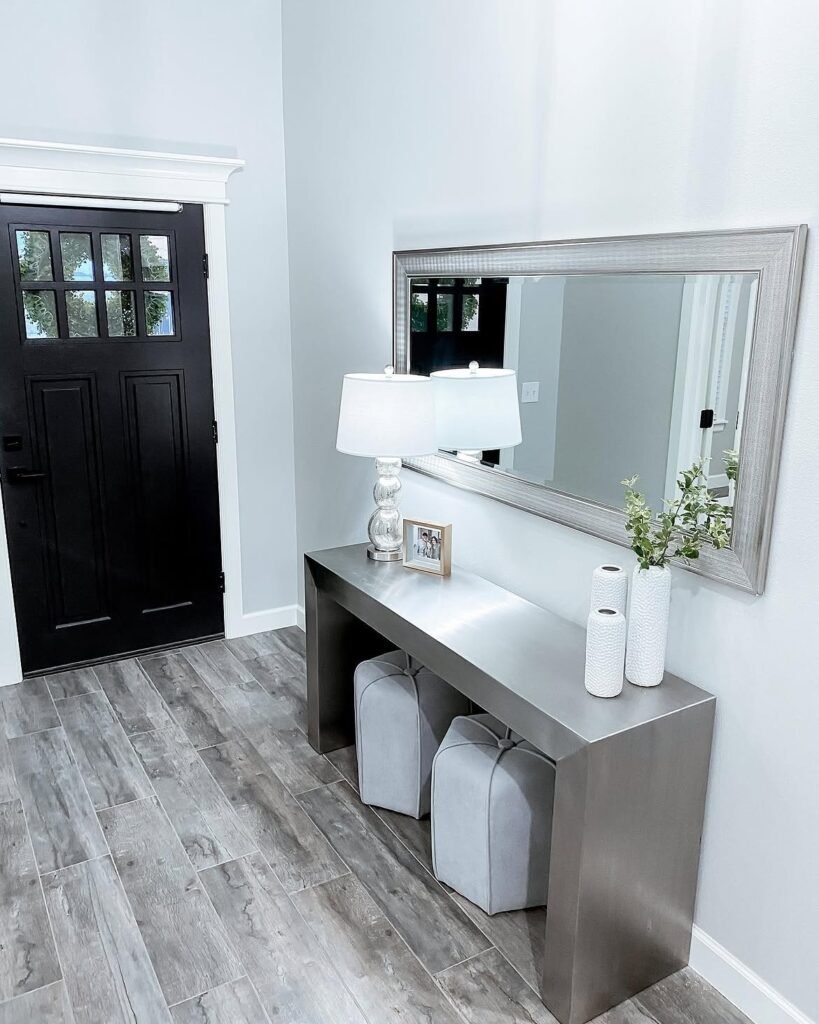
The mirror that does this well isn’t necessarily the largest or most expensive one available. It’s the one placed correctly, sized to the wall it occupies, and chosen in a shape and frame that suits the rest of the entryway’s styling rather than fighting it. Here are 13 ways to get that right.
Why Some Entryway Mirrors Fall Flat
The placement problem:
Without considered placement:
- The mirror hung to reflect a blank wall or a closet door, rather than a window or light source
- Positioned too high or too low relative to the console or the average sightline passing through
- Centred on a wall with no relationship to the furniture beneath it
- The result: a mirror that adds decoration but does none of the light-bouncing work it’s capable of
With considered placement:
- The mirror positioned to reflect a window, a light fixture, or the open depth of another room
- Hung at a height proportional to the furniture below it, typically 6–8 inches above a console table
- Angled or positioned to catch the sightline of anyone entering, not just anyone standing directly in front of it
- The result: a mirror that visibly brightens and enlarges the space, not just decorates it
The sizing problem:
- A mirror significantly smaller than the wall or console it occupies reads as an afterthought
- A mirror significantly larger than the available wall space reads crowded rather than expansive
- The correct scale is what allows a mirror to actually do its light and space work — an undersized mirror simply doesn’t reflect enough to matter
The frame-clash problem:
- A frame finish that doesn’t relate to any other metal or material already in the entryway (a chrome mirror in an otherwise brass-and-wood space, for instance) reads as mismatched regardless of the mirror’s shape or size
- Matching the frame finish to existing hardware, light fixtures, or furniture legs ties the mirror into the room rather than leaving it to stand apart
The Five Entryway Mirror Principles
Before choosing any individual idea below, these five principles separate a mirror that genuinely brightens and expands an entryway from one that simply hangs there:
Reflect a light source, not a blank wall:
- Position the mirror to catch a window, a lamp, or an open sightline into another room
- This single decision does more for the room’s brightness than the mirror’s size or shape
Scale to the furniture or wall beneath it:
- Roughly two-thirds the width of a console table, or sized to leave a clear margin on a bare wall
- Undersized mirrors don’t reflect enough light to matter; oversized ones crowd the space
Match the frame to existing metal finishes:
- Brass, matte black, or natural wood, consistent with any other hardware already in the entryway
- A mismatched frame finish reads as an unrelated purchase rather than part of the room’s system
Hang at a height relative to the sightline passing through:
- Centred at eye height for a standing adult, or 6–8 inches above a console table’s surface
- A mirror hung purely for wall-filling purposes, without regard to sightline, loses much of its functional value
Consider shape as a counterpoint to the room’s other lines:
- A round or arched mirror softens a hallway full of straight furniture lines
- A rectangular or geometric mirror adds structure to a space that’s otherwise all curves and texture
1. The Oversized Leaning Floor Mirror
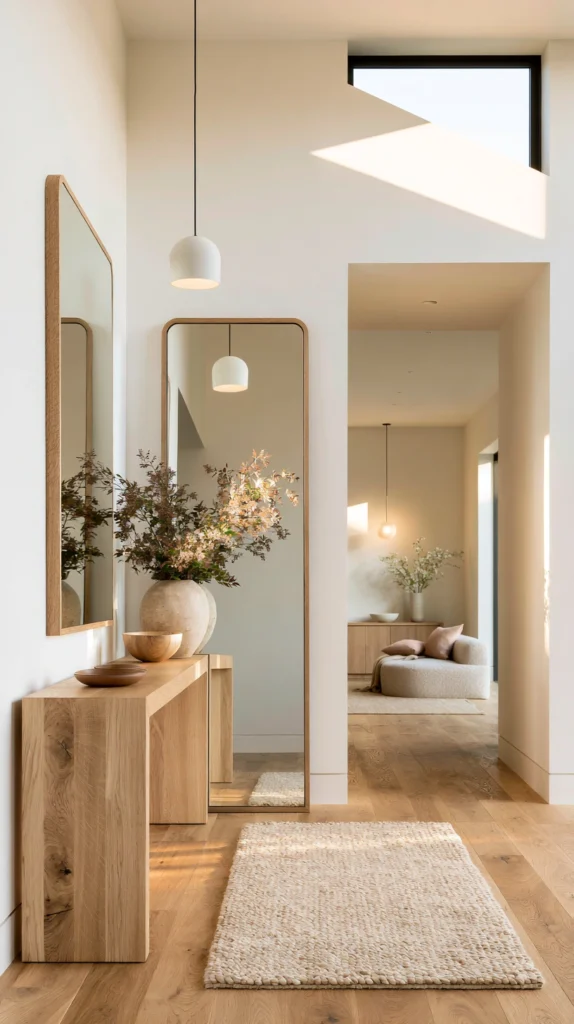
A large mirror, leaned against the wall rather than hung, positioned beside or opposite the console table.
Why a leaning mirror expands a narrow entryway especially well
A full-height leaning mirror reflects floor-to-ceiling depth, which does more to visually double a narrow hallway’s perceived width than a smaller, wall-hung mirror positioned only at eye level. The leaned angle also catches ambient light from a wider range of the room than a flush-mounted mirror does.
Sizing and placement
- Height: 60–72 inches, tall enough to reflect most of the room’s vertical space
- Leaned at a slight backward angle against the wall, positioned so it doesn’t obstruct the walking path
- Best suited to an entryway with at least 18 inches of floor space beyond the console or bench
Cost breakdown
- Large leaning floor mirror: $120–280
- Total: $120–280
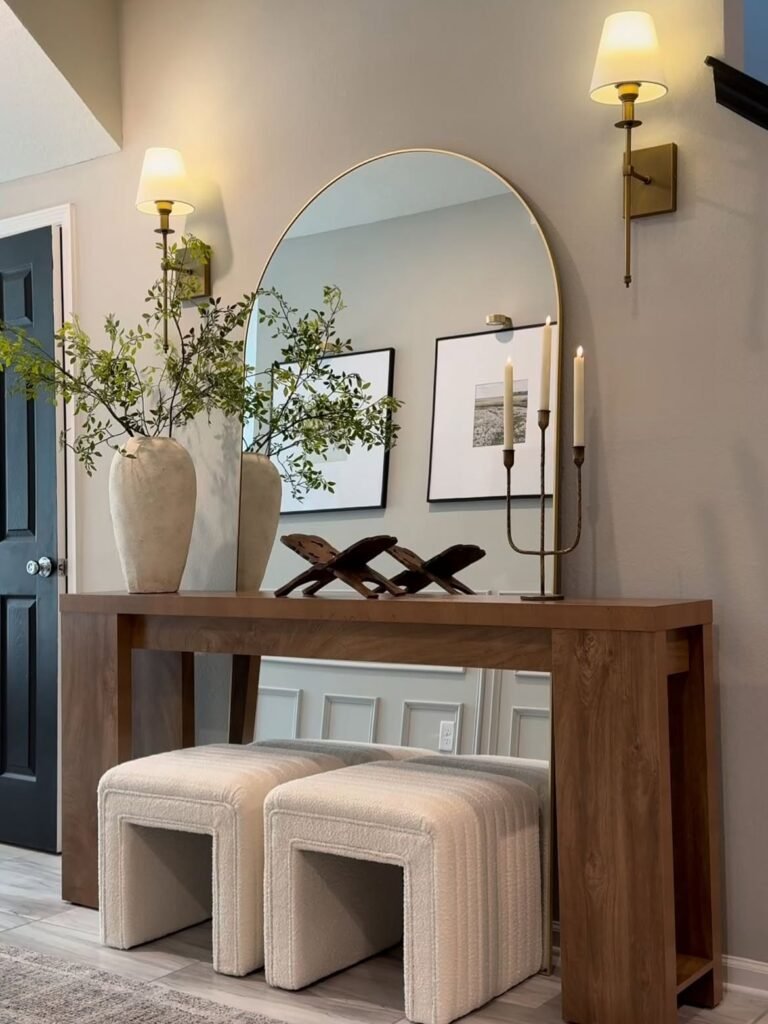
2. The Arched Mirror Above the Console
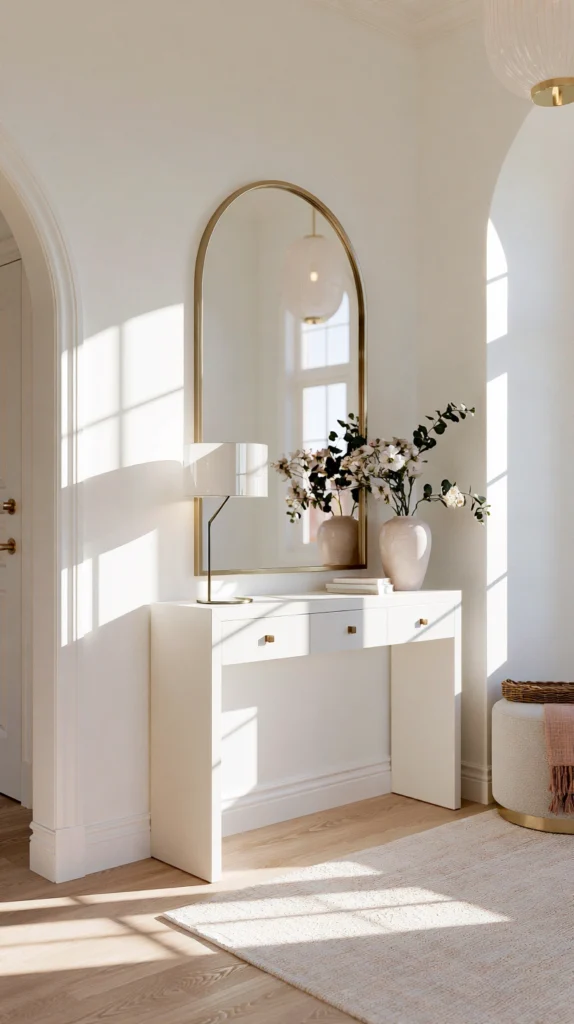
An arched-top mirror hung directly above the console table, its rounded top softening the straight lines of the table and any hardware below it.
Why the arch shape suits an entryway specifically
An entryway is typically built from straight architectural lines: a rectangular console, a straight doorway, a rectangular hook rail. An arched mirror introduces the one curved line in the room, drawing the eye upward in a way a rectangular mirror of the same size doesn’t accomplish as clearly.
Sizing
- Width: roughly two-thirds the width of the console table beneath it
- Bottom edge: 6–8 inches above the console’s surface, consistent with standard entryway mirror placement
Cost breakdown
- Arched mirror (24–30 inches wide): $90–220
- Total: $90–220
3. The Grouped Round Mirror Cluster
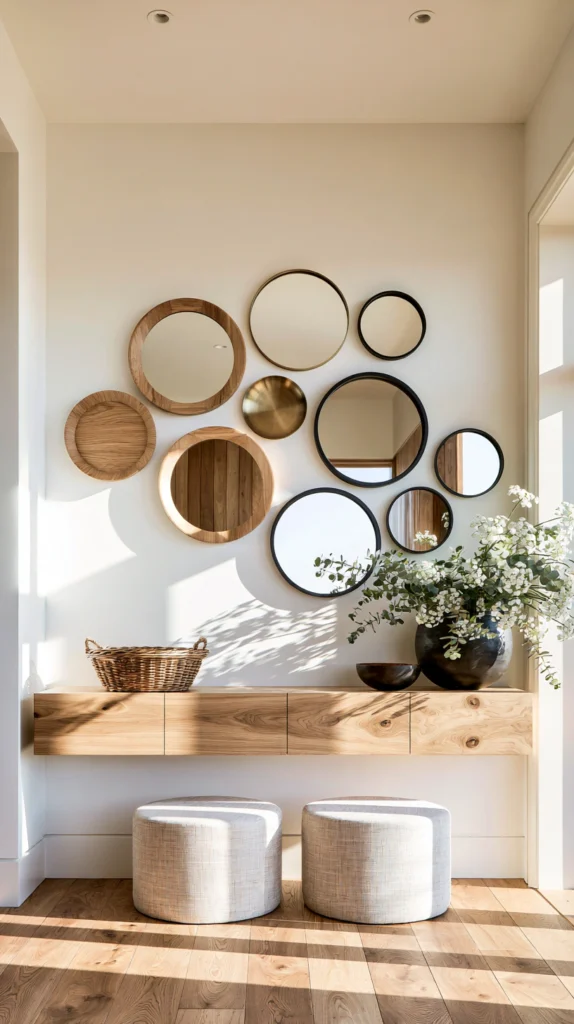
Three to five small round mirrors, varied slightly in size and frame finish, clustered on the wall in place of one large mirror.
Why a cluster can outperform a single large mirror
A grouped arrangement of small mirrors reflects light from multiple points across the wall rather than one central point, and the layered, collected quality reads as more intentionally styled than a single mirror on a wall with otherwise little going on. It’s also a strong option where wall space is too narrow for one large piece.
Layout guidance
- 3–5 mirrors, ranging from 8–16 inches in diameter
- Arranged in a loose cluster rather than a perfectly even grid, with 2–3 inches of spacing between pieces
- Slight variation in frame finish (aged brass beside a plain wood frame, for instance) reinforces the collected-over-time feeling
Cost breakdown
- Small round mirrors (4, mixed sizes): $60–140
- Total: $60–140
4. The Mirror Positioned Opposite a Window
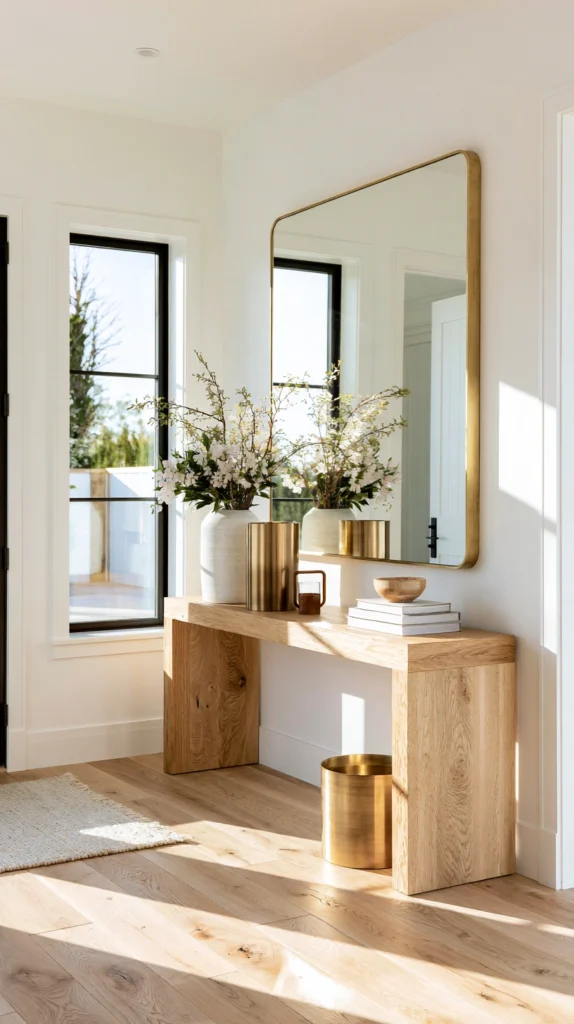
A mirror hung directly across from the entryway’s window, if one exists, to catch and redistribute natural daylight into the space.
Why this placement matters more than the mirror’s style
Of every principle on this list, light-source placement has the single largest measurable effect on how bright a room actually reads, independent of the mirror’s shape, size, or frame. A mirror opposite even a small window can noticeably lift the daytime brightness of an entryway that would otherwise rely entirely on artificial light.
Placement specifics
- Positioned directly across from the window, not at an angle, for the most direct light reflection
- Height aligned so the window’s light lands roughly at the mirror’s centre, maximising the reflected daylight
Cost breakdown
- Mirror (sized to the available wall, style flexible): $80–200
- Total: $80–200
5. The Full-Length Door Mirror
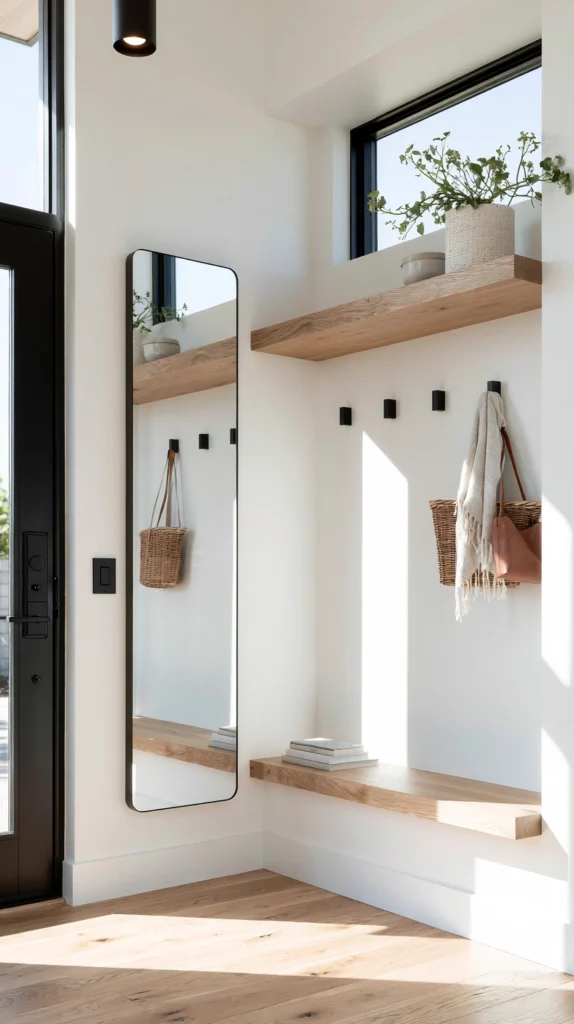
A full-length mirror mounted on or beside the entry door, or on the back of a nearby closet door, for a last-look function as much as a design one.
Why a full-length mirror belongs in the entryway specifically
The entryway is the last space anyone sees before leaving the house, making it the most functionally logical place in the home for a full-length mirror — a role often assigned instead to a bedroom, where the mirror is used less frequently in the course of a normal day.
Placement options
- Mounted directly on the back of a closet door, using minimal additional wall space
- Freestanding, leaned in a corner if door-mounting isn’t an option
- Height: full-length mirrors typically run 50–65 inches tall for a full reflection at most heights
Cost breakdown
- Full-length door mirror (hardware-mounted): $40–90
- Total: $40–90
6. The Sunburst Statement Mirror
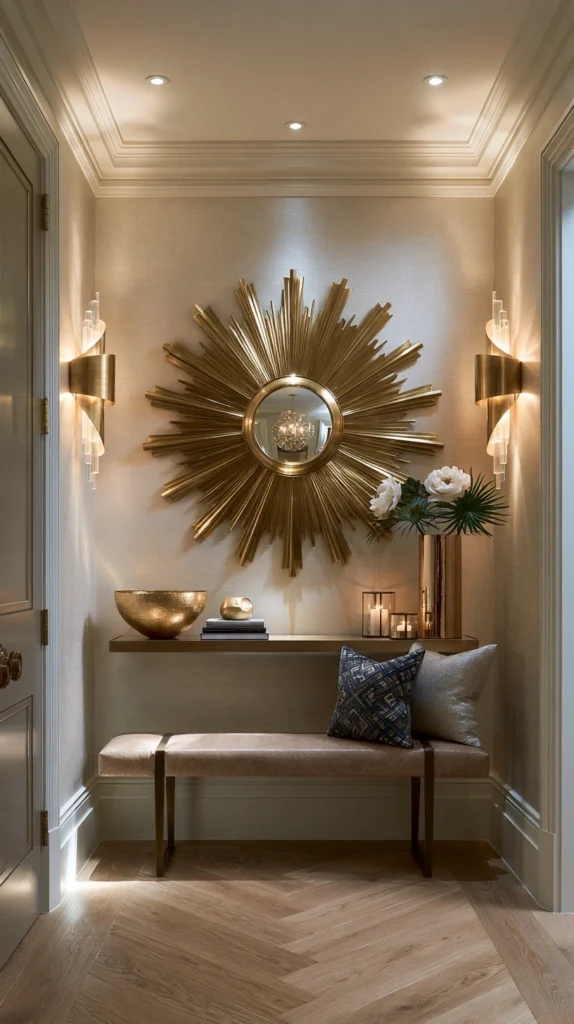
A sunburst or starburst-framed mirror, hung as the entryway’s clear focal point rather than paired with a console table beneath it.
Why a sunburst mirror works as a standalone statement
The sunburst’s radiating frame draws the eye more strongly than a plain-framed mirror of the same size, which makes it well suited to an entryway wall with limited additional decor — the mirror itself provides enough visual interest to anchor the space without needing a console or gallery wall to support it.
Placement
- Centred on the most visible wall from the front door, ideally at a height where the full radiating frame is visible without craning
- Works well above a narrow shelf or with no furniture beneath it at all, unlike most other entries on this list
Cost breakdown
- Sunburst mirror (24–32 inches diameter): $70–160
- Total: $70–160
7. The Vintage or Antique-Finish Mirror
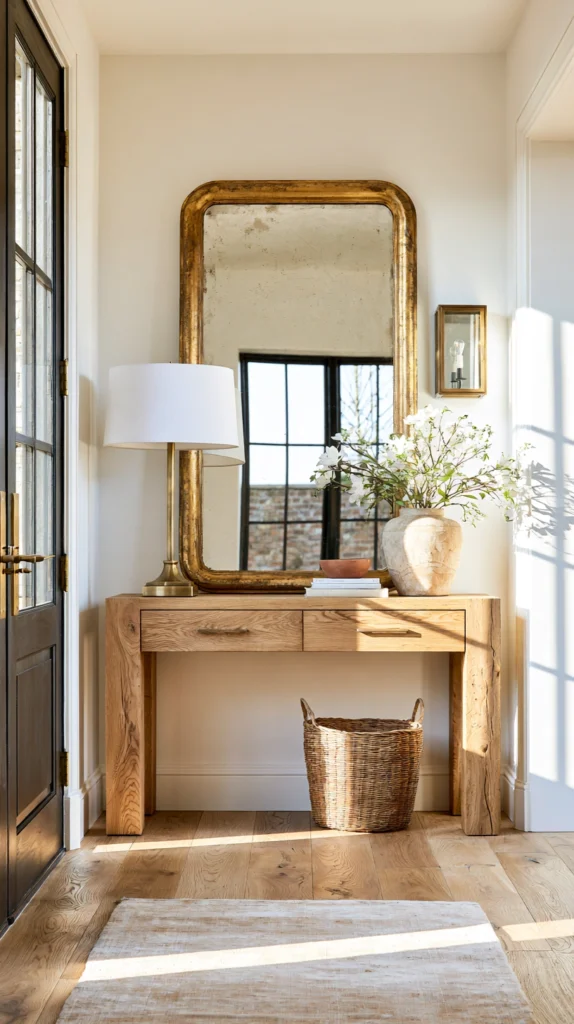
A mirror in an aged, distressed, or genuinely antique frame, chosen for the character its imperfections add rather than for a flawless finish.
Why an aged finish suits an entryway’s collected feeling
An entryway styled with any warmth (a woven basket, a wood console, brass hardware) benefits from a mirror that matches that same collected, lived-in quality. A brand-new mirror with a flawless, uniform finish can read slightly at odds with an otherwise warm, textural entryway, where a genuinely aged or deliberately distressed frame fits more naturally.
Where to find one
- Secondhand shops and estate sales often carry mirrors with more frame character than new-budget equivalents
- A new mirror finished in an aged or antiqued gold or silver leaf achieves a similar effect without the search
Cost breakdown
- Secondhand or antique-finish mirror: $40–120
- Total: $40–120
8. The Black-Framed Mirror for Contrast
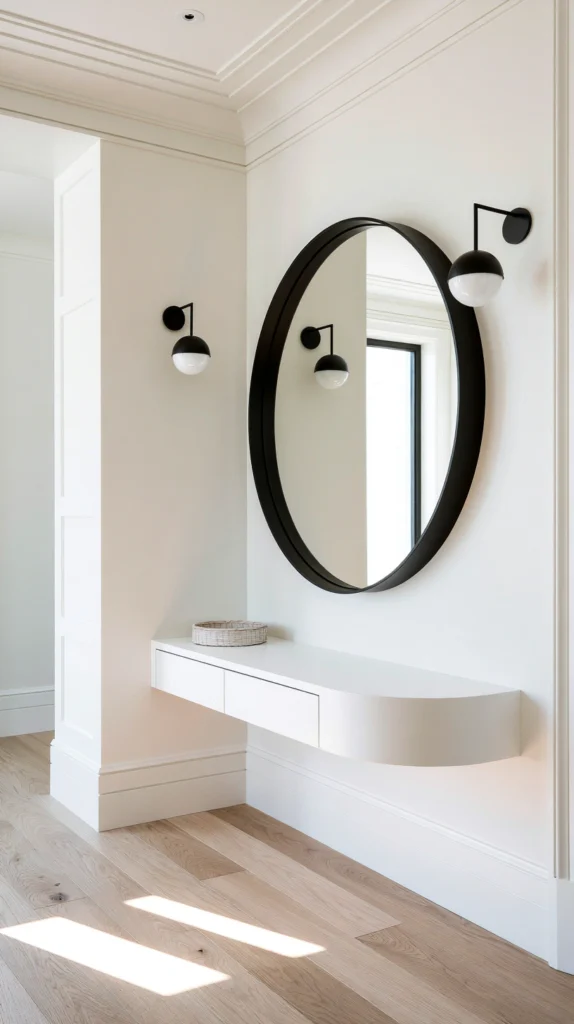
A mirror in a matte black frame, hung against a lighter wall colour, for a graphic, high-contrast focal point.
Why black works especially well in a pale entryway
A black frame provides the strongest possible contrast against a white or warm-white entryway wall, giving the mirror a clearly defined edge that a lighter or metallic frame doesn’t achieve in the same way. This contrast makes the mirror read as a deliberate design choice rather than simply a reflective surface on the wall.
Pairing considerations
- Works best paired with at least one other matte black element in the room — a light fixture, door hardware, or window frame — so the mirror doesn’t stand alone as the only black object present
- Suits both round and rectangular shapes equally well, unlike some of the more ornate frame styles on this list
Cost breakdown
- Matte black framed mirror: $60–150
- Total: $60–150
9. The Mirrored Console Surface
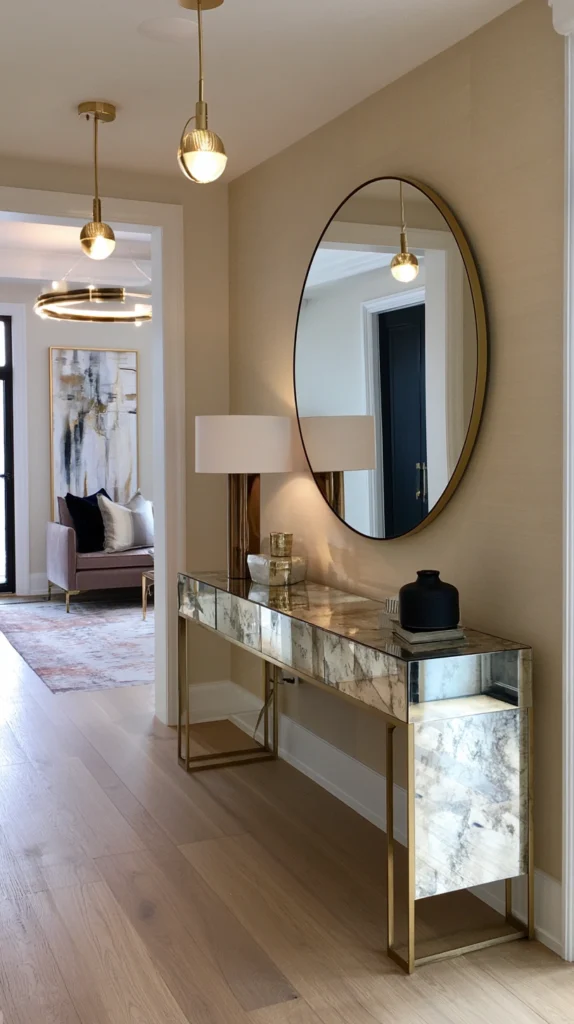
A console table with a mirrored top or mirrored front panel, adding reflective surface at furniture level in addition to, or instead of, a wall-hung mirror.
Why reflection at furniture level adds a different effect
A wall-hung mirror reflects primarily what’s across from it at eye level and above. A mirrored console surface reflects light and depth closer to the floor, which can make the lower portion of a narrow entryway — often the darkest part of the room — read brighter and less enclosed.
Where this style suits the room
- Works particularly well in a more formal or glamorous entryway, alongside brass hardware and a chandelier or statement pendant
- Less suited to a heavily rustic or farmhouse-styled entryway, where the reflective surface can feel visually at odds with the room’s other materials
Cost breakdown
- Console table with mirrored surface: $150–350
- Total: $150–350
10. The Mixed-Shape Gallery Wall
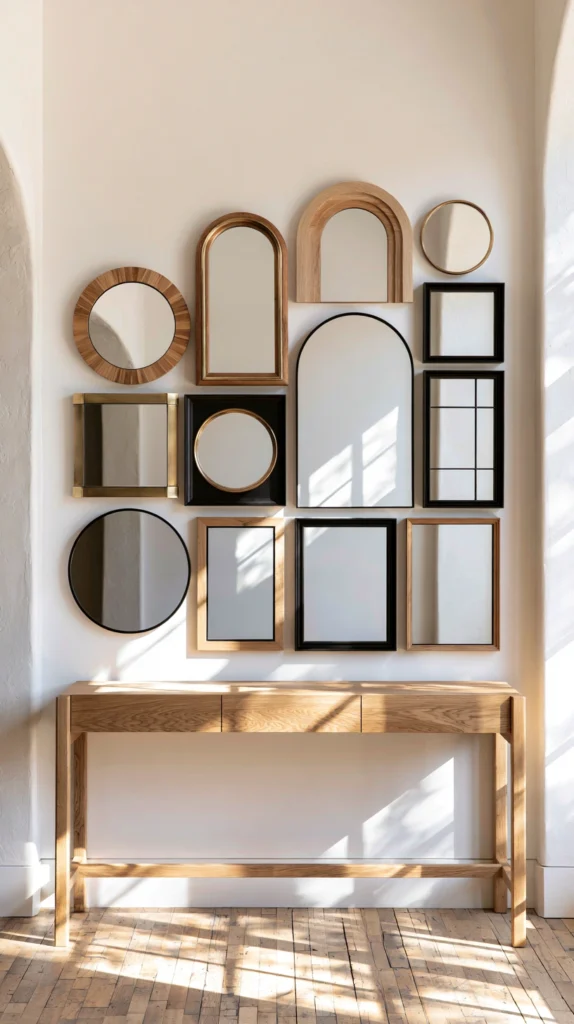
A cluster of mirrors in varied shapes — round, arched, and rectangular — arranged together on one wall, rather than repeating a single shape.
Why mixed shapes read more curated than a matched cluster
A cluster where every mirror shares the same shape (as in Idea #3’s round grouping) reads as a cohesive set. A cluster mixing shapes reads as a more personally assembled, gallery-style collection, better suited to an entryway with an eclectic or maximalist overall styling direction.
Layout guidance
- 4–6 mirrors in a mix of shapes and sizes, generally ranging from 8–20 inches
- Arranged with the largest piece slightly off-centre, rather than centred as the group’s anchor
- Frame finishes can vary more here than in a single-shape cluster, since the shape variety already signals an intentionally eclectic approach
Cost breakdown
- Mixed-shape mirrors (5, varied sizes): $100–220
- Total: $100–220
11. The Mirror With an Integrated Shelf
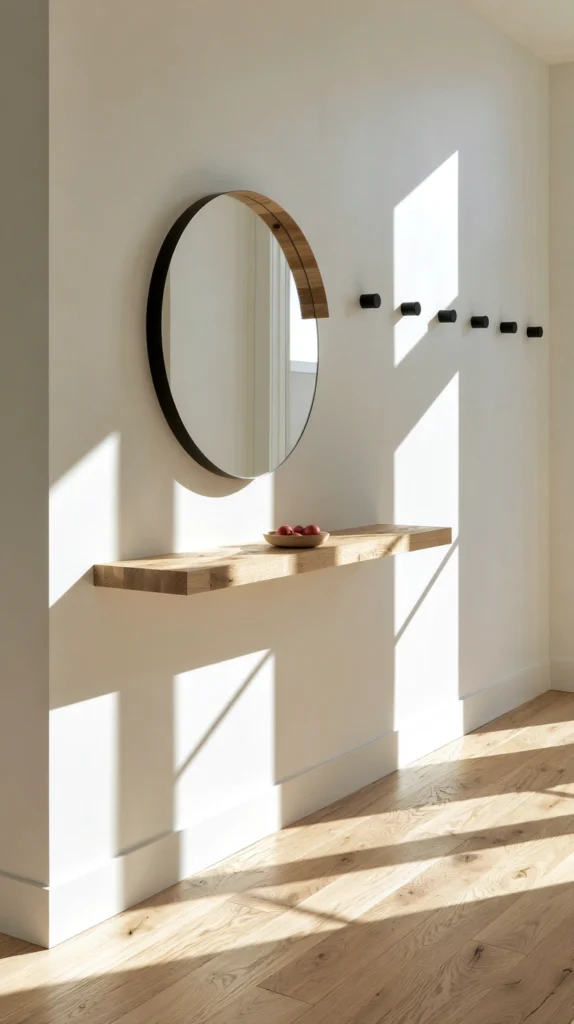
A mirror mounted with a small attached shelf or ledge at its base, combining the light-reflecting function of a mirror with a landing spot for keys or a small plant, in entryways too narrow for a full console table.
Why this suits the narrowest entryways
Not every entryway has the floor space for a console table. A mirror with an integrated shelf delivers a landing surface, a reflective element, and a vertical focal point all within a single wall-mounted piece, making it one of the most space-efficient options on this list.
Sizing
- Shelf depth: typically 4–6 inches, enough for a small tray or a few keys, not a full console’s worth of storage
- Mirror height above the shelf: 20–28 inches, proportional to the shelf’s width
Cost breakdown
- Mirror with integrated shelf: $70–150
- Total: $70–150
12. The Backlit or LED-Edge Mirror
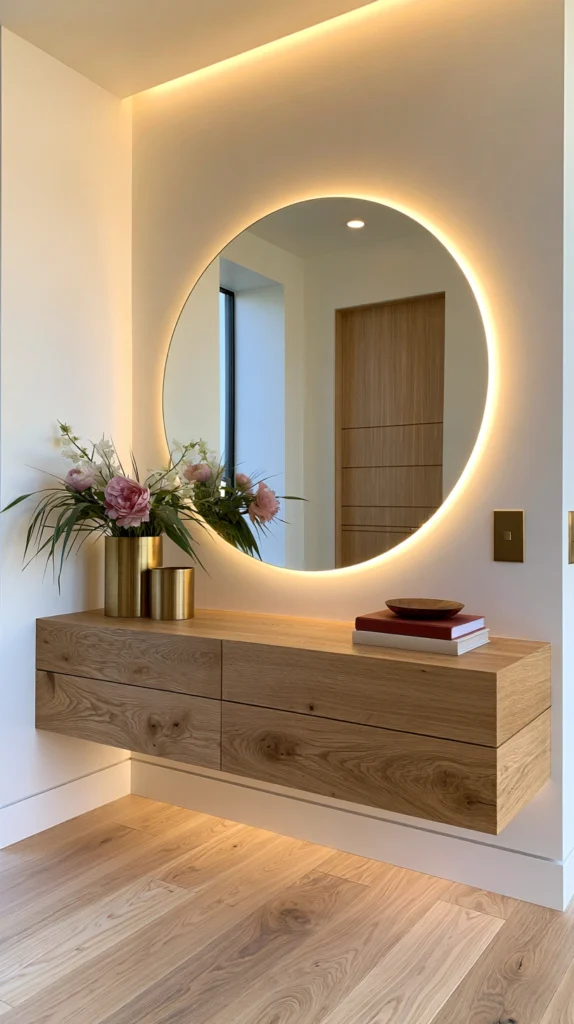
A mirror with a built-in LED edge or backlight, providing a soft, ambient glow in addition to its reflective surface — a more contemporary option suited to a darker entryway with limited access to layered lamp lighting.
Why backlighting matters specifically in a low-light entryway
An entryway without an easy spot for a table lamp or wall sconce (see the layered light principle common across other rooms in this pipeline) can still achieve some of that same warm, ambient effect through a backlit mirror, which adds its own soft light source without requiring additional furniture or an accessible outlet nearby.
Specification notes
- Choose a warm-temperature LED edge (2700–3000K), consistent with the warm lighting principle used throughout the home, rather than a cooler daylight-toned LED
- Most backlit mirrors require a nearby outlet or hardwired connection — confirm access before purchasing
Cost breakdown
- Backlit or LED-edge mirror: $90–220
- Total: $90–220
13. The Complete Entryway Mirror Styling
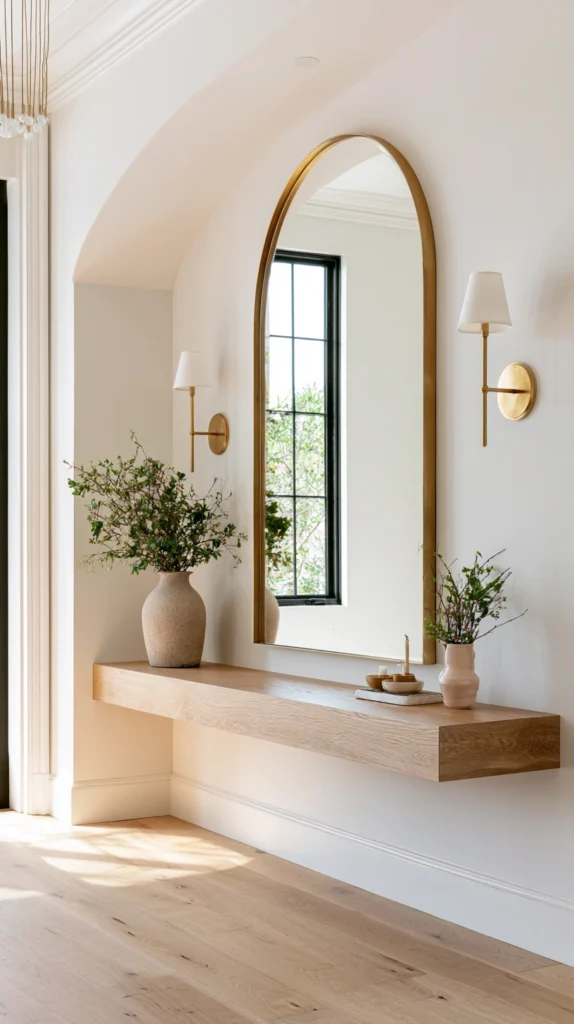
An entryway mirror chosen and placed with every principle above applied together — the definitive version of a mirror that does its full job, brightening and expanding the space rather than simply decorating one wall of it.
What separates the complete approach from just hanging a nice mirror
A beautiful mirror hung at the wrong height, reflecting a blank wall instead of a light source, still leaves most of its functional value on the table. The complete approach resolves every layer at once — placement relative to light, scale relative to the furniture below it, frame finish relative to the room’s existing hardware, and shape relative to the room’s other lines — so the mirror does its full job rather than half of it.
The elements of the complete approach
The placement:
- Positioned to reflect a window or the entryway’s primary light source (Idea #4)
- Hung at a height proportional to the console table beneath it
The scale:
- Sized to roughly two-thirds the width of the console, or full-height if using a leaning floor mirror (Idea #1)
The frame:
- Finished in the same warm metal already used for hardware and light fixtures elsewhere in the entryway
- An aged or antiqued finish if the rest of the room leans warm and collected (Idea #7)
The supporting light:
- A wall sconce or lamp positioned so its light is caught and redistributed by the mirror, reinforcing the light-bouncing function the mirror is chosen for
The entryway on an ordinary afternoon:
Daylight from the window lands across the room and bounces back through the mirror, doubling the sense of depth in a hallway that measures the same few feet it always has. The frame finish matches the hook rail and the console’s hardware, so the mirror reads as part of one considered system rather than a separate purchase. The room feels wider and brighter than its actual dimensions, entirely because of where the mirror was hung.
Cost breakdown for the complete approach
Assuming a starting point of a bare entryway wall:
- Mirror (mid-range size and frame): $90–220
- Wall sconce or lamp, if not already in place: $50–140
- Console table, if not already in place: $120–320
Total: $260–680 (assuming console and lighting already exist, mirror alone: $90–220)
The Question Before Choosing an Entryway Mirror
Before buying a frame or shape:
Is there a window or light source this mirror could realistically reflect?
If the answer is: yes — prioritise placement opposite that light source over any other styling consideration; this single decision has the largest functional impact.
If the answer is: no natural light available — a backlit mirror, or one positioned to reflect an existing lamp or sconce, becomes the more useful choice.
If the answer is: the entryway is very narrow, with no room for a console — the mirror with an integrated shelf solves both the reflective and the landing-surface need in one piece.
If the answer is: the space already has strong function, it just needs personality — a sunburst, grouped cluster, or mixed-shape gallery wall adds character beyond what a single practical mirror provides.
The choice follows the room’s actual light and space constraints more than any single trending shape or frame. A well-placed plain mirror will out-brighten a beautiful one hung facing a blank wall every time.
Getting Started This Weekend
The immediate mirror upgrade:
Check what the entryway’s main wall currently faces.
A window, a lamp, or a blank interior wall — this determines where the mirror will do the most work.
Hang or lean one mirror at the height of the console or eye level.
Even a mirror already owned, relocated to the correct placement, can measurably change how the space reads.
Swap the frame if it doesn’t match existing hardware.
A quick paint update (metallic spray paint works for many frame materials) can bring a mismatched mirror into the room’s palette without a full replacement.
Add one warm light source near the mirror if none exists.
Confirms how much brightness the mirror is actually able to reflect back into the room.
The rest of the design: the elaboration of this weekend.
The reflection: the beginning. The brighter entryway: what the room becomes once the light actually has somewhere to go.