15 Small Farmhouse Bathroom Ideas That Blend Vintage Appeal With Contemporary Comfort
15 Small Farmhouse Bathroom Ideas That Blend Vintage Appeal With Contemporary Comfort
There is a specific quality that the farmhouse bathroom achieves in a small space that the grand bathroom cannot replicate in a large one. It is the quality of a room that was designed for the specific pleasures of washing rather than for the impression of luxury — intimate in scale, honest in material, warm in atmosphere, and possessing the specific quality of a room that was made for its function rather than its photograph.

The small farmhouse bathroom at its best communicates that this is a room where someone actually washes — where the towels have been used, where the timber has developed its patina through contact with warm water, where the space was designed for the person in it rather than for an imagined observer of it.
The small farmhouse bathroom does not apologise for its size. It uses the constraints of the compact space to produce the intimacy that the farmhouse tradition values — the warmth of the small room, the efficiency of a space where everything needed is within reach, the specific comfort of a bathroom that was scaled for a single person rather than designed for admiration.
The ideas below address every element of this aesthetic in a compact space, from the first decision about tile to the final decision about the hook on the back of the door.
Each idea below is a specific approach to one element of the small farmhouse bathroom. Each includes what you will need, what it will cost, and a practical tip to make it work as well as the warm, considered space it is reaching for.
1. The Shiplap Wall Treatment
Budget: $80 – $400
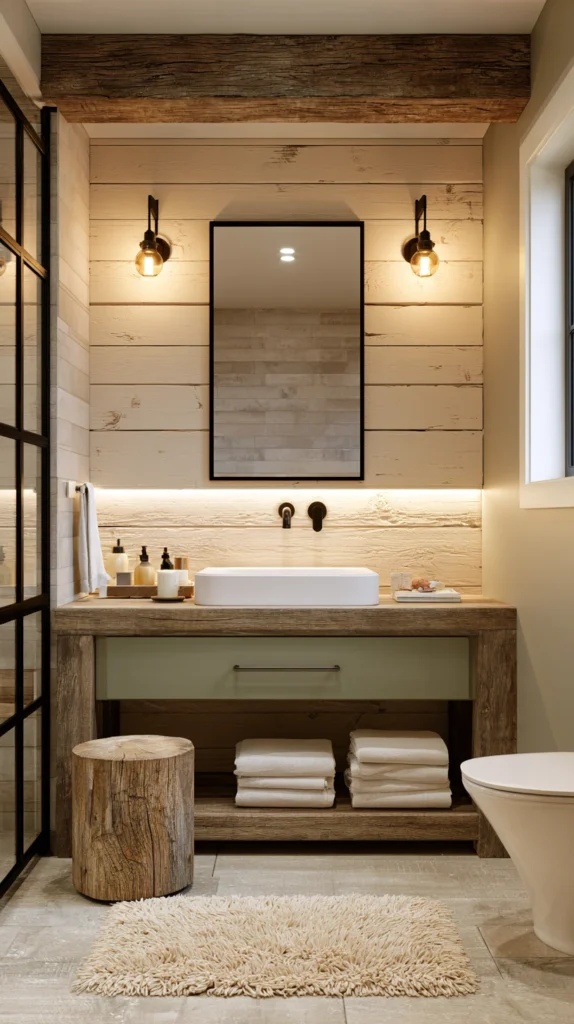
Horizontal shiplap panelling on the wall behind the bath or the vanity — either genuine timber boards with a rabbeted overlap joint, moisture-resistant MDF equivalents, or a quality peel-and-stick shiplap panel — creates the most immediately recognisable farmhouse element available to a small bathroom and the one that contributes the most warmth and texture to a compact space. Shiplap in a small bathroom does not make the room feel smaller — it makes it feel more considered, because the horizontal line of the boarding draws the eye along the wall rather than stopping it at the wall face.
Moisture-resistant MDF shiplap panels cost $20–$50 per sheet. Real timber shiplap in a moisture-resistant species runs $15–$40 per linear metre. A half-wall application of shiplap at chair rail height — the most practical approach for a small bathroom with limited wall area — requires approximately 8–10 linear metres for a standard 2-metre wall — $120–$400 in materials.
Style tip: Paint the shiplap in a warm white — ivory, antique white, or a slightly cream tone — rather than the bright white that most farmhouse bathroom shiplap photographs show. Bright white shiplap in a small bathroom reads as clinical rather than farmhouse; the warm white reads as the specific quality of paint applied to timber in a room with a history, which is the farmhouse quality the shiplap is intended to communicate.
2. The Clawfoot or Slipper Bath
Budget: $600 – $3,000
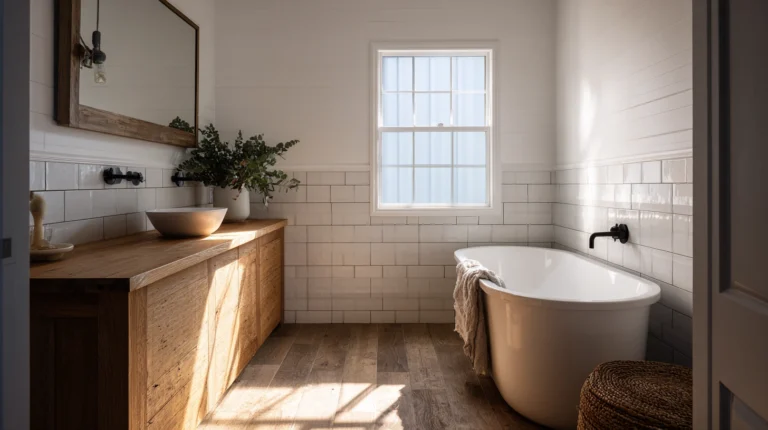
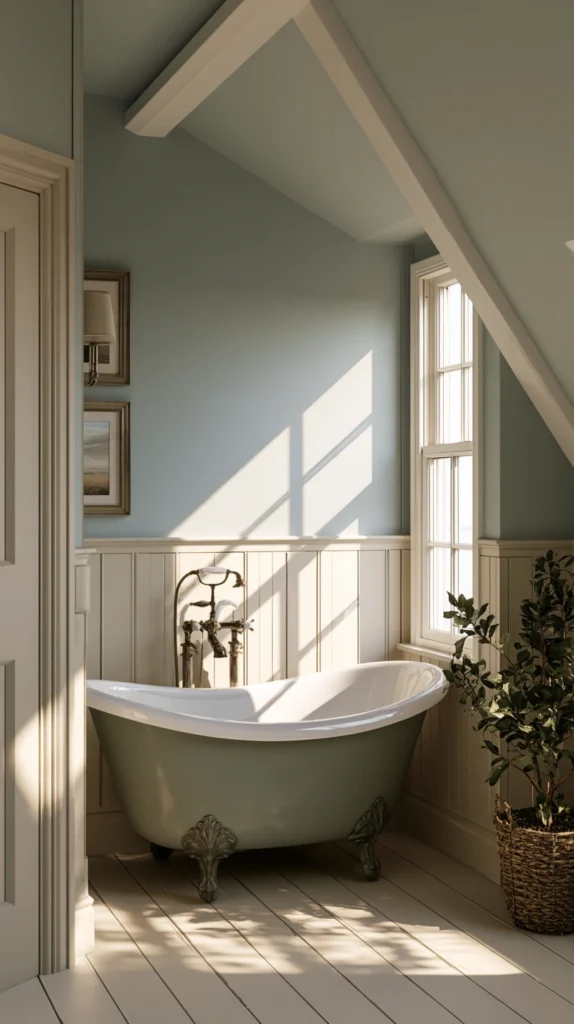
A freestanding bath — either the traditional clawfoot on ball-and-claw feet or the slipper style with one raised end — in a small farmhouse bathroom communicates a commitment to the bathing experience that the built-in alcove bath, however practically superior, cannot match. In a small bathroom, a freestanding bath requires careful dimensional planning — it must fit with adequate clearance on all sides — but the specific visual quality of a freestanding vessel in a small room is the quality that most completely produces the farmhouse aesthetic in the compact bathroom.
A basic acrylic clawfoot bath costs $600–$1,500. A cast iron version runs $1,500–$4,000. In a small bathroom, a compact 1500-millimetre clawfoot bath fits where a standard 1700-millimetre version does not, and the shorter length accommodates the compact floor plan without the compromise of a slipper bath where the raised end reduces the usable soaking length further.
Style tip: Choose a clawfoot bath in a colour other than the standard white for the small farmhouse bathroom — a deep sage green exterior, a charcoal exterior, or a deep blue exterior with a white interior creates the most specific and most character-full farmhouse bath quality. The coloured exterior clawfoot reads as a piece of furniture in the room; the white exterior reads as a bath fixture. The furniture quality is the farmhouse quality.
3. The Butler Sink Vanity
Budget: $150 – $600
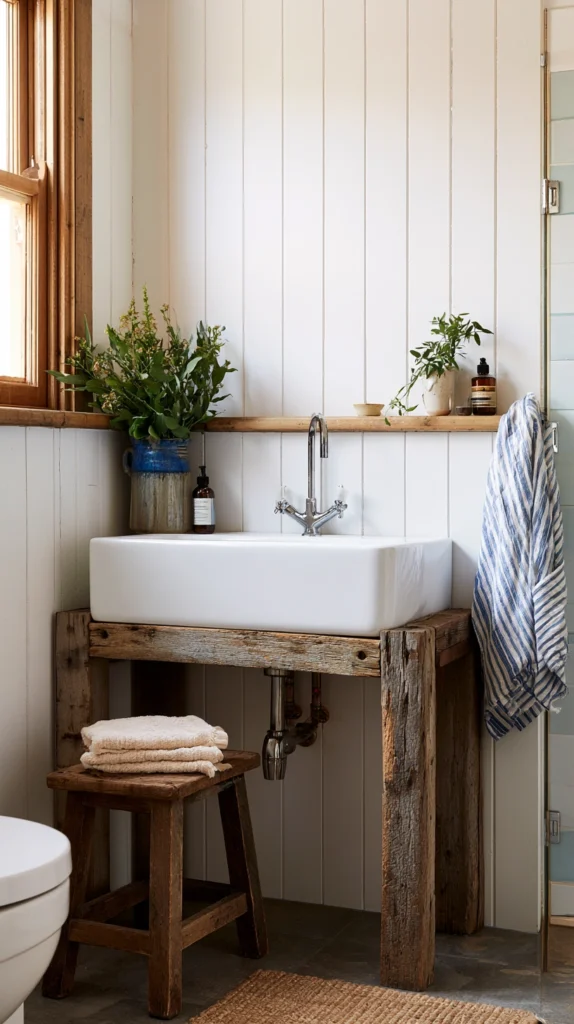
A butler or Belfast sink — the deep, apron-front white ceramic sink of the Victorian scullery — used as the bathroom basin in a small farmhouse bathroom is the material choice that most honestly communicates the working quality of the farmhouse aesthetic. The butler sink is not pretending to be a decorative basin; it is a working vessel that was made for the genuine business of washing, and its deep, practical form communicates exactly that quality of honest utility at the most directly experienced point of the bathroom.
A ceramic butler sink in a bathroom size costs $150–$350. A full-size kitchen butler sink adapted for bathroom use runs $200–$500. Period-style cross-head taps in aged brass or chrome cost $80–$200. The butler sink requires a timber or stone vanity surface with an apron-front clearance — the visible ceramic front panel of the sink extends below the worktop surface and the vanity unit must accommodate this projection.
Style tip: In a small farmhouse bathroom, wall-mount the butler sink rather than placing it on a vanity unit. A wall-mounted butler sink with exposed pipework below — the supply pipes and the waste trap left visible rather than concealed in a cabinet — communicates the honest, unconcealed quality of the farmhouse working interior at the basin position and opens the floor space beneath the sink that a vanity unit occupies.
4. The Vintage Timber Vanity
Budget: $100 – $600
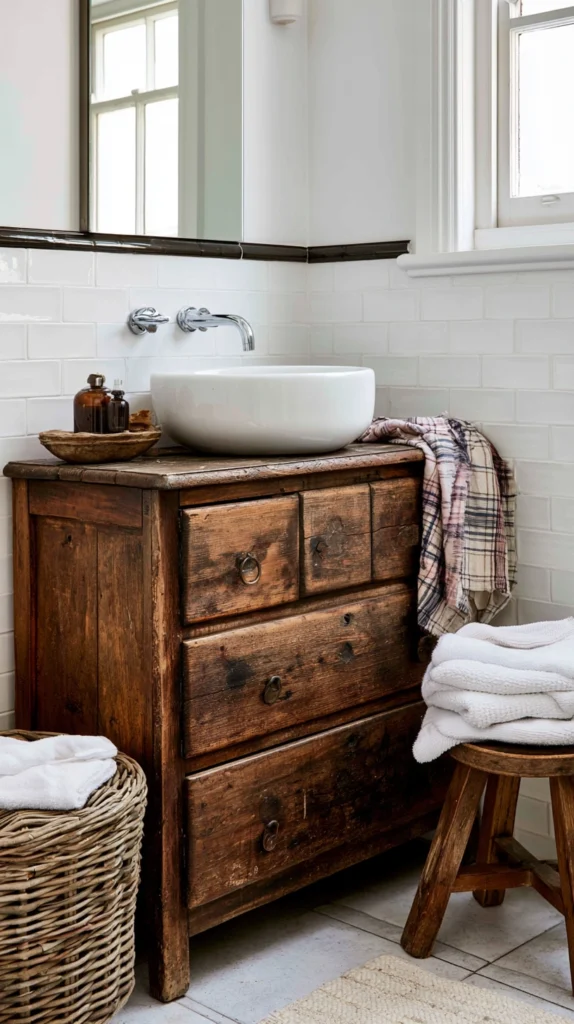
A vanity unit in a repurposed or vintage timber piece — an old dresser, a painted chest of drawers, a reclaimed cabinet — converted for bathroom use by drilling the required basin hole in the top and the plumbing access in the back creates the most characterful and most specifically individual of all the small farmhouse bathroom vanities. The repurposed piece communicates that the bathroom was assembled from genuinely loved objects rather than specified from a bathroom catalogue, and that quality of accumulation is the farmhouse aesthetic’s most specific property.
A secondhand dresser or chest of drawers from a charity shop or online market costs $20–$100. Conversion to a bathroom vanity requires a basin hole, which costs $50–$100 in professional routing, and the plumbing connection, which costs $150–$300 in labour. A quality ceramic basin for the top runs $60–$150. The total repurposed timber vanity costs $280–$650 — equivalent to a standard vanity unit — and produces an entirely individual result.
Style tip: Seal the repurposed timber inside and out with a quality water-resistant finish before installation. Secondhand furniture intended for a room of normal humidity will deteriorate rapidly in bathroom conditions without adequate sealing — the interior of the cabinet particularly, where the plumbing pipework produces ambient moisture, requires as thorough a sealing treatment as the exterior faces that are more visually apparent.
5. The Subway Tile in Warm Tones
Budget: $80 – $400
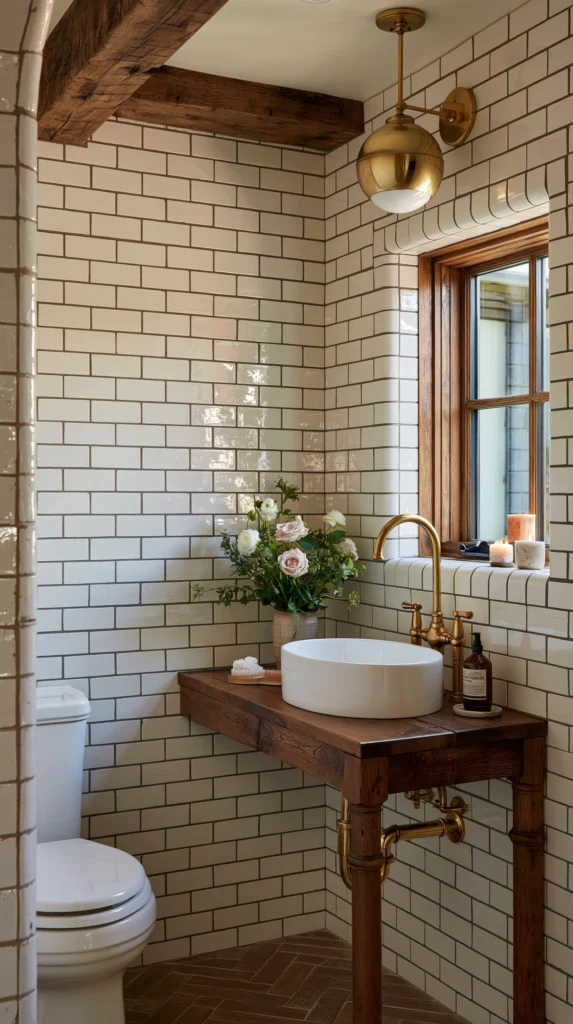
Classic white subway tiles — the 7.5 by 15-centimetre rectangular format that is the most versatile and most consistently appropriate tile for a small farmhouse bathroom — used as the primary wall tile in a warm white rather than a brilliant white, with a charcoal or dark grey grout that gives the tile its contemporary edge, creates the most balanced of the farmhouse bathroom tile treatments. The subway tile reads as clean and functional — the language of the dairy, the scullery, and the working kitchen — and in a small bathroom its relatively small format creates the rhythm of repeated units that gives the compact room visual texture without visual complexity.
White ceramic subway tiles cost $1–$3 each. A standard small bathroom of 4 square metres of tiled wall requires approximately 360 tiles — $360–$1,080 in tile material. Dark charcoal grout costs $15–$25 per bag — sufficient for a standard bathroom. The dark grout with white tile is the combination that gives the small farmhouse bathroom its contemporary quality — the tile is traditional, the grout is modern, and the combination communicates both simultaneously.
Style tip: Lay subway tiles in a brick-bond offset pattern — each row offset by half a tile from the one above — rather than in a stacked vertical grid. The brick bond is the farmhouse tile laying tradition and it gives the tiled surface a visual rhythm that the stacked grid lacks. The vertical stacked grid is the contemporary option; the horizontal brick bond is the farmhouse one.
6. The Exposed Timber Shelving
Budget: $40 – $200
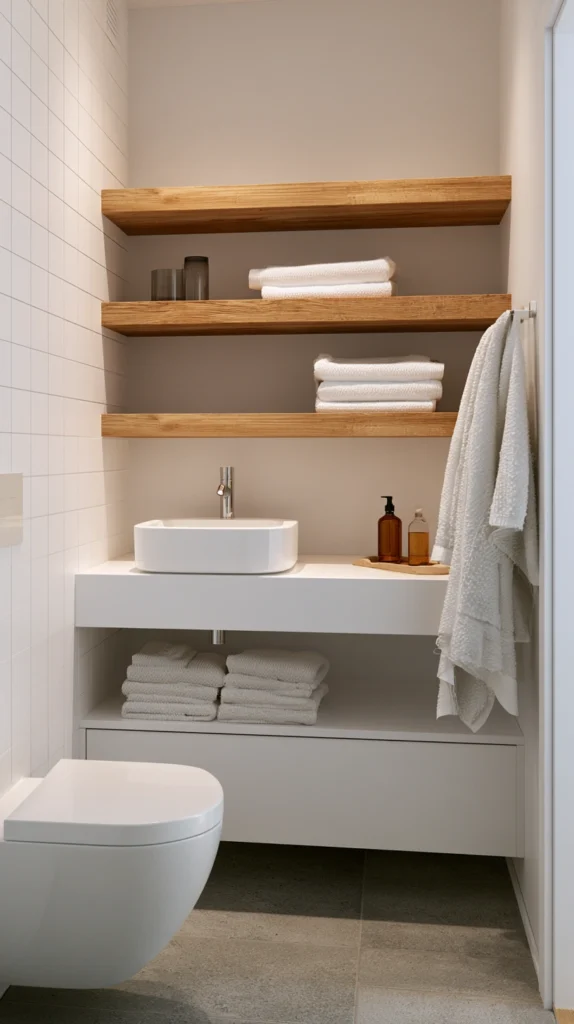
Open timber shelving — raw oak, reclaimed scaffold plank, or painted pine — in a small farmhouse bathroom replaces the upper cabinet that most small bathroom plans default to with a display of the bathroom’s most beautiful objects. The open shelf communicates honesty — the objects stored on it are visible and must therefore be beautiful or functional or both — and in a small bathroom the visual openness of the shelf contributes to the perceived spaciousness of the room in a way that a closed cabinet, however efficiently it stores the same objects, does not.
A reclaimed timber shelf of 60 centimetres in length on industrial steel brackets costs $30–$60. A pair of shelves on the primary vanity wall costs $60–$120. Style the shelves with: white ceramic vessels, glass storage jars for cotton balls and bath salts, one small plant, a quality candle, rolled white towels. The styling is the investment that makes the shelf beautiful; the timber is the material that makes it farmhouse.
Style tip: Position the lowest shelf at a minimum of 40 centimetres above the vanity worktop surface — a shelf too close to the worktop restricts the working height at the basin and creates the sense of the wall pressing down on the most used surface in the room. A shelf at 40–50 centimetres above the worktop provides storage and display without reducing the working quality of the surface below it.
7. The Freestanding Towel Rail
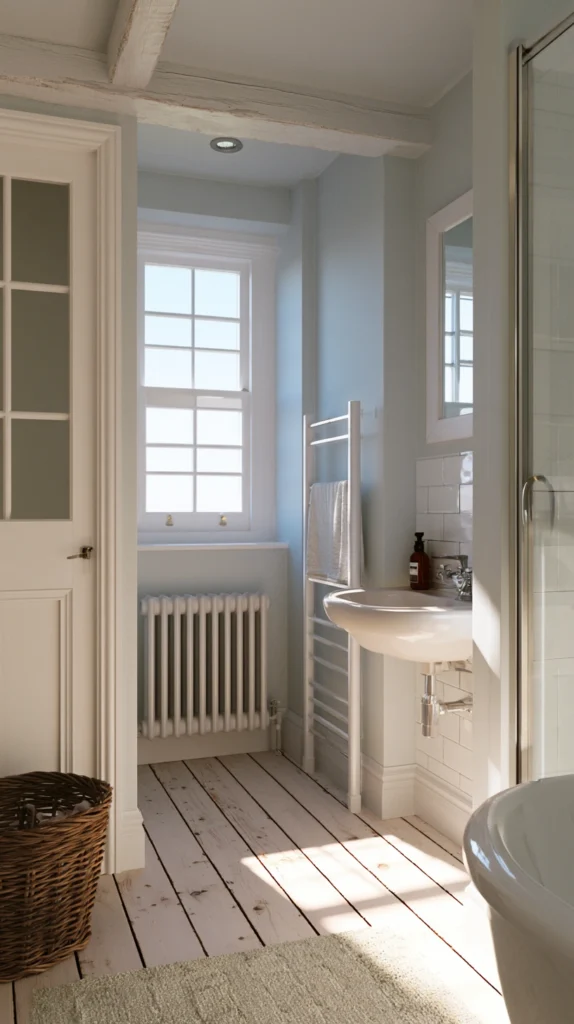
Budget: $40 – $200
A freestanding towel rail — in a traditional radiator style, a ladder style in raw steel or black iron, or a vintage-style heated rail on floor-standing feet — provides the towel storage function at the position in the small bathroom where it is most needed without requiring the wall fixings that a mounted rail demands. In a small bathroom where wall space is at a premium, the freestanding towel rail earns its floor space by providing warmth, towel drying capacity, and the specific domestic quality of a rail designed for the room rather than fitted to whatever wall space remained after the fixed elements were installed.
A floor-standing ladder towel rail in black iron costs $40–$100. A vintage-style freestanding heated towel rail runs $100–$250. A cast iron freestanding rail in a period style costs $150–$400. Position the rail where it receives the heat from the radiator or the towel rail circuit rather than in the coldest corner of the bathroom — a towel rail that is warm enough to dry towels provides genuine comfort; one that is decorative but ineffective is a piece of furniture rather than a bathroom function.
Style tip: Hang towels on the freestanding rail in a consistent fold — thirds lengthwise, then folded over the rail bar — rather than draped casually. The precisely folded towel on a farmhouse rail communicates the quality of the well-kept home rather than the casual quality of the bathroom where towels are hung however they come to hand. The fold takes ten seconds and communicates the care that the farmhouse aesthetic values.
8. The Antique Mirror
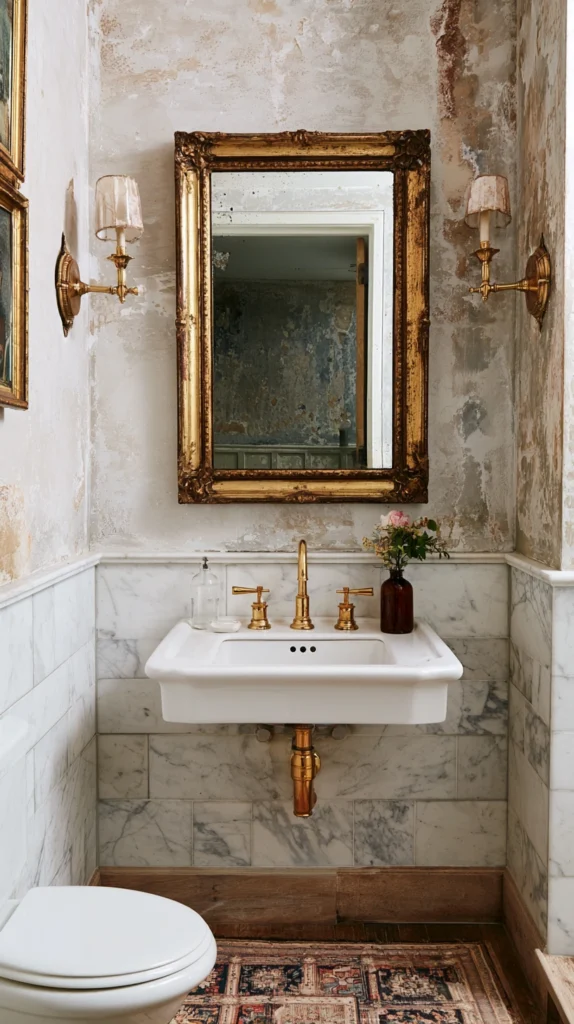
Budget: $20 – $150
An antique or antique-style mirror — in an aged gilt frame, a painted timber frame, or a simple worn frame that has developed its quality through use rather than design — above the vanity in a small farmhouse bathroom communicates the character and the accumulated quality of the farmhouse aesthetic more directly than any designed or contemporary equivalent. The antique mirror is the element that most consistently makes the small farmhouse bathroom look as if it has always been this way rather than recently decorated in the farmhouse style.
A genuine antique mirror from a charity shop or market costs $20–$80 depending on size and frame. An antique-style reproduction in an aged finish runs $40–$150. The mirror should be positioned so its centre is at 130–140 centimetres from the floor — slightly lower than the standard 145–150-centimetre gallery height — to suit the specific use of a bathroom mirror, which is operated from closer range and from a position that is often slightly lower than the standing height of the person using it.
Style tip: Choose a mirror frame that is slightly too large for the conventional convention of the vanity it serves — a mirror frame that extends 10–15 centimetres beyond the vanity width on each side reads as a character piece rather than as a mirror purchased to specifications. The oversized antique mirror communicates the farmhouse quality of objects chosen for their own quality rather than for their coordination with the furniture below them.
9. The Dark Painted Walls
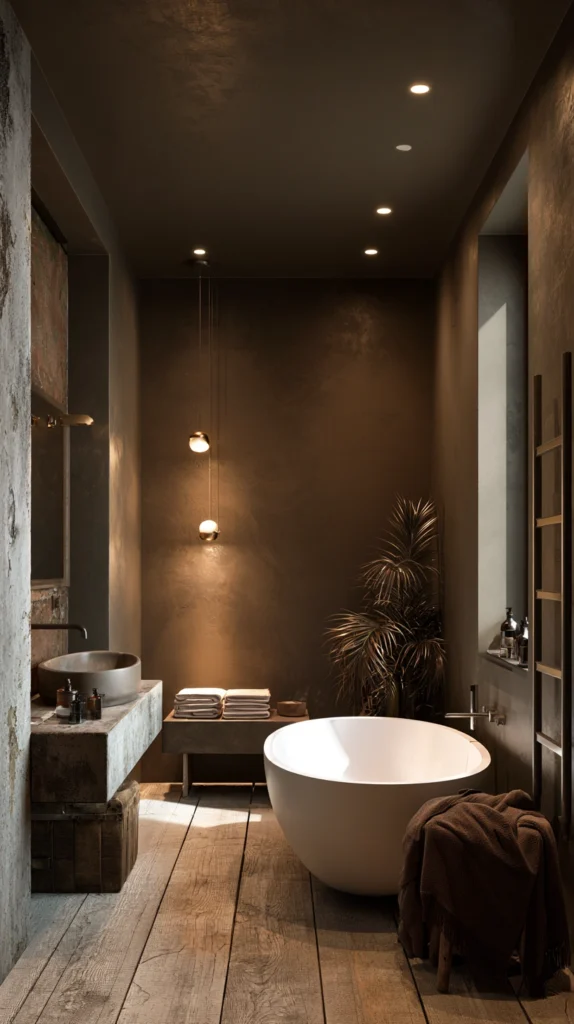
Budget: $25 – $80
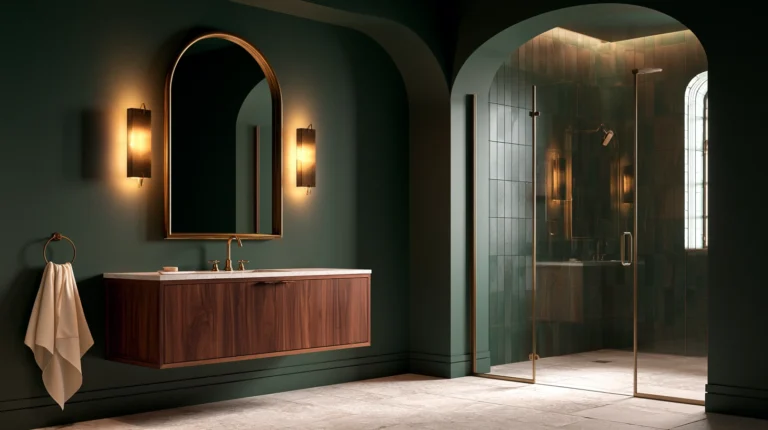
A small farmhouse bathroom painted in a deep, warm colour — a dark sage green, a warm charcoal, a deep navy, or a rich plum — communicates the opposite of the instinctive response to a small bathroom space. The instinct is to paint small rooms pale to make them appear larger. The correct farmhouse response is to paint them a colour that communicates comfort and enclosure — to lean into the intimacy of the small room rather than attempting to disguise it. A dark-walled small bathroom feels warm, considered, and cozy rather than small.
A quality bathroom-specific paint in a deep tone costs $25–$60 per tin. A small bathroom requires one tin for walls and ceiling in two coats. The bathroom-specific formulation is a non-negotiable specification — standard emulsion in a bathroom develops mould at the ceiling and corner junctions within the first damp season regardless of the paint quality or the ventilation provision. The anti-mould, moisture-resistant properties of specialist bathroom paint are the functional requirement of the bathroom application.
Style tip: Paint the ceiling the same deep colour as the walls — both in the same tin, applied consistently across all surfaces including the ceiling. A dark ceiling above a dark-walled bathroom creates the enveloping quality of a room that is entirely itself; a white ceiling above dark walls creates the visual break of an incomplete decision. The same-colour ceiling is the decision that most transforms the dark small bathroom from a room with dark walls to a genuinely dark room.
10. The Reclaimed Timber Floor
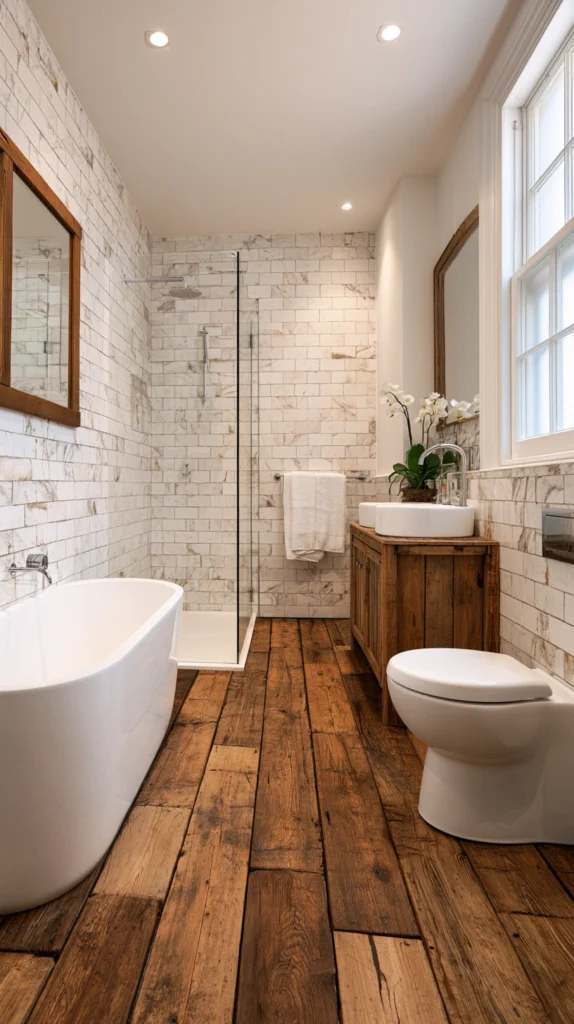
Budget: $150 – $600
Reclaimed timber flooring in a small farmhouse bathroom — in a properly sealed and properly specified engineered timber product rather than solid timber — creates the most warm and the most material-honest floor surface available to the compact bathroom at a cost below natural stone and with a warmth underfoot quality that stone cannot provide. The reclaimed timber floor communicates the farmhouse tradition of a room made from materials with a history, and the aged grain, the nail holes, and the accumulated character of reclaimed boards produce a floor that communicates genuine age from the first day of installation.
Reclaimed oak in an engineered format — the format suitable for bathroom humidity — costs $40–$80 per square metre in materials. A small bathroom floor of 4 square metres costs $160–$320 in flooring material plus installation. Seal with a minimum of three coats of a water-resistant hard-wax oil rated specifically for bathroom use — standard floor oils are not rated for the sustained moisture exposure of a bathroom floor and will require reapplication within the first year.
Style tip: Choose a reclaimed timber with a wider board width — 150 millimetres minimum, 200 millimetres ideally — rather than the narrow strip format that most engineered timber flooring produces. Wide boards in a small bathroom read as genuinely reclaimed material from a building with a history; narrow strip flooring reads as a general timber floor finish regardless of the reclaimed character of the individual boards.
11. The Wicker and Rattan Storage
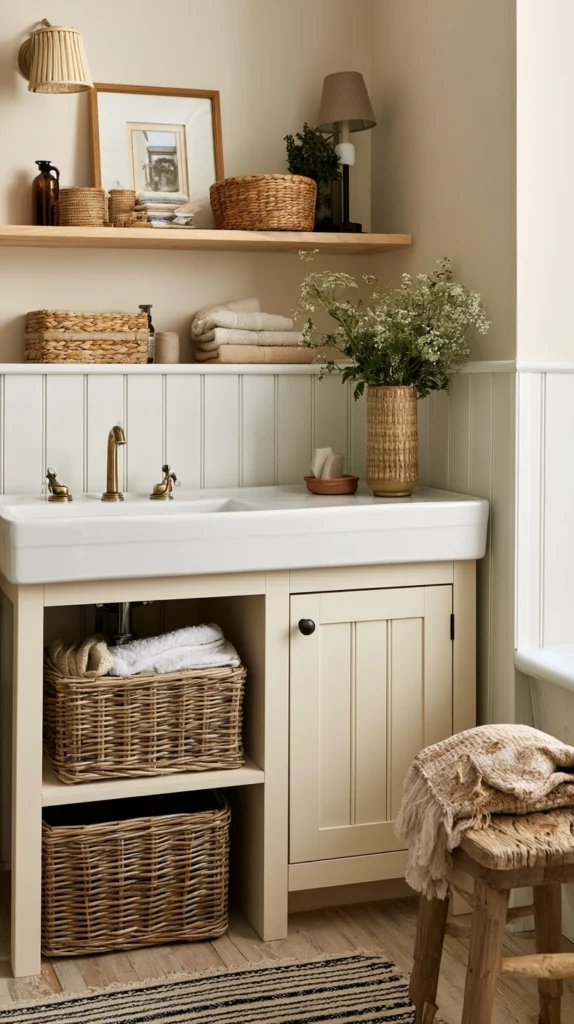
Budget: $20 – $100
Wicker baskets, rattan trays, and seagrass containers used as bathroom storage — on the open shelving, beside the bath, or in the under-vanity space — give the small farmhouse bathroom its natural material warmth at the storage and organisation level. The wicker basket is the farmhouse bathroom’s most characteristic small-scale element, communicating the natural, the practical, and the accumulated quality of the farmhouse tradition through the most economically accessible of all the natural material options.
Individual wicker baskets cost $8–$25 each. A set of three in coordinating sizes runs $25–$60. Rattan trays cost $10–$30. Use the wicker for dry storage — towels, toilet paper, bath salts, cotton products — rather than for wet or frequently moisture-exposed items. The wicker basket that holds rolled guest towels beside the bath communicates the farmhouse quality of prepared hospitality; the same basket beside the shower holds moisture and deteriorates.
Style tip: Choose wicker in a natural, undyed tone rather than a painted white or a bleached version for the farmhouse bathroom. The natural honey-amber of undyed wicker relates to the warm timber tones of the farmhouse palette; a white-painted basket loses the material warmth that makes wicker the right choice for the farmhouse aesthetic and reads as a styled version of the material rather than the material itself.
12. The Vintage Tap Hardware
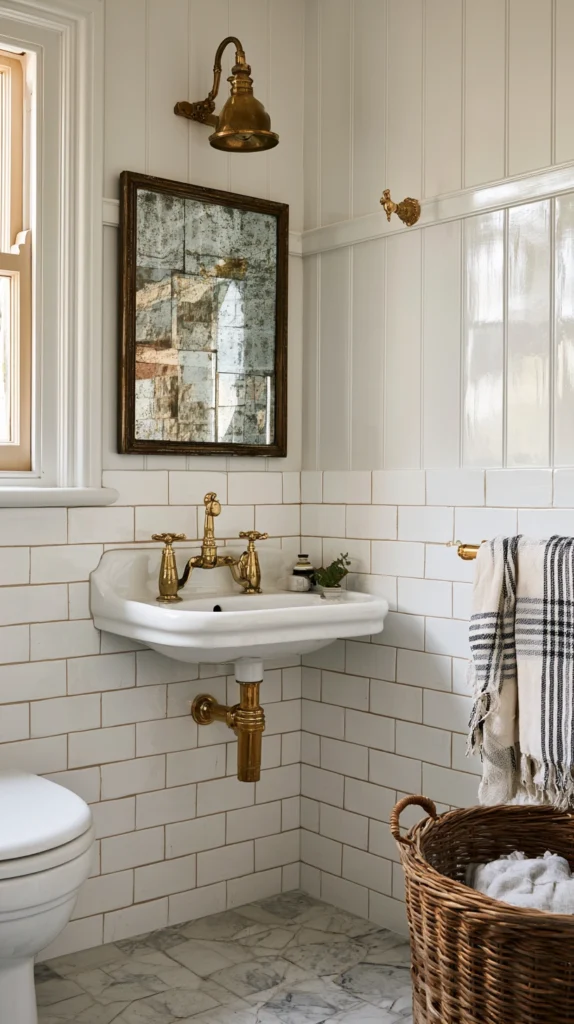
Budget: $80 – $300
Replacing standard chrome lever taps with period-style cross-head taps in aged brass, brushed nickel, or antique chrome gives the small farmhouse bathroom its most consistently present and most directly experienced period reference. The tap is the object touched most frequently in any bathroom and the one whose quality and character is most directly communicated through daily use — a period-style tap of genuine quality feels different in the hand from a modern lever tap, and that tactile difference is the experience of the farmhouse aesthetic rather than simply the observation of it.
Cross-head basin taps in aged brass cost $80–$200 for a pair. A period-style bath filler in the same finish runs $150–$400. A matching shower valve costs $100–$250. Specify ceramic disc valves within the period-style bodies rather than older rubber washer valves — ceramic discs have the period appearance without the maintenance requirement of rubber washer replacement that genuine period taps demand every two to three years.
Style tip: Choose a single metal finish for all taps, towel rails, mirror fixings, and toilet roll holder rather than mixing aged brass basin taps with chrome shower fittings and nickel towel rail. The hardware finish consistency is the specification that most distinguishes the designed farmhouse bathroom from the assembled one — a single aged brass finish throughout reads as a considered material palette; mixed finishes read as components chosen independently.
13. The Practical Farmhouse Storage Solutions
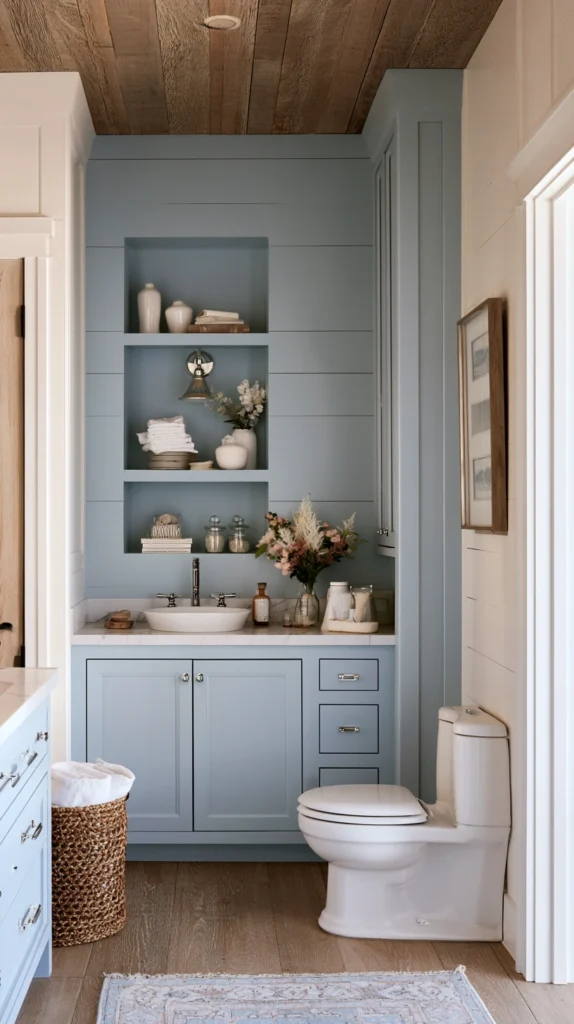
Budget: $50 – $250
A small farmhouse bathroom requires storage solutions that are both practically effective and visually consistent with the aesthetic — the apothecary cabinet with its glass and timber construction, the painted wall cabinet in a complementary tone to the wall colour, the stone or timber shelf that holds the daily products in a considered arrangement rather than in the random accumulation that bathroom surfaces inevitably attract. The storage solution in a small farmhouse bathroom must work harder than in a large one because there is less floor and wall area to absorb the evidence of inadequate storage.
A painted timber wall cabinet of 30 by 40 centimetres costs $30–$80. A mirror-fronted apothecary cabinet runs $60–$200. A recessed shelf niche built into the shower wall costs $50–$150 in tile and waterproofing materials. The recessed niche is the most space-efficient storage solution for the small farmhouse bathroom — it occupies no floor space, no wall projection, and no visual depth, and it eliminates the shower caddy that is the most aesthetically compromising element of the standard small bathroom.
Style tip: Designate one storage space as the display storage — the open shelf or the apothecary cabinet whose contents are visible and must therefore be beautiful — and separate it from the functional storage where the practical but aesthetically undistinguished products are kept out of sight. The small farmhouse bathroom that contains only what is visible and beautiful on its visible surfaces is the bathroom that most consistently communicates the farmhouse aesthetic regardless of its size.
14. The Wainscoting and Painted Upper Wall
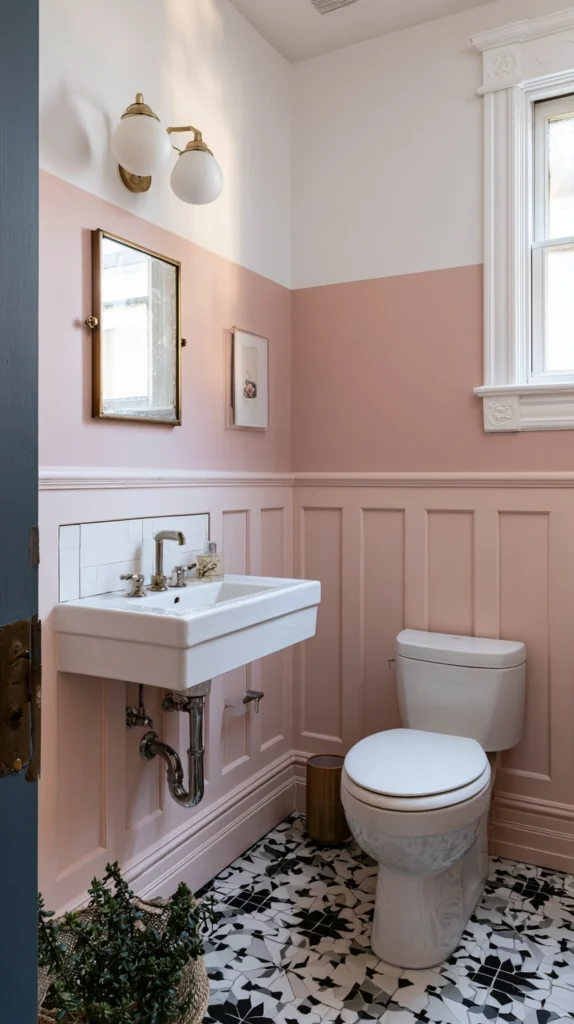
Budget: $100 – $500
Wainscoting — tongue-and-groove timber panelling or beaded board applied to chair-rail height, with the painted plaster above — creates the wall treatment most characteristic of the American and British farmhouse bathroom tradition and the one that most completely produces the quality of a room that was built with a specific understanding of what bathrooms require. The wainscoting provides moisture resistance at the most splash-prone height of the bathroom wall while the painted plaster above provides the warmth and the softness that full tile or full panelling lacks.
Moisture-resistant MDF beaded board panelling costs $20–$40 per sheet. A small bathroom wall panelled to chair-rail height of 90 centimetres requires two to three sheets per wall — $120–$360 in materials for the full room. A chair rail in a complementary timber or MDF profile costs $5–$15 per linear metre. Paint the upper wall in the room’s chosen farmhouse colour — the wainscoting provides the texture layer; the upper paint provides the colour layer.
Style tip: Paint the wainscoting in a tone that is two shades darker than the upper wall rather than in white or a contrasting colour. The slightly darker lower panel creates the visual depth of a room that has two tonal layers rather than one — the wall reads as having warmth at the lower level and lightness at the upper level — while maintaining the colour coherence that a contrasting colour disrupts. The tonal rather than the contrasting approach is the decision that makes the wainscoted small bathroom feel like a designed room rather than a panelled one.
15. The Considered Small Details
Budget: $30 – $150
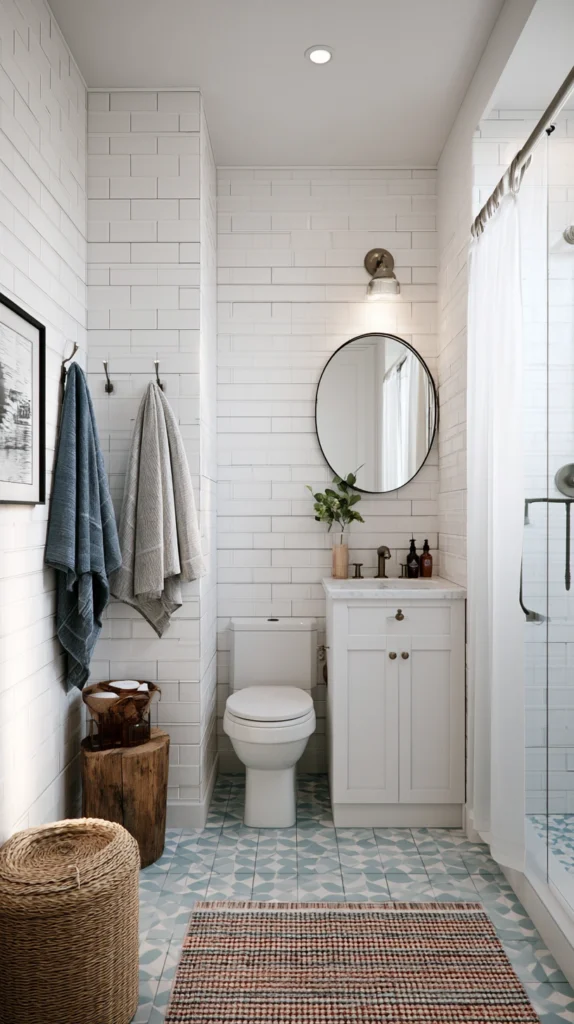
The small farmhouse bathroom is ultimately defined not by its largest elements but by the quality of its smallest ones — the iron hook on the back of the door, the stone soap dish beside the basin, the ceramic toothbrush holder, the linen hand towel with a simple stripe, the small pot of a specific plant on the windowsill. These are the details that communicate the care and the attention that the farmhouse aesthetic is built on, and in a small bathroom where every element is visible simultaneously, the quality of the small details is experienced as the quality of the room.
A cast iron hook costs $5–$15. A stone soap dish runs $8–$20. A ceramic toothbrush holder costs $8–$20. A linen hand towel costs $10–$25. A small plant — a fern, a succulent, a small pothos — in a simple ceramic pot runs $8–$20. The total investment in small details of $50–$100 produces more improvement to the perceived quality of the small farmhouse bathroom than any single larger investment at equivalent cost.
Style tip: Assess the small details by standing in the bathroom doorway and observing the room as a visitor would see it on first entering. The objects visible from the doorway — the items on the vanity, the towel on the rail, the soap dish, the mirror, the light fitting — are the objects that form the first impression of the bathroom’s quality. Ensure that every object visible from the doorway is the best version of itself — cleaned, filled, precisely placed — and the small farmhouse bathroom will communicate its specific quality of care and warmth from the first moment of encounter.
The small farmhouse bathroom communicates its quality not through its size or its specification but through the consistency of the care that its details receive — the timber sealed before installation, the taps chosen in a single consistent finish, the shiplap painted in the warmth of white rather than the brightness of it, the wicker basket in its natural tone rather than painted to a trend. These are the decisions that produce the farmhouse quality rather than the farmhouse appearance, and the two are not the same thing.
Begin with the material decisions — the tile, the timber, the tap finish — because the materials determine the room’s character and all the subsequent decisions follow from them. Choose warm over bright, honest over designed, practical over decorative. And then tend the room as the farmhouse tradition tends all the rooms it values — with the daily care of an environment that was made for genuine use and that earns its quality through the consistency of the attention it receives rather than the grandeur of the specification it was built to.