14 Natural Wood Bathroom Vanity Ideas That Bring Warmth and Character to Your Space
14 Natural Wood Bathroom Vanity Ideas That Bring Warmth and Character to Your Space
There is a specific quality that a wooden vanity brings to a bathroom that no painted cabinet, no laminate finish, and no engineered alternative manages quite as well. It is the quality of something that was grown rather than manufactured — the grain that moves through the timber in a pattern formed over decades, the warmth that no paint colour can replicate, the way the surface changes in the steam and the light of a bathroom in a way that reveals rather than conceals its material honesty.
A natural wood bathroom vanity is not a trend. It is a return to the oldest and most reliable of all bathroom materials, updated by the quality of the craftsmanship, the choice of timber species, and the relationship between the wood and the other materials in the room. Done well, a wooden vanity makes the bathroom the warmest and most genuinely personal room in the house. Done carelessly, it is simply timber in a wet environment that was not properly prepared for what a bathroom demands of it.
Each idea below is a specific approach to one type of natural wood bathroom vanity. Each includes what you will need, what it will cost, and a practical tip to make it work as well as it deserves.
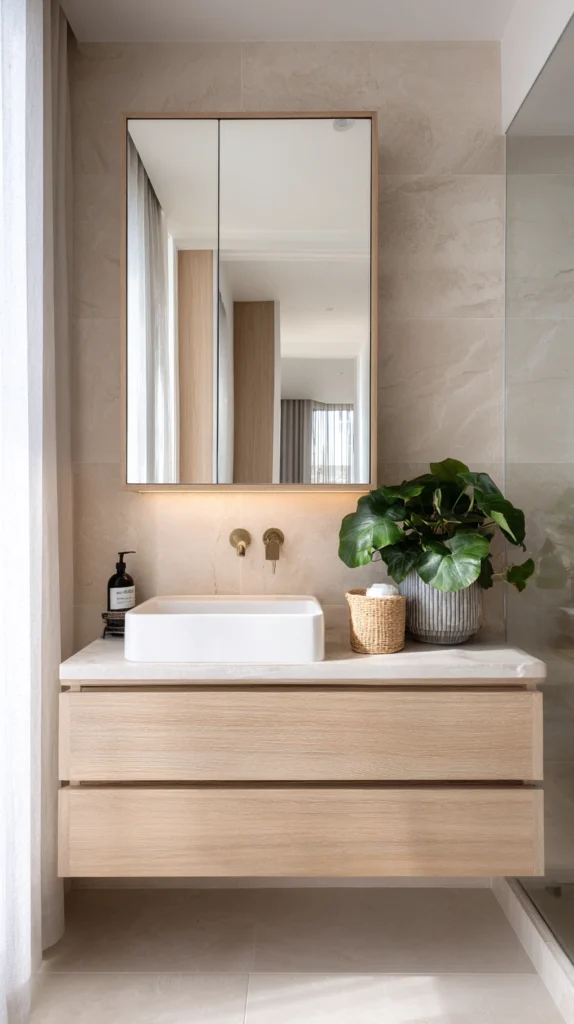
1. The Light Oak Floating Vanity
Budget: $400 – $2,000
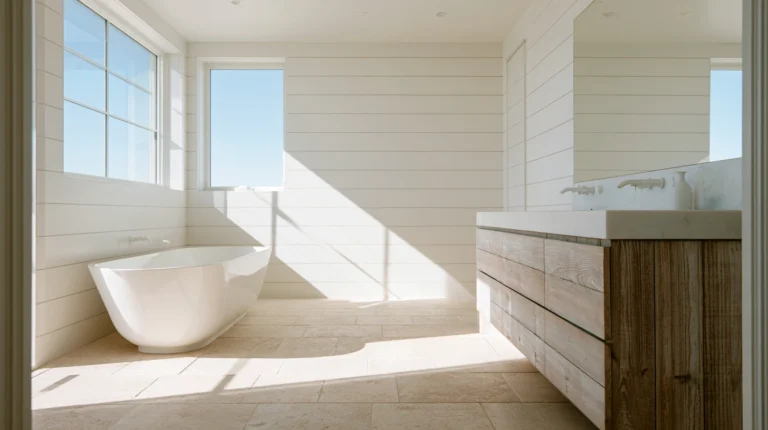
A wall-mounted floating vanity in pale, straight-grained oak — positioned clear of the floor, with the floor tile running beneath it — creates the most spatially generous and most contemporary of all the wood vanity formats. The floating position makes a small bathroom read as larger by exposing the full floor area, and pale oak in the specific honey-and-cream tone of European white oak is warm enough to read as genuinely wooden and light enough to avoid making a compact bathroom feel enclosed.
A solid oak floating vanity unit in a standard 60-centimetre width costs $400–$1,200. A bespoke version in a specific timber and configuration runs $1,000–$3,000. The floating mount requires a wall that can accept the structural fixing — solid masonry or a timber stud wall with blocking installed between studs at the correct height. A floating vanity on an inadequate fixing is a significant safety risk and the structural assessment should precede the vanity selection.
Style tip: Choose a matte or satin water-resistant finish for the oak rather than a high gloss lacquer. A high gloss oak vanity reads as sealed and synthetic; a satin or matte finish allows the timber grain to remain the dominant visual quality of the surface. The finish is the specification that determines whether the oak reads as wood or as a wood-coloured surface.
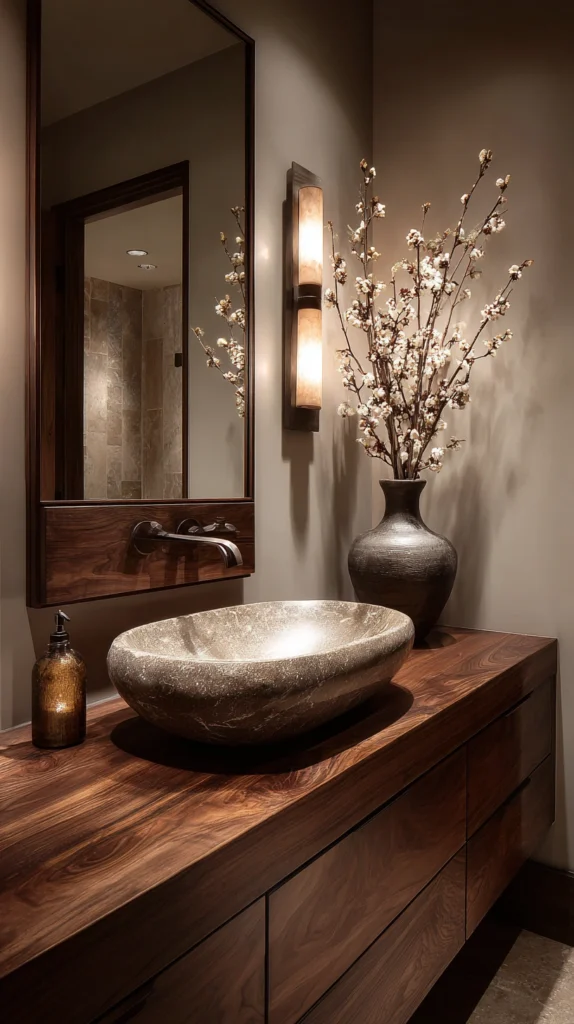
2. The Dark Walnut Statement Vanity
Budget: $600 – $3,000
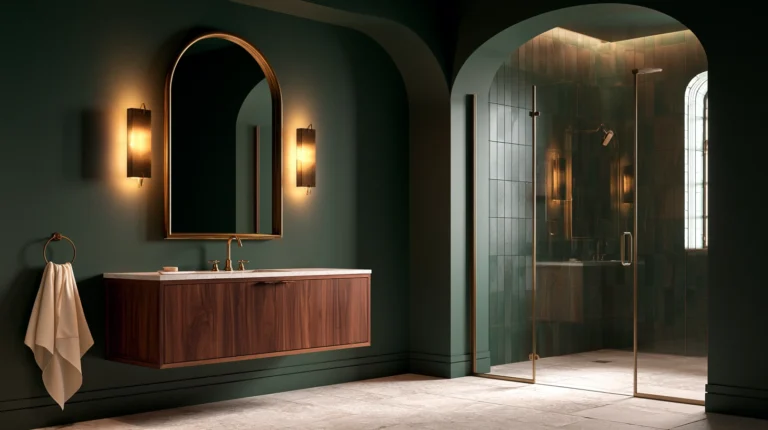
A dark walnut vanity — the specific chocolate-brown with purple undertones that is the most luxurious of all the standard cabinet timbers — in a bathroom creates a room of considerable drama and considerable warmth simultaneously. Walnut is heavy in tone and rich in grain, and it suits a bathroom where the intention is to create a genuinely spa-like atmosphere rather than a functional wet room.
A solid walnut vanity in a standard 90-centimetre double-basin configuration costs $800–$2,500. A wall-hung walnut vanity with integrated basin runs $1,200–$4,000. Walnut requires a quality water-resistant finish applied to all surfaces including the interior of the cabinet — unsealed internal surfaces absorb the moisture that is present in every bathroom and eventually deteriorate regardless of how well the exterior is sealed.
Style tip: Pair dark walnut with warm white or cream ceramic basins rather than pure brilliant white. Brilliant white against dark walnut creates a contrast that reads as stark; warm white softens the contrast and allows both the basin and the timber to read as warm materials in the same register rather than as competing elements at opposite ends of the tonal spectrum.
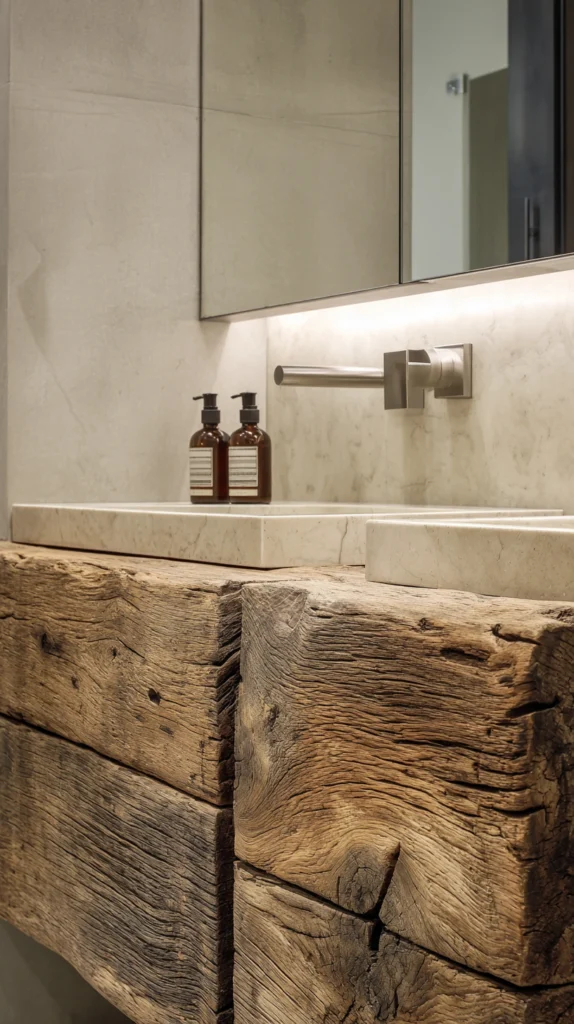
3. The Reclaimed Timber Vanity
Budget: $300 – $2,000
A vanity built from reclaimed timber — old barn timber, reclaimed railway sleeper, salvaged floorboard, or any timber with a previous life visible in its surface — creates the bathroom feature with the most character and the most specific material history available. Reclaimed timber brings the evidence of age — the nail holes, the saw marks, the colour variations of decades of patina — into the bathroom as a form of decoration that no new timber can replicate.
Reclaimed timber from salvage yards costs $5–$30 per linear metre depending on species and quality. A DIY reclaimed timber vanity cabinet built around a standard plumbing configuration costs $150–$500 in materials. A commissioned reclaimed timber vanity from a furniture maker runs $600–$2,000. The reclaimed timber must be sealed more thoroughly than new timber — the open grain of aged wood is more porous and less predictable in its moisture absorption behaviour.
Style tip: Seal the reclaimed timber vanity with two coats of a penetrating water-resistant oil or a hard-wax oil finish rather than a surface lacquer. A surface lacquer on aged timber can peel at the edges of nail holes and saw marks as the timber moves with temperature and humidity; a penetrating finish moves with the timber and maintains its protection through the seasonal movement that reclaimed timber in a bathroom will always produce.
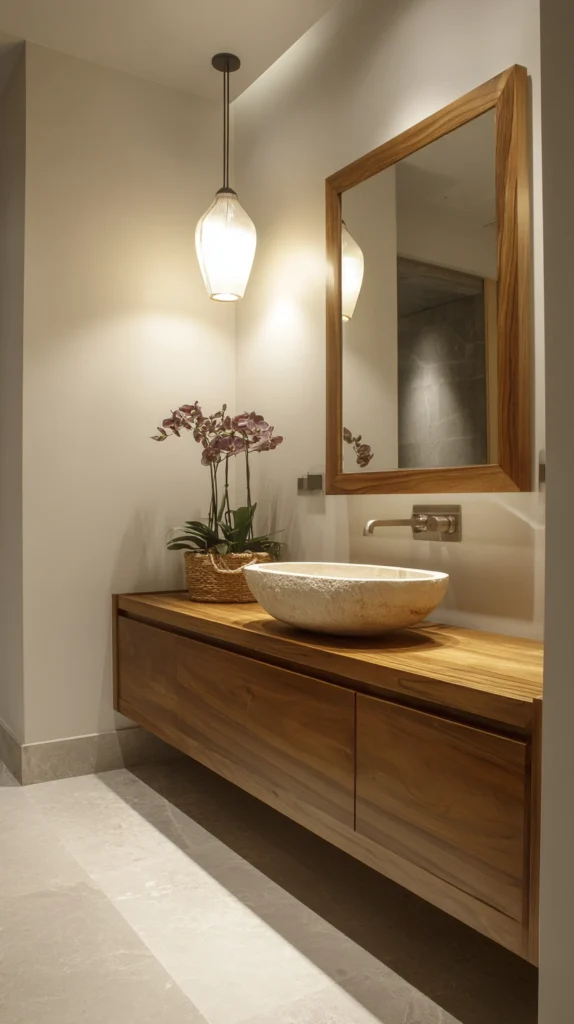
4. The Teak Freestanding Vanity
Budget: $500 – $2,500
Teak is the timber that is most naturally suited to wet environments — its high natural oil content and tight grain structure make it the choice of boat builders and outdoor furniture makers for exactly the quality that a bathroom requires. A teak freestanding vanity needs less sealing and less maintenance than any other timber species in a bathroom context, and its specific warm golden-brown tone darkens to a rich honey with age in a way that makes the vanity more beautiful at five years than it was at installation.
A solid teak freestanding vanity unit costs $600–$2,000. A teak vanity with an integrated stone or ceramic top runs $800–$2,500. Teak requires minimal finishing for bathroom use — a single coat of teak oil before installation and an annual reapplication thereafter is the maintenance schedule that keeps the timber performing and looking its best for decades.
Style tip: Allow teak to silver naturally if the bathroom receives significant daylight rather than re-oiling to maintain the golden tone. The silvered teak of a naturally weathered surface is one of the most beautiful finishes available to any timber and in a bathroom context it reads as a material that has been honestly used rather than carefully preserved. The choice between golden-oiled teak and silver-weathered teak is a genuine aesthetic decision with no wrong answer.
5. The Bamboo Eco Vanity
Budget: $300 – $1,200
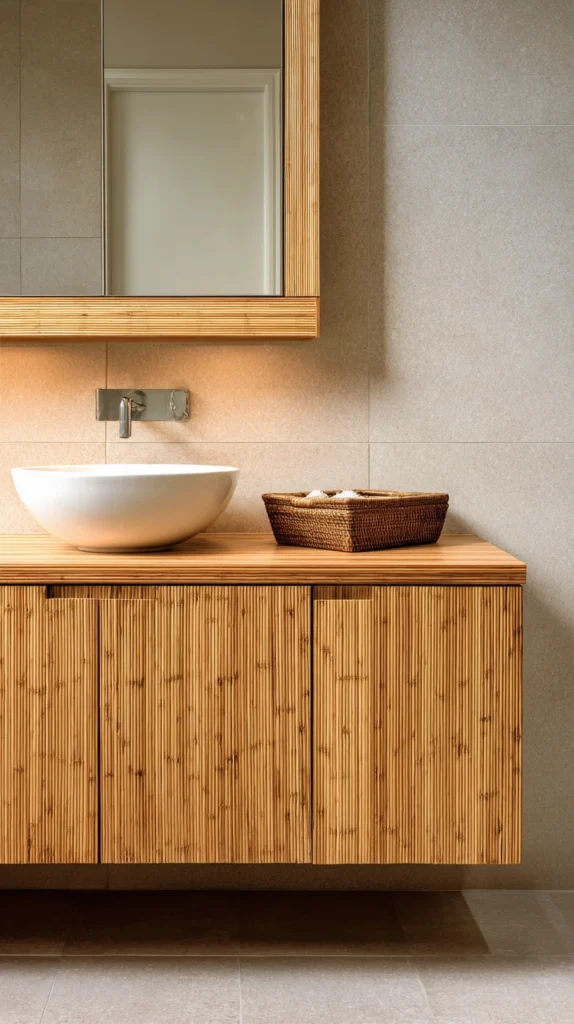
Bamboo — technically a grass rather than a timber but processed and used in identical applications — is the most rapidly renewable of all the natural materials available for bathroom vanity construction. A bamboo vanity has a tight, linear grain pattern that reads as contemporary rather than traditional, a natural blonde or caramel tone that suits the pale, minimal bathroom, and a hardness and density that makes it more durable than many slower-growing timber species.
A bamboo vanity unit in a standard 60-centimetre width costs $300–$800. A strand-woven bamboo version — the densest and most water-resistant form of bamboo board — runs $400–$1,200. The edge of bamboo vanity components should be sealed as carefully as the face — the cut edge of bamboo board is more porous than the face and more vulnerable to moisture ingress that causes delamination.
Style tip: Choose a carbonised bamboo finish — the process that heats the bamboo to produce a darker, more caramel tone — rather than the natural blonde finish if the bathroom has warm-toned tiles or fittings. The carbonised finish reads as warmer and more timber-like; the natural finish reads as cooler and more contemporary. Both are appropriate but they suit different bathroom palettes.
6. The Live Edge Wood Vanity
Budget: $800 – $5,000
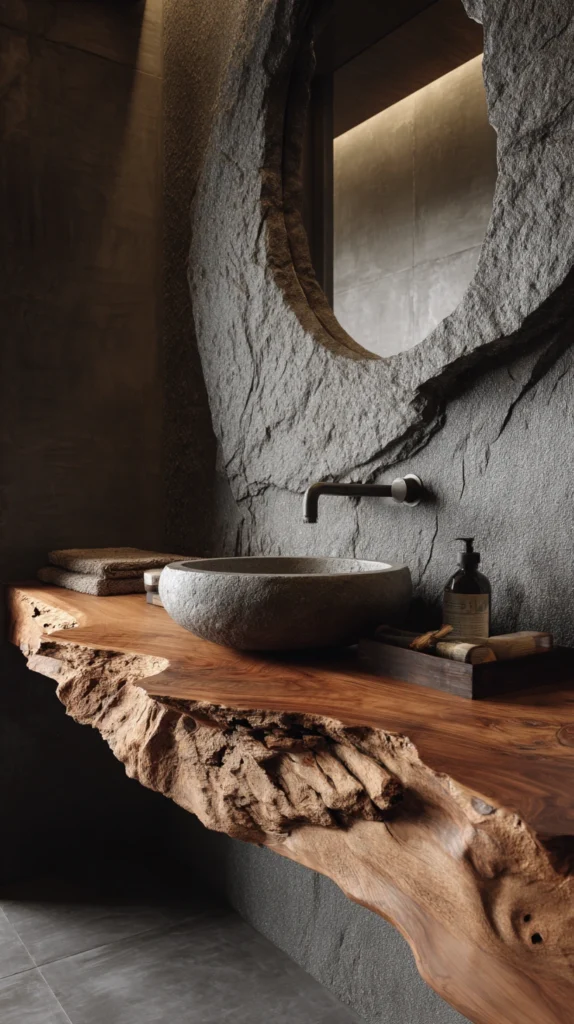
A vanity top or a full vanity unit incorporating a live edge slab — the natural edge of the tree preserved rather than cut straight — is the most dramatically individual and most specifically artisanal of all the wood vanity options. No two live edge slabs are identical, and the organic outline of the natural tree edge gives a vanity top a sculptural quality that no manufactured edge can replicate.
A live edge walnut or oak vanity slab of 120 centimetres in length costs $400–$1,500 for the timber alone. A complete live edge vanity with integrated plumbing runs $1,500–$5,000. The live edge surface requires more careful finishing than a straight-edged slab — the natural edge has more surface variation and more exposed end grain that requires specific sealing treatment to prevent moisture ingress at the most vulnerable sections of the timber.
Style tip: Pair the live edge vanity with the simplest possible basin — an undermount or a vessel basin in pure white ceramic — to allow the timber’s form to be the room’s primary visual statement. A decorative basin on a live edge slab creates two competing design statements; a simple basin on the same slab creates one clear statement in which the timber’s natural form is unambiguously the point.
7. The Pine and White Cottage Vanity
Budget: $200 – $800
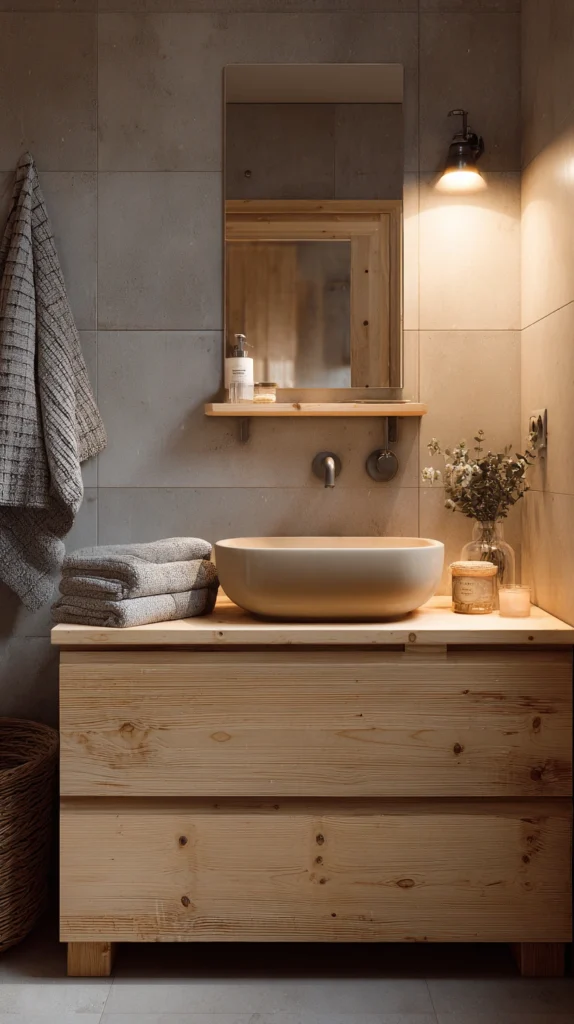
A pine vanity — painted, waxed, or left in its natural resinous golden tone — creates the most specifically cottage and most warmly domestic of all the wood vanity aesthetics. Pine is the most affordable of all the timber species used for bathroom furniture and the one with the most visible, most characterful grain — the knots, the resin pockets, the wide grain rings of fast-grown softwood are the specific qualities that make pine the warmest and most forgiving of bathroom timbers.
A pine vanity unit in a standard 60-centimetre width costs $150–$500. A painted pine vanity — painted in a soft white, a pale sage, or a warm cream — costs the same plus $20–$60 in paint. Pine requires thorough sealing before painting in a bathroom context — the resin pockets in pine bleed through water-based paint unless a shellac-based primer is applied first.
Style tip: Use a shellac primer on pine before any water-based topcoat in a bathroom. The resin in pine timber migrates through water-based paint over time and produces yellow staining at the knots that cannot be covered with additional coats of paint. The shellac primer seals the resin before the topcoat is applied and prevents the staining permanently at a cost of $15–$25 for a small tin.
8. The Japandi Wood and Stone Vanity
Budget: $600 – $3,000
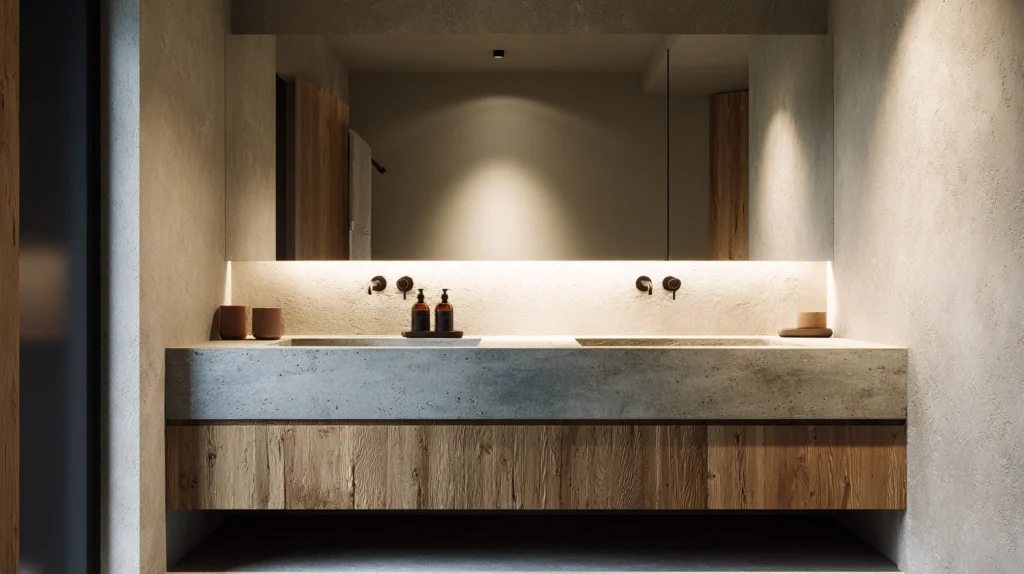
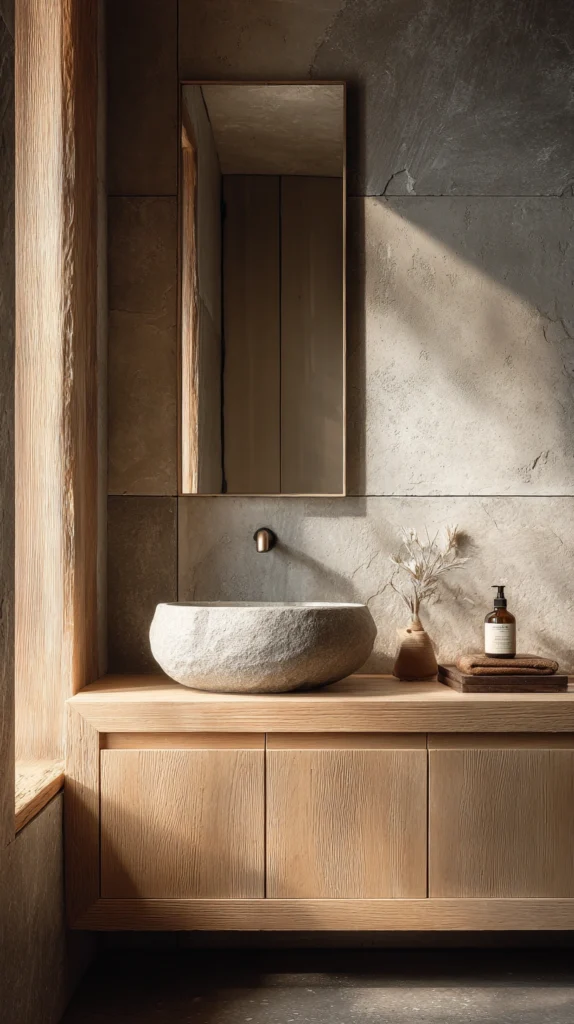
A bathroom vanity in the Japandi aesthetic — the Japanese-Scandinavian design fusion that combines the warmth and naturalness of Nordic materials with the restraint and precision of Japanese design — uses timber of a consistent, relatively featureless grain in a pale or warm tone alongside stone or concrete surfaces in a composition of extraordinary calm. The Japandi vanity is not decorated; it is composed.
A pale ash or light oak vanity in the Japandi format costs $500–$1,500. A natural stone basin or stone vanity top runs $200–$800. Matte black or brushed steel hardware — the only metal finish that suits the Japandi palette — costs $20–$60 per fitting. The Japandi vanity requires a total absence of decorative accessories — no soap dishes, no toothbrush holders, no storage caddies — in favour of the concealed storage that the vanity unit itself provides.
Style tip: Choose a timber with a fine, consistent grain for the Japandi vanity rather than a heavily figured or knotty timber. The Japandi aesthetic values the quietness of natural material over its dramatic qualities — a pale ash with a fine, regular grain reads as Japandi; the same ash with bold figure and prominent knots reads as rustic. The grain restraint is the timber selection criterion that most determines whether the vanity reads as Japandi or as natural-rustic.
9. The Timber and Rattan Boho Vanity
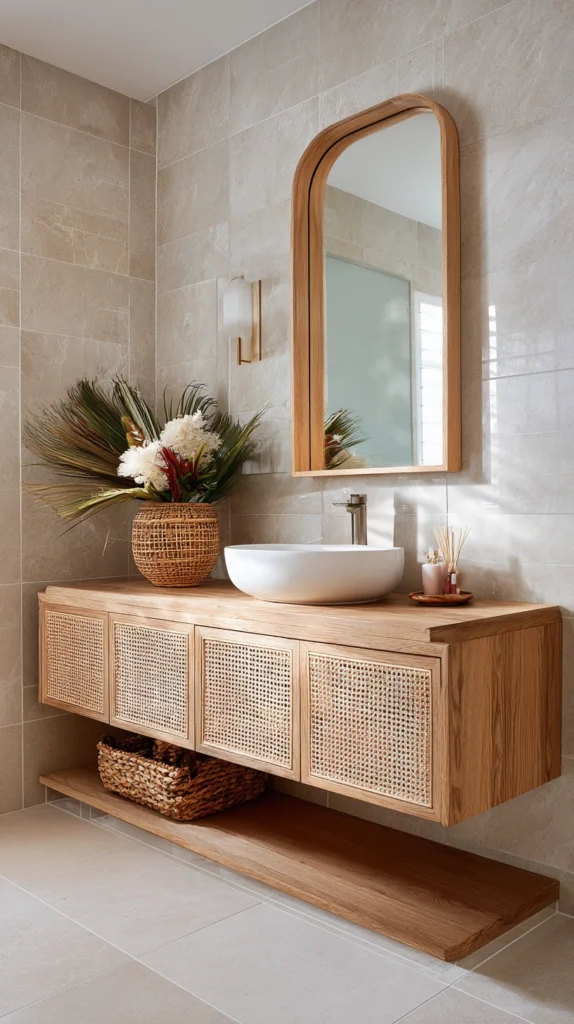
Budget: $300 – $1,500
A wooden vanity with rattan-fronted drawer and cabinet panels — the woven natural fibre visible through the cabinet frame — creates the bathroom’s most specifically bohemian and most texturally interesting storage solution. The rattan allows the cabinet interior to breathe while providing visual screening of the stored contents, and the combination of natural timber and natural woven fibre creates a material pairing of genuine warmth.
A timber vanity with rattan panel inserts costs $300–$1,000. A DIY version — an existing vanity with the solid panel doors replaced with rattan panel inserts — costs $50–$200 in rattan sheets and timber framing. The rattan panels should be sealed with a water-resistant treatment before installation — natural rattan absorbs moisture and darkens unevenly if left unsealed in a bathroom environment.
Style tip: Paint the timber frame of the rattan-panelled vanity in a warm, earthy tone — terracotta, warm sand, sage — rather than white. A rattan-panelled vanity in white reads as coastal; the same vanity in a warm earthy tone reads as boho. The colour of the frame is the single decision that most determines which aesthetic the rattan panel vanity occupies.
10. The Double Timber Vanity for Master Bathrooms
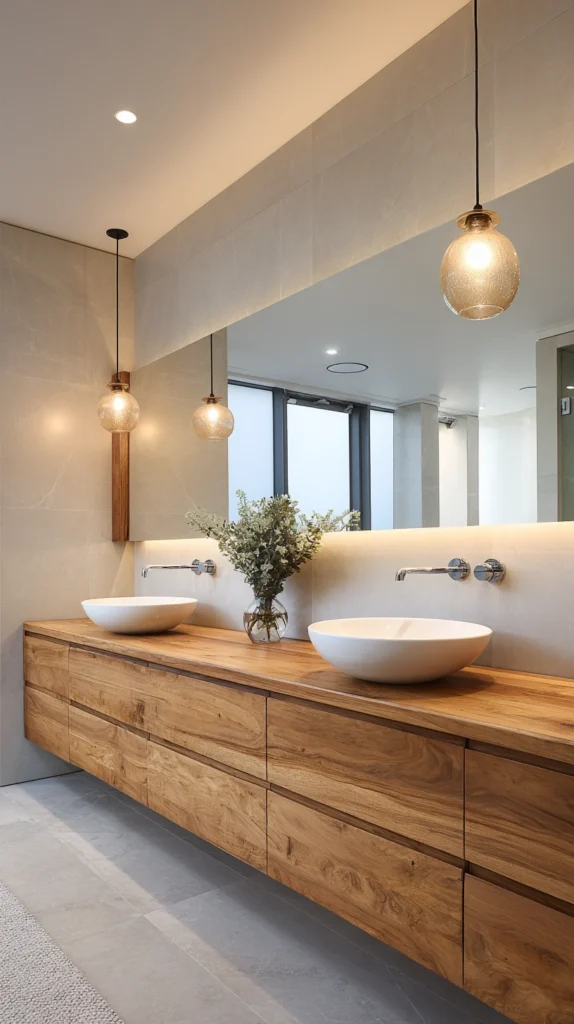
Budget: $800 – $4,000
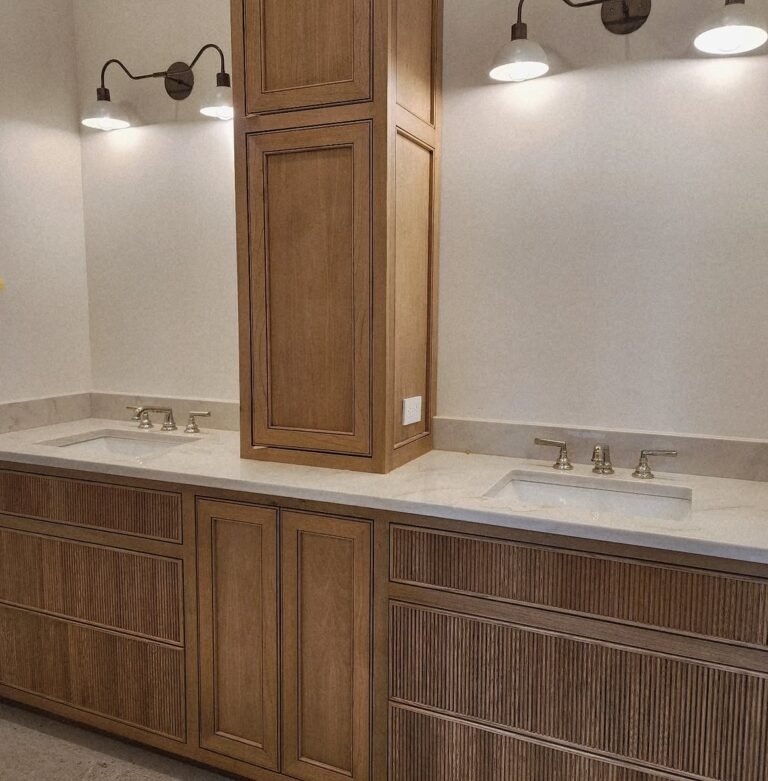
A double vanity in natural timber — wide enough for two basins, long enough to provide genuine prep space for two people, with drawer storage on each side for individual organisation — is the most functional and most genuinely useful of all the wood vanity formats. A double vanity in a quality timber makes a master bathroom feel genuinely designed for the people who use it rather than for the minimum functional requirement.
A solid timber double vanity in a standard 150-centimetre width costs $800–$2,500. A bespoke version in a specific timber and configuration runs $2,000–$5,000. The double vanity requires careful plumbing planning — the basin positions, the waste outlet locations, and the hot and cold supply points must be determined before the vanity is fabricated rather than after.
Style tip: Specify the drawer organisation within each side of the double vanity based on the actual contents to be stored — the drawer heights and widths determined by the specific products the occupant uses — rather than accepting the standard drawer configuration. A double vanity with storage configured for the specific users is used more effectively and maintained more consistently than one with a generic internal configuration.
11. The Timber Vanity With Vessel Basin
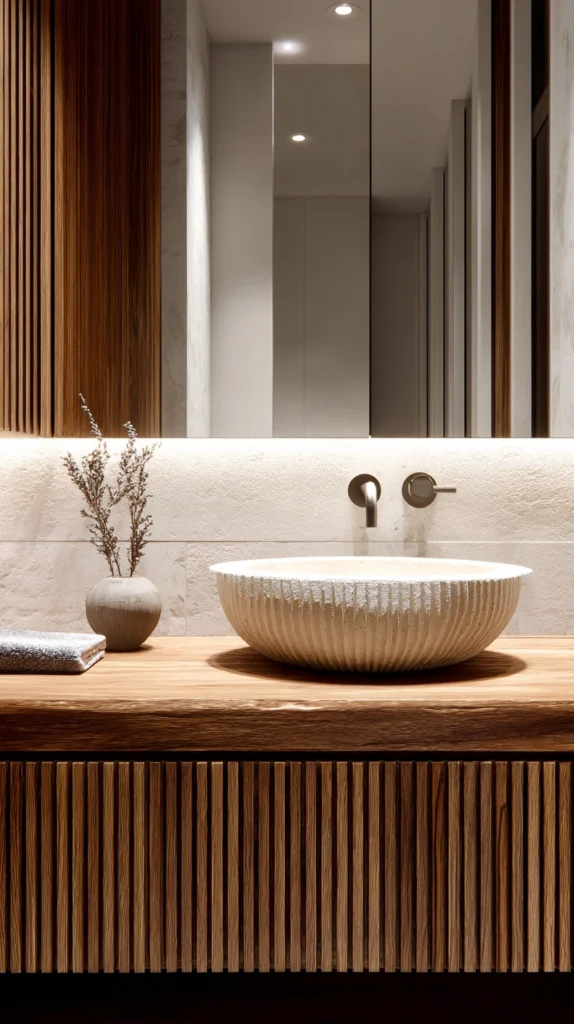
Budget: $400 – $2,000
A low timber vanity — lower than standard, at 75–80 centimetres rather than the standard 85–90 centimetres — with a vessel basin sitting on top of the timber surface creates one of the most visually distinctive and most specifically designed bathroom configurations available. The vessel basin and the timber surface together read as a piece of furniture rather than a bathroom fitting, and the low vanity height suits the proportion of a vessel basin in a way that a standard-height vanity does not.
A low timber vanity in solid oak or walnut at 75 centimetres costs $400–$1,500. A ceramic or stone vessel basin runs $80–$400. The low vanity requires a wall-mounted tap rather than a deck-mounted one — the vessel basin height places the water outlet at a different position from a standard basin and the tap specification must be assessed for the specific basin height.
Style tip: Choose a vessel basin in a material that contrasts with the timber rather than one in a timber-adjacent tone. A dark walnut vanity with a matte black stone vessel basin reads as a composed two-material statement; the same walnut vanity with a wooden vessel basin reads as redundant — the timber message is already made by the vanity and repeating it at the basin level adds nothing.
12. The Timber Vanity With Integrated Basin
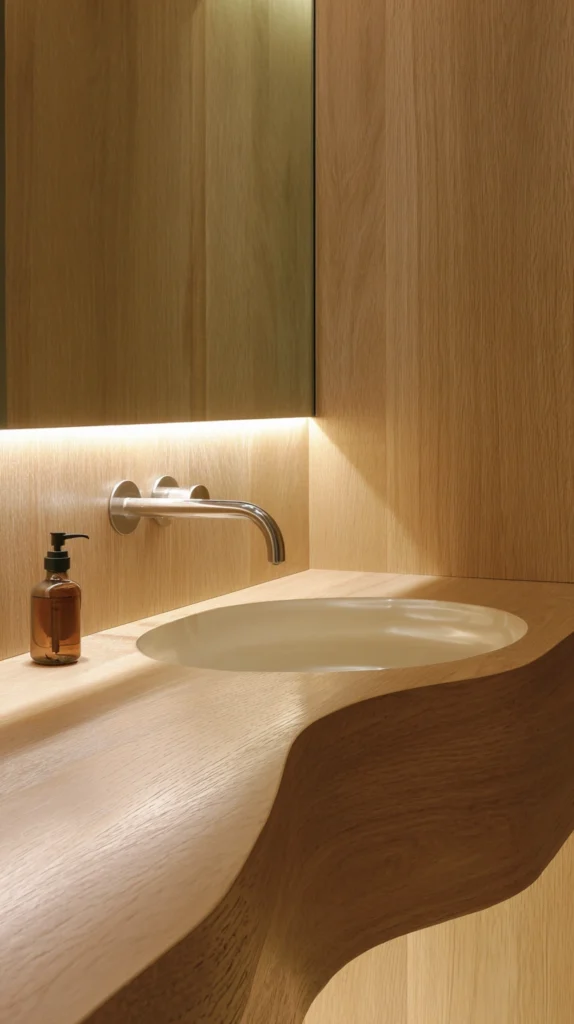
Budget: $600 – $3,500
A timber vanity with a basin integrated into the timber surface itself — either routed directly into the wood and sealed with a waterproof coating, or formed as a recessed ceramic or stone basin that sits flush with the timber top — creates the most seamless and most considered of all the wood vanity formats. The integrated basin eliminates the visual junction between the basin and the worktop that all standard drop-in or vessel basin configurations produce.
A solid timber vanity with an integrated routed basin costs $800–$2,500. A timber vanity with a flush-mounted undermount stone or ceramic basin runs $600–$2,000. The routed timber basin is the most technically demanding option — it requires a hardwood of sufficient density, a thorough internal sealing process, and a specific drain fitting designed for use in timber rather than ceramic or stone.
Style tip: Seal the interior of a routed timber basin with a specialist waterproof resin rather than a standard timber finish. Standard timber sealants — oil, wax, lacquer — are not rated for continuous water contact and will fail within months in a basin that is used daily. The specialist resin is the technical specification that makes the routed timber basin a long-term installation rather than a short-term design statement.
13. The Timber Vanity and Terrazzo Combination
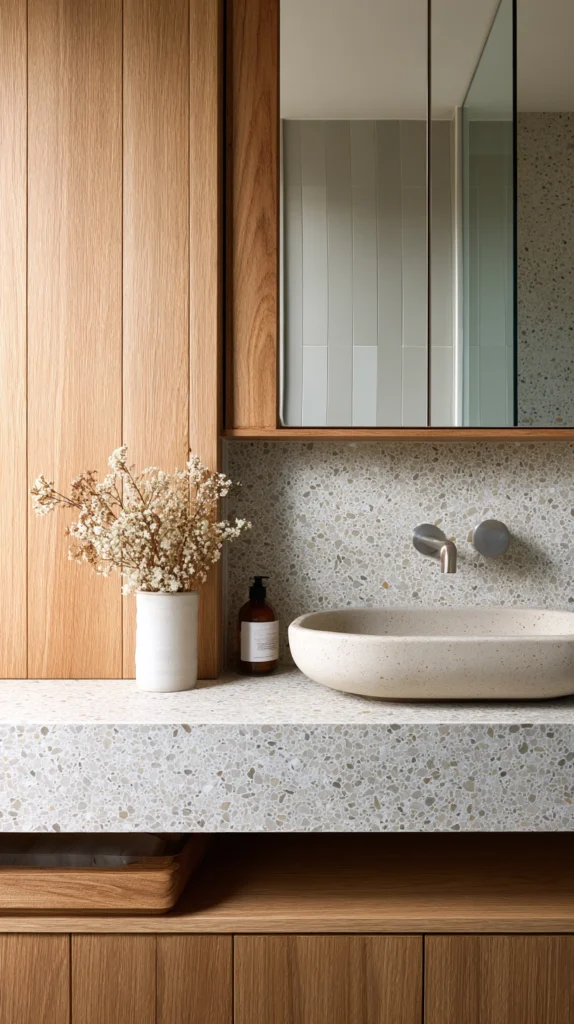
Budget: $500 – $2,500
A natural timber vanity cabinet with a terrazzo basin top — the composite of marble chips in a cement or resin matrix that reads simultaneously as contemporary and as historically ancient — creates one of the most considered and most visually interesting material combinations available to a bathroom. The organic irregularity of the timber grain alongside the geometric randomness of the terrazzo chip pattern creates a material composition of genuine depth.
A timber vanity cabinet costs $400–$1,500. A terrazzo basin top in a standard size runs $200–$800. A terrazzo vessel basin costs $150–$500. Choose a terrazzo with chip colours drawn from the timber’s own tone — warm buff and cream chips beside a pale oak, warm grey and white chips beside a darker timber — so the two materials read as related rather than independent.
Style tip: Seal the terrazzo surface with a penetrating stone sealer before installation and reseal annually. Unsealed terrazzo in a bathroom absorbs water, soap, and cosmetic products that stain the cement matrix permanently within the first weeks of use. The sealant application is the most important installation step and the one most consistently omitted.
14. The Timber Vanity in a Wet Room
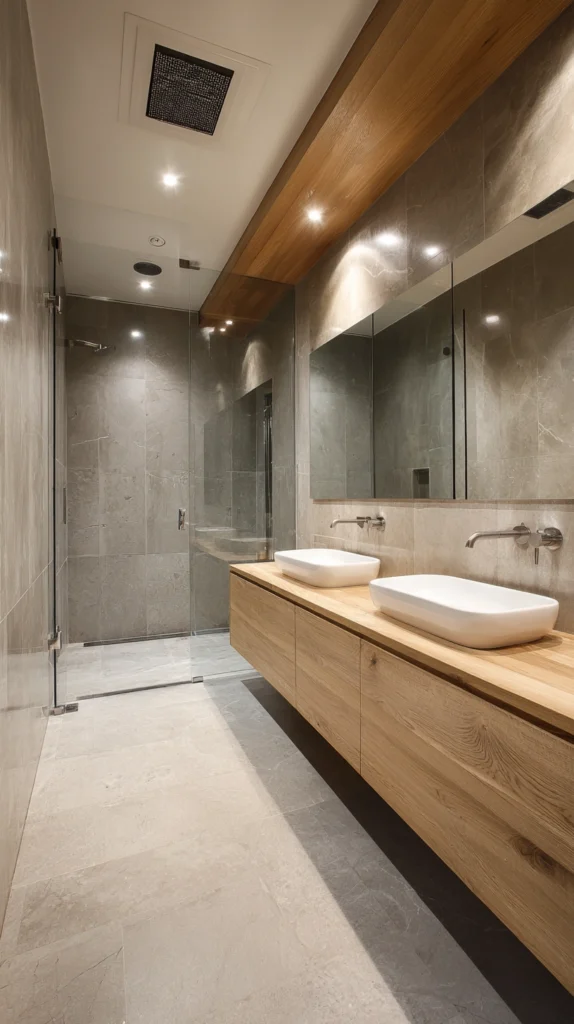
Budget: $800 – $4,000
A timber vanity in a fully wet room — a bathroom where the entire floor is the shower tray and water can reach any surface — requires a higher specification of timber treatment and a more deliberate design consideration than a vanity in a conventional dry zone. The wet room timber vanity must be in a naturally moisture-resistant species, finished to a waterproof standard, and positioned so that the shower water flow does not reach the timber directly.
A teak or iroko vanity in a wet room costs $800–$3,000. The vanity position in the wet room should be at the maximum distance from the shower head and positioned so that the floor falls away from the vanity base rather than toward it. A wall-hung floating vanity with no contact between the timber and the wet floor is the safest format for a wet room timber application.
Style tip: Specify a linear drain positioned between the shower zone and the vanity position to intercept the water flow before it reaches the timber. The linear drain is the infrastructure decision that makes the timber vanity in a wet room a long-term installation rather than a design decision that compromises the timber within the first season of use. The drain position is determined during the bathroom design stage and cannot be effectively retrofitted.
The natural wood bathroom vanity is the single material decision that most consistently elevates a bathroom from a functional space to a genuinely considered one. The warmth of the grain, the honesty of the material, the specific quality of timber in a space defined by water and light — these are the qualities that no manufactured alternative provides and that make the wood vanity worth the additional care of proper specification, proper finishing, and proper ongoing maintenance.
Choose the timber for the specific bathroom — the light it receives, the moisture level it produces, the aesthetic of the materials it already contains — and finish it for the actual conditions rather than the ideal ones. A wood vanity prepared honestly for a bathroom’s real demands is a wood vanity that will be the most admired and most enjoyed element of the room for decades.