15 Modern Farmhouse Bathroom Design Ideas That Blend Rustic Charm With Contemporary Style
15 Modern Farmhouse Bathroom Design Ideas That Blend Rustic Charm With Contemporary Style
There is a bathroom aesthetic that manages to be simultaneously warm and clean, old-feeling and new, decorated and uncluttered. It sits at the specific intersection of the farmhouse tradition — natural materials, honest surfaces, the functional made beautiful — and contemporary design — clean lines, considered hardware, a restraint that prevents the rustic from becoming fussy.
The modern farmhouse bathroom does not try to look like a Victorian outhouse or a spa hotel. It tries to look like the bathroom of someone who genuinely loves good materials and has the taste not to overload them with decoration.
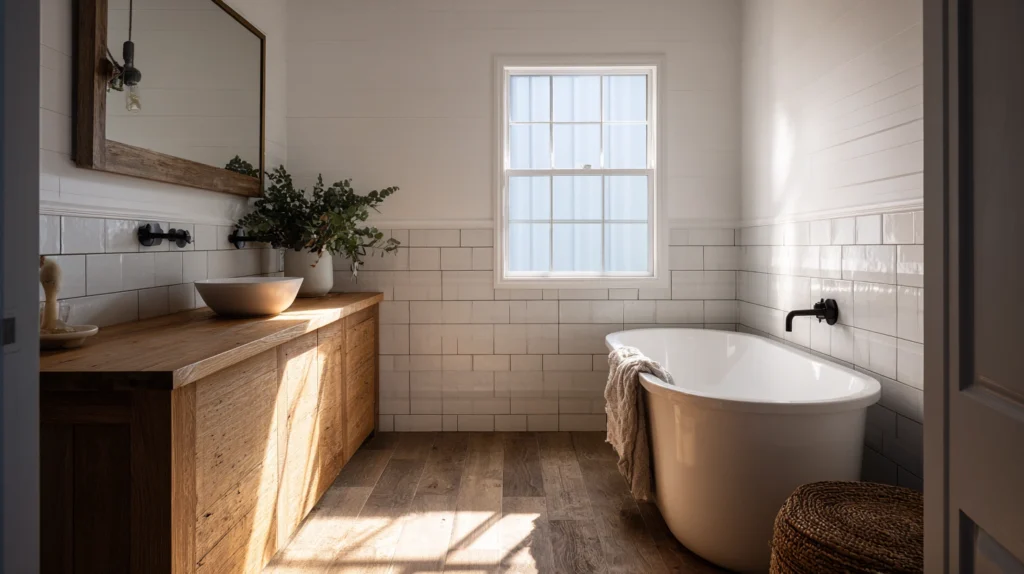
It is one of the most enduringly appealing bathroom aesthetics precisely because it is not a trend. The farmhouse instinct — timber, stone, white ceramic, natural light — has been the instinct of good bathroom design for as long as bathrooms have existed in domestic buildings. The modern inflection is what prevents it from feeling dated: the clean hardware, the restrained palette, the quality of the fixtures chosen over the quantity of the decoration.
Each idea below is a specific approach to one element of the modern farmhouse bathroom. Each includes what you will need, what it will cost, and a practical tip to make it work as well as the aesthetic it is reaching for.
1. The Shiplap Feature Wall
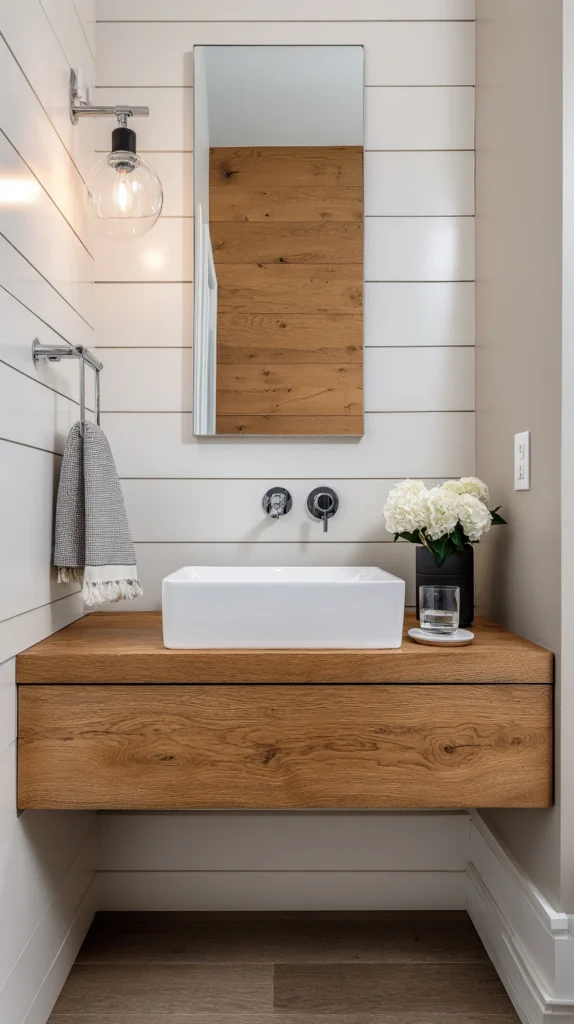
Budget: $80 – $400
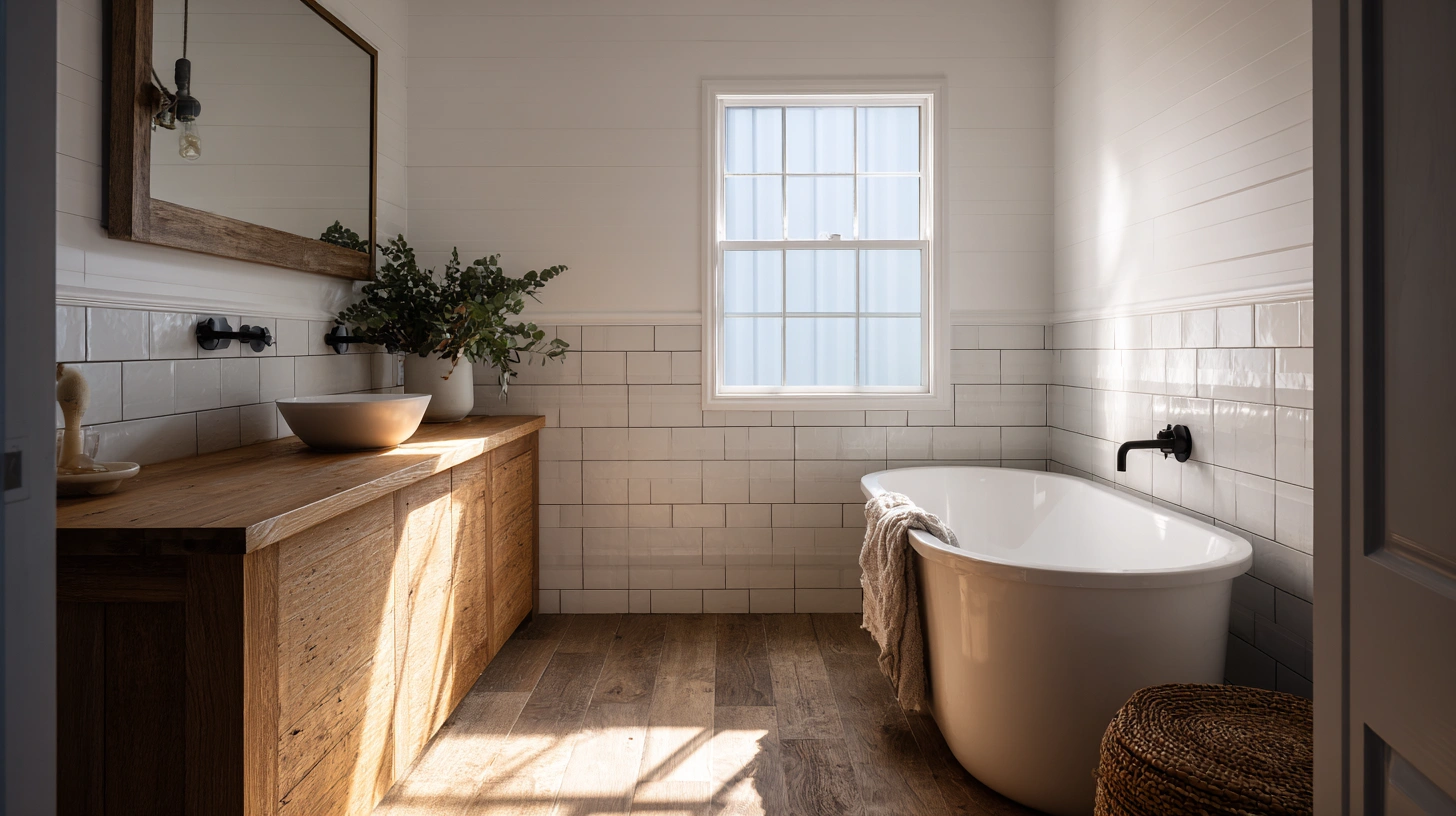
Horizontal shiplap panelling — either genuine timber boards with a rabbeted overlap joint or a modern moisture-resistant MDF equivalent — on the wall behind the bath or the vanity creates the most immediately recognisable farmhouse element available to a bathroom at a cost significantly below a full tile installation. Shiplap in a bathroom reads as the honest, functional wall cladding of a working building rather than as decoration, and that quality of functional honesty is what distinguishes the farmhouse aesthetic from a merely rustic one.
Moisture-resistant MDF shiplap panels cost $20–$50 per sheet. Real timber shiplap boards in a moisture-resistant species run $15–$40 per linear metre. Exterior-grade primer and bathroom-specific paint add $25–$50. Apply to a moisture-resistant substrate — cement board or water-resistant plasterboard — rather than to standard plasterboard, which absorbs moisture behind the shiplap and develops mould within the first season. Seal all joints and edges with a flexible bathroom sealant before painting.
Style tip: Paint the shiplap in a warm white or soft cream rather than a cool brilliant white. Brilliant white shiplap in a bathroom reads as clinical; warm white reads as the specific quality of a well-kept farmhouse interior where the white has accumulated warmth from years of natural light and natural materials around it. The wall colour is the temperature decision that most determines whether the shiplap reads as farmhouse or as institutional.
2. The Freestanding Roll-Top Bath
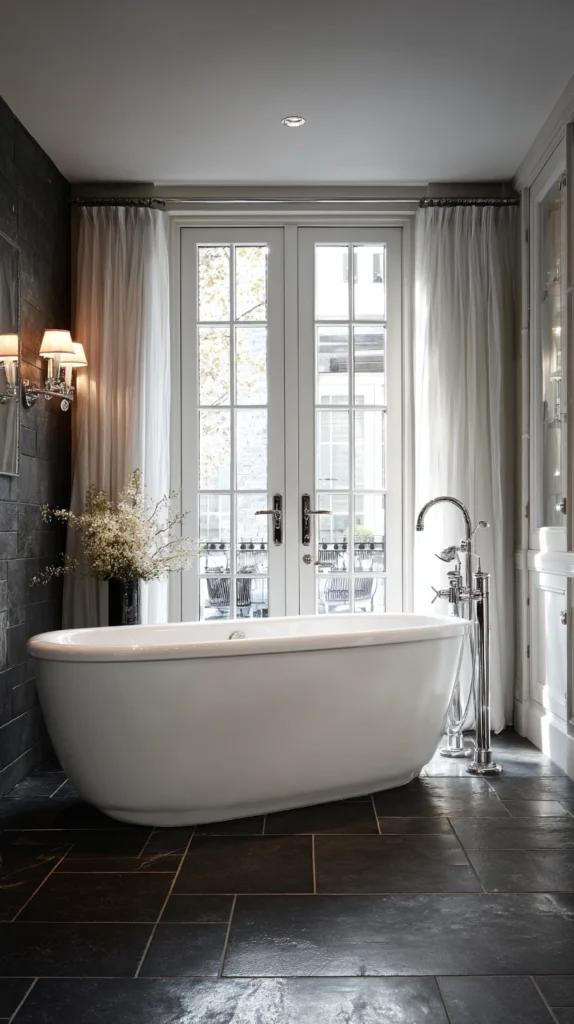
Budget: $600 – $3,000
A freestanding roll-top bath — in white porcelain or enamelled cast iron, on ball-and-claw feet or on a slipper base, positioned in the room rather than against a wall — is the bathroom element that most completely communicates the farmhouse aesthetic at its most generous and most romantic. The roll-top bath communicates that bathing is considered a pleasure rather than a hygiene routine, and a bathroom designed around a freestanding bath is a bathroom designed for the experience of being in the room rather than for the efficiency of passing through it.
A basic acrylic roll-top bath costs $600–$1,500. A cast iron version runs $1,500–$4,000. Freestanding bath taps in a compatible finish cost $200–$600. Position the roll-top bath so it is visible from the bathroom door on entering — the bath as the room’s focal point rather than its most concealed element. A roll-top bath positioned in the centre of the room or at an angle to the walls reads as more confident and more genuinely farmhouse than one pushed into a corner.
Style tip: Choose a bath colour that contrasts with the floor rather than blending into it. A white roll-top bath on a white tile floor disappears; the same bath on a dark slate floor or a warm timber floor reads as a sculptural object that was placed in the room with intention. The contrast between the bath and the floor is what gives the freestanding piece its visual authority.
3. The Natural Wood Vanity
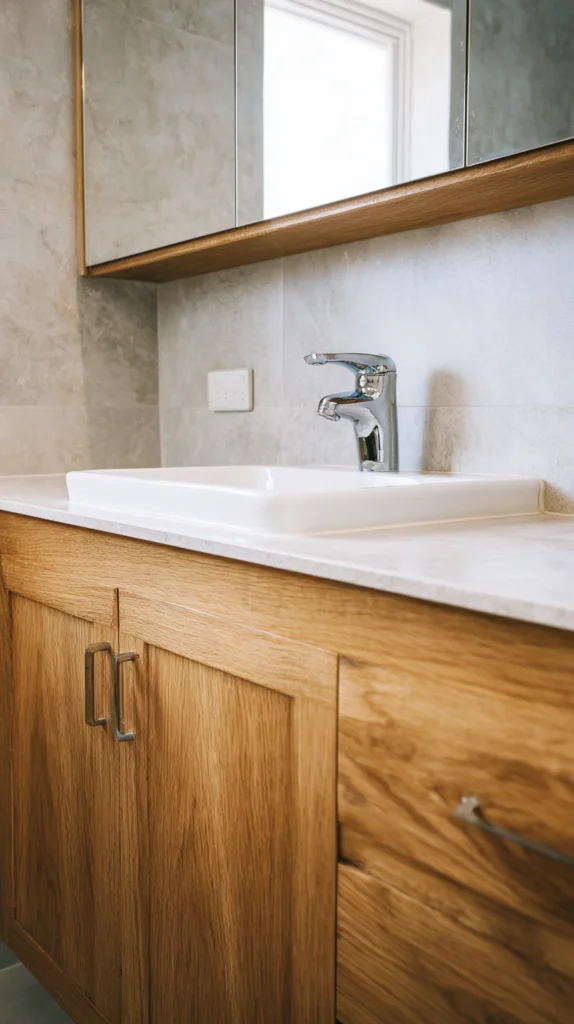
Budget: $400 – $2,500
A vanity unit in natural timber — solid oak, walnut, reclaimed pine, or any wood that shows its grain and its warmth honestly — is the modern farmhouse bathroom’s most important furniture decision. The timber vanity brings the warmth and the material honesty of the farmhouse interior into the bathroom at the largest available scale of furniture, and it prevents the bathroom from reading as a purely functional space by introducing the material vocabulary of a living room.
A solid oak floating vanity unit costs $400–$1,200. A reclaimed timber vanity in a bespoke configuration runs $600–$2,500. A DIY version built from reclaimed timber around a standard basin costs $100–$400 in materials. Seal all surfaces thoroughly before installation with a penetrating water-resistant finish — oil, hard-wax oil, or a specialist bathroom timber sealer — applied to every face including the interior of the cabinet and the underside of the top surface.
Style tip: Keep the timber vanity in its natural, unsealed-looking finish rather than applying a high-gloss lacquer. A lacquered timber vanity reads as timber-coloured furniture; a naturally finished one reads as wood. The matte or satin finish that allows the grain to remain the dominant quality of the surface is the specification that makes the timber vanity read as a farmhouse material choice.
4. The Butler Sink Basin
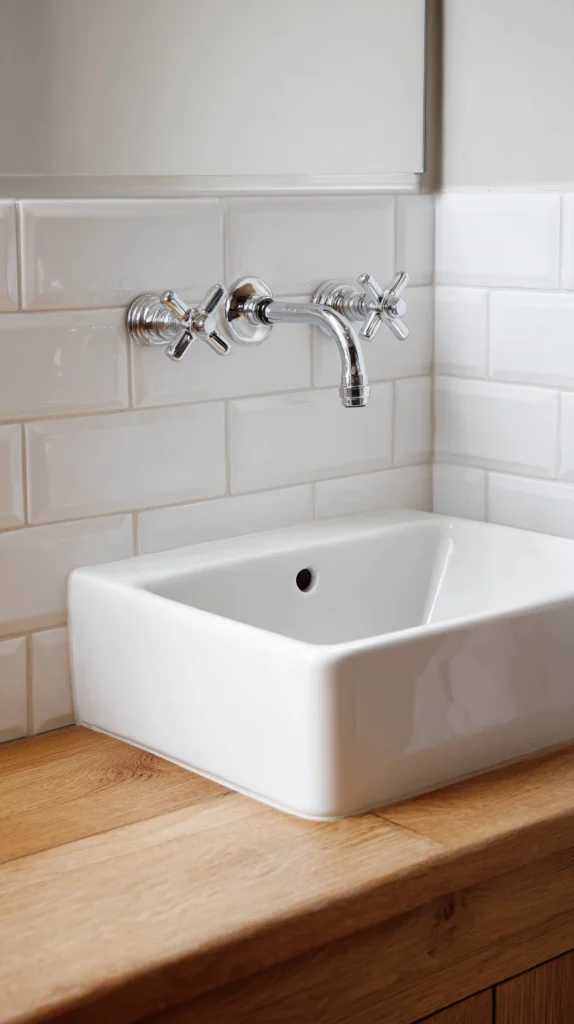
Budget: $150 – $600
A butler sink — the deep, single-basin, apron-front ceramic sink of the Victorian scullery, scaled for bathroom use as an undermount or a vessel basin — is the farmhouse bathroom’s most functional and most historically specific basin choice. The butler sink reads as a working object that was made for purpose rather than as a decorative basin designed to look interesting, and that quality of purposeful making is what distinguishes the farmhouse aesthetic from the merely decorative.
A ceramic butler-style basin in a standard bathroom size costs $150–$400. A full-size kitchen butler sink adapted for bathroom use runs $200–$600. Wall-mounted taps in a period style — cross-handle lever taps in chrome, nickel, or brass — cost $80–$250. The butler sink requires a vanity unit with an apron-front clearance — the front of the vanity must accommodate the exposed front panel of the sink — so the vanity unit must be specified in relation to the sink dimensions before either is purchased.
Style tip: Pair the butler sink with a wooden draining board surface on the adjacent vanity — a length of teak or oak cut and fitted beside the basin as if the bathroom were a scullery rather than a washroom. The wooden draining surface beside a ceramic butler sink is the material combination that most specifically communicates the farmhouse working interior in a contemporary bathroom context.
5. The Exposed Brick or Stone Wall
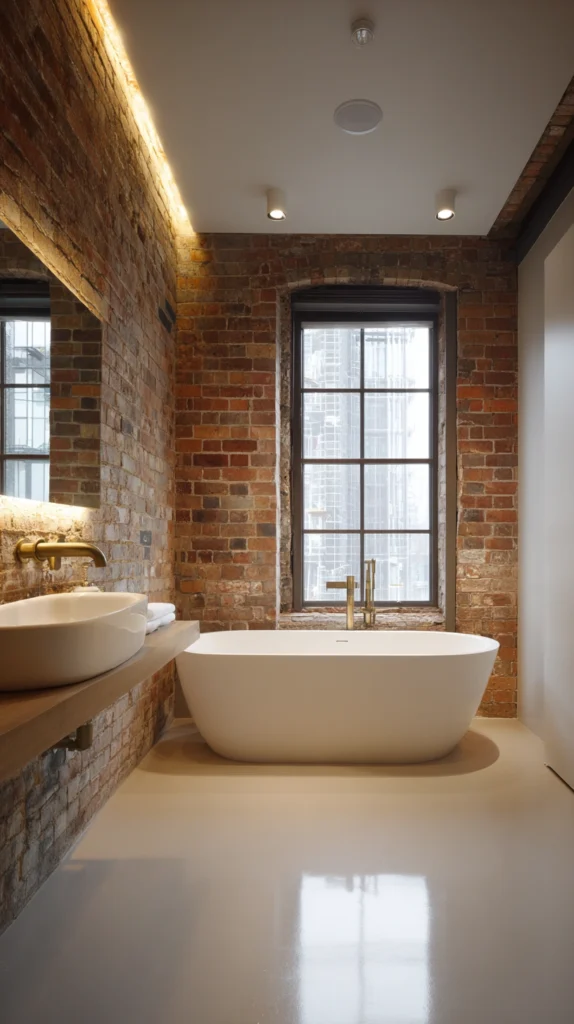
Budget: $100 – $600
A wall of exposed brick or natural stone — either original building fabric uncovered by removing plaster, or a brick-slip or stone-slip cladding applied to an existing wall — creates the most genuinely architectural of all the farmhouse bathroom elements. Exposed brick or stone communicates that the building has a history and a material fabric that the bathroom acknowledges rather than covers, and in a bathroom context the aged, textural quality of the masonry provides a warmth that no painted or tiled surface approaches.
Brick slips for cladding an existing wall cost $30–$80 per square metre. Natural stone slips run $40–$100 per square metre. A sealer rated for bathroom use costs $15–$30 per litre. Seal brick and stone in a bathroom thoroughly — unsealed masonry in a wet environment absorbs moisture, soap, and cosmetic products that stain permanently and promote mould growth in the porous surface within the first months of use.
Style tip: Use the exposed masonry on the wall that is least exposed to direct water spray — the wall opposite the shower or bath rather than the wall behind it. Masonry sealed for bathroom use handles ambient moisture effectively but direct water spray at high pressure eventually penetrates even the best sealant. The correct wall placement for exposed masonry is the dry side of the bathroom rather than the wet zone.
6. The Black Hardware and Fixtures
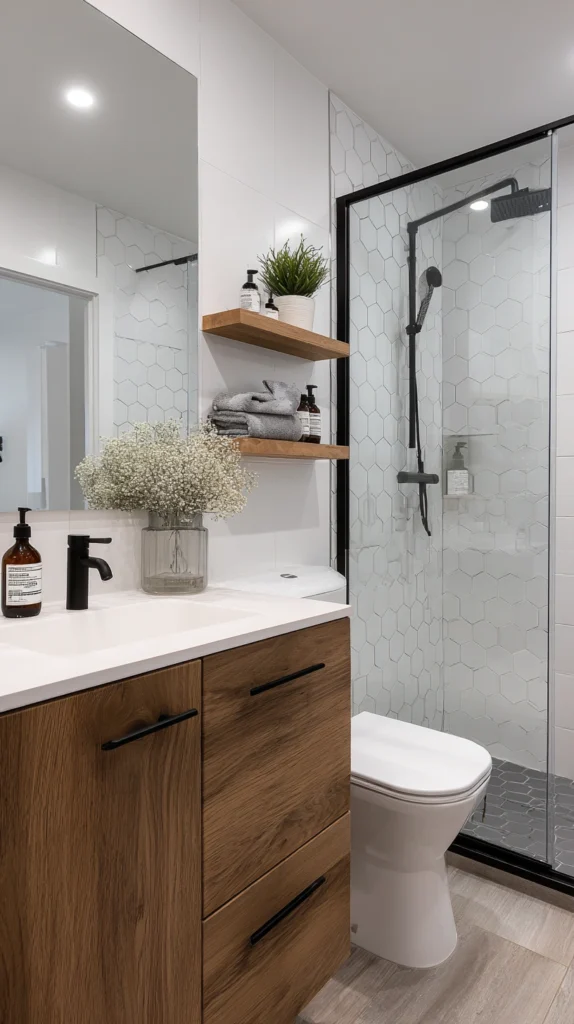
Budget: $100 – $500
Replacing all bathroom hardware — tap handles, shower fittings, towel rails, robe hooks, toilet roll holder — with matte black equivalents creates the modern element of the modern farmhouse aesthetic at the component scale. Matte black hardware reads as contemporary without being cold, and against white ceramic, warm timber, and natural stone it provides the graphic definition that chrome or brushed steel provides without the industrial quality that those metal finishes carry in a warm, natural-material bathroom.
A matte black basin mixer tap costs $80–$200. A black towel rail runs $40–$100. A black toilet roll holder costs $15–$40. A complete hardware replacement in matte black for a standard bathroom costs $200–$500. Replace all hardware simultaneously rather than gradually — a bathroom with some black fittings and some chrome fittings reads as incomplete conversion rather than as a considered material palette.
Style tip: Pair matte black hardware specifically with warm-toned natural materials — honey oak, warm white ceramic, warm stone — rather than with cool-toned ones. Matte black against cool grey stone or cool white tiles reads as contemporary industrial; the same matte black against warm timber and warm white reads as modern farmhouse. The warmth of the surrounding materials is what places the black hardware within the farmhouse rather than the industrial register.
7. The Subway Tile Bathroom
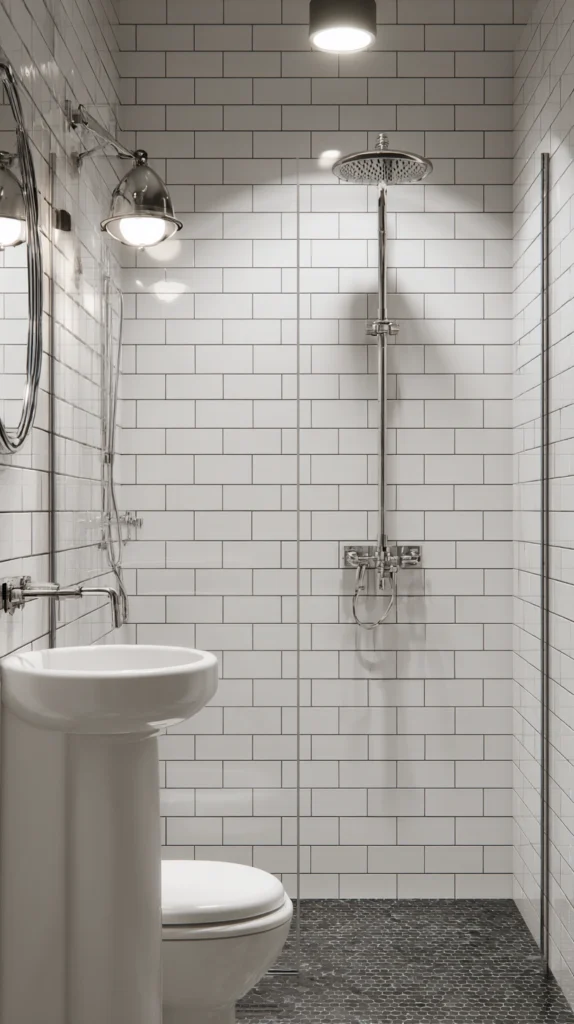
Budget: $100 – $500
Classic white subway tiles — the 7.5 by 15 centimetre rectangular format that has been used in functional tiling since the New York subway opened in 1904 — are the farmhouse bathroom’s most versatile and most historically grounded tile choice. Subway tiles read as clean, functional, and honest in a way that decorative or patterned tiles do not, and their long association with the functional spaces of the early twentieth century — kitchens, dairies, sculleries — makes them the most naturally farmhouse-appropriate of all tile formats.
White ceramic subway tiles cost $1–$3 each. A standard bathroom surround of 10 square metres requires approximately 900 tiles — $900–$2,700 in tile costs at the full range, or $150–$500 for a partial surround around the bath and basin only. Dark grout in charcoal, slate grey, or near-black gives the subway tile its modern edge — the combination of the classic white tile and the contemporary dark grout is the detail that places the subway tile in the modern farmhouse rather than the Victorian scullery.
Style tip: Lay the subway tiles in a brick-bond offset pattern — each row offset by half a tile length from the one above — rather than in a stacked grid. The brick bond is the standard farmhouse tile laying pattern and it gives the tiled surface a visual rhythm that the stacked grid lacks. The stacked grid is the contemporary option; the brick bond is the farmhouse one.
8. The Vintage Style Tap Collection
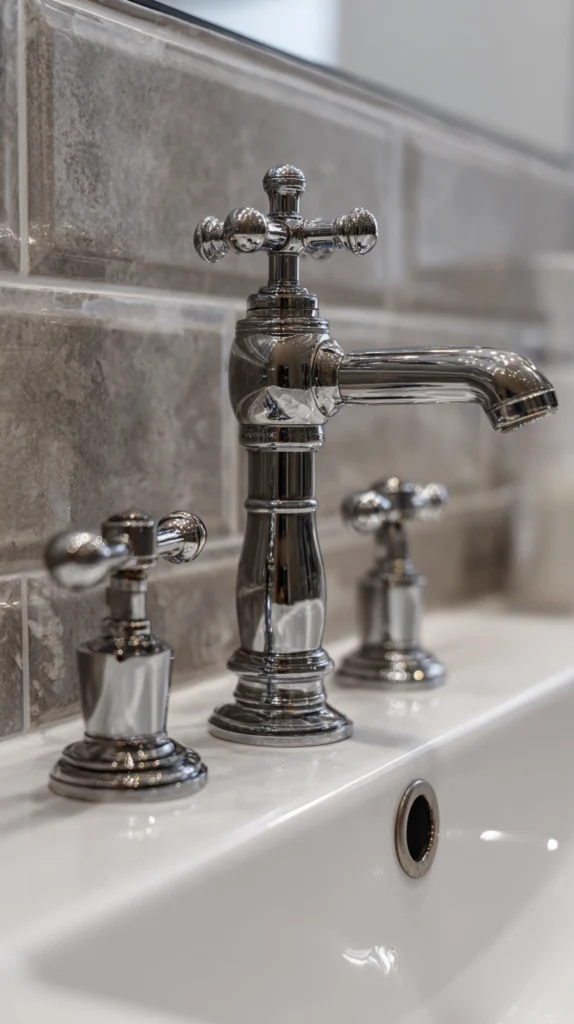
Budget: $150 – $800
Taps in a period-referencing style — cross-handle lever taps, pillar taps, quarter-turn ceramic disc taps in a traditional form — in a warm metal finish of aged brass, antique nickel, or brushed bronze give the modern farmhouse bathroom its most consistently present period reference. The tap is the object most handled in any bathroom and the one whose quality and character is most directly experienced by the person using it.
Cross-handle basin taps in aged brass cost $150–$400 for a pair. A period-style bath filler tap runs $200–$600. A vintage telephone handshower in a matching finish costs $80–$250. Specify quarter-turn ceramic disc valves inside the period-style bodies rather than the older-style washer valves — ceramic disc valves have the period appearance without the maintenance requirement of rubber washer replacement that genuine period taps demand.
Style tip: Choose a single metal finish for all taps and hardware in the modern farmhouse bathroom and use it consistently throughout. Aged brass taps beside chrome towel rails and brushed nickel drawer handles reads as three separately purchased metal choices; aged brass throughout reads as a considered material palette. The metal finish consistency is the specification decision that most distinguishes the designed bathroom from the assembled one.
9. The Reclaimed Timber Flooring
Budget: $400 – $2,000
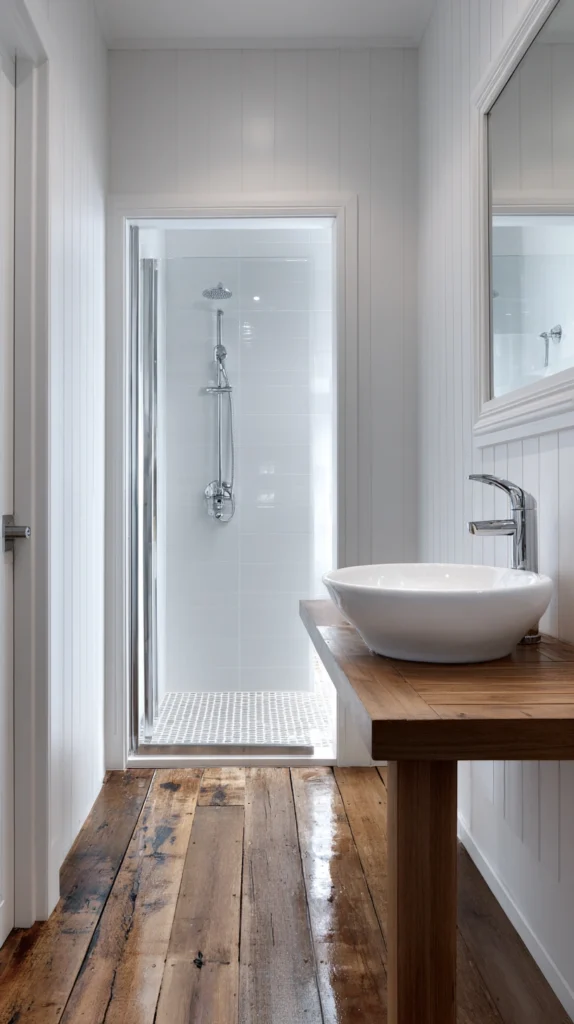
Reclaimed timber flooring in the bathroom — properly sealed and maintained, in a species suited to moisture exposure — creates the farmhouse bathroom’s most warm and most characterful floor surface. The grain, the age marks, the nail holes, and the accumulated character of reclaimed timber produce a floor that reads as genuinely lived-in from the first day of installation, and no amount of new timber distressing achieves the same quality of authentic age.
Reclaimed oak flooring in a standard plank width costs $30–$80 per square metre. An engineered reclaimed oak version — more dimensionally stable and more suitable for bathroom use — runs $40–$100 per square metre. Seal with a minimum of three coats of a hard-wax oil rated for bathroom use — the sealing schedule is the technical decision that determines whether the reclaimed timber floor lasts decades or begins to deteriorate within the first year.
Style tip: Choose plank widths that are wider than standard for the farmhouse bathroom floor — 150-millimetre boards minimum, 200-millimetre boards ideally. Wide planks show the grain and the character of the timber to better effect than narrow strips, which read as laminate flooring regardless of the quality of the timber. The board width is the specification that communicates the farmhouse floor rather than the general timber floor.
10. The Open Shelving Display
Budget: $60 – $300
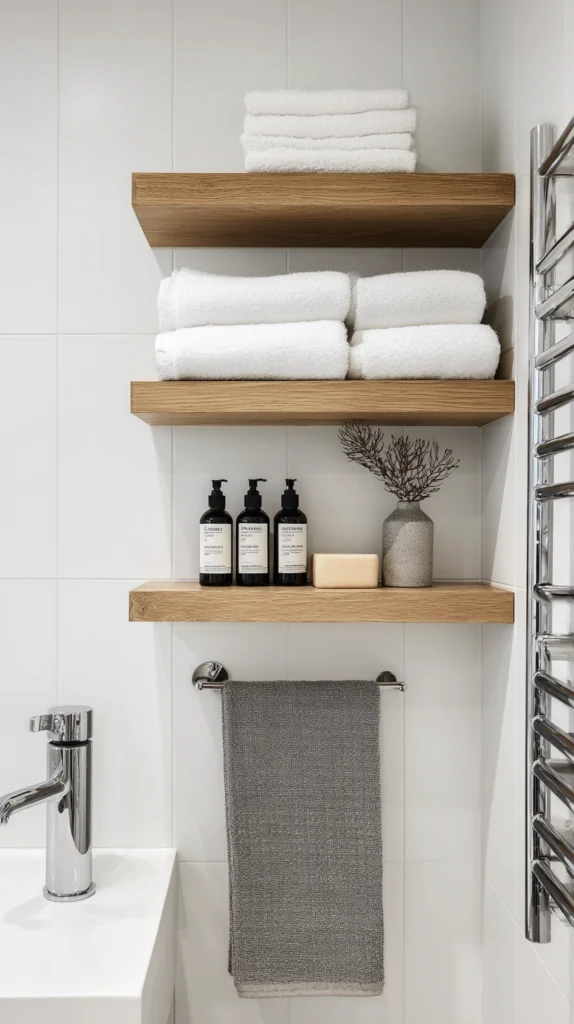
Open timber shelving — in reclaimed wood, raw oak, or a painted timber that relates to the vanity — displayed with an apothecary-style collection of glass jars, ceramic vessels, rolled white towels, and a small plant creates the farmhouse bathroom’s most characterful and most specifically domestic storage display. Open shelving communicates confidence — in the organisation of the bathroom, in the quality of the objects stored on it — and that confidence is part of the farmhouse aesthetic’s specific quality.
A pair of reclaimed timber shelves with raw steel brackets costs $60–$150. A set of matching apothecary jars for the display runs $15–$40. Rolled white towels on the shelf cost whatever the towels cost. A small plant — a trailing pothos, a small fern — costs $8–$20. Keep only beautiful or functionally honest objects on open shelving in the bathroom — the display should contain things that earn their visibility, not things that have nowhere else to go.
Style tip: Style the open shelf with objects in groups of odd numbers — one tall jar, three medium jars, five rolled towels — rather than in symmetrical pairs. Odd-numbered groups read as gathered and placed; symmetrical pairs read as purchased as a set. The asymmetric, odd-numbered arrangement is the display approach that gives the farmhouse shelf its collected, personal quality.
11. The Clawfoot Shower and Bath Combination
Budget: $800 – $4,000
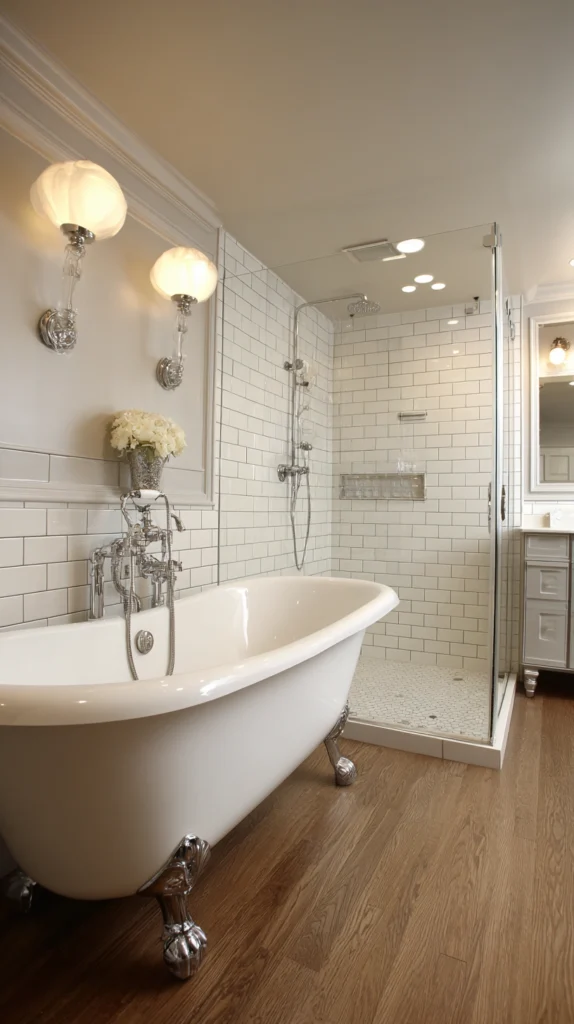
A bathroom that combines a clawfoot roll-top bath with a freestanding shower column — both in a period-inspired form, both in the same metal finish, both positioned as objects in the room rather than as fixtures built into it — creates the most complete and most specifically farmhouse bathroom configuration. The freestanding shower column beside the freestanding bath communicates the farmhouse bathroom as a room of independent objects rather than a room of built-in installations.
A freestanding shower column with a rainfall head and a handshower costs $400–$1,500. A matching clawfoot bath runs $800–$3,000. The shower tray beneath the freestanding column must be large enough to accommodate both the column base and the natural movement of showering — a minimum of 90 by 90 centimetres, ideally 100 by 100 centimetres, in a stone resin or ceramic format that suits the farmhouse floor.
Style tip: Position the freestanding shower column so the shower spray direction is away from the bath rather than toward it — a shower that wets the bath surround and the bath taps each time it is used creates a maintenance problem that the period aesthetic of the freestanding column does not compensate for. The practical positioning of the shower column is as important as its visual quality.
12. The Farmhouse Mirror
Budget: $40 – $300
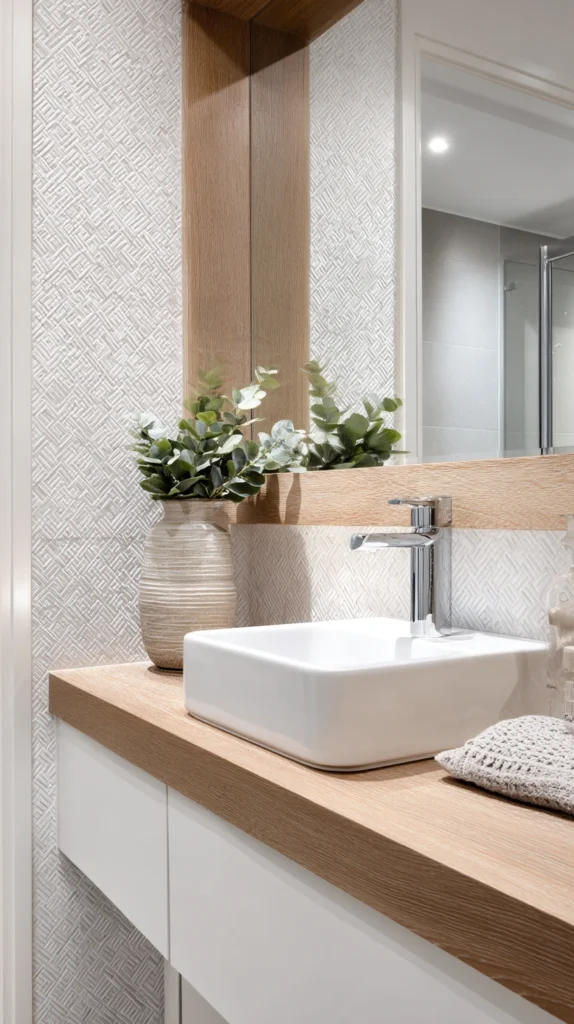
A mirror in a period-referencing frame — an aged timber frame, a wrought iron frame, a simple timber frame painted in the bathroom’s wall colour — above the vanity or the basin creates the finishing element of the modern farmhouse bathroom at the most visible and most consistently used bathroom surface. The mirror frame is the detail seen most closely and most regularly by the person using the bathroom, and its quality and character communicate more about the bathroom’s design intention than any element viewed from a distance.
An aged timber-framed mirror of 60 by 80 centimetres costs $40–$120. A custom-made mirror in a reclaimed frame runs $80–$250. A wrought iron-framed mirror costs $60–$200. Choose a mirror frame that is slightly wider than the vanity below it — a mirror that is wider than the furniture it sits above gives the vanity visual support; one that is narrower than the vanity reads as a small mirror placed above furniture rather than as a designed arrangement of furniture and mirror as a unified element.
Style tip: Hang the farmhouse mirror lower than standard hanging height — with the bottom of the mirror at approximately 100 centimetres from the floor rather than the standard 120 centimetres. The lower position suits the vanity height of a farmhouse bathroom, places the reflection at the correct height for the person standing at the basin, and gives the wall arrangement the grounded, furniture-like quality that a mirror hung too high always lacks.
13. The Barn Door Bathroom Door
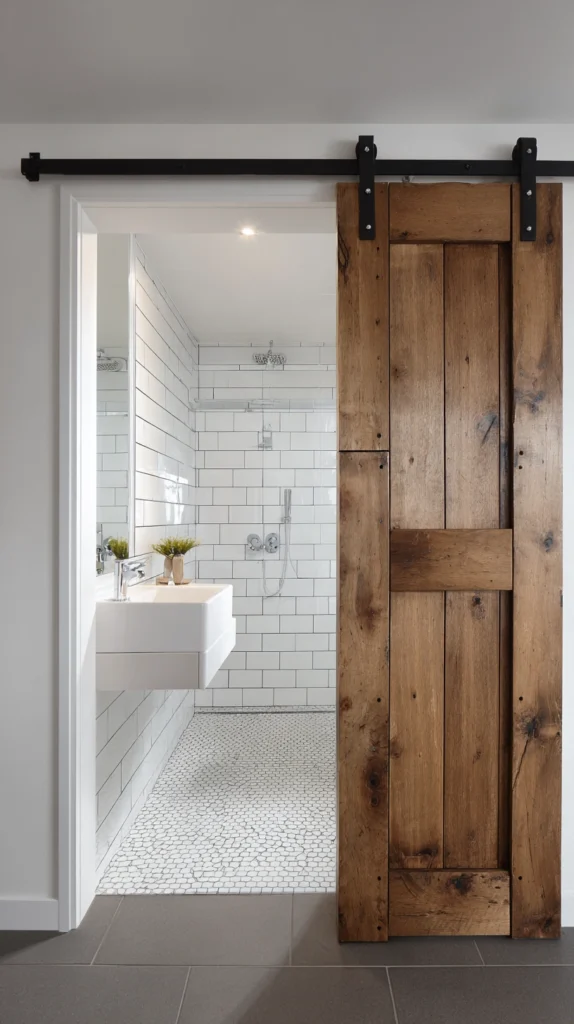
Budget: $150 – $600
A sliding barn door — a solid timber door on an exposed rail-and-wheel system that slides parallel to the bathroom wall rather than swinging on hinges — is the farmhouse bathroom’s most dramatically functional and most specifically agricultural reference. The barn door communicates the farmhouse aesthetic through the hardware as much as through the door itself — the exposed black iron track, the steel wheels, the raw simplicity of a door that moves by sliding rather than swinging.
A solid timber barn door in a standard 760 by 1980 millimetre size costs $100–$300. A barn door hardware kit with track, rollers, and fixings runs $60–$200. A pre-made barn door with hardware kit costs $200–$500. The barn door requires wall space of at least the door width beside the door opening — a barn door fitted where there is insufficient wall space to fully open the door is a barn door that creates a permanent partial obstruction.
Style tip: Finish the barn door in a way that relates to the bathroom’s dominant material rather than as a standalone design decision. A barn door in the same timber species as the vanity reads as a material thread through the bathroom; one in an unrelated timber or a painted finish reads as a dramatic feature that was introduced without reference to the room around it. The barn door earns its presence as an architectural element when it belongs to the room’s material palette.
14. The Industrial Pipe Towel Rail
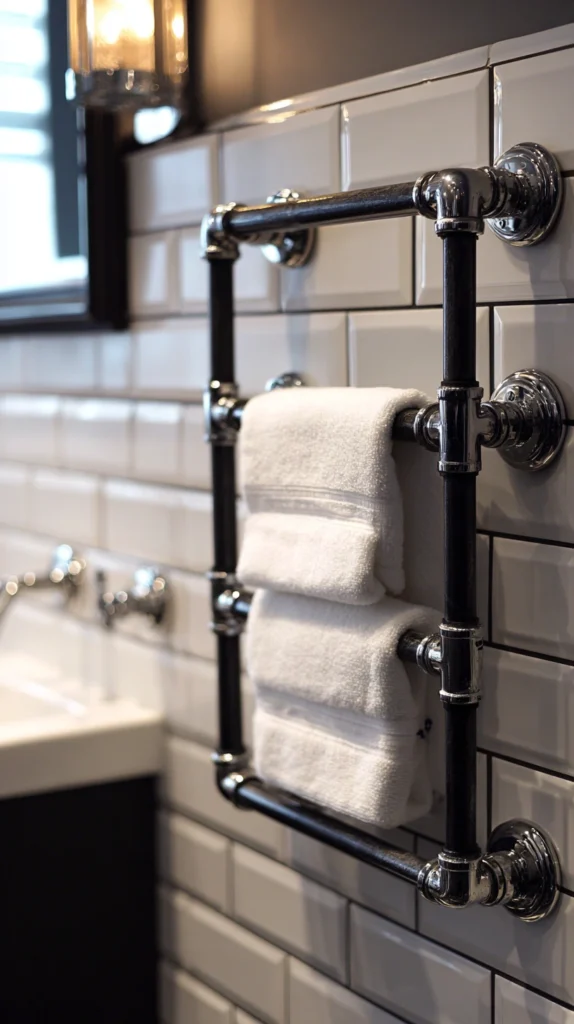
Budget: $40 – $200
A towel rail made from steel pipe — threaded pipe in a standard plumbing diameter, fitted with pipe fittings at the ends and fixed to the wall with pipe flanges — creates the most specifically industrial-farmhouse of all the bathroom hardware elements. The pipe towel rail reads as made from working materials that were repurposed for domestic use, which is exactly the ethos of the farmhouse aesthetic — functional objects adapted for comfort and beauty.
Steel pipe in a standard 22-millimetre diameter costs $3–$6 per linear metre. Pipe fittings and flanges run $5–$15 each. A complete DIY pipe towel rail of 1 metre in length costs $30–$80 in materials. Finish the pipe in a black pipe paint, a raw steel wax, or leave in a natural rusted patina sealed with a clear lacquer — all three finishes suit the farmhouse bathroom and all three communicate the industrial-farmhouse material honesty that the design is reaching for.
Style tip: Mount the pipe towel rail at a height that suits the towels being hung rather than at a standard fitting height. A towel that touches the floor when hung is a towel that becomes damp and unhygienic at its lower end; one hung at the correct height dries freely and remains clean. Measure the longest bath towel in the household and mount the lower rail at a height that allows the towel to hang clear of the floor by at least 15 centimetres.
15. The Wainscoting and Painted Upper Wall
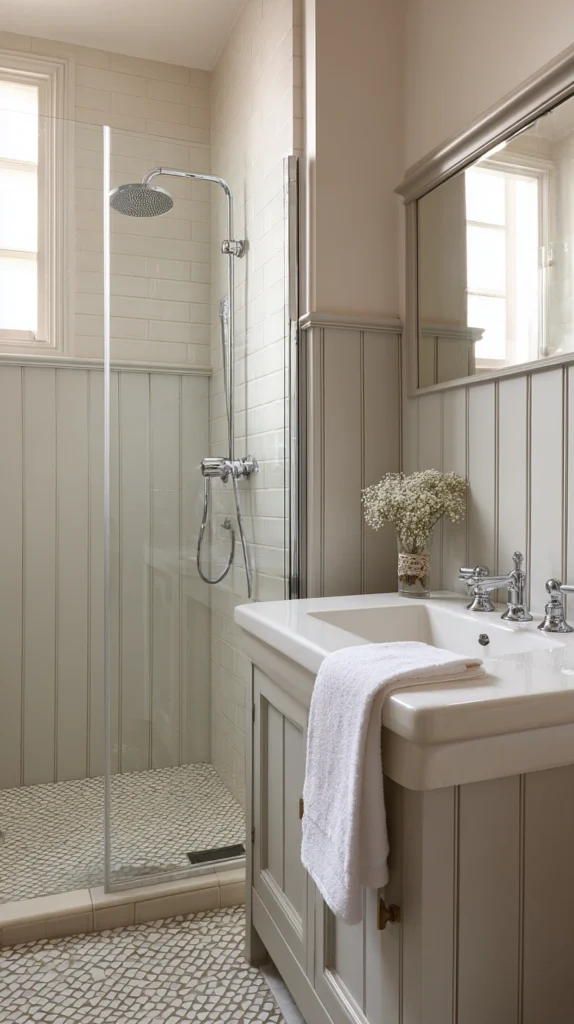
Budget: $150 – $600
Wainscoting — tongue-and-groove timber panels or beaded board panelling installed to chair-rail height, approximately 90–120 centimetres from the floor — with painted plaster above creates the wall treatment that most completely reproduces the functional interior of a genuine farmhouse bathroom. The wainscoting is the wall’s damp-resistant lower layer; the painted plaster above it is the upper layer; and the paint colour chosen for the upper section is the decision that most determines the atmosphere of the whole room.
Moisture-resistant MDF tongue-and-groove panelling costs $20–$40 per sheet. A standard bathroom wall panelled to chair-rail height requires two to three sheets per wall. A chair rail in a complementary timber or MDF profile costs $5–$15 per linear metre. Paint the upper wall in a colour drawn from the farmhouse palette — a warm sage, a dusty blue, a soft terracotta, a warm grey — rather than leaving it in standard white. The colour above the wainscoting is the room’s primary atmospheric contribution and it should be chosen with the same seriousness as the tile or the vanity.
Style tip: Paint the wainscoting in a slightly deeper tone of the same colour as the upper wall rather than in a contrasting colour. A bathroom where the wainscoting and the upper wall are in the same colour family — one slightly deeper, one slightly lighter — reads as a considered tonal composition; one where the two surfaces are in contrasting colours reads as a design feature that divides the wall rather than unifying it. The tonal graduation from the deeper lower to the lighter upper is the wall treatment decision that gives the modern farmhouse bathroom its specific quality of warmth and depth.
The modern farmhouse bathroom earns its description not through the accumulation of rustic accessories but through the quality of its material decisions — the warmth of the timber, the honesty of the ceramic, the period reference of the hardware, the restrained palette that allows each material to be seen clearly. It is a bathroom that was designed rather than decorated, and the difference between the two is the difference between a room that improves with use and age and one that begins to look tired within the first season.
Choose the elements that suit the specific bathroom — the light it receives, the scale it provides, the materials already present in the house — and apply them with the quality of finish that natural materials require. A farmhouse bathroom that was built to last, and maintained as a room that was built to last, is the farmhouse bathroom at its best — honest, warm, and genuinely beautiful in the way that things made well and maintained carefully always are.