13 Fall Guest Bathroom Refresh Ideas
13 Fall Guest Bathroom Refresh Ideas
Most guest bathrooms get decorated once, when the house is first set up, and then left exactly as they were for years. A neutral shower curtain, whatever towels were on sale, a bar of soap that’s been sitting in the same dish since spring. It works fine when no one’s really looking closely.
Someone is always looking closely in a guest bathroom. It’s one of the only rooms in the house a visitor spends real, private, unhurried time in, alone, with nothing to do but notice the details. A guest bathroom that hasn’t been touched in years reads as exactly that, while a few smart, low-effort updates can make the same room feel like it was prepared specifically for whoever’s about to use it.

A guest bathroom refresh isn’t a full renovation, and it isn’t the same project as updating a primary bathroom used daily by the household. It’s a smaller, faster, more targeted set of changes, aimed specifically at the brief but close-up impression a guest actually forms during their visit. Done well, a weekend’s worth of small updates can make a guest bathroom feel genuinely considered, just in time for the season most likely to bring visitors through the door.
Here are 13 ideas for refreshing a guest bathroom for fall, without a single major renovation involved.
Why a Guest Bathroom Refresh Plays by Different Rules Than a Primary Bathroom Update
The rules are not the same for every bathroom in the house:
Primary Bathroom Advantages:
- Daily use justifies investing in long-term storage, organization, and durability
- The household knows the space intimately, so function can take priority over first impressions
- Updates get judged over months of regular use, not a single weekend visit
The primary bathroom comparison: function first, for the people who use it every day
Guest Bathroom Advantages and Realities:
- A guest experiences the room fresh, all at once, with no context for how it usually looks
- The room is used briefly and occasionally, which means small, high-impact touches matter more than deep functional storage
- A guest bathroom gets judged almost entirely on first impression, since there’s rarely a second visit close enough behind the first to notice gradual improvement
The key insight:
- A primary bathroom rewards investment in daily-use function
- A guest bathroom rewards investment in immediate impression and hospitality, since that’s the entire interaction most guests will have with the space
- These are different bathrooms to plan for, not the same room with a lower priority
The First Impression and Low-Maintenance Reality
The most important principle in a guest bathroom refresh:
The five-minute visit:
- Most guests spend only a few minutes at a time in this specific room, which means the details that register fastest matter more than anything requiring a longer look
- A fresh towel and a clean mirror communicate more in those few minutes than an elaborate styled vignette a guest might not even notice
- Know this — it governs which updates on this list matter most, and in what order
The “low-upkeep, high-polish” calculation:
- A guest bathroom isn’t cleaned and restocked as constantly as a primary bathroom, so updates need to hold their finished look without daily maintenance
- Choose materials and products that stay looking good with occasional rather than constant attention
- Anything requiring daily upkeep to look intentional is the wrong choice for a room only checked on before guests arrive
Most guest bathroom refreshes happen in a single weekend, not in phases:
- Unlike a primary bathroom project, a guest bathroom refresh is usually triggered by an upcoming visit, which means most of these ideas get tackled together rather than spread across months
- The fastest, cheapest swaps — towels, soap, a candle — typically happen first, since they require no tools or drying time
- The larger updates — paint, a mirror, a light fixture — get added when there’s a little more lead time before guests arrive
1. The Fresh Hand Towel Swap (The Fastest, Most Noticed Update on the List)
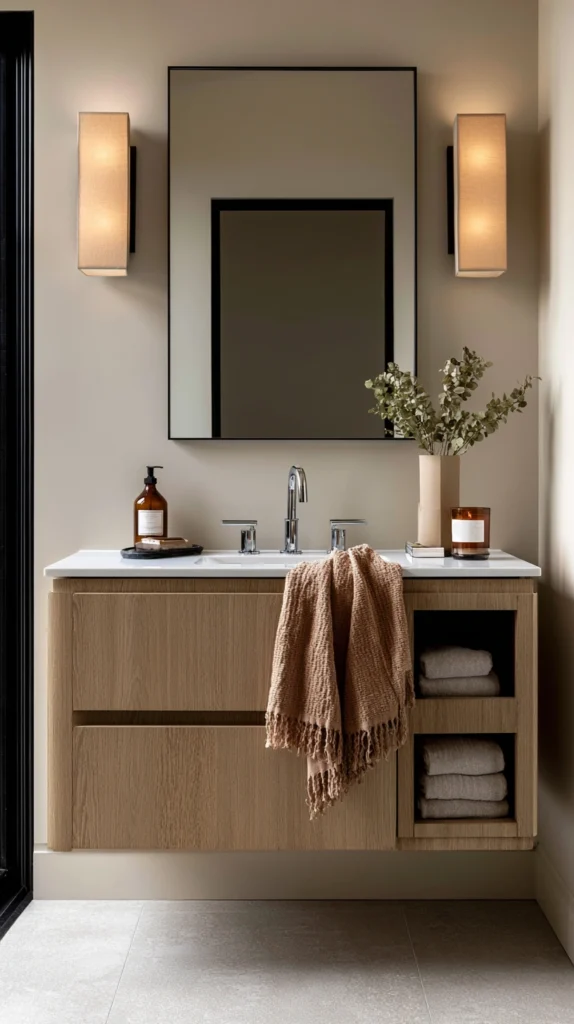
A full set of new, plush hand towels and a bath towel, replacing whatever’s currently hanging — the single change most likely to be noticed by a guest within the first minute of using the room.
Why towels matter more in a guest bathroom than almost anywhere else
- The direct-contact factor: unlike most decor, towels are touched immediately and directly by every guest who uses the room, making their condition and quality felt as much as seen
- The wear-and-tear reality most guest bathroom towels share: because this room is used infrequently, towels here often go years longer between replacements than the towels in a primary bathroom, accumulating a thinness or graying that’s easy to overlook until it’s pointed out by fresh ones beside it
- The hospitality signal a fresh towel sends: a plush, clearly new towel communicates that the room was prepared specifically for the guest’s visit, more directly than almost any other single object in the space
The options
- A matched set of hand towels and a bath towel, in a single solid color for a clean, hotel-like look
- A set in a deep fall tone — rust, olive, charcoal — coordinating with the season
- A textured waffle-weave towel, for a slightly more elevated material than a standard terry cloth
- A guest-specific towel set kept separate from the household’s everyday towels, reserved exclusively for this purpose so they always look fresh when needed
The practical execution
- Wash new towels before hanging them, both to remove manufacturing residue and to achieve their full, fluffy texture
- Fold or roll towels neatly on a bar or ring rather than draping them loosely, for a more finished, intentional presentation
- Keep a backup set in a nearby closet specifically for this bathroom, so towels can be swapped quickly before any visit without needing to do laundry first
Cost breakdown
- Hand towels, a set of 2: $20–40
- Bath towels, a set of 2: $30–60
- Total: $50–100
The fresh towel folded on the bar: the smallest change on this entire list, and the one most guests will actually touch within their first minute in the room.
2. The Accent Wall Paint Refresh (A Fast, Affordable Mood Change)
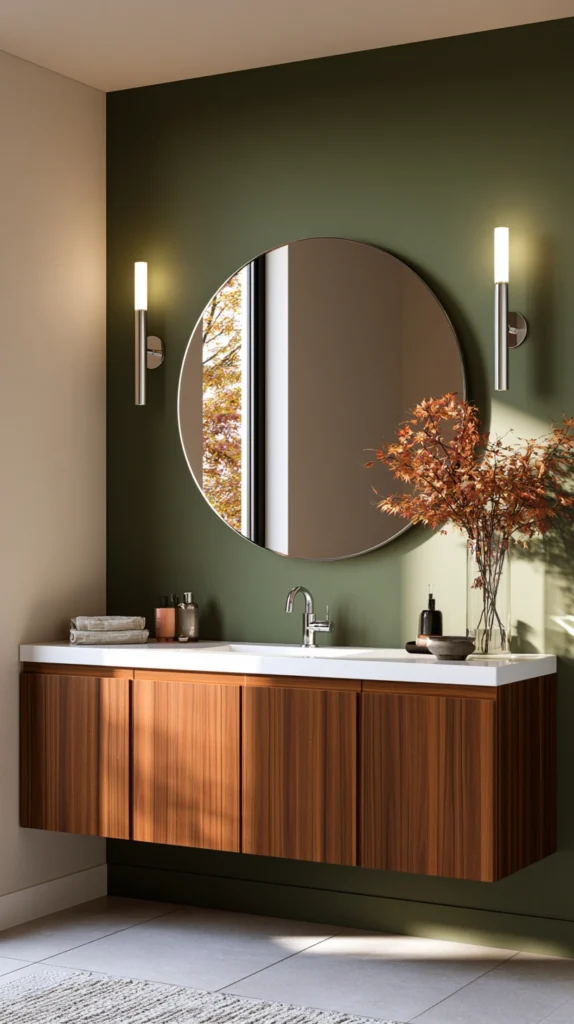
A single wall painted in a deeper, more current color, while the rest of the room stays neutral — the update that changes the room’s entire feel without the time or cost of painting every surface.
Why one wall can do the work of a full repaint
- The contained scope it offers relative to a full room repaint: a guest bathroom is almost always small, which means even a single accent wall represents a meaningful share of the room’s total visible surface
- The mood shift it delivers fastest: paint color does more to change a room’s overall atmosphere than almost any other single update, and a guest bathroom’s small size means the effect happens quickly with relatively little paint
- The lower commitment than a full color change: an accent wall lets a deeper, moodier color be tested in a smaller, less central room before committing to it more broadly elsewhere in the house
The options
- A deep, saturated color — forest green, navy, charcoal — on the wall behind the vanity or toilet
- A wallpaper accent, in place of paint, for pattern and texture rather than a solid color
- A two-tone wall, with a deeper color on the lower half and a lighter shade above
- A bold ceiling color, painting the “fifth wall” instead of a vertical one, for a different but equally fast update**
The practical execution
- Choose a satin or eggshell sheen for any painted bathroom wall, balancing humidity resistance with enough light reflection to keep a deeper color from feeling flat
- Tape and prep carefully around any fixtures or trim adjacent to the accent wall, since a small bathroom often has more edges and obstacles than a typical larger room
- Allow full cure time before reinstalling any hardware or decor removed during the painting process, since paint applied in a humid bathroom can take longer to fully cure than in a drier room
Cost breakdown
- Paint, one gallon: $35–65
- Painter’s tape and supplies: $10–20
- Total: $45–85
3. The Statement Mirror Swap (Replacing the Builder-Grade Original)
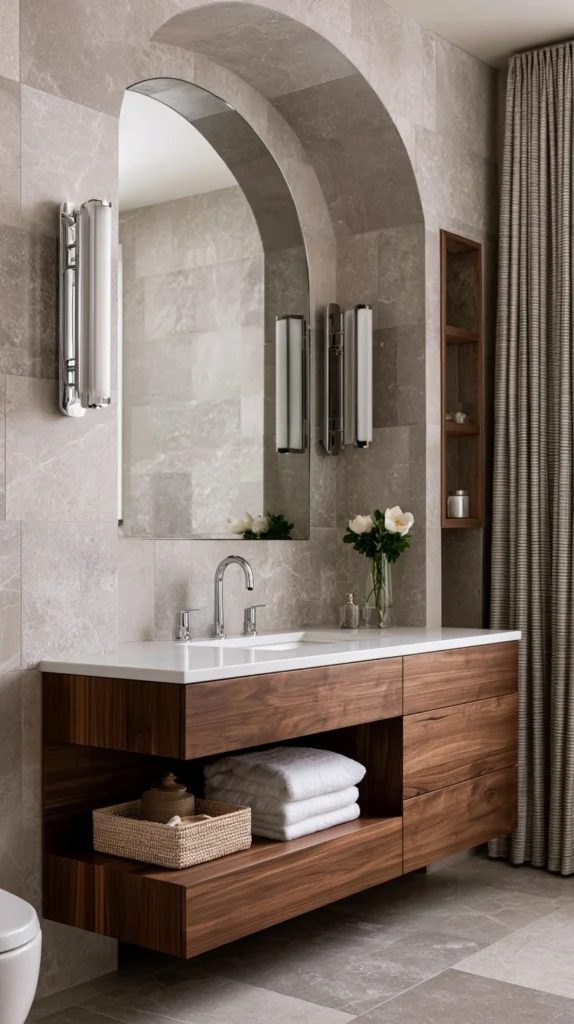
A new mirror, larger or more distinctive than the original flat rectangular mirror most guest bathrooms ship with — the upgrade that changes the room’s focal point more than almost any other single swap.
Why the mirror deserves specific attention in a guest bathroom
- The forced-attention factor shared with a foyer mirror: a guest standing at the sink has little choice but to look directly at the mirror, making it one of the most consistently noticed objects in the entire room
- The builder-grade default most guest bathrooms still have: many guest bathrooms retain the original flat, frameless mirror installed when the house was built, and swapping it is one of the more noticeable upgrades available without any plumbing or electrical work
- The light-bounce benefit in a typically small, sometimes windowless room: a larger or more reflective mirror can make a small guest bathroom feel less cramped, bouncing whatever light is available further into the room
The options
- A framed mirror, in wood, black metal, or brass, replacing a frameless builder original**
- A round or arched mirror, for a softer shape than the standard rectangle
- An oversized mirror, extending beyond the vanity’s width for more dramatic visual impact
- A vintage or vintage-style mirror, sourced secondhand for character a new mirror wouldn’t have
The practical execution
- Measure the existing mirror and the available wall space carefully before ordering a replacement, since guest bathrooms often have limited width to work with
- Choose a frame finish that coordinates with any other hardware updates planned for the room, tying the mirror into the rest of the refresh
- Confirm mounting hardware is rated for the new mirror’s actual weight, particularly for anything larger or framed in a heavier material than the original
Cost breakdown
- Budget framed mirror: $40–90
- Mid-range statement mirror: $100–250
- Total: $40–250
4. The New Shower Curtain and Liner (One of the Largest Fabric Surfaces in the Room)
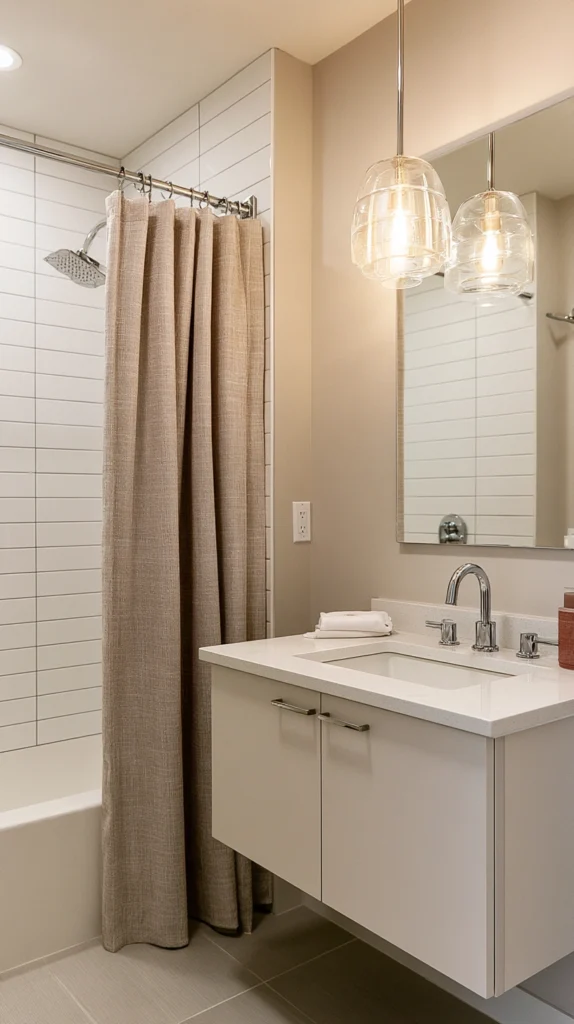
A fresh shower curtain paired with a new liner, replacing whatever’s currently hanging — the update that changes one of the largest visible surfaces in a typically small guest bathroom.
Why the shower curtain carries more visual weight than its cost suggests
- The largest-fabric-surface logic: in a small guest bathroom, a shower curtain often covers more visible square footage than any other single textile, making its pattern and color disproportionately influential on the room’s overall feel
- The mildew and wear reality most guest bathroom curtains share: because this room is used infrequently, a shower curtain liner here can develop mildew or staining over a long stretch without anyone noticing until a guest does
- The fast, tool-free installation: unlike paint or a mirror, swapping a shower curtain takes minutes and requires no special skills or drying time
The options
- A solid-color curtain, in a deep fall tone for a clean, coordinated look
- A patterned curtain, in a check, stripe, or subtle print
- A textured fabric curtain, like waffle weave or linen-look, for more visual interest than a flat solid
- A curtain and liner sold as a matched set, simplifying the coordination between the two layers**
The practical execution
- Replace the liner every time the decorative curtain is swapped, since liners show wear and mildew more visibly and more quickly than the outer curtain
- Choose a curtain length appropriate to the tub or shower’s actual height, since an ill-fitting curtain undercuts the polish a fresh one is meant to add
- Wash or wipe down the curtain rod itself while it’s accessible, since this is an easy detail to overlook during a routine cleaning
Cost breakdown
- Shower curtain: $20–45
- Liner: $8–18
- Total: $28–63
5. The Guest Amenity Tray (A Small Gesture That Reads as Genuine Hospitality)
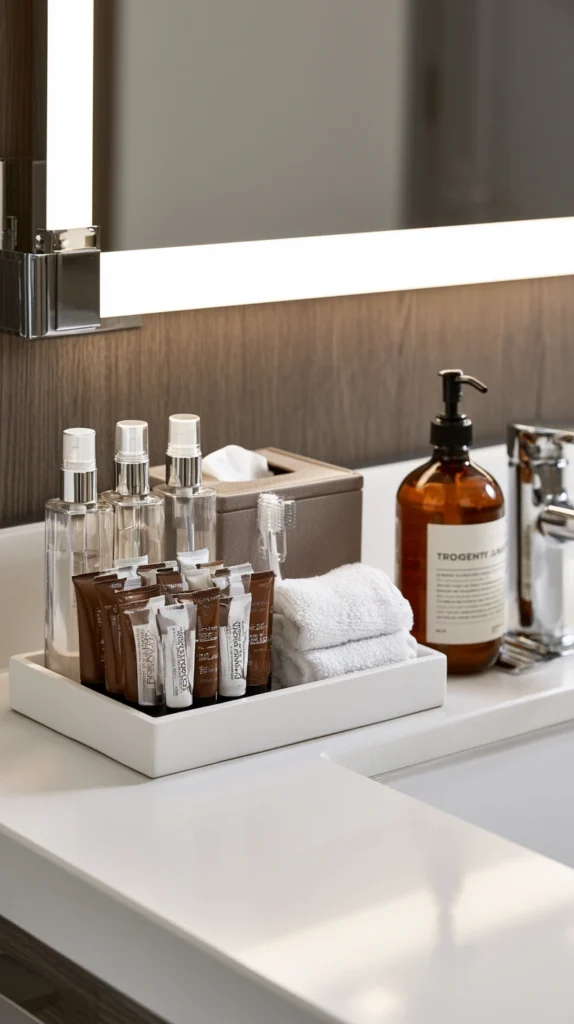
A small tray stocked with travel-size toiletries, a spare toothbrush, and a few other small essentials a guest might have forgotten to pack — the addition that signals real thoughtfulness more directly than almost anything else on this list.
Why a stocked tray matters more in this room than in any other
- The forgotten-item problem it solves directly: guests inevitably leave something behind, and a small tray of backups — a toothbrush, travel toothpaste, a razor — solves a real, common need rather than just adding decoration
- The hospitality signal it sends clearly: unlike most updates on this list, which improve the room’s appearance, this one demonstrates direct consideration for the guest’s actual experience during their stay
- The low cost relative to the impression it makes: a fully stocked amenity tray costs little but is the kind of detail guests specifically remember and mention afterward, more than almost any cosmetic update
The options
- A small tray with travel-size toiletries, shampoo, conditioner, body wash, and lotion
- A tray with a spare toothbrush, toothpaste, and dental floss, addressing the most commonly forgotten items
- A tray including a few feminine hygiene products, discreetly available without a guest needing to ask
- A tray with a small first-aid kit addition, bandages and pain relievers, for genuinely practical guest support
The practical execution
- Choose travel-size or sample products specifically, rather than full-size bottles that look out of place or oversized on a small tray
- Refresh and restock the tray after each guest’s visit, checking for anything used up or expired
- Position the tray somewhere visible but not obtrusive, such as the back corner of the vanity counter, so it’s easily found without dominating the room’s overall styling
Cost breakdown
- Travel-size toiletries, a starter set: $15–30
- Tray to hold them: $10–25
- Total: $25–55
6. The Vanity Light Fixture Update (Better Light for a Room That Gets Used Up Close)
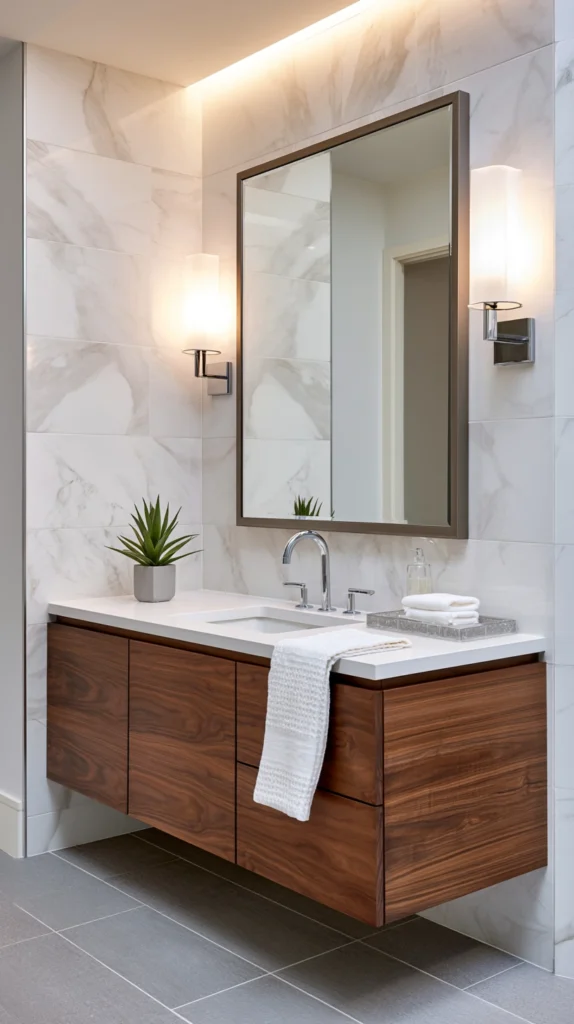
Replacing a dated or overly harsh vanity light fixture with a warmer, more current option — the upgrade that changes both the room’s look and the quality of light a guest actually sees themselves in.
Why the vanity light deserves more attention than it usually gets
- The up-close-use factor: a guest bathroom’s vanity light is used at close range, for grooming and getting ready, more than almost any other light source in the room, making its quality and warmth directly felt
- The dated fixture problem many guest bathrooms share: because this room is updated less frequently than a primary bathroom, the original builder-grade vanity light often lingers far longer than it would elsewhere in the house
- The flattering light value specifically relevant to a guest’s experience: a warm, well-diffused vanity light makes the act of using the mirror more pleasant, a small but real contributor to how comfortable a guest feels in the space
The options
- A horizontal bar-style fixture, with multiple bulbs for even, shadow-free light across the mirror
- A pair of wall sconces, flanking the mirror rather than mounted above it, for more flattering side light
- A single modern fixture, replacing a dated brass or builder-basic original
- A fixture with a built-in dimmer or warm-only bulb option, for softer evening light**
The practical execution
- Choose warm-toned bulbs (2700–3000K) for the most flattering, inviting light quality
- Confirm the new fixture’s mounting pattern matches the existing electrical box, or budget for an electrician if it doesn’t
- Position sconces, if chosen over a single overhead bar, at roughly eye level on either side of the mirror for the most even, shadow-reducing light
Cost breakdown
- Budget vanity light fixture: $40–90
- Mid-range fixture or sconce pair: $100–250
- Professional installation, if needed: $100–250
- Total: $40–500
7. The Scented Candle or Diffuser Layer (The Detail Noticed Before Anything Is Seen)
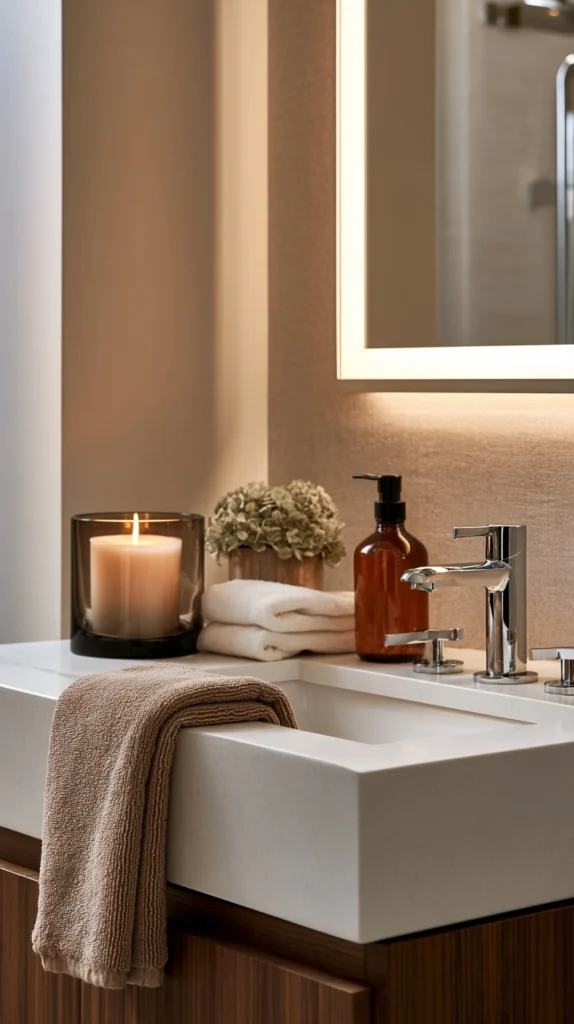
A candle or reed diffuser in a warm, fall-appropriate scent, placed on the vanity counter — the sensory layer that registers the moment a guest opens the door, before they’ve consciously looked at a single object in the room.
Why scent earns a dedicated place on a guest bathroom refresh list
- The first-sense-engaged advantage: smell registers faster than the eye can take in the room’s details, meaning this is often the very first impression a guest forms upon entering
- The function this room specifically benefits from: unlike most rooms on a typical decor list, a bathroom has an obvious practical reason to want a pleasant, consistent scent, beyond pure ambiance
- The low-maintenance reliability a diffuser offers in particular: a reed diffuser provides a consistent scent without requiring anyone to remember to light or blow out a candle, suited to a room that isn’t checked on daily
The options
- A reed diffuser, in a warm scent like cedar, amber, or spiced apple, for a flame-free, low-maintenance option
- A soy or beeswax candle, for a slightly stronger, more immediate scent when lit ahead of a guest’s arrival
- A simple bowl of dried cinnamon sticks or cloves, the lowest-cost, no-flame option
- An automatic scent diffuser, releasing a measured amount on a timer, for the most hands-off option available
The practical execution
- Choose a single, moderate scent rather than something overpowering, since a small enclosed bathroom intensifies fragrance more than a larger room would
- Position away from direct water splash, particularly important for a reed diffuser, which can be disrupted by humidity over time
- Replace or refresh before each guest’s stay, since a diffuser’s scent strength fades gradually and a stale or empty vessel undercuts the intended effect
Cost breakdown
- Reed diffuser: $18–35
- Candle: $12–28
- Total: $12–35
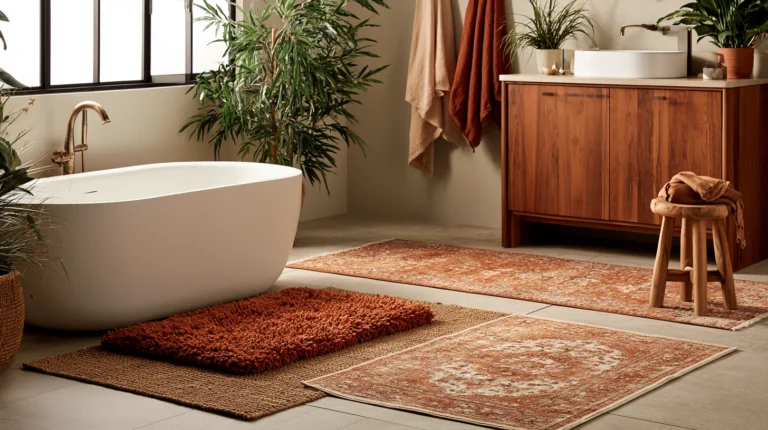
8. The Fresh Bath Mat (An Easy Swap for One of the Most-Used Textiles in the Room)
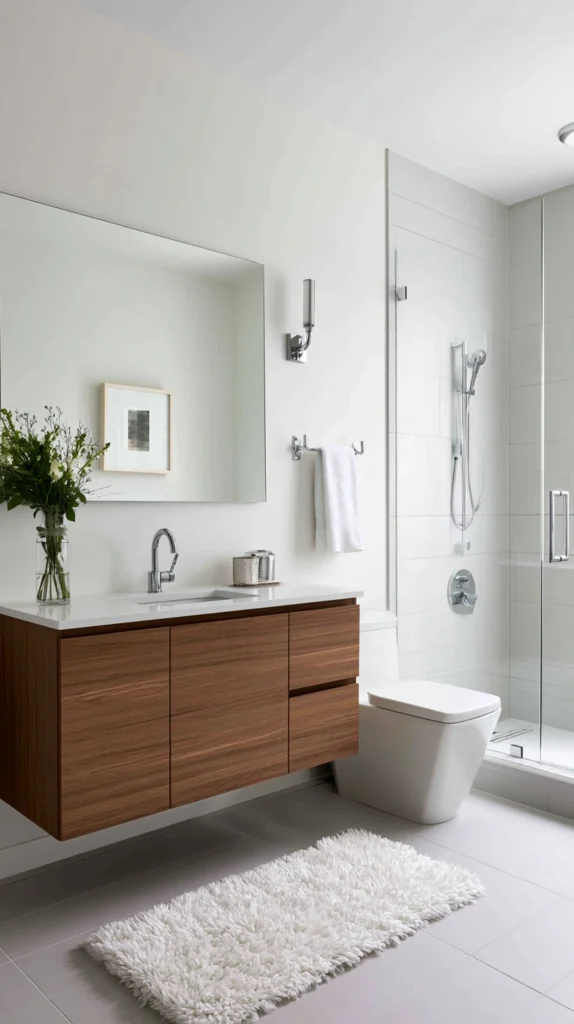
A new bath mat, replacing whatever’s currently on the floor — a small, fast update addressing one of the most frequently touched, and most frequently overlooked, textiles in a guest bathroom.
Why the bath mat deserves its own dedicated swap
- The barefoot-contact factor: like the hand towels, a bath mat is touched directly, in this case by bare feet, making its condition felt as immediately as it’s seen
- The wear-and-staining reality guest bathroom mats share: a mat in an infrequently used bathroom often goes years without replacement, developing a flatness or discoloration easy to miss until a fresh one is right beside it
- The fast, tool-free nature of the update: like the curtain swap, this requires no installation, drying time, or special skill, just unrolling a new mat in place of the old one
The options
- A plush cotton bath mat, in a solid color matching the towel set from Idea #1
- A washable, low-pile mat, for easier maintenance between infrequent uses
- A jute-look or natural-fiber mat, for more texture than a standard cotton option
- A mat sized generously to the room’s actual floor space, rather than whatever happened to be on hand originally**
The practical execution
- Choose a machine-washable mat specifically, given how infrequently a guest bathroom mat tends to actually get cleaned between visits
- Size to the available floor space in front of the tub or shower, rather than defaulting to a single standard size that might be too small or too large for the room
- Use a non-slip backing, particularly important for safety given how a guest unfamiliar with the room’s layout might move around it
Cost breakdown
- Bath mat: $20–40
- Total: $20–40
9. The Decluttered Counter Vignette (Editing Down to What Actually Belongs)
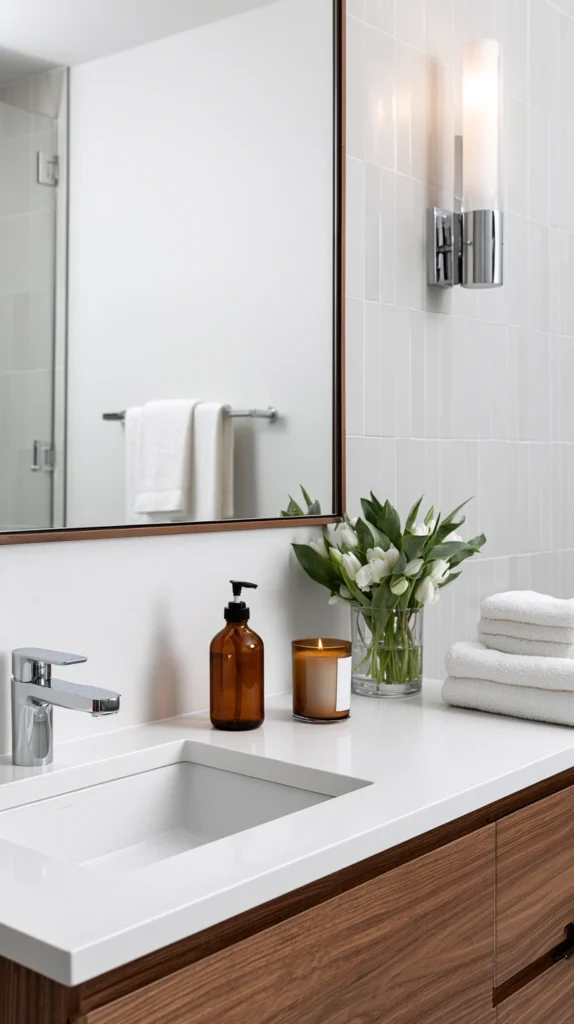
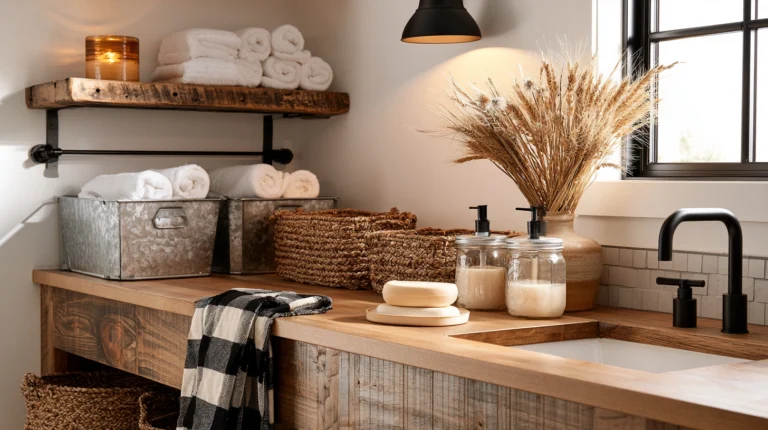
Removing everyday clutter from the vanity counter and replacing it with a small, intentional grouping — a soap dispenser, a candle, a stack of folded hand towels — the update that costs nothing but a half hour of editing.
Why decluttering does more work than it initially seems to
- The accumulation problem most guest bathrooms develop over time: because this room isn’t used or tidied daily, items tend to accumulate on the counter — old products, stray cosmetics, miscellaneous bottles — without anyone consciously deciding to put them there
- The visual-clarity benefit of a smaller, edited grouping: a counter with three or four intentional objects reads as considered, where the same counter with a dozen miscellaneous items reads as cluttered regardless of how nice any individual piece is
- The zero-cost nature of the update: unlike nearly everything else on this list, this idea requires no purchase at all, just the time to sort and remove what doesn’t belong
The options
- A counter edited down to a soap dispenser, a small candle, and a folded hand towel, the simplest possible vignette
- A tray-based grouping, corralling the few remaining items onto a single surface, echoing the same tray principle used in kitchen and entryway styling
- A counter with the amenity tray from Idea #5 as its sole additional object, combining function and minimal styling in one
- A counter left almost entirely bare, save for a single statement object, for the most minimal version of this idea**
The practical execution
- Remove everything from the counter first, then add back only what genuinely belongs in a guest-facing display, storing the rest in a cabinet or drawer
- Group remaining items by height and shape for visual variety, the same composition principle used throughout kitchen and entry vignettes
- Do a quick edit before every guest’s visit rather than treating this as a one-time fix, since clutter tends to creep back in over time even in an infrequently used room
Cost breakdown
- No new purchases required: $0
- Total: $0
10. The Small Plant or Greenery Touch (A Living Detail in an Otherwise Static Room)
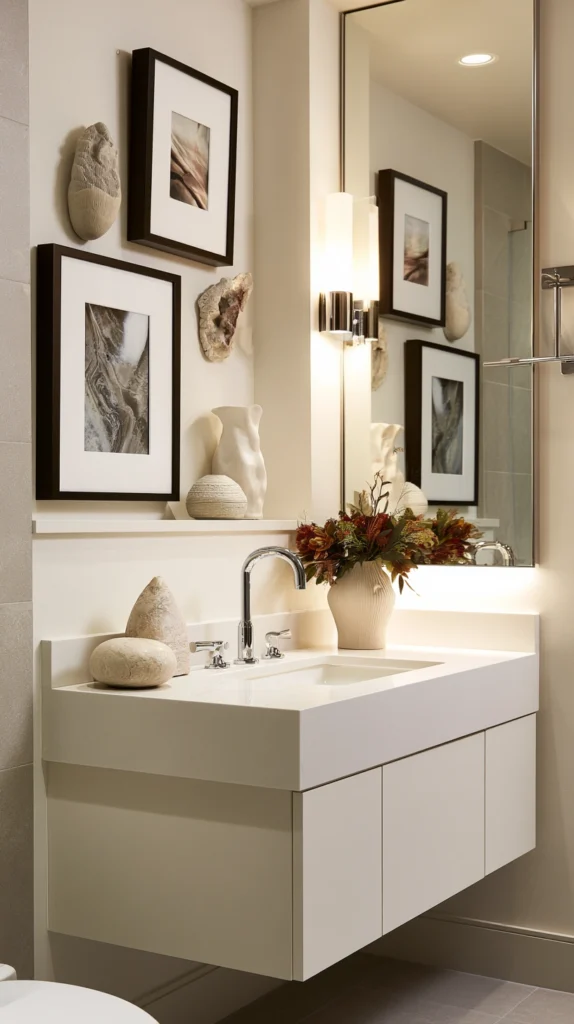
A single small plant, real or high-quality faux, placed on the counter or a shelf — the detail that introduces life and color into a room otherwise made up entirely of hard, static surfaces.
Why a plant matters in a room this size
- The living-object effect shared with other rooms’ greenery: a plant is one of the only elements in a guest bathroom that visibly changes, even subtly, adding a sense of a cared-for space rather than a purely staged one
- The low-light reality most guest bathrooms share: guest bathrooms are frequently windowless or have minimal natural light, which narrows the plant options without eliminating them entirely
- The color contribution it makes in a typically neutral room: a small plant introduces green, a color otherwise often missing from a guest bathroom’s palette of white fixtures, neutral towels, and tile
The options
- A small snake plant or ZZ plant, both genuinely tolerant of low light and infrequent care
- A faux eucalyptus or olive branch arrangement, for a room too dark to support anything living
- A small air plant, requiring no soil and minimal water, suited to a counter or open shelf
- A single stem in a small bud vase, the lowest-commitment version of this idea, easily refreshed**
The practical execution
- Choose a genuinely low-light-tolerant variety if going with a real plant, rather than something that will visibly decline within weeks in a typical guest bathroom’s lighting
- Water on a fixed schedule rather than relying on memory, since this room doesn’t get checked on as often as a primary bathroom
- Wipe down faux greenery periodically, since dust accumulates on artificial plants without anyone touching or watering them to dislodge it the way a real plant’s handling would
Cost breakdown
- Small real plant: $10–25
- Faux greenery arrangement: $15–35
- Total: $10–35
11. The Artwork or Print Swap (Personality on the Room’s Smallest Wall)
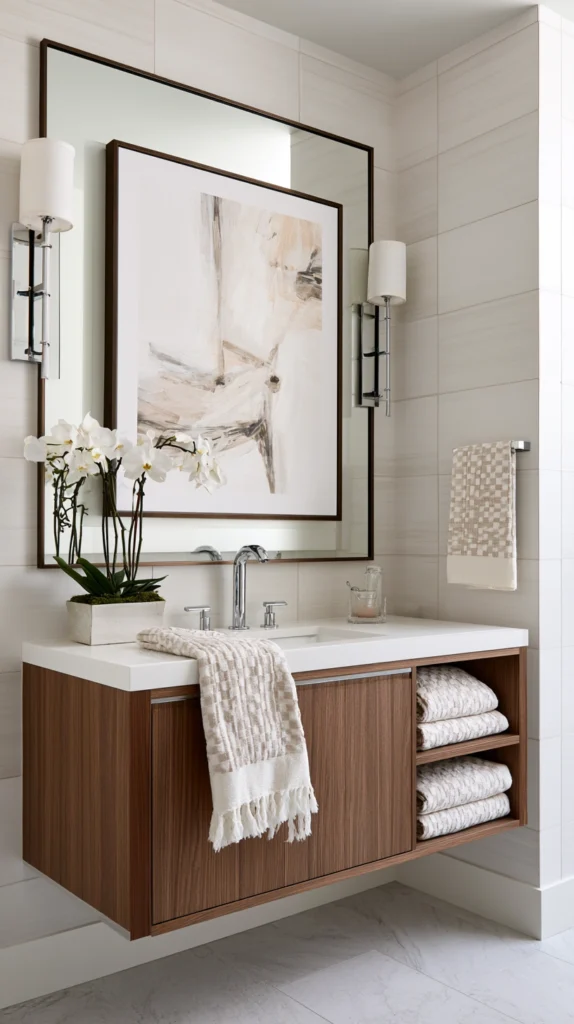
A new piece of art or a simple framed print, replacing whatever’s currently hanging or filling an empty wall for the first time — the update that gives the room a clear point of view beyond its fixtures and textiles.
Why art matters even in the smallest room in the house
- The personal-touch value it adds: in a room otherwise defined by function — a toilet, a sink, a shower — a piece of art is one of the few places a household’s actual taste and personality gets expressed
- The often-empty-wall reality many guest bathrooms share: because this room gets decorated last and least, it’s common for at least one wall to remain entirely bare long after the rest of the house has been art
- The low cost relative to the impact: a single well-chosen print, simply framed, can transform the room’s overall feel without any of the cost or complexity of a fixture or paint update
The options
- A simple botanical or nature print, fitting comfortably into nearly any bathroom’s overall style
- A small gallery cluster, mixing two or three smaller pieces rather than one larger one
- A piece of original or local art, for more character than a mass-produced print
- A framed quote or simple graphic print, for a touch of light personality or humor**
The practical execution
- Choose a humidity-tolerant frame and glass, since standard wood or paper-based frames can warp or buckle over time in a consistently humid room
- Hang at eye level relative to the room’s main standing or seated vantage point, rather than too high simply because there’s available wall space above
- Keep art away from direct shower spray or splash zones near the sink, positioning it instead on a drier wall section
Cost breakdown
- Simple framed print: $20–50
- A small gallery cluster of 2–3 pieces: $50–120
- Total: $20–120
12. The Hardware and Fixture Refresh (Tying Every Other Update Together)
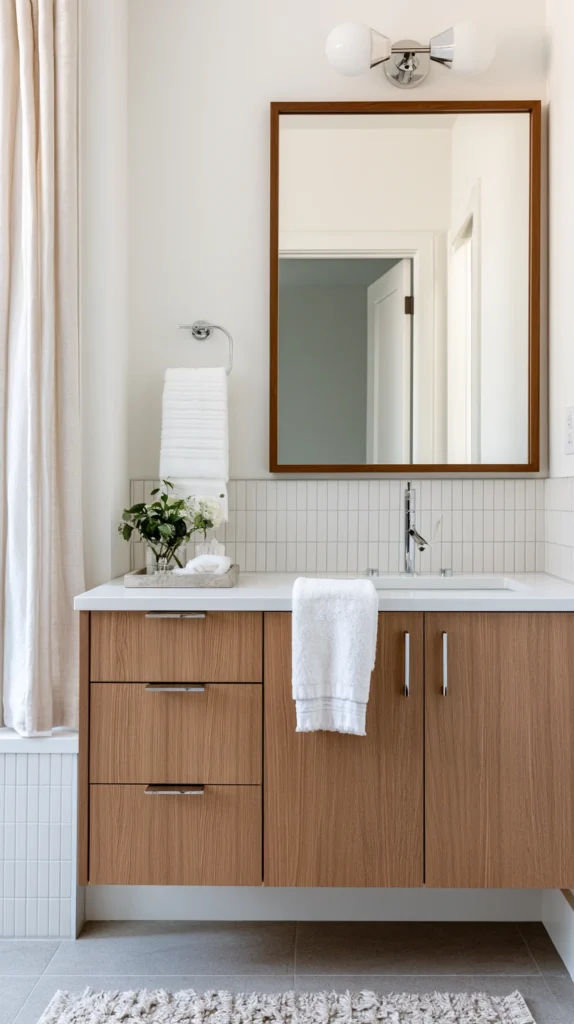
Replacing the towel bar, robe hooks, and faucet handles with a single consistent finish — the project that unifies every other update on this list into one cohesive, intentional-looking room.
Why hardware finish matters more than its individual size suggests
- The unifying function it serves across the whole room: hardware touches nearly every surface in the bathroom, and a single consistent finish does more to make the space feel deliberately put together than almost any individual decorative choice
- The dated-finish problem many guest bathrooms share: builder-grade or older hardware, in a finish that no longer matches current taste, is one of the most common reasons an otherwise clean guest bathroom still reads as tired
- The relatively contained cost for the visual return: swapping hardware costs far less than replacing fixtures entirely, while changing a comparable amount of what’s actually seen and touched
The options
- Matte black hardware, for a current, widely available finish across towel bars, hooks, and pulls
- Brushed nickel, for a slightly softer, equally versatile alternative
- Brass or warm gold, for a more traditional or elevated finish
- A mixed-metal approach, intentionally pairing two coordinating finishes rather than a single uniform one**
The practical execution
- Measure existing mounting hole spacing before ordering replacement hardware, since mismatched spacing means drilling new holes or patching old ones
- Choose a single consistent finish across every piece, rather than mixing several near-identical metals that read as mismatched rather than intentional
- Patch and touch up any old screw holes with spackle and matching paint if hole spacing changes during the swap
Cost breakdown
- Towel bar and ring set: $25–60
- Robe hooks, a pair: $15–30
- Faucet, if replacing: $50–150
- Total: $40–240, depending on how many fixtures are included
13. The Stocked, Styled Toilet Paper Display (A Small Detail That Avoids an Awkward Ask)
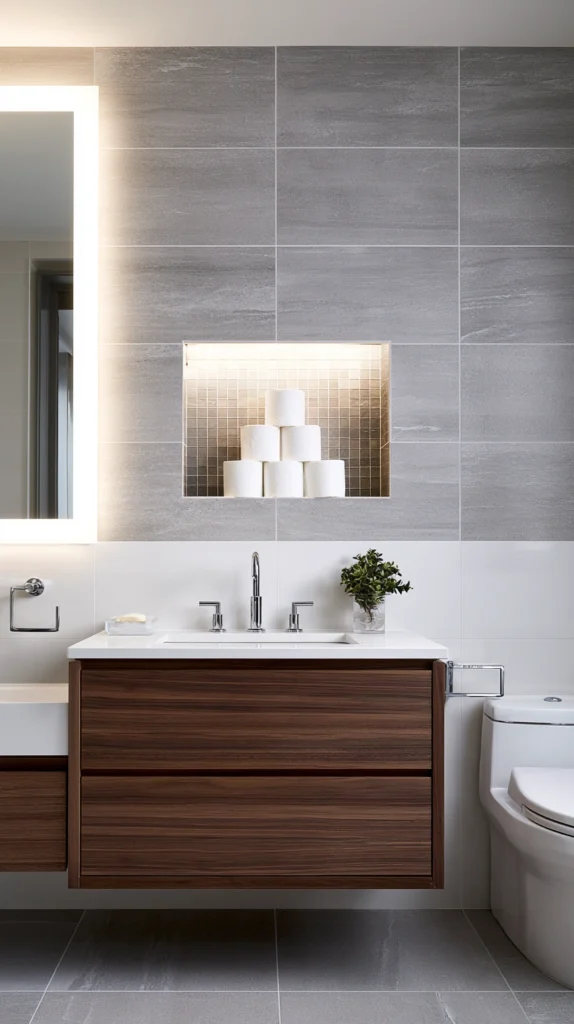
A visible, generously stocked supply of toilet paper, displayed in a basket or holder rather than hidden away or left as a single roll on the dispenser — the detail that prevents one of the most common and most awkward guest bathroom moments.
Why this small detail deserves its own dedicated attention
- The genuinely common problem it solves: running out of toilet paper mid-visit, with no idea where to find more, is one of the most universally awkward situations a guest can encounter, and a visible backup supply removes that risk entirely
- The hospitality signal it sends alongside the amenity tray from Idea #5: like the stocked toiletries, an obviously available extra supply demonstrates the room was genuinely prepared for guest use, not just decorated for appearance
- The styling opportunity it offers even for something this practical: a basket or holder displaying extra rolls can be chosen to match the room’s overall material palette, turning a purely functional necessity into a small, considered detail
The options
- A small basket or bin, holding 3–4 extra rolls visibly near the toilet
- A freestanding toilet paper holder with built-in storage, for a more furniture-like presentation
- A decorative canister or jar, for a single backup roll kept close at hand
- A wall-mounted shelf with a small stack, integrating the extra supply into the room’s existing storage**
The practical execution
- Remove rolls from their original plastic packaging before displaying them, for a cleaner, more intentional look
- Position within easy reach of the toilet, rather than across the room or in a cabinet a guest might not think to check
- Restock before every guest’s visit specifically, treating this as part of the same routine as refreshing the towels and amenity tray
Cost breakdown
- Small basket or bin: $10–20
- Decorative canister: $12–25
- Total: $10–25
The basket of extra toilet paper, visible without being asked for: the smallest, least glamorous idea on this entire list, and quite possibly the one a guest is most grateful for without ever mentioning it.
The Fall Guest Bathroom Refresh Roadmap
The work, sequenced:
Phase One (the fast, no-tool swaps):
- The fresh hand towel swap (#1)
- The new shower curtain and liner (#4)
- The fresh bath mat (#8)
- The decluttered counter vignette (#9)
Phase Two (the hospitality layer):
- The guest amenity tray (#5)
- The stocked, styled toilet paper display (#13)
- The scented candle or diffuser layer (#7)
Phase Three (the visual updates):
- The statement mirror swap (#3)
- The hardware and fixture refresh (#12)
- The artwork or print swap (#11)
- The small plant or greenery touch (#10)
Phase Four (the bigger projects, if time allows):
- The accent wall paint refresh (#2)
- The vanity light fixture update (#6)
Getting Started This Weekend
The immediate-impact refresh:
One afternoon, three changes:
- Swap in fresh hand towels and a new bath mat (Ideas #1 and #8)
- Declutter the counter down to a simple vignette (Idea #9)
- Add a stocked amenity tray and a candle (Ideas #5 and #7)
Total cost: $90–190. Time: about an hour. The room will read as genuinely prepared for guests by the time the work is done, without a single tool or drying time involved.
The structural investment (the next big project):
The statement mirror swap (Idea #3) is the single highest-impact visual update on this list relative to the effort involved. Once a builder-grade mirror is replaced, the room’s main focal point changes immediately, and every other update — the hardware, the art, the lighting — has a more elevated backdrop to coordinate against.
What a refreshed fall guest bathroom provides that a neglected one can’t:
The first impression that arrives before a word is spoken:
- Fresh towels and a new bath mat that read as prepared rather than overlooked
- A decluttered counter that feels intentional rather than accumulated
- A scent layer registering before a guest has consciously looked at a single object
The hospitality that solves real problems, not just appearances:
- An amenity tray covering whatever a guest forgot to pack
- A visible toilet paper supply avoiding an awkward mid-visit search
- A vanity light flattering enough to make getting ready genuinely pleasant
The polish that ties the smallest room in the house together:
- A statement mirror replacing a forgettable builder original
- Consistent hardware finishing every other update with a single cohesive look
- A small plant and a piece of art proving even a guest bathroom has a point of view
A guest bathroom doesn’t need a renovation to feel like it was actually thought about. It needs the same kind of attention given to any room a visitor spends real time in, just compressed into the handful of details a few minutes alone in that room will actually register. The towel folded fresh on the bar before a guest arrives is doing the exact same job a far more expensive update would do. The basket of extra toilet paper, quietly stocked and never mentioned, is often the detail that’s remembered longest.