Turn the Blank Wall Above Your TV Into the Room’s Best Feature: 15 Decor Ideas for a Stylish Look
Turn the Blank Wall Above Your TV Into the Room’s Best Feature: 15 Decor Ideas for a Stylish Look
The space above the television is one of the most consistently wasted surfaces in the home. It is large, it is visible from the primary seating position, and in most living rooms, it is occupied by nothing more than a blank stretch of painted wall.
The ideas below treat that space as the design opportunity it actually is — a surface that, when given genuine attention, can become the most visually interesting wall in the room rather than the most ignored one.

Each idea covers what you will need, what it will cost, and a practical tip to make it work in a real living room rather than a showroom display.
1. The Gallery Wall Above the TV
Budget: $40 – $300
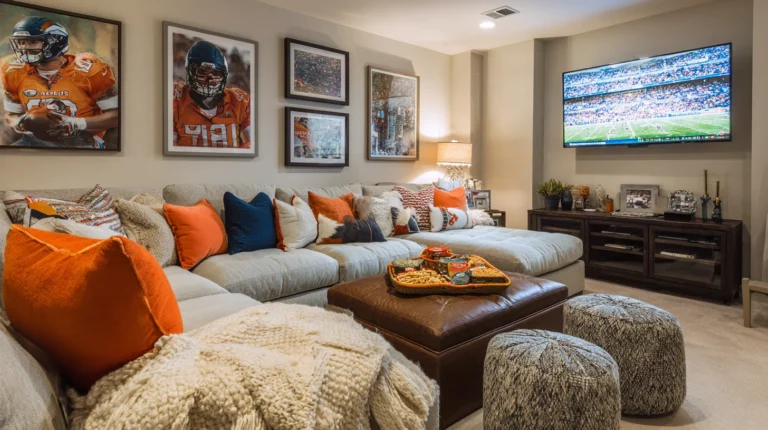
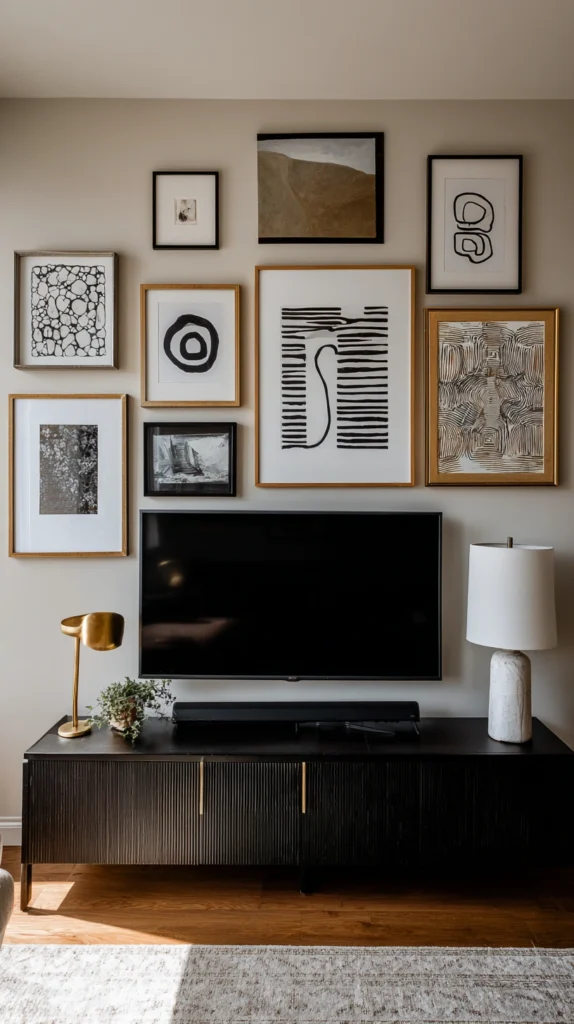
A gallery wall above the television — a curated arrangement of frames in complementary sizes, holding botanical prints, abstract art, photography, and personal pieces — turns the blank wall into a visual installation that draws the eye upward and gives the television a considered context rather than an accidental one.
Frames in warm gold, natural timber, or matte black cost $5 – $25 each. A set of seven to nine frames in varying sizes fills a standard above-TV wall generously for $35 – $225 in total. Prints in a cohesive palette downloaded free or purchased from independent makers add $0 – $150 depending on the source.
Decor tip: Centre the gallery wall arrangement on the midpoint of the television below it rather than on the midpoint of the full wall. A gallery wall centred on the TV reads as a designed pairing. A gallery wall centred on the wall but offset from the TV reads as two separate decisions that happen to share the same surface.
2. The Single Large Statement Art Piece
Budget: $50 – $500
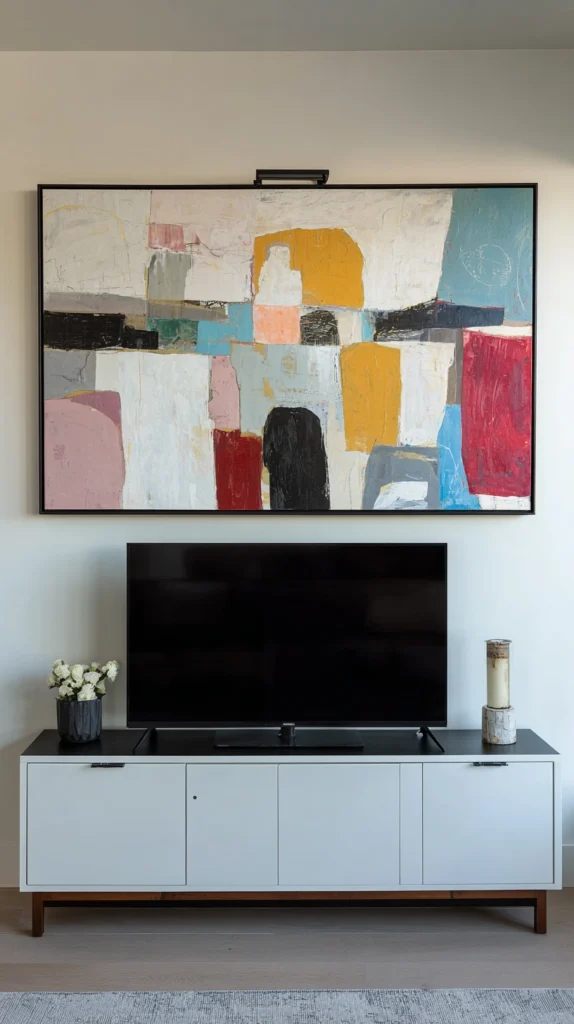
A single large artwork — a canvas, a framed print, or a photographic piece — positioned above the television and scaled to at least two-thirds the width of the screen below it, is the simplest and most resolved solution to the above-TV wall. One good piece, properly scaled and properly hung, outperforms any more complex arrangement.
A large canvas print in a complementary palette costs $50 – $200 from an online print supplier. A framed photographic or illustrative print in a statement size runs $60 – $300 framed. The artwork should share at least one colour with the room’s existing palette so that it reads as chosen for the space rather than placed there by default.
Decor tip: Hang the artwork 15 to 20 centimetres above the top of the television rather than directly against it. A gap of this size reads as a deliberate visual separation between the screen and the art above it. An artwork hung too close to the television appears to sit on top of it rather than above it, which reduces the impact of both.
3. The Floating Shelves Display
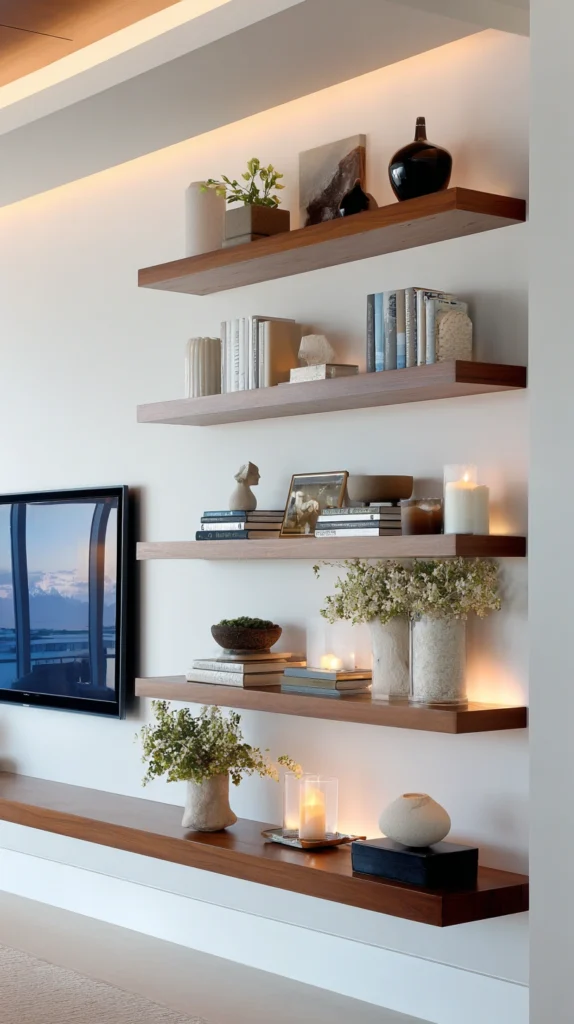
Budget: $60 – $300
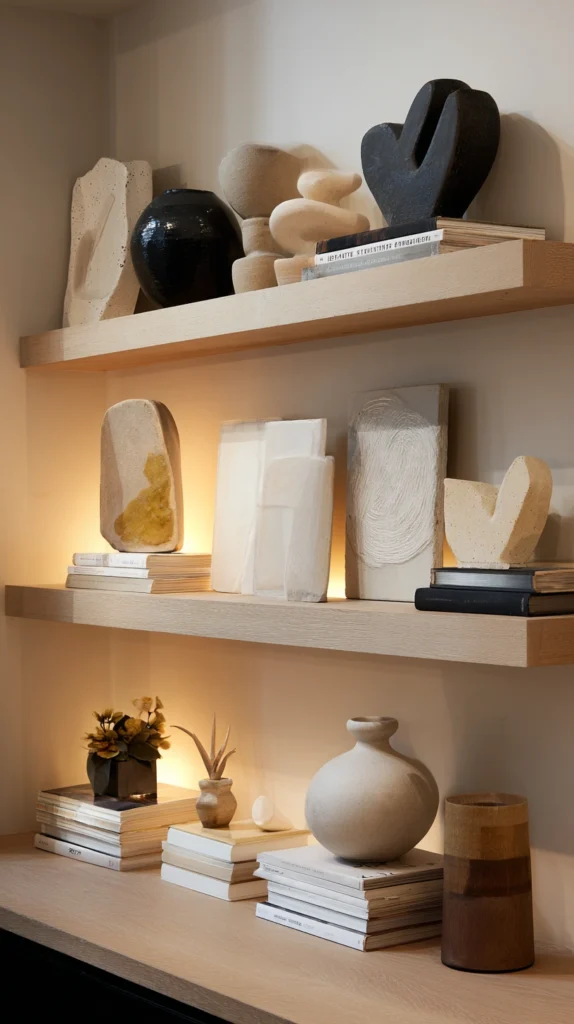
Floating shelves above the television — one long shelf or a staggered arrangement of two to three at varying heights — provide both a display surface and a practical storage solution for the objects and books that belong in the living room but have nowhere considered to live.
Timber floating shelves in a natural or dark-stained finish cost $20 – $60 each installed. A single long shelf above the TV — running the full width of the television or slightly beyond — costs $30 – $80 in materials and fixings. Objects on the shelf — ceramics, candles, small plants, books — cost whatever the chosen objects cost and are largely drawn from what the room already contains.
Decor tip: Style the shelf above the TV with objects of varying heights rather than a uniform line of same-sized pieces. A tall vase, a medium candle holder, a low ceramic bowl, and a stack of books at one end produce a shelf profile that moves up and down and reads as curated. A row of objects at the same height reads as a queue.
4. The Sconce Pair Flanking the Screen
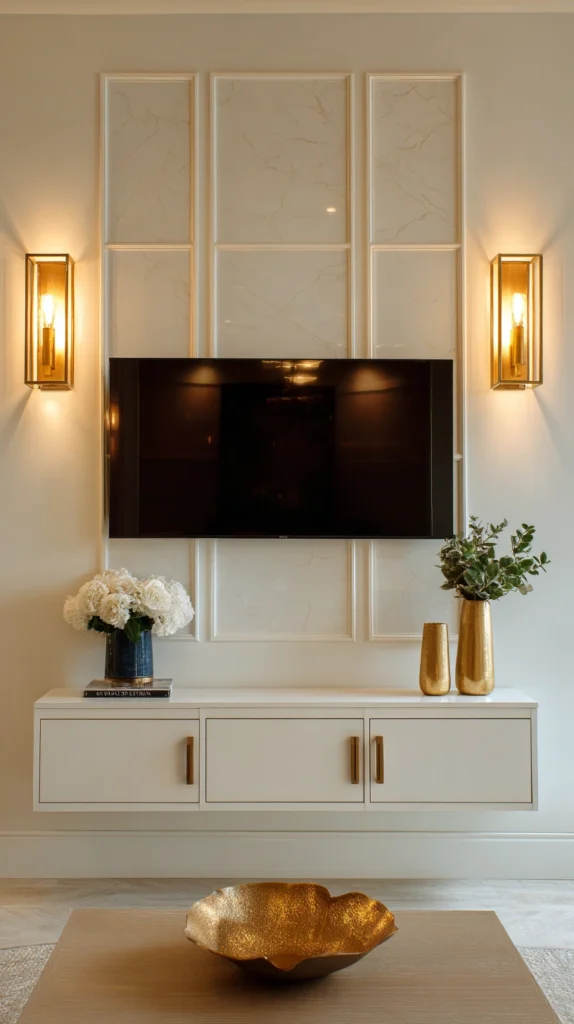
Budget: $60 – $400
A pair of wall sconces — positioned symmetrically on either side of the television and slightly above the screen level — frames the TV as an intentional architectural element rather than a practical appliance that happens to be on the wall. The sconces provide warm, low-level ambient light in the evening and a decorative moment during the day.
Plug-in or hardwired wall sconces in a warm brass, black iron, or natural rattan shade cost $30 – $100 each. A matching pair — $60 – $200 — is the minimum investment for this approach. Plug-in versions with a cord cover — $10 – $20 — avoid the need for electrical work and are appropriate for any rental or low-commitment installation.
Decor tip: Choose sconces with a downward or diffused light direction rather than upward-facing open shades. A sconce that directs light downward beside a television screen produces warm ambient illumination without creating glare on the screen surface. An upward-facing sconce beside a TV produces a light source directly in the peripheral vision of a viewer — which is both distracting and uncomfortable over a long viewing session.
5. The Macramé or Textile Wall Hanging
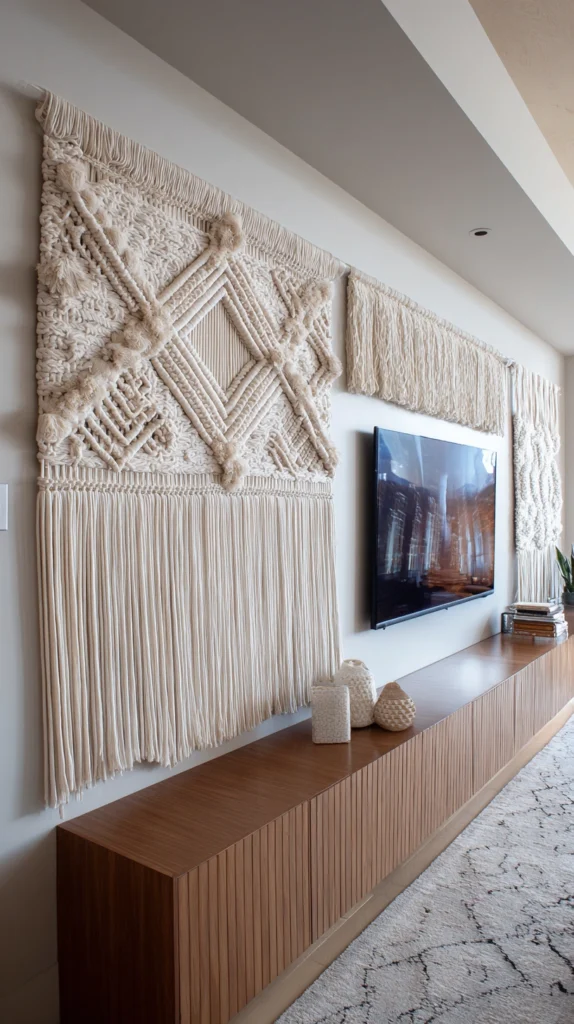
Budget: $30 – $200
A large macramé or woven textile wall hanging above the television brings texture, warmth, and handmade quality to the wall in a form that no framed print can replicate. It softens the hard, reflective surface of the screen below it and introduces a material warmth that transforms the entire wall.
A large hand-knotted macramé wall hanging in natural cotton cord costs $40 – $150 from independent makers. A woven tapestry in a complementary colour palette — $50 – $180. A DIY macramé version made from natural cotton cord — $10 – $25 in materials — is achievable in an afternoon with basic knotting techniques available freely online.
Decor tip: Choose a textile hanging that is at least as wide as the television below it and ideally slightly wider. A hanging that is narrower than the screen below it reads as too small for the wall and makes the television appear larger and more dominant by comparison. A hanging at the same width or wider creates a visual balance between the two elements.
6. The Mirror Above the TV
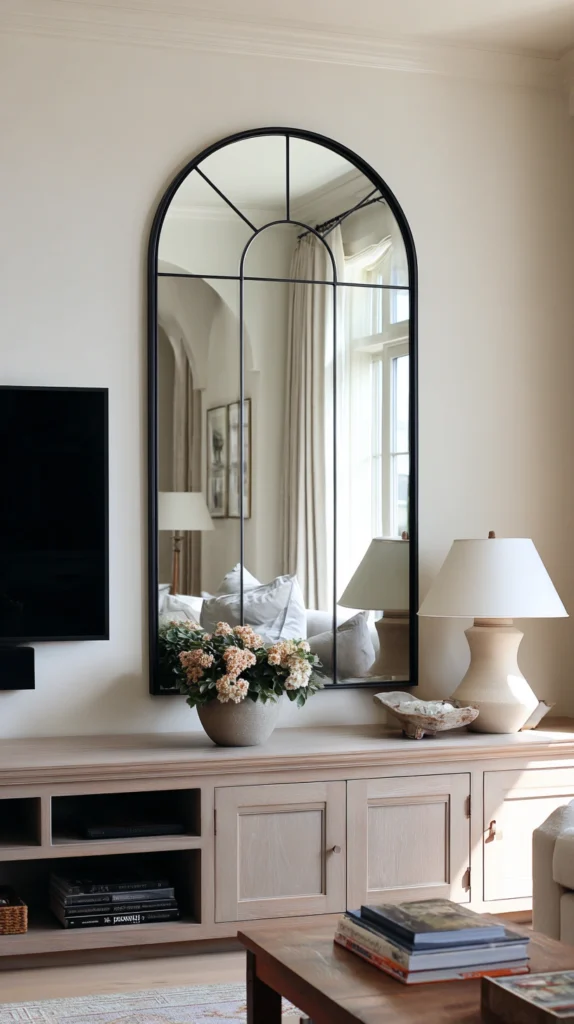
Budget: $40 – $300
A large mirror above the television — round, arched, or rectangular — reflects the room back into itself, creates the impression of greater depth and space, and provides a decorative moment that works equally well in contemporary, traditional, and eclectic interiors. It is one of the most universally applicable above-TV solutions available.
A round mirror in a warm gold or black metal frame costs $40 – $150. An arched mirror — the most current and most versatile mirror format — runs $60 – $250 depending on size and frame finish. A large rectangular mirror in a simple frame — $50 – $200 — suits a more traditional or symmetrical wall arrangement.
Decor tip: Position the mirror so that it reflects something worth seeing — a window, a piece of art on the opposite wall, or the natural light of the room — rather than reflecting the viewer directly. A mirror that reflects the television below it doubles the visual presence of the screen rather than complementing it. The angle of installation determines what the mirror shows, and that angle is worth considering before the fixings are committed.
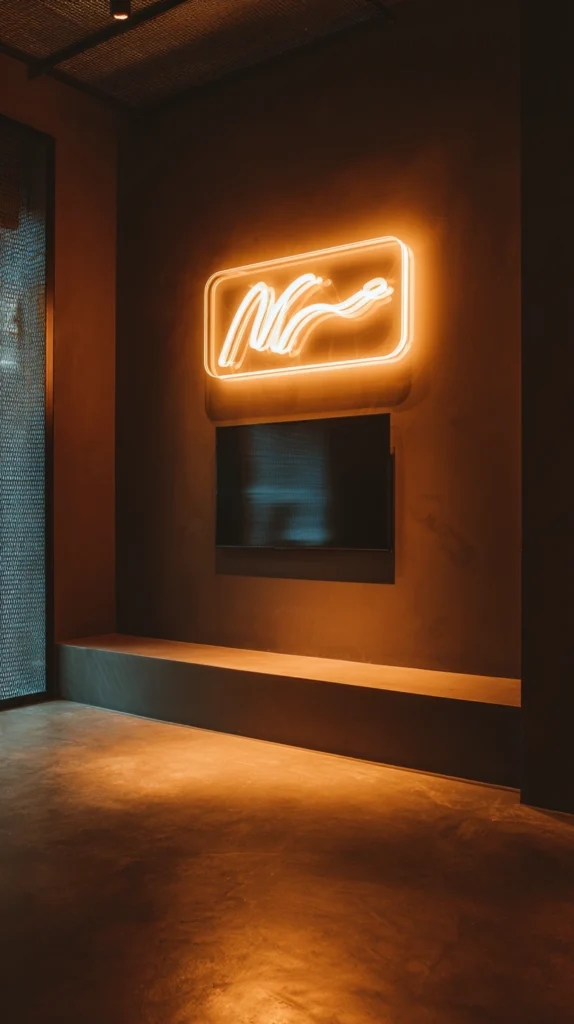
7. The Neon or LED Sign
Budget: $30 – $200
A neon or LED sign above the television — a word, a phrase, a symbol, or a simple shape in a warm or complementary colour — introduces a playful, contemporary energy to the wall that no other decorative element quite replicates. It works particularly well in media rooms, home cinemas, and living rooms with an eclectic or maximalist aesthetic.
A custom LED neon sign in a chosen word or phrase costs $40 – $150 depending on size and complexity from online custom sign makers. A standard shape or commonly available phrase — a star, a lightning bolt, “good vibes,” “cinema” — runs $30 – $100. A warm white or amber neon reads as sophisticated. A saturated colour neon reads as playful — and the choice between them determines the register of the entire wall.
Decor tip: Mount the neon sign on a dark-coloured wall or a dark backing panel rather than directly against a light wall. A neon sign on a white wall loses approximately half its visual impact because the background provides insufficient contrast for the light to read against. The same sign on a dark grey, deep navy, or matte black wall glows with its full intended intensity.
8. The Botanical and Plant Shelf
Budget: $30 – $200
A shelf above the television planted with trailing and structural plants — a trailing pothos cascading down from the shelf, a small monstera at one end, a collection of succulents filling the middle — brings the living, organic quality of plants to the room’s most prominent wall and softens the hard technology of the screen below with something entirely natural.
A timber floating shelf capable of holding plant weight costs $25 – $60 installed. A trailing golden pothos — $8 – $20 — is the most effective above-TV plant because its cascading growth draws the eye from the shelf level down toward the screen in a gradual, organic movement. A collection of three to five plants for the shelf costs $20 – $80 in total.
Decor tip: Choose plants with trailing or cascading growth habits for an above-TV shelf rather than upright structural plants. A plant that grows upward from an above-TV shelf draws the eye toward the ceiling rather than toward the room. A plant that trails downward draws the eye through the wall arrangement in a natural, flowing movement that reads as intentional and elegant.
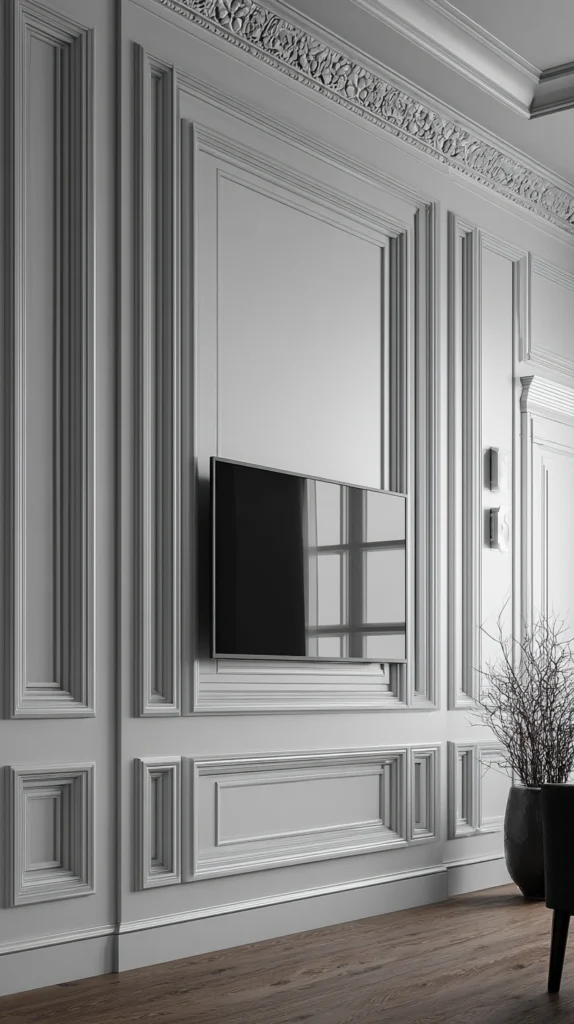
9. The Panelling and Moulding Frame
Budget: $80 – $500
Wall panelling or decorative moulding applied to the above-TV wall — creating a frame or a series of frames within which the television sits as a designed element rather than an appliance on a wall — is the most architecturally complete solution to the above-TV decorating challenge. It makes the entire wall feel built rather than decorated.
MDF panel moulding applied in a simple rectangular frame above and around the TV costs $30 – $100 in materials. A more elaborate panelled wall — full-height panels running from floor to ceiling, with the TV inset as part of the composition — costs $150 – $500 in materials for a standard wall. Painted in the same colour as the wall — or in a contrasting tone for a more dramatic effect — the moulding reads immediately as architectural.
Decor tip: Paint the panelling and the wall in the same colour rather than contrasting them if the room is small or the ceiling is low. Same-colour panelling reads as subtle and architectural — the texture of the moulding is visible but the tonal contrast is minimal. Contrasting panelling reads as more dramatic but also more visually busy, which can reduce the apparent size of a room that is already modest in its proportions.
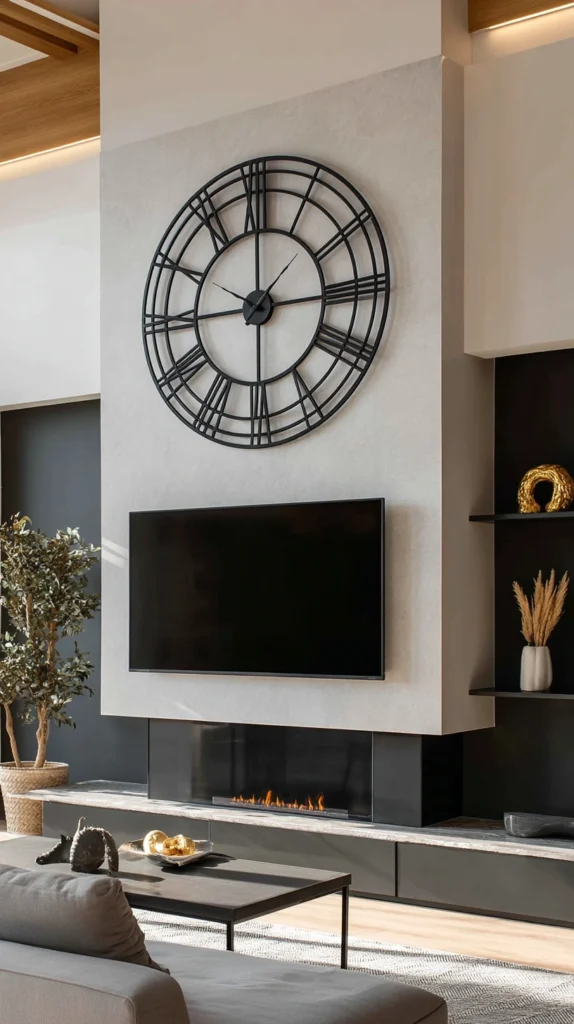
10. The Clock as a Design Statement
Budget: $30 – $300
A large, architecturally considered clock above the television — a wide-diameter metal clock in a warm brass or matte black, an industrial-style gear clock, or a minimalist wooden clock face — is both a functional object and a strong visual statement that gives the above-TV wall a single, confident focal point.
A large-diameter wall clock in a brass or black metal frame costs $40 – $150 depending on size and finish. An oversized clock — 70 centimetres or more in diameter — costs $80 – $300 and commands the wall with an authority that smaller versions cannot achieve. The clock should be at least half the width of the television for the visual relationship between the two to read as balanced.
Decor tip: Choose a clock with a simple, legible face rather than a decorative or novelty design for an above-TV application. A clock face that is also a design object — minimal, well-proportioned, and beautiful in its own right — reads as a considered decorating decision. A novelty clock in the same position reads as a theme, which is a different and considerably less versatile outcome.
11. The Horizontal Book and Object Ledge
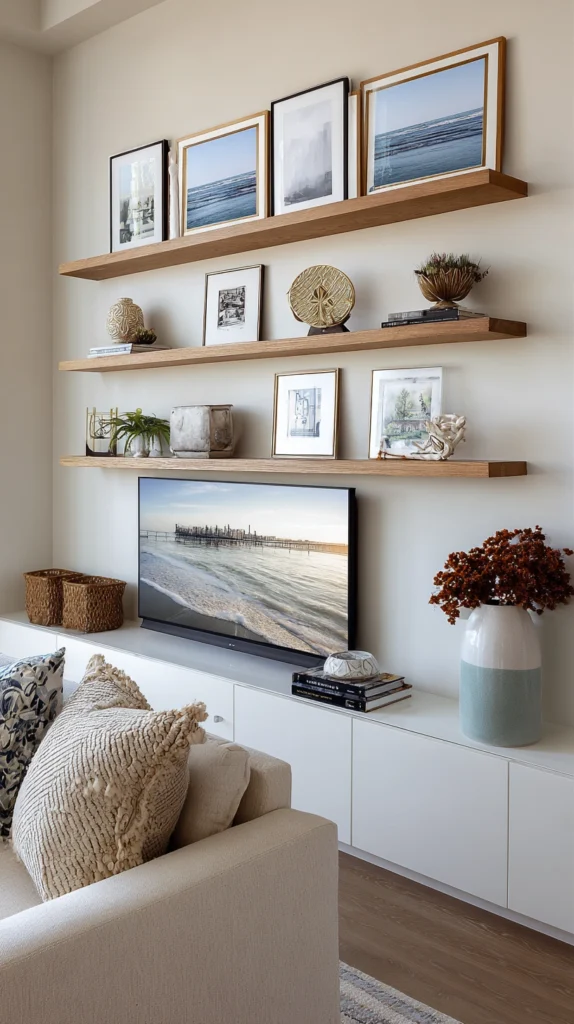
Budget: $30 – $150
A long, shallow picture ledge above the television — holding a rotating selection of leaned artworks, small objects, candles, and seasonal botanical details — gives the above-TV wall flexibility and variety that a fixed gallery wall cannot provide. The ledge allows the display to change seasonally or simply whenever the mood calls for something different.
A standard picture ledge in a natural timber or white-painted finish costs $20 – $50 installed. Objects and artwork leaned against the ledge back wall — $20 – $100 depending on what is chosen — can be swapped without touching the wall fixings. A combination of a leaned artwork, two candle holders, a small ceramic, and a botanical sprig fills the ledge with visual interest at minimal cost.
Decor tip: Overlap the leaned artworks on the picture ledge rather than spacing them evenly apart. Artworks overlapped at slight angles read as casually curated — as though placed by someone who changes them regularly and knows what they are doing. Artworks spaced evenly apart read as deliberately positioned, which is a more formal and less relaxed result than the picture ledge aesthetic calls for.
12. The Wallpaper Feature Panel
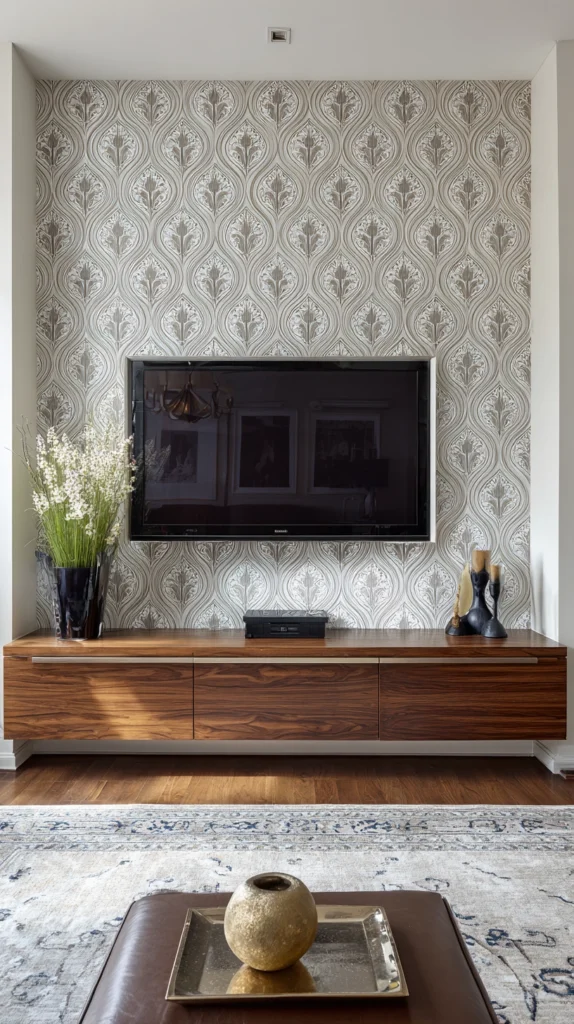
Budget: $40 – $300
A panel of wallpaper applied to the above-TV wall — either the full wall or a defined rectangle framed by simple moulding — brings pattern, colour, and texture to the room’s most prominent surface in a form that paint alone cannot achieve. A botanical wallpaper, a geometric print, or a textured grasscloth all work well in this application.
A quality wallpaper in a bold botanical or geometric print costs $15 – $50 per roll. A standard above-TV wall requires two to three rolls depending on pattern repeat and wall dimensions. A grasscloth or textured wallpaper — $20 – $60 per roll — adds material texture rather than pattern and suits rooms where the wall is intended to read as a background rather than a focal point.
Decor tip: Choose a wallpaper with a vertical pattern orientation for an above-TV application — stripes, climbing botanicals, or tall geometric repeats — rather than a predominantly horizontal pattern. A vertical pattern draws the eye upward and makes the wall feel taller. A horizontal pattern draws the eye sideways and can make the wall feel lower and wider than it is, which is the reverse of the effect most above-TV walls benefit from.
13. The Floating Shelf With Integrated Lighting
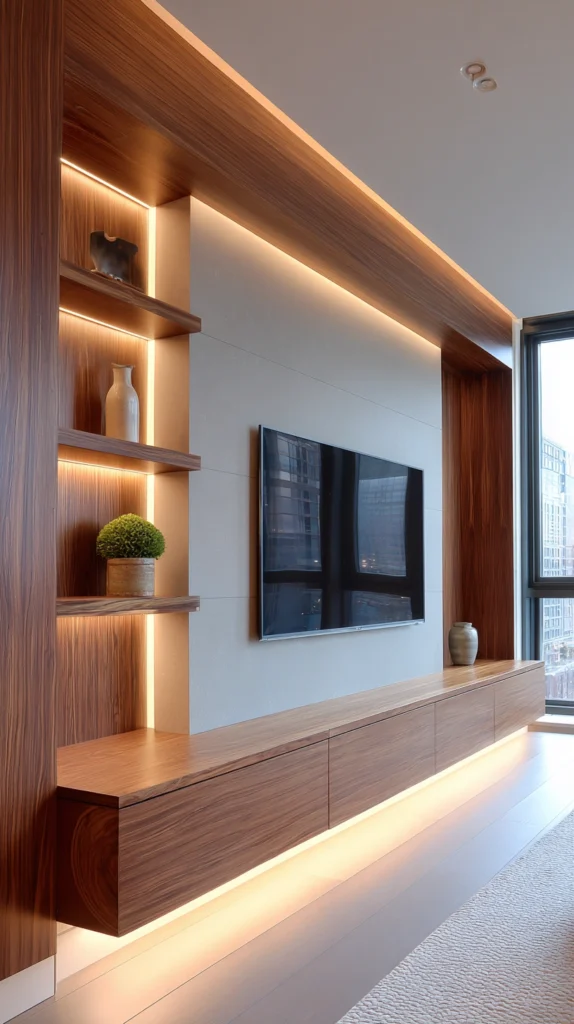
Budget: $80 – $400
A floating shelf above the television with integrated LED strip lighting beneath it — casting a warm, diffused glow downward onto the television and the surrounding wall — creates a backlit effect that is both practically useful and visually dramatic. The shelf provides the display surface. The light provides the atmosphere.
A timber floating shelf with a routed channel for LED strip installation costs $40 – $100 in materials. A warm white LED strip — 2700K colour temperature — costs $15 – $40 for the length required. A dimmer switch or a smart LED controller — $15 – $30 — allows the intensity of the backlight to be adjusted according to the ambient lighting conditions of the room.
Decor tip: Use warm white LED strips — 2700K — rather than cool white or colour-changing RGB strips for an above-TV shelf installation. Cool white backlight beside a television screen produces a colour temperature conflict that the eye registers as uncomfortable during viewing. Warm white backlight reads as a gentle, non-distracting ambient glow that enhances the viewing environment rather than competing with it.
14. The Symmetrical Object Arrangement
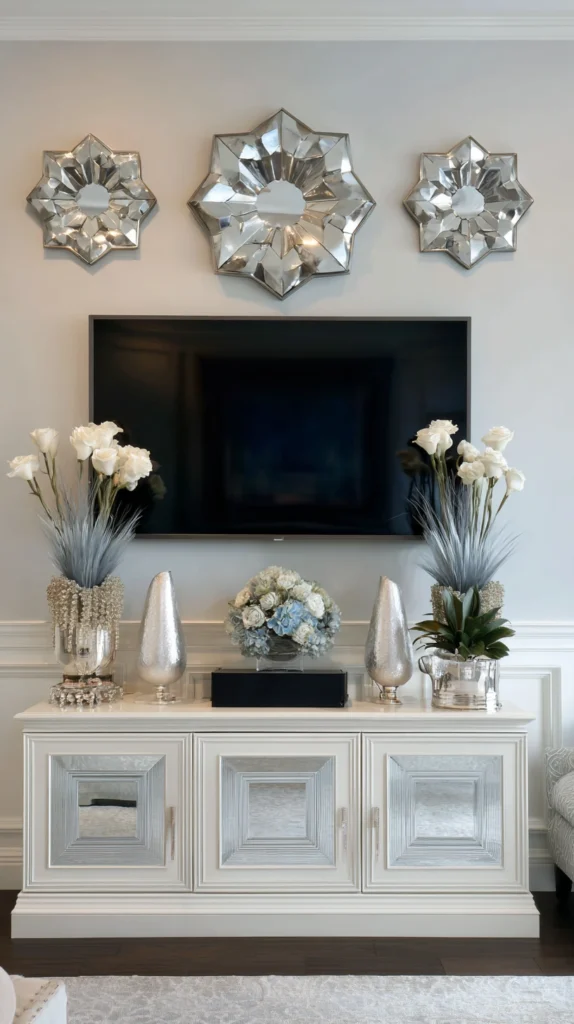
Budget: $40 – $200
A symmetrical arrangement above the television — two matching sconces, two identical vases, two framed prints of the same size in matching frames — creates a formal, considered visual order that suits traditional, classic, and period-style interiors. Symmetry above the television reads as architectural intention rather than decorative accident.
A pair of matching ceramic vases in a complementary colour — $20 – $60 for the pair. Two identical framed prints — $30 – $80 for both framed. A matching pair of wall-mounted sconces — $60 – $200 for the pair. Any of these three symmetrical approaches costs less than $200 and produces a wall arrangement that reads as resolved and confident from the primary seating position.
Decor tip: Use an odd-numbered central element alongside the symmetrical pair to prevent the arrangement from reading as too formal. Two matching vases flanking a single central artwork — or two sconces flanking a single central mirror — introduces the odd number that breaks the pure symmetry and gives the arrangement life and movement without abandoning the formal structure that makes it work.
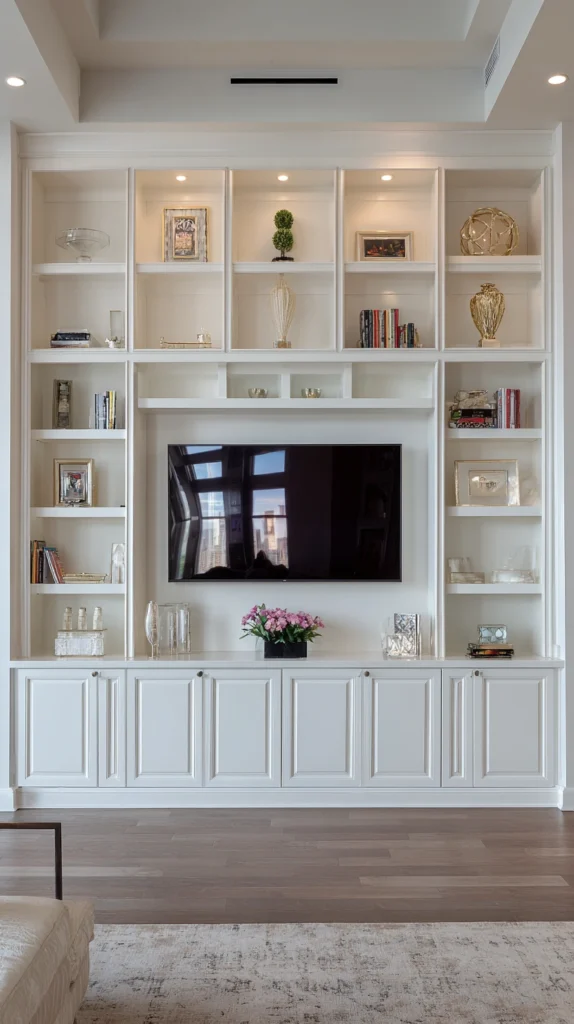
15. The Full Media Wall Treatment
Budget: $200 – $3000
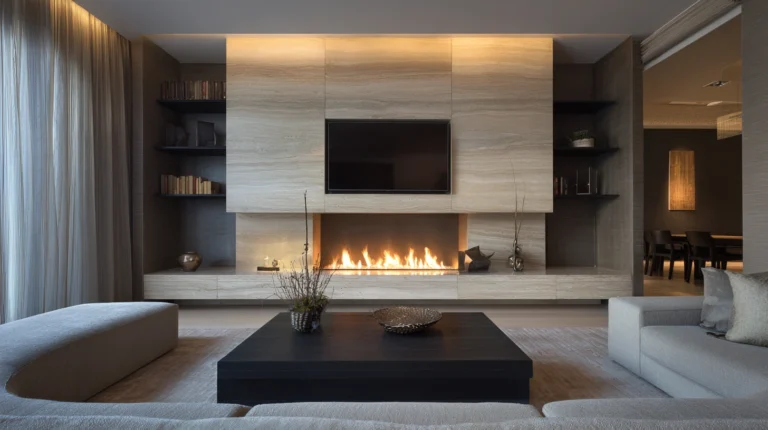
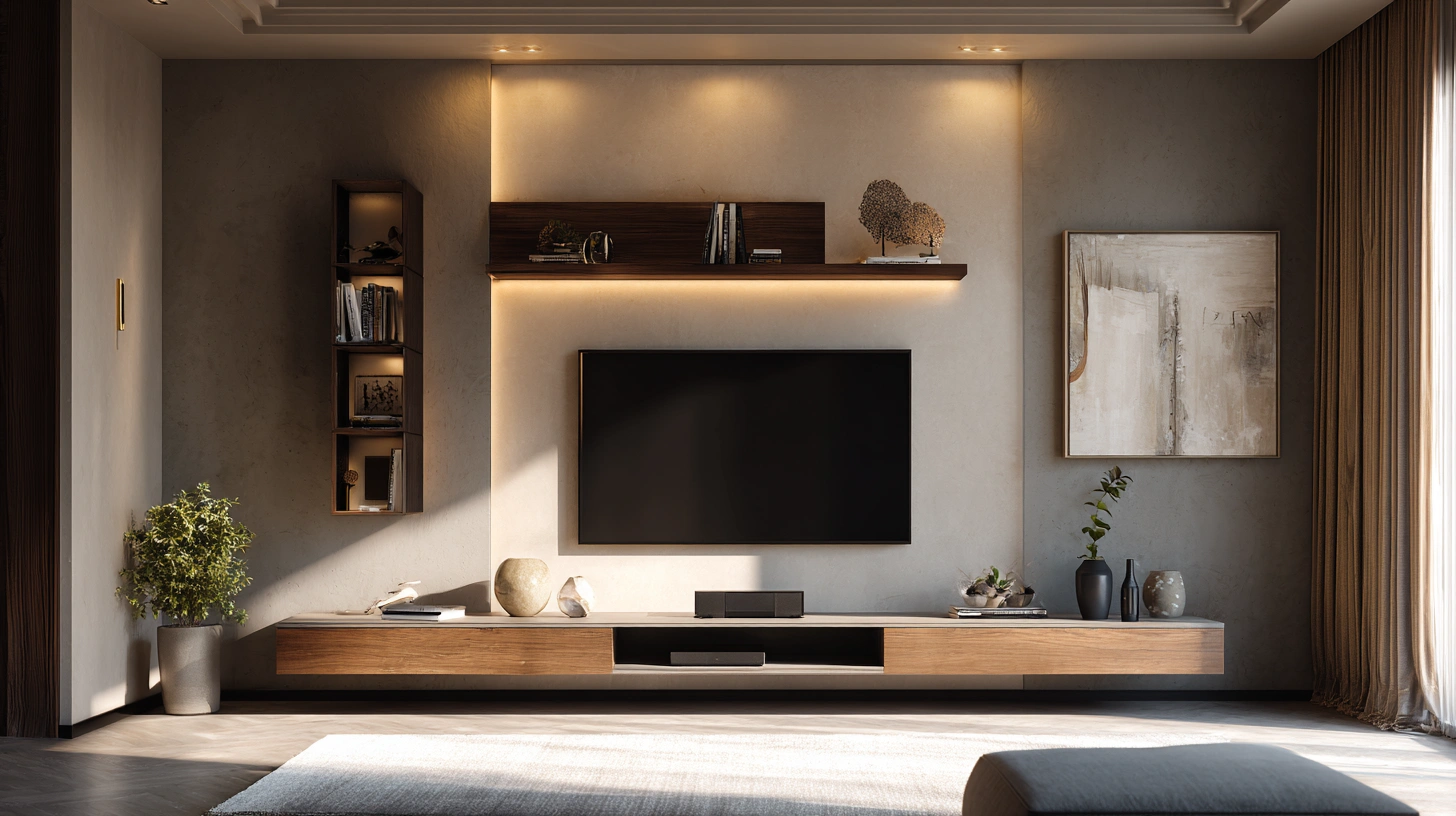
A full media wall — the television integrated into a designed wall composition that includes built-in cabinetry, open shelving, integrated lighting, decorative objects, and a cohesive material or colour treatment — is the most complete and most architecturally ambitious solution to the above-TV decorating challenge. It treats the television as one element of a designed wall rather than the wall’s reason for existing.
A DIY built-in media wall using flat-pack cabinetry and timber shelving costs $200 – $800 in materials. A bespoke carpenter-built media wall runs $800 – $3000 depending on size, material, and complexity. The television, integrated into a wall composition of this scale, reduces from the room’s dominant object to one of several considered elements — which is the most significant visual transformation available to any living room.
Decor tip: Paint the full media wall in a single colour — a deep shade that contrasts with the room’s other walls — so that the television screen disappears into the dark background when switched off rather than reading as a large black rectangle against a pale wall. A television on a dark wall is considerably less visually intrusive when not in use than the same screen on a white or light-coloured wall, and the reduction in visual intrusion is immediate and dramatic.
The space above the television deserves the same level of consideration as any other wall in the room. It is large, it is prominent, and it is seen from the most-used seat in the house every single day.
Choose one idea that fits the room’s existing palette and style. Commit to it fully rather than hedging between two approaches. A single well-executed above-TV moment transforms the room’s most neglected wall into its most interesting one — and that transformation costs far less and takes far less time than most people assume before they begin.