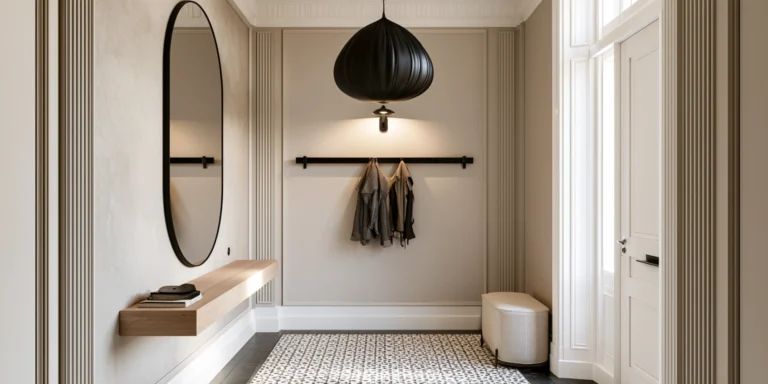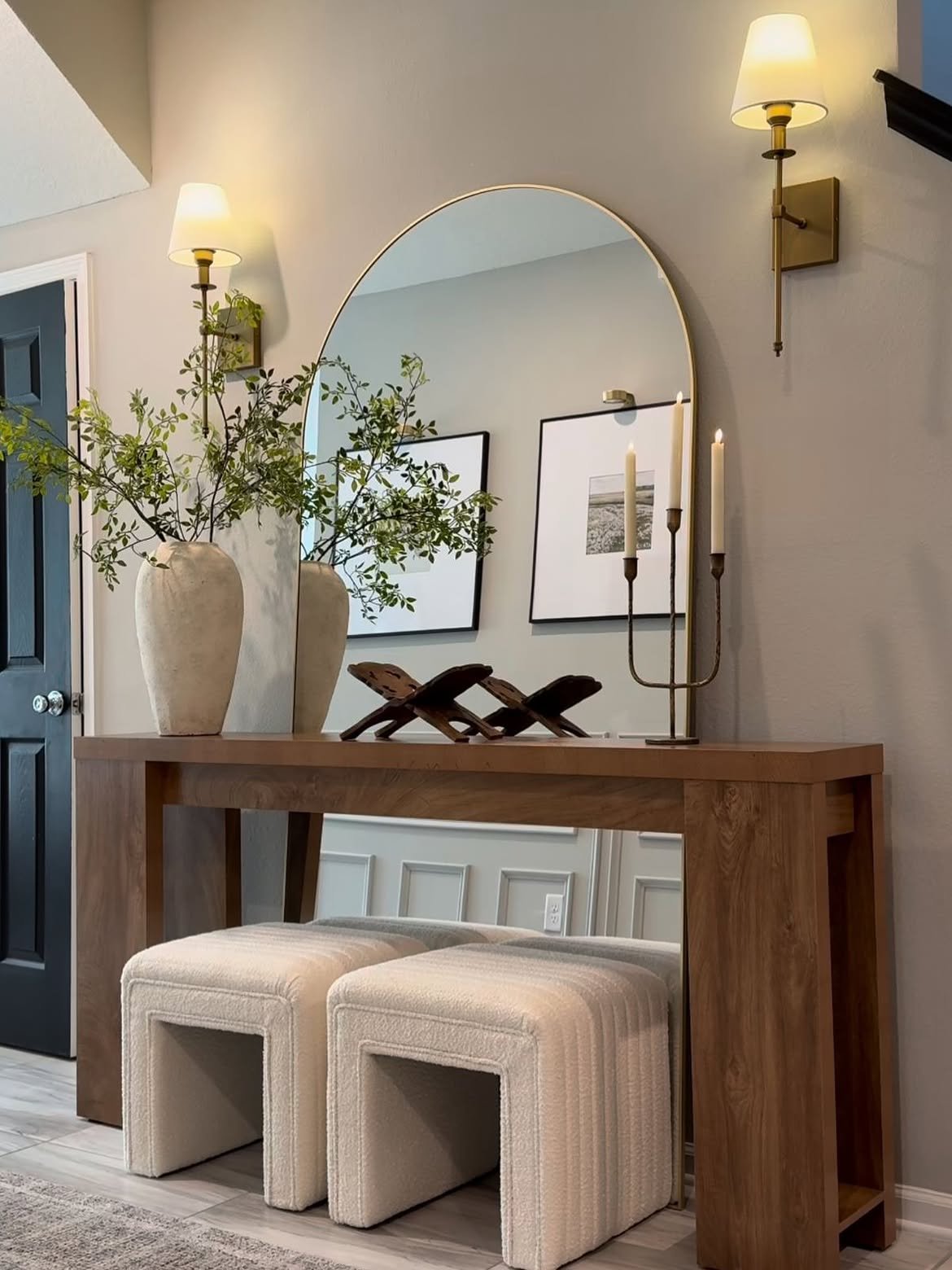
13 Entryway Decor Ideas That Feel Instantly Put-Together
13 Entryway Decor Ideas That Feel Instantly Put-Together
The entryway is the only room in the house that every single visitor experiences, every single time, without exception. The living room might be skipped on a quick visit. The kitchen might stay closed off. The entryway is mandatory — everyone walks through it, and everyone forms an impression in the eight or ten seconds it takes to cross it.
That is an enormous amount of design responsibility for a space that, in most homes, gets almost none of the attention. A pile of shoes. A hook with three coats on it. Mail on a table that was never meant to hold mail. The entryway absorbs the overflow of every other room and rarely gets designed on its own terms.
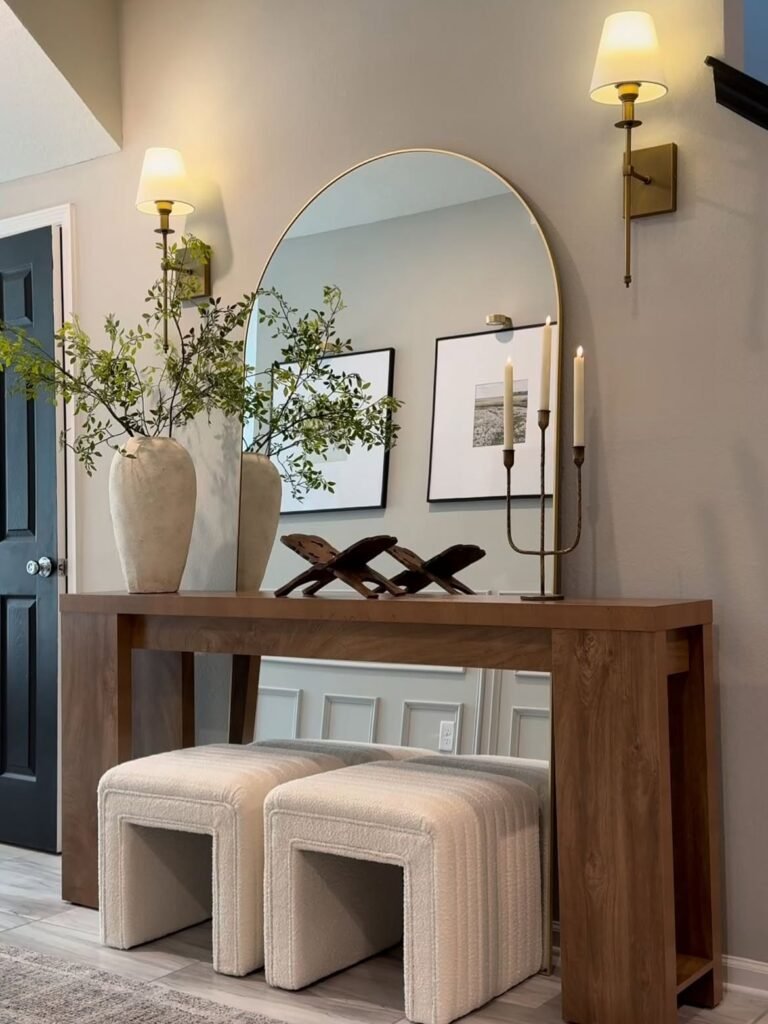
A put-together entryway is not a bigger entryway or a more expensive one. It is a deliberately edited one — a small number of pieces, each doing a specific job, arranged so the eight-second impression reads as intentional rather than accidental.
Here are 13 ways to get there, from the five-minute fix to the full redesign.
Why Entryways Feel Unfinished
The first-impression physics:
Without intentional design:
- Shoes and bags accumulate at floor level with no assigned place
- Mail, keys, and small daily items collect on whatever surface is nearest the door
- Coats hang on a single overloaded hook or over a chair back
- The eye has nowhere to land: everything competes for attention at once
With intentional design:
- Every category of daily object has one designated spot
- The eye lands on one focal point (a mirror, a piece of art, a light fixture) before taking in the rest
- The floor stays visually clear even when storage is full
- The entryway: reads as arranged within the first two seconds, not the full eight
The function-first problem:
Most entryways fail not because they lack decor but because the function was never solved. Decorating a space that has no home for shoes, keys, or mail simply adds another layer on top of the daily clutter. The function has to be solved first; the decor makes the solved function look intentional.
The threshold effect:
- The entryway is a transition space — between outside and inside, between public and private
- Design that acknowledges this transition (a change in flooring, a boundary object like a rug or bench) feels resolved
- Design that ignores it (the entryway as an unmarked continuation of the hallway) feels unfinished regardless of what’s on the walls
The Five Entryway Essentials
Before choosing any individual idea below, these five categories account for nearly every successful entryway:
A landing surface:
- A console table, shelf, or wall-mounted ledge
- The one place keys, mail, and a bag land the moment someone walks in
- Without it, these items land on the floor or migrate into other rooms
A seat or perch:
- A bench, stool, or chair for putting on and removing shoes
- Not required in every home, but transforms the daily shoe routine when space allows
Hidden storage:
- A basket, closed cabinet, or drawer for anything that shouldn’t stay visible
- The visible surfaces stay calm because the overflow has somewhere to go
A vertical element:
- A mirror, art, or a tall plant
- Draws the eye upward and keeps a small entryway from reading as just a floor and a wall
- The single most common missing ingredient in flat, unfinished entryways
Layered light:
- Overhead light alone reads utilitarian
- A wall sconce, table lamp, or pendant at a lower height adds the warmth an entryway needs, especially in the evening
1. The Console Table Landing Zone
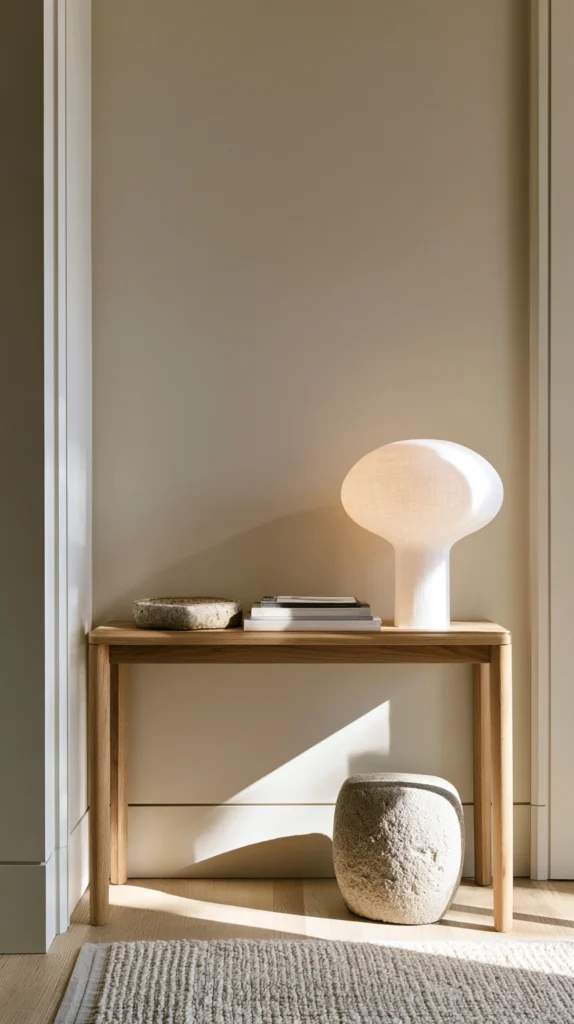
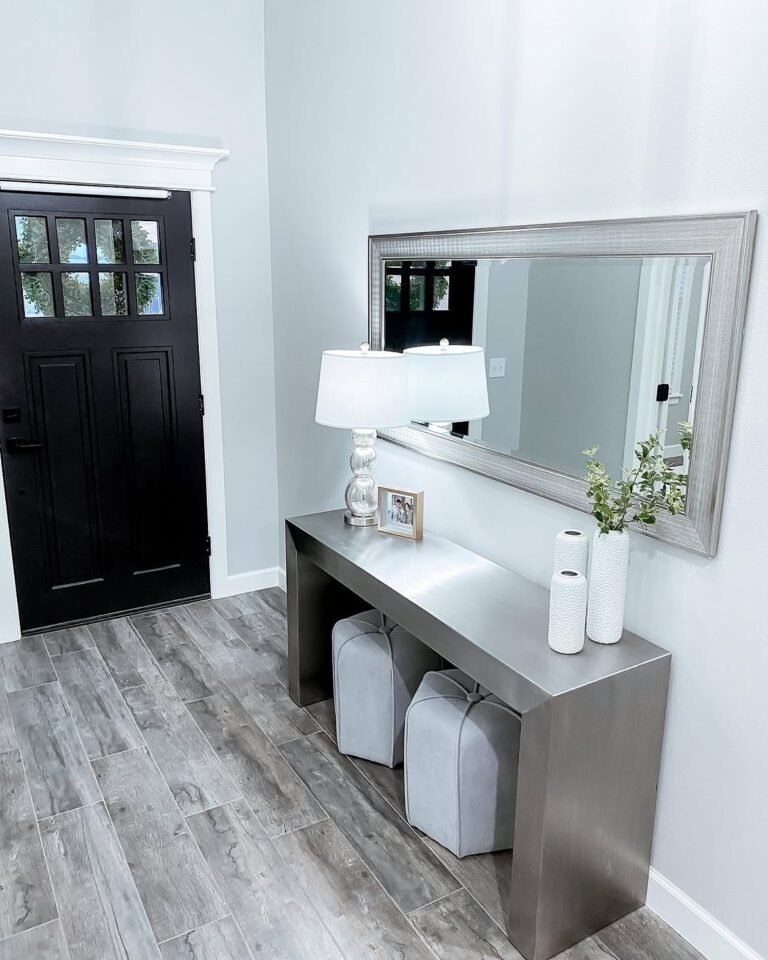
A slim console table positioned against the entry wall, sized to hold daily essentials without blocking passage — the single most transformative entryway addition available.
Why the console table does the most work
Every other entryway decision benefits from having a console table in place first. It’s the surface for the tray, the vase, the mirror to lean against or hang above. Without it, every other idea on this list has nowhere to sit.
Sizing for a real hallway
- Depth: 12–16 inches for a standard hallway (anything deeper narrows the walking path)
- Length: leave at least 36 inches of clear walking space beyond the table’s edge
- Height: 30–34 inches, roughly counter height
Cost breakdown
- Slim console table: $120–320
- Total: $120–320
2. The Layered Entry Rug
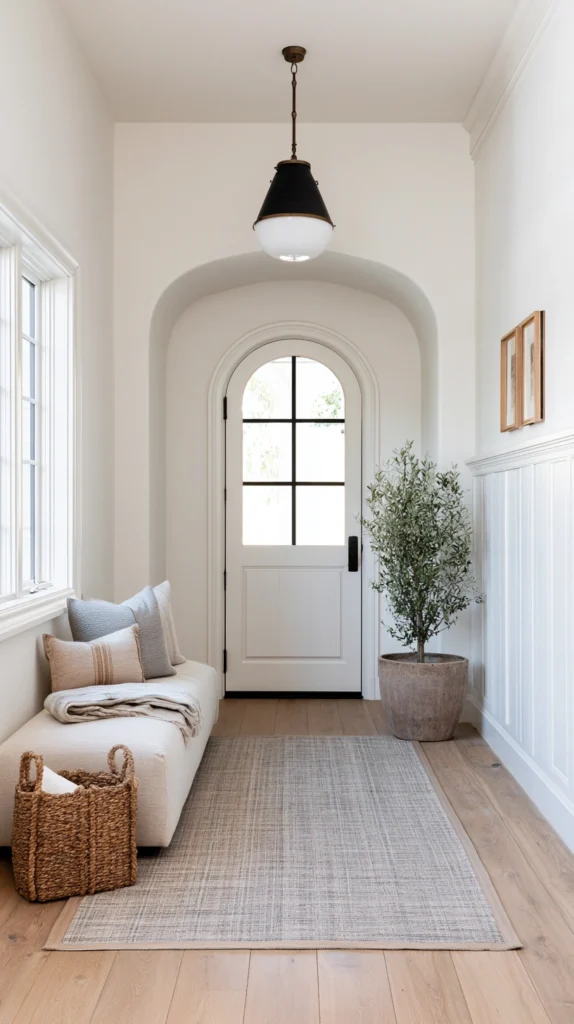
A durable outdoor-rated rug at the threshold, layered with a smaller indoor rug just past it — marking the transition from outside to inside in a way bare flooring cannot.
Why one rug isn’t enough here
The threshold rug takes the brunt of dirt, water, and wear and should be built for it. The second, softer rug just past it signals “you have now arrived indoors” and is where bare or socked feet actually land.
The layout
- Outdoor-rated rug directly at the door: 2×3 ft, flatweave, easily hosed off or shaken out
- Indoor rug 6–12 inches past it: 3×5 ft, higher pile, in a warmer tone
- Both rugs anchored with a non-slip pad underneath
Cost breakdown
- Outdoor-rated entry rug: $30–60
- Indoor layered rug: $60–130
- Total: $90–190
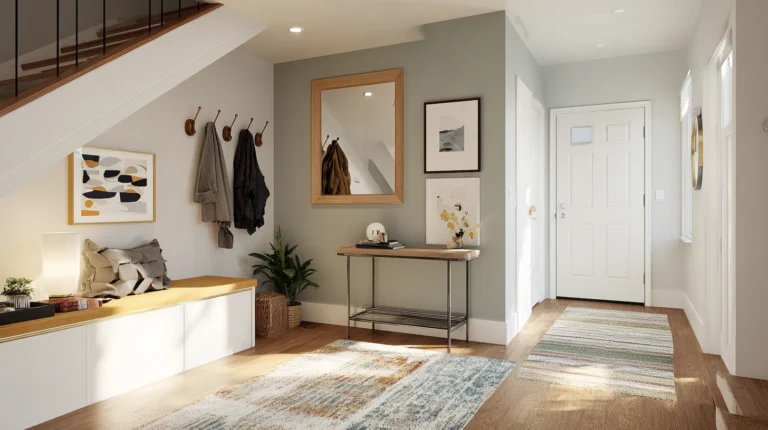
3. The Wall-Mounted Hook Rail
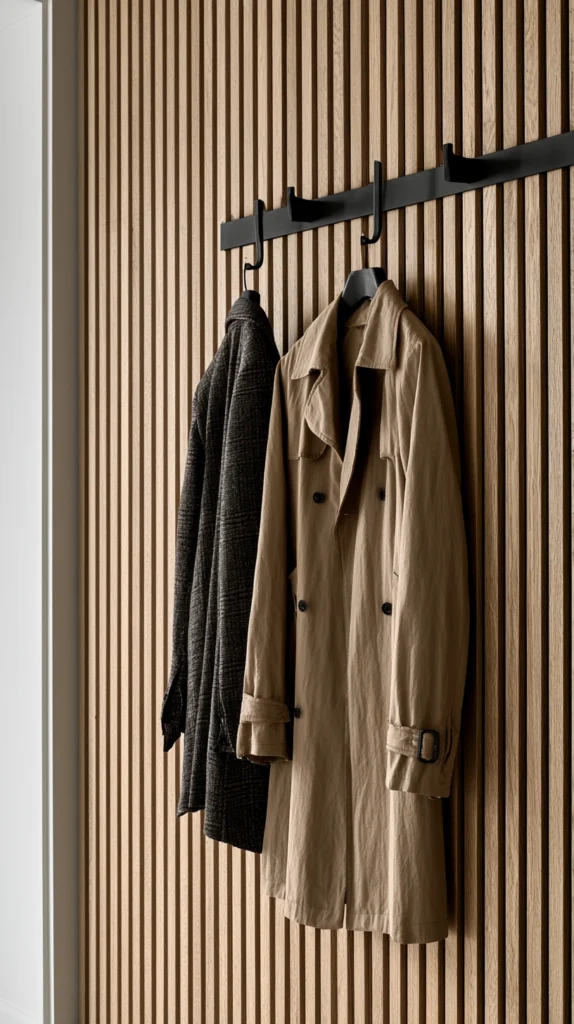
A row of three to five matching hooks mounted at a consistent height, replacing a single overloaded coat hook — the storage fix that also functions as a design element.
Why a rail beats a single hook
One hook holding four coats looks like a problem. Five hooks holding one item each look like a system. The visual difference is entirely in the distribution, not the total storage capacity.
Installation specifics
- Mounting height: 60–66 inches from the floor for adult use
- Spacing: 6–8 inches between hooks
- Material: brass or matte black hardware reads more finished than chrome or bare steel
Cost breakdown
- Wall-mounted hook rail (5 hooks): $35–70
- Total: $35–70
4. The Mirror Above the Console
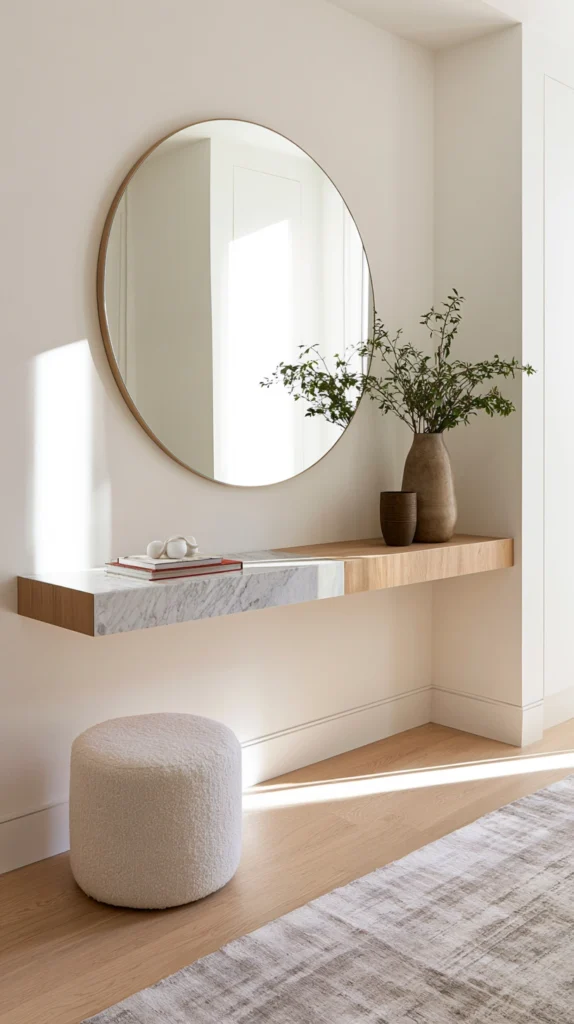
A mirror hung directly above the console table, sized to roughly two-thirds the width of the table below it — the vertical anchor that keeps a narrow entryway from reading as flat.
Why the proportion matters
A mirror significantly narrower than the table beneath it looks like an afterthought. A mirror significantly wider looks unbalanced. Two-thirds of the table’s width is the proportion that consistently reads as intentional.
Placement height
- Bottom edge of the mirror: 6–8 inches above the console table’s surface
- Centre of the mirror at roughly eye height for a seated or standing glance on the way out the door
Cost breakdown
- Mirror (24–30 inches wide): $80–200
- Total: $80–200
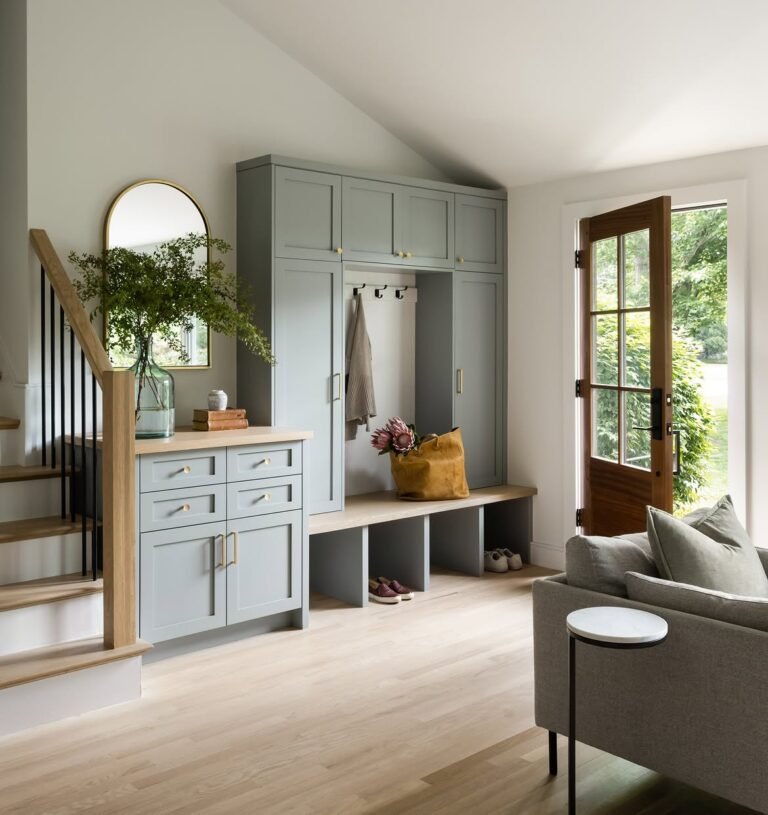
5. The Bench With Concealed Storage
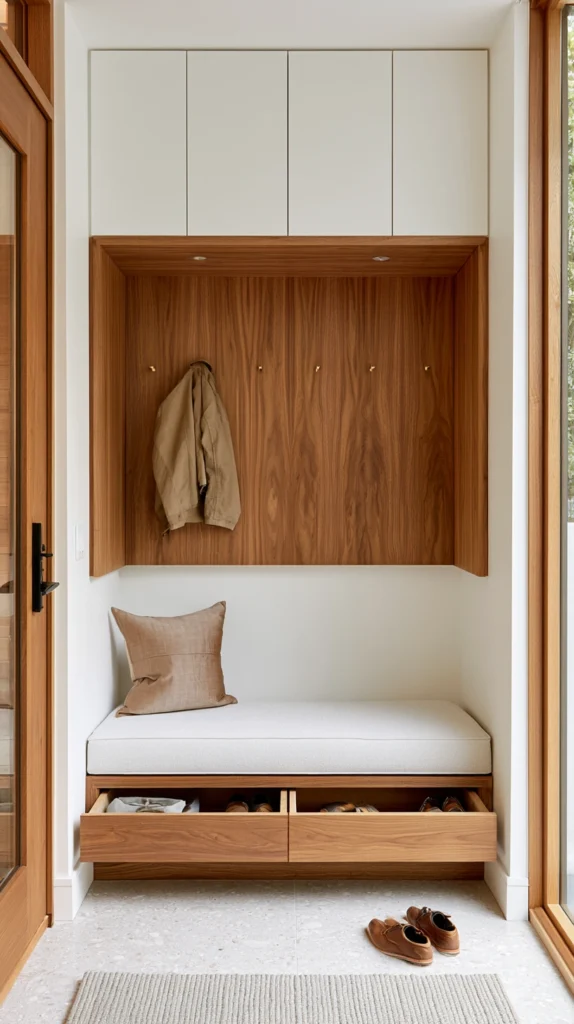
A narrow bench with a lift-top seat or under-seat baskets, positioned along the entry wall — seating and shoe storage combined into one footprint.
Why concealed storage matters more here than elsewhere
The entryway is the room where storage gets used daily, by everyone, often in a hurry. Open, visible shoe storage looks tidy for approximately one day before it doesn’t. A bench that closes over the mess solves the daily-use problem that open shelving can’t.
Sizing
- Length: 36–48 inches for two people to sit simultaneously
- Depth: 14–18 inches
- Seat height: 17–19 inches, standard bench height
Cost breakdown
- Storage bench: $140–320
- Total: $140–320
6. The Catch-All Tray
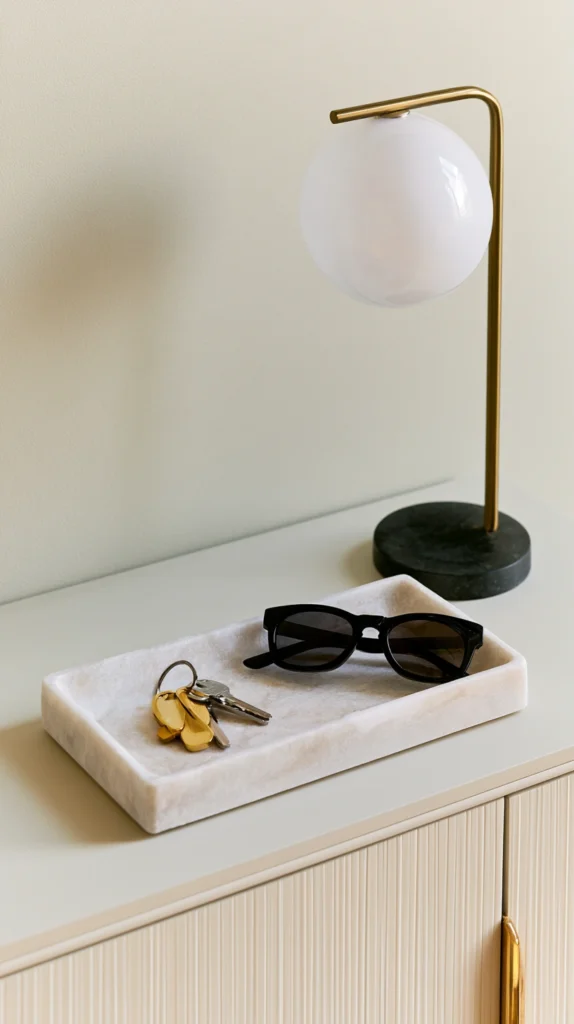
A single shallow tray on the console table for keys, sunglasses, and loose change — the smallest item on this list and one of the highest-impact.
Why a tray specifically, not a bare tabletop
Without a defined container, small daily items spread across the entire console surface individually. A tray corrals them into one visual unit, so the rest of the table surface stays clear.
Material and placement
- Wood, stone, or ceramic tray, roughly 8×10 inches
- Positioned at the end of the console nearest the door, for the fastest drop-and-go
Cost breakdown
- Catch-all tray: $18–45
- Total: $18–45
7. The Wall Sconce or Table Lamp
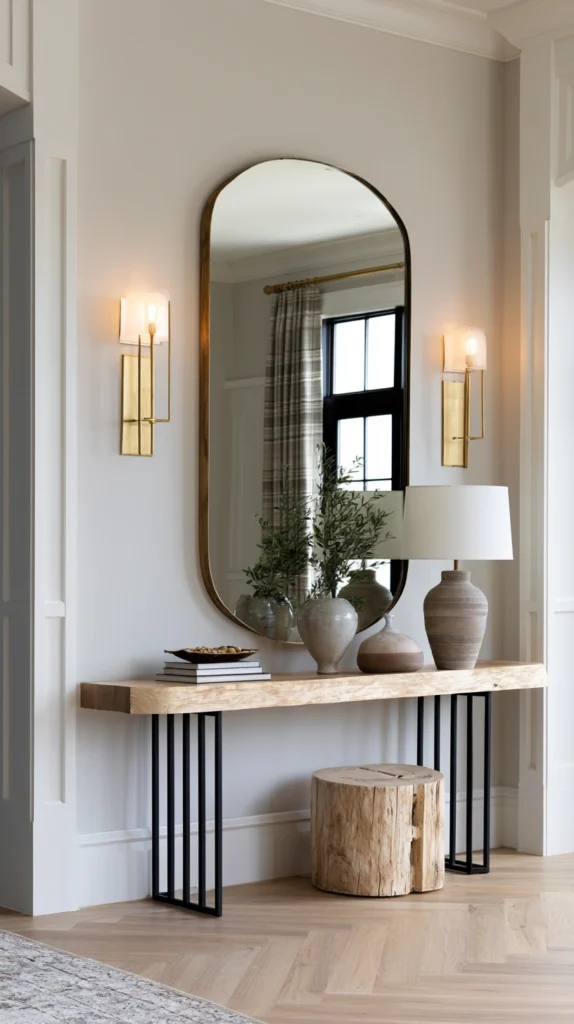
Adding a wall-mounted sconce beside the mirror, or a small table lamp on the console — supplementing the overhead fixture that most entryways rely on alone.
Why overhead light alone falls short
A single overhead fixture creates flat, even light with no warmth at eye level. A sconce or lamp adds a lower, warmer light source that’s especially noticeable at night, when the entryway is often the first lit space a person sees on arriving home.
Placement
- Wall sconce: mounted 60–66 inches from the floor, one on each side of the mirror if space allows, or a single sconce opposite the mirror
- Table lamp: scaled small enough to leave room for the catch-all tray on the same surface
Cost breakdown
- Wall sconce (1 or pair): $50–140
- Or small table lamp: $35–80
- Total: $35–140
8. The Single Framed Art Piece
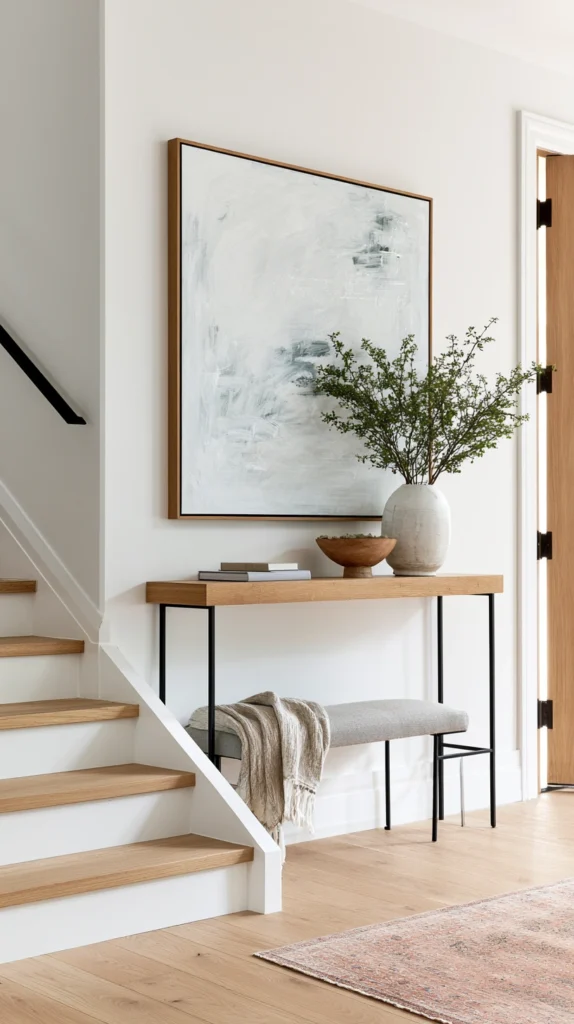
One piece of art, sized proportionally to the wall it occupies, hung where the eye naturally lands on entry — an alternative or companion to the mirror for entryways with more wall space.
Why one piece beats a gallery wall here
A gallery wall works well in a room people linger in. An entryway is crossed quickly, and a single confident piece registers in that short window in a way a multi-piece arrangement often doesn’t.
Sizing and placement
- Width: roughly 60–75% of the console table’s width if hung above it
- Centre height: 57–60 inches from the floor to the centre of the piece (standard gallery height)
Cost breakdown
- Framed art piece: $60–180
- Total: $60–180
9. The Woven Storage Basket
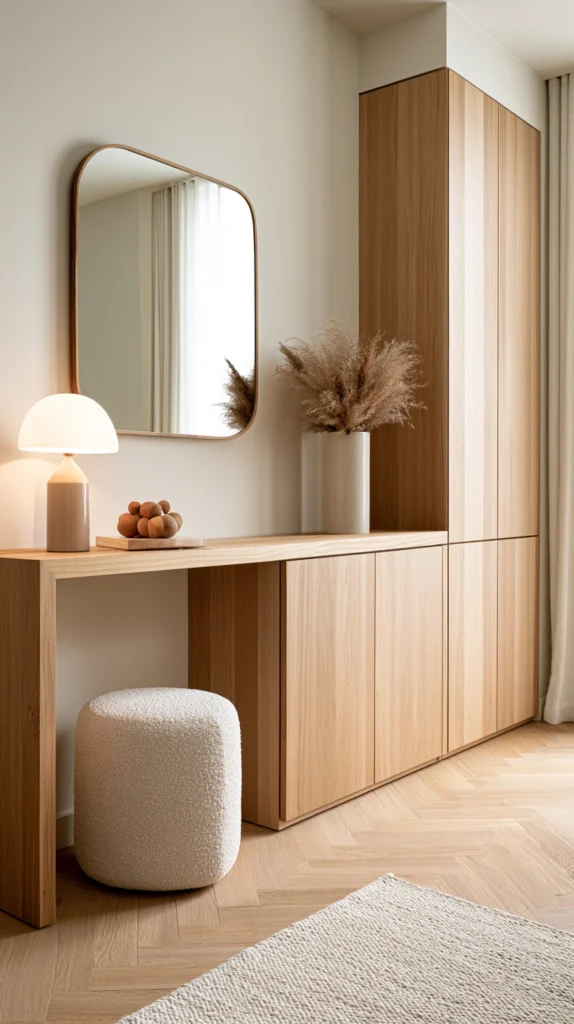
A large woven basket on the floor beside the console or bench, for shoes, bags, or outdoor gear that doesn’t have another home — the flexible catch-all for whatever the rest of the system doesn’t cover.
Why it belongs even with a bench or console in place
No storage system anticipates every object a household brings through the door. The floor basket is the flexible overflow — sports equipment one week, umbrellas the next — without those items ending up loose on the floor.
Sizing
- Diameter: 14–18 inches for a single basket, or two smaller baskets side by side for households with more daily gear
- Material: seagrass, rattan, or jute for texture that pairs with a console table’s wood tone
Cost breakdown
- Large woven basket: $35–70
- Total: $35–70
10. The Small Plant or Greenery
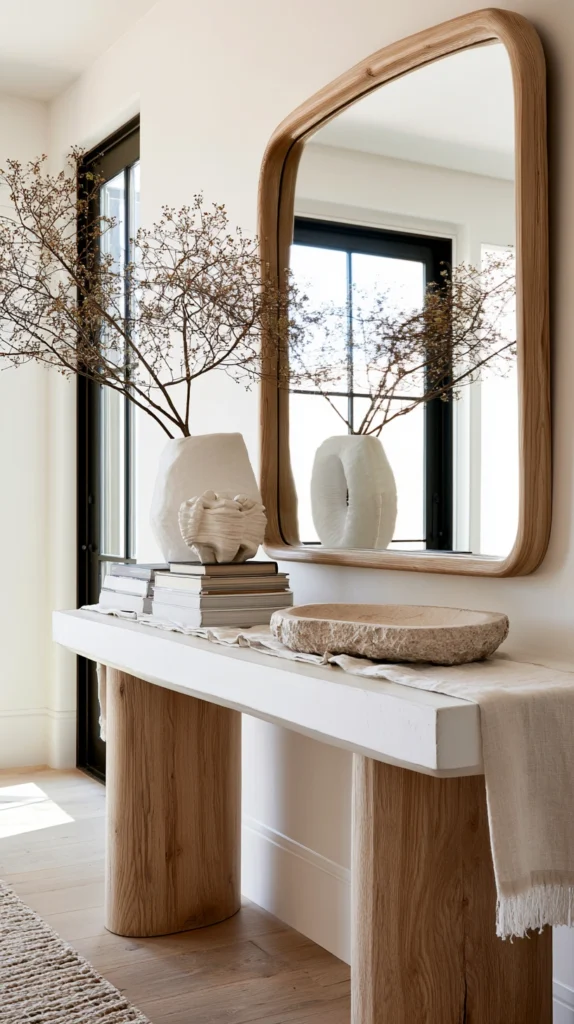
One plant in a floor-standing pot beside the console, or a small potted plant on the console itself — a living element that keeps the entryway from reading as purely functional.
Why a plant specifically
An entryway is often low in natural light and high in foot traffic, which rules out delicate plants. A resilient, structural plant survives those conditions and adds the one organic note most entryways are otherwise missing entirely.
Plant selection for low light and traffic
- Snake plant or ZZ plant for floor-standing height (both tolerate low light and infrequent watering)
- A smaller pothos or succulent for the console tabletop
Cost breakdown
- Floor plant with pot: $30–70
- Or small tabletop plant: $12–25
- Total: $12–70
11. The Seasonal Styling Rotation
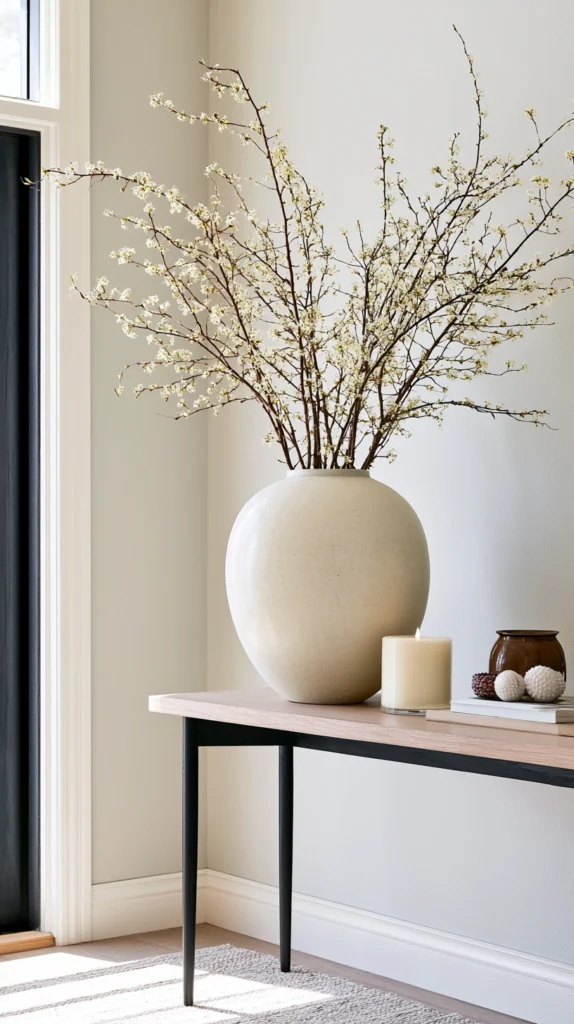
A small, changeable object or two on the console — swapped seasonally — that signals the entryway is actively maintained rather than set once and forgotten.
Why seasonal rotation matters here specifically
Because the entryway is seen daily, a static display becomes invisible within a week. A small seasonal change (a different candle scent, a seasonal stem in a vase, a changed tray colour) keeps the space feeling current without requiring a redesign.
What to rotate
- A single stem or small seasonal branch in a bud vase
- A candle in a seasonally appropriate scent
- A small textile change, such as a table runner beneath the tray
Cost breakdown
- Seasonal stems or branch: $8–15
- Candle: $18–35
- Total: $26–50 per season
12. The Slim Shoe Storage Cabinet
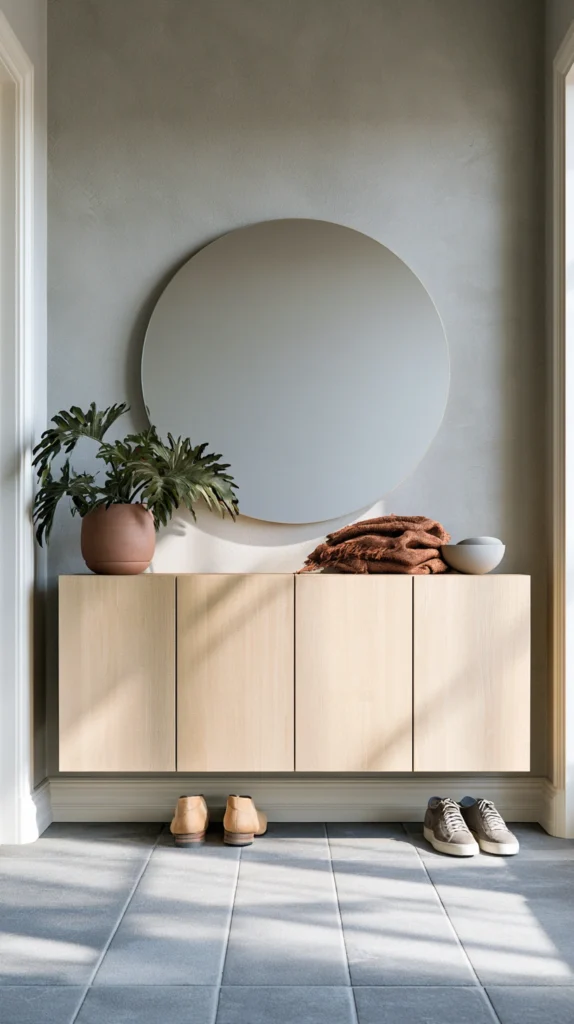
A narrow, closed-front cabinet along the entry wall, sized for the household’s daily shoe rotation — the solution for entryways where an open bench isn’t practical.
Why closed storage over an open shoe rack
An open shoe rack is functional but rarely photographs or feels finished, because shoes in daily rotation are visually busy by nature. A closed cabinet holds the same shoes with none of the visual noise.
Sizing
- Depth: 12–14 inches, shallow enough for a narrow hallway
- Width: sized to household size — roughly 24 inches per two to three pairs of shoes in daily rotation
- Height: knee to hip height, so the top surface can double as a landing spot
Cost breakdown
- Slim shoe storage cabinet: $90–220
- Total: $90–220
13. The Complete Put-Together Entryway
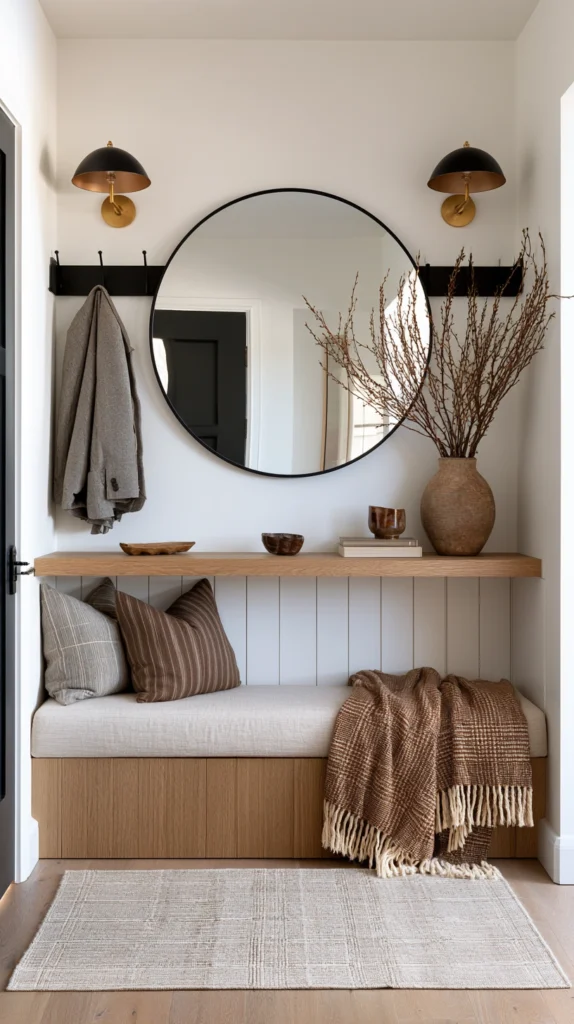
An entryway designed with every element above working together — the definitive version of a space that reads as finished the moment the door opens.
What separates the complete entryway from a collection of good pieces
An entryway with a beautiful mirror and a floor covered in loose shoes still reads as unfinished. The complete version resolves every category — landing surface, seating, storage, vertical element, and light — at the same time, so nothing is left for the eye to catch on.
The elements of the complete entryway
The landing zone:
- Console table sized to the hallway (Idea #1)
- Catch-all tray for keys and small items (Idea #6)
The floor:
- Layered entry and indoor rug (Idea #2)
- Woven basket for overflow (Idea #9)
The seating and storage:
- Storage bench or slim shoe cabinet, whichever suits the space (Idea #5 or #12)
- Wall-mounted hook rail above or beside it (Idea #3)
The vertical anchor:
- Mirror above the console, or a single framed art piece (Idea #4 or #8)
The light:
- Wall sconce or table lamp supplementing the overhead fixture (Idea #7)
The living detail:
- One resilient plant (Idea #10)
- Seasonal styling rotated on the console (Idea #11)
The entryway in use on an ordinary evening:
The door opens. Keys go into the tray without a search for somewhere to put them. Shoes come off at the bench and go into the basket beneath it. A coat goes on its own hook, not the one already holding three others. The lamp is already lit, warmer than the hallway light beyond it. The whole sequence takes under a minute and requires no decisions along the way — every object already has its place.
Cost breakdown for the complete entryway
Assuming a starting point of an unfurnished entry hallway:
- Console table: $120–320
- Layered rug: $90–190
- Hook rail: $35–70
- Mirror: $80–200
- Storage bench: $140–320
- Catch-all tray: $18–45
- Wall sconce or lamp: $35–140
- Woven basket: $35–70
- Small plant: $12–70
Total: $565–1,425
Phased over two or three stages:
Stage one ($150–300):
- Console table
- Catch-all tray
- Hook rail
Stage two ($200–400):
- Layered rug
- Mirror
- Wall sconce or lamp
Stage three ($200–700):
- Storage bench or shoe cabinet
- Woven basket
- Plant and seasonal styling
The complete entryway: not a single purchase but a small system, built one function at a time, until the eight-second impression takes care of itself.
The Question Before Any Entryway Redesign
Before buying a single piece:
What currently lands on the floor that shouldn’t?
If the answer is: shoes — the bench or slim shoe cabinet comes first.
If the answer is: keys, mail, and bags — the console table and catch-all tray come first.
If the answer is: coats — the hook rail comes first.
If the answer is: nothing lands on the floor, the space just feels flat — the mirror, art, and layered light are the answer.
The redesign follows the actual daily problem, not the most photogenic idea on the list. Solve the function first. The put-together look follows the function almost automatically once it’s solved.
Getting Started This Weekend
The immediate entryway fix:
Clear the floor down to zero loose items.
Everything currently on the floor gets a temporary home in a basket, even before the “right” storage arrives.
Add one tray to whatever surface is nearest the door.
Even a repurposed bowl works for the first week. Keys and small items go in it, not loose on the surface.
Hang one mirror or one piece of art at eye height.
The single vertical element that keeps the space from reading as flat.
Turn on a lamp instead of the overhead light for one evening.
Notice the difference before deciding whether to make it permanent.
The rest of the design: the elaboration of this weekend.
The system: the beginning. The put-together entryway: what stays organized once it’s in place.