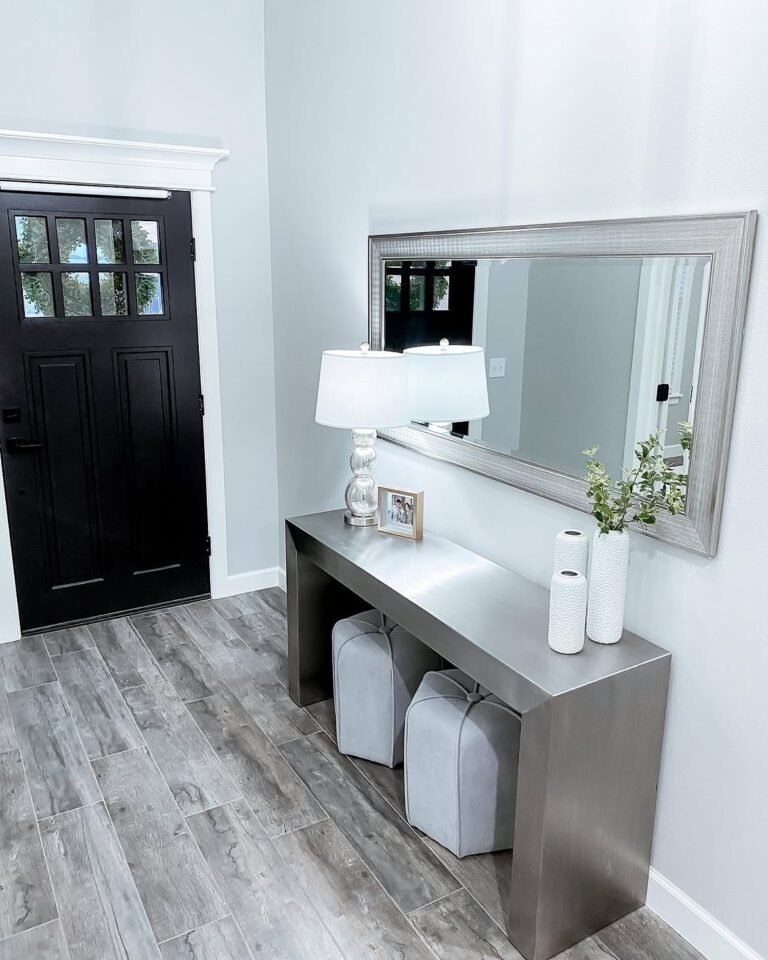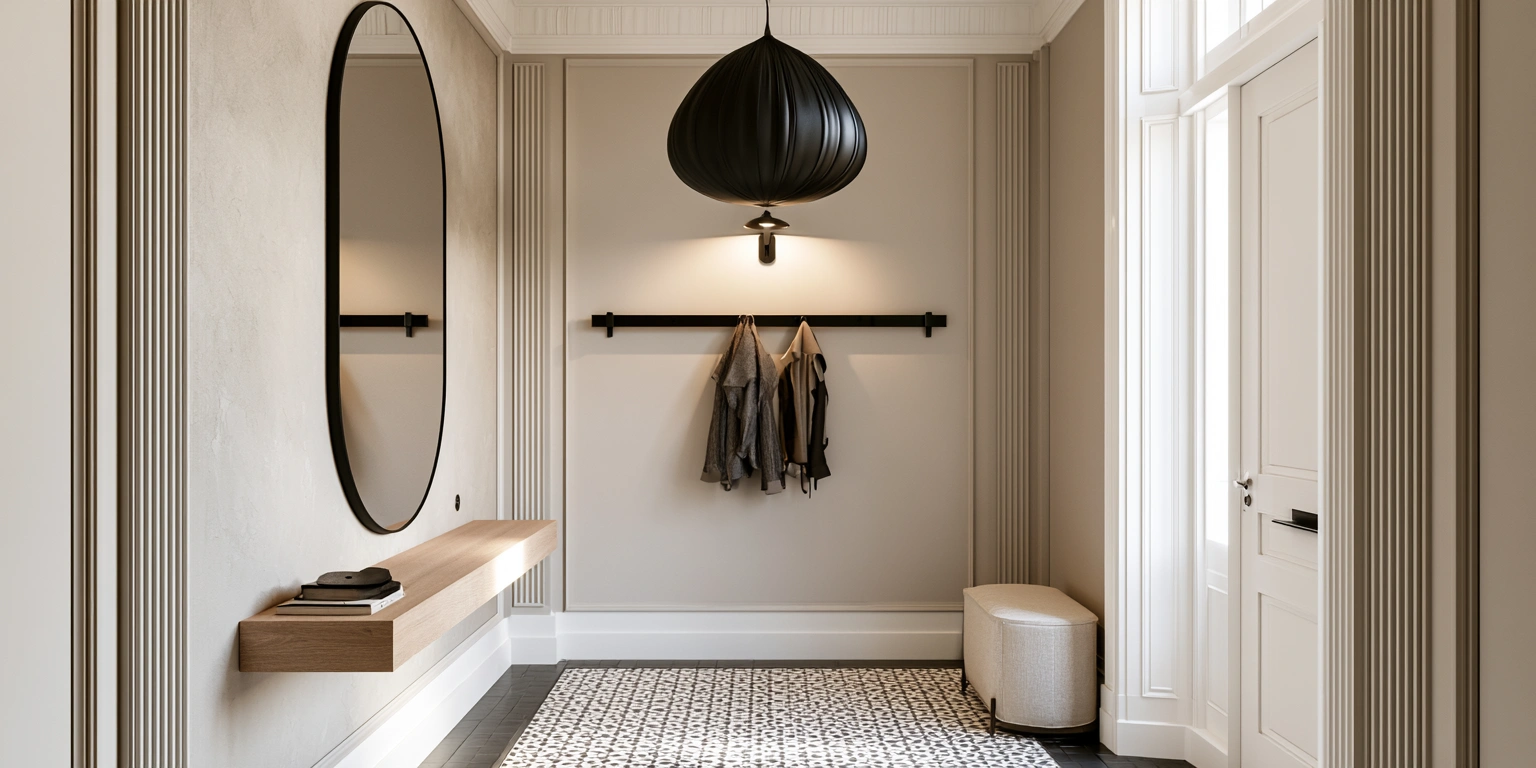
12 Small Entryway Ideas That Make a Big First Impression
12 Small Entryway Ideas That Make a Big First Impression
Most small entryways get treated as a problem to be minimized rather than a space to be designed. The thinking goes: it’s too small to do much with, so a bench that fits and a hook that holds coats will have to be enough. The goal becomes not making it worse rather than actually making it good.
That instinct produces exactly the kind of entry that feels like a compromise — not bad enough to fix, not good enough to be proud of. It holds coats. It has a mat. And every time someone walks in from outside, it reads as the house clearing its throat before the rooms that actually got decorated begin.
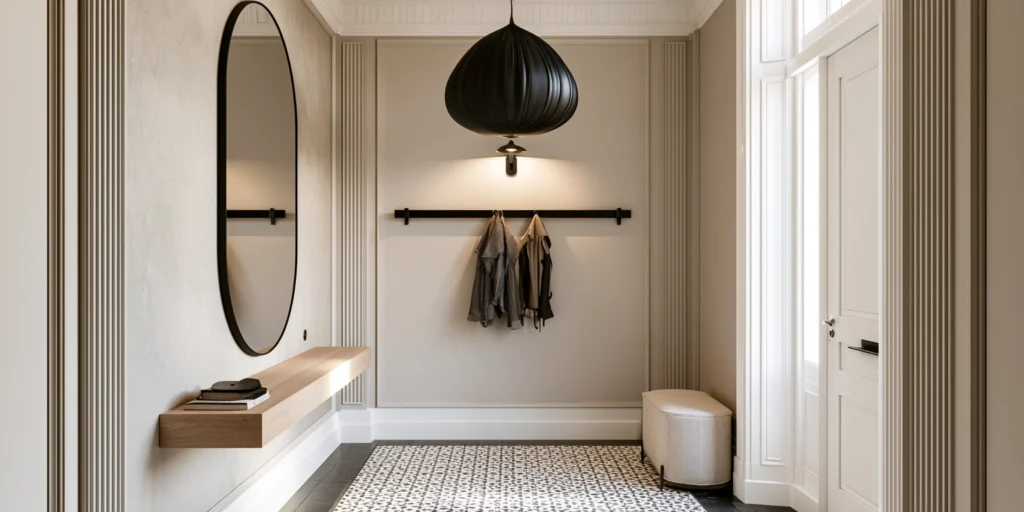
A small entryway doesn’t need more floor space to make a strong first impression. It needs the same thing every other small space needs: decisions made at a higher resolution than “it fits, so it works.” The right mirror in a 4-foot entry does more than the right sofa does in a 16-foot living room, simply because a small space amplifies every choice — both the good ones and the ones made by default.
Here are 12 ideas for a small entryway that punches well above its square footage.
Why a Small Entryway Plays by Different Rules Than a Larger One
The rules are not the same for a 40-square-foot entry and a 150-square-foot foyer:
Large Entryway Advantages:
- Room for a full console table, a seating bench, and a full mirror simultaneously
- Enough floor space that a slightly wrong choice can be absorbed without dominating the room
- Multiple walls that can each do their own thing without competing
The large entryway comparison: space absorbs mistakes and allows for multiple simultaneous decisions
Small Entryway Advantages and Realities:
- Every object carries more visual weight than the same object would in a larger room
- A single right choice — a correct mirror, a correct light, a correct paint decision — lands more powerfully than the same choice made in a room with many competing elements
- The speed of the experience, which a guest passes through in seconds, means impact-per-moment matters far more than breadth of styling
The key insight:
- A large entryway rewards a complete, multi-piece styling plan
- A small entryway rewards one or two extremely well-chosen things and the restraint to leave the rest alone
- These are different design problems, not the same problem with less room
The Scale and Sightline Reality
The most important factor in a small entryway:
The entry sightline:
- Most small entryways are experienced almost entirely from a single position: the door, just inside it
- What the eye lands on from that position is nearly the whole of what gets registered, since most people don’t explore a small entry the way they might settle into a living room
- Know this — it governs where the most important object or decision should be placed, directly on that sightline, rather than distributed across the space evenly
The “vertical over horizontal” calculation:
- Small entryways almost always have more ceiling than floor space to work with
- An 8-foot ceiling in a 4-foot-wide entry has more potential than the floor plan suggests
- Work vertically — tall mirrors, ceiling-mounted lights, hooks at multiple heights — before considering horizontal solutions that compete with the walking path
Most small entryway improvements happen in a deliberate sequence:
- The functional anchor — a hook system, a minimal console, a coat rack — gets established first, since a small entry that doesn’t function creates daily friction that no amount of styling resolves
- The visual focal point — a mirror, a light fixture, a piece of art — comes next, giving the entry a reason to look at rather than simply pass through
- The smallest finishing touches — a mat, a small plant, a candle — come last, filling the remaining space without cluttering a room where every inch is noticed
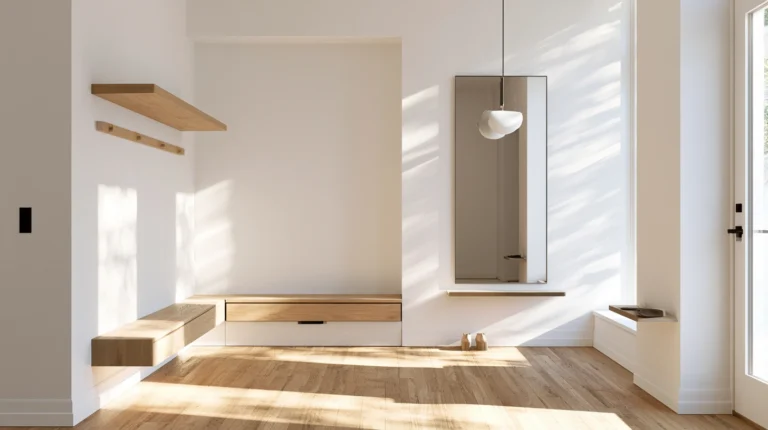
1. The Oversized Mirror (The Single Object Most Responsible for Making a Small Entry Feel Considered)
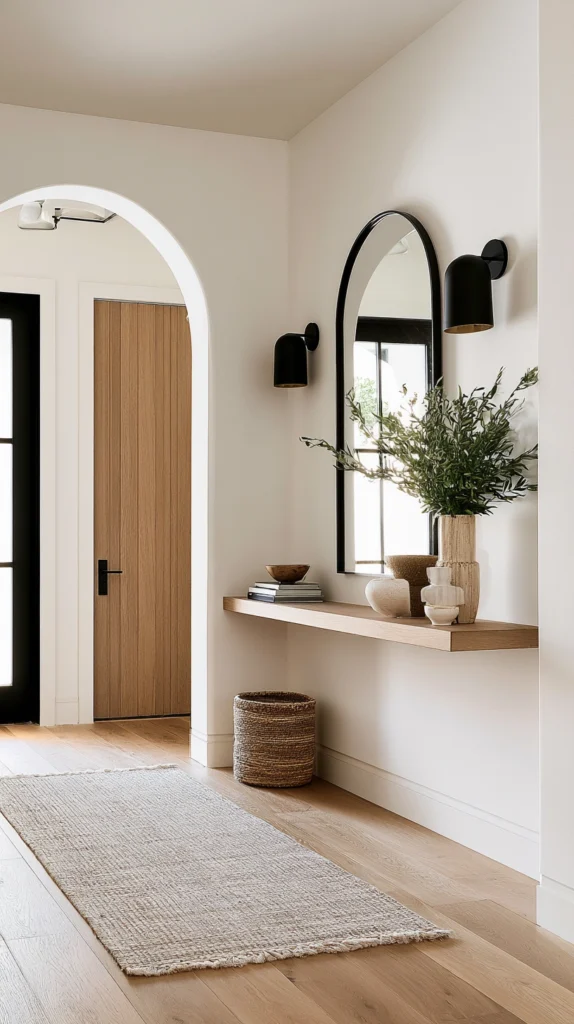
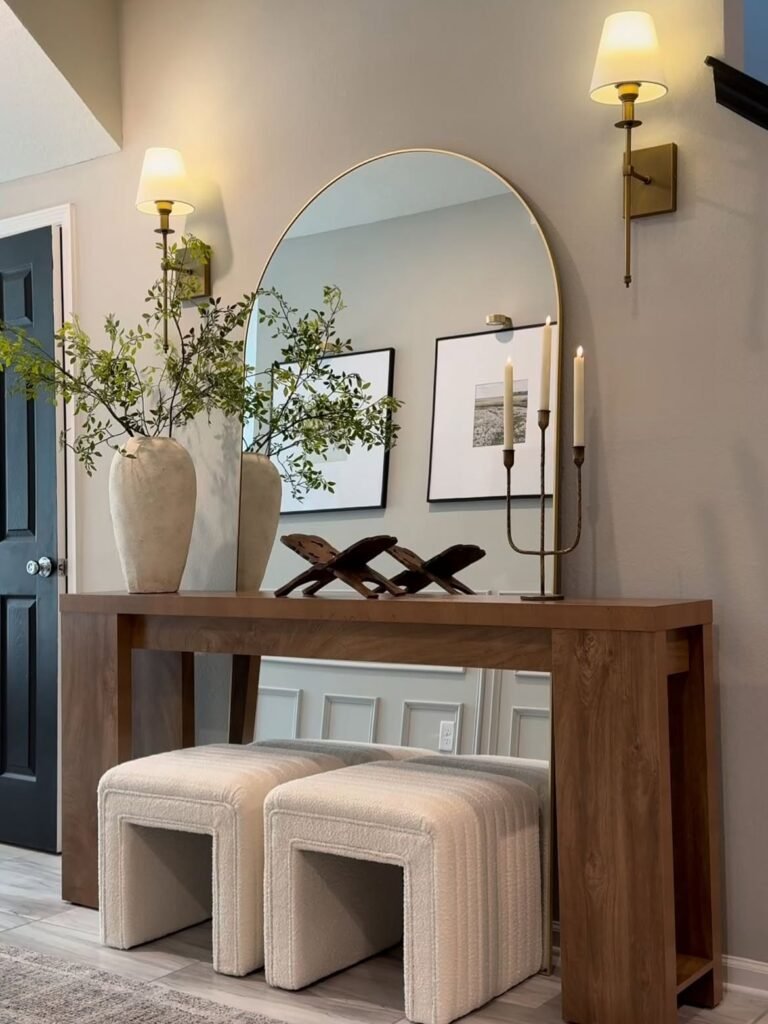
A mirror large enough to feel slightly unexpected in the space — larger than a guest might anticipate — hung on the entry’s main wall, doing the simultaneous work of reflecting light, creating visual depth, and providing the last-look surface every entry should offer.
Why the mirror size matters more in a small entry than anywhere else
- The visual depth it creates in a space that has almost no physical depth: a large mirror reflects the full entry back at itself, creating the perception of double the space in a room where the actual square footage provides none to work with
- The light-multiplication effect in an entry that typically has no window: most small entryways rely entirely on artificial light, and a large mirror amplifies that light throughout the space in a way a correct-sized mirror never quite achieves
- The focal-point function a single oversized object serves in a room with very little surface area: in a small entry, one large, intentional object reads as a design decision, while the same space fitted with several small objects reads as cluttered — the oversized mirror is the clearest expression of this principle
The options
- A large arched or round mirror, for a softer shape in a space already full of straight door frames and hard angles
- A leaning floor mirror, for an entry with enough floor depth to accommodate it, adding casual height with no installation required
- A full-width mirror running nearly the entry wall’s complete horizontal span, for the most dramatic light-and-space expansion
- A vintage or uniquely framed mirror, since the frame’s character carries more styling impact per dollar in a small space than it would in a room where many other objects compete for attention
The practical execution
- Size the mirror to roughly two-thirds to three-quarters the width of the wall it hangs on, rather than the smaller fraction that typically reads as “correct” in a larger room
- Hang slightly lower than standard living room height, since entry mirrors get used at close range and by people whose primary position is standing near the door rather than sitting on a sofa across the room
- Anchor securely into studs, since a large mirror in an entry is positioned where it will be touched and leaned near more than a piece of art in a living room would be
Cost breakdown
- Budget large mirror: $50–100
- Mid-range statement mirror: $120–300
- Total: $50–300
The oversized mirror on the entry wall: the one object most likely to make a guest stop and register that the entry was actually decorated, rather than simply functional.
2. The Statement Light Fixture (The Ceiling as a Design Surface in a Tiny Room)
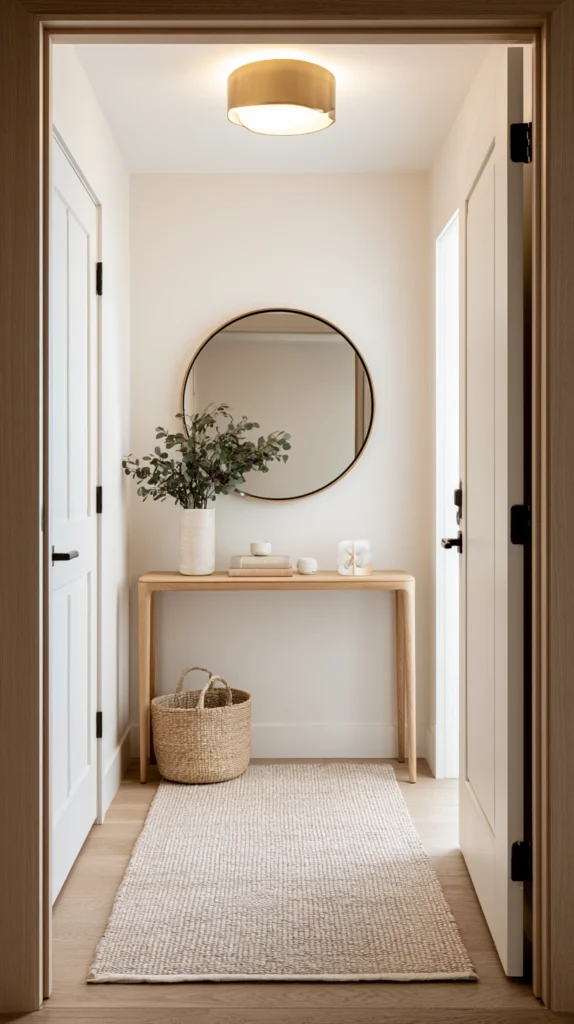
A pendant, small chandelier, or interesting flush-mount installed in the entry ceiling — the choice that turns the overhead function of lighting into an active design decision in a room where the ceiling is one of the few surfaces large enough to hold something with real presence.
Why an entry light fixture carries disproportionate weight
- The entry ceiling’s visibility from the one position everyone occupies: standing at the door, looking in, the ceiling of a small entry is nearly always in the field of view, making the ceiling fixture one of the most consistently noticed objects in the space
- The complete room-changing effect a fixture swap delivers relative to its cost: replacing a builder-grade flush-mount with something interesting costs relatively little and changes how the entire ceiling reads, which in a small entry means changing how the entire room reads
- The first-impression timing that makes ceiling fixtures specifically important here: a guest registering the entry in a few quick seconds takes in the ceiling light as part of their initial, compressed scan of the space, giving it more relative influence than a fixture in a room where attention gets distributed across many surfaces
The options
- A small statement pendant, if the ceiling is high enough to clear anyone walking through
- A sculptural flush-mount, for low ceilings where a pendant would be a clearance problem
- A lantern-style pendant, fitting naturally in an entry where a more period-appropriate aesthetic is part of the direction
- A cluster of small pendants at varying heights, for an entry with a taller ceiling that can support more fixture volume
The practical execution
- Confirm ceiling height before choosing a pendant, since a fixture that requires ducking to enter the space creates a very different first impression from the one intended
- Choose warm-toned bulbs specifically — 2700K maximum — since an entry lit by a cool white fixture reads as clinical rather than welcoming at the one moment in the house where warmth of reception matters most
- Install a dimmer on any entry fixture where one doesn’t already exist, since the ability to lower entry lighting for evening arrivals changes the space’s atmosphere dramatically for minimal additional cost
Cost breakdown
- Statement flush-mount: $60–150
- Small pendant: $80–200
- Dimmer switch addition: $15–35
- Total: $60–235
3. The Hooks Done Right (The Function That Determines Whether the Rest of the Entry Works)
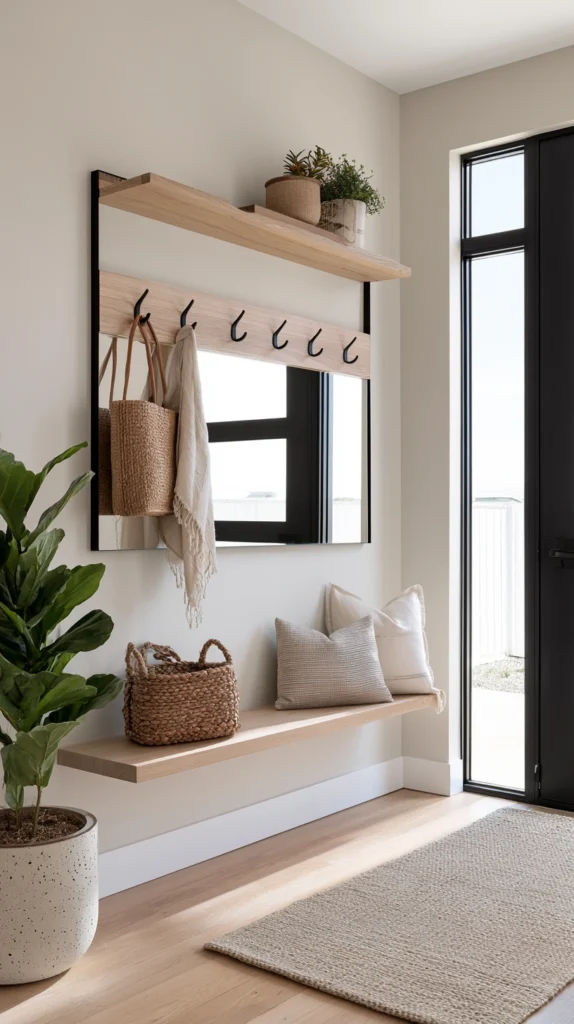
A dedicated hook system — a rail, a panel, or a row of individual hooks — installed at a height and in a finish that reads as a deliberate choice rather than a coat crisis solution.
Why hooks deserve more attention than most entries give them
- The daily-use reality that hooks face but most decor doesn’t: a hook rail in an entry is touched by every household member multiple times every day, which means its quality, its finish, and its placement are noticed constantly in a way that artwork or a mirror might not be
- The visual clutter that wrong hooks create in a space too small to absorb it: a row of ill-positioned hooks with coats and bags hanging at inconsistent heights can overwhelm a small entry’s visual field in a way the same storage would barely register in a mud room
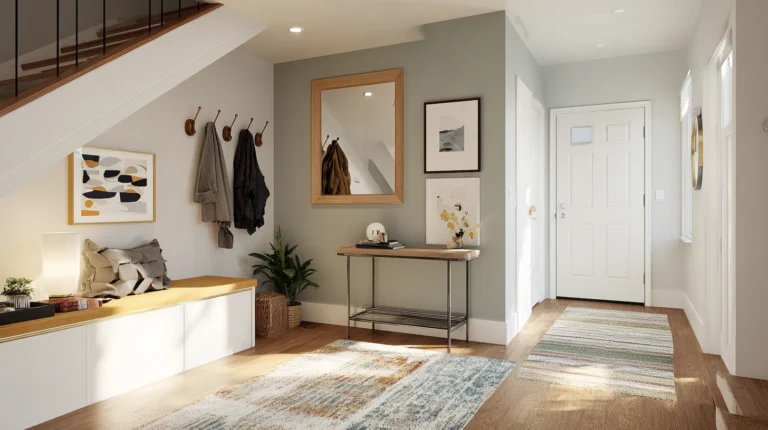
- The styling opportunity the right hook system provides: a well-chosen hook rail in a complementary metal finish, properly positioned and at the right scale for the wall, can read as part of the entry’s design rather than a functional afterthought hung after the fact
The options
- A continuous hook rail, the most visually tidy option, with hooks spaced evenly along a single horizontal line
- Individual statement hooks, in a consistent finish but varying shapes, for a more deliberately curated look
- A shaker-peg rail, for an entry leaning toward a more classic or farmhouse aesthetic
- A hook rail positioned at two heights, one standard for adult coats and one lower for kids’ bags and coats, accommodating a family household’s full range of daily needs
The practical execution
- Mount into studs specifically, given the weight of coats, bags, and umbrellas that will hang from this system daily
- Position the rail or hooks 60–68 inches from the floor for adult use, ensuring coats clear the floor even for longer wool overcoats
- Choose a finish that coordinates with the entry’s other metal — the door hardware, the mirror frame, the light fixture — rather than introducing a second competing metal into a room too small to absorb the contrast
Cost breakdown
- Hook rail with 4–6 hooks: $30–80
- Individual statement hooks, a set of 4–6: $25–70
- Total: $25–80
4. The Slim Console Table (Surface Without Sacrifice)
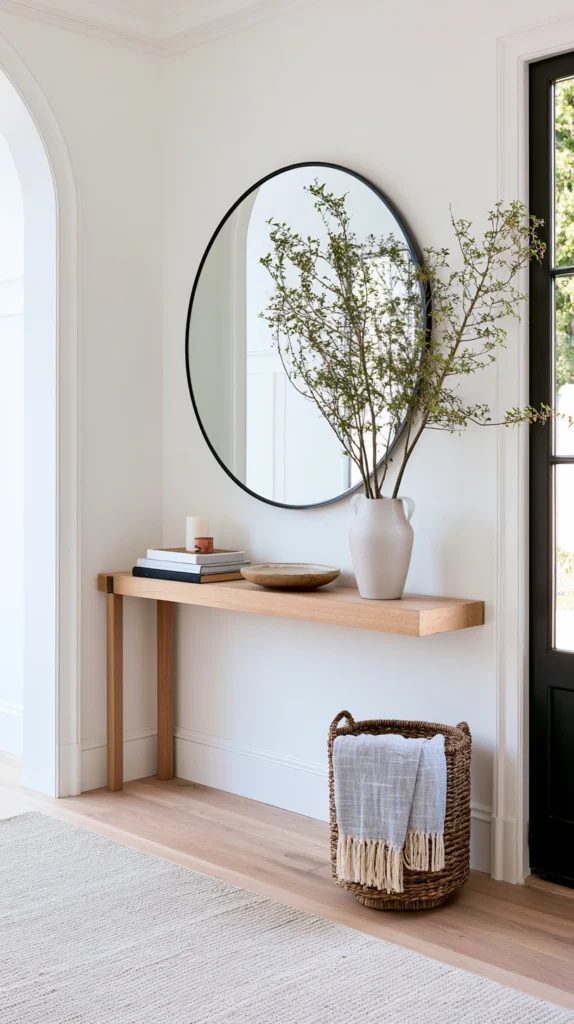
A console table no deeper than 12–14 inches, positioned against the entry’s main wall, providing a surface for a small vignette, daily drop items, and the objects that give the entry its visual identity.
Why a shallow console solves the small entry’s hardest problem
- The walking-clearance problem that depth creates in a narrow entry: a standard console at 16–18 inches deep can consume a meaningful fraction of an already tight walking path, while a 12-inch console provides the same surface functions without meaningfully narrowing the space
- The single-surface vignette opportunity a console creates: in a room with very few horizontal surfaces, a console table provides the one spot where a considered arrangement of objects can establish the entry’s character without being on the floor or mounted on the wall
- The furniture-scaled object that grounds a small entry: without some piece of actual furniture, even a well-mirrored and well-lit entry can read as a large closet rather than a room — a console, however slim, establishes the entry as a space with furniture in it
The options
- A demilune (half-moon) console, whose curved front face takes up less visual space than a rectangular alternative while still providing full surface use
- A floating shelf at console height, for the absolute minimum footprint version of the same surface function
- A small antique or vintage chest, for an entry that can support a slightly more substantial footprint in exchange for storage the slim console doesn’t provide
- A wall-mounted drop-leaf table, which can be folded flat against the wall when not in active use
The practical execution
- Measure the entry’s walking clearance precisely before buying, confirming that the chosen console depth leaves at least 36 inches of clear floor for two people to enter and exit comfortably
- Style the console surface simply and with restraint, since a small console in a small entry tips from styled to cluttered with fewer objects than a larger surface would require
- Leave some open space on the console surface deliberately, both for actual daily use and because a small entry’s console reads as more considered with some surface visible than one covered edge to edge
Cost breakdown
- Slim console table, budget: $80–160
- Mid-range slim console: $200–450
- Total: $80–450
5. The Wallpaper Moment (The Pattern Punch a Small Room Can Support More Easily Than a Large One)
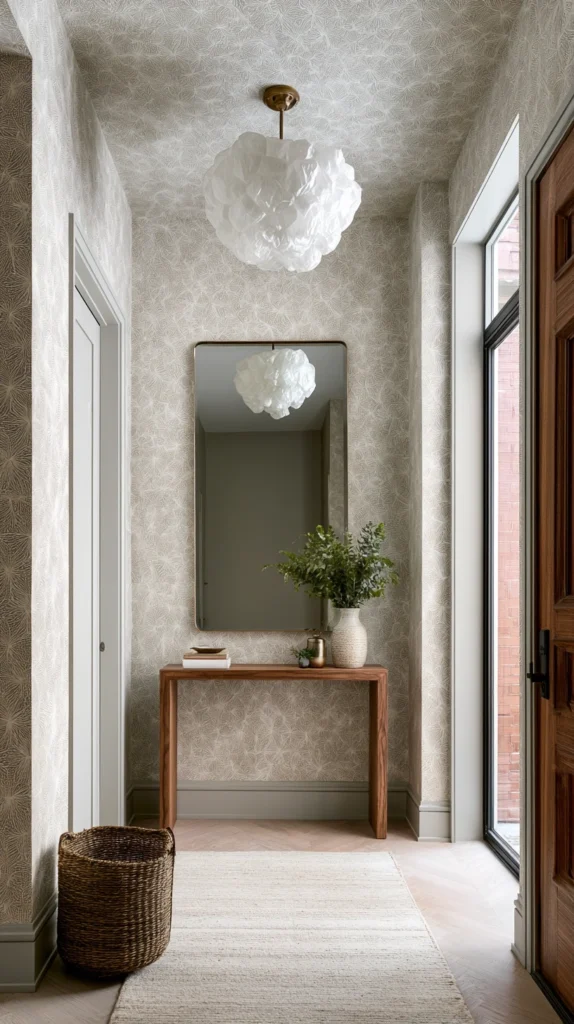
A wallpaper applied to the entry’s main wall, or to all four walls of a small enclosed entry — a design decision that large rooms often shy away from but small ones can carry completely, since containment is part of what makes a bold pattern work.
Why a small entryway is the best room in the house to try wallpaper first
- The containment principle that benefits bold pattern specifically: a wallpaper that might overwhelm a large, open living room reads as intentional and completely resolved in a small, enclosed entry, because the pattern fills a bounded space rather than competing with sightlines to adjacent rooms
- The square footage that makes wallpaper’s cost manageable: papering a 4×6-foot entry requires a fraction of the rolls and a fraction of the installation time of any larger room, making a higher-cost pattern genuinely affordable where it would otherwise be a significant investment
- The first-impression positioning that makes the entry wallpaper the most-seen wallpaper in the house: a guest who enters an entryway registers the wallpaper immediately and directly, with no competing surfaces or objects to dilute the impact
The options
- A large-scale botanical or jungle print, for the most dramatic pattern-in-a-small-space effect
- A classic toile or geometric pattern, for a more contained, traditional take on the same principle
- A textured grasscloth or linen wallpaper, adding material texture rather than pattern, for an entry that wants warmth without visual complexity
- A mural-style wallpaper, treating the entry’s main wall as a single artwork surface rather than a pattern-repeated installation
The practical execution
- Measure the entry’s walls carefully and account for doors, light switches, and any built-in elements before ordering, since small rooms often have less usable wall area than their footprint suggests
- Hire a professional installer for complex patterns requiring significant pattern matching, since a mismatched seam in a 4-foot-wide entry is more visible than the same misalignment in a wider room
- Test any wallpaper sample in the entry’s actual lighting before ordering, since entry lighting conditions, often without natural light, can shift pattern colors significantly from how they appear in daylight
Cost breakdown
- Budget peel-and-stick wallpaper for a small entry: $30–80
- Mid-range wallpaper, materials for a small entry: $80–250
- Professional installation: $200–500
- Total: $30–750, depending heavily on the wallpaper chosen and whether installation is DIY
6. The Bench or Seat (The Practical Object That Signals Hospitality)
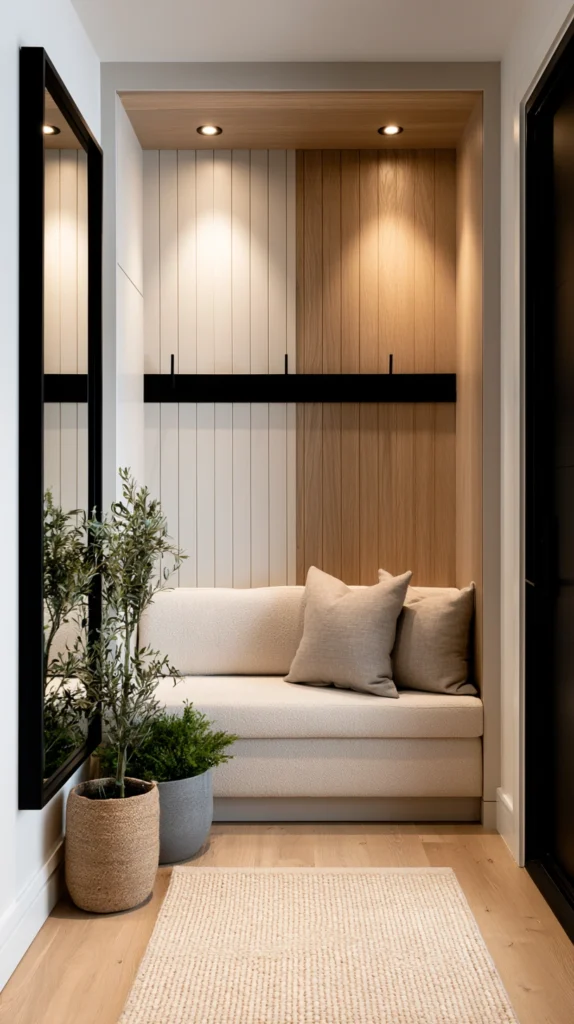
A small bench or upholstered stool, positioned to allow someone to sit while putting on shoes — the piece of furniture that signals, more than any decorative object, that the entry was designed for the people who use it.
Why a seat communicates something other furniture can’t
- The hospitality signal a seat sends before a word is spoken: a bench at a doorway says “you are welcome to take a moment here” in a way that a console table with a styled vignette, however beautiful, doesn’t quite communicate
- The functional value that justifies its footprint in a tight space: unlike a console table that serves primarily aesthetic purposes, a bench solves a real daily problem — the difficulty of putting on boots or shoes standing unsupported — giving it a function-to-footprint ratio that makes it worth the space it takes even in a tiny entry
- The texture and warmth it contributes at the lowest visual level: a bench with an upholstered seat or a throw draped over it introduces softness at floor level in a room otherwise composed of hard surfaces, wall, door, and tile
The options
- A small upholstered bench with no back, the most flexible option that works in the narrowest spaces
- A storage bench with a lift-top seat, adding hidden organization capacity alongside the seating function
- A wooden stool or two, for an entry that can’t support a full bench footprint but benefits from any kind of seat
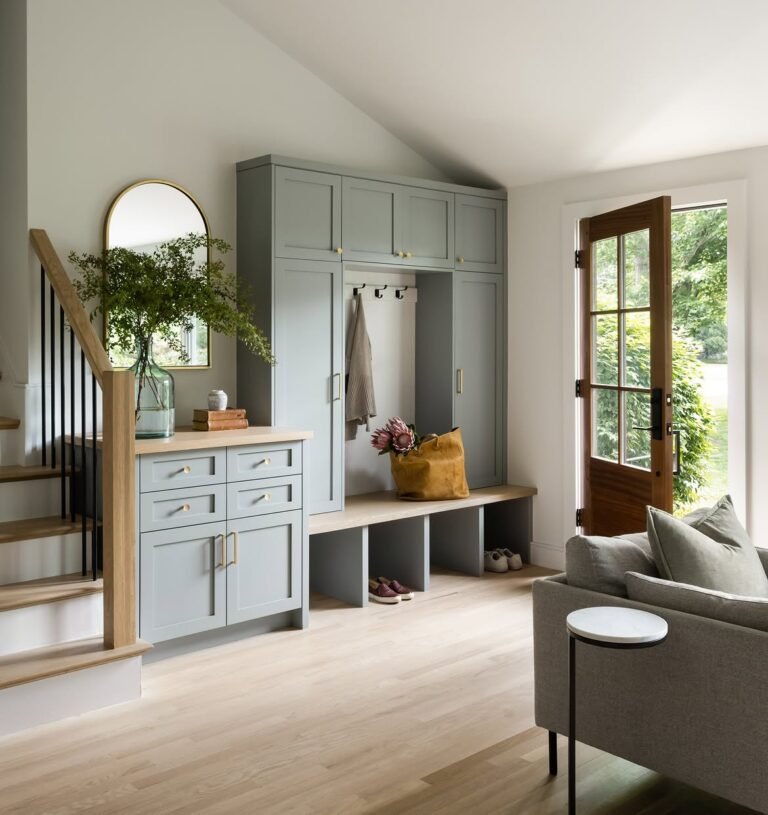
- A bench integrated into a built-in coat-and-hook unit, combining the seating function with the hooks from Idea #3 into a single, space-efficient installation
The practical execution
- Size to leave the entry’s main walking clearance unobstructed when the bench is occupied — someone sitting should not block another person from entering or exiting
- Choose a seat height of 17–18 inches for the most universally comfortable seated position for boot and shoe use
- Add a small basket or crate beneath an open bench, turning the floor space beneath it into additional storage without requiring a built-in solution
Cost breakdown
- Simple small bench: $60–150
- Storage bench: $120–300
- Total: $60–300
7. The Layered Rug and Mat Combination (Ground-Level Color and Texture in a Space Where the Floor Is Almost All There Is)
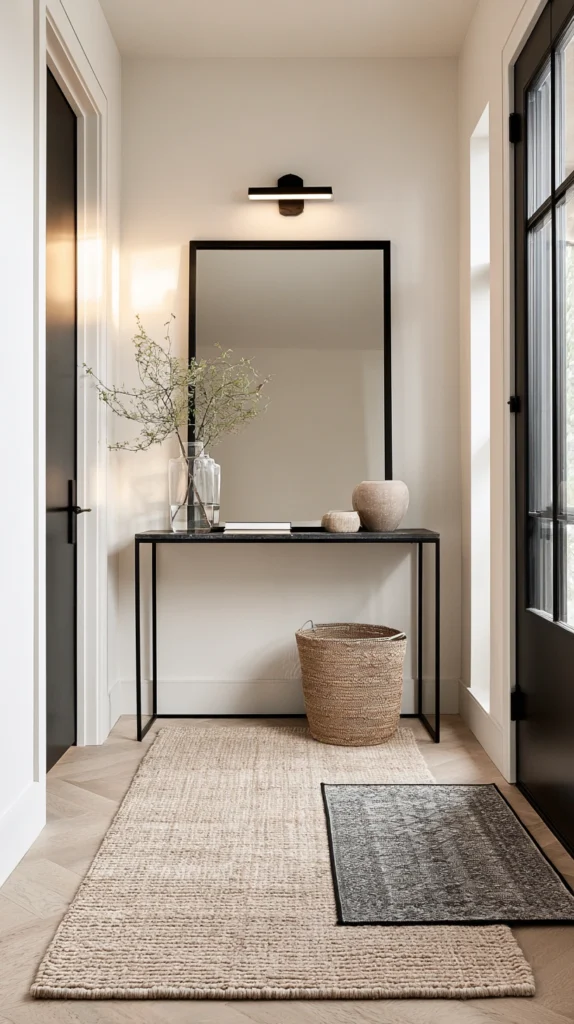
An outdoor-rated or washable rug layered beneath a smaller, more decorative accent mat — or a single well-chosen rug replacing the generic single mat that most entries default to — the flooring decision that grounds the entire entry’s color story at the level every visitor literally steps on.
Why the entry rug matters more here than in any other room
- The forced-interaction factor: unlike a rug in a living room that people walk to the edge of and stop, an entry rug is stepped on directly by every person who enters, making its color, texture, and condition felt immediately and personally
- The full-floor coverage a rug can achieve in a small entry: in a larger room, a rug defines a zone within a larger floor area; in a small entry, the right rug covers most or all of the visible floor, giving flooring decisions a room-spanning influence they rarely have elsewhere
- The color-palette anchor a rug establishes for the entire entry: in a room with very few objects, the rug’s color is often the entry’s dominant color note, and that note sets the tone for everything placed above it
The options
- A single large rug sized to the full entry floor area, rather than the undersized mat most entries default to
- A runner in a bold or distinct pattern, using length to make a visual statement in a space where width may be limited
- A layered approach, with a neutral jute or sisal base beneath a smaller, more colorful or patterned accent piece
- A washable rug specifically rated for entry use, since entry floors take more abuse than any other room and the rug needs to handle mud, water, and heavy cleaning without losing its appearance
The practical execution
- Size the rug generously relative to the entry floor area, since the single most common entryway rug mistake is choosing one too small
- Use a non-slip rug pad beneath any rug on a hard entry floor, both for safety and to keep the rug from shifting under the constant, directional foot traffic of an entry
- Clean or replace the entry rug more frequently than rugs elsewhere in the house, since it accumulates dirt and wear faster than any other floor covering in the home
Cost breakdown
- Washable entry rug: $40–120
- Runner for a narrow entry: $30–100
- Total: $30–120
8. The Strategic Plant (One Living Object That Changes the Entry’s Whole Energy)
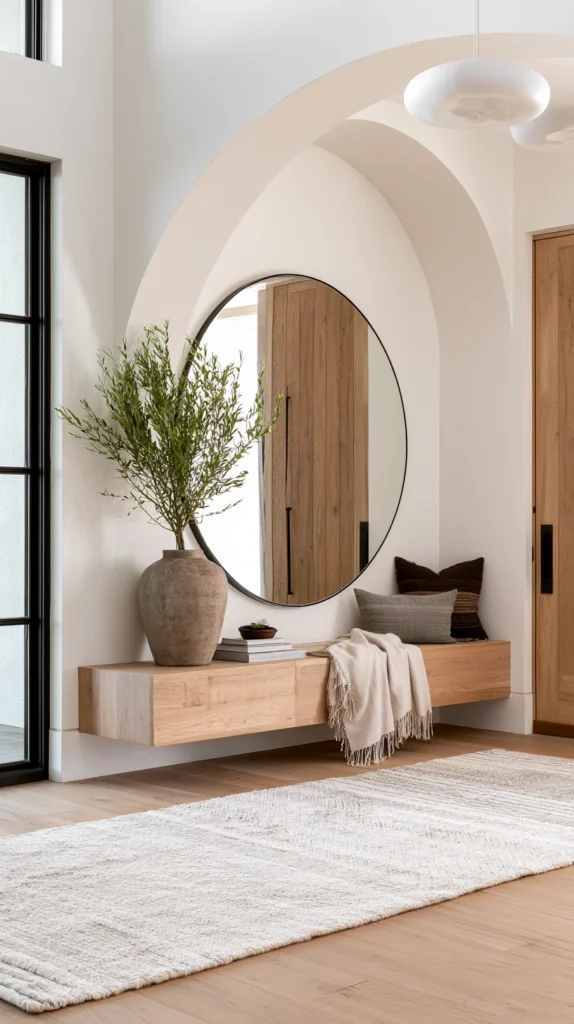
A single plant — well-chosen for the entry’s specific light conditions and appropriately sized for the available space — positioned in the entry where it introduces the only living, organic element in an otherwise hard-surfaced space.
Why a single plant lands differently in a small entry than a collection would
- The amplification effect a small space has on a single object: one well-placed plant in a 4-foot entry has the presence of three plants in a larger foyer, simply because it occupies proportionally more of the visible field
- The living-quality that no other material or object can contribute: a plant introduces visible growth and change into a space that would otherwise be entirely static, creating the sense of a living environment rather than a dressed storage area
- The light-indicator function a plant serves for the entry’s otherwise less-obvious lighting conditions: a plant that thrives in the entry is a demonstration of its light conditions, while a plant that struggles there makes the same point less pleasantly
The options
- A tall, narrow fiddle-leaf fig or snake plant, for an entry with reasonable light, contributing architectural height on a small floor footprint
- A trailing pothos, in a hanging planter or on a high shelf, using vertical rather than floor space for the plant’s growing volume
- A ZZ plant or cast iron plant, for a windowless entry that needs a genuine low-light-tolerant option rather than a plant that’s simply tolerant
- A single statement orchid, for a very small entry where a larger plant isn’t practical, using the orchid’s inherent elegance to carry the same visual weight
The practical execution
- Assess the entry’s actual light level honestly rather than hopefully, since a plant chosen for a sunlit entry and installed in a windowless one declines in a way that undermines the entry rather than enhancing it
- Position the plant where it won’t narrow the walking clearance, since a plant in an already-tight entry is only an improvement when it adds to the visual experience rather than becoming a physical obstacle
- Use a cache pot or a decorative outer pot sized to complement the entry’s other materials, since a plant in a grower’s plastic container in an otherwise considered entry reads as incomplete
Cost breakdown
- Small to medium houseplant: $15–40
- Decorative cache pot: $15–35
- Total: $30–75
9. The Tray and Vignette System (The Drop Zone Made Into a Style Moment)
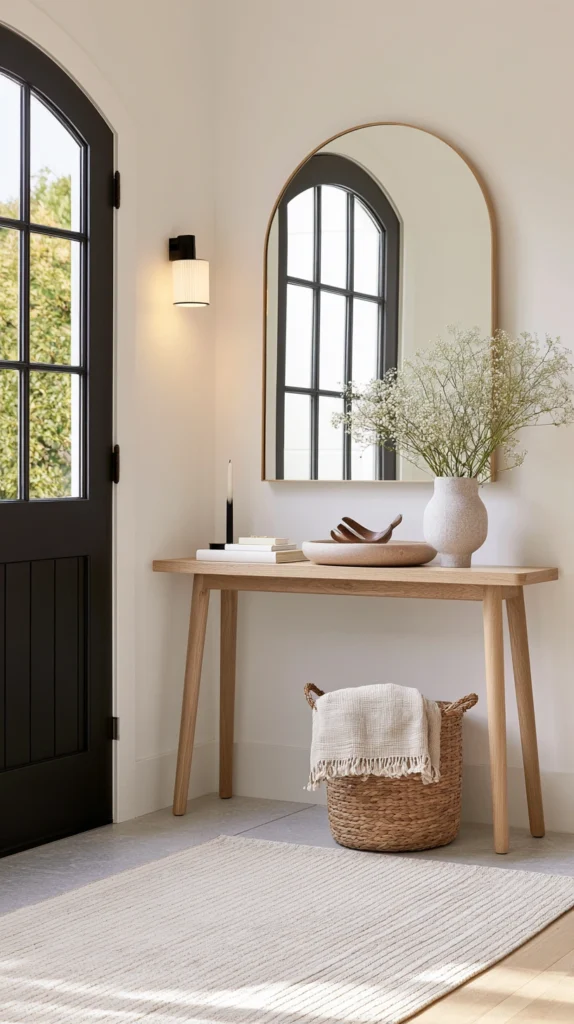
A small tray or dish on the console or a wall shelf, holding keys and daily essentials, paired with two or three other small objects at varying heights — a candle, a small vase, a decorative piece — turned into a deliberate vignette rather than a random accumulation of whatever lands there.
Why a tray vignette specifically matters in a small entry
- The organizational function that makes the rest of the styling sustainable: a tray gives daily drop items — keys, sunglasses, mail — a designated home, which means they’re contained rather than scattered across the entire console surface and undermining the entry’s overall appearance
- The styled composition a vignette creates from a small number of objects: in a small entry, the vignette on a console table is often the entry’s most detailed close-up styling, seen clearly by guests who are close enough to read it at the natural viewing distance of the entry
- The height variation a small group of objects introduces at counter level: a tray beside a small candle beside a bud vase with a single stem creates exactly the kind of low-level height composition that an entry’s focal point benefits from
The options
- A round ceramic or wooden tray, holding a key dish, a small candle, and a single decorative object
- A small book stack used as a riser, elevating one item within the grouping to create height variation without an additional piece of furniture
- A seasonal object swap, treating the vignette as the one element in the entry that changes with the seasons while the larger, more permanent elements stay constant
- A single-object vignette, for the smallest entries where even a few objects feel like too many — one perfect object on an otherwise empty surface reads as more sophisticated than a busy grouping
The practical execution
- Edit ruthlessly and continuously, since the tendency in any tray is for items to accumulate beyond the original intention, and a tray overflowing with miscellaneous daily objects has the opposite effect from the one intended
- Vary the height of the three or so objects in any grouping deliberately, using even a small height difference between pieces to give the composition visual movement
- Anchor the vignette with the tray itself, not just with the objects on it — a tray beneath a vignette makes it look placed, while the same objects without a tray look dropped
Cost breakdown
- Small ceramic or wooden tray: $15–35
- Small candle: $12–25
- Total: $27–60
10. The Ceiling Height Trick (Using Curtain Rods and Vertical Elements to Make Eight Feet Feel Taller)
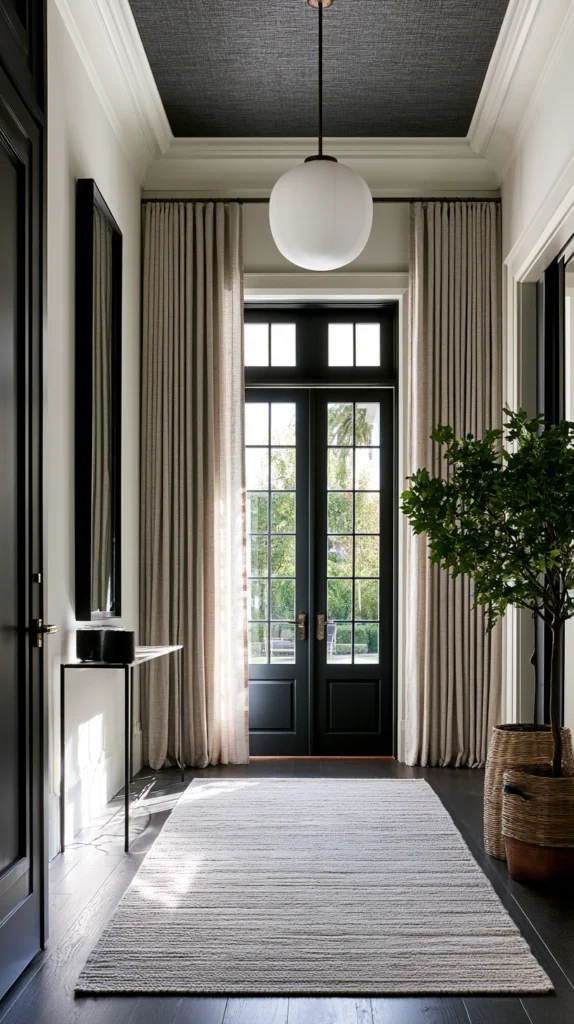
Curtain rods or picture rails mounted at ceiling height, panels hung from above rather than from directly over a window or door, and any vertical element in the entry positioned to lead the eye upward rather than across.
Why vertical elongation specifically helps a small entry
- The psychological height-expansion that top-mounted verticals create: a curtain panel hung from the ceiling and pooling at the floor, even when covering only a doorway or a narrow coat alcove, makes the ceiling read as taller than it is in the same way high-mounted curtains in a bedroom do
- The dimension a small entry often has that it’s not using: a tight entry with 8-foot ceilings has twice the vertical space of a horizontal space but typically uses only one-third of it with hooks, a console, and a small mirror
- The specific application of a ceiling-hung curtain for a coat or storage area: a curtain hung from ceiling level in front of a small coat closet or storage nook conceals the storage entirely while making the entry feel taller rather than shorter, a double improvement from a single vertical element
The options
- A ceiling-mounted curtain track, with a simple panel concealing a coat area or an awkward alcove
- Tall, narrow artwork hung as close to the ceiling as possible, drawing the eye upward along the full wall rather than stopping it midway
- A tall, narrow mirror, using its vertical dimension rather than its horizontal span as the primary design element
- A vertical stripe treatment in paint or wallpaper, for the most architectural version of this visual elongation technique
The practical execution
- Mount any curtain track or rod within 2–3 inches of the ceiling for the most effective ceiling-height illusion, since a rod mounted at standard window height defeats the vertical purpose entirely
- Choose panels in a single solid color or a subtle texture rather than a bold pattern, since vertical panels serve primarily as a backdrop that allows the ceiling line to read clearly
- Use a fabric that falls cleanly without bunching, since a curtain in a tight entry that bunches at the sides adds visual complexity a small room doesn’t have room to absorb
Cost breakdown
- Ceiling-mounted curtain track: $30–80
- Simple curtain panels: $30–70
- Total: $60–150
11. The Paint Color Decision (The One Choice That Affects Every Inch of Every Surface Simultaneously)
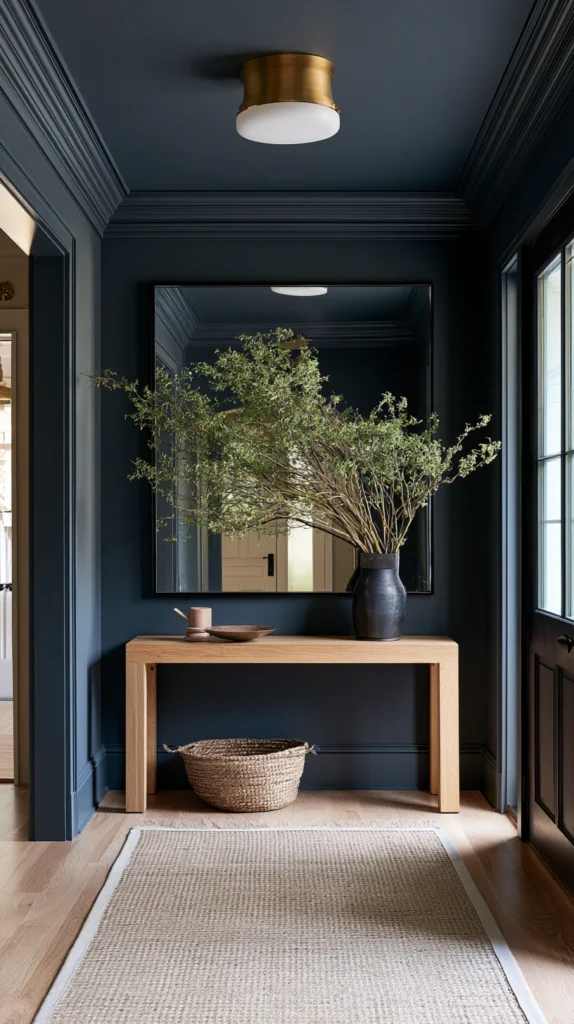
A deliberate, specific paint color applied to the entry — whether a deep, saturated tone for a moody entry or a bright, specific color to announce the house’s personality — chosen because it was decided on rather than because it was already there.
Why the entry is where the paint decision matters most
- The total-surface-coverage a single paint choice achieves in a small entry: unlike a large room where paint is one of several visual elements, a small entry is mostly its walls — choosing the paint color is almost choosing the room’s character entirely
- The first-impression positioning that gives the entry’s color more influence per decision than the same color would have in a larger, more object-filled room: guests register the entry’s color before anything else, and it sets the tone for the whole house that follows
- The small-room logic that allows bolder color choices to work here more easily than elsewhere: the same deep forest green that might feel overwhelming in a large living room resolves perfectly in a small, contained entry, because the containment of the space is what makes a saturated color feel intentional rather than oppressive
The options
- A deep, saturated jewel tone, using the entry’s small scale to commit to a color the rest of the house might not be able to carry
- A bright, specific white — not builder beige, not accessible gray, but an actual chosen warm white — for an entry where the goal is maximum light reflection rather than color presence
- A color that bridges the entry to the first room it opens into, creating a visual connection between spaces that makes the home feel more cohesive
- A painted ceiling in a contrasting or coordinating color, treating the “fifth wall” as part of the color plan rather than an afterthought
The practical execution
- Test paint samples specifically in the entry’s own lighting and at different times of day, since entry lighting conditions, often without natural light, shift color significantly from daytime natural light conditions
- Apply the chosen color to all four walls and the ceiling if pursuing the deep jewel-tone approach, since painting only some surfaces in a small, enclosed space creates an unresolved feeling that full coverage resolves
- Address the trim and baseboard at the same time, since the contrast between a deliberate wall color and a builder-white trim is part of what makes the wall color read as intentional rather than accidental
Cost breakdown
- Paint for a small entry (1–2 gallons): $40–130
- Total: $40–130
12. The Scent and Seasonal Touch (The Detail That Completes an Entry Most Guests Consciously Remember)
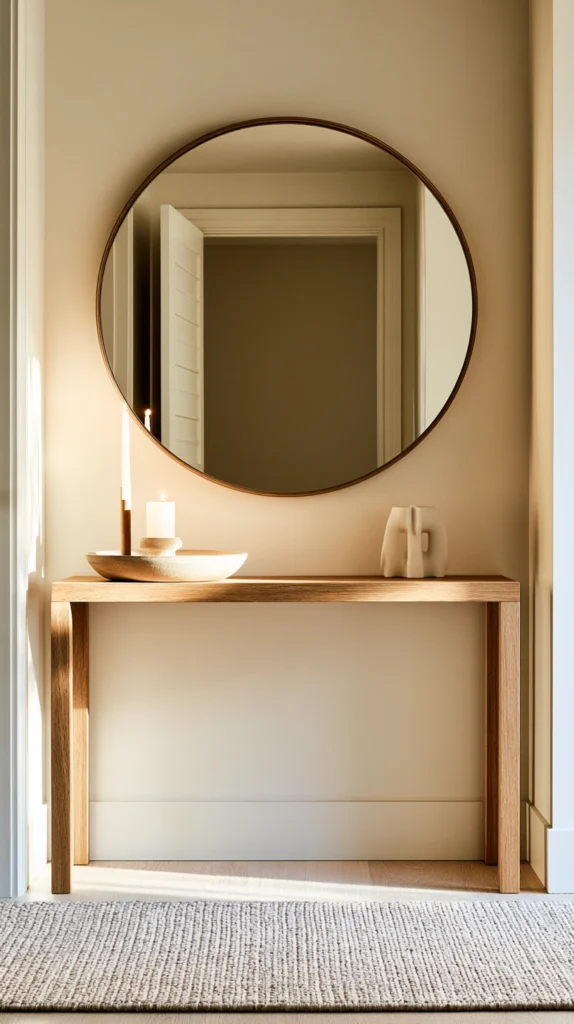
A candle, a small bunch of seasonal foliage, or a reed diffuser — one scent and one seasonal visual touch, both small, that give the entry a specific sensory character beyond what the mirror, the light, and the hooks alone can deliver.
Why the entry benefits from a seasonal touch more than any other room
- The threshold nature of the entry as a transition point between outside and inside: a small scent or seasonal object in the entry signals the transition between the two, marking the arrival in a way that carries more weight in this particular location than the same object would in a room further into the house
- The brief-but-concentrated attention that every guest gives an entry: because the entry is experienced quickly, a single sensory element — a scent, a branch, a seasonal arrangement — lands with more impact than it would in a room where attention is distributed across multiple surfaces over a longer visit
- The maintenance-free or low-maintenance opportunity this layer provides: a reed diffuser in an entry continues doing its job without daily attention, while a single branch of dried eucalyptus or seasonal foliage lasts weeks before needing replacement, making this the lowest-upkeep layer in the entry’s whole plan
The options
- A reed diffuser in a clean, neutral scent, for a maintenance-free fragrance layer that works without any lighting or attention
- A single stem in a small bud vase, changed seasonally and requiring almost no commitment of space or ongoing care
- A small scented candle, for an entry where there’s a flat surface to hold it safely and someone to light it before arrivals
- A dried botanical or foliage branch, a purely visual seasonal touch that requires no watering, no maintenance, and no flame
The practical execution
- Choose only one or the other — a scent or a seasonal visual touch, rather than both simultaneously in a small entry where either would be noticed clearly and the two together risk creating a busy visual impression in a room this size
- Match the scent to the season rather than using a year-round neutral, since the seasonal specificity of the fragrance contributes to the entry’s capacity to signal the time of year before any visual element is registered
- Change this layer seasonally rather than annually, keeping the entry’s smallest touch current even when the larger, more established elements stay constant
Cost breakdown
- Reed diffuser: $18–35
- Small bud vase and a single stem: $10–20
- Total: $10–35
The small candle lit or the single stem in its vase, at the entry’s console, noticed in passing: the last detail of a well-put-together entry, doing its work in a moment so brief that most guests couldn’t say exactly what it was, only that the entry felt complete.
The Small Entryway Roadmap
The work, sequenced:
Phase One (the functional foundation):
- The hooks done right (#3)
- The layered rug and mat combination (#7)
- The bench or seat (#6)
Phase Two (the visual focal points):
- The oversized mirror (#1)
- The statement light fixture (#2)
- The paint color decision (#11)
Phase Three (the surface and detail layers):
- The slim console table (#4)
- The tray and vignette system (#9)
- The strategic plant (#8)
Phase Four (the finishing and atmospheric layers):
- The wallpaper moment (#5)
- The ceiling height trick (#10)
- The scent and seasonal touch (#12)
Getting Started This Weekend
The immediate-impact entry refresh:
One afternoon, three changes:
- Swap in a larger, better mirror if the current one is undersized or builder-grade frameless (Idea #1)
- Install a hook rail that was deliberately chosen rather than simply available (Idea #3)
- Add a small tray with a candle and a bud vase to whatever surface the entry currently has (Idea #9)
Total cost: $75–200. Time: about two hours. The entry will already feel measurably more considered from the inside of the door by the time the work is done.
The structural investment (the next big project):
The paint color decision (Idea #11) is the highest-impact, lowest-cost structural change available in a small entry, given how completely a paint color determines an enclosed room’s overall character. Once the color is right, every other idea on this list has a better backdrop to work against, and the entry that felt generically beige starts feeling specifically like a room someone decided on.
What a well-designed small entry provides that a merely functional one can’t:
The first impression that sets the whole house’s tone in a few seconds:
- An oversized mirror that makes the entry feel designed rather than default
- A statement light that signals the ceiling was considered alongside the walls
- A paint color chosen because someone decided it, not because it was already there
The daily function that makes the good impression sustainable:
- Hooks in the right place at the right height, actually used because they work
- A tray that contains daily chaos so the entry’s styling isn’t undermined by whatever happened to land there
- A rug sized correctly so it actually covers what it’s meant to cover
The sensory experience that makes a guest’s memory of the entry specific rather than vague:
- A scent layer that signals arrival in more than just a visual way
- A single seasonal touch that keeps the entry current even when everything else stays the same
- A plant that makes the hard-surfaced space feel alive in the way only a living thing can
A small entryway doesn’t need to be large to make a strong first impression. It needs to be deliberately designed rather than casually assembled — because in a room this small, the difference between one and the other is the difference between a space that apologizes for itself and one that announces the house that follows. The right mirror on the right wall, doing the right job, says more about the home than any amount of decoration in the rooms that come after it.