14 Fall Wreath Ideas for Every Front Door Style
14 Fall Wreath Ideas for Every Front Door Style
Most fall wreath advice treats every front door the same way: pick a wreath, hang it, done. But a wreath that looks considered on a farmhouse door can look mismatched on a sleek modern one, and a wreath sized and styled for a wide traditional door can overwhelm a narrow apartment entrance entirely. The door itself — its style, its colour, its proportions — is as much a design input as the season is.
The wreaths that read as genuinely chosen, rather than grabbed off a seasonal display, are the ones matched to the door’s actual architecture. A busy, ornate wreath suits a door with matching traditional detail. A single stem or an asymmetrical form suits a clean modern door far better than a full round shape ever could. Getting this match right takes the same wreath from looking generic to looking like it was made for that specific entrance.
Here are 14 wreaths, organized by the door style each one suits best, along with the sizing and styling details that make the pairing work.
Why Some Wreaths Look Wrong Regardless of Quality
The style-mismatch problem:
Without considering the door:
- A dense, ornate, traditional wreath hung on a flat, minimalist modern door
- A single sparse, architectural stem arrangement hung on a heavily detailed traditional door
- The result: even a beautifully made wreath reads oddly out of place, regardless of its individual quality
With door-appropriate matching:
- A wreath’s density, shape, and colour palette chosen specifically to complement the door’s existing style and colour
- The result: the wreath reads as an extension of the door’s architecture, not a decoration applied on top of it
The scale problem:
- A wreath sized without reference to the door’s actual dimensions, either too small and lost on a large door or too large and crowding a narrow one
- The result: even the right style, at the wrong size, looks miscalculated
The colour-clash problem:
- A wreath in a tone that fights the door’s paint colour rather than complementing it
- The result: the door and wreath compete for attention instead of working together as one considered entrance
The Five Door-Matching Principles
Before choosing any individual wreath below, these five principles govern how well a wreath suits its specific door:
Match density to detail level:
- A heavily detailed, ornate door suits a fuller, denser wreath
- A flat, minimal door suits a sparser, more architectural arrangement
Size relative to the door’s actual width:
- A wreath roughly one-third to one-half the width of the door reads proportional on most standard doors
- Oversized or undersized wreaths are one of the most common and most fixable mistakes
Colour that complements, not matches exactly:
- A wreath in a tone that harmonizes with the door’s paint colour, rather than blending in completely or clashing directly
- Some contrast is good; too much similarity makes the wreath disappear against the door
Shape suited to the door’s own lines:
- Round wreaths suit traditional, symmetrical doors
- Asymmetrical or vertical arrangements suit modern or narrow doors better than a full round shape
Hardware appropriate to the door material:
- A suction hook for glass panels, an over-the-door hook for solid wood, adhesive hooks for surfaces that can’t be pierced
- The right hardware avoids damage and keeps the wreath securely and attractively placed
1. The Single Stem Wreath for Modern Minimalist Doors
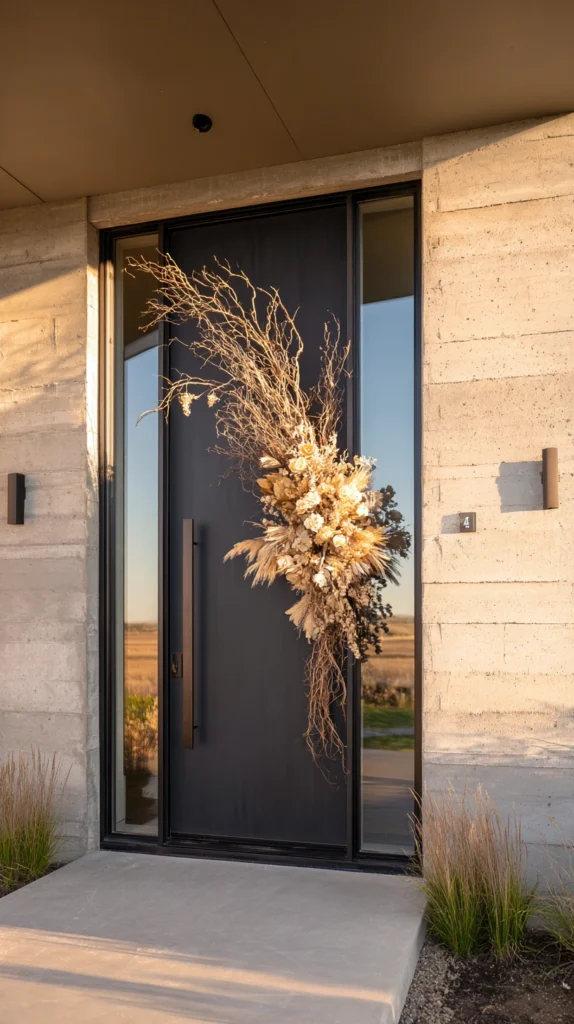
An asymmetrical arrangement built from one or two dried branches and a small cluster of foliage, rather than a full round wreath, suited to a flat, clean-lined modern door.
Why an asymmetrical form suits modern architecture better than a round wreath
A full, dense round wreath can read as visually busy against a door defined by simplicity and clean lines. An asymmetrical arrangement — a single dried branch curving to one side, with a small cluster of foliage at its base — echoes the same restraint and negative space that defines the door’s own architecture.
Sizing and placement
- Height: 24–30 inches, taller and narrower than a traditional round wreath
- Hung slightly off-centre on the door, rather than perfectly centred, to reinforce the asymmetrical form
Cost breakdown
- Dried branches and foliage: $20–35
- Total: $20–35
2. The Wheat and Burlap Wreath for Farmhouse Doors
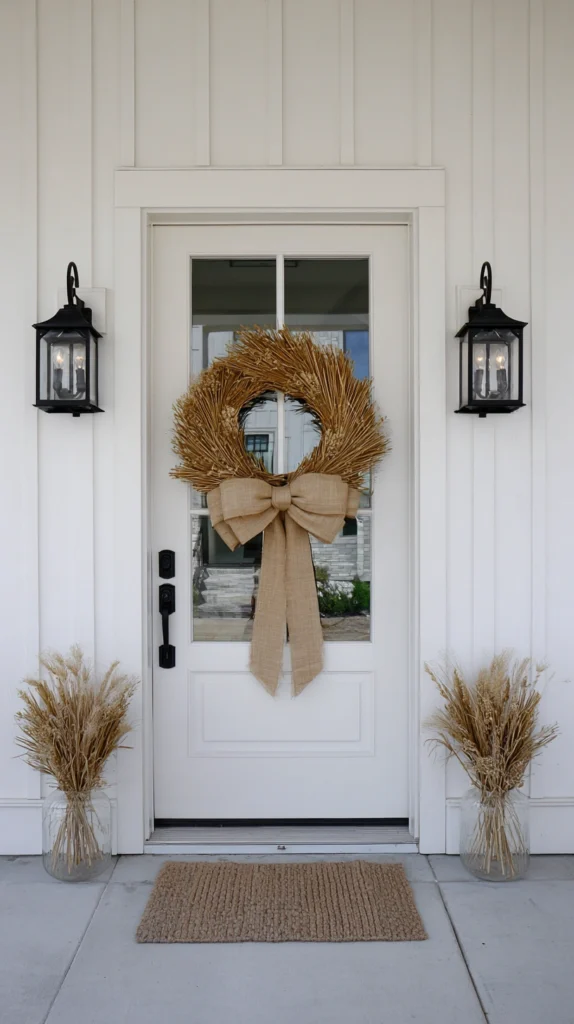
A dense, round wreath built from dried wheat stalks and a burlap or jute ribbon bow, suited to a farmhouse door’s typically rustic, natural material palette.
Why wheat and burlap suit farmhouse architecture specifically
A farmhouse door’s shiplap panels, natural wood tone, or black-and-white palette pair naturally with the same raw, unrefined materials already common in farmhouse interior styling. Wheat and burlap extend that same material language to the exterior entrance.
Sizing and placement
- Diameter: 20–24 inches, a full, traditional round size that suits the farmhouse door’s typically generous proportions
- Centred on the door, at eye height for a standing adult
Cost breakdown
- Wheat and burlap wreath: $30–55
- Total: $30–55
3. The Oak Leaf and Acorn Wreath for Craftsman and Bungalow Doors
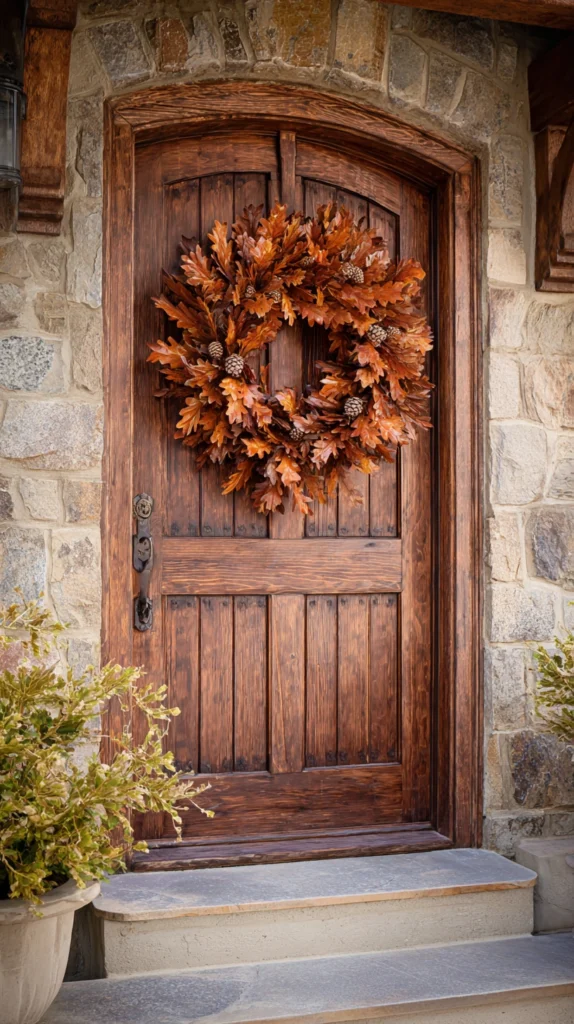
A wreath built from faux oak leaves in deep rust and olive tones, with small acorn clusters, suited to a craftsman or bungalow door’s typically warm wood tones and simple, sturdy detailing.
Why oak and acorn motifs suit this architectural style
Craftsman and bungalow homes draw heavily on natural, arts-and-crafts-era materials and motifs, and oak specifically has a long association with this architectural tradition. A wreath built from oak leaves and acorns extends that same material and motif language to the seasonal display.
Sizing and placement
- Diameter: 18–22 inches, suited to a craftsman door’s typically medium width and often flanked by sidelights
- A muted, warm colour palette (deep rust, olive, warm brown) rather than bright orange, to match the architectural style’s generally earthy tones
Cost breakdown
- Oak leaf and acorn wreath: $28–50
- Total: $28–50
4. The Classic Mixed Foliage Wreath for Colonial and Traditional Doors
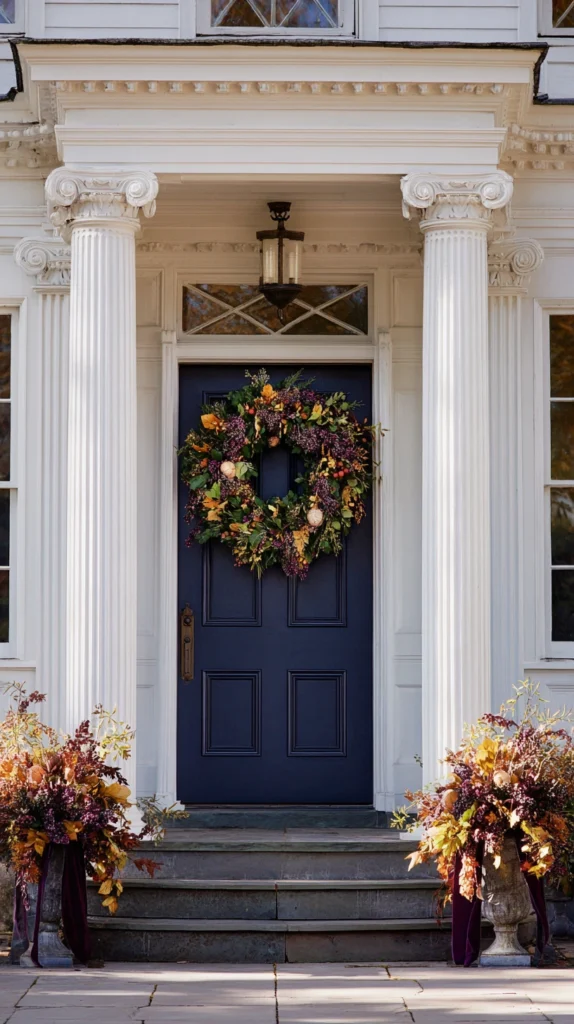
A full, dense, round wreath combining several types of foliage, berries, and a formal ribbon bow, suited to a colonial or traditional door’s symmetrical, classically detailed architecture.
Why a fuller, more classic wreath suits traditional architecture
A colonial or traditional door, often featuring detailed millwork, a fanlight, or flanking columns, suits a wreath with a similarly rich, layered quality rather than a sparse or minimal arrangement. The formality of the architecture calls for a formality in the wreath’s own construction.
Sizing and placement
- Diameter: 22–26 inches, generously sized to suit the door’s typically larger scale and formal proportions
- A wide grosgrain or velvet ribbon bow at the base, reinforcing the formal, traditional quality
Cost breakdown
- Mixed foliage wreath with ribbon: $40–70
- Total: $40–70
5. The Dried Floral and Berry Wreath for Cottage Doors
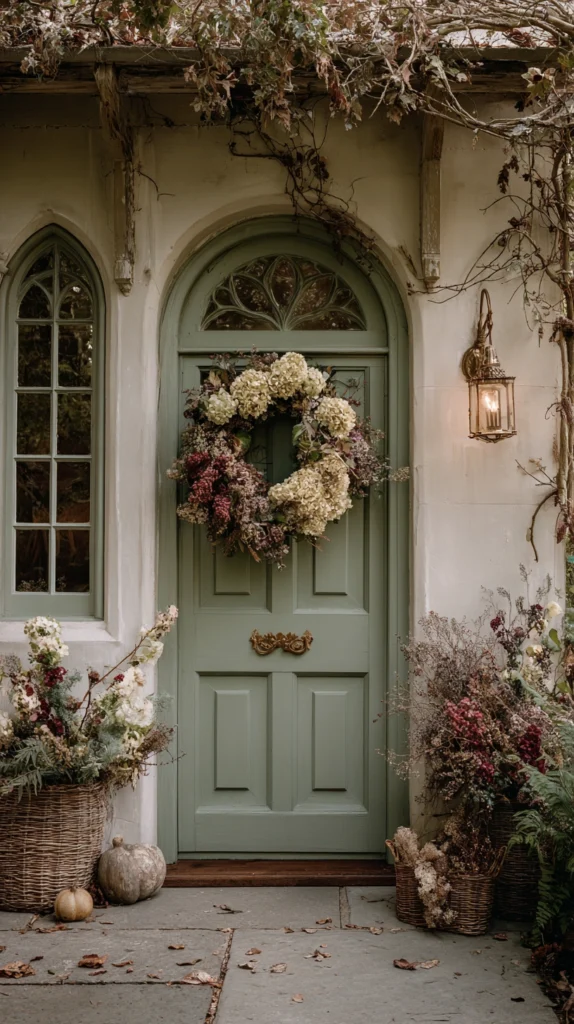
A softer, slightly looser wreath combining dried florals, berries, and delicate foliage, suited to a cottage door’s typically smaller scale and more whimsical architectural details.
Why a looser construction suits cottage-style architecture
A cottage door, often featuring an arched top, small windowpanes, or an informal, slightly irregular architectural character, suits a wreath built with a similarly relaxed, gathered-rather-than-arranged quality. A tightly uniform, formal wreath can read at odds with the cottage style’s inherent informality.
Sizing and placement
- Diameter: 16–20 inches, smaller and more delicate, matched to a cottage door’s typically more modest scale
- A mix of dried florals (hydrangea, statice) and berries, rather than a single dominant material
Cost breakdown
- Dried floral and berry wreath: $30–55
- Total: $30–55
6. The Monochromatic Dried Grass Wreath for Contemporary Black Doors
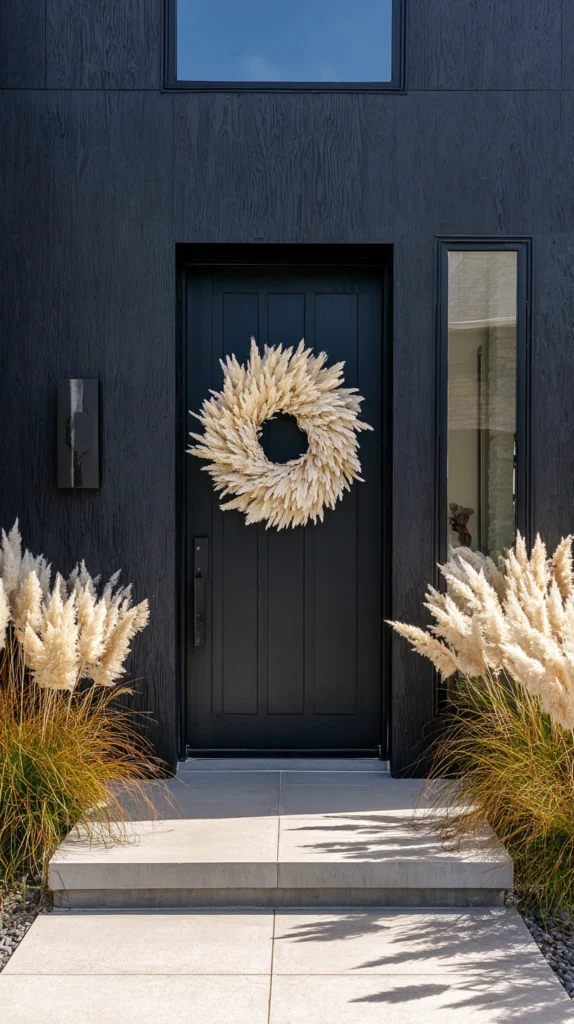
A wreath built entirely from one or two tones of dried grass or pampas, with no additional colour or ribbon, suited to a bold, contemporary black or dark-toned door.
Why a monochromatic approach suits a strong door colour
A black or deep-toned contemporary door is already a strong visual statement, and a wreath in a single restrained tone (pale cream or warm beige dried grass) provides contrast without competing with the door’s own boldness. A busier, multicoloured wreath can visually clash with a door already carrying significant colour weight.
Sizing and placement
- Diameter: 20–24 inches, full enough to register clearly against the dark door background
- No ribbon or additional colour accent, keeping the palette to the pale grass tone alone against the dark door
Cost breakdown
- Dried grass or pampas wreath: $30–50
- Total: $30–50
7. The Layered Ornate Wreath for Victorian Doors
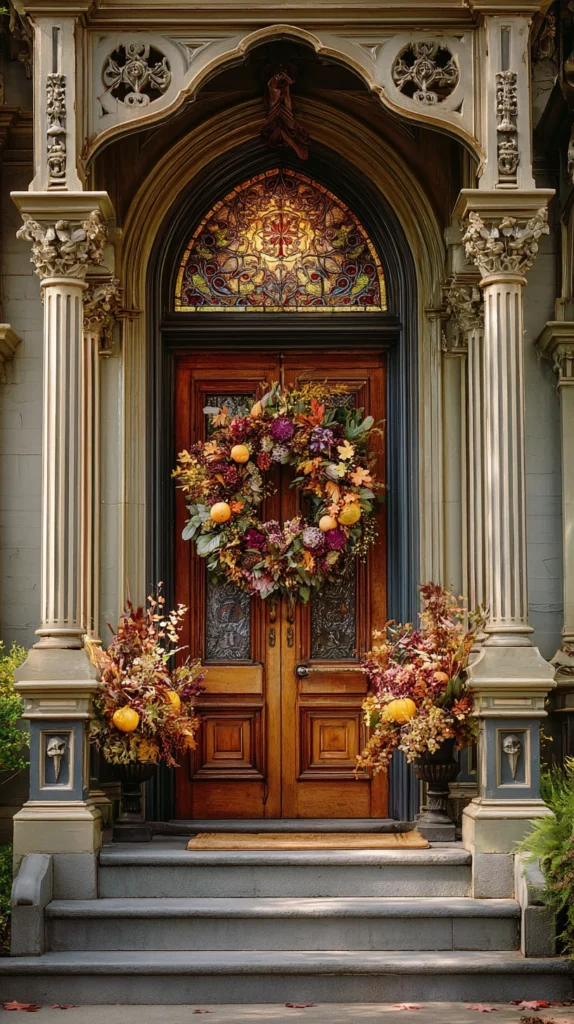
A dense, multi-layered wreath incorporating varied textures — dried florals, ribbon, small ornamental accents — suited to a Victorian door’s typically elaborate millwork and decorative detailing.
Why more layering and detail suits Victorian architecture specifically
Victorian doors often feature stained glass, elaborate trim, and decorative hardware, an architectural style that embraces visual richness and detail rather than restraint. A wreath matching that same layered, detailed quality reads as appropriately matched, where a simpler, more minimal wreath can look under-scaled against the door’s own ornamentation.
Sizing and placement
- Diameter: 22–26 inches, generously sized and densely constructed
- Multiple ribbon accents or a mix of 3–4 different dried materials, embracing more visual complexity than most other styles on this list
Cost breakdown
- Layered ornate wreath: $45–80
- Total: $45–80
8. The Simple Grapevine Wreath for Ranch-Style Doors
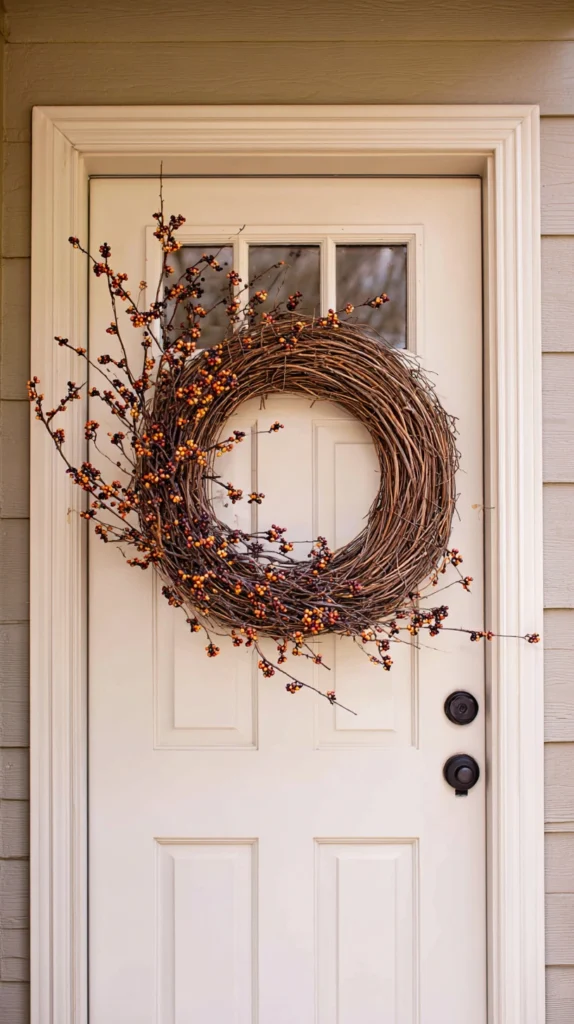
An unadorned or lightly accented grapevine base wreath, suited to a ranch-style door’s typically simple, low-key architectural character.
Why an unadorned base wreath suits ranch architecture
Ranch-style homes are generally defined by simple, horizontal lines and a lack of ornamentation, and a plain or lightly accented grapevine wreath matches that same understated quality. A heavily decorated, dense wreath can read as excessive against a door with otherwise minimal architectural detail.
Sizing and placement
- Diameter: 16–20 inches, kept relatively modest and unfussy
- A single small accent (one dried stem, a small cluster of berries) rather than a fully built-out arrangement
Cost breakdown
- Grapevine wreath base with a single accent: $18–35
- Total: $18–35
9. The Vertical Swag for Glass or French Doors
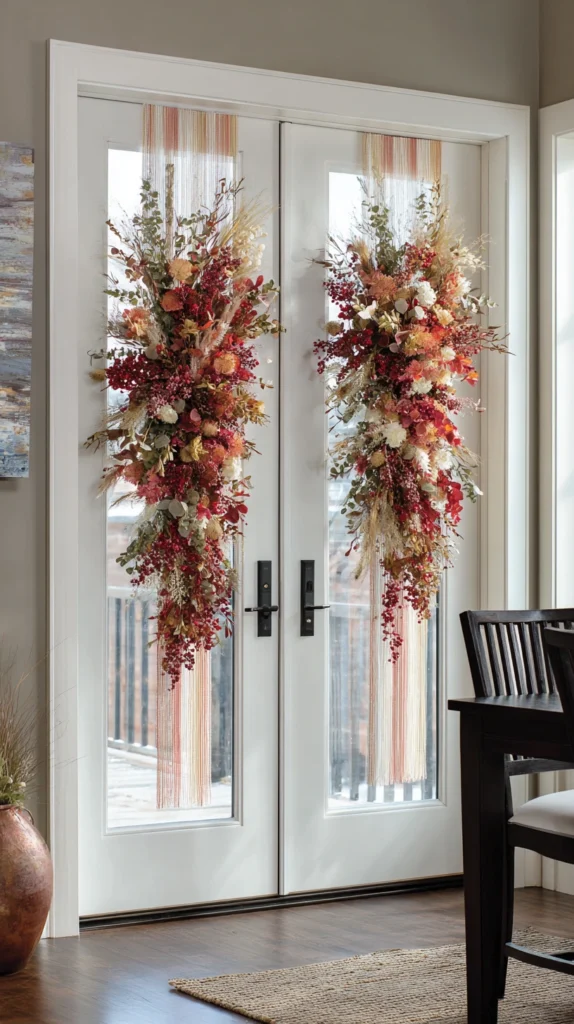
A vertical swag arrangement, rather than a round wreath, hung to one side of a glass-paneled or French door, avoiding obstruction of the door’s window area.
Why a swag suits a door with significant glass paneling
A round wreath hung centrally on a door with substantial glass paneling can obstruct visibility through the door or interfere with the door’s own visual proportions. A vertical swag, mounted to one side rather than centred, adds the same seasonal presence without covering or competing with the glass.
Sizing and placement
- Length: 24–36 inches, running vertically along one side of the door frame rather than centred on the door itself
- Mounted to the door frame or an adjacent wall, rather than directly on the glass panel
Cost breakdown
- Vertical swag arrangement: $30–55
- Total: $30–55
10. The Matching Wreath Pair for Double Doors
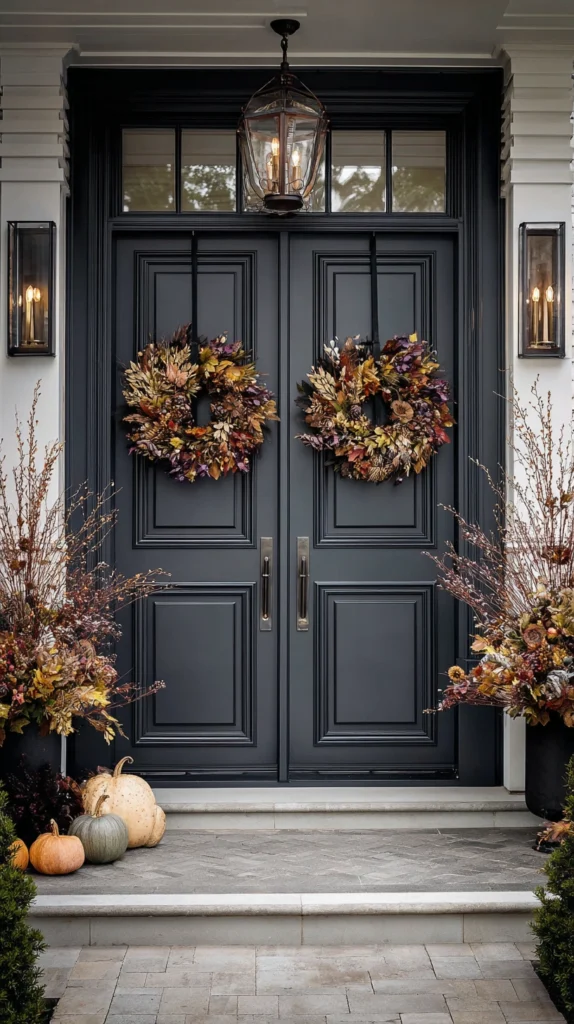
Two identical or closely matched wreaths, one centred on each door of a double-door entrance, rather than a single wreath on only one side.
Why symmetry matters specifically for double doors
A single wreath on only one side of a symmetrical double-door entrance reads as unbalanced, drawing attention to the asymmetry rather than the wreaths themselves. A matched pair, one per door, reinforces the entrance’s inherent symmetry rather than working against it.
Sizing and placement
- Diameter: 18–22 inches per wreath, smaller than a single-door wreath would be, since two wreaths together already provide more total visual presence
- Centred identically on each door, at matching heights
Cost breakdown
- Matching wreath pair (per wreath): $28–50 each
- Total (pair): $56–100
11. The Upper-Half Wreath for Dutch Doors
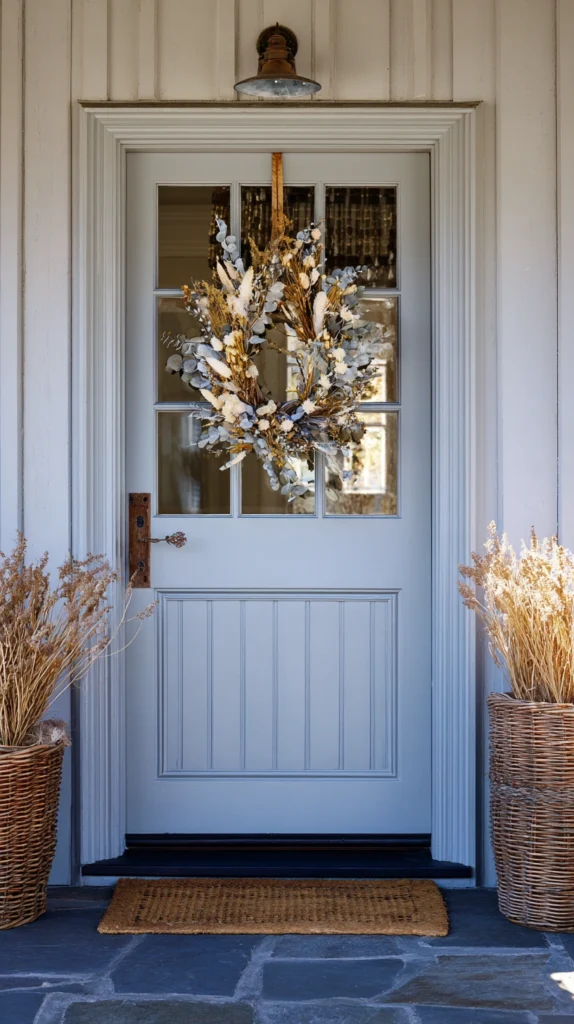
A wreath sized and positioned specifically for the upper, often-open half of a Dutch door, rather than a standard full-door placement.
Why Dutch doors need a specifically adapted approach
A Dutch door’s split design means the upper half often opens independently, and a wreath positioned as it would be on a standard door can interfere with that function or hang awkwardly across the split line. Sizing and placing the wreath specifically within the upper panel avoids this problem.
Sizing and placement
- Diameter: 14–18 inches, smaller to fit within the upper panel alone without extending across the door’s horizontal split
- Mounted with a hook positioned above the split line, so the lower half can still open freely if needed
Cost breakdown
- Smaller wreath, sized for the upper panel: $22–40
- Total: $22–40
12. The Flat-Backed Wreath for Storm or Screen Doors
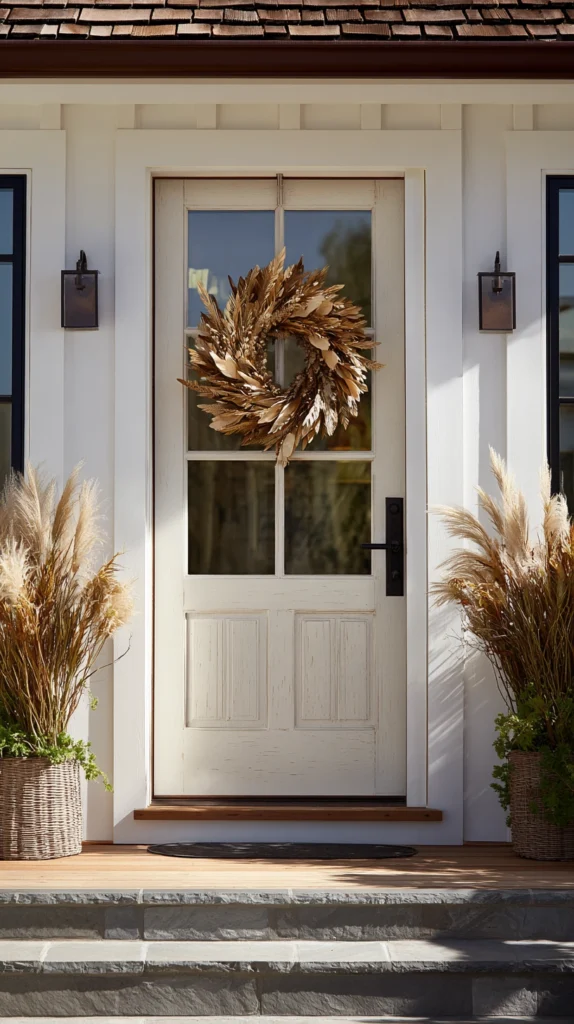
A wreath with a flat, low-profile back, or one specifically designed for storm door use, allowing the storm door itself to still close and latch properly.
Why standard wreaths often don’t work on storm doors
A standard wreath, with its typical depth and dimension, can prevent a storm or screen door from closing and latching correctly, since the added thickness gets caught in the door frame. A flat-backed or storm-door-specific wreath avoids this functional problem while still providing full seasonal presence when viewed from outside.
Sizing and placement
- A wreath specifically marketed or constructed with a flattened back profile, rather than a standard rounded wreath form
- Hung with a slim, low-profile hook designed for storm door use
Cost breakdown
- Flat-backed or storm-door wreath: $25–45
- Total: $25–45
13. The Slim Vertical Wreath for Narrow Apartment Doors
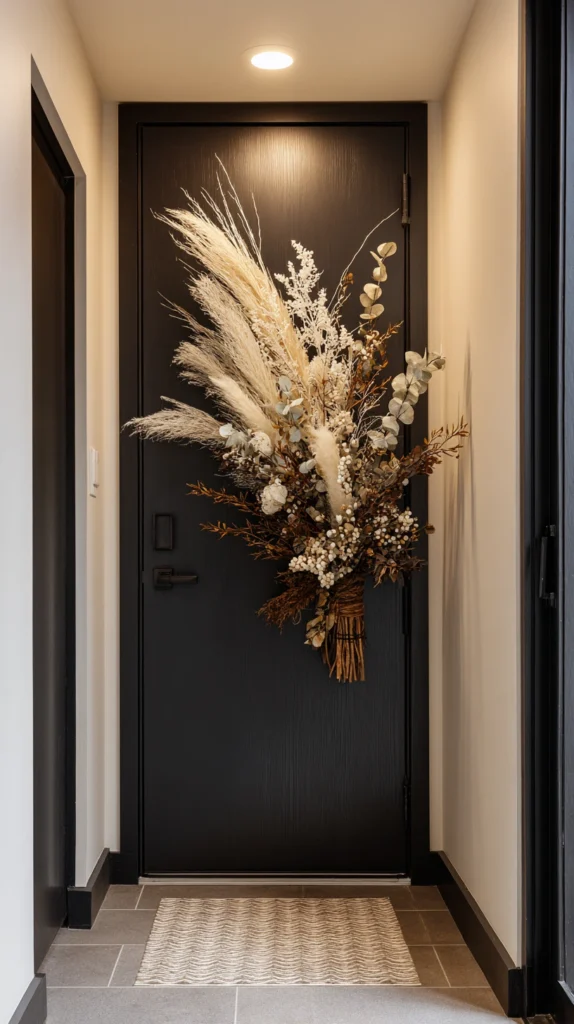
An elongated, narrow wreath or a vertical arrangement, suited to an apartment door’s typically narrower width compared to a single-family home’s front entrance.
Why apartment doors need a narrower proportion
A standard 20–24 inch round wreath, appropriate for a wider single-family front door, can look oversized and crowd a narrower apartment door, which is often only 32–34 inches wide including trim. A more elongated, narrower arrangement respects the door’s actual proportions.
Sizing and placement
- Width: 12–16 inches, considerably narrower than a standard round wreath
- Height: can extend slightly longer (18–24 inches) to compensate for the narrower width while maintaining visual presence
Cost breakdown
- Slim vertical wreath or arrangement: $20–38
- Total: $20–38
14. The Complete Door-Matched Wreath Selection Guide
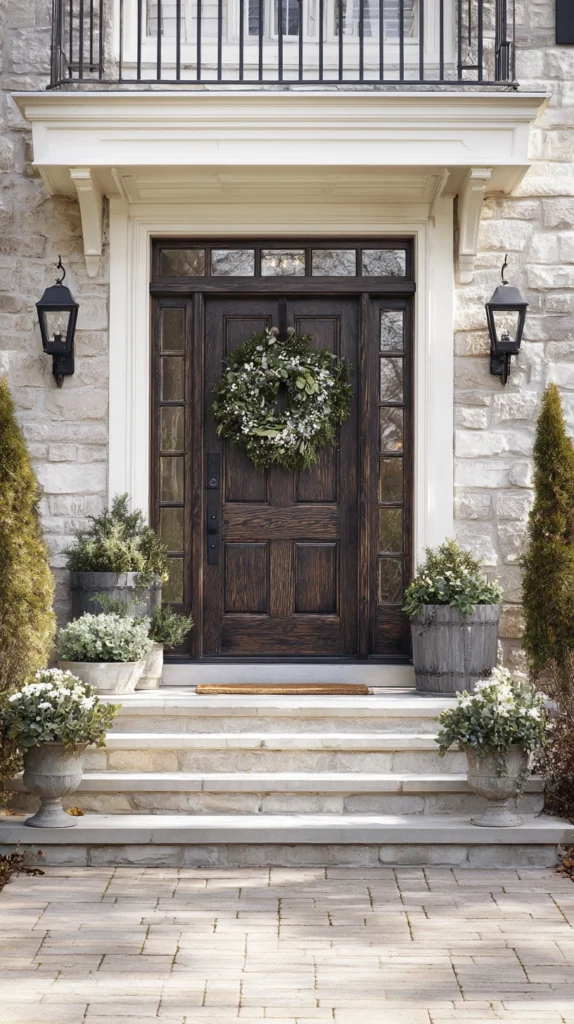
A framework for choosing and building the right wreath for any specific door — the definitive approach to matching wreath style, size, and colour to the door’s actual architecture rather than choosing a wreath in isolation.
What separates a matched wreath from a generic one
A beautiful wreath, chosen without reference to the door it will hang on, still risks looking mismatched regardless of its individual quality. The complete approach starts with the door itself — its style, width, colour, and material — and builds every wreath decision outward from those specific constraints.
The assessment framework
Step 1: Identify the door’s architectural style.
- Modern, farmhouse, craftsman, colonial, cottage, contemporary, Victorian, or ranch
- This determines the wreath’s density and level of ornamentation (Ideas #1 through #8)
Step 2: Measure the door’s actual width.
- Standard single door: 20–24 inch wreath
- Double door: 18–22 inch wreath per door (Idea #10)
- Narrow or apartment door: 12–16 inch wreath (Idea #13)
Step 3: Note any structural considerations.
- Glass paneling: consider a vertical swag instead of centred round wreath (Idea #9)
- A Dutch door split: size and place specifically within the upper panel (Idea #11)
- A storm or screen door: choose a flat-backed style (Idea #12)
Step 4: Match the colour palette to the door’s paint.
- A wreath tone that complements rather than exactly matches or directly clashes with the door colour
- Darker doors generally suit paler, more restrained wreaths; lighter doors can support a fuller range of tones
Step 5: Confirm the hardware suits the door material.
- An over-the-door hook for solid wood
- A suction hook for glass panels
- An adhesive hook for surfaces that shouldn’t be pierced or hooked over an edge
Cost breakdown for building a matched wreath
Regardless of which style is chosen, most individually matched wreaths fall within a similar cost range:
- Wreath base and materials: $18–80, depending on density and door formality
- Appropriate hanging hardware: $5–15
Total: $23–95 for most door and style combinations
The Question Before Choosing Any Fall Wreath
Before buying a wreath:
What does the door’s own architecture already suggest?
If the answer is: heavily detailed, traditional, or ornate — lean into a fuller, denser wreath that matches that same visual richness.
If the answer is: flat, clean-lined, and modern — choose an asymmetrical or sparser arrangement rather than a full round wreath.
If the answer is: narrow, or part of a double-door or Dutch door setup — prioritise the sizing and placement adjustments in Ideas #10, #11, and #13 before any style consideration.
If the answer is: unclear, or the door doesn’t fit neatly into one category — a classic, moderately full round wreath in a neutral warm tone is the safest match for almost any door style, and a reasonable default when in doubt.
The choice follows what the door itself calls for, not the most popular or most photographed wreath style available. A wreath matched to its door reads as considered regardless of trend; one chosen without reference to the door risks looking slightly wrong no matter how well it’s made.
Getting Started This Weekend
The immediate wreath-matching fix:
Measure the door’s actual width before buying anything.
The single most common wreath mistake is sizing, and it’s the easiest to get right with one measurement.
Note the door’s style category and its existing paint colour.
Both determine the wreath’s density and tone before a single purchase is made.
Confirm the correct hook or hanging hardware for the door’s material.
Prevents damage and ensures the wreath actually hangs securely and at the right height.
Hold a candidate wreath up to the door, even a photo overlay, before finalizing the choice.
Confirms the proportion and colour match in the door’s actual context, not just how the wreath looks on its own.
The rest of the selection: the elaboration of this weekend.
The measurement: the beginning. The matched wreath: what a generic seasonal purchase becomes once it’s chosen specifically for the door it’s meant to hang on.