Warm, Classic, and Built to Last: 14 Cream Kitchen Cabinet Ideas for a Timeless Look
Warm, Classic, and Built to Last: 14 Cream Kitchen Cabinet Ideas for a Timeless Look
There is a kitchen colour that has outlasted every trend that has attempted to replace it. Grey came and stayed for a decade and is now retreating. White came and went and came back and went again. The Navy had its moment. Sage is having its moment now. But cream — warm, unhurried, slightly imperfect in the way of things that were not made by a machine — has simply continued to be beautiful throughout all of it, and it will continue after whatever comes next.
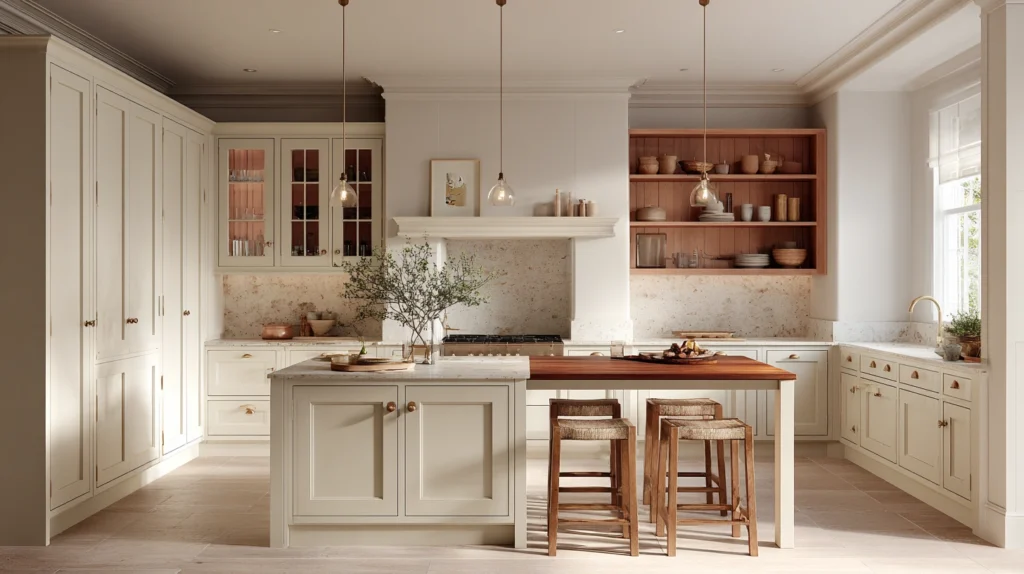
Cream kitchen cabinetry is not a safe choice in the way that a hedge is a safe choice. It is a confident one — a decision that says the kitchen was not designed for this year’s mood board but for the decades of morning coffee and family dinners and late-night conversations that a kitchen actually contains. It is the colour of rooms that are genuinely lived in and genuinely loved, and it rewards that love with a warmth and a character that no cooler alternative provides.
The fourteen ideas below cover every approach to cream kitchen cabinetry — from a single set of lower cabinets to a fully committed kitchen scheme — and each one is built on the principle that cream works best when it is treated as a warm foundation rather than a neutral compromise.
1. The All-Cream Shaker Kitchen
Budget: $2000 – $20000
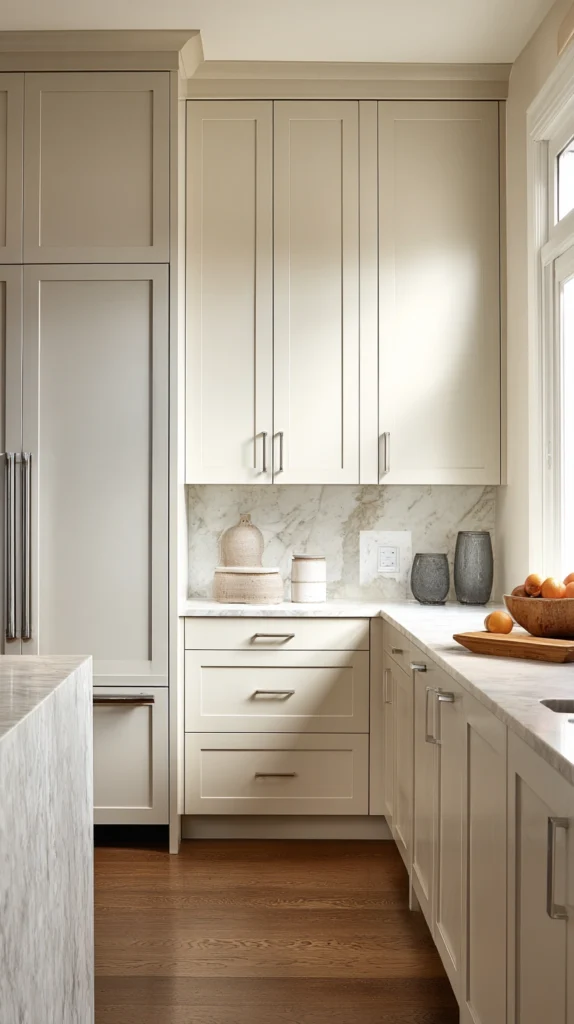
The all-cream Shaker kitchen — every cabinet in the same warm cream, upper and lower, painted in a flat or eggshell finish, with simple recessed panel doors and a consistent hardware choice throughout — is the most classically resolved and the most enduringly beautiful kitchen scheme available. It has been built in this format for over a century and will be built in this format for the next century without requiring any apology for its consistency.
Flat-pack Shaker-style cabinetry in a cream finish costs $1500 – $5000 for a standard kitchen supply. A bespoke hand-painted version — existing cabinets resprayed by a specialist — runs $800 – $3000 depending on the number of doors. A fully bespoke cream Shaker kitchen from a specialist maker costs $5000 – $20000 for a complete installation and produces a finish that flat-pack alternatives cannot replicate.
Decor tip: Choose a cream with a yellow rather than a pink undertone for Shaker cabinetry. A yellow-undertoned cream reads as warm and buttery — the colour of rooms that have been cooking for a long time. A pink-undertoned cream can shift toward blush in certain lights and reads as less resolved beside natural timber and stone worktops. The undertone is the most important decision in the cream paint choice.
2. The Cream Lower Cabinets With White Uppers
Budget: $1500 – $15000
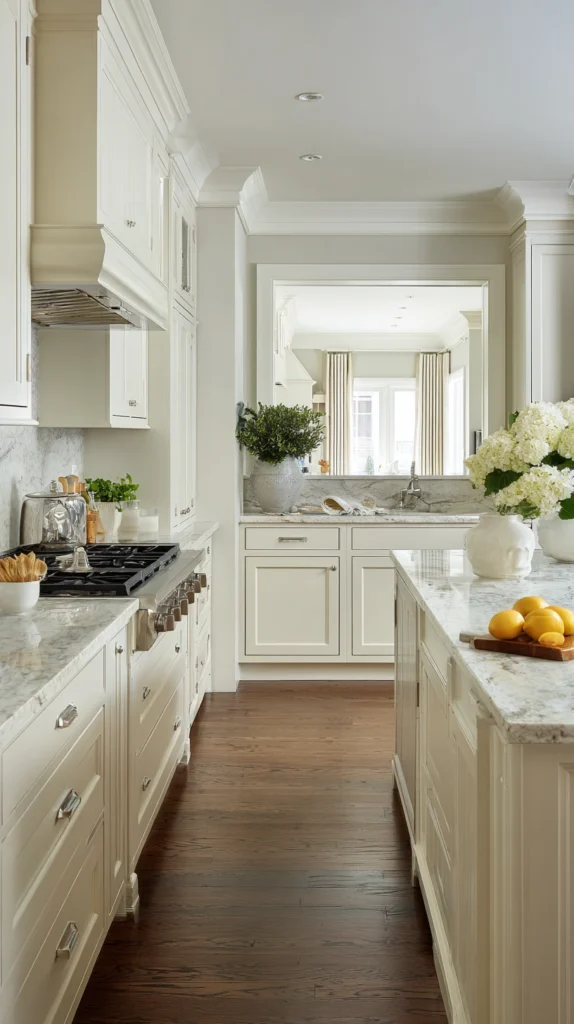
A kitchen with cream lower cabinets and white upper cabinets — a combination that gives the space visual weight at the lower level and airiness at the upper — produces a kitchen that reads as designed rather than simply painted. The cream anchors the room to the worktop and the floor. The white opens the upper space and allows the ceiling to read as generous even in rooms with modest ceiling heights.
Lower cabinets in cream and upper cabinets in a warm white — a white with the same yellow undertone as the cream rather than a bright cool white — cost the same as a single-colour scheme at any budget level. The visual effect of the two-tone arrangement is significantly more dynamic than a single colour throughout and considerably more interesting than the standard white-upper and coloured-lower combination.
Decor tip: Ensure the cream and the white share the same undertone family. A cream with yellow undertones beside a white with blue undertones produces a colour temperature conflict that registers as slightly wrong from across the room without the observer being able to identify the specific cause. A cream and a white from the same paint brand’s warm family read as a deliberate tonal pairing rather than two colours that failed to match.
3. The Cream Cabinet With Brass Hardware
Budget: $100 – $2000 for hardware upgrade
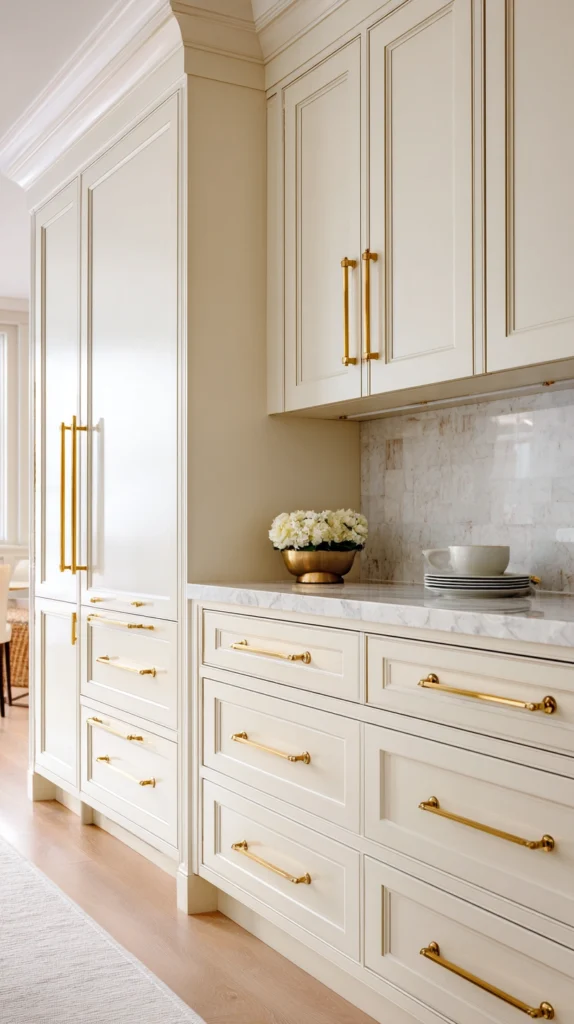
Cream cabinetry with aged brass or unlacquered brass hardware — cup pulls, bar handles, and cabinet knobs in a warm, slightly dull gold — is the kitchen material pairing that reads as most quietly luxurious at any price point. The warm yellow of the brass and the warm yellow of the cream occupy the same colour temperature, and their combination produces a kitchen surface that feels genuinely considered at the level of the smallest detail.
Aged brass cup pulls cost $8 – $25 each. Bar handles in an unlacquered brass — $10 – $30 each. Cabinet knobs in a warm brushed gold — $5 – $20 each. A standard kitchen requiring twenty to thirty hardware pieces sits at $150 – $900 in total for a hardware upgrade that transforms the kitchen’s material character completely without touching a single cabinet or worktop.
Decor tip: Use aged or unlacquered brass rather than polished lacquered gold throughout the cream kitchen. Polished gold beside cream can read as slightly bright and slightly commercial — the high shine of the metal pulling against the matte, slightly worn quality of the cream. Aged brass, with its warm patina and its suggestion of genuine age and genuine use, is in exactly the same material register as a good cream paint — honest, warm, and entirely without pretension.
4. The Cream Kitchen With Stone Worktops
Budget: $500 – $5000 for worktops
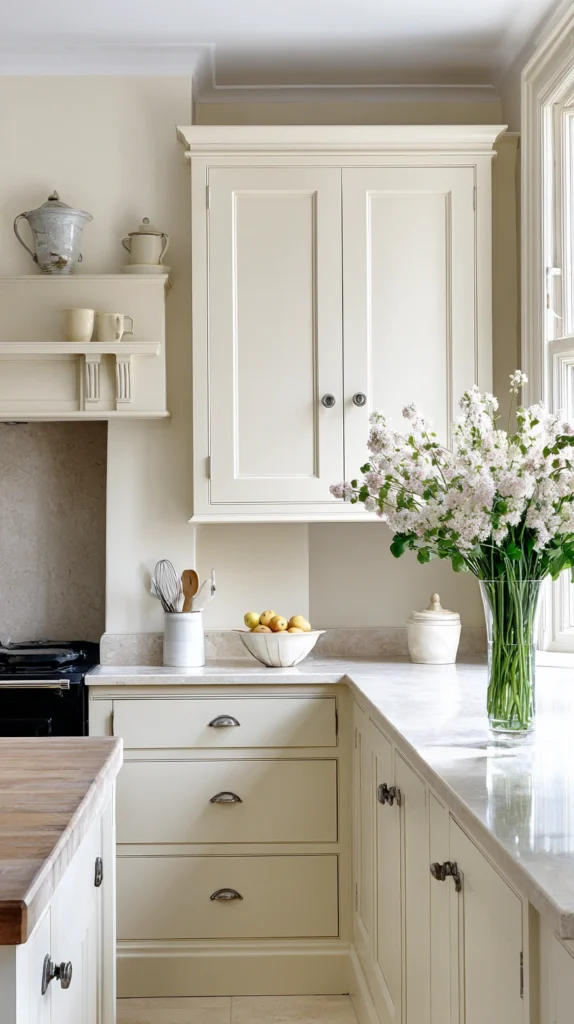
Cream cabinetry beneath a natural stone worktop — honed marble, unlacquered limestone, or a warm-veined granite — is the kitchen material combination that has defined every great traditional kitchen for the past two centuries and shows no sign of exhausting itself. The cool, natural quality of the stone and the warm, painted quality of the cream are in productive tension in a way that no synthetic worktop alternative replicates.
Honed Carrara marble worktops cost $200 – $600 per linear metre installed. Limestone — warmer in tone and slightly less demanding in its maintenance requirements — runs $150 – $400 per linear metre. A warm-veined granite — the most practically durable of the natural stone options — sits at $100 – $300 per linear metre. The investment in genuine stone beside cream cabinetry produces a kitchen that improves in character with every year of genuine use.
Decor tip: Specify honed rather than polished stone for cream kitchen worktops. A polished marble or granite beside cream cabinetry produces a high-gloss surface that reads as slightly cold and slightly formal. A honed surface in the same stone has a soft, matte quality that reads as warm and natural — the correct material register for a cream kitchen whose primary virtue is warmth rather than brilliance.
5. The Cream and Sage Green Kitchen
Budget: $50 – $500 for the colour pairing
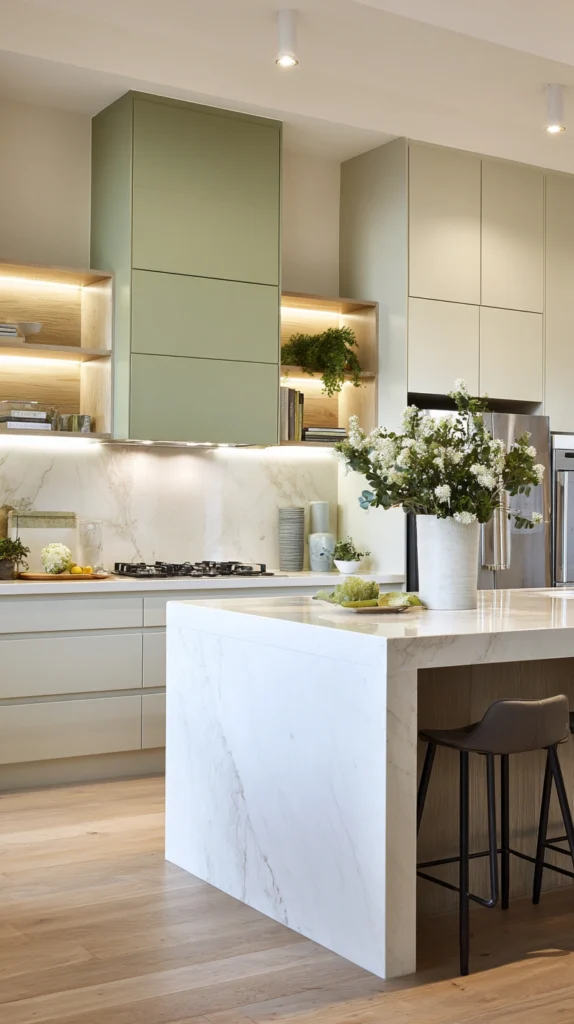
Cream and sage green in a kitchen — cream lower cabinets with sage upper cabinets, or cream throughout with sage green introduced through a painted island, a pantry door, or a bank of open shelving — is one of the most naturally harmonious kitchen colour combinations available. The two colours belong to the same organic, botanical world and their pairing reads as resolved and beautiful without effort.
Sage green paint for upper cabinets or a kitchen island costs $20 – $50 per litre — sufficient for a standard kitchen element in two coats. A kitchen island painted in sage while the remaining cabinets are cream costs $20 – $50 in paint for a transformation that gives the kitchen a dual-tone dynamism that a single colour throughout does not produce. The sage and cream together read as more considered than either colour alone.
Decor tip: Choose a sage green with a grey undertone rather than a yellow one for pairing with cream cabinetry. A grey-toned sage beside cream reads as composed and sophisticated — both colours slightly muted, both in the same tonal register of warmth without saturation. A yellow-toned sage beside cream can read as two warm colours competing rather than complementing — a distinction that is small in theory and significant in practice.
6. The Cream Open Shelf Kitchen
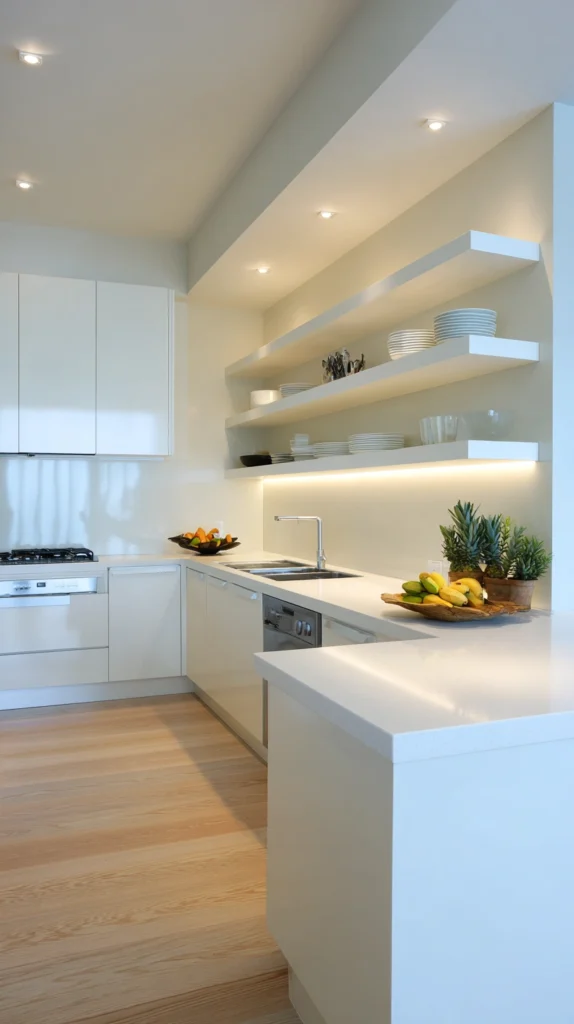
Budget: $100 – $600 for shelving
A kitchen that combines cream lower cabinets with open timber or cream-painted shelving in the upper zone — replacing the standard upper cabinet format with open shelves — is the cream kitchen’s most relaxed and most honest version. The open shelves show what the kitchen contains rather than hiding it, and the combination of cream cabinetry below and open shelving above reads as simultaneously functional and genuinely beautiful.
Floating timber shelves above the cream lower cabinets cost $20 – $60 each installed. Three to four shelves across the kitchen’s main wall — $60 – $240 in timber and fixings. The objects displayed on the open shelves — white ceramic plates, glass storage jars, a small plant, a ceramic jug — cost $40 – $120 in a fully styled shelf arrangement. The shelves are installed once. The styling develops over time as the kitchen is used and inhabited.
Decor tip: Edit the open kitchen shelves consistently — removing anything that does not contribute to the display and returning it to a cupboard below. An open shelf kitchen that accumulates clutter loses its beauty faster than any other kitchen format because everything on an open shelf is permanently visible. A shelf that is edited to contain only what is beautiful or essential reads as a genuine design decision. One that accumulates anything set down temporarily reads as a surface where decisions are postponed.
7. The Cream Kitchen With Coloured Tiles
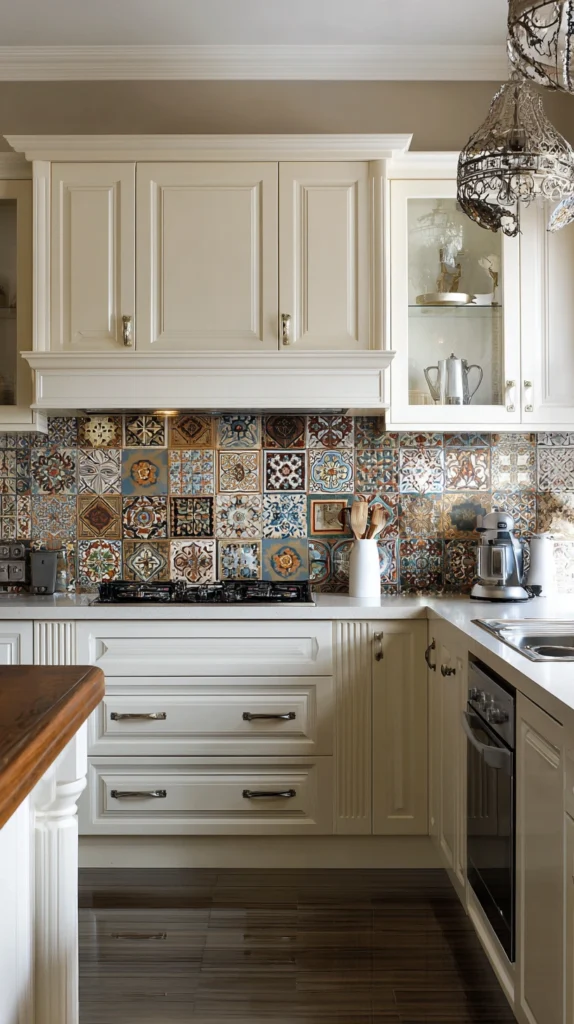
Budget: $200 – $2000 for tiles
A cream kitchen given a tiled splashback in a bold, characterful colour — a deep navy blue, a rich bottle green, a warm terracotta, or a Moroccan-patterned encaustic tile — reads as a room where the cream is not the design decision but the foundation for one. The cream cabinets provide the quiet base. The tile provides the colour and the character that lifts the entire kitchen above the merely beautiful into the genuinely memorable.
Metro tiles in a deep green or navy — $20 – $60 per square metre in standard sizes. Encaustic cement tiles in a pattern — $60 – $150 per square metre. Handmade terracotta tiles — $40 – $100 per square metre. A standard kitchen splashback of two to three square metres costs $40 – $450 in tiles depending on the type and source. The tile investment is modest relative to the visual transformation it produces in a cream kitchen.
Decor tip: Choose a tile grout colour that complements the tile rather than defaulting to white throughout the cream kitchen. A dark green tile with white grout reads as a grid. The same tile with a dark grey or charcoal grout reads as a surface — the tile joints receding rather than being emphasised. Grout colour is the tiling decision most frequently made without enough consideration and most consistently regretted afterward.
8. The Cream Kitchen Island
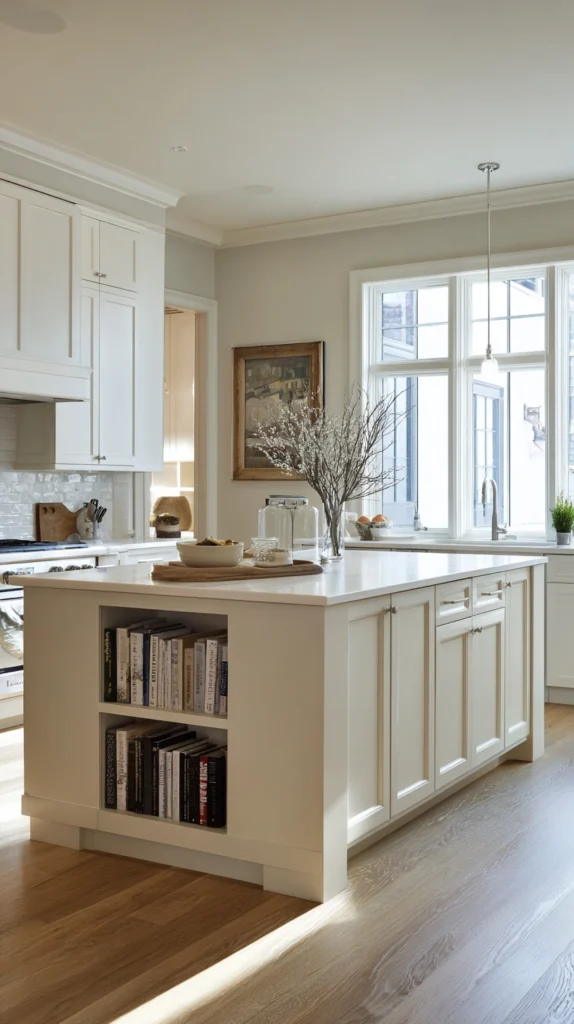
Budget: $500 – $5000
A cream kitchen island — in the same cream as the surrounding cabinetry or in a complementary tone — provides the kitchen’s central work surface and its social heart simultaneously. The island is the room’s most visible piece of furniture from the adjacent living or dining space and the one that determines the kitchen’s overall aesthetic impression at a glance.
A freestanding cream kitchen island costs $200 – $800 from kitchen suppliers. A fitted island with integrated storage and a seating overhang — $800 – $3000 in materials and installation. A bespoke island with a stone top and painted cream base — $1500 – $5000 depending on size and specification. Any of the three improves the kitchen’s functionality and its visual organisation simultaneously.
Decor tip: Choose a stone or timber worktop for the cream island rather than matching the main kitchen worktop material if the budget allows one differentiating choice. An island in cream cabinetry with a walnut timber top beside main cream cabinetry with a marble worktop reads as a considered material variety — the warm timber of the island against the cool stone of the perimeter producing a material tension that makes the kitchen more visually interesting than a single worktop material throughout.
9. The Cream Kitchen With Dark Floors
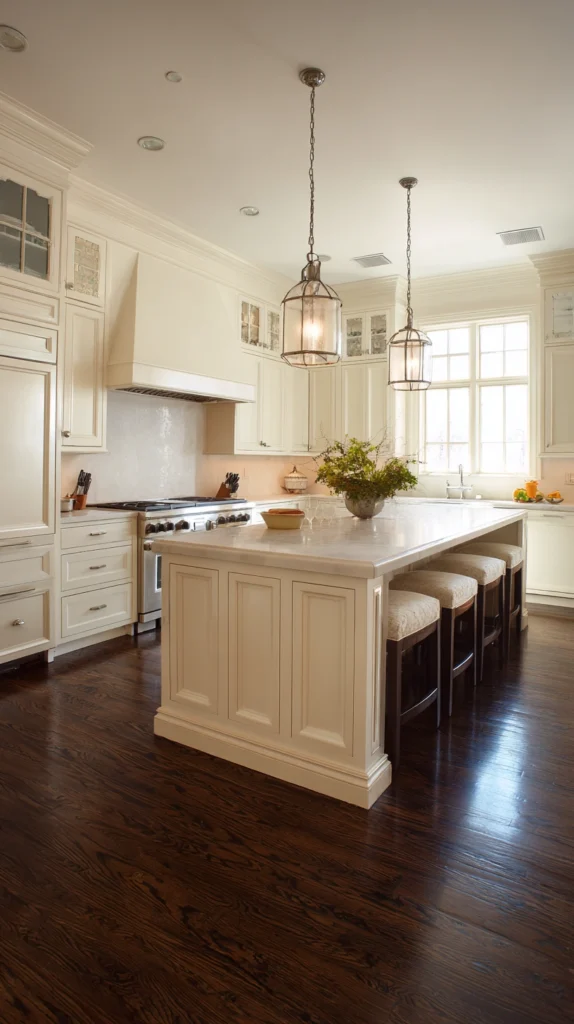
Budget: $500 – $3000 for flooring
Cream cabinetry above dark floor tiles or dark-stained timber floorboards — the pale warmth of the cream visually lifted by the depth of the floor below it — produces a kitchen with genuine visual drama and the particular quality of a room that knows how to use contrast. The dark floor grounds the cream cabinetry in a way that pale or mid-toned floors do not, and the contrast between the two makes both read more beautifully than either would alone.
Dark slate or porcelain floor tiles in a large format — $30 – $80 per square metre. Dark-stained engineered timber — $40 – $100 per square metre. Dark natural stone — $50 – $150 per square metre. The floor investment for a standard kitchen sits at $500 – $2000 in materials plus installation — significant but producing a pairing with cream cabinetry that is one of the most visually resolved kitchen combinations available.
Decor tip: Choose a dark floor in a warm tone — a dark brown rather than a cool dark grey or black — beside cream cabinetry. A warm dark floor and a warm cream cabinet are both in the same earthy, natural colour family and read together as a considered warm scheme. A cool dark grey floor beside warm cream cabinetry produces a colour temperature conflict that registers as slightly wrong without the observer being able to specify the precise cause.
10. The Cream Kitchen With Terracotta Accents
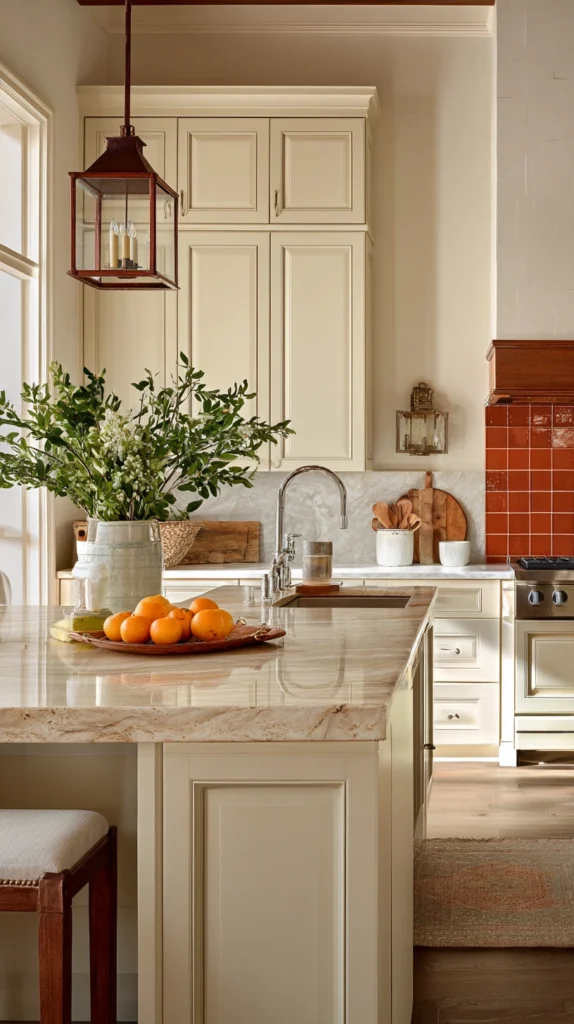
Budget: $50 – $400
Cream cabinetry with terracotta introduced through accessories, textiles, and small decorative objects — terracotta pots of herbs on the windowsill, a terracotta-coloured ceramic jug on the open shelf, terracotta floor tiles, and a terracotta linen tea towel draped over the oven handle — is the cream kitchen’s warmest and most earthy version. The two colours belong to the same warm, sun-baked, Mediterranean world and their combination communicates a specific quality of warmth that no cooler palette achieves.
Terracotta plant pots — $3 – $8 each. A terracotta ceramic jug — $15 – $40. Terracotta linen tea towels — $8 – $20 each. Terracotta floor tiles — $20 – $60 per square metre. The terracotta accent layer built through accessories costs $26 – $68 in total for a transformation of the cream kitchen’s warmth that a full renovation could not achieve more effectively.
Decor tip: Use real, unglazed terracotta wherever possible rather than terracotta-coloured glazed ceramic. Unglazed terracotta has a matte, porous surface that reads as genuine earth — warm, honest, and slightly imperfect in exactly the right way. Terracotta-coloured glazed ceramic reads as the colour of terracotta without the material quality, which is a distinction immediately apparent when the two are placed beside each other on the same shelf.
11. The Cream Kitchen With Wooden Accents
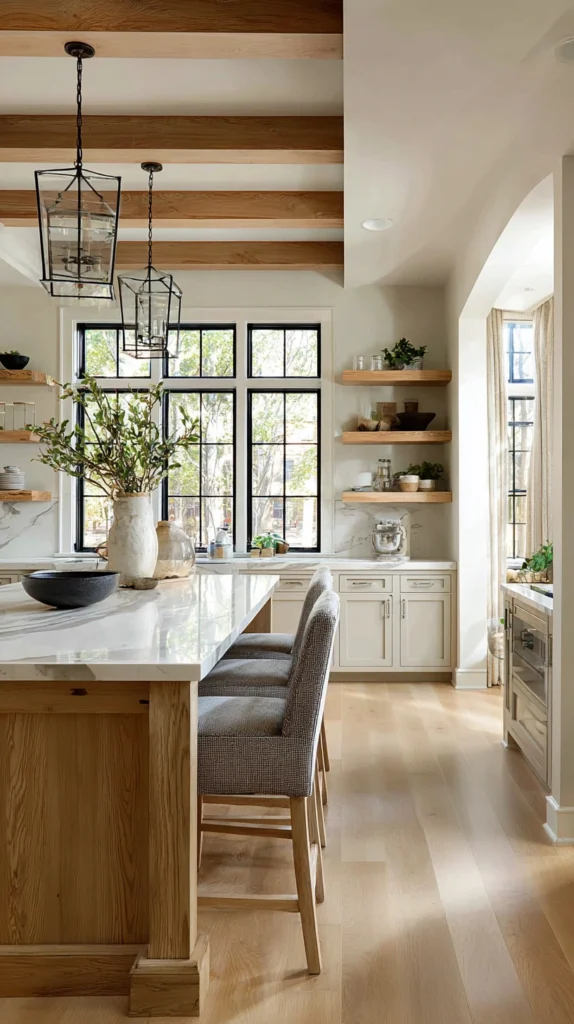
Budget: $100 – $1000
Cream cabinetry with warm timber accents throughout — a butcher block island top, open timber shelving in the upper zone, a timber-framed range hood, a natural oak bar stool, and a timber bread board leaned against the splashback — reads as a kitchen that belongs to both the natural world and the domestic one simultaneously. The cream and the timber are the two materials most naturally suited to each other in kitchen design and their combination requires no additional colour to produce a complete and beautiful scheme.
A butcher block island worktop — $150 – $400. Open timber shelves — $20 – $60 each. A timber-framed range hood — $200 – $600. Natural oak bar stools — $60 – $150 each. The timber accents distributed across the cream kitchen cost $450 – $1210 in total for a material story that reads as warm, natural, and entirely resolved.
Decor tip: Use the same timber species throughout the cream kitchen — all oak, all walnut, or all pine — rather than mixing timber species at different warmth levels. A kitchen where every timber element is in warm oak reads as a material decision. A kitchen where the island is walnut, the shelves are pine, and the bar stools are beech reads as assembled from available pieces without a unifying material intention — which is the reverse of the quality a considered kitchen scheme requires.
12. The Cream Pantry as Kitchen Feature
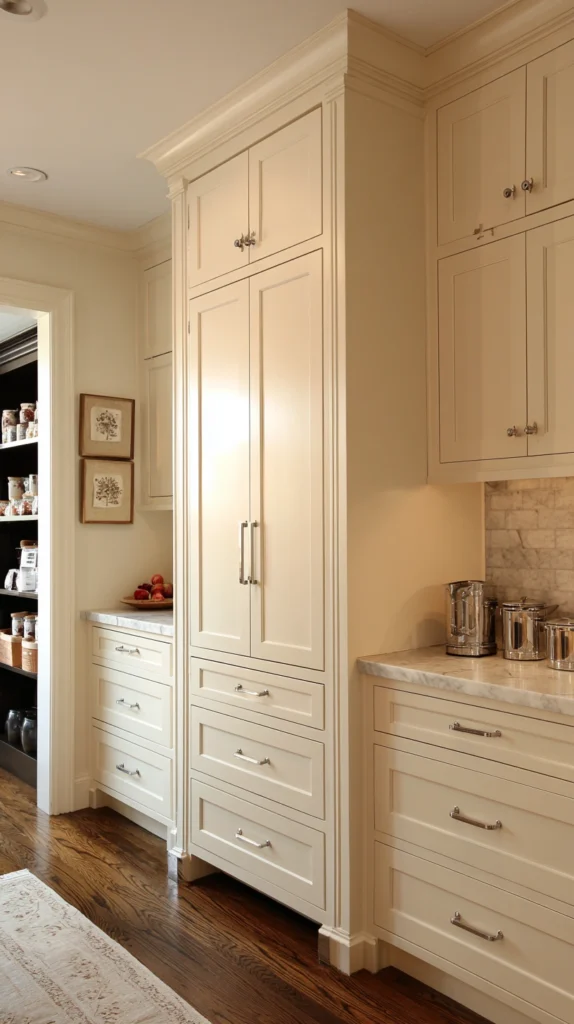
Budget: $200 – $3000
A cream pantry — a dedicated storage cupboard with floor-to-ceiling shelving, a solid or glazed door in the same cream as the kitchen cabinetry, and shelves stocked with glass jars and ceramic storage vessels — is the cream kitchen’s most characterful and most functionally generous element. A pantry communicates that the kitchen was designed for genuine, enthusiastic cooking rather than for minimal, aesthetic domesticity.
A freestanding cream pantry cabinet — $200 – $600. A fitted floor-to-ceiling pantry with solid doors in the kitchen cream — $500 – $2000 in materials and installation. Internal shelving in timber or painted wood — $50 – $200 for a standard pantry depth. Glass storage jars in graduated sizes for the pantry shelves — $15 – $40 for a set. A stocked, organised pantry beside a cream kitchen reads as the room’s most genuinely hospitable feature.
Decor tip: Install the pantry with a full-width shelf at eye height specifically for the most frequently used items — the olive oil, the salt, the coffee, and the tea — so that daily cooking does not require searching through the full pantry depth for the things needed most often. A pantry that is beautiful but difficult to use is one that will gradually accumulate disorder as the inconvenience of the organisation system defeats the intention behind it.
13. The Cream Kitchen With Statement Lighting
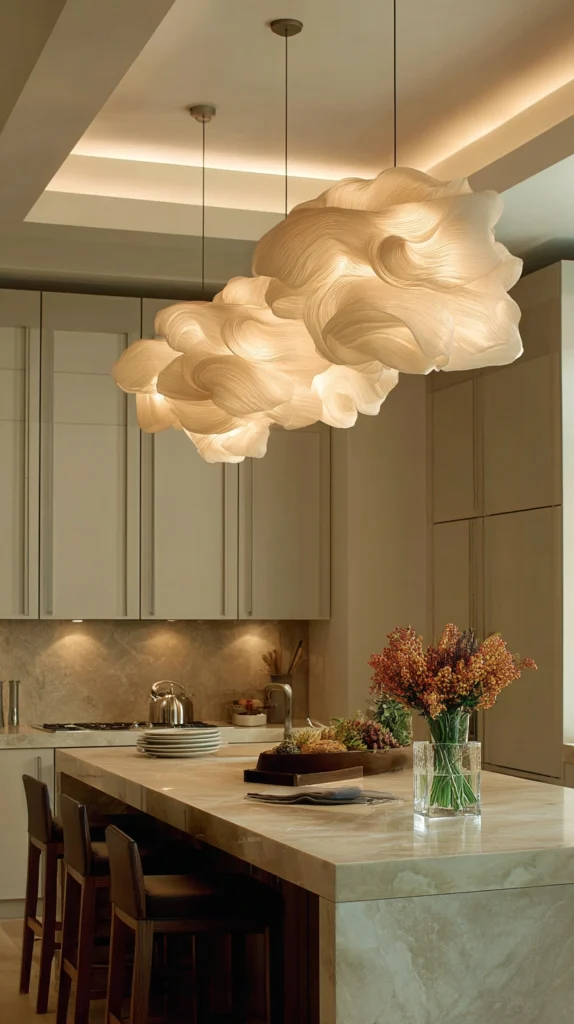
Budget: $100 – $1000
A cream kitchen given statement lighting — a cluster of rattan or brass pendant lights above the island, a large vintage-style glass pendant above the sink, and under-cabinet LED strips in a warm colour temperature — reads as a room that has been considered at every level from the floor to the ceiling. Lighting in a kitchen is rarely given the attention it deserves, and the cream kitchen — which relies on warmth for its entire aesthetic argument — is more dependent than most on the quality of its light sources.
Rattan pendant lights above the island — $30 – $100 each, a cluster of three for $90 – $300. A large glass pendant above the sink — $50 – $200. Under-cabinet LED strip lighting in a 2700K warm white — $15 – $40 per metre. Total statement lighting investment: $155 – $540 for a kitchen that is correctly lit at every working surface and atmospherically beautiful in the evening.
Decor tip: Install under-cabinet lighting as the kitchen’s primary working light source rather than relying on overhead pendants for task illumination. Overhead pendants in a kitchen produce shadows on the worktop directly beneath the upper cabinets — precisely where the most detailed food preparation work occurs. Under-cabinet lights eliminate these shadows entirely and produce an even, warm, task-appropriate light at the worktop level where it is most needed.
14. The Fully Committed Cream Kitchen
Budget: $5000 – $30000
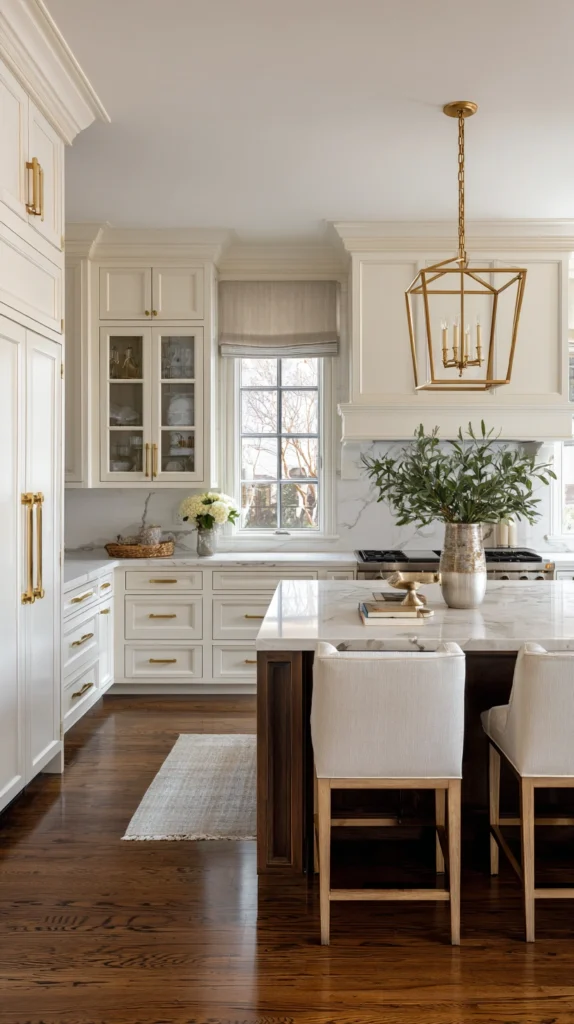
The fully committed cream kitchen — all-cream Shaker cabinetry throughout, aged brass hardware on every door and drawer, honed marble worktops, a terracotta tile floor, open timber shelves in the upper zone, a sage green painted island with a walnut worktop, a cluster of rattan pendants above the island, under-cabinet lighting on a warm circuit, terracotta pots of herbs on the windowsill, and a pantry stocked with glass jars and ceramic vessels — is a kitchen that will look as good in thirty years as it does on the day of completion.
Cabinetry: $2000 – $15000. Worktops: $500 – $3000. Hardware: $150 – $900. Flooring: $500 – $2000. Open shelving: $60 – $240. Island: $500 – $3000. Lighting: $155 – $540. Accessories and plants: $100 – $400. Total fully committed cream kitchen: $3965 – $25080 — the cost of a kitchen that was built rather than assembled.
Decor tip: Specify the cream kitchen in a single consistent paint colour throughout — every cabinet, every pantry door, and every painted surface in the same cream — rather than attempting to match multiple cream shades from different sources. Creams that appear identical in different lighting conditions diverge significantly when placed in the same room under the same light. A single colour source for every painted surface ensures the consistency that the all-cream kitchen requires to read as a considered, unified scheme rather than an approximation of one.
Cream kitchen cabinetry does not ask to be the most exciting decision in the room. It asks to be the best one — the decision that makes every other decision easier, that ages better than its alternatives, and that produces a kitchen that people want to be in at every hour of the day for every year it stands.
It rewards investment in genuine materials — real stone, real timber, real brass — more than any cooler colour does. It improves with use rather than showing it. And it communicates, to anyone who walks through the kitchen door, that the person who built this room was not building for the moment but for the long, warm, genuinely lived-in life that a kitchen at its best is always there to support.
Choose the cream carefully. Invest in the materials around it generously. And then cook in it — as much and as enthusiastically as possible — because a cream kitchen that is genuinely used becomes more beautiful with every year that passes.