14 Outdoor Curtain Ideas for a Breezy Patio Look
14 Outdoor Curtain Ideas for a Breezy Patio Look
There is a moment, usually sometime in early summer, when a patio that has served perfectly well as an outdoor space suddenly reveals what it has been missing. Not furniture, not lighting, not plants — but softness. The kind of softness that only fabric brings. A curtain catching a light breeze, a panel of sheer linen filtering afternoon sun, a pair of heavy canvas drops framing a view that was always there but never quite felt framed before.
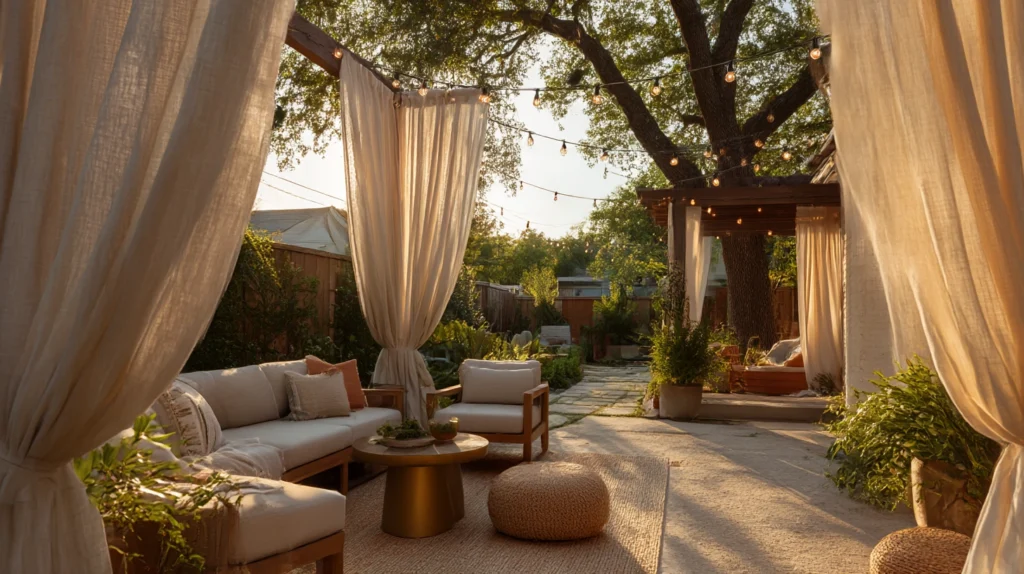
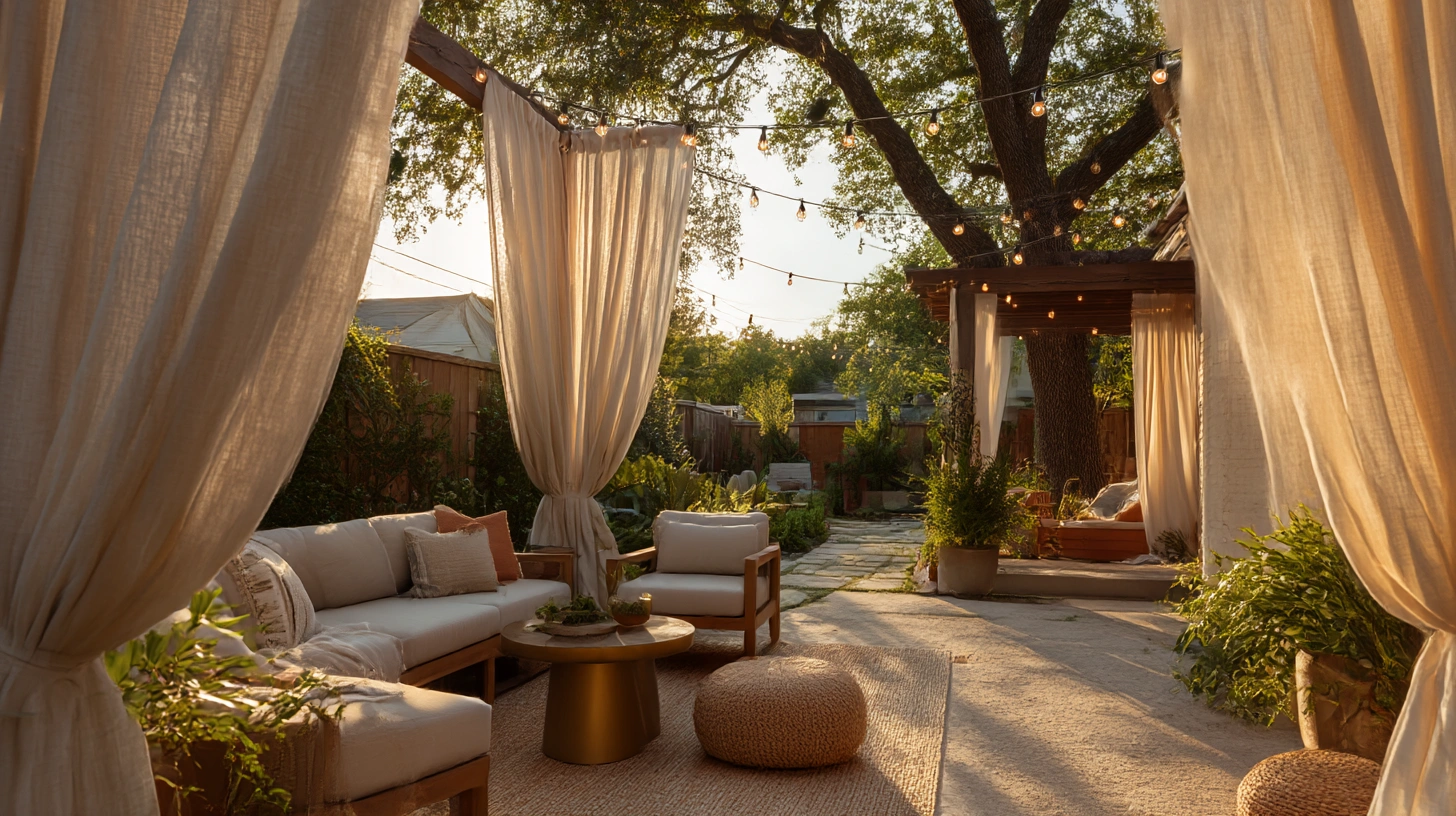
Outdoor curtains do several things at once that almost nothing else in a garden can manage: they add privacy without building anything, they control light without blocking it entirely, they define a space without enclosing it, and they introduce colour, texture, and movement to an area that hard surfaces and timber furniture alone can never provide. And they cost less, in almost every configuration, than any structural alternative.
Whether you are working with a pergola, a covered terrace, a simple clothesline frame, or two fence posts with hooks between them, the ideas below cover every scale and every budget. Each one includes what you will need, what it will cost, and a practical tip to make the whole thing work as well as the idea deserves.
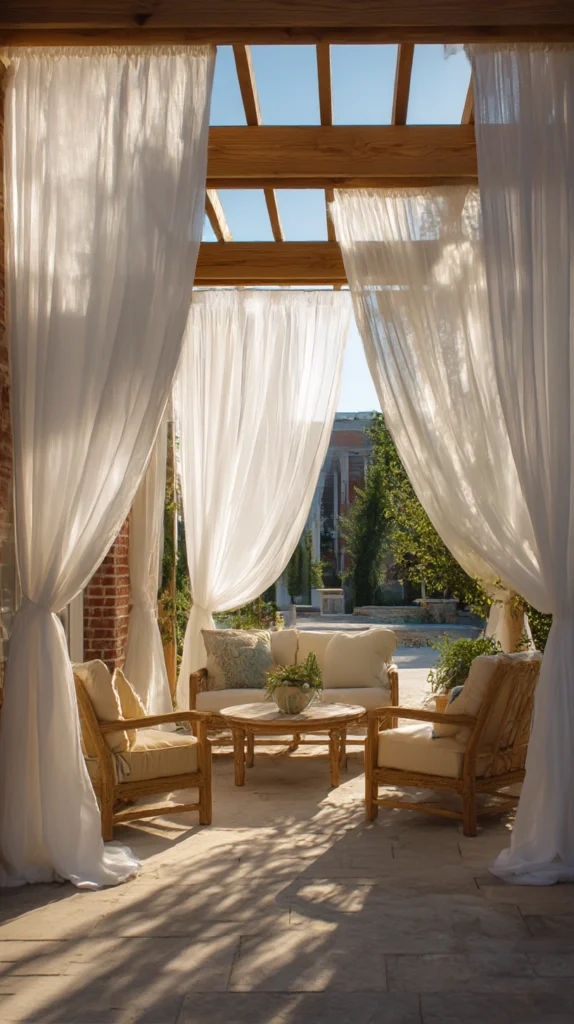
1. The Sheer White Linen Drop
Budget: $20 – $80
A pair of sheer white or natural linen panels hung from a simple curtain rod or tensioned wire transforms any patio structure into something that feels genuinely considered. Linen sheers filter harsh afternoon light into something soft and diffuse, move beautifully in the smallest breeze, and sit comfortably alongside almost any outdoor furniture style from rustic to contemporary. They are the most versatile option on this list and the right starting point for any patio that has never had curtains before.
Outdoor sheer curtain panels cost $15–$35 each. A basic stainless steel tension wire with end fixings runs $10–$20 and is more weather-resistant than a painted curtain rod. Rust-proof curtain rings or clip rings cost $5–$10 for a pack of ten. Wash linen panels before hanging — they soften and drape more naturally after the first wash and lose the stiff, packaged quality that makes new fabric look unlived-in.
Style tip: Hang the panels higher than the fixing point requires — ideally from as close to the roof of the pergola or the top of the frame as possible — and let them pool very slightly on the ground. Extra height makes the ceiling of the outdoor space feel taller and the panels more generous, and a small pool of fabric on the ground is the detail that separates a considered installation from a functional one.
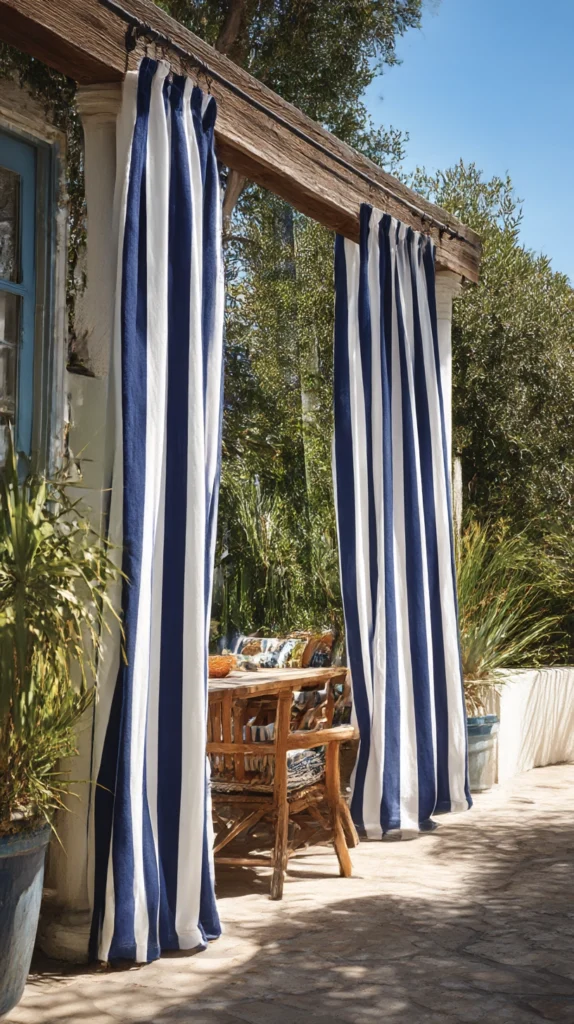
2. The Striped Canvas Panel
Budget: $30 – $120
A bold horizontal or vertical stripe in two colours — navy and white, terracotta and cream, forest green and natural — brings the language of beach huts and Mediterranean terraces to a backyard patio without requiring anything beyond the panel itself. Striped canvas is heavy enough to provide real privacy and wind resistance, opaque enough to block direct sun, and graphic enough to anchor an outdoor space visually in a way that plain panels rarely manage.
Outdoor striped canvas curtain panels cost $25–$60 each. A heavier canvas weight (at least 280 grams per square metre) resists wind movement and holds its drape in exposed positions. Stainless steel rings or eyelet tops rather than clip rings work better with heavier fabric — the weight of canvas can pull clip rings open in strong wind.
Style tip: Use one stripe pattern consistently across all panels rather than mixing two different stripe widths or colour combinations. A patio with three panels in matching stripes reads as a design decision; a patio with three panels in three different stripe variations reads as a clearance sale.
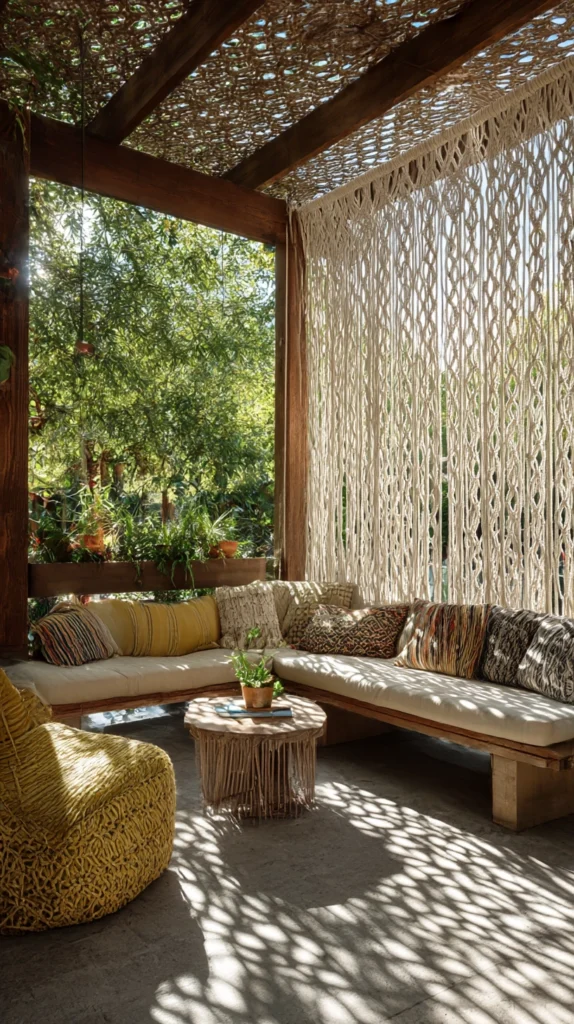
3. The Macramé Privacy Screen
Budget: $40 – $150
A large macramé panel hung between two posts or from a pergola beam functions as a curtain, a privacy screen, and a textile artwork simultaneously. The open weave allows air and light through while obscuring the view, and the natural cotton or jute fibre ages gracefully outdoors, developing a warm patina that synthetic fabrics never achieve. For patios where full privacy is not the goal but visual softening is, macramé is the most textural option available.
A large handmade macramé panel costs $40–$120 depending on size and complexity. Making one at home requires cotton rope ($15–$25 for a 3mm, 100-metre reel) and a dowel rod or bamboo pole ($3–$8) — basic macramé patterns for wall hangings are widely available free online and take a weekend to complete for a beginner. Seal the hanging points with weatherproof sealant ($5–$10) to prevent the wood from absorbing moisture where the rope contacts it.
Style tip: Position macramé panels away from the most exposed side of the patio. The open weave that makes them beautiful also makes them vulnerable to prolonged direct rain, which can cause natural fibres to shrink unevenly and lose their shape. A covered or semi-covered position extends the life of a macramé panel considerably.
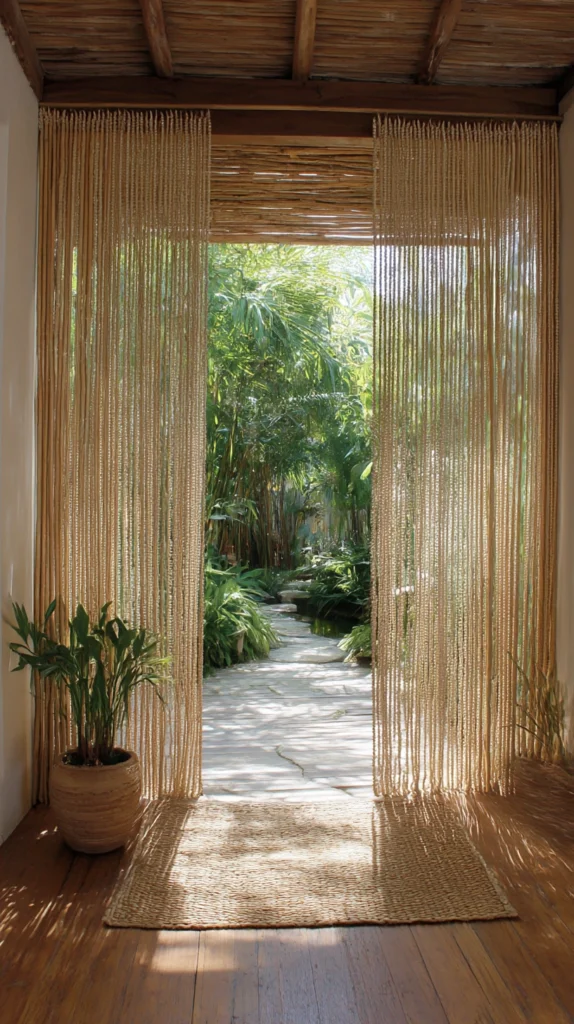
4. The Bamboo Bead Curtain
Budget: $15 – $60
Bamboo bead or reed curtains hung in a doorway or between two posts create a light, casual screen that moves in the breeze with a gentle sound and filters rather than blocks the view. They are the most informal option on this list — suited to relaxed, eclectic outdoor spaces rather than formal terraces — and they are among the least expensive, most lightweight curtain solutions available. They also age well, darkening slightly with exposure to sun and developing a natural warmth that new bamboo lacks.
A bamboo bead curtain for a standard doorway width costs $15–$35. Wider custom versions run $30–$60. Fix them from a simple timber batten screwed to the top of the frame rather than a curtain rod — the batten distributes the weight of the strings more evenly and prevents them from bunching at a central hanging point. Treat the batten with exterior wood stain to prevent moisture absorption.
Style tip: Hang two bamboo curtains side by side with a 15-centimetre overlap at the centre rather than a single wide curtain. Two narrower panels are easier to walk through, drape more naturally, and can be tied back independently to create an open-centre framing effect that a single wide panel cannot replicate.
5. The Weatherproof Velvet Drop
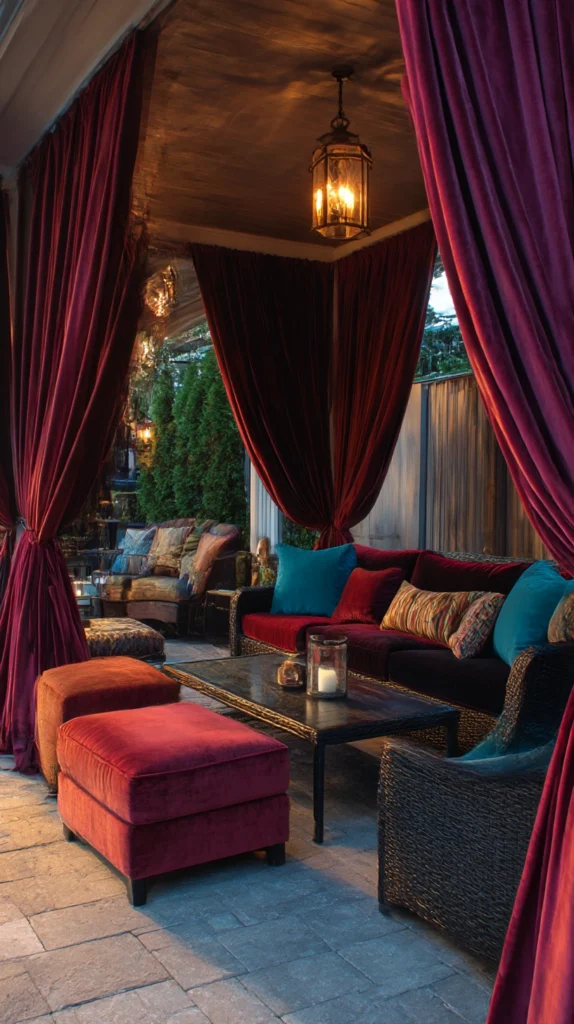
Budget: $60 – $200
Outdoor performance velvet — a synthetic fabric that mimics the weight and texture of interior velvet while resisting moisture, fading, and mildew — produces the most luxurious outdoor curtain available at a price point that is accessible. In deep jewel tones — plum, sapphire, burnt orange, bottle green — outdoor velvet panels make an evening patio feel genuinely opulent, and the weight of the fabric means it moves slowly and deliberately in the breeze rather than flapping and tangling.
Outdoor performance velvet panel pairs cost $60–$180. The weight of the fabric requires a sturdy rod or wire system rated for heavier loads — a standard tension wire rated to 20 kilograms is sufficient for two panels up to 250 centimetres long. Use large eyelet tops rather than rings for heavy panels — the eyelet distributes load across the fabric rather than concentrating it at a clip point that can tear.
Style tip: Limit outdoor velvet to covered or sheltered positions only. The texture that makes performance velvet beautiful — the deep pile that catches light differently from every angle — also traps water if saturated in heavy rain, and a waterlogged velvet panel takes a full day to dry and loses its drape in the process.
6. The Repurposed Bed Sheet Curtain
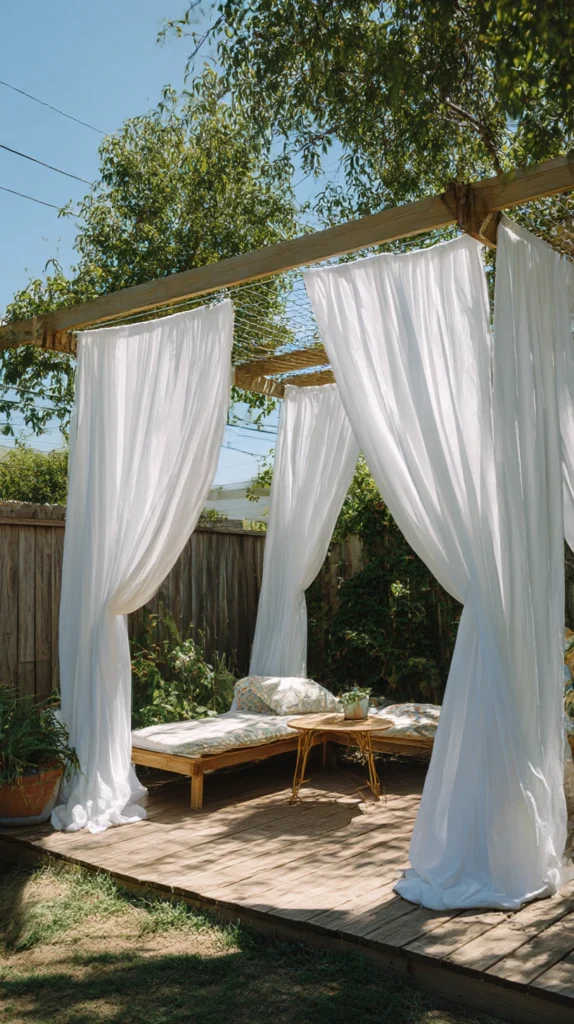
Budget: $0 – $20
A flat white or plain cotton bed sheet hung from a wire or rod between two posts is the most budget-conscious outdoor curtain on this list and, handled with care, one of the most charming. The key is in the approach: a sheet that is pressed, evenly folded at the top for a neat heading, and hung at the correct height looks like a considered sheer panel rather than an improvised covering. It is what is already in the linen cupboard, treated with the same intention as something bought specifically for the purpose.
Existing bed sheets cost nothing. A packet of curtain clip rings to attach the sheet to a rod or wire costs $5–$10. If purchasing sheets specifically for outdoor use, plain white Egyptian cotton flat sheets cost $15–$40 and produce the best drape. Wash and dry the sheet outdoors before hanging — a sheet that has been air-dried in sunlight has a crispness and faint outdoor scent that freshly ironed linen alone does not replicate.
Style tip: Fold the top edge of the sheet over by 15–20 centimetres before clipping, creating a self-valance. The folded heading adds visual weight at the top of the panel, makes the clip attachment less visible, and gives the sheet a finished quality that a plain clipped edge never achieves.
7. The Dip-Dyed Ombre Panel
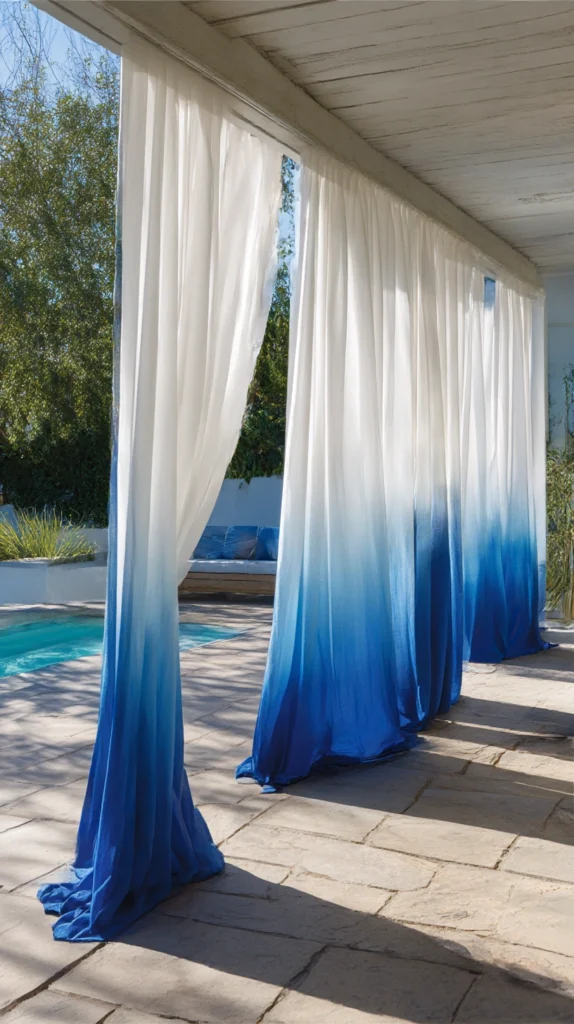
Budget: $25 – $70
Take plain white outdoor curtain panels and dip-dye the lower third in a single strong colour — indigo, sage, terracotta, charcoal — using fabric dye diluted in a bucket. The ombre effect that results, with the colour fading upward into white over 10–20 centimetres, is one of the most visually effective DIY treatments available for outdoor fabric and costs almost nothing beyond the dye and the panels. The colour choice can reference the planting in the garden, the furniture, or simply the palette you want to introduce.
Plain outdoor curtain panels cost $15–$35 each. Fabric dye in the chosen colour runs $5–$12 per packet — one packet is sufficient for several panels at the dilution required for a gradient effect. A plastic bucket and rubber gloves complete the equipment. Fix the dye with a heat setting following the packet instructions, or simply accept that outdoor dye will fade gradually in sunlight and plan to refresh it every one to two seasons.
Style tip: Dip the panels unevenly rather than in a perfectly level horizontal line — allow one edge to be 5 centimetres deeper in the dye than the other, so the colour line angles very slightly. A perfectly level dip line reads as mechanical; a slight angle reads as organic and handmade in a way that suits outdoor fabric well.
8. The Block Print Curtain
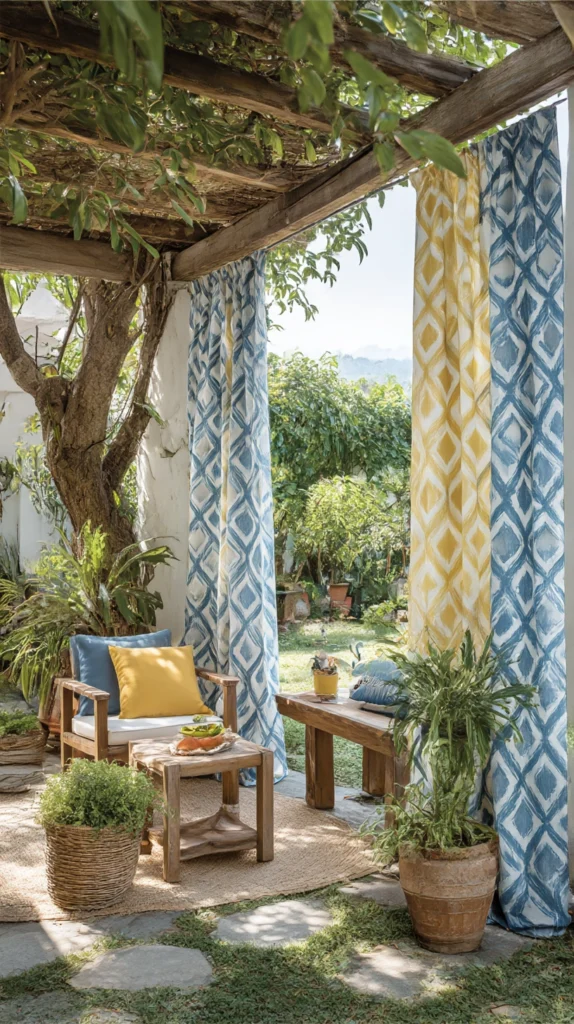
Budget: $30 – $90
Print a simple repeating pattern onto plain outdoor canvas using a carved lino block or a cut potato ($0 in materials) and exterior fabric paint ($8–$15 per colour). Geometric shapes — diamonds, triangles, simple leaves, circles — repeat well and require no artistic skill to execute cleanly. A block-printed panel in two colours is a genuinely handmade outdoor textile that costs less than most plain purchased panels and looks considerably more interesting.
Exterior fabric paint costs $8–$15 per 250ml. A lino cutting block and tools for a more precise pattern run $10–$20. Plain outdoor canvas panels cost $15–$35 each. Practice the print spacing on paper first — a pattern that looks evenly spaced in isolation often drifts when repeated across a full 250-centimetre drop. Use a light pencil grid on the fabric as a guide and erase it after the paint dries.
Style tip: Print in one direction only — either all horizontal repeats or all vertical — rather than alternating. A pattern that reads consistently in one direction has graphic strength; a pattern that switches orientation looks like a mistake even when it is intentional.
9. The Tied-Back Garden Drape
Budget: $20 – $70
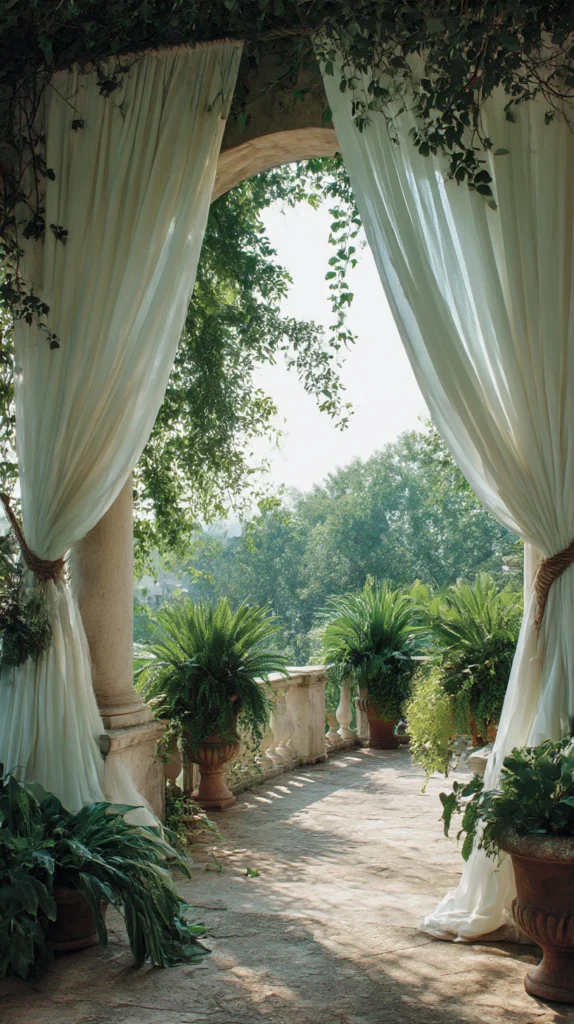
Hang panels on a fixed rod and hold them permanently in a tied-back position using a length of natural rope, jute twine, or a fabric tie looped around each panel and fixed to a wall hook. The tied-back drape is less functional as a privacy or shade solution than a loose panel, but as a purely decorative framing device — creating a soft arch around a garden view, a seating area, or an entrance — it is one of the most elegant curtain treatments available for an outdoor space.
Outdoor curtain panels cost $15–$35 each. Natural jute rope for ties runs $3–$8 for a reel. Brass or black iron wall-mounted curtain tie-back hooks cost $5–$12 each. The tie-back height matters more than most people expect — a tie placed at one-third of the panel height from the bottom creates a full, generous billow; a tie placed at the midpoint creates a flatter, more graphic silhouette.
Style tip: Allow the tied-back panel to pool on the ground by 10–15 centimetres rather than cutting it to a precise floor-length. The pool creates the impression that the panel was designed for a larger space and chosen for generosity rather than economy — exactly the feeling a tied-back drape is trying to create.
10. The Outdoor Canopy Curtain Wall
Budget: $60 – $250
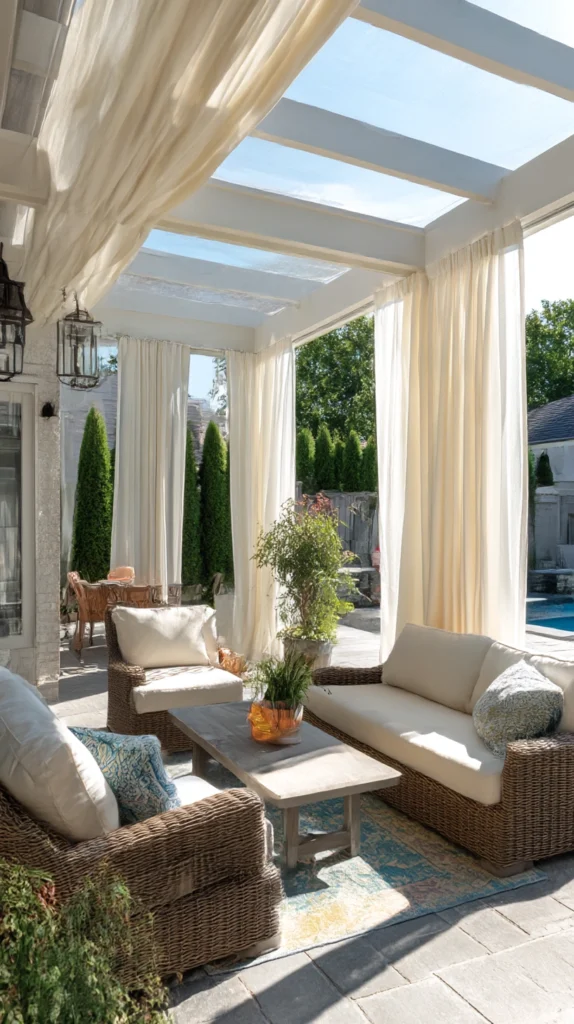
Hang multiple panels side by side across the full width of one or two sides of a patio, using a continuous rod or wire running the entire length of the structure, so the patio can be fully enclosed or fully opened depending on how the panels are drawn. It is the most functional curtain setup on this list — providing genuine privacy, wind shelter, and sun control — and when all panels are drawn back to one side, it adds no visual clutter to the open space.
A 3-metre stainless steel curtain rod costs $20–$40. Four to six panels to cover the width run $15–$35 each. A continuous rod bracket every 60 centimetres ($5–$8 each) prevents the rod from sagging under the weight of multiple panels. Use panels in the same fabric and colour throughout — a mixed-panel curtain wall looks unplanned regardless of how intentionally it was assembled.
Style tip: Add a second row of hooks at the far end of the rod, opposite where the panels begin, so the drawn-back panels stack tightly against one post rather than bunching loosely in the middle of the rod. Neatly stacked panels at one end of a structure look architectural; panels bunched at the centre look gathered and unresolved.
11. The Embroidered Panel Statement
Budget: $40 – $160
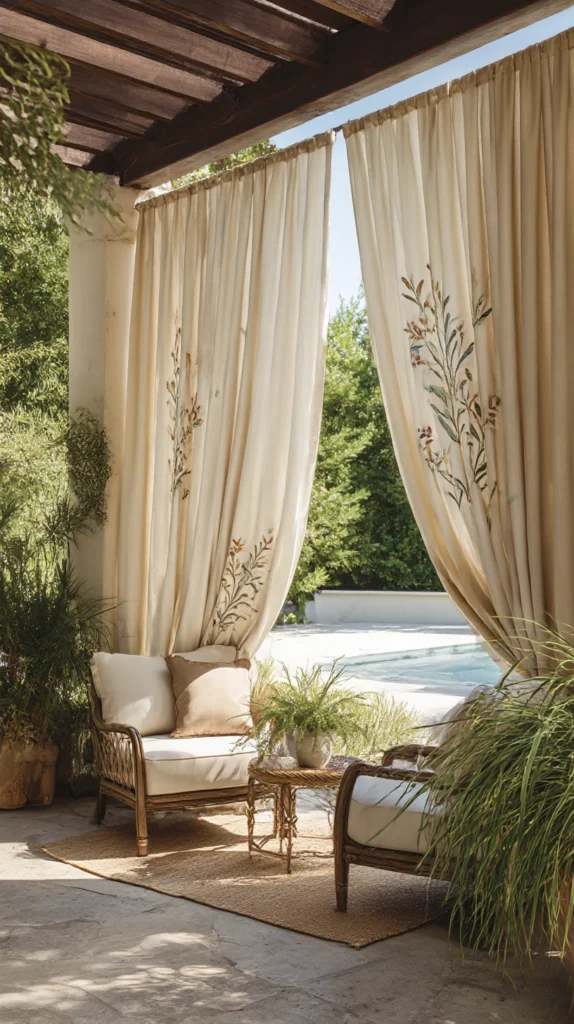
A single large embroidered outdoor panel — a botanical print, a geometric pattern, a simple floral motif — used as a centrepiece curtain between two plain panels creates a focal point on the patio without requiring any other decoration. The embroidery or print does the work that paint, plants, and furniture all contribute separately, and a single statement panel is considerably less expensive than three decorative panels of equal visual weight.
Embroidered outdoor curtain panels cost $40–$120 each for good quality versions with UV-stabilised thread. Pairing one statement panel with two plain panels in a neutral tone that picks up one colour from the embroidery costs less than three statement panels while achieving a more considered result. Hang the embroidered panel at the centre of the arrangement rather than at one end — central placement reads as intentional; an end placement reads as if the other panels ran out.
Style tip: Choose an embroidery or print motif that references something already present in the garden — a leaf shape that echoes the climbing plant on the fence, a colour that repeats in the outdoor cushions, a botanical pattern that reflects the planting in the beds. The repetition of a motif or colour between the curtains and the rest of the space creates coherence that a panel chosen in isolation rarely achieves.
12. The Rust-Dyed Natural Canvas
Budget: $15 – $50
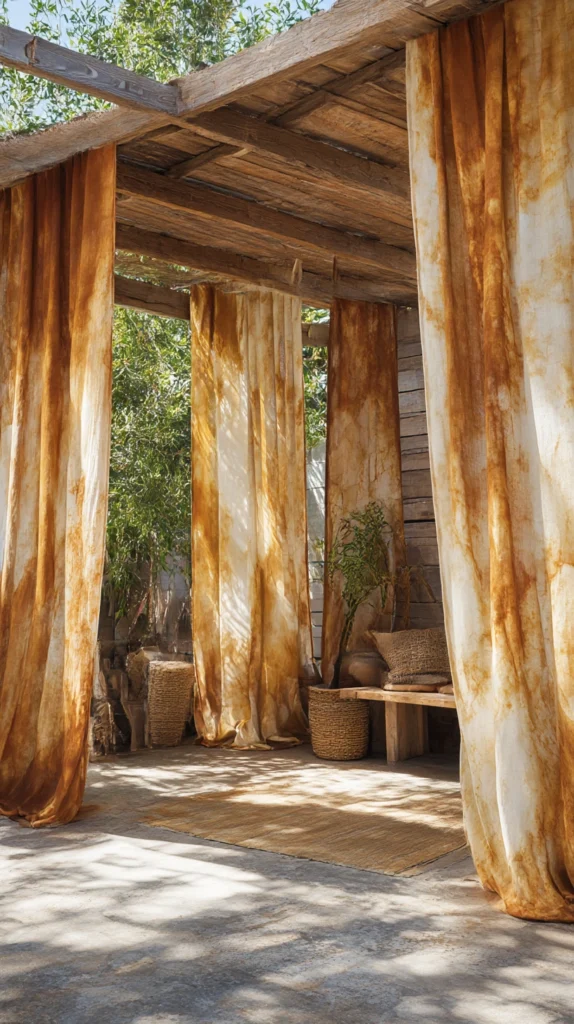
Lay plain natural canvas panels over rusted metal objects — old nails, screws, wire mesh, a section of chain — spritz with a water and vinegar solution, fold the canvas over the metal, and leave overnight. The rust transfers to the fabric in organic, unpredictable patterns that look like deliberate botanical prints. The result is a genuinely unique textile that costs almost nothing and ages in a way that purchased prints never do.
Natural canvas panels cost $15–$35 each. A bottle of white vinegar costs $2–$3. Rusted metal objects are available for nothing in most sheds and garages. Fix the rust pattern by washing the panel in a solution of baking soda and water to neutralise the acid, then allow to dry fully before hanging. The pattern will fade slightly with washing but never disappears entirely.
Style tip: Layer two or three different metal textures on the same panel — fine wire mesh in one area, large bolts in another, a section of chain across the middle — so the finished print has variation in scale and density. A pattern made from a single object repeated uniformly looks stamped; a pattern made from layered objects of different scales looks grown.
13. The Bamboo Pole Curtain Frame
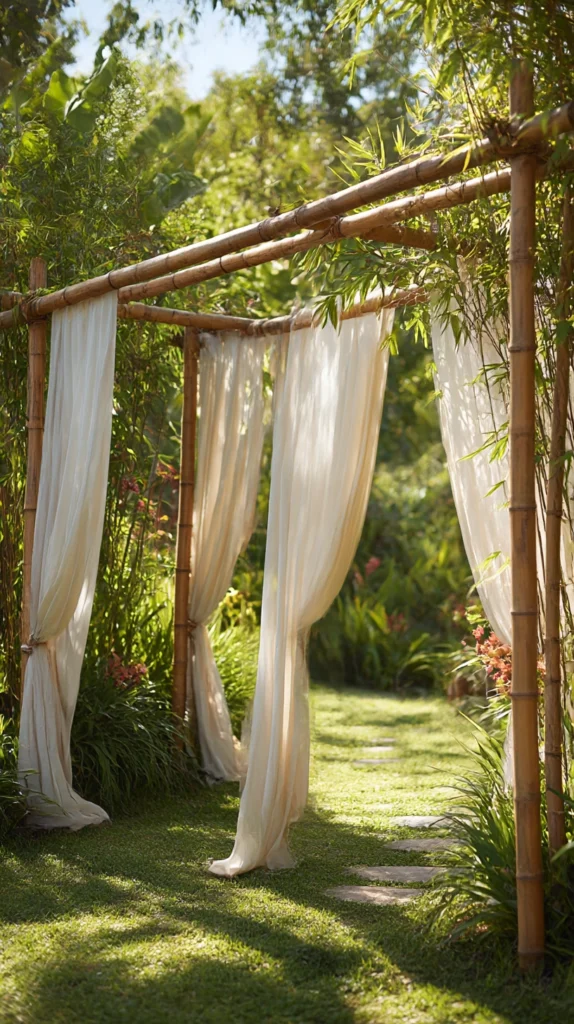
Budget: $20 – $80
Where no existing structure exists to hang curtains from, build a simple freestanding frame from four bamboo poles lashed together at the top with natural rope — two uprights and a crossbar, stabilised with diagonal bracing — and hang panels from the crossbar. A freestanding bamboo frame requires no fixing to walls or ground, costs almost nothing, and can be repositioned, disassembled, and stored flat at the end of the season.
Thick bamboo poles (at least 4 centimetres in diameter) cost $5–$12 each from garden centres or online. Natural sisal rope for lashing runs $3–$8 per reel. A simple lashing technique — two wrapping turns and two frapping turns — requires no knot experience and produces a joint strong enough to support the weight of two or three fabric panels. Seal the base of each upright with a coat of exterior wood preservative to prevent rot where it contacts damp ground.
Style tip: Angle the uprights very slightly outward at the base — a 5-degree lean — rather than standing them perfectly vertical. The slight angle gives the frame a more intentional, architectural quality and makes it visually stable in a way that perfectly vertical poles, which can look as if they are about to topple, do not.
14. The Seasonal Colour Swap
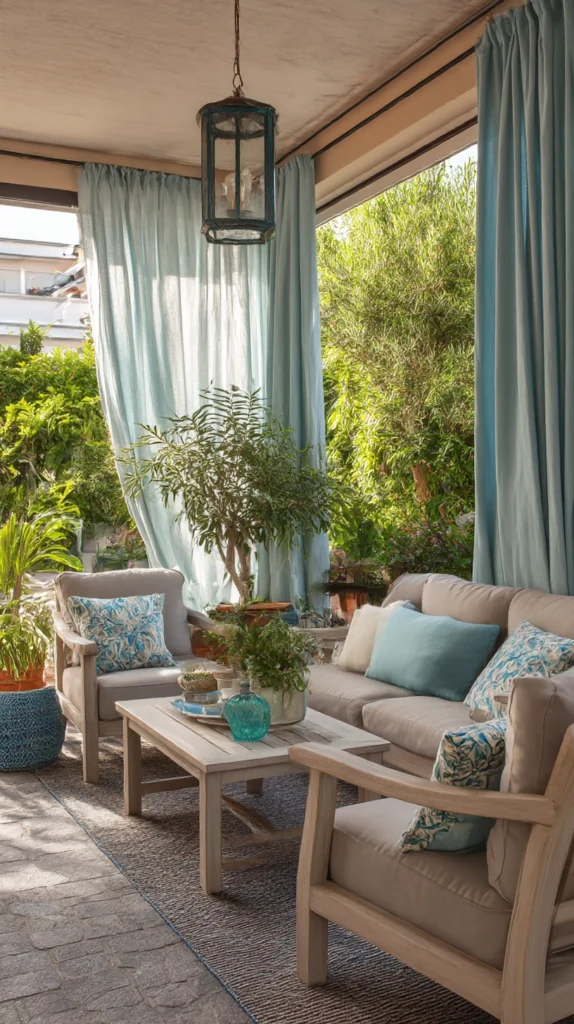
Budget: $30 – $100 per season
Rather than one permanent outdoor curtain installation, buy two sets of panels in different colourways — one light and cool for summer, one warm and deep for the tail end of the season — and swap them as the temperature changes. Pale blue and white for July and August; burnt amber and deep rust for September and October. The seasonal swap costs no more than a single mid-range installation over two seasons and keeps the patio looking considered rather than static across the months when it is most used.
A pair of light summer panels costs $20–$50. A pair of autumn-toned panels runs $20–$50. Store the off-season panels in a weatherproof bag or box to prevent dust and moisture damage. The same rod, wire, and fixing system serves both sets — only the panels change.
Style tip: Choose the two colourways so that they share at least one tone — a summer palette of pale blue and cream transitions naturally to a deeper blue and warm amber for autumn, because the blue is common to both. A seasonal swap that shares a colour reads as an evolution of the same space; a swap between entirely unrelated palettes reads as a change of mood that the rest of the furniture and planting may not support.
The best outdoor curtain is not the most expensive one or the most elaborate one — it is the one that does exactly what that particular patio needs: more privacy here, softer light there, a frame around a view that was always worth looking at. Get the hanging system right first, choose a fabric weight appropriate to the exposure, and let the colour and texture follow from what is already in the space.
Start with a single pair of panels on the side of the patio that most needs them, live with it for a season, and add from there. The breeze will do the rest.