13 Fall Staircase Garland Ideas
13 Fall Staircase Garland Ideas
A staircase is one of the few places in a home where decor is seen from multiple angles and distances at once — from the entryway looking up, from the landing looking down, and up close on every step in between. That makes a staircase garland one of the highest-impact seasonal installations available, and also one of the easiest to get wrong: a garland that looks full and considered from a distance can look thin, uneven, or overly busy the moment someone climbs past it.
Fall garland specifically carries a built-in advantage most seasonal installations don’t have. The material palette — dried foliage, warm ribbon, muted botanicals — already relates to itself before a single design decision gets made, the same natural cohesion that makes fall entry tables and fire pit plantings easy to get right. The task with a staircase, more than with a table or a shelf, is technique: even fullness, secure attachment, and a scale that suits the banister rather than overwhelming it.
A well-built fall garland turns a staircase into the seasonal focal point of the whole home, visible from nearly every room on the ground floor. Here are 13 ways to build one that holds up, looks intentional at every angle, and doesn’t come apart by the second week of the season.
Why Some Staircase Garlands Look Thin or Uneven
The single-strand problem:
Without layered construction:
- One thin strand of faux foliage wound directly around the banister
- No variation in thickness along the garland’s length
- Gaps visible between the banister spindles and the greenery
- The result: reads sparse, especially when viewed from below looking up the stairwell
With layered construction:
- A base garland (the foliage) with at least one additional layer — ribbon, lights, or a botanical accent — woven through it
- Thicker sections at the newel post and the base, tapering slightly as the garland climbs
- The layers fill visual gaps that a single strand alone leaves behind
- The result: reads full and considered from every viewing angle
The attachment problem:
- Garland tied loosely or only at the top and bottom, sagging visibly along its middle length
- Zip ties or floral wire placed too far apart to hold the garland’s shape against gravity and the banister’s angle
- The result: an uneven, drooping line that undercuts an otherwise good material choice
The colour-repetition problem:
- Every accent (ribbon, pumpkins, berries) placed at irregular, inconsistent intervals
- The eye can’t establish a rhythm, so the garland reads as decorated rather than designed
- Repeating the same accent at a consistent interval (every third step, for instance) creates the rhythm a staircase garland needs to read as intentional from a distance
The Five Staircase Garland Essentials
Before choosing any individual idea below, these five principles separate a garland that holds its shape and reads intentional from one that sags or looks thin:
A secure attachment method:
- Floral wire or zip ties, spaced every 12–18 inches along the banister
- The single most important technical factor in how the finished garland actually looks
A base layer with real volume:
- Faux or dried foliage with enough density to fill the space along the banister without gaps
- Thin, sparse garland reads unfinished no matter how it’s accessorised afterward
A consistent accent rhythm:
- One repeated accent (a ribbon bow, a mini pumpkin, a cluster of berries) at a regular interval
- Irregular placement reads as decoration; regular placement reads as design
A warm, muted colour palette:
- Rust, cream, warm brown, and muted gold rather than bright orange or saturated red
- The same restraint principle that applies to any fall styling surface
Consideration of the multi-angle view:
- Checked from below, from the landing, and up close on the stairs themselves
- A garland that only looks finished from one angle isn’t finished
1. The Faux Fall Foliage Base Garland
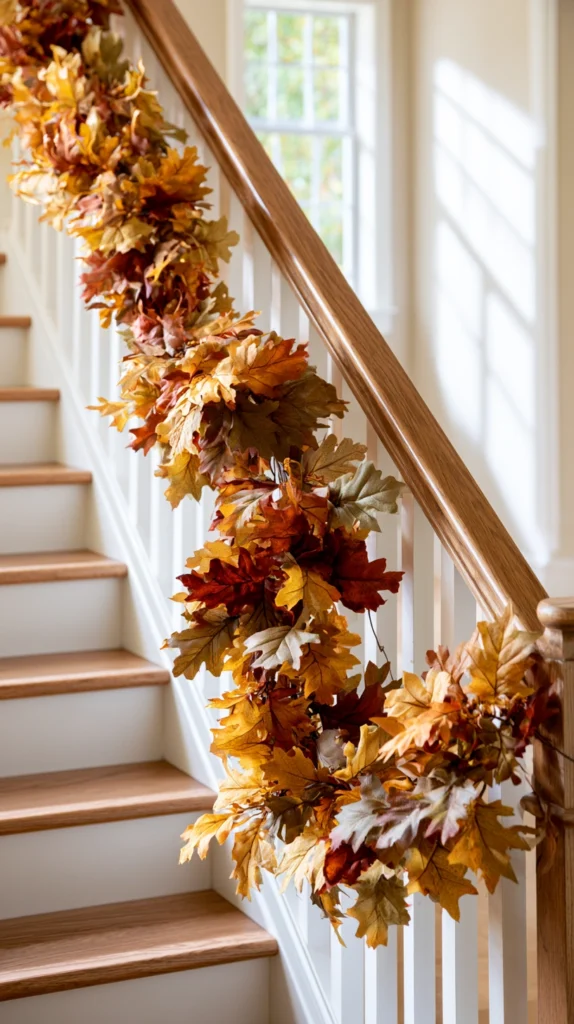
A faux maple or oak leaf garland, in mixed autumn tones, wound along the banister as the foundational layer every other idea on this list builds from.
Why faux over fresh for a staircase specifically
A staircase garland typically stays in place for six to ten weeks, far longer than fresh foliage can hold its colour and shape without significant wilting and mess. High-quality faux foliage holds its rust, gold, and warm green tones for the full season and can be reused in subsequent years, making it the more practical base layer for this specific application.
Sizing and attachment
- Garland length: measured along the banister’s slope, typically 9–15 feet for a standard staircase run
- Attached with floral wire at 12–15 inch intervals, wrapped around both the garland and the banister spindle or handrail for a secure hold
Cost breakdown
- Faux fall foliage garland (9 ft): $35–65
- Floral wire: $5–8
- Total: $40–73
2. The Ribbon-Wrapped Accent
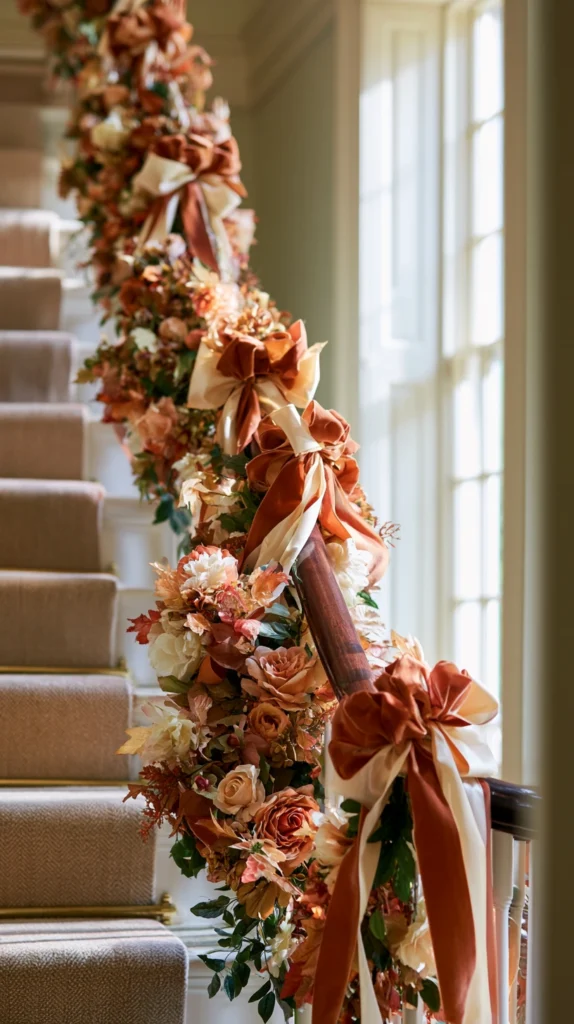
A wide velvet or grosgrain ribbon woven diagonally through the base garland, in a warm rust or cream tone, tied into a bow at consistent intervals.
Why ribbon adds the rhythm a plain garland lacks
A garland of foliage alone, however full, reads as a single continuous texture with no visual punctuation. Ribbon woven through it at a repeated interval breaks that continuity into a rhythm the eye can follow up the staircase, and velvet specifically catches light in a way that reinforces the season’s warm, low-light quality.
Placement
- One bow at the newel post (the base of the staircase), then repeated every third or fourth step
- Ribbon width: 2.5–4 inches for visibility against the foliage without overwhelming it
Cost breakdown
- Velvet or grosgrain ribbon (10 yards): $20–35
- Total: $20–35
3. The Dried Wheat and Pampas Accent
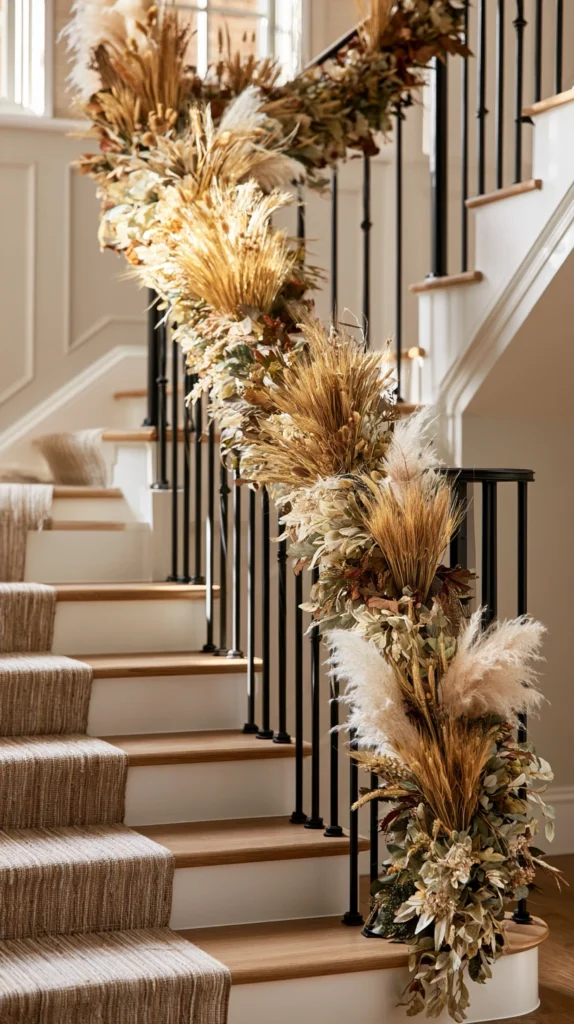
Small bundles of dried wheat or pampas grass, tucked into the base garland at intervals, adding a pale, textural contrast to the darker foliage tones.
Why a pale accent matters against a darker base
A garland built entirely from deep rust and brown foliage can read heavy across a long staircase run. Pale, dried wheat or pampas bundles tucked in at intervals lighten the overall visual weight and add textural variation, the same contrast principle used in a fall entry table’s height anchor.
Placement
- Small bundles (4–6 stems each), tucked into the garland every third step, alternating with any ribbon bows from Idea #2
- Secured with a small wrap of floral wire directly into the base garland, not resting loosely on top of it
Cost breakdown
- Dried wheat or pampas stems (bundle): $15–25
- Total: $15–25
4. The Mini Pumpkin Clusters
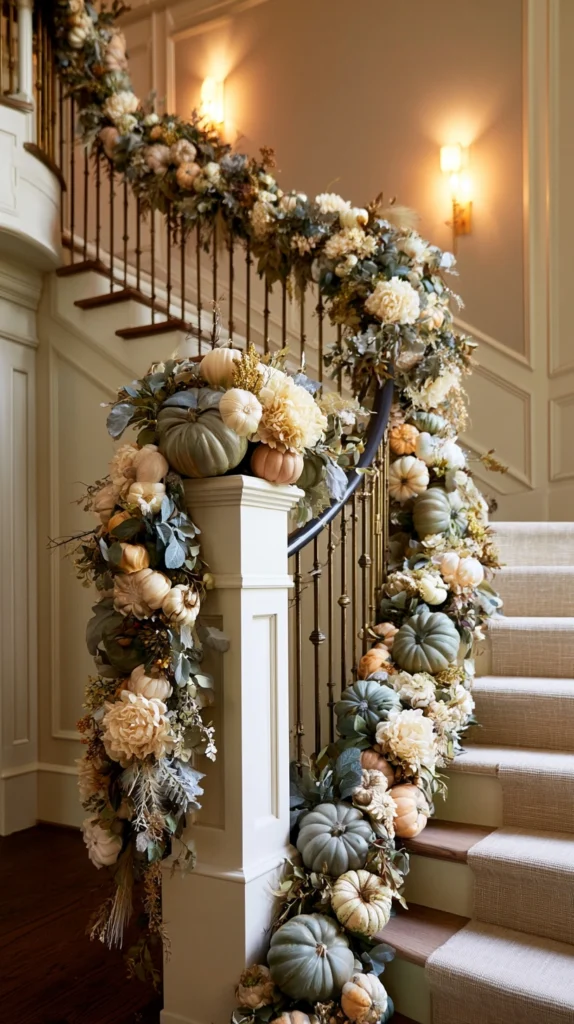
Small faux pumpkins, in groups of two or three, wired directly into the garland at the newel post and at one or two points along the staircase’s climb.
Why clusters instead of single pumpkins spaced evenly
A single mini pumpkin wired in every few steps reads scattered and thin against the volume of the surrounding foliage. The same pumpkins grouped into small clusters at fewer points along the garland read as intentional accents rather than an attempt to space decor evenly across the whole run.
Placement
- One larger cluster (3 pumpkins) at the newel post, where the garland begins
- One or two smaller clusters (2 pumpkins) at the midpoint and near the top of the staircase
Cost breakdown
- Mini faux pumpkins (7–8 total): $15–30
- Total: $15–30
5. The Magnolia Leaf Garland Base
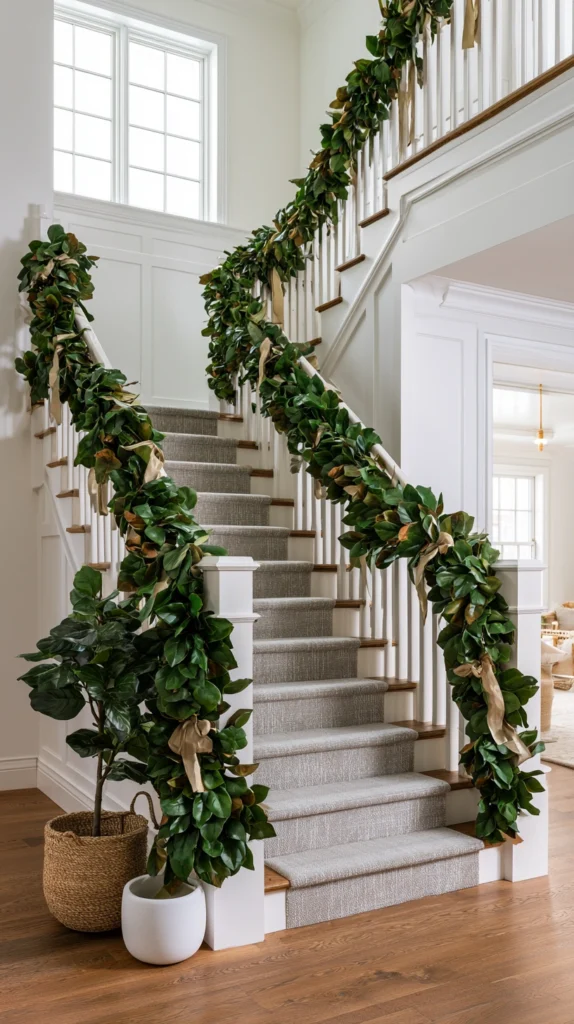
A garland built from faux magnolia leaves — their dark green fronts and warm brown, velvety undersides — used as an alternative base layer to standard maple or oak foliage.
Why magnolia suits a more sophisticated fall palette
Magnolia’s two-toned leaves (deep green on one side, warm brown on the other) already carry the tonal contrast a garland needs, meaning fewer additional accents are required to keep the base layer visually interesting. It also reads slightly more formal and less overtly “autumn” than bright maple foliage, suiting a home that wants a fall feeling without a strongly seasonal, novelty appearance.
Styling considerations
- Works especially well with brass or gold ribbon accents (Idea #2), since the warm brown undersides already relate to that metal tone
- Pairs less naturally with bright orange pumpkin accents, which can clash with magnolia’s more muted, formal palette
Cost breakdown
- Faux magnolia leaf garland (9 ft): $45–80
- Total: $45–80
6. The Berry and Branch Accent
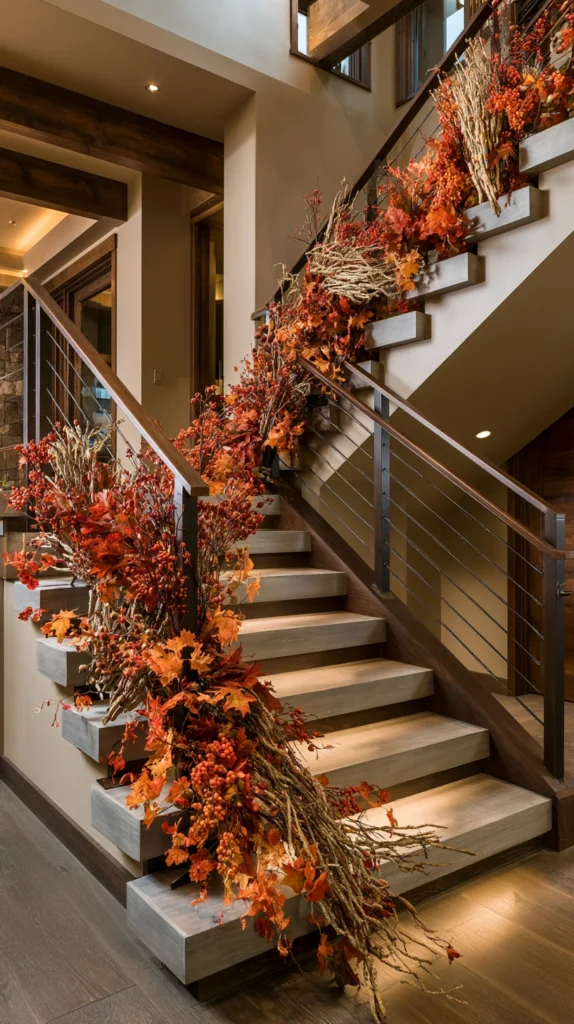
Small clusters of faux autumn berries (rust, deep red, or burgundy) combined with a few bare, textured branches, tucked into the garland alongside the main foliage.
Why berries and branches add depth without adding bulk
Berries introduce small, saturated points of colour that catch the eye against the garland’s broader foliage texture, while bare branches add an architectural, slightly wild line that keeps the garland from reading as uniformly soft and rounded throughout its length.
Placement
- Berry clusters tucked in every second or third step, smaller and more frequent than the mini pumpkin clusters in Idea #4
- One or two longer branches allowed to extend slightly beyond the garland’s edge for a more natural, gathered look
Cost breakdown
- Faux berry stems (4–5): $12–20
- Textured branches (2–3): $10–18
- Total: $22–38
7. The Warm String Light Weave
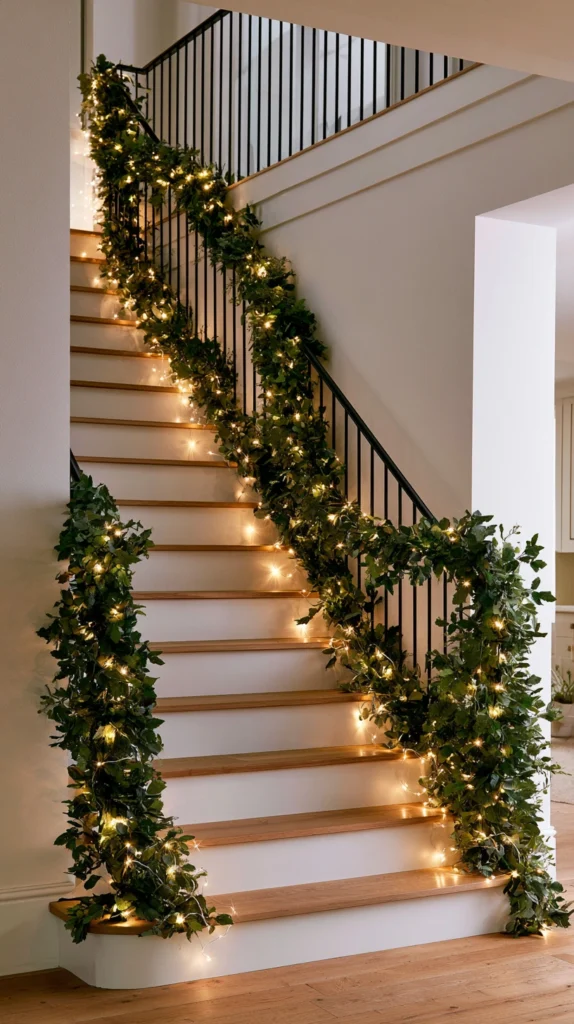
A strand of warm white string lights woven through the base garland, extending its visual presence into the evening once natural light fades.
Why lighting matters more on a staircase than in many other garland applications
A staircase is often used at all hours, including after dark, in a way a mantel or table garland typically isn’t. Lights woven through the greenery mean the garland continues doing its seasonal, focal-point work in the evening rather than disappearing into shadow once the sun goes down.
Installation notes
- 2700K warm white lights, woven loosely through the garland rather than wrapped tightly, so the bulbs remain visible rather than buried in foliage
- A battery-powered or plug-in strand with a timer function avoids needing to manually turn the lights on each evening
Cost breakdown
- Warm white string lights (extendable strand, 20–30 ft): $20–35
- Total: $20–35
8. The Cinnamon Stick and Botanical Bundle
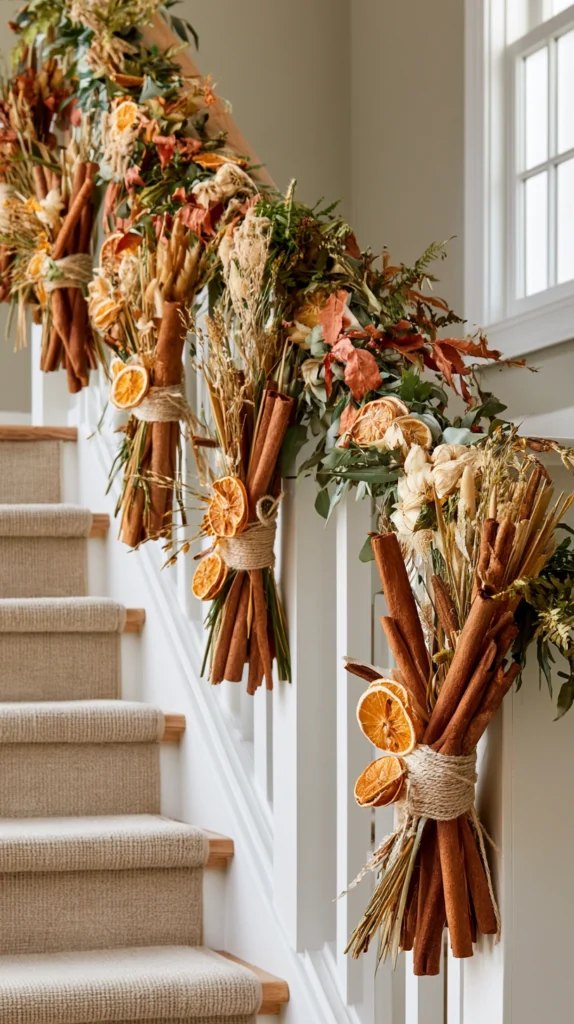
Small bundles of cinnamon sticks, dried orange slices, or mixed dried botanicals, tied with twine and tucked into the garland at a few key points, echoing the same detail used on a fall entry table.
Why a small tied bundle works at close range on a staircase
Unlike accents viewed from a distance, anyone actually walking the stairs sees the garland at close range, where a small, detailed bundle rewards a closer look in a way larger accents don’t. Cinnamon sticks and dried citrus also introduce a subtle scent, which most other accents on this list don’t provide.
Placement
- Two to three bundles total, positioned at the newel post and roughly the midpoint of the staircase, where close-range viewing is most likely
- Tied with jute twine, left with a short tail for texture
Cost breakdown
- Cinnamon sticks or dried orange slices: $8–15
- Jute twine: $3–5
- Total: $11–20
9. The Ombre Fall Tone Garland
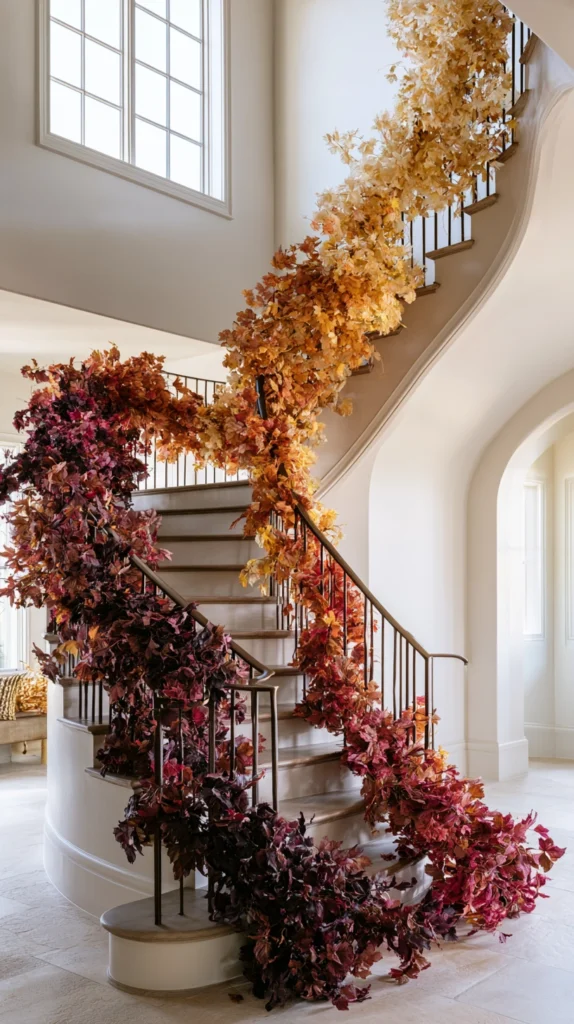
A base garland constructed or accented so the colour gradually shifts along its length — deep rust near the base of the stairs, transitioning to warm gold or cream near the top.
Why a gradient reads more sophisticated than a flat, single-tone garland
A garland in one uniform colour, however well-chosen, reads as a single flat decision repeated along the full staircase length. A gradual colour shift introduces a sense of movement and intention that a flat-toned garland can’t achieve, and it gives the eye a reason to follow the garland’s full path rather than registering it as one repeated unit.
Achieving the gradient
- Combine two or three foliage garlands in different but related tones (deep rust, burnt orange, warm gold), overlapping their ends where the colours transition
- Alternatively, use one base garland and shift the accent colours (ribbon, berries) gradually from deep to pale along its length
Cost breakdown
- Foliage garland in a second tone (additional 4–5 ft section): $20–35
- Total (in addition to base garland cost): $20–35
10. The Lantern Accent at the Newel Post
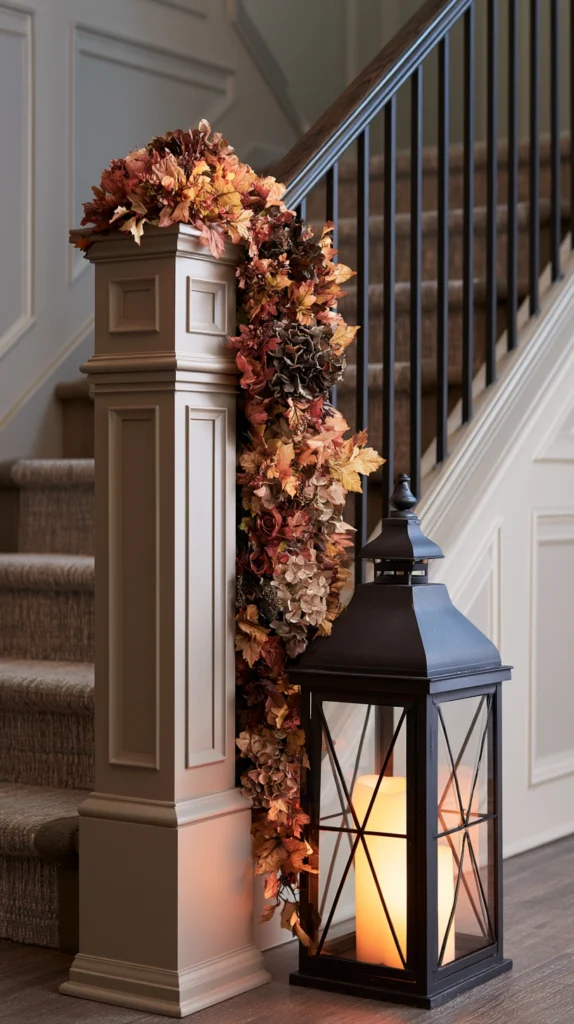
A small lantern, holding a flameless candle, positioned at the base of the staircase where the garland begins — a height and light anchor similar to the lantern used on a fall entry table.
Why the newel post is the right place for this accent
The newel post is typically the staircase’s most visually prominent single point, seen directly on entry to the home. A lantern here gives the garland a clear starting point and a warm light source at the exact spot most likely to be noticed first, before the eye follows the garland’s line upward.
Sizing and placement
- Lantern height: 10–14 inches, sized to sit naturally on or beside the newel post’s cap without overwhelming it
- A flameless, battery-operated candle is the safer choice in a high-traffic area at the base of a staircase
Cost breakdown
- Small lantern: $25–50
- Flameless candle: $10–18
- Total: $35–68
11. The Chunky Knit Textile Garland
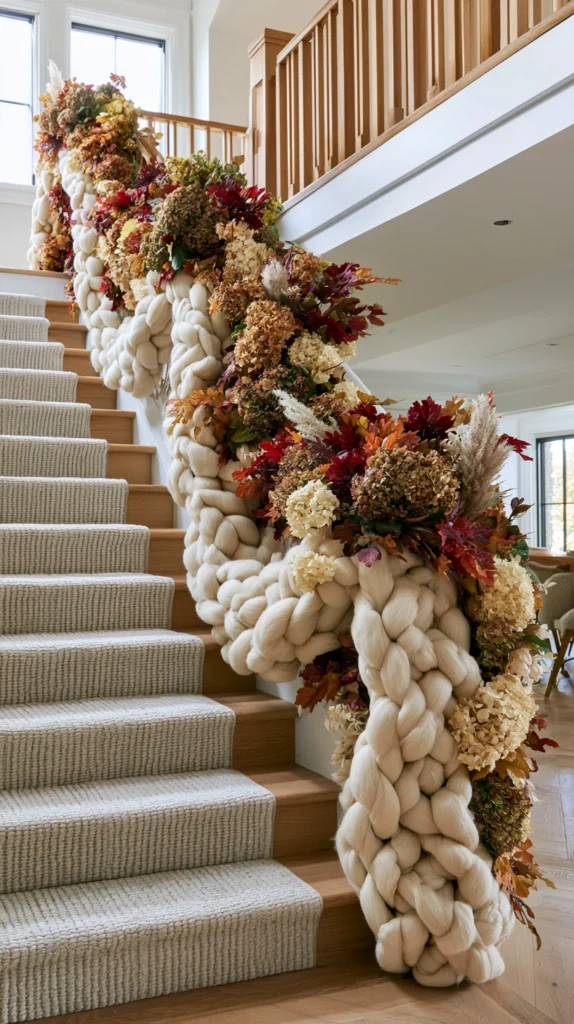
A garland-length knit or woven textile rope, in a warm cream or oatmeal tone, layered alongside the foliage garland rather than replacing it — a non-floral texture that adds a cozy, tactile quality.
Why a textile layer works alongside foliage rather than instead of it
A textile garland alone, without any botanical element, can read more like a general cozy-season accessory than a specifically fall one. Layered alongside a foliage base, it adds the same chunky-knit warmth used in blanket and throw styling elsewhere in the home, without sacrificing the seasonal specificity the foliage provides.
Installation
- Draped alongside the foliage garland, following the same line, rather than wound separately around the banister
- Secured at the same intervals as the base garland, using the foliage’s existing wire attachment points where possible
Cost breakdown
- Chunky knit garland rope (9 ft): $25–45
- Total: $25–45
12. The Two-Level Staircase and Landing Garland
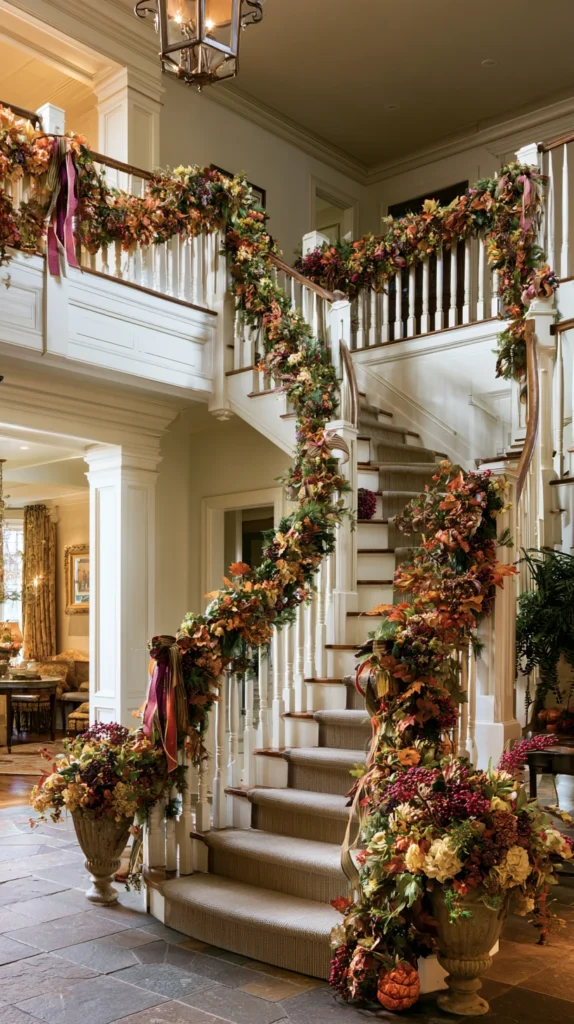
Extending the garland treatment beyond the staircase itself onto the landing railing or an adjoining hallway railing, creating one continuous seasonal line through the full vertical space.
Why extending beyond the staircase matters in open-plan homes
In a home where the staircase is visible from an open living or entry space, stopping the garland abruptly at the top step can look unfinished from certain vantage points. Continuing the same garland treatment onto a landing or upper railing creates one unbroken seasonal statement through the entire visible stairwell.
Scaling the extension
- Use a slightly thinner garland or the same garland at reduced density on the upper level, since it’s typically viewed from farther away and doesn’t need to match the base level’s full volume
- Repeat the same accent rhythm (ribbon, berries, or pumpkins) established on the main staircase run, rather than introducing new accent types on the upper level
Cost breakdown
- Additional garland for landing or upper railing (4–6 ft): $20–40
- Total: $20–40
13. The Complete Layered Staircase Garland
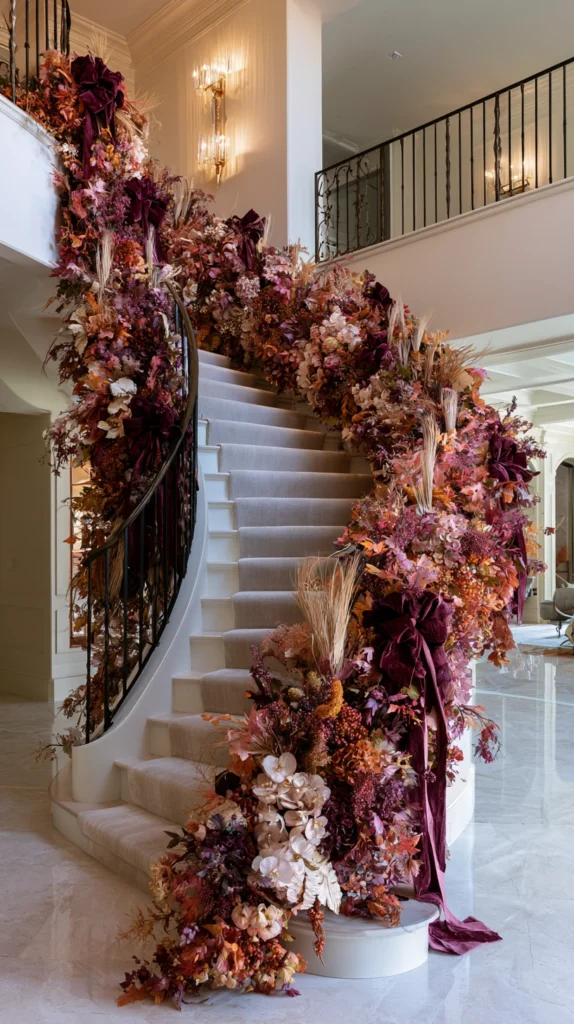
A staircase garland built with every principle above applied together — the definitive version of a fall garland that reads full, intentional, and cohesive from every angle in the home.
What separates the complete garland from a single strand with a few accents
A base garland with one type of accent, however nice, can still read thin from certain angles or during evening hours. The complete version resolves every layer at once — volume, rhythm, colour variation, and light — so the garland functions as a genuine focal installation rather than a single decorated strand.
The elements of the complete garland
The base:
- A full faux foliage garland, securely wired at 12–15 inch intervals (Idea #1)
- An ombre colour shift along its length, from deep rust at the base to warm gold near the top (Idea #9)
The rhythm accents:
- Velvet ribbon bows repeated every third or fourth step (Idea #2)
- Mini pumpkin clusters at the newel post and two points along the climb (Idea #4)
- Berry and branch accents filling the gaps between the ribbon and pumpkins (Idea #6)
The texture layer:
- Dried wheat or pampas bundles for pale contrast against the darker foliage (Idea #3)
- A chunky knit textile rope layered alongside the foliage for tactile warmth (Idea #11)
The light layer:
- Warm string lights woven through the full garland length (Idea #7)
- A lantern with a flameless candle at the newel post (Idea #10)
The detail layer:
- Cinnamon stick bundles at two close-range viewing points (Idea #8)
The staircase on an ordinary fall evening:
The lantern at the newel post is the first thing visible on walking through the front door, its light picked up and carried upward by the string lights woven through the garland above it. The ombre shift from deep rust to warm gold is visible from the entryway looking up, and up close on the stairs themselves, the cinnamon bundles and ribbon bows reward a closer look. From every angle in the house, the staircase reads as the seasonal centrepiece it was built to be.
Cost breakdown for the complete garland
Assuming a starting point of a bare staircase banister:
- Base foliage garland: $40–73
- Second-tone garland for the ombre effect: $20–35
- Ribbon: $20–35
- Mini pumpkin clusters: $15–30
- Berry and branch accents: $22–38
- Dried wheat or pampas bundles: $15–25
- Chunky knit textile layer: $25–45
- String lights: $20–35
- Lantern and candle: $35–68
- Cinnamon bundles: $11–20
Total: $223–404
Phased for a simpler versus fuller installation:
Simple version ($60–110):
- Base foliage garland
- Ribbon accent
- Mini pumpkin clusters
Fuller version ($200–400):
- All of the above, plus the ombre second tone, textile layer, string lights, and lantern
The complete staircase garland: not a single strand of greenery, but a layered seasonal installation built to hold its shape and its warmth for the full length of the season.
The Question Before Any Staircase Garland Project
Before buying a single garland strand:
Will this staircase be seen mostly from a distance, or up close as people climb it?
If the answer is: mostly from a distance, from an open living or entry space — prioritise the ombre colour shift and rhythm accents, which read clearly from far away.
If the answer is: up close, as the primary route through the home — prioritise the detail-scale accents, like the cinnamon bundles, that reward a closer look.
If the answer is: both, in an open-plan home — build the complete version, with distance-readable rhythm and close-range detail both included.
If the answer is: this is a first attempt and the budget is limited — start with the base foliage garland and ribbon alone; both read as intentional on their own before any additional layers are added.
The build follows how the staircase is actually experienced in the home, not the most elaborate version available. A well-secured, single-layer garland with good rhythm will outperform a heavily layered one that sags or looks uneven from the angle most people actually see it from.
Getting Started This Weekend
The immediate staircase garland fix:
Measure the banister’s full slope length before buying any garland.
Confirms how many feet of garland the project actually needs, and avoids an under-filled or overly bunched result.
Secure the base garland with floral wire every 12–15 inches.
The single technical step that prevents sagging and keeps the garland’s shape intact for the full season.
Add one ribbon accent, repeated at a consistent interval.
The fastest way to introduce rhythm without needing multiple accent types yet.
Step back and check the garland from the bottom of the stairs, the top, and up close.
Confirms the garland reads as finished from every angle before considering it complete.
The rest of the design: the elaboration of this weekend.
The garland: the beginning. The staircase: the seasonal focal point it becomes once every layer is in place.