12 Mudroom Bench Ideas with Built-In Storage That Actually Work
12 Mudroom Bench Ideas with Built-In Storage That Actually Work
Most mudroom benches fail for the same reason: they were chosen for how they look in a photo, not for how a household actually uses them at 7:45 on a Tuesday morning. A beautiful bench with no storage underneath just becomes a place where shoes pile up beside it instead of under it. A bench with storage that’s hard to access under a fitted cushion gets bypassed entirely, and the shoes end up back on the floor.
A mudroom bench that actually works starts from the daily sequence it needs to support — sit down, remove shoes, shoes go somewhere, stand up, coat goes on a hook — and builds the storage around that sequence rather than around a Pinterest image. The best-looking mudroom benches are usually the ones solving that sequence well; the styling follows the function, not the other way around.
This isn’t a list of the most photogenic bench styles. It’s a list of storage configurations that hold up to daily use by an actual household, with the specific dimensions and access details that separate a bench that gets used from one that gets bypassed within a month.
Why Some Mudroom Benches Stop Getting Used
The access problem:
Without easy access:
- Storage buried under a fixed cushion that has to be lifted and moved every time
- Deep bins requiring someone to kneel or reach fully into the space to retrieve anything
- One large undivided storage cavity where everything shifts into a single pile
- The result: the storage gets used for the first week, then bypassed as items simply accumulate on top of or beside the bench instead
With easy access:
- Storage reachable without lifting anything, or with a lift mechanism light enough for a child to operate
- Divided sections (baskets, cubbies, or drawers) so retrieving one item doesn’t require moving everything else
- A clear, obvious assignment for what goes where, understood by every household member without needing to be told
- The result: the storage stays in active daily use because using it is actually easier than not using it
The single-user sizing problem:
- A bench sized and configured for one adult, in a household with multiple people and different shoe sizes and gear
- No differentiation in storage by person or category
- The result: works for the first user who claims it, then everyone else’s gear ends up somewhere else entirely
The seasonal-only problem:
- Storage sized only for shoes, with no allowance for seasonal gear (boots, sports equipment, umbrellas) that varies in bulk throughout the year
- The result: the bench works well for part of the year and becomes inadequate exactly when it’s needed most, like the start of a wet or cold season
The Five Working Mudroom Bench Principles
Before choosing any individual idea below, these five principles separate a bench that actually stays in use from one that becomes another surface collecting clutter:
Storage accessible without a multi-step process:
- Baskets that slide, lids that lift with one hand, drawers that pull directly
- Every extra step between “sitting down” and “putting the shoe away” reduces the odds the storage gets used
Division by person or category, not one large cavity:
- Individual cubbies, labeled baskets, or assigned sections
- Prevents the single-cavity pile-up that makes retrieving anything a full excavation
Seat height and depth that actually supports sitting to remove shoes:
- 17–19 inches seat height, 14–18 inches depth
- A bench too shallow or too high discourages the sitting-down step the whole system depends on
Storage sized for the household’s actual gear, not just shoes:
- Room for boots, bags, and seasonal equipment, not only a single layer of everyday shoes
- Undersized storage gets bypassed the moment gear exceeds its capacity
A hook or hanging zone directly above or beside the bench:
- Completes the full sequence — shoes below, coats above — in one physical location
- Separating the two locations breaks the routine the bench is meant to support
1. The Lift-Top Bench With a Light Mechanism
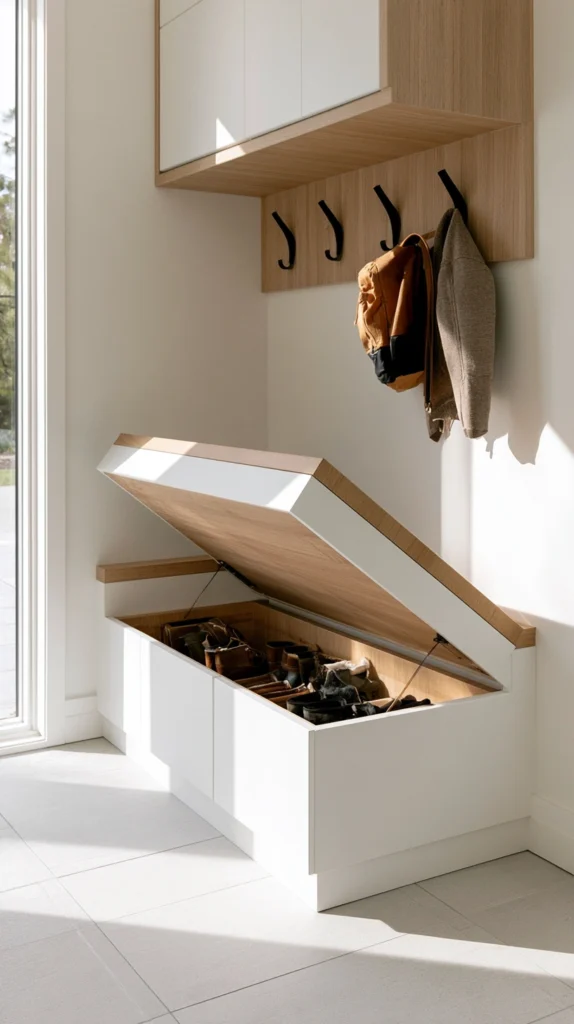
A bench with a hinged, lift-up seat revealing storage beneath, built with a soft-close or gas-assist hinge light enough for a child to operate.
Why the hinge mechanism matters more than the storage capacity
A lift-top bench with a heavy, awkward hinge gets used once and then avoided, regardless of how much storage sits beneath it. A soft-close, gas-assist hinge that lifts with one hand and closes gently on its own removes the friction that causes lift-top storage to fall out of daily use.
Sizing
- Interior storage depth: 12–14 inches, deep enough for boots stored upright
- Seat height including cushion: 18 inches, standard bench height
Cost breakdown
- Lift-top storage bench with gas-assist hinge: $180–380
- Total: $180–380
2. The Open Cubby Bench With Baskets
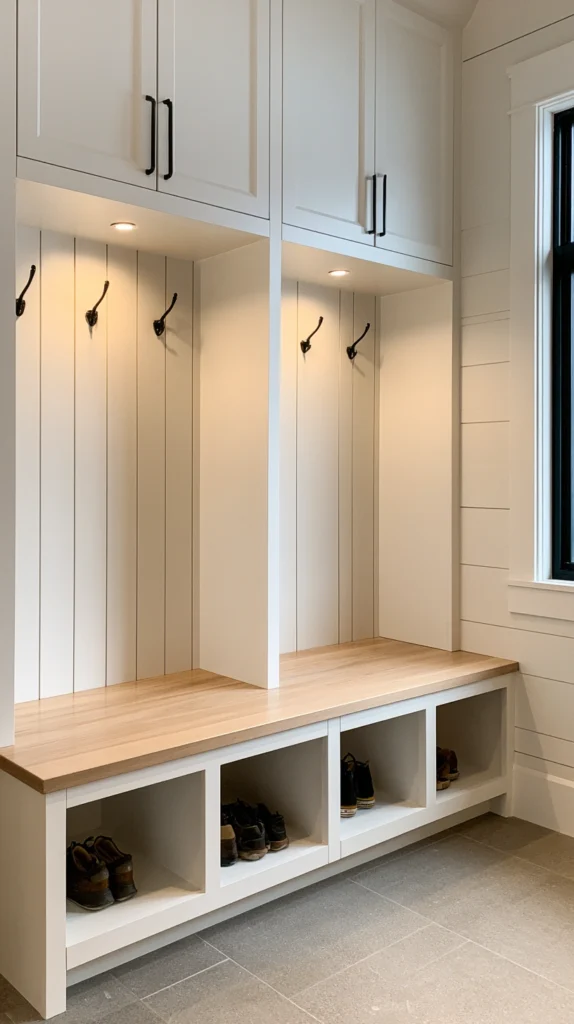
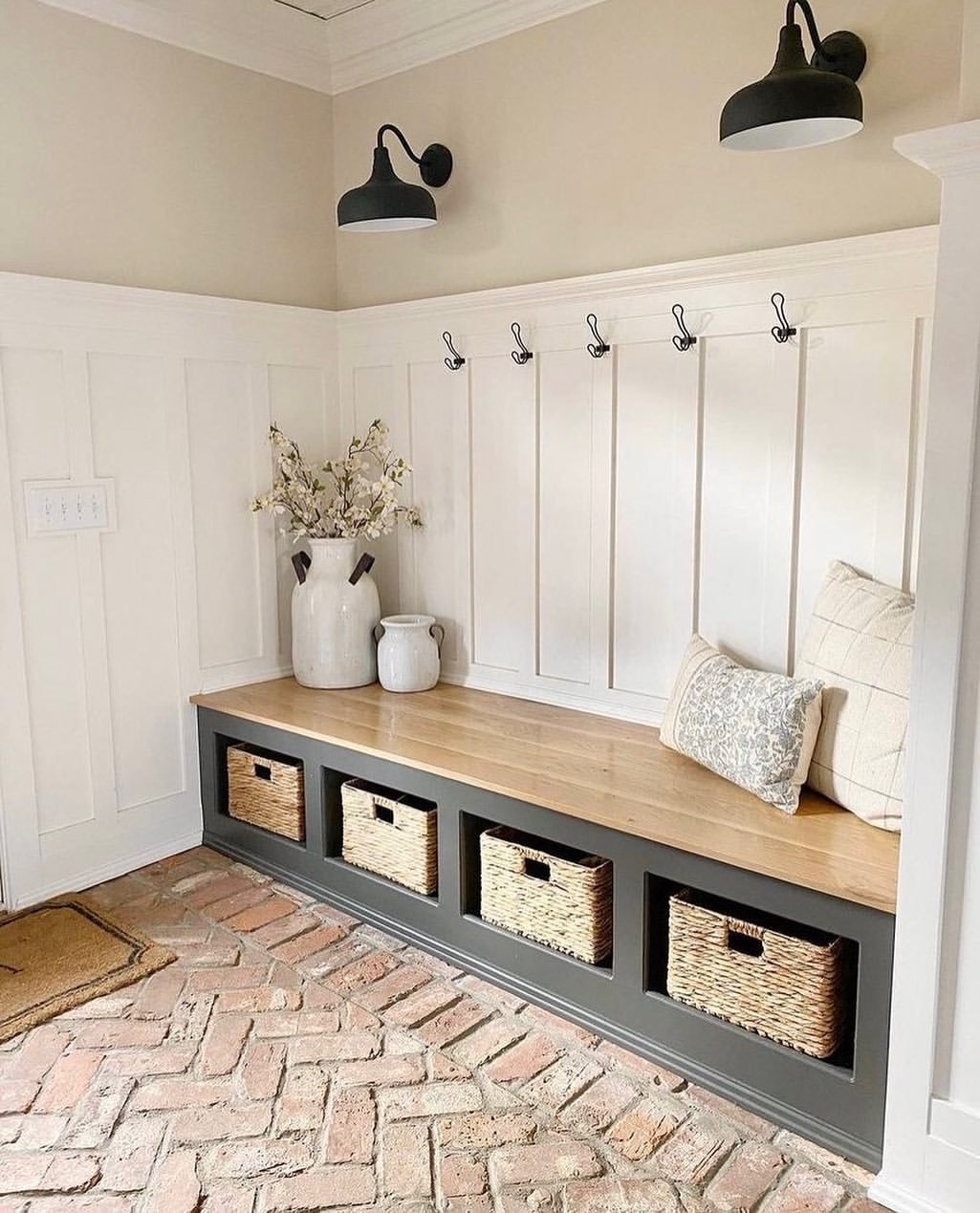
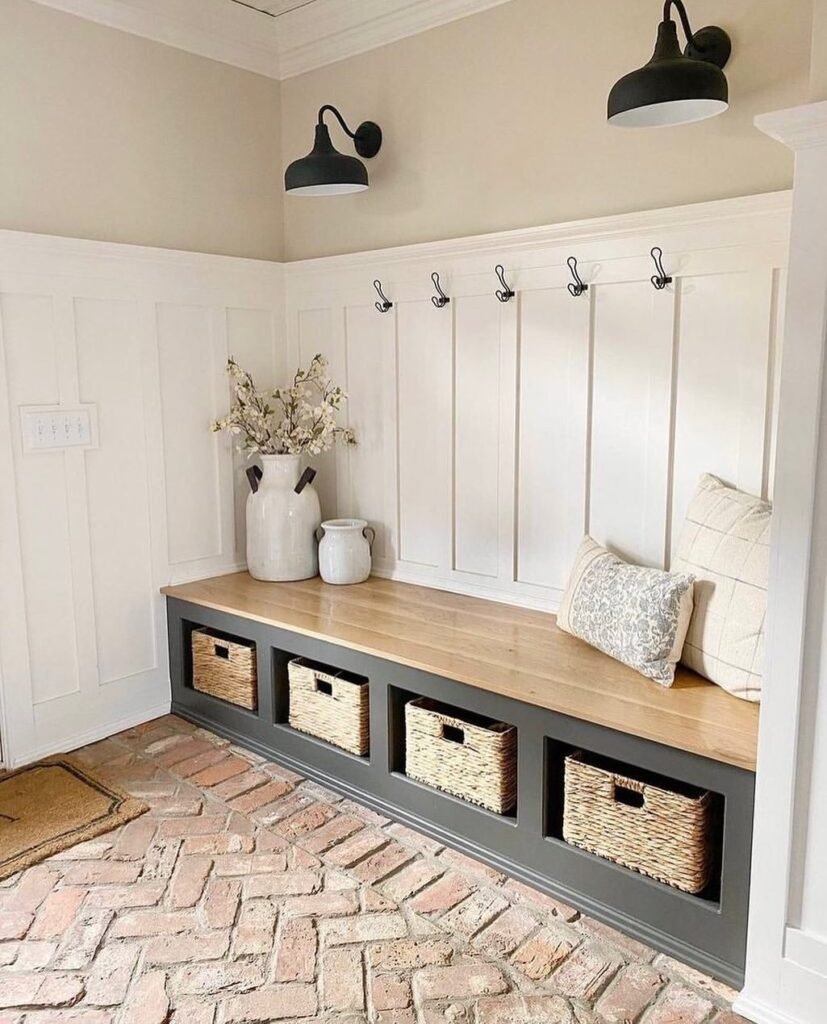
A bench built with three to five open cubby sections underneath, each fitted with a matching woven or fabric basket, rather than a single enclosed storage cavity.
Why divided cubbies outperform one large storage space
A single storage cavity under a bench inevitably becomes one undivided pile, where finding a specific pair of shoes means moving everything else first. Individual cubbies, each with its own basket, mean every household member (or every category of gear) has a defined, separate space, which is what actually sustains the “put it back in its spot” habit long-term.
Sizing
- Cubby width: 12–14 inches per section, sized to a standard basket
- One cubby per household member is the simplest assignment system, with an additional cubby for shared items like umbrellas
Cost breakdown
- Open cubby bench (4 sections): $200–400
- Matching baskets (4): $80–140
- Total: $280–540
3. The Drawer-Front Storage Bench
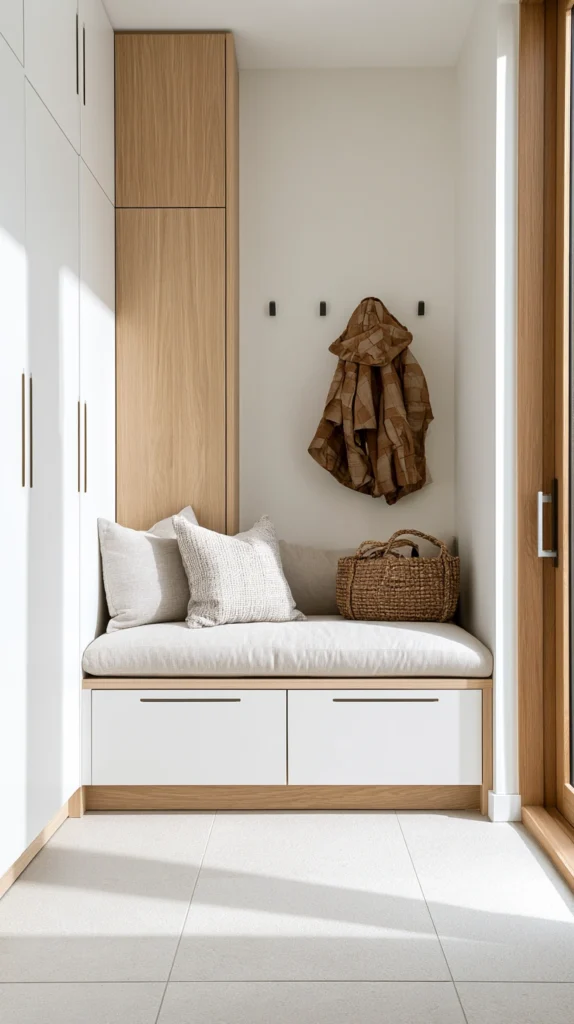
A bench with two or three full-extension drawers built into its base, rather than a lift-top or open cubby configuration.
Why drawers work well for smaller, mixed items
Drawers suit gear that doesn’t stand upright well in an open cubby or basket — gloves, hats, dog leashes, small sports equipment. A full-extension drawer slide (rather than a partial-extension one) means the entire drawer depth is reachable without needing to feel around at the back of a half-open drawer.
Sizing
- Drawer depth: 16–18 inches, matching the bench’s overall depth
- Drawer height: 6–8 inches, enough for folded items without excessive unused vertical space
Cost breakdown
- Drawer-front storage bench (2–3 drawers): $250–480
- Total: $250–480
4. The Bench and Locker Combination
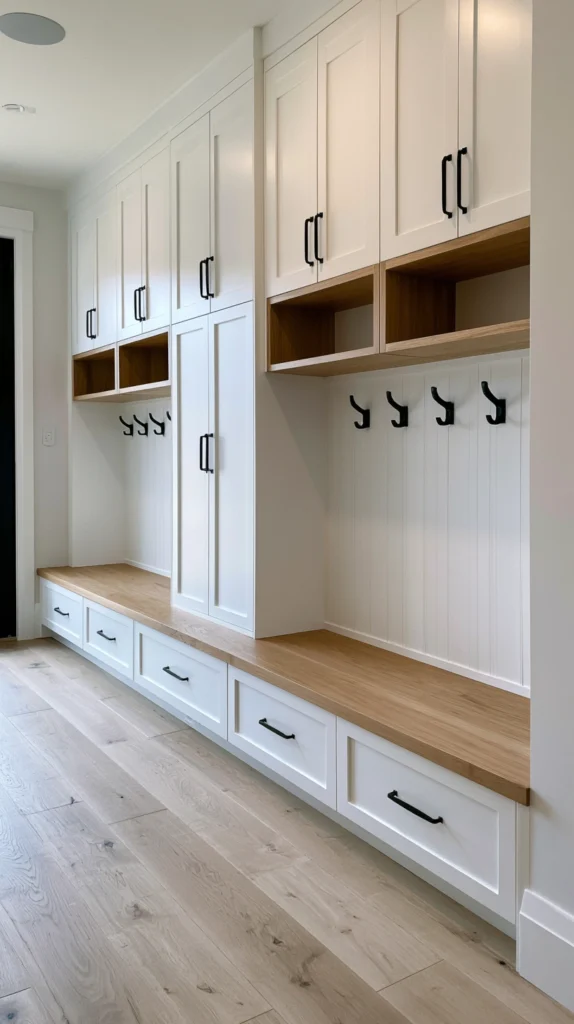
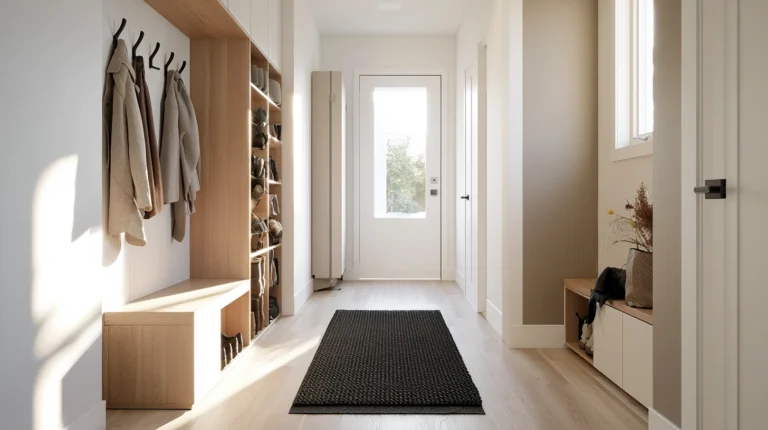
A bench with a full-height, individual locker or cubby unit built directly above or beside each seating section — one complete storage column per household member.
Why a full locker column suits larger, multi-person households
Where a simple cubby bench divides shoe-level storage by person, a full locker combination divides the entire vertical mudroom zone by person — a hook, a shelf, and a floor-level cubby all in one column, assigned to one household member. This scales especially well for families where shoe storage alone isn’t the only daily bottleneck.
Sizing
- Locker width per person: 14–16 inches
- Locker height: full height to a hook zone at 60–66 inches, well above the bench seat itself
Cost breakdown
- Bench and locker combination unit (per linear foot, built or purchased modular): $150–280
- Total (for a 3-person, 4-foot-wide unit): $600–1,120
5. The Boot Tray Base Bench
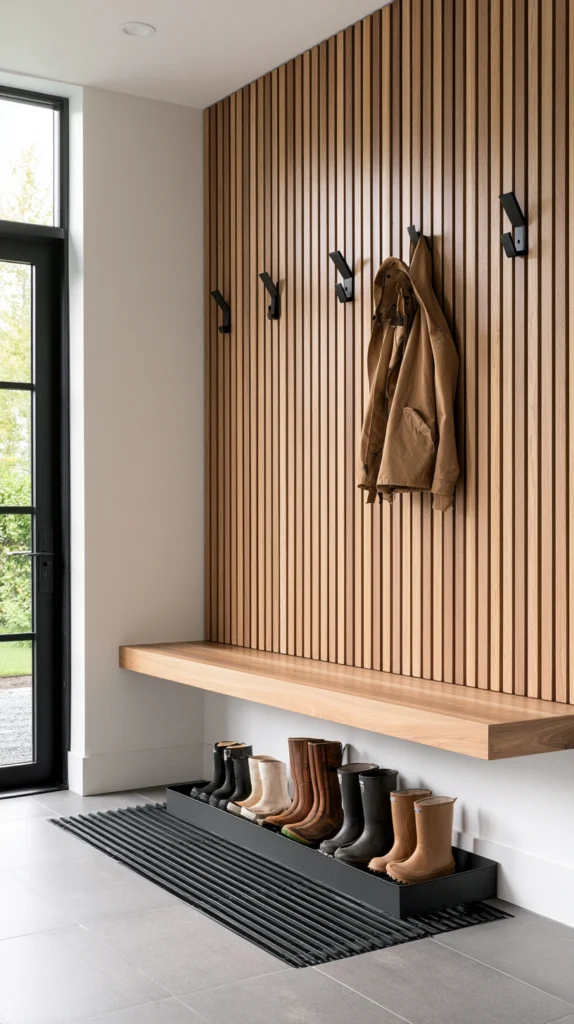
A bench with an open, low base fitted with a waterproof boot tray rather than baskets or a lift-top lid — built specifically around wet or muddy footwear rather than everyday shoes.
Why a boot tray base solves a problem baskets and cubbies don’t
Wet or muddy boots don’t belong in a fabric basket or an enclosed drawer, where moisture has nowhere to go and can damage the storage itself. A boot tray, with a raised lip and a water-resistant surface, is built specifically to contain moisture and mud, making this configuration the right choice for a household in a wet or snowy climate where boots are a daily reality rather than an occasional item.
Sizing
- Boot tray depth: sized to the bench’s full width, typically 30–48 inches for a standard bench
- Bench clearance above the tray: at least 14 inches, enough for tall boots to stand upright beneath the seat
Cost breakdown
- Open-base bench: $120–250
- Waterproof boot tray: $25–45
- Total: $145–295
6. The Bench With an Integrated Hook Rail
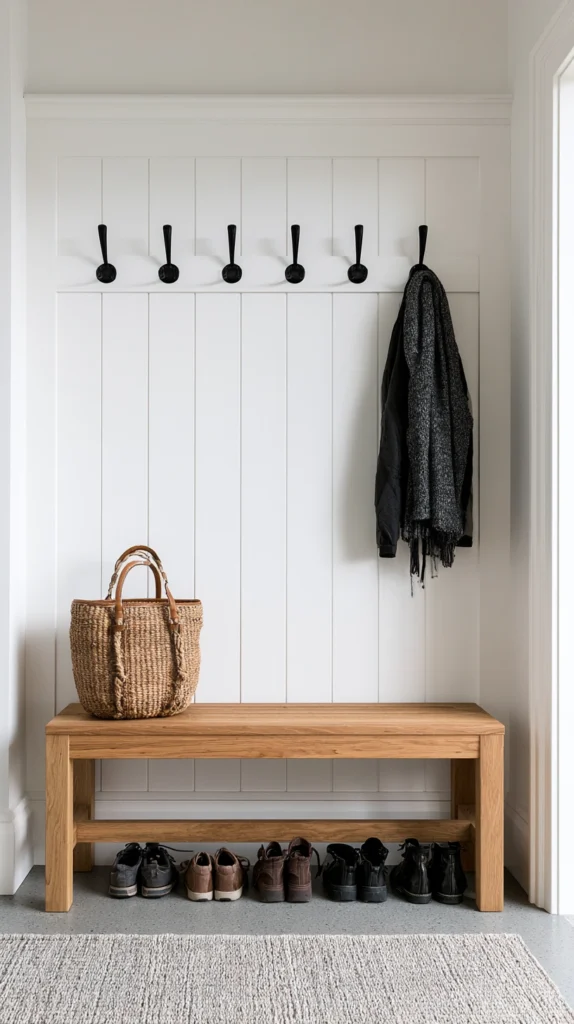
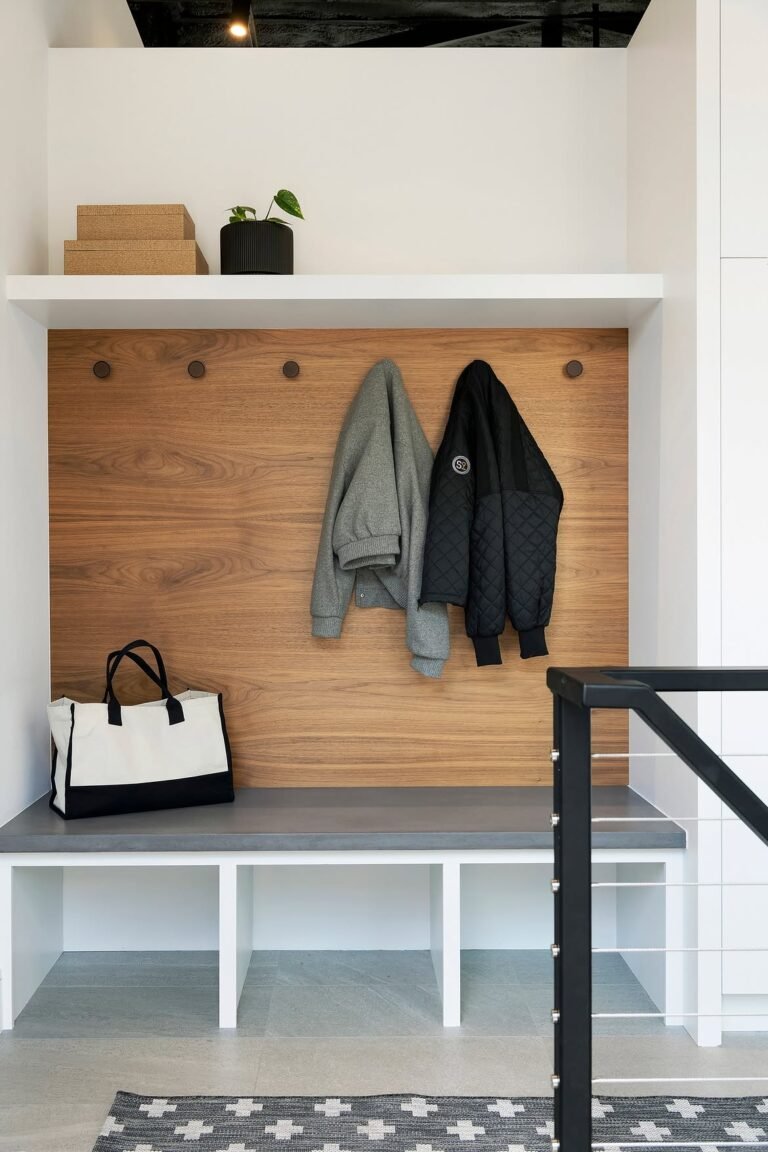
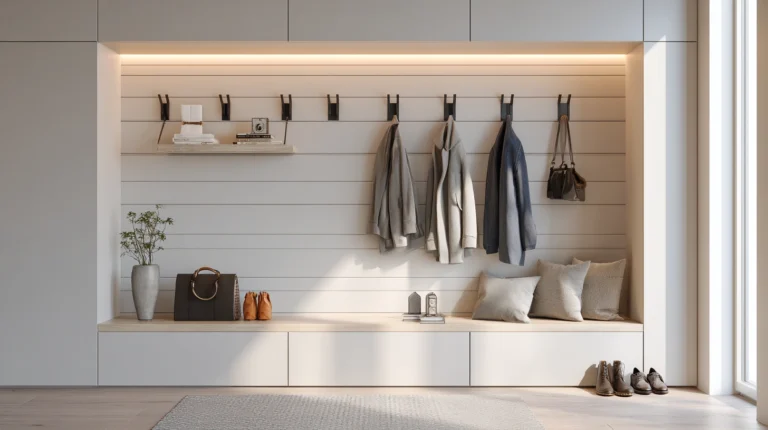
A bench built with a wall-mounted hook rail directly above it, at a height matched to the bench’s seating position, completing the sit-down-and-hang-up sequence in a single physical zone.
Why the hook rail needs to be attached to the bench system, not a separate purchase
A hook rail installed in a different part of the entryway, disconnected from where shoes are actually removed, breaks the natural sequence a mudroom is meant to support. Positioning the hooks directly above the bench means removing a coat and sitting down to remove shoes happen in the same physical motion, without requiring a walk to a separate wall.
Installation specifics
- Hook height: 60–66 inches for adult coats, with a second, lower rail at 36–42 inches for children if the household includes them
- Hook spacing: 6–8 inches apart, one per household member at minimum
Cost breakdown
- Wall-mounted hook rail (5–6 hooks): $35–70
- Total: $35–70
7. The Corner Bench With Custom Angled Storage
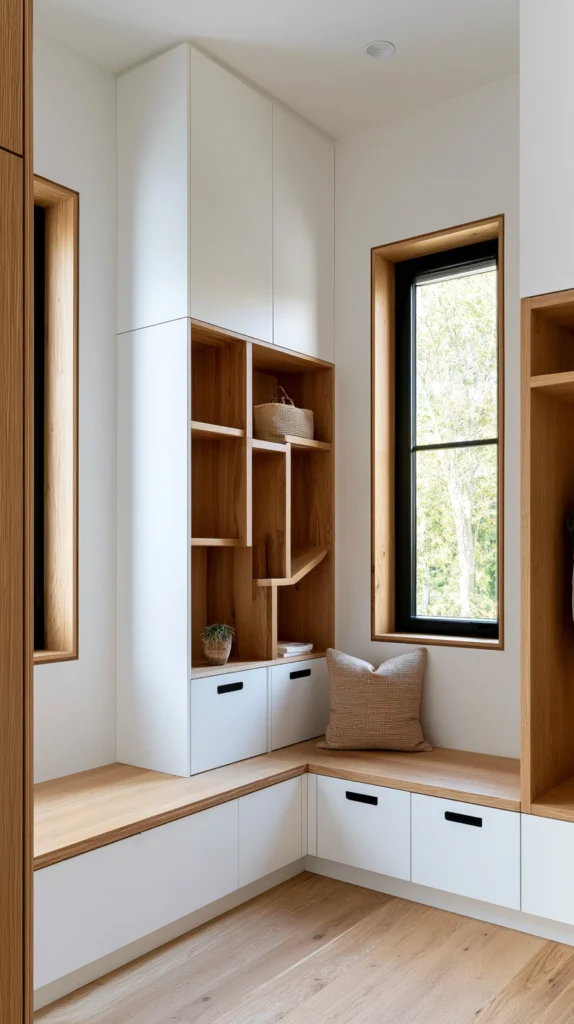
An L-shaped or corner-configured bench, built to use an underutilized corner of the mudroom, with custom-fitted storage sections following the angled layout.
Why a corner configuration solves space-limited mudrooms
Many mudrooms are narrow, awkwardly shaped spaces where a standard straight bench doesn’t fit well without blocking a doorway or walkway. A corner bench uses square footage that would otherwise go unused, and because it’s typically custom-built or custom-fitted, the storage sections can be configured exactly to the household’s actual gear rather than a standard modular size.
Sizing considerations
- Each arm of the L-shape: minimum 36 inches to comfortably seat one person per side
- Storage beneath: can combine multiple approaches from this list (cubbies on one arm, a boot tray on the other) since the two sections function somewhat independently
Cost breakdown
- Custom corner bench with built-in storage: $500–1,200
- Total: $500–1,200
8. The Bench With Adjustable Interior Shelving
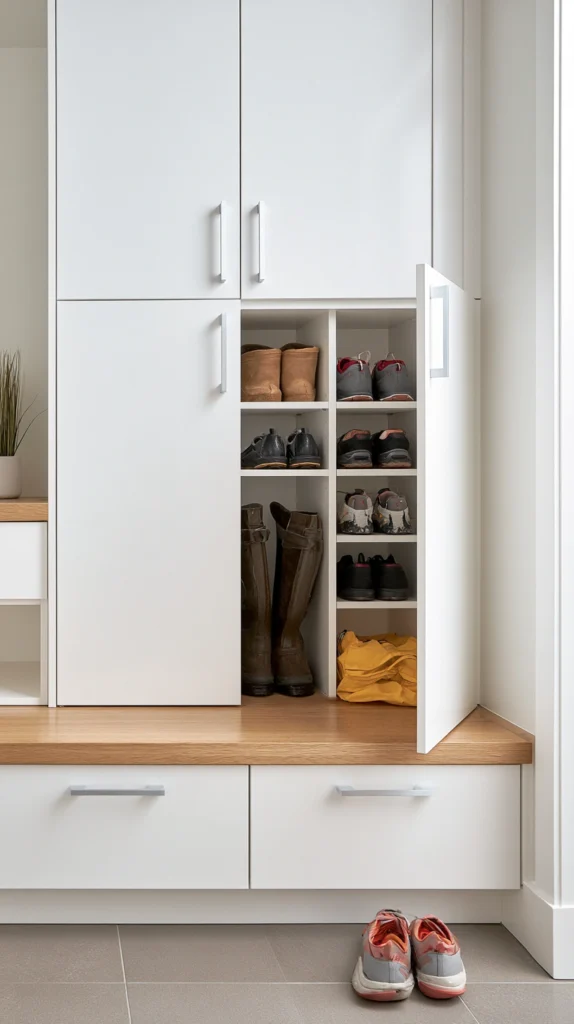
A bench with an enclosed storage cavity fitted with adjustable shelf pegs, allowing the interior configuration to change as the household’s gear needs shift throughout the year.
Why adjustability matters for seasonal gear specifically
A fixed shelf configuration that works well for a single layer of sneakers in summer often doesn’t accommodate tall winter boots without reconfiguration. Adjustable shelving means the same bench can be reconfigured seasonally — more vertical clearance for boots in winter, more shelf divisions for a wider variety of lighter shoes in summer — without needing a second, season-specific storage piece.
Sizing
- Shelf peg spacing: holes every 1–2 inches for fine adjustment
- Minimum shelf clearance for boots: 14–16 inches when configured for winter use
Cost breakdown
- Bench with adjustable interior shelving: $220–420
- Total: $220–420
9. The Bench With a Built-In Charging and Drop Zone
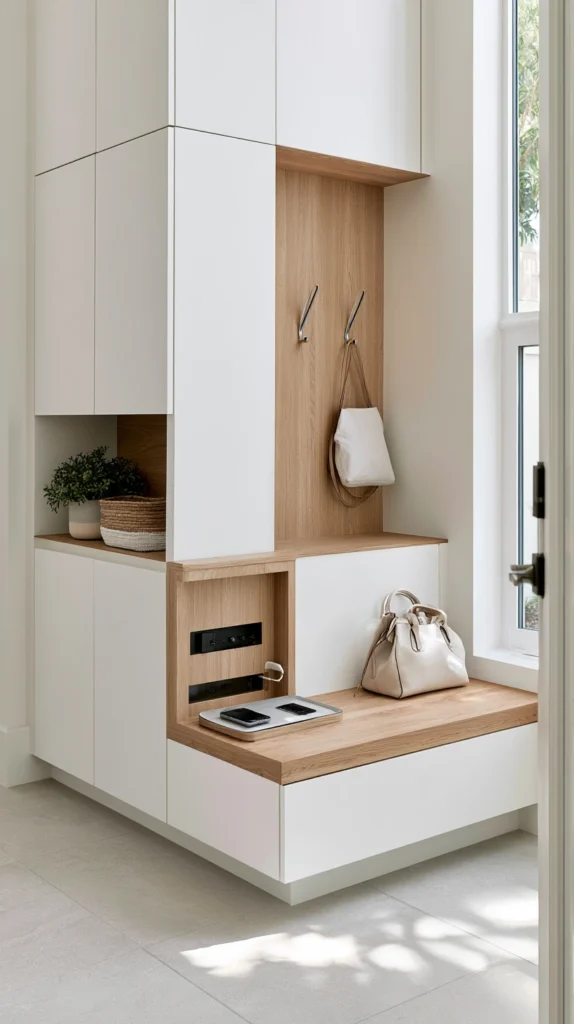
A bench with a small integrated shelf or drawer at one end fitted with an outlet or USB charging port, functioning as a landing spot for phones, keys, and wallets alongside the shoe storage below.
Why combining charging with the bench matters
A separate charging station elsewhere in the home means daily items get set down in one place and shoes come off in another, splitting a routine that works better consolidated. Building a small charging shelf into one end of the bench keeps the entire arrival routine — coat, shoes, phone, keys — in one physical zone.
Installation notes
- Requires an accessible outlet near the bench’s installation location, or a battery-based USB charging unit if wiring isn’t feasible
- Shelf sized small and shallow (6–8 inches), just enough for a phone and a small tray, so it doesn’t compete with the bench’s primary shoe and gear storage
Cost breakdown
- Charging shelf attachment or insert: $30–70
- Total: $30–70
10. The Cushioned Bench Over Open Bins
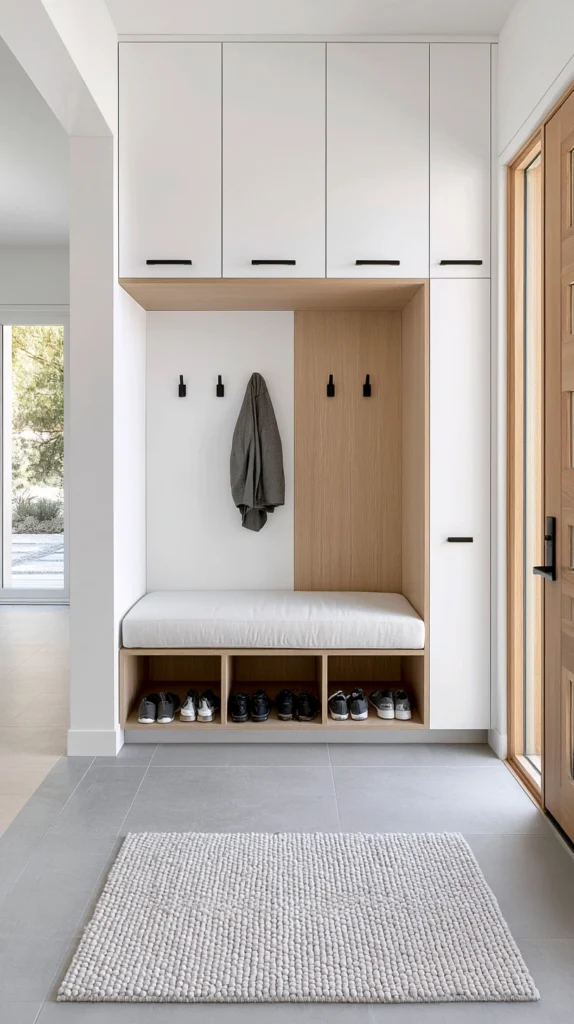
A bench with a fixed (non-lifting) cushioned seat, with open bins or baskets positioned underneath and accessed from the front rather than by lifting the seat.
Why front-access solves the lift-top’s biggest limitation
A lift-top bench requires clearing anything placed on the seat before it can be opened, which is exactly the kind of extra step that leads to storage falling out of use. A bench with a fixed cushion and front-accessible bins beneath it means the seat stays comfortably usable at all times, while the storage remains equally accessible without ever needing to move anything off the seat first.
Sizing
- Bin height clearance: 10–12 inches beneath a fixed seat, sized to standard bin or basket heights
- Bin width: matched to 2–4 sections across the bench’s width, following the same divided-storage principle as the open cubby version
Cost breakdown
- Fixed cushioned bench with open base: $150–300
- Bins or baskets (3–4): $60–110
- Total: $210–410
11. The Slatted Shoe Rack Base Bench
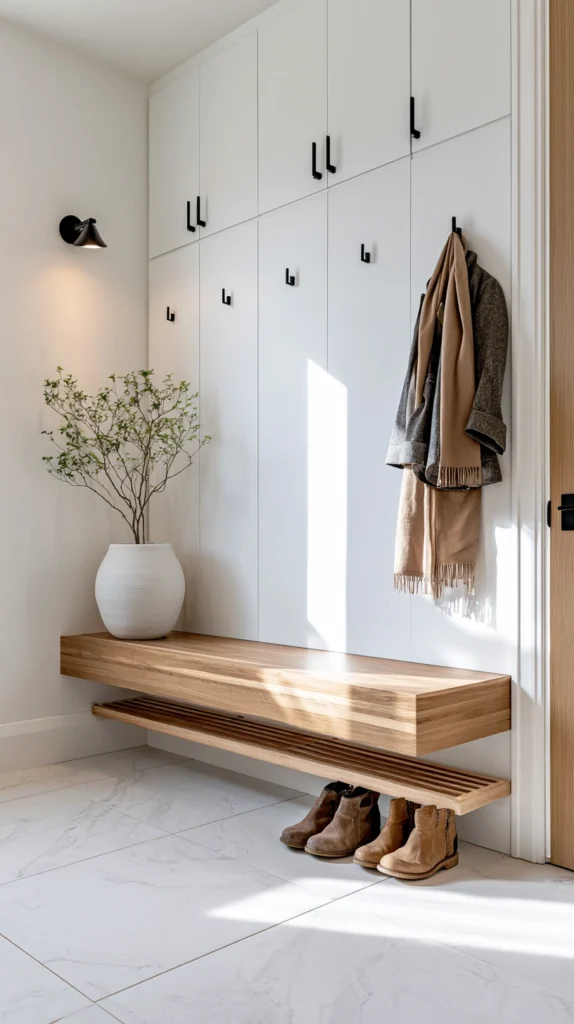
A bench with a slatted or louvered base rather than a solid floor, allowing wet or muddy shoes to air out and drain rather than sitting in an enclosed, moisture-trapping space.
Why ventilation matters as much as capacity for shoe storage specifically
Shoes stored in a fully enclosed cavity, especially if put away slightly damp, can develop odor or mildew over time. A slatted base allows air circulation beneath and around stored shoes, addressing a maintenance problem that none of the fully enclosed storage configurations on this list solve on their own.
Design notes
- Slat spacing: 1–1.5 inches, wide enough for airflow without shoes falling through
- Often paired with a boot tray (Idea #5) beneath the slatted shelf itself, to catch any drips before they reach the floor
Cost breakdown
- Slatted-base storage bench: $150–320
- Total: $150–320
12. The Complete Working Mudroom Bench System
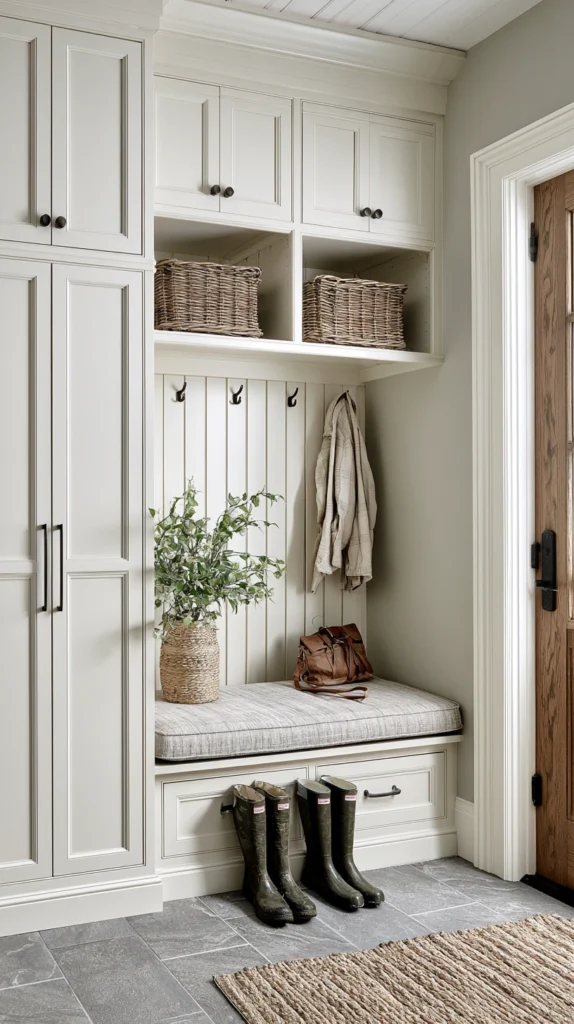
A mudroom bench system with every principle above applied together — the definitive version of a bench that supports the household’s actual daily routine rather than one that photographs well and falls out of use within weeks.
What separates the complete system from a single well-chosen bench
A beautiful lift-top bench, on its own, still requires clearing the seat, lifting the lid, and searching a single undivided cavity — friction at every step. The complete system resolves every point of friction at once: divided, easily accessible storage; a hook zone directly above; sizing that accounts for the whole household and the whole year; and a small daily-item landing spot, so the entire arrival routine happens in one place with no extra steps.
The elements of the complete system
The seating and primary storage:
- An open cubby bench, one section per household member, with matching baskets (Idea #2)
- A boot tray or slatted base beneath at least one section, for wet-weather gear specifically (Idea #5 or #11)
The adjustable capacity:
- Adjustable interior shelving in at least one section, for seasonal reconfiguration (Idea #8)
The vertical zone:
- A hook rail directly above the bench, sized one hook per household member (Idea #6)
The daily-item zone:
- A small charging and drop shelf at one end (Idea #9)
The system in use on an ordinary morning:
Each household member has their own cubby, their own hook directly above it, and knows exactly where their shoes and coat belong without needing to be reminded. Wet boots go into the slatted or tray-based section without concern about moisture. A phone charges on the small shelf at the end while shoes come off. Nothing about the routine requires an extra step, which is the entire reason the system is still in daily use six months after installation instead of having quietly become another surface where things pile up.
Cost breakdown for the complete system
Assuming a starting point of an empty mudroom wall:
- Open cubby bench with baskets: $280–540
- Boot tray or slatted base addition: $25–45
- Adjustable shelving section: $220–420
- Hook rail: $35–70
- Charging shelf: $30–70
Total: $590–1,145
Phased over two stages:
Stage one ($300–600):
- Open cubby bench with baskets
- Hook rail
Stage two ($300–550):
- Adjustable shelving or boot tray addition
- Charging shelf
The complete mudroom bench system: not the most photogenic bench available, but the one configured closely enough to an actual household’s daily sequence that the storage keeps getting used long after the first week.
The Question Before Any Mudroom Bench Project
Before buying a bench:
What currently causes shoes and gear to end up on the floor instead of in existing storage?
If the answer is: storage is too hard to access — the lift-top mechanism or a front-access bin configuration solves the friction directly.
If the answer is: everything goes into one pile and becomes impossible to search — the divided cubby or drawer configuration solves the organization problem.
If the answer is: gear is too wet or bulky for the storage available — the boot tray or slatted base addresses the specific moisture and capacity issue.
If the answer is: there’s no consistent “spot” for anyone’s things — the locker combination or individually assigned cubbies solve the assignment problem directly.
The bench configuration follows the actual daily failure point, not the most attractive style. A bench solving the real friction in a household’s routine will stay in use; one chosen purely for appearance usually doesn’t survive contact with an actual Tuesday morning.
Getting Started This Weekend
The immediate mudroom bench fix:
Identify what currently ends up on the floor instead of stored properly.
Shoes, bags, or seasonal gear — this determines which storage configuration actually solves the problem.
Add one basket or bin under the existing bench, even without a full rebuild.
A single divided space, even improvised, is a meaningful improvement over one undivided area or none at all.
Mount a hook rail directly above the bench if one isn’t already there.
Completes the coat-and-shoes sequence in one location rather than two.
Assign one section or hook per household member.
The organizational change that determines whether the system gets used consistently, independent of any furniture upgrade.
The rest of the design: the elaboration of this weekend.
The system: the beginning. The mudroom bench that actually works: what keeps the entryway floor clear long after the novelty of a new bench wears off.