14 Modern Laundry Room Shelf Styling Ideas (That Look Designer)
14 Modern Laundry Room Shelf Styling Ideas (That Look Designer)
The laundry room is the one space in the house nobody designs for on purpose. It gets a washer, a dryer, a shelf above them for detergent, and that’s usually where the decisions stop. The shelf becomes a landing spot for whatever bottle was bought most recently, in whatever packaging the store happened to sell it in.
That’s the gap between a functional laundry room and a designer one. The function — a place to put detergent, a place to put towels — is identical in both. What changes is whether the objects on that shelf were chosen and arranged, or simply accumulated.
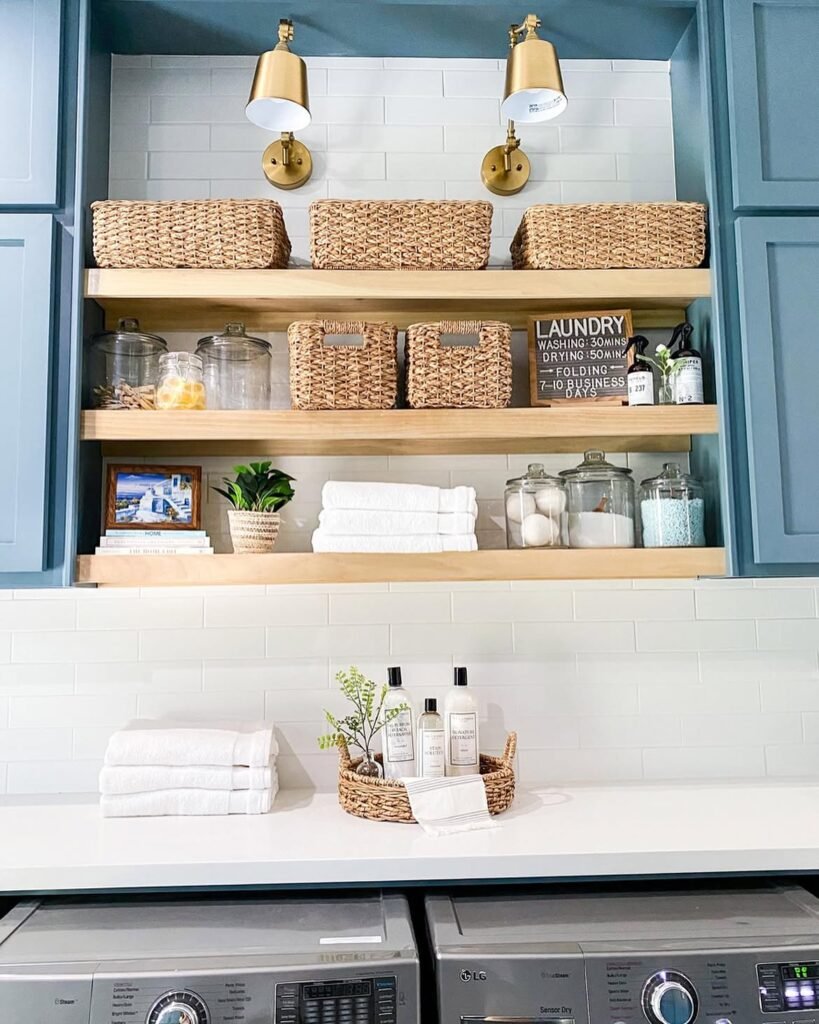
A designer laundry shelf isn’t about buying more. It’s usually about owning less variety, in better containers, arranged with the same care given to a kitchen open shelf or a living room console. The washer and dryer don’t change. The eight seconds someone spends looking at the shelf above them does.
Here are 14 ways to close that gap, from a five-minute swap to a full shelf system.
Why Laundry Shelves Look Unfinished
The clutter physics of a laundry shelf:
Without intentional styling:
- Mismatched detergent, softener, and stain-remover bottles in their original retail packaging
- Bright, high-contrast branded labels facing outward
- No grouping logic — bottles, boxes, and loose items mixed together
- The eye reads the shelf as inventory, not decor
With intentional styling:
- Detergent and softener decanted into matching, labeled containers
- A single material and colour palette across containers (glass, ceramic, or matte plastic in neutral tones)
- Items grouped by function, with the most-used items at the most reachable height
- The eye reads the shelf as arranged, the same as any other open shelving in the house
The visibility problem specific to laundry rooms:
- Retail packaging is designed to stand out on a store shelf, which is the opposite of what a calm home shelf needs
- The label, not the container, is usually what makes a laundry shelf look chaotic
- Removing or replacing the label solves more of the problem than any amount of rearranging
The height-and-reach layout:
- The lowest shelf (or countertop): daily-use items, reached without a step stool
- The middle shelf: weekly-use items and styling objects
- The top shelf: seasonal or infrequent items, and taller decorative pieces where reach matters less
The Five Laundry Shelf Essentials
Before choosing any individual idea below, these five categories account for nearly every well-styled laundry shelf:
Decanted containers:
- Detergent, softener, and pods moved out of retail packaging into matching vessels
- The single highest-impact change available on a laundry shelf
A grouping surface:
- A tray or shallow bin that corrals small items (dryer sheets, stain pens, spare buttons)
- Keeps the shelf from reading as loose objects spread across the whole surface
One textural basket:
- Woven or fabric-lined, for lint rollers, rags, or anything that doesn’t need to be visible
- The same warmth principle that applies to any open shelf in the home
A vertical or living element:
- A plant, a piece of art, or a tall vessel
- Keeps a narrow utility shelf from reading as purely flat storage
Labels in one consistent style:
- Whether printed, hand-lettered, or engraved
- Ties every container together as one system rather than a collection of separate purchases
1. The Glass Canister Decant
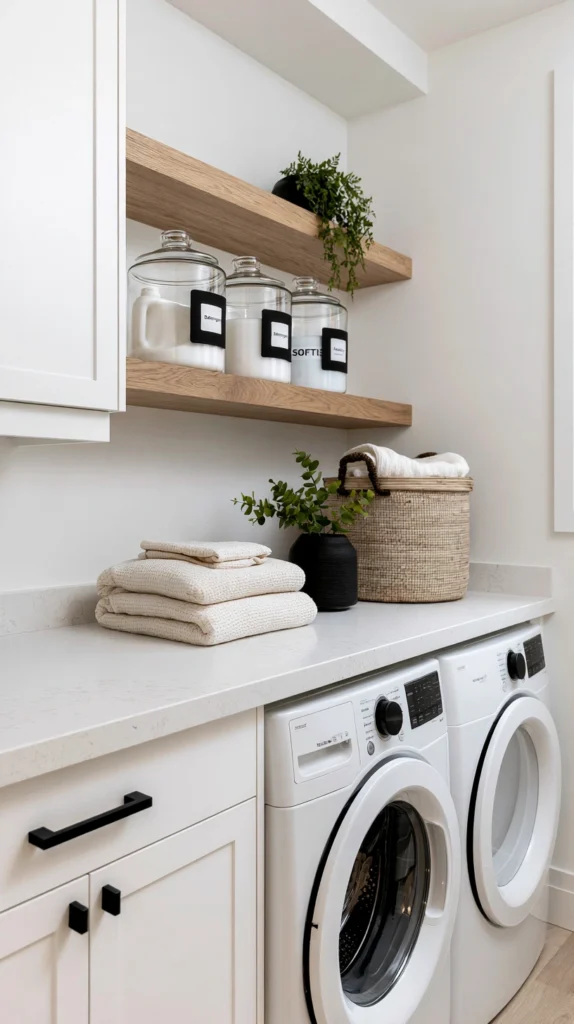
Replacing detergent and softener bottles with matching glass canisters, each labeled clearly — the single most transformative laundry shelf change available.
Why glass specifically
Glass shows the product level at a glance (useful for knowing when to reorder) while presenting a uniform, light-catching surface that plastic retail bottles can’t match. A shelf of five different glass canisters in the same style reads as a set even when the products inside are entirely different brands.
Sizing for common products
- Detergent (liquid): 32–48 oz canister with a pump or flip-top lid
- Detergent (powder) or pods: wide-mouth jar, 24–32 oz, with a scoop stored inside
- Fabric softener: 24–32 oz canister, matching the detergent vessel
Cost breakdown
- Glass canister with pump (for liquid detergent): $22–40
- Wide-mouth glass jar (for powder or pods): $15–28
- Total (2–3 canisters): $37–96
2. The Custom Label Set
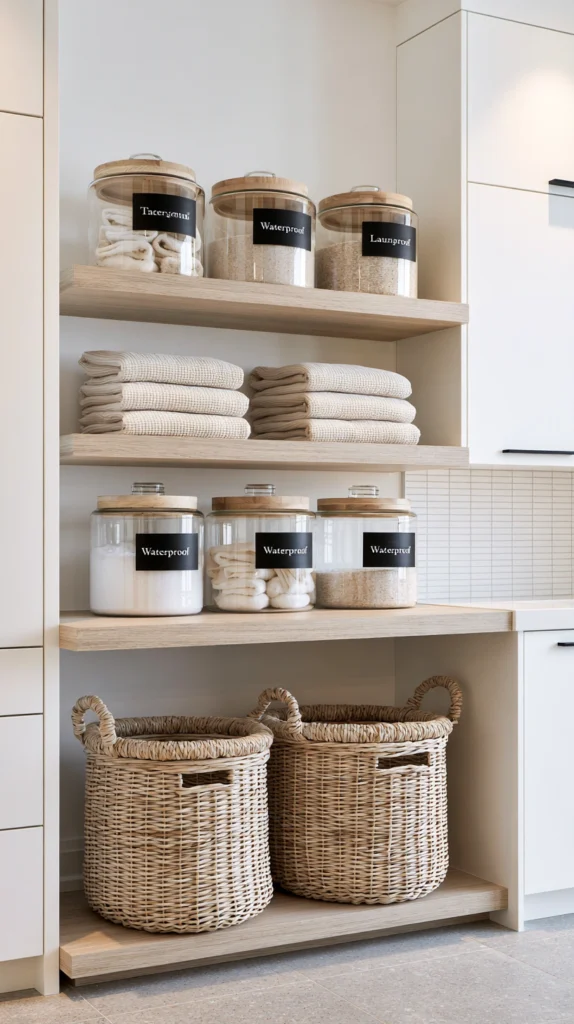
Applying a matching set of printed or engraved labels to every decanted container — the detail that makes a shelf of glass jars read as a designed system rather than a lucky assortment.
Why labels matter even on clear containers
A glass jar of white powder is not self-explanatory. Without a label, the shelf still requires guessing, which undercuts the calm the decanting was meant to create. The label closes that gap and adds the one graphic element that ties every container together visually.
Label style options
- Waterproof vinyl labels, printed in a single consistent font
- Engraved or etched glass, for a more permanent, higher-end result
- Hand-lettered chalkboard-style labels on wood or ceramic tags tied at the neck
Cost breakdown
- Printed vinyl label set (6–8 labels): $12–25
- Or engraved glass canisters: $30–60 additional over plain glass
- Total: $12–60
3. The Woven Basket for Loose Supplies
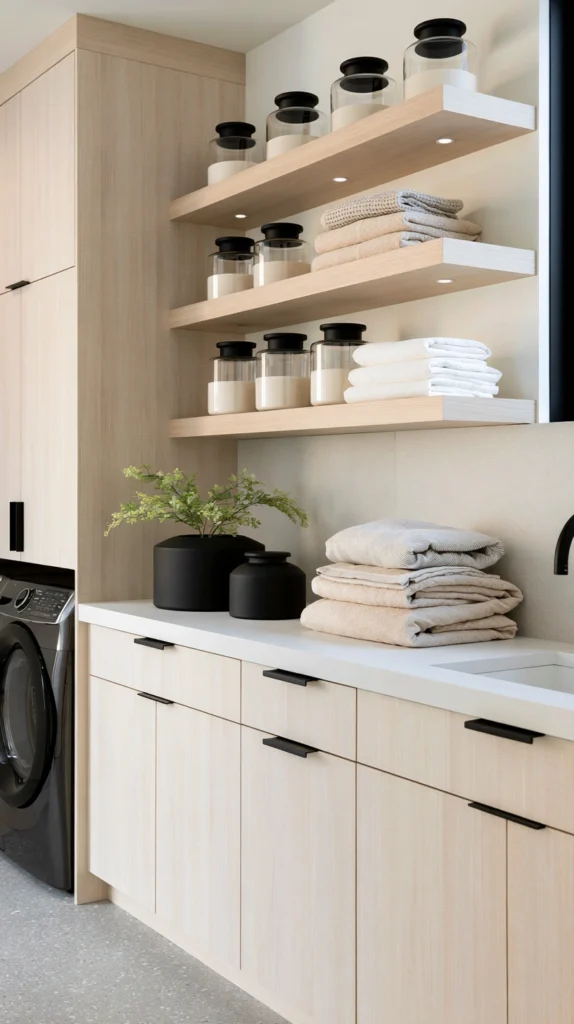
A single woven basket on the shelf for dryer sheets, lint rollers, and stain pens — the items too small or too irregularly shaped to decant into a canister.
Why a basket instead of a drawer or bin
Not every laundry item can be decanted, and a designer shelf still needs somewhere for the loose, irregular items to go without them becoming the visual focal point. A woven basket hides the contents while adding the same texture layer that works on any open shelf.
Sizing
- Small basket, 8–10 inches wide, sized to the shelf depth with room to slide in and out easily
- Positioned at the end of the shelf, not the centre, so it doesn’t compete with the canisters
Cost breakdown
- Small woven basket: $18–35
- Total: $18–35
4. The Folded Towel Stack
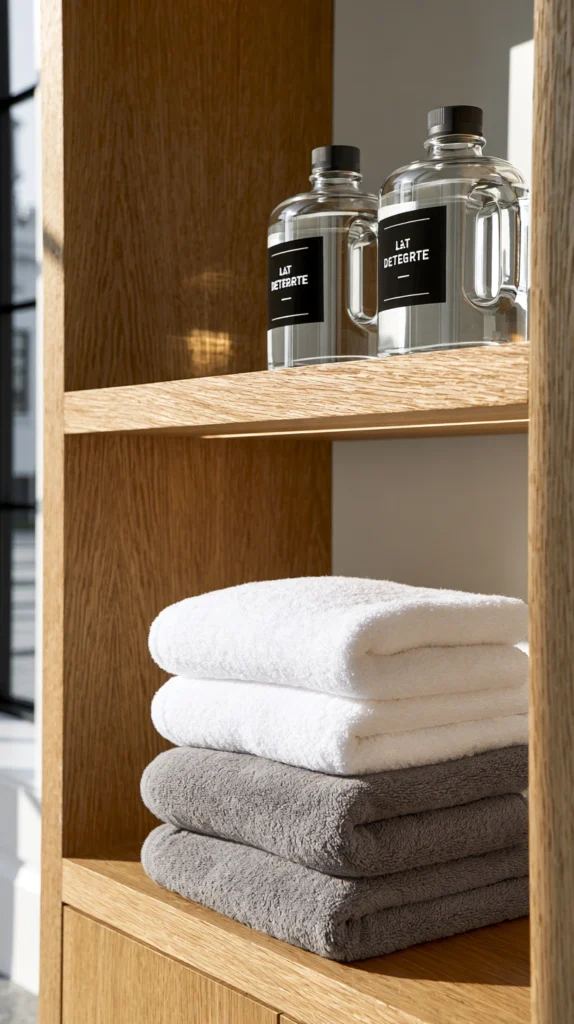
A neat stack of two or three folded towels on the open shelf, in a single colour family — functional storage that doubles as styling.
Why towels work as a styling element
A stack of matching towels reads the same way a stack of linen-bound books does on a living room shelf: as a considered object with visual weight, not just as stored inventory. The key is limiting the stack to one colour family so it reads as a single block rather than mismatched linens.
The folding method
- Tri-fold each towel lengthwise, then in half, for a clean rectangular stack
- Stack tallest or largest towel on the bottom, smallest on top
- Limit to 2–3 towels per stack — beyond that, the stack starts to lean and lose its shape
Cost breakdown
- Matching towel set (if replacing mismatched towels): $30–60
- Total: $0–60 depending on whether existing towels already match
5. The Wood Tray Corral
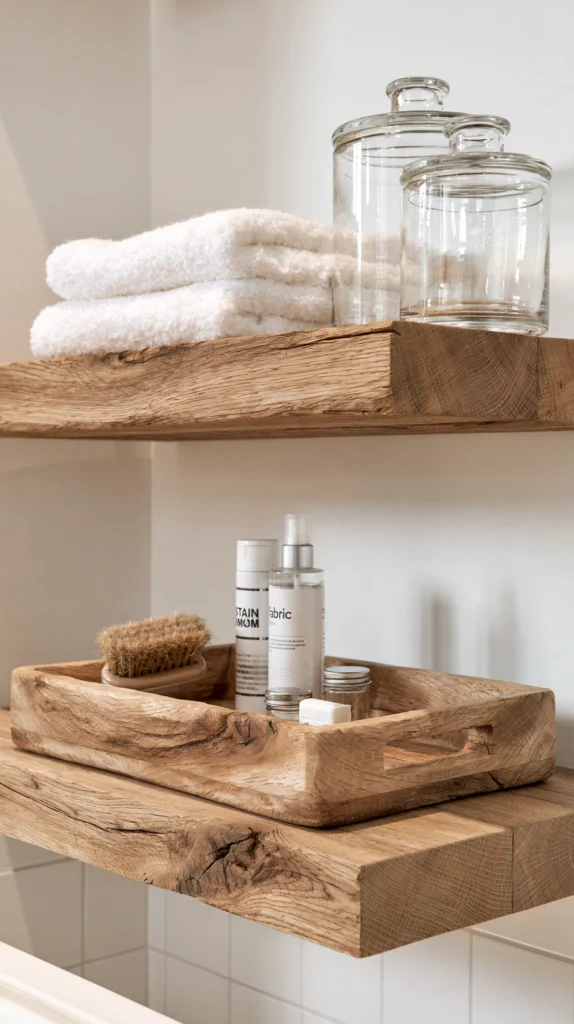
A single wood tray on the shelf, grouping the stain pen, a small pair of scissors, and a lint brush into one visual unit.
Why a tray does the same job here as anywhere else
The same principle that keeps a bathroom counter or entry console from looking cluttered applies to a laundry shelf: small, irregular objects spread loose across a surface read as mess, while the same objects inside a defined tray read as a kit.
Placement
- Positioned on the most-reached shelf, since these are typically daily or weekly-use items
- Sized to roughly 8×10 inches, small enough not to dominate the shelf
Cost breakdown
- Wood tray: $15–30
- Total: $15–30
6. The Apothecary-Style Pump Bottles
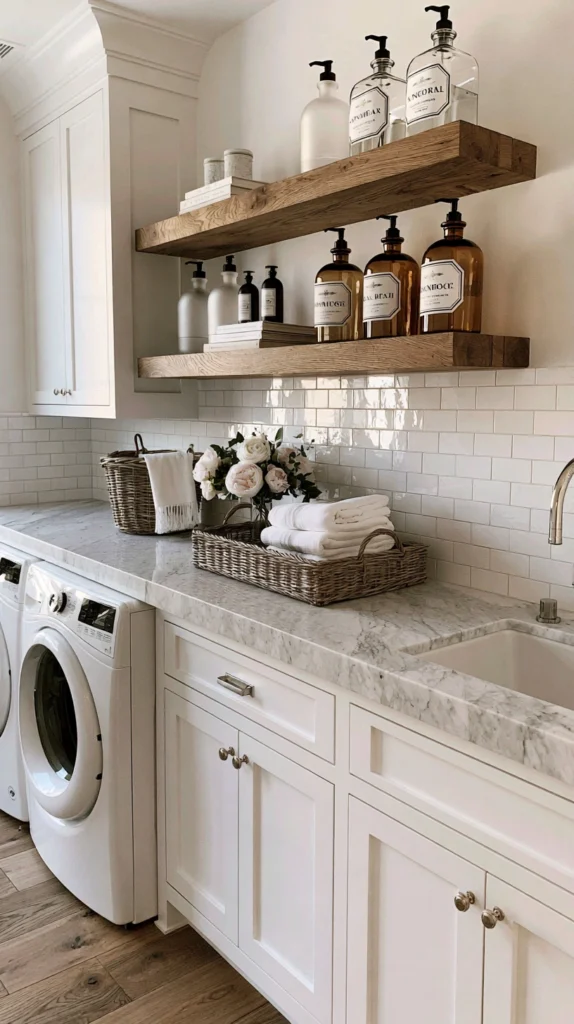
Amber or frosted glass apothecary bottles for liquid detergent and softener, in place of standard cylindrical canisters — a more elevated variation on the glass decant for laundry rooms leaning into a vintage or spa aesthetic.
Why the apothecary style reads differently than plain glass
Amber and frosted glass diffuse light rather than fully revealing the contents, giving the shelf a softer, more considered look than clear glass. The apothecary silhouette also borrows visual language from bath and skincare products, which shifts the laundry shelf’s overall feeling toward spa rather than utility closet.
Cost breakdown
- Amber or frosted glass apothecary bottle with pump: $25–45 each
- Total (2 bottles): $50–90
7. The Small Plant on the Top Shelf
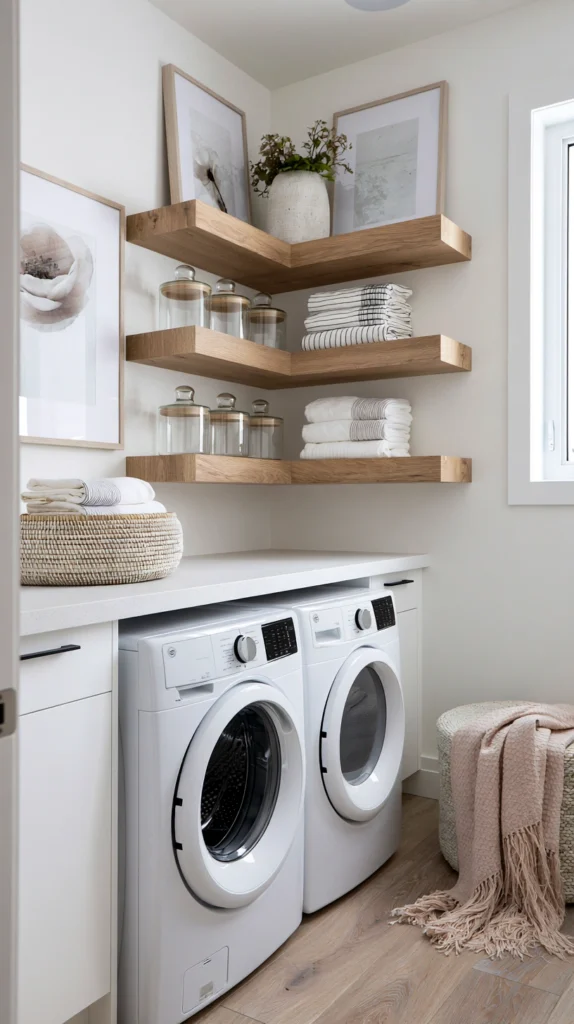
One low-maintenance plant positioned on the highest shelf, where humidity from the dryer vent is minimal and reach doesn’t matter for daily use.
Why a plant belongs in a laundry room at all
A laundry shelf is almost entirely hard, manufactured surfaces: glass, plastic, metal appliances. A single plant introduces the one organic element most laundry rooms are missing, the same way it does on a kitchen or entryway shelf.
Plant selection for laundry room conditions
- Pothos or a small snake plant, both tolerant of inconsistent light and infrequent watering
- Avoid anything humidity-sensitive if the shelf sits directly above a vented dryer
Cost breakdown
- Small potted plant: $12–25
- Total: $12–25
8. The Open Shelf Bracket Upgrade
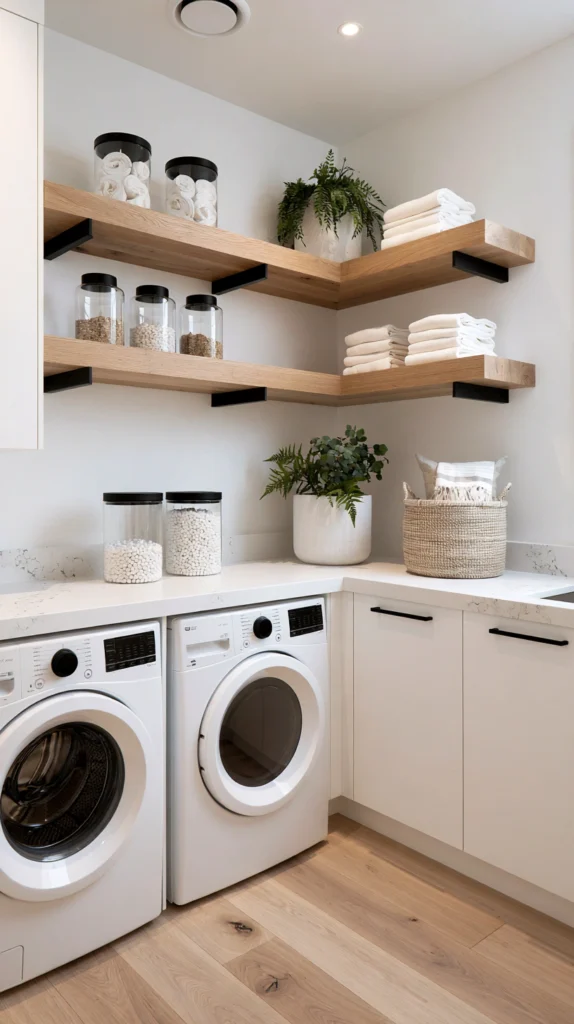
Replacing plain white wire shelving with wood shelves on exposed metal or wood brackets — a structural change that elevates everything placed on it afterward.
Why the shelf material itself matters
Wire shelving reads as builder-grade storage regardless of what’s styled on top of it. A wood shelf on a simple bracket reads as intentional open shelving, the same visual category as a kitchen or living room shelf, before a single object is placed on it.
Sizing and installation
- Shelf depth: 10–12 inches, enough for canisters and baskets without overhang
- Shelf thickness: 1.5 inches minimum for a substantial, non-flimsy appearance
- Bracket spacing: every 24–32 inches depending on shelf length and load
Cost breakdown
- Wood shelf board (per 36-inch length): $35–65
- Brackets (pair): $20–45
- Total per shelf: $55–110
9. The Framed Art Above the Shelving
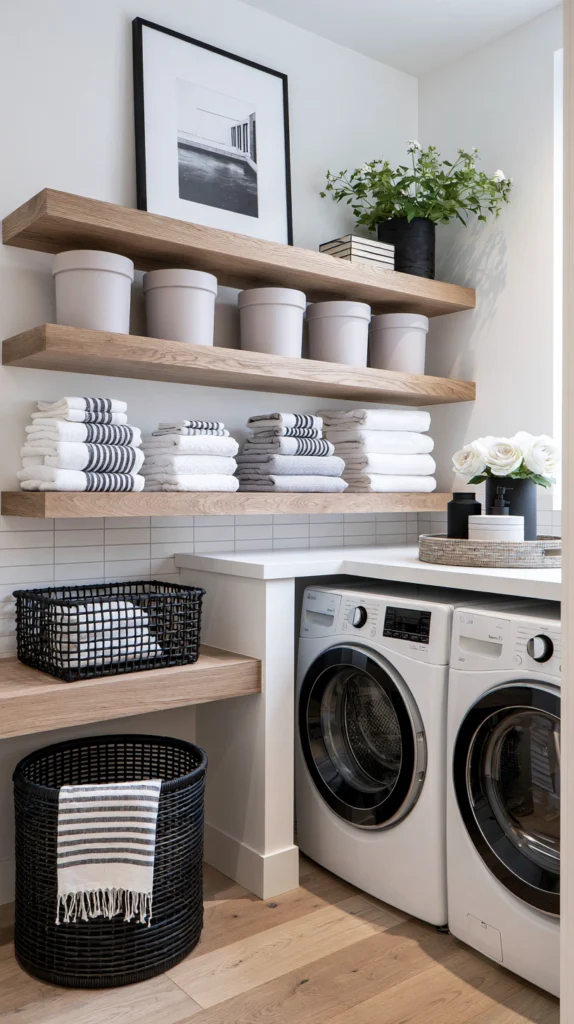
A single small piece of art or a framed print positioned above or beside the laundry shelving — the vertical element that keeps the wall from reading as purely utilitarian.
Why art works even in a small utility space
The same principle that applies to an entryway or bathroom applies here: a wall of pure function, with nothing to draw the eye upward, reads as unfinished regardless of how tidy the shelf below it is. A single piece of art signals the room was considered as a whole, not just organized.
Sizing and placement
- One piece, 8×10 to 11×14 inches, sized to the available wall space above the shelf
- Hung so the bottom edge sits 4–6 inches above the top shelf, avoiding a cramped or overlapping look
Cost breakdown
- Small framed print: $25–60
- Total: $25–60
10. The Matching Bin System for Sorting
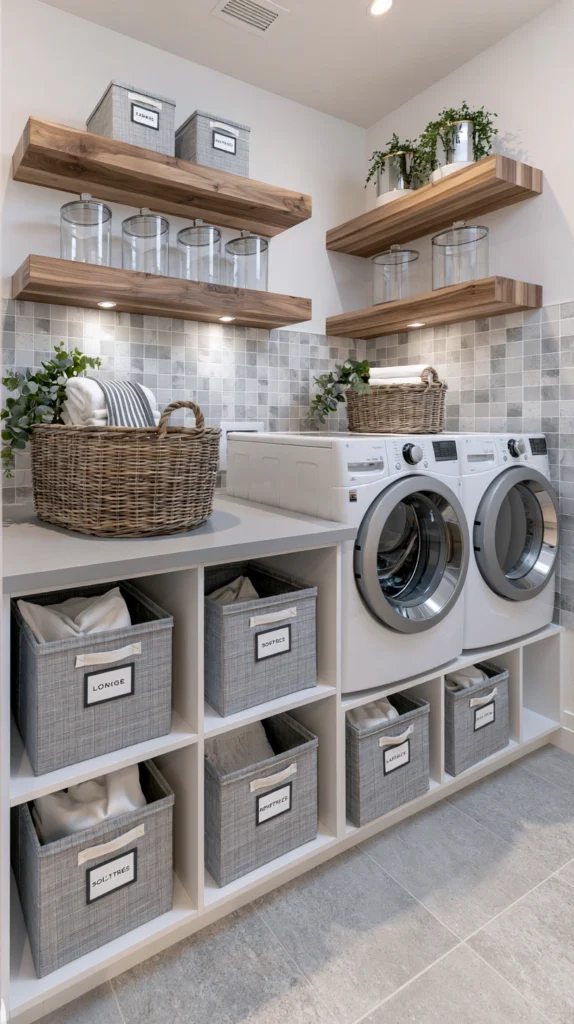
Two or three matching fabric or canvas bins on a lower shelf, labeled for sorting (darks, lights, delicates) — turning the sorting step itself into part of the styled system.
Why matching bins outperform mismatched laundry baskets
Sorting laundry typically happens with whatever baskets were on hand, usually in different colours, sizes, and materials. A matching set, in the same palette as the canisters above, extends the designed system all the way down to floor or lower-shelf level instead of stopping at the detergent.
Sizing
- Standard sorting bin: 16x12x12 inches, sized to hold a few days’ worth of one category
- Labeled with the same label style used on the canisters above (Idea #2), for full system consistency
Cost breakdown
- Fabric or canvas sorting bin: $20–35 each
- Total (3 bins): $60–105
11. The Exposed Hook Rail for Ironing Tools
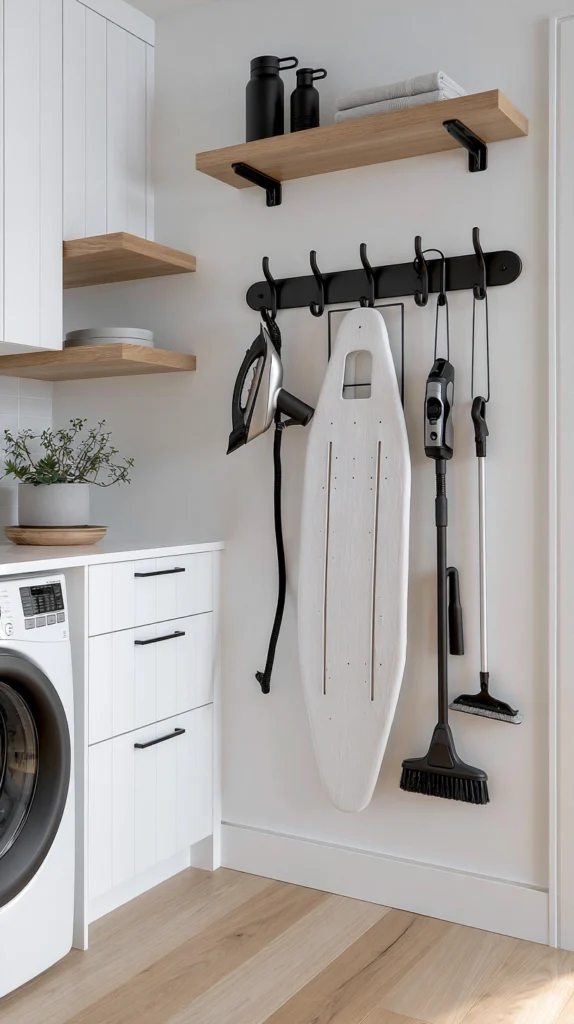
A short row of hooks mounted at the end of the shelving unit, holding the ironing board, a spray bottle, and a small broom — visible storage for tools too large to shelve, styled instead of shoved in a corner.
Why visible can still look designer
Some laundry tools are too large or awkward to hide, and forcing them into a closed cabinet in a small space often isn’t practical. Mounting them on a clean hook rail, matched in finish to the rest of the room’s hardware, turns necessary visible storage into an intentional design element instead of clutter leaning in a corner.
Installation specifics
- Mounting height: high enough that the ironing board hangs clear of the floor, typically 60+ inches
- Hook finish: matte black or brass, matching any other hardware in the room
- Spacing: 6–8 inches between hooks for full-sized tools
Cost breakdown
- Wall-mounted hook rail (3–4 hooks): $25–50
- Total: $25–50
12. The Seasonal Styling Swap
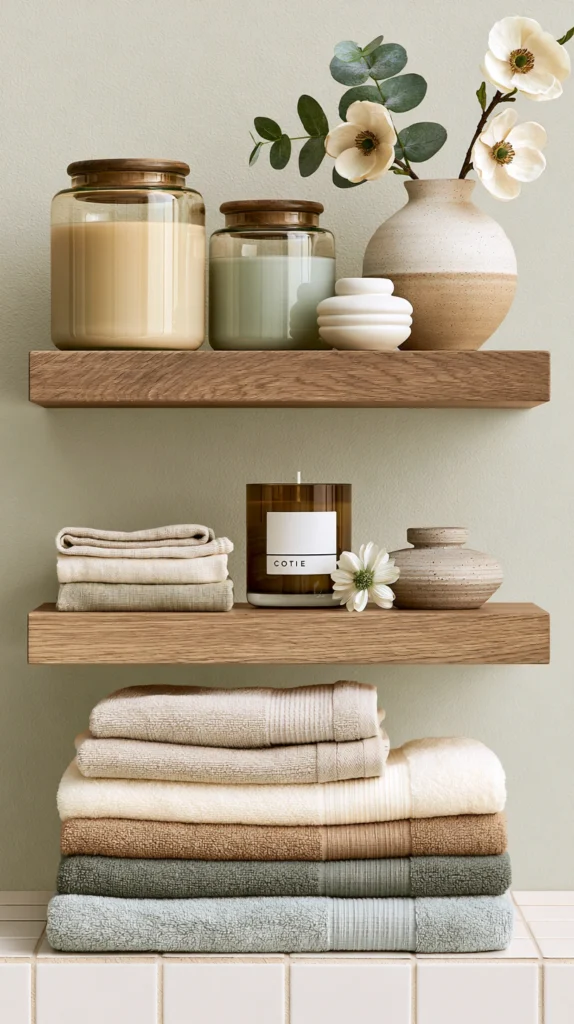
A single small object on the shelf — a candle, a stem in a bud vase, a seasonal-scented sachet — changed every few months to keep the space feeling maintained.
Why seasonal rotation matters in a utility room specifically
A laundry room is used daily but rarely lingered in, which makes it easy for styling to go stale and unnoticed. A small, regularly rotated detail keeps the shelf from reading as a display set up once and forgotten, the same principle that applies to an entryway console.
What to rotate
- A small bud vase with a single seasonal stem
- A scented sachet or small candle, tucked beside the canisters
- A seasonal-coloured tea towel folded on top of the towel stack (Idea #4)
Cost breakdown
- Bud vase and stem: $10–20
- Or seasonal candle: $15–30
- Total: $10–30 per season
13. The Single Statement Canister for Pods or Sheets
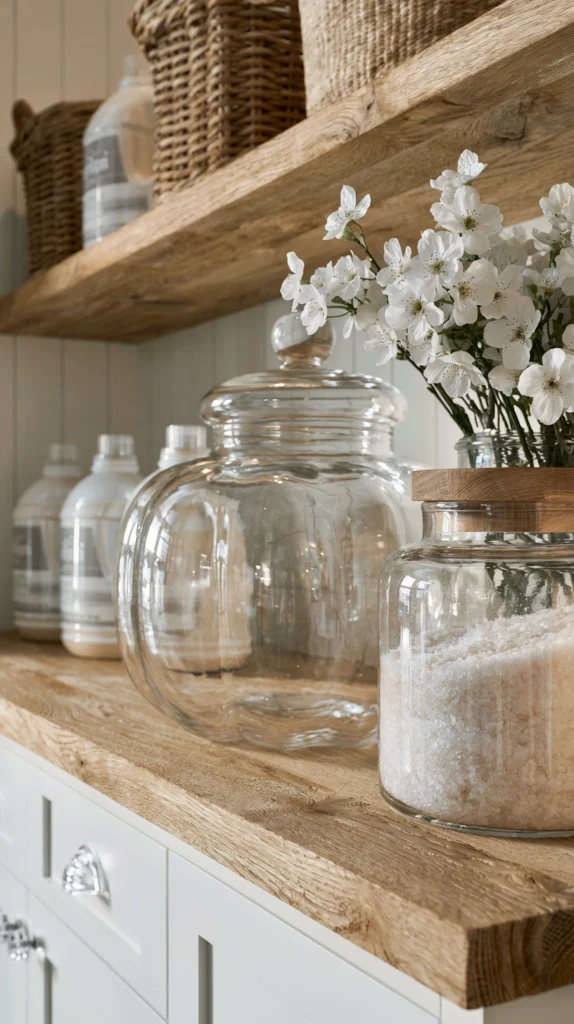
One larger, more sculptural jar dedicated to laundry pods or dryer sheets, positioned as the shelf’s focal point rather than blended in with the others.
Why one larger piece anchors the whole shelf
The same principle that works on a living room shelf applies here: a single larger object gives the eye a place to land before it takes in the smaller items around it. A shelf of five same-sized canisters can read as repetitive; one slightly taller or more sculptural piece breaks that rhythm.
Sizing
- 8–10 inches tall, noticeably taller than the surrounding canisters
- Positioned at one end of the shelf or slightly off-centre, not dead centre
Cost breakdown
- Statement ceramic or glass canister: $30–55
- Total: $30–55
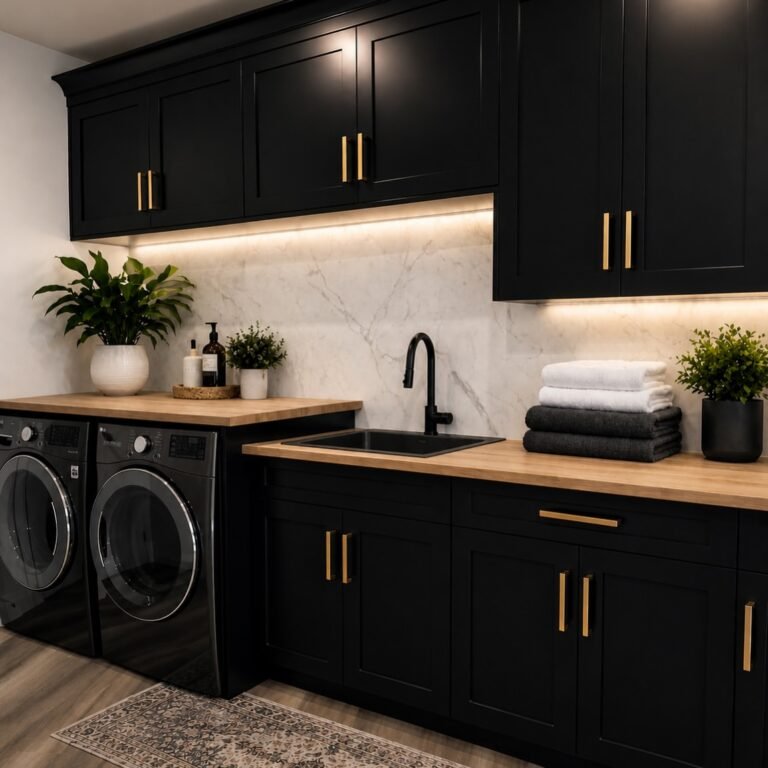
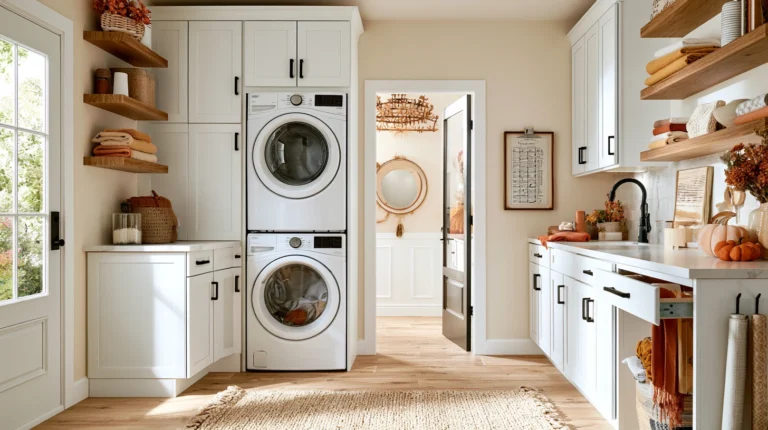
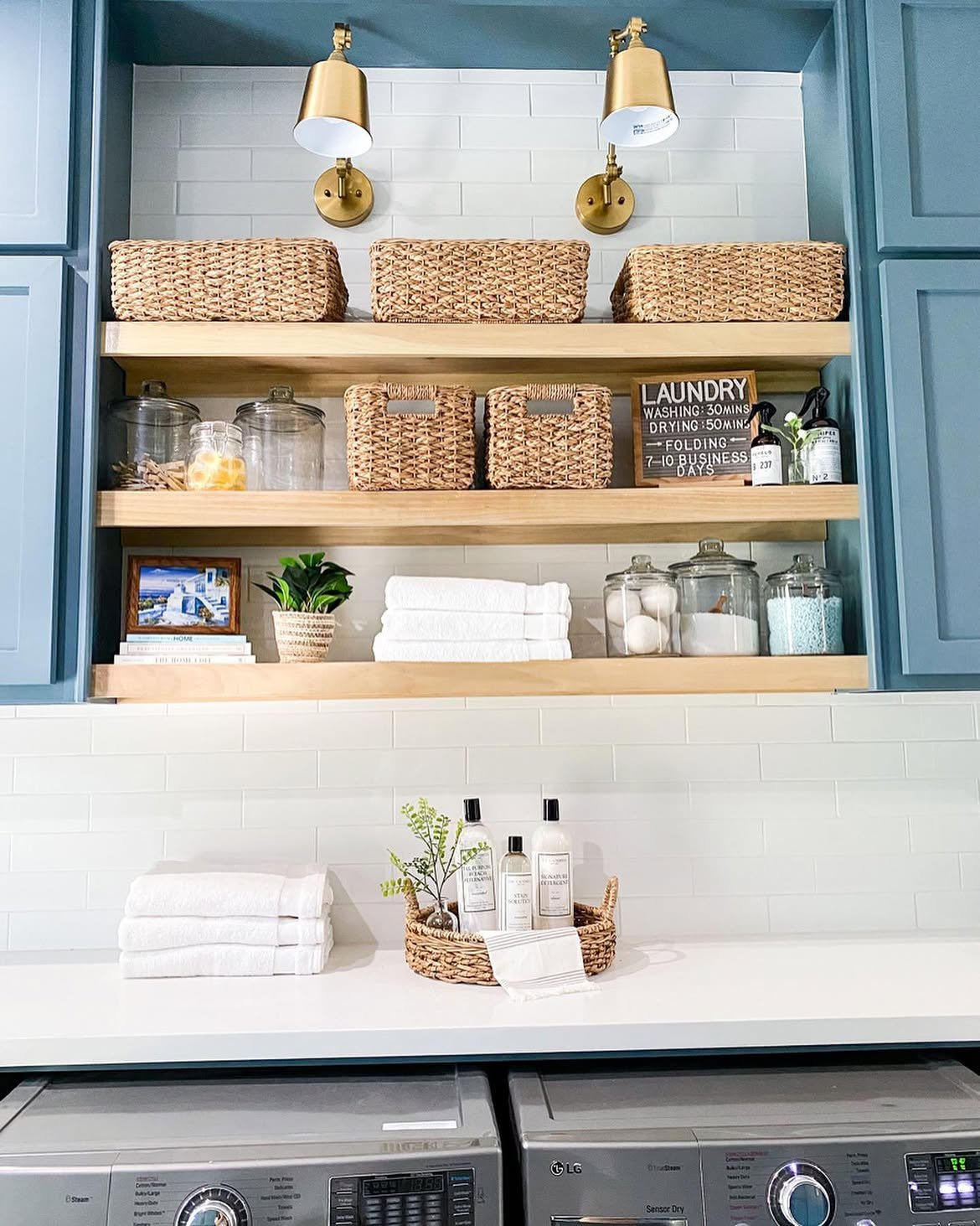
14. The Complete Designer Laundry Shelf
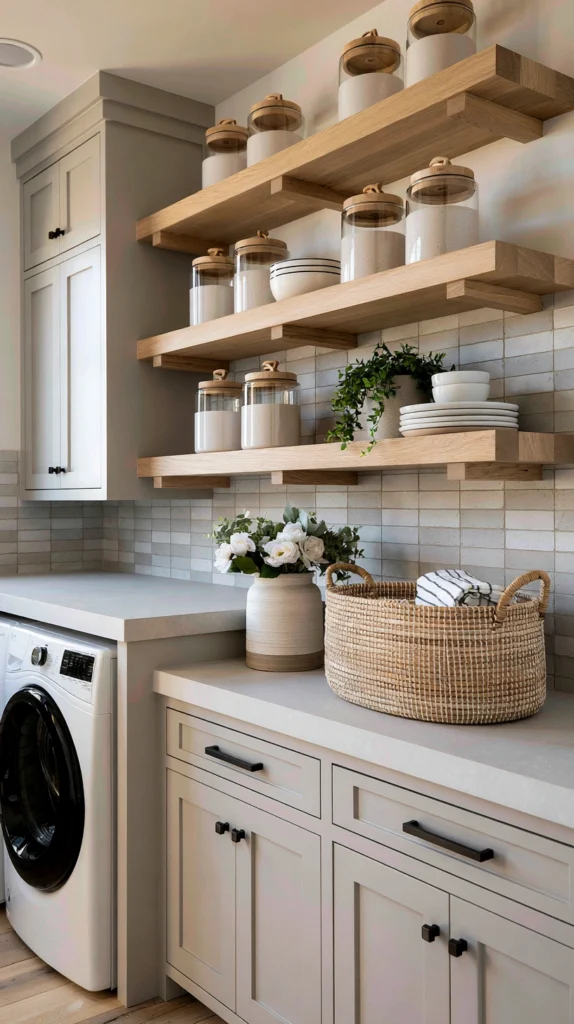
A full shelf system with every element above working together — the definitive version of a laundry shelf that looks intentionally designed rather than incidentally accumulated.
What separates the complete shelf from a few nice jars
A shelf with beautiful glass canisters sitting beside a pile of loose dryer sheets and a mismatched laundry basket still reads as unfinished. The complete version resolves every category at once — decanted containers, grouped small items, hidden storage, a vertical element, and a consistent label system — so nothing on the shelf is left unaddressed.
The elements of the complete shelf
The containers:
- Glass canisters for detergent and softener (Idea #1)
- A matching custom label set across all of them (Idea #2)
- One statement canister as the focal point (Idea #13)
The grouped items:
- A wood tray corralling small tools (Idea #5)
- A woven basket for loose or irregular supplies (Idea #3)
The structure:
- Wood shelving on exposed brackets, replacing wire shelving (Idea #8)
- A hook rail at the end for the ironing board and larger tools (Idea #11)
The vertical layer:
- A small framed print above the shelf (Idea #9)
- One low-maintenance plant on the top shelf (Idea #7)
The lower system:
- Matching sorting bins, labeled to match the canisters above (Idea #10)
The shelf in use on an ordinary laundry day:
The detergent canister is reached without needing to check which of three mismatched bottles is actually detergent. The stain pen is exactly where the wood tray left it. Dirty clothes go straight into the labeled “darks” bin instead of a pile on the floor. Nothing about the process changed — the shelf simply stopped requiring decisions along the way.
Cost breakdown for the complete shelf
Assuming a starting point of wire shelving and original retail packaging:
- Wood shelving upgrade: $55–110
- Glass canisters (3): $37–96
- Custom label set: $12–60
- Wood tray: $15–30
- Woven basket: $18–35
- Statement canister: $30–55
- Framed print: $25–60
- Small plant: $12–25
- Hook rail: $25–50
- Sorting bins (3): $60–105
Total: $289–626
Phased over two stages:
Stage one ($100–200):
- Glass canisters and label set
- Wood tray for small items
- Woven basket
Stage two ($200–450):
- Wood shelving upgrade
- Framed print and plant
- Sorting bins and hook rail
The complete laundry shelf: the smallest room in the house getting the same design attention as any other open shelf, one decanted bottle at a time.
The Question Before Any Laundry Shelf Redesign
Before buying a single canister:
What currently makes the shelf look chaotic — the containers, or the clutter?
If the answer is: mismatched retail bottles — the glass canister decant and label set come first.
If the answer is: loose small items with nowhere assigned — the wood tray and woven basket come first.
If the answer is: the shelving itself looks like storage, not decor — the bracket and wood shelf upgrade comes first.
If the answer is: nothing is wrong, it just feels flat — the plant and framed art are the answer.
The redesign follows what’s actually creating the chaos, not the most photogenic idea on the list. Once the real source is solved, the rest of the styling reads as effortless.
Getting Started This Weekend
The immediate laundry shelf fix:
Decant the detergent and softener into two matching containers.
Even without custom labels yet, matching glass alone removes most of the visual noise.
Corral every loose small item into one tray or basket.
Stain pens, clips, spare buttons — anything currently sitting directly on the shelf surface.
Fold the towels into one matching stack.
Mismatched towels folded neatly still read as mismatched; a single colour family reads as styled.
Add one small object — a plant, a candle, or a vase — as the shelf’s focal point.
The rest of the design: the elaboration of this weekend.
The system: the beginning. The designer laundry shelf: what stays organized once it’s in place.