14 Autumn Bathroom Storage Hacks That Look Pretty
14 Autumn Bathroom Storage Hacks That Look Pretty
Most bathroom storage solutions come from the same place: a plastic bin shoved under the sink, a stack of products balanced precariously on the back of the toilet, a drawer nobody can fully close. It solves the problem of where things go, but it rarely solves the problem of what the room actually looks like once everything’s been put away.
That trade-off isn’t necessary. A bathroom can be genuinely organized and genuinely pretty at the same time, and the gap between the two is usually just a matter of choosing storage that was designed to be seen, not just to hold things. Once that shift happens, the same clutter that used to get hidden becomes part of the room’s actual styling.

Pretty bathroom storage isn’t about buying more matching bins. It’s about choosing a small number of storage pieces that do real work and also belong in the room visually, the same way good kitchen storage doubles as kitchen decor. Add in a few fall-appropriate textures and tones, and the bathroom’s most practical problem becomes one of its better-looking corners.
Here are 14 storage hacks for an autumn bathroom that solves clutter without looking like it’s solving clutter.
Why Pretty Storage Plays by Different Rules Than Hidden Storage
The rules are not the same for every approach to bathroom organization:
Hidden Storage Advantages:
- Clutter disappears completely behind closed doors and drawers
- No pressure to coordinate colors, materials, or finishes, since nothing is meant to be seen
- Fast and cheap to set up, since function is the only consideration
The hidden storage comparison: out of sight, out of mind
Pretty, Visible Storage Advantages:
- Everyday items become part of the room’s actual decor rather than something to apologize for
- A bathroom that looks finished even with the cabinet doors wide open
- A more flexible system, since visible storage gets used more consistently than anything tucked behind a door
The key insight:
- Hidden storage rewards convenience over appearance
- Pretty storage rewards a small amount of upfront thought about material and color, paid back every single day the room gets used
- These are different organizing philosophies, not the same bins simply left out in the open
The Visibility and Moisture Reality
The most important decision in pretty bathroom storage:
The seen-versus-stored divide:
- Not everything in a bathroom deserves to be on display — some items genuinely look better tucked away, and some look fine in the open
- Decide which category each item falls into before choosing a storage piece for it, rather than buying a container first and figuring out what goes in it later
- Know this — it determines whether a piece of storage should be chosen for looks, for full concealment, or for both
The “humidity-safe materials” calculation:
- Anything left in the open in a bathroom is also left in the open to the room’s humidity, which rules out some otherwise appealing materials
- Sealed wood, glazed ceramic, treated metal, and tightly woven natural fiber all tolerate a bathroom’s moisture better than raw wood, paper, or loosely woven baskets
- Choose material first, then style, since a beautiful piece that warps or mildews within a season was never actually a solution
Most pretty bathroom storage gets layered in, not bought all at once:
- The biggest, most visible pieces — a cabinet, a ladder shelf — come first, since they anchor the room’s overall storage logic
- Mid-size containers — baskets, jars, trays — come next, sorting smaller categories of items
- The smallest finishing touches — labels, a seasonal swap, a tray arrangement — come last, and are the easiest layer to adjust as the season changes
1. The Woven Basket Under-Sink System (Replacing the Plastic Bin Pile)
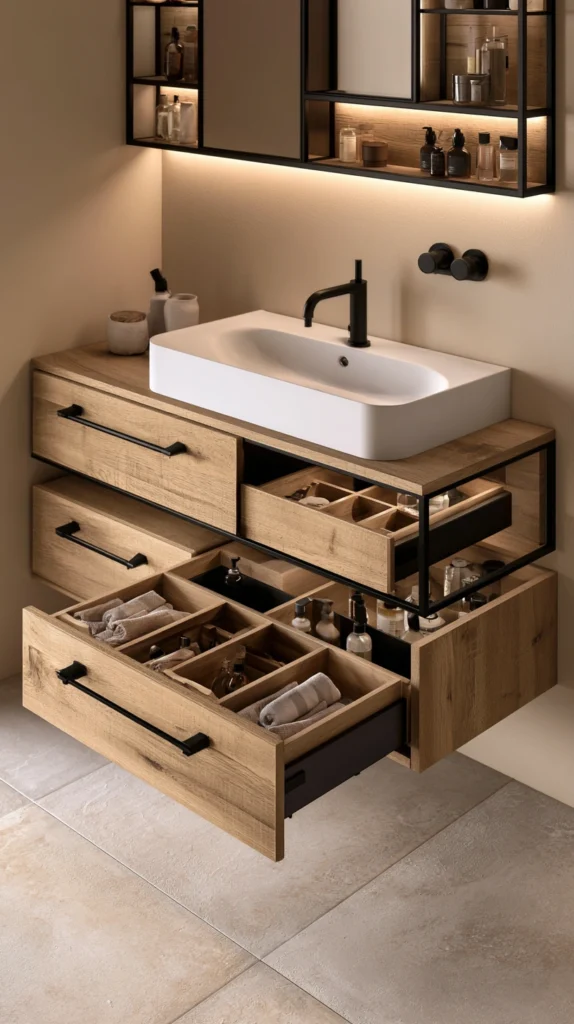
A set of woven baskets, sized to fit the cabinet beneath the sink, replacing whatever loose plastic bins and bottles have accumulated there — the single change most likely to make the bathroom’s least photogenic storage spot actually look intentional.
Why under-sink storage deserves this much attention
- The accumulation problem it solves: under-sink cabinets are where bathroom clutter tends to collect fastest, since the door hides whatever gets shoved in
- The category-sorting function: a basket per category — cleaning supplies, extra toiletries, spare toilet paper — means finding something doesn’t require pulling everything else out first
- The pulled-open-door reality: this cabinet gets opened constantly, which means even “hidden” storage here is seen far more often than storage tucked into a closet elsewhere in the house
The options
- Tightly woven seagrass baskets, tolerant of the cabinet’s higher humidity exposure near plumbing
- Wire baskets with a fabric liner, for a slightly more open, airier look
- Stackable baskets, maximizing vertical space in a typically tall but narrow cabinet
- A pull-out basket on a small tray or slide, for easier access to items at the back of a deep cabinet
The practical execution
- Measure the cabinet’s interior dimensions before buying, since under-sink cabinets are often interrupted by plumbing that limits usable width
- Group by category rather than by how items happen to fit, so each basket has one clear purpose
- Check for any moisture or leaks around the plumbing periodically, since a basket sitting against a slow leak will show it before the leak is otherwise noticed
Cost breakdown
- Small to medium woven basket, each: $10–22
- A full set of 3–4 for one cabinet: $35–80
- Total: $35–80
The under-sink cabinet that finally looks as good open as closed: the lowest-visibility win on this list, and one of the most genuinely useful.
2. The Wall-Mounted Ladder Shelf (Vertical Storage That Doubles as Display)
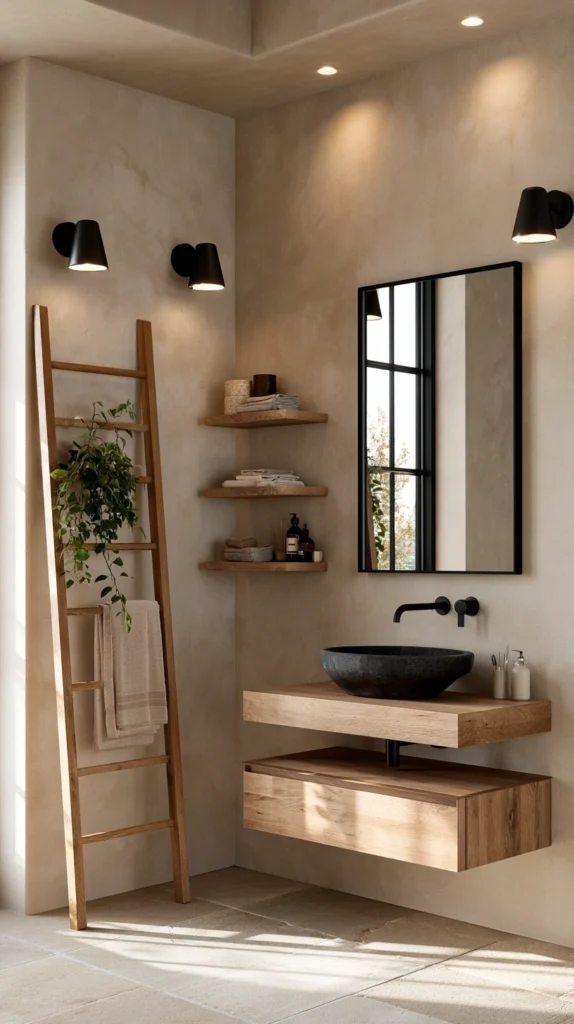
A wood ladder shelf, leaned against the wall or mounted flat, holding folded towels and a few styled accessories — the storage piece that claims vertical space most bathrooms leave completely empty.
Why vertical storage solves what floor and counter space can’t
- The unclaimed space it uses: most bathrooms have bare wall space above the toilet or beside the vanity that never gets considered for storage at all
- The display-while-storing logic: a ladder shelf turns folded towels into part of the room’s styling, the same way an open kitchen shelf turns dishware into decor
- The flexible capacity it offers: a ladder typically holds more linens than a single towel bar, useful in a bathroom serving more than one person
The options
- A narrow single-width ladder shelf, suited to a smaller bathroom with limited floor footprint
- A ladder shelf with built-in rungs and a flat top shelf, combining hanging storage with a small display surface
- A wall-mounted, securely flat-fixed ladder, for households with pets or kids where a leaning piece feels like a tipping risk
- A whitewashed or painted finish, for a lighter look than a natural wood tone
The practical execution
- Choose a sealed or finished wood rather than raw lumber, given the bathroom’s humidity
- Secure with a simple wall bracket or strap even on a “leaning” style ladder, both for safety and to prevent slipping on tile flooring
- Roll towels rather than folding flat across the rungs, for a fuller look and easier one-handed retrieval
Cost breakdown
- Small ladder shelf: $30–60
- Ladder shelf with a built-in top shelf: $50–110
- Total: $30–110
3. The Labeled Apothecary Jar System (Small Items Finally Sorted, Not Scattered)
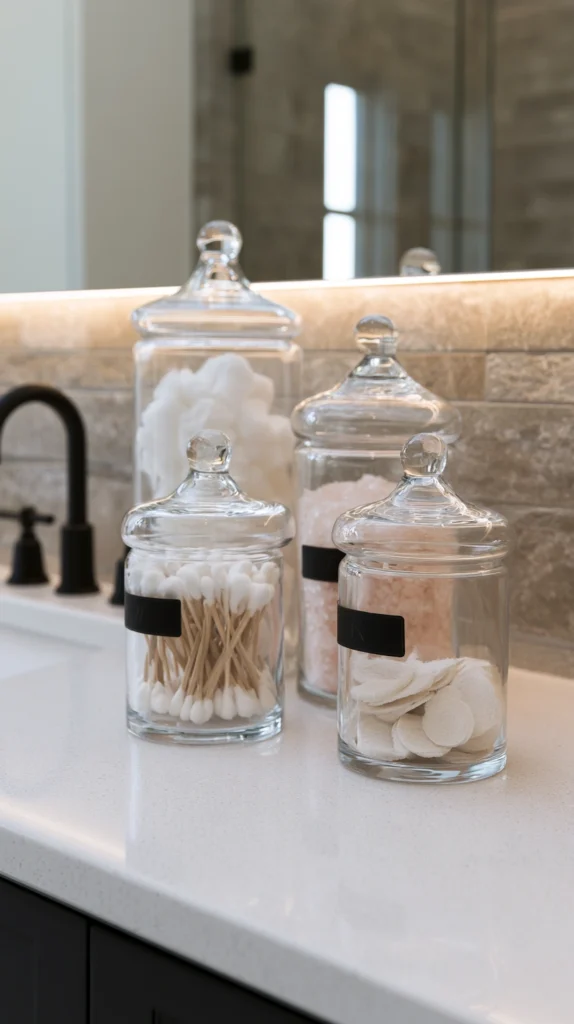
A set of clear, lidded glass jars on the vanity counter, holding cotton balls, cotton swabs, bath salts, and other loose small items — the storage upgrade that replaces a drawer of half-empty boxes with a single, cohesive display.
Why small loose items deserve dedicated jars
- The drawer-clutter problem it solves directly: cotton balls and swabs are some of the worst offenders for sliding around loose in a drawer, especially once their original packaging starts to fall apart
- The visibility benefit: jars on the counter make daily-use items easy to grab without opening a single drawer, while still looking deliberate rather than messy
- The refill-not-replace logic: once the jars are in place, restocking is as simple as topping off rather than buying a new container each time
The options
- Clear glass jars with a hinged or screw-top lid, in a matched set of two or three different sizes
- Jars with wood or cork lids, for a softer material contrast against the glass
- A single larger jar, for cotton balls or rolled washcloths as a singular statement piece
- Labeled jars, with a simple printed or handwritten tag for each container’s contents
The practical execution
- Decant from original packaging gradually as products are used up, rather than discarding usable supply all at once
- Choose airtight lids for anything moisture-sensitive, like bath salts, given the bathroom’s naturally humid environment
- Group jars by height for visual variety on the counter, rather than lining identical sizes up in a single row
Cost breakdown
- Glass apothecary jar, each: $8–18
- A set of 3: $25–50
- Total: $25–50
4. The Over-the-Toilet Cabinet or Étagère (The Most-Underused Storage Spot in Most Bathrooms)
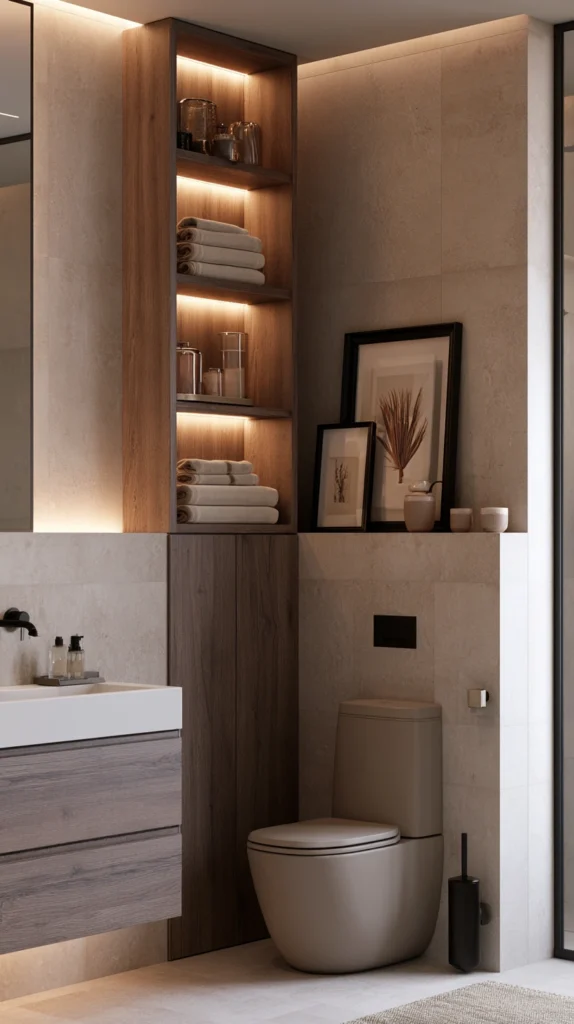
A tall, narrow cabinet or open-shelf étagère, installed in the space directly above the toilet tank — the storage piece purpose-built for the one stretch of vertical space almost every bathroom has and almost no bathroom uses by default.
Why this exact spot deserves its own dedicated furniture piece
- The near-universal availability of the space: unlike most storage opportunities, the space above a toilet tank exists in nearly every bathroom layout, making this one of the most broadly applicable ideas on the list
- The significant storage volume it adds: a tall étagère can hold several shelves’ worth of linens, toiletries, and decor in a footprint that was otherwise doing nothing
- The styling opportunity layered on top of the function: an open-shelf version becomes a display spot for several smaller items from this list — jars, baskets, a folded towel stack — arranged together
The options
- A fully enclosed cabinet, for a bathroom that wants more concealed storage than open display
- An open-shelf étagère, for maximum styling opportunity at the cost of full concealment
- A combination piece, with closed cabinet storage at the bottom and open shelving above
- A slim, freestanding ladder-style unit, for bathrooms where a permanently mounted cabinet isn’t an option
The practical execution
- Measure the toilet tank’s height and the available wall space carefully before buying, since this category of furniture comes in widely varying depths
- Anchor any tall freestanding unit to the wall, given how narrow its footprint typically is relative to its height
- Reserve the lowest, most accessible shelves for daily-use items, with decorative-only pieces positioned higher up
Cost breakdown
- Open-shelf étagère: $60–150
- Enclosed cabinet: $100–250
- Total: $60–250
5. The Tension Rod Cabinet Dividers (Nearly Free Order for a Sliding Mess)
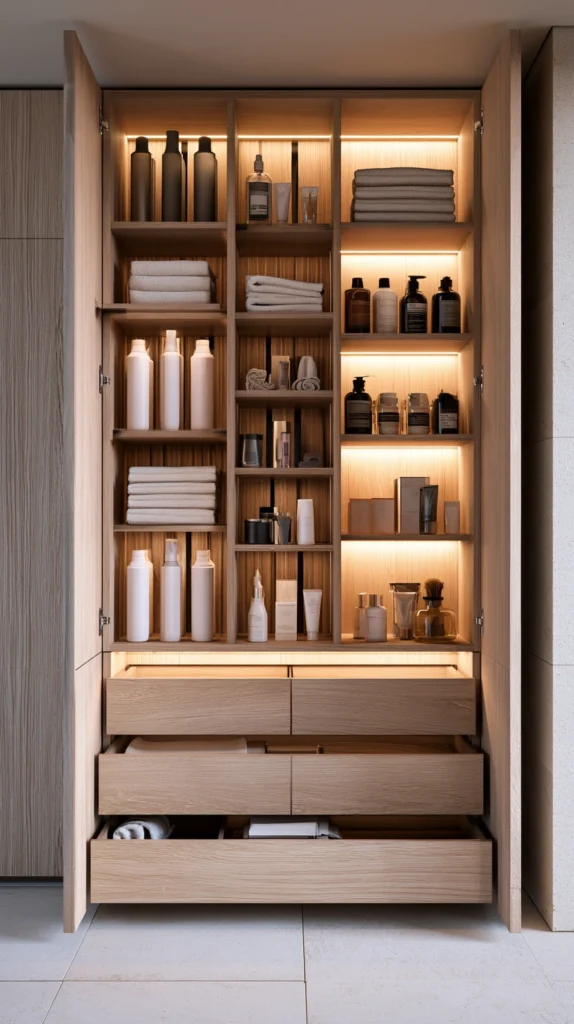
Spring-tension rods installed inside a cabinet to create vertical dividers — the smallest-cost project on this entire list, solving the specific problem of bottles and boxes sliding into a single jumbled pile every time the cabinet door opens.
Why a few dollars of hardware fixes a recurring problem
- The sliding-pile reality: a single open cabinet shelf, especially a deep one, tends to collapse into one disorganized mass the moment anything gets pulled out or put back
- The no-installation advantage: tension rods require no drilling, no permanent modification, and no real tools, making this the lowest-commitment idea on the whole list
- The reconfiguration flexibility: dividers can be repositioned in minutes as the contents of a cabinet shift through the season
The options
- Standard spring tension rods, sized to the cabinet’s depth, creating vertical slots for bottles, boxes, or flat items
- Tension rods used horizontally, creating a barrier that keeps stacked items from tipping forward when the cabinet door is opened
- Adjustable shelf risers, a related tool for adding a horizontal tier rather than a vertical divider
- A combination of risers and rods, for a cabinet handling several different item categories at once
The practical execution
- Install rods snugly enough to hold their position without bowing the cabinet’s interior walls
- Group items by shape and height rather than strictly by category, since the rods are organizing by physical fit as much as by use
- Check the fit periodically, since humidity can occasionally cause slight shifts in tension over time
Cost breakdown
- Tension rod, each: $5–12
- A set of 3–4 for a full cabinet: $20–40
- Total: $20–40
6. The Hanging Woven Shower Caddy (Bottles Off the Tub Ledge, Texture On the Wall)
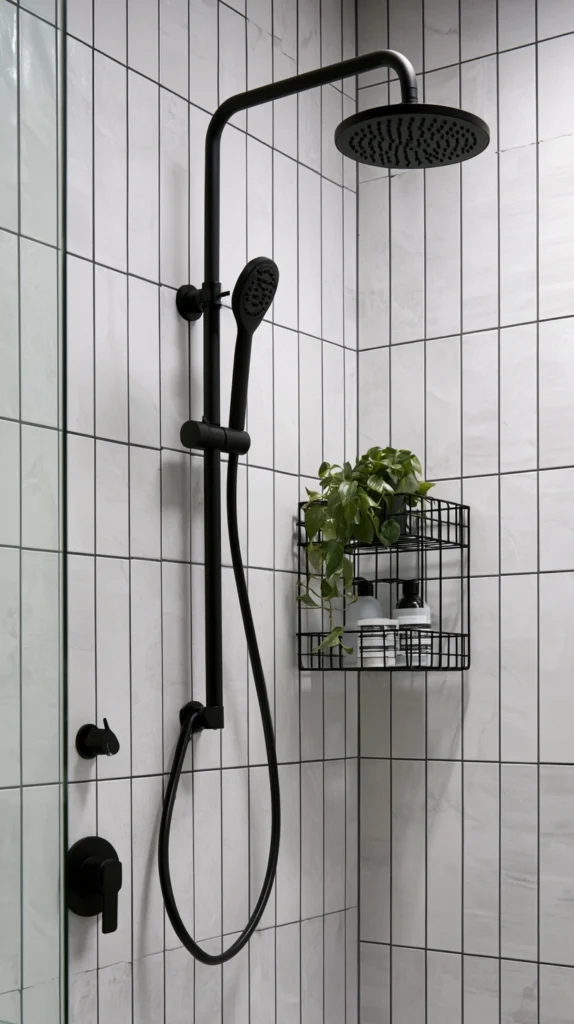
A woven or wire hanging caddy, suspended from the shower head or a wall hook, replacing the usual lineup of bottles balanced along the tub edge — the storage piece that solves the shower’s most universal clutter problem with material that actually fits the room’s overall look.
Why the shower deserves a more deliberate storage solution than the tub ledge
- The tub-ledge problem nearly every bathroom shares: bottles balanced along a tub edge or a builder-grade plastic corner caddy are some of the most consistently unattractive clutter in any bathroom
- The drainage benefit a hanging caddy provides: unlike a flat ledge, a hanging caddy lets water run off and away from bottle bottoms, reducing the ring of grime that builds up underneath stationary products
- The material upgrade it allows: replacing a plastic caddy with a woven or finished metal one is one of the more visible material changes available in the shower specifically
The options
- A woven caddy with a drainage-friendly open weave, hung from the shower head
- A black iron or matte metal caddy, for a more substantial, less plastic-feeling look
- A tension-pole caddy, mounted floor to ceiling for more shelves without any drilling
- A wall-mounted wire basket, fixed with adhesive hooks rather than hung from the shower head itself
The practical execution
- Choose a genuinely rust-resistant metal finish or a tightly woven, mold-resistant material, given how directly this piece sits in the shower’s water spray
- Position the caddy to allow water to drain freely rather than pool in any low point of the weave or wire
- Wipe down periodically as part of the regular bathroom cleaning routine, since this is the single most consistently wet storage spot in the entire room
Cost breakdown
- Woven or wire hanging shower caddy: $15–35
- Total: $15–35
7. The Drawer Organizer Tray System (Finally Closing the Drawer All the Way)
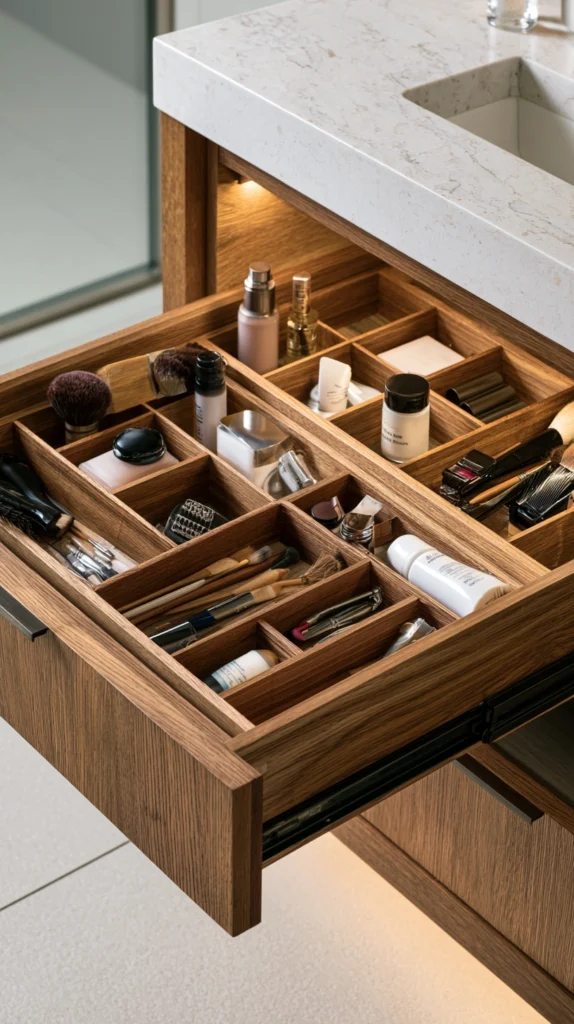
A set of fitted or adjustable drawer organizer trays, sized to the vanity’s actual drawers — the upgrade that turns a drawer of loose, sliding products into neat, separated rows that close fully every time.
Why drawers need their own dedicated system, not just good intentions
- The sliding-contents problem unique to drawers: unlike a cabinet shelf, a drawer’s contents shift every time it opens and closes, which over time turns even a well-organized drawer back into a jumble
- The full-closure benefit: a properly fitted tray system means the drawer closes flush every time, rather than getting stuck on a tube of something wedged sideways
- The category separation it enforces: dedicated compartments keep makeup, hair tools, and grooming items from migrating into each other’s space over weeks of daily use
The options
- Adjustable expandable trays, fitting a range of drawer widths without custom measuring
- A set of smaller fitted bins, arranged within the drawer rather than a single connected tray
- Velvet-lined trays, for a slightly more elevated look and feel for makeup or jewelry-adjacent items
- Clear acrylic trays, for full visibility of contents without opening multiple compartments
The practical execution
- Measure the drawer’s interior dimensions precisely before ordering, since vanity drawers are frequently shallower or narrower than standard kitchen drawer sizes
- Assign each compartment a single category and stick to it, rather than letting overflow from one section creep into another
- Wipe trays out periodically, since spilled liquid products are far easier to clean from a removable tray than from the drawer itself
Cost breakdown
- Adjustable expandable tray, each: $12–25
- A full drawer system (2–3 trays): $30–65
- Total: $30–65
8. The Repurposed Vintage Crate or Drawer (Storage With Some Found Character)
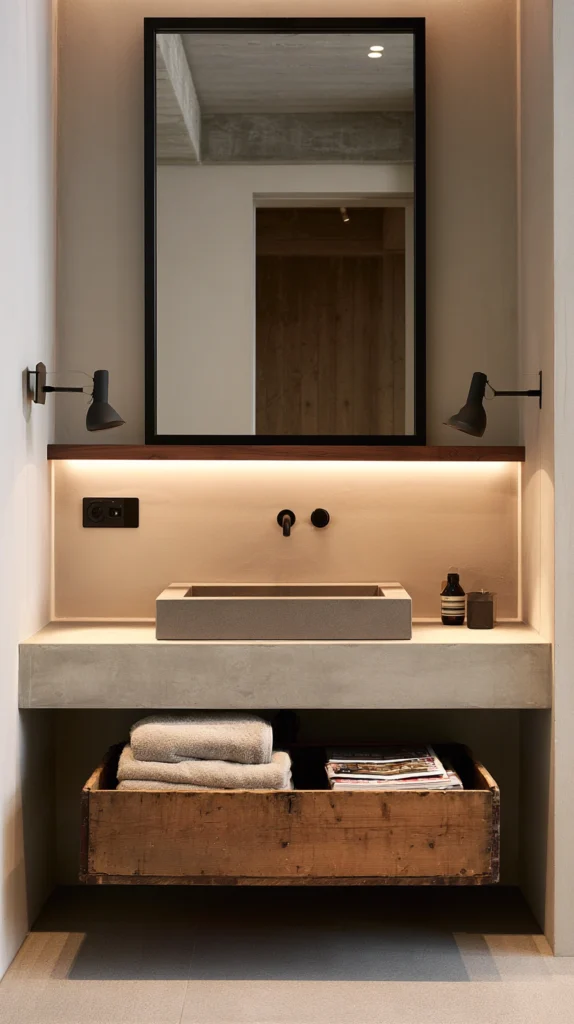
A small wooden crate or a salvaged drawer, used as open storage for towels, toilet paper, or magazines — the storage piece that brings a sense of gathered, secondhand character into a room usually filled with new, matching fixtures.
Why a repurposed piece works harder than something bought new for the purpose
- The collected-not-purchased signal: a genuinely old crate or drawer reads as more interesting and more intentional than a new basket bought specifically to match the room
- The low-cost entry point it often offers: secondhand and salvage pieces are frequently less expensive than new decorative storage of comparable size
- The conversation-piece value: unlike most of the storage on this list, a piece with real age or an obvious former life is the kind of detail a guest is likely to actually ask about
The options
- A small wooden crate, used upright on the floor or on its side as a shelf
- A salvaged dresser drawer, repurposed as an open bin, sometimes fitted with small caster wheels for mobility
- An old wire basket or milk crate, for a slightly more industrial version of the same idea
- A vintage suitcase, stood on end or used flat as a lower shelf, for a larger-scale version of the concept
The practical execution
- Source from secondhand shops, estate sales, or salvage yards for genuine age and patina, rather than only buying new pieces distressed to look old
- Seal or finish any raw wood surface before placing it in the bathroom, given the room’s humidity
- Check secondhand pieces for structural soundness before loading them with anything heavy, since age can mean wear as well as character
Cost breakdown
- Secondhand crate or drawer: $10–40
- Sealant or finish, if needed: $10–20
- Total: $10–60
9. The Magnetic Strip for Metal Tools (Tweezers, Nail Clippers, and Small Tools Off the Counter)
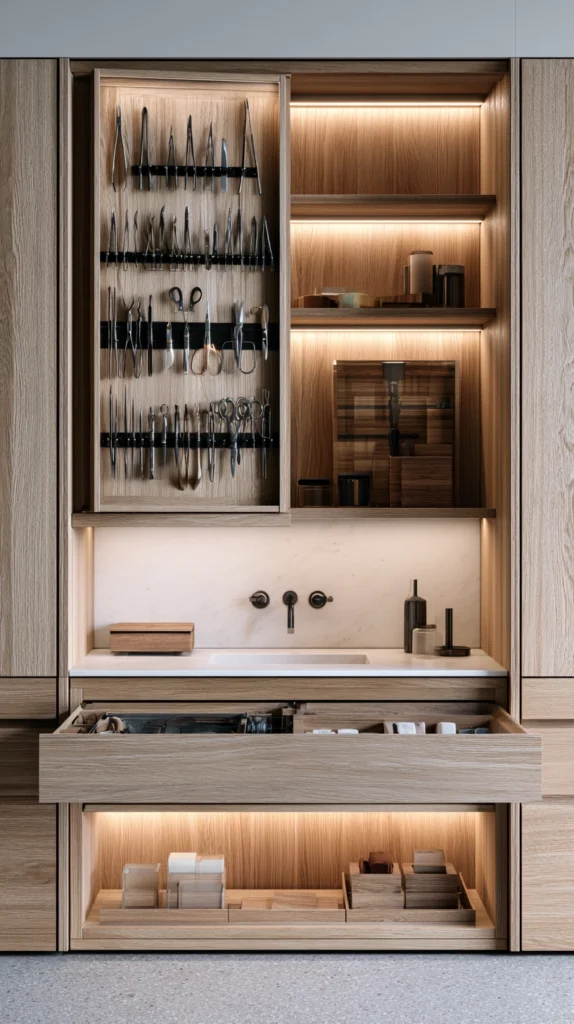
A magnetic strip mounted inside a cabinet door or on an open wall, holding tweezers, nail clippers, and other small metal grooming tools — the storage solution that uses claimed wall space rather than another drawer compartment.
Why a magnetic strip earns its place over a small dish or drawer
- The drawer-clutter problem it solves at the source: small metal tools are some of the worst offenders for getting lost or tangled together loose in a drawer
- The vertical-space logic shared with Idea #2: like the ladder shelf, this claims wall space that would otherwise sit completely empty
- The visibility and findability benefit: tools stored visibly on a strip are far easier to locate at a glance than the same tools buried at the bottom of a drawer
The options
- A magnetic strip mounted inside a cabinet door, keeping tools concealed but still off the counter and out of a drawer
- An open wall-mounted strip, for a more visible, styled display of tools
- A magnetic strip combined with small magnetic dishes, for non-magnetic small items like cotton swabs or jewelry
- Adhesive-backed magnetic strips, for a no-drill installation option
The practical execution
- Mount inside a cabinet door rather than an open wall in a household with young children, keeping sharper tools out of casual reach
- Confirm the mounting surface can actually hold a magnet securely, since not every interior cabinet panel is magnetic
- Space items with enough clearance that the cabinet door still closes fully if mounted on the interior
Cost breakdown
- Magnetic strip, small size: $8–18
- Total: $8–18
10. The Floating Corner Shelf (Claiming the Bathroom’s Most Overlooked Triangle)
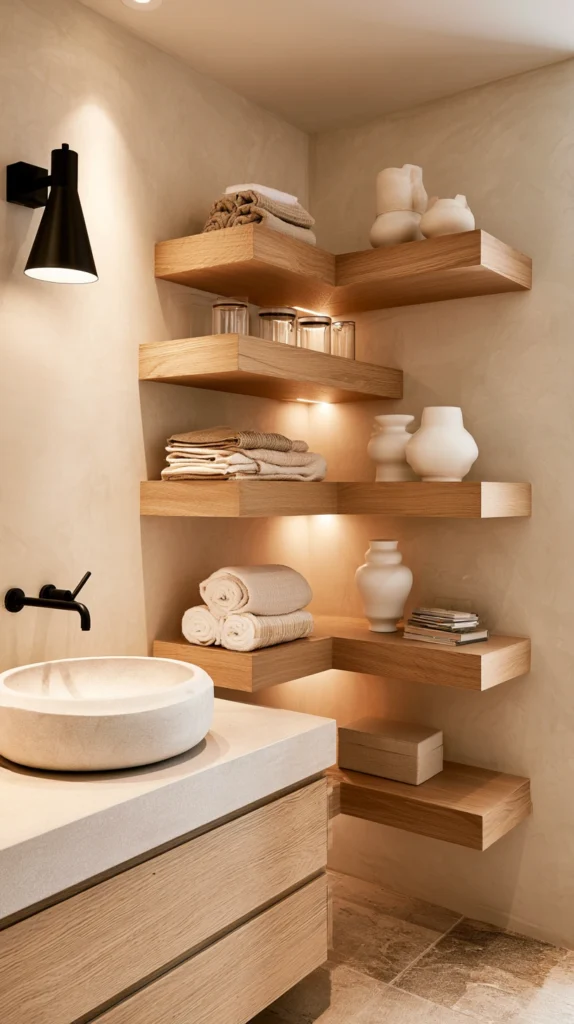
A small floating shelf installed in a bathroom corner, often above the toilet or beside the shower — the storage piece sized specifically for the awkward triangular space most bathrooms have and most storage furniture is too rectangular to use.
Why a corner deserves its own purpose-built shelf
- The shape-specific problem it solves: standard rectangular shelving and furniture rarely fit a true corner cleanly, leaving that space empty by default in most bathroom layouts
- The minimal footprint it requires: a corner shelf adds real storage and display space without intruding on any of the room’s already-limited floor or wall area elsewhere
- The tiered-display opportunity: a set of two or three stacked corner shelves creates a small vertical gallery for jars, plants, or folded towels in a spot that would otherwise be entirely wasted
The options
- A single floating corner shelf, for a small, simple display spot
- A tiered set of two or three corner shelves, stacked at intervals for more storage in the same footprint
- A corner shelf with a small lip or rail, preventing items from sliding off in a shower-adjacent installation
- A wood corner shelf, finished or sealed to match other wood tones used elsewhere in the room
The practical execution
- Mount into wall studs where possible, particularly for any shelf positioned near the shower where it may hold heavier glass bottles
- Choose a sealed finish for any wood shelf installed close to the shower’s direct spray zone
- Style with a mix of heights across a tiered set, the same vignette principle used on a console table or kitchen shelf
Cost breakdown
- Single floating corner shelf: $15–35
- A tiered set of 2–3: $30–70
- Total: $15–70
11. The Lidded Bin for Toilet Paper Stockpile (A Bulk Necessity, Finally Out of Sight and Pretty Anyway)
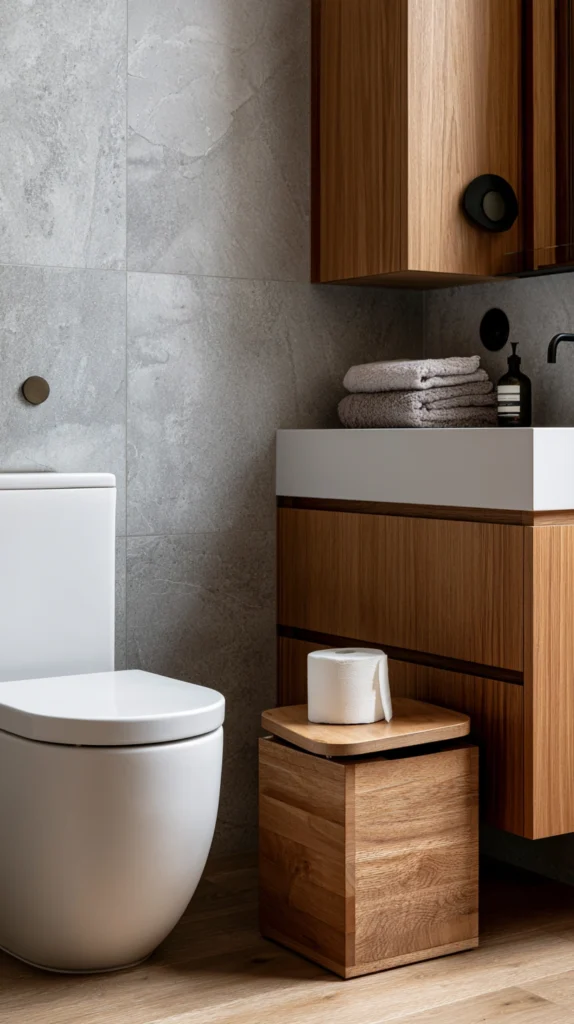
A single large lidded basket or bin, holding a full stockpile of toilet paper or paper towels — the storage piece that solves the universally awkward problem of where to keep bulk paper goods without leaving the original plastic packaging in view.
Why bulk storage deserves its own dedicated, styled container
- The packaging problem it solves directly: bulk toilet paper almost always comes wrapped in branded plastic, which is one of the most visually jarring things to leave sitting out in an otherwise styled bathroom
- The single-container simplicity: rather than distributing a stockpile across multiple smaller spots, one generously sized lidded bin holds the full supply in one place
- The dual accessibility and concealment it offers: a lidded bin keeps the stockpile out of view while still being faster to access than a stockpile kept in a hall closet down the hallway
The options
- A large lidded woven basket, sized to hold a full bulk pack
- A galvanized metal bin with a lid, echoing the farmhouse material used in other galvanized storage pieces
- A wood storage box or trunk, doubling as a small side table or step stool when closed
- A fabric-lined collapsible bin, for a lighter-weight, lower-cost option
The practical execution
- Size the container generously enough to hold a full bulk purchase, rather than needing to split the stockpile between two spots
- Remove paper goods from their original plastic packaging before placing them in the bin, for a cleaner look every time the lid comes off
- Position within reach of the toilet itself, rather than across the room, so the bin actually gets used rather than bypassed out of inconvenience
Cost breakdown
- Large lidded woven basket: $25–55
- Galvanized metal bin with lid: $20–45
- Total: $20–55
12. The Over-the-Door Pocket Organizer (The Back of the Door, Finally Put to Work)
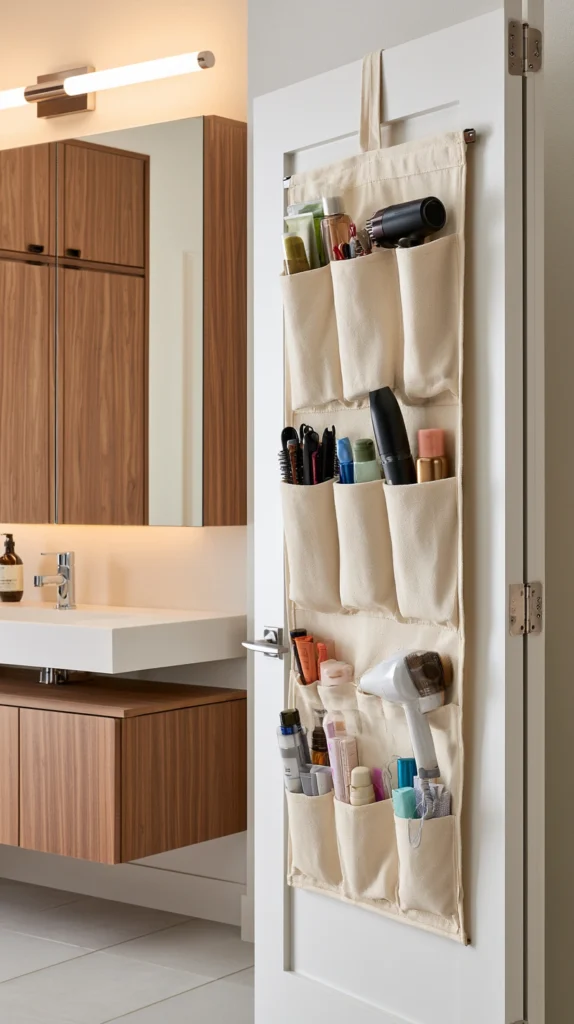
A fabric pocket organizer hung over the bathroom door, holding hair tools, extra toiletries, or cleaning supplies — the storage solution that claims one of the only surfaces in a small bathroom that almost never gets used for anything.
Why the back of the door is worth this much attention
- The truly unused space it claims: in most bathrooms, the back of the door is bare and unconsidered, despite offering a real, flat storage surface
- The hair tool problem it solves specifically: curling irons, straighteners, and hair dryers are some of the most awkward items to store neatly, and a pocket organizer gives each one its own dedicated slot
- The no-drilling installation: most over-the-door organizers hang directly from the door’s top edge, requiring no permanent modification to the door or surrounding wall
The options
- A clear-pocket organizer, for quick visual identification of contents
- A canvas or felt pocket organizer, for a softer, less utilitarian look than clear plastic
- A heat-resistant pocket organizer, specifically rated for storing hot tools like curling irons shortly after use
- A mix of pocket sizes, with larger slots for tools and smaller ones for travel-size toiletries or extra supplies
The practical execution
- Choose a heat-resistant option specifically for any pocket meant to hold a tool that’s still warm, rather than risking melted or scorched fabric
- Assign each pocket to a specific item or category, rather than letting it become a single catch-all
- Mount on the inside of the door rather than a frequently swung exterior door, to avoid the organizer snagging or swinging into anyone passing through
Cost breakdown
- Standard over-the-door pocket organizer: $12–25
- Heat-resistant version: $20–35
- Total: $12–35
13. The Stacked Stoneware Tray System (Counter Organization That Looks Like a Vignette)
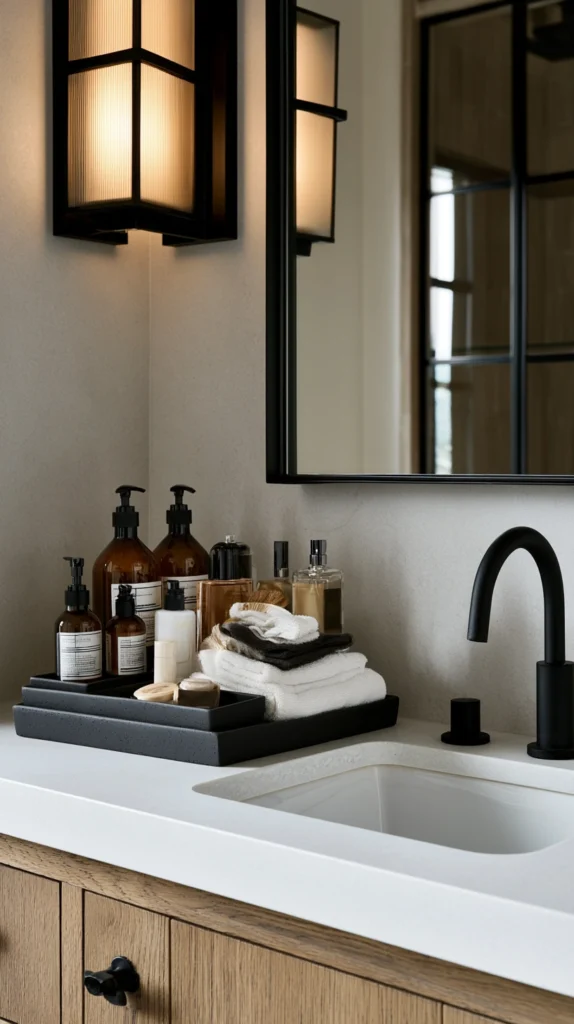
A small stack or arrangement of stoneware or ceramic trays, organizing items directly on the vanity counter rather than hiding them in a drawer — the storage idea that treats the counter itself as a place worth styling, not just a flat surface to set things on.
Why a tray system beats simply setting items directly on the counter
- The visual-corralling effect: a tray groups loose items — a soap dish, a small vase, a candle — into a single intentional cluster rather than letting them scatter across the counter individually
- The cleaning efficiency it adds: wiping down a counter is far easier when most of what’s on it sits on a removable tray that can simply be lifted and set aside
- The vignette-building opportunity: like a console table vignette in an entryway, a styled tray gives the counter a sense of having been arranged, not just used
The options
- A single large stoneware tray, holding the soap dispenser, a small candle, and one or two other items as a unified display
- A stack of two trays of different sizes, adding height and a tiered look to the arrangement
- A wood tray with a raised edge, for a material contrast against ceramic accessories
- A galvanized metal tray, tying the look to other farmhouse-leaning pieces used elsewhere in the room
The practical execution
- Keep the items on each tray to a small, edited number, since an overloaded tray defeats its own organizing purpose
- Choose a tray material that tolerates regular water exposure near the sink without staining or warping
- Wipe the tray and the items on it down together as part of the regular counter cleaning routine, rather than cleaning around a cluttered arrangement
Cost breakdown
- Stoneware or ceramic tray: $12–25
- Galvanized metal tray: $10–20
- Total: $10–25
14. The Seasonal Swap Storage Bin (A System for the System Itself)
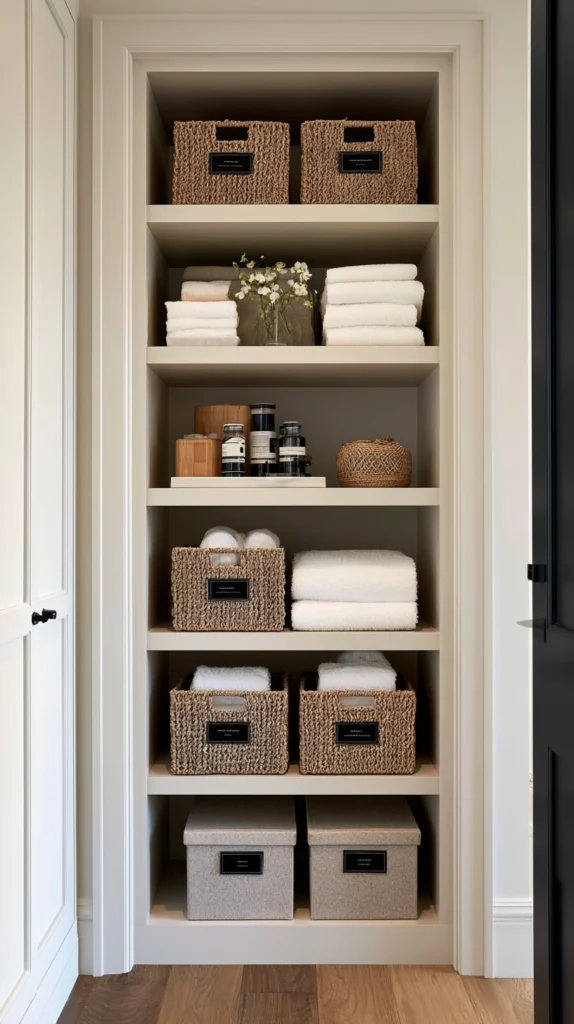
A single labeled bin, stored outside the bathroom, holding whatever seasonal accessories and accents get rotated in and out — the meta-organization idea that makes every other styling choice on this list easier to maintain over time.
Why the storage system needs its own storage plan
- The rotation reality most of this list creates: between fall-specific jars, seasonal trays, and swapped textiles, a styled bathroom accumulates a small rotating wardrobe of its own that needs somewhere to live when it’s not in use
- The time-saving function: a single labeled bin means swapping the bathroom’s look for the next season takes minutes instead of a search through several closets or drawers
- The longevity it adds to the rest of this list: items stored properly between uses last longer and stay in better condition than anything left loose in a junk drawer or closet shelf
The options
- A single lidded bin, labeled by season, kept in a hall closet or under a guest bed
- A set of smaller labeled bins, one per season, for households that rotate decor more frequently
- A clear bin, for at-a-glance contents review without needing to open it
- A bin with dividers or smaller bags inside, separating fragile items like jars from sturdier textiles
The practical execution
- Label clearly by season rather than by vague category, so the right bin is obvious without opening several to check
- Wrap any glass or ceramic pieces individually before storing, to prevent breakage between uses
- Do a quick inventory each time the bin comes out, replacing anything worn out or faded before it goes back into rotation for the next season
Cost breakdown
- Storage bin with lid: $10–25
- Total: $10–25
The labeled bin tucked into the hall closet: the only idea on this entire list that isn’t actually visible in the bathroom, and the one quietly responsible for how easy every other idea is to keep up.
The Pretty Bathroom Storage Roadmap
The work, sequenced:
Phase One (the anchor pieces):
- The wall-mounted ladder shelf (#2)
- The over-the-toilet cabinet or étagère (#4)
- The floating corner shelf (#10)
Phase Two (the cabinet and drawer systems):
- The woven basket under-sink system (#1)
- The tension rod cabinet dividers (#5)
- The drawer organizer tray system (#7)
Phase Three (the daily-use surfaces):
- The labeled apothecary jar system (#3)
- The stacked stoneware tray system (#13)
- The hanging woven shower caddy (#6)
- The magnetic strip for metal tools (#9)
Phase Four (the finishing and supporting pieces):
- The repurposed vintage crate or drawer (#8)
- The lidded bin for toilet paper stockpile (#11)
- The over-the-door pocket organizer (#12)
- The seasonal swap storage bin (#14)
Getting Started This Weekend
The immediate-impact storage refresh:
One afternoon, three changes:
- Add tension rods to the most chaotic cabinet (Idea #5)
- Decant cotton balls and swabs into apothecary jars (Idea #3)
- Swap a plastic shower caddy for a woven or metal one (Idea #6)
Total cost: $60–105. Time: about forty-five minutes. The most-touched parts of the bathroom will already feel more orderly and more styled by the time the work is done.
The structural investment (the next big project):
The over-the-toilet cabinet or étagère (Idea #4) is the single highest-capacity addition on this list. Once it’s in place, it can absorb extra linens, backup toiletries, and several of the smaller styled pieces — jars, baskets, trays — giving them somewhere to live without competing for an already-crowded vanity counter.
What pretty, organized bathroom storage provides that a bin-and-bottle approach can’t:
The function that doesn’t sacrifice how the room looks:
- A drawer that closes flush because everything inside has its own compartment
- A shower caddy that drains properly and still looks intentional, not improvised
- A toilet paper stockpile finally out of its plastic wrapping and out of view
The vertical space most bathrooms never claim:
- A ladder shelf and a corner shelf both using wall space that was otherwise doing nothing
- An over-the-door organizer turning the most ignored surface in the room into real storage
- An étagère stacking several shelves of capacity into a footprint the room already had
The small details that make the system sustainable, not just a one-time tidy-up:
- A magnetic strip that keeps small tools from disappearing into a drawer again
- A labeled seasonal bin that makes the next swap take minutes, not an afternoon
- A tray system that turns daily wipe-downs into a thirty-second task instead of a chore
A bathroom doesn’t have to choose between organized and pretty. The two were only ever in tension because most storage gets bought for function alone, with looks treated as an unaffordable extra. Choose the material and the placement with a little more care, and the same baskets and jars solving the clutter problem end up being the reason the room looks finished. The ladder shelf holding towels on a Tuesday morning is doing the exact same job a plastic bin would have done — it just also happens to be the first thing a guest notices when they walk in.