15 Backyard Fence Landscaping Ideas for Style and Privacy
15 Backyard Fence Landscaping Ideas for Style and Privacy
There is a specific quality that the boundary of a well-designed garden possesses that the boundary of a standard garden consistently fails to achieve. It is the quality of a wall that becomes a garden — the fence that grows things, the boundary that contributes colour and fragrance and seasonal change rather than simply marking the perimeter of the outdoor space. Most backyard fences are at the end of the garden. The best backyard fences are part of it.

Fence landscaping is the discipline of designing the boundary as a positive element of the garden rather than as its negative limit. It requires thinking about the fence not as the backdrop to the planting but as a structure that participates in the planting — as the support for the climber, the backing for the border, the surface for the living wall, the warm south-facing microclimate that makes the tender plant possible in a climate that would otherwise not support it. It requires thinking, in short, about the fence as a garden resource rather than a garden boundary.
Each idea below is a specific approach to one type of fence landscaping. Each includes what you will need, what it will cost, and a practical tip to make it work as well as the garden boundary it is capable of becoming.
1. The Climbing Rose Fence
Budget: $60 – $300
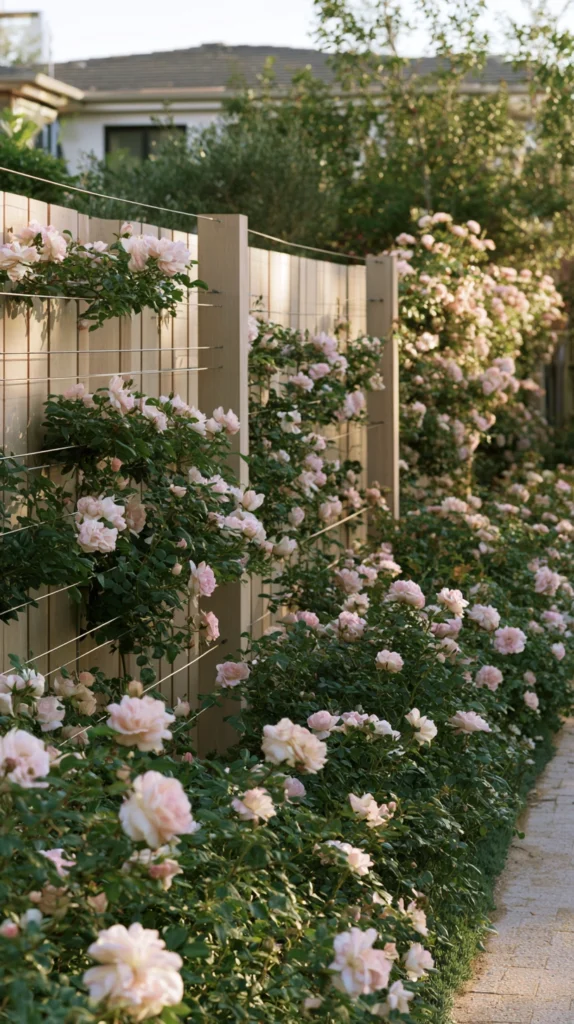
A fence planted with climbing roses — trained horizontally along wires fixed to the fence posts, with the lateral canes producing flowering side shoots along their full length — creates the most classically beautiful and most fragrant of all the fence landscaping treatments.
The rose-covered fence is the fence that has been genuinely absorbed into the garden rather than simply softened by planting in front of it, and the moment of its peak flowering in June, when the canes are obscured by bloom and the fragrance carries across the garden in the warm air, is one of the specific pleasures of the English garden tradition.
Horizontal training wires at 30-centimetre intervals along the fence cost $10–$25 in wire and vine eyes. A climbing rose in a 5-litre pot costs $15–$35 — one per 2 metres of fence provides coverage within three seasons. Choose a repeat-flowering variety — Climbing Iceberg, Madame Alfred Carrière, Zéphirine Drouhin — rather than a once-flowering one so the fence provides bloom from June through to October rather than for a single flush.
Style tip: Train the first canes horizontally from the base of each rose rather than allowing them to grow upward. A rose trained horizontally from its base produces flowering side shoots along the full length of each horizontal cane; a rose allowed to grow upward produces a single column of growth with flowers only at the tip. The horizontal training takes twenty minutes per year and determines the difference between a fence covered in flowers and a fence with a rose attached to it.
2. The Lavender Border
Budget: $30 – $150
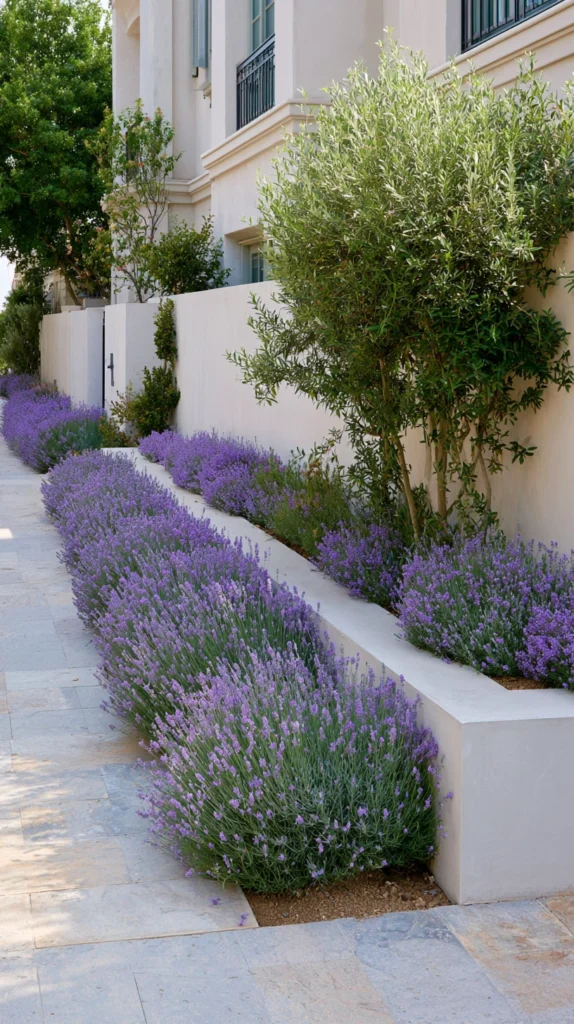
A border of lavender planted along the base of a fence — with the plants touching the fence at the back, growing outward to the path or lawn edge, and allowed to bush freely into their characteristic soft, silver-leaved mound — creates the most fragrant and most specifically Mediterranean of all the fence border treatments. The lavender border is also the most wildlife-beneficial — a fence line of lavender in July and August is a continuous food source for bees, butterflies, and every beneficial insect in the garden, and the fragrance it releases in warm afternoon air is one of the specific pleasures of an English summer.
Lavender plants in a 9-centimetre pot cost $4–$8 each. A border of 6 metres requires twelve to fifteen plants — $48–$120 in plant material. Trim the lavender immediately after flowering to prevent the plant from becoming woody at the base — the annual trim is the single maintenance action that extends the productive life of the lavender from three years to fifteen.
Style tip: Plant lavender in a single variety along the full fence run rather than mixing different varieties. A border of all Hidcote, or all Munstead, or all Vera reads as a considered planting decision; a border of mixed varieties at different heights and in slightly different purple tones reads as plants assembled from whatever was available. The single-variety lavender border is the planting decision that gives the fence landscape its specific quality of intention.
3. The Espalier Fruit Tree Fence
Budget: $60 – $300
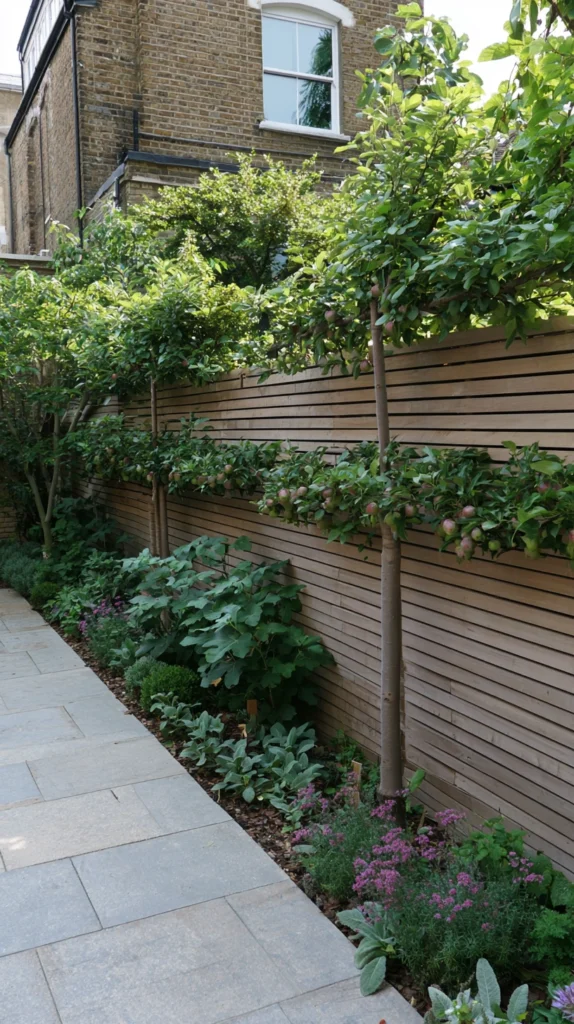
A fruit tree trained as an espalier against the fence — its branches extended horizontally in flat tiers of 40-centimetre intervals, producing fruit along the full length of each horizontal arm — is the fence landscaping treatment that is most productive, most beautiful in its formal geometric structure, and most specific in its communication of the traditional kitchen garden tradition. The espalier is the training method developed specifically to maximise fruit production from a wall or a fence surface, and a mature espaliered apple or pear on a south-facing fence produces more fruit per square metre than almost any other growing method.
A young apple or pear tree for espalier training costs $25–$60. Horizontal training wires at 40-centimetre intervals cost $10–$20 in wire and vine eyes. The training itself costs nothing beyond the annual twenty minutes of tying and pruning. Choose a variety grafted onto a semi-dwarfing rootstock — M26 for apple, Quince A for pear — so the eventual tree size suits the fence height rather than overwhelming it.
Style tip: Begin the espalier training in the first winter after planting by selecting the two strongest lateral shoots emerging from the main stem at the height of the first wire, tying them horizontally to the wire, and removing all other growth below the second wire height. The discipline of the first winter’s training determines the structure of the espalier for its full life — an espalier correctly formed in its first winter develops cleanly; one allowed to grow freely for the first two years and then trained afterward never achieves the formal quality that makes the espalier beautiful.
4. The Mixed Climber Fence
Budget: $60 – $300
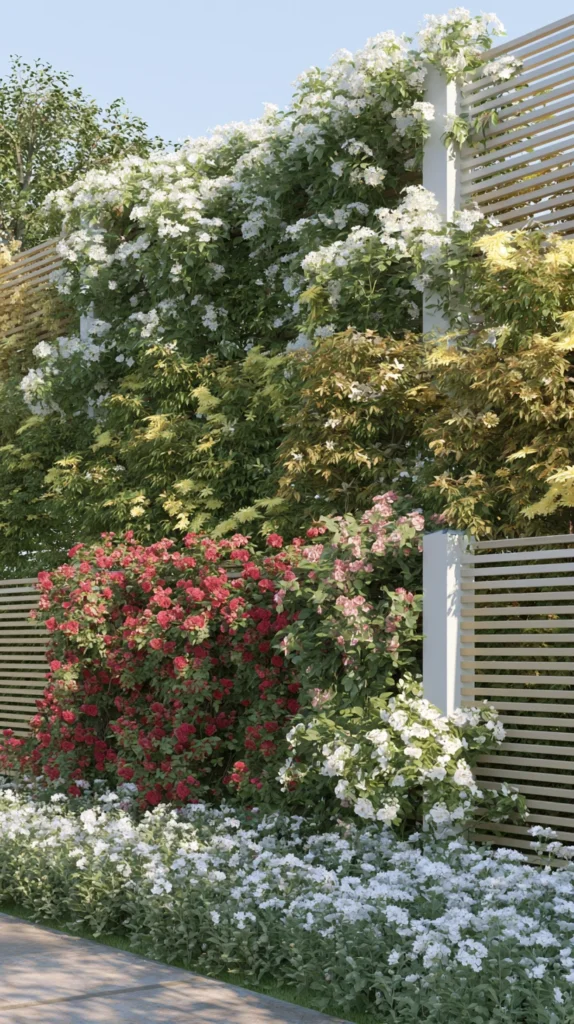
A fence planted with a sequence of climbers chosen for different flowering seasons — a clematis Montana for spring, a climbing rose for summer, a late-flowering Clematis viticella for August and September, and a Virginia creeper for autumn colour — creates the fence that provides seasonal change across the full year rather than a single period of peak performance. The mixed climber sequence is the fence treatment that rewards careful planning with the most complex and most continuously changing seasonal display.
Clematis Montana costs $10–$25. A climbing rose runs $15–$35. Clematis viticella costs $10–$20. Virginia creeper runs $8–$20. The total plant cost for a 6-metre fence of four species is $60–$200. Space the plants so each climber has 1.5–2 metres of fence to colonise — the plants will eventually merge at their margins, creating the continuous climber coverage that the fence treatment is designed to achieve.
Style tip: Plant each climber in the specific position that suits its cultural requirements. The Clematis Montana at the shaded end of the fence where the cool, moist root conditions it prefers are more likely; the climbing rose at the sunniest section where it flowers most prolifically; the Virginia creeper at the section most visible from the house where its autumn colour provides the most valuable display. The culturally correct placement produces better plants rather than a compromise performance from all of them.
5. The Bamboo Privacy Planting
Budget: $100 – $500
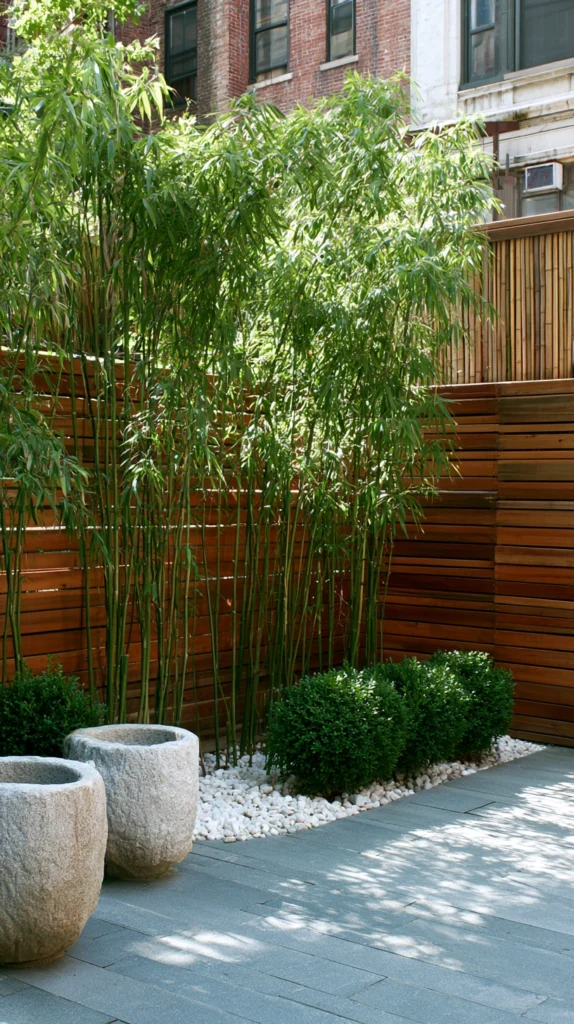
Clump-forming bamboo planted along the inside face of the fence — in a trough container to control the spread, or in a root barrier system in the border — creates a living screen of considerably more visual interest, ecological value, and acoustic absorption than the fence alone. The bamboo provides the specific privacy function at the height where the fence is insufficient — screening upper windows of adjacent properties — while creating the sound quality of moving bamboo in the lightest breeze that makes the garden acoustically distinctive.
Fargesia bamboo in a 5-litre pot costs $20–$40 each. A row of five provides immediate density — $100–$200. A 60-centimetre-deep galvanised root barrier for running species costs $8–$15 per linear metre. Specify Fargesia species for clump-forming behaviour — Phyllostachys and other running species spread aggressively and require permanent root barrier management.
Style tip: Allow the bamboo to grow slightly taller than the fence before beginning any annual maintenance trimming. The bamboo that overhangs the fence height is the bamboo that is providing the upper-level privacy from overlooking upper windows — trimming it to fence height eliminates the specific function that makes bamboo planting along a fence more valuable than the fence alone.
6. The Native Hedge Within the Fence
Budget: $30 – $200
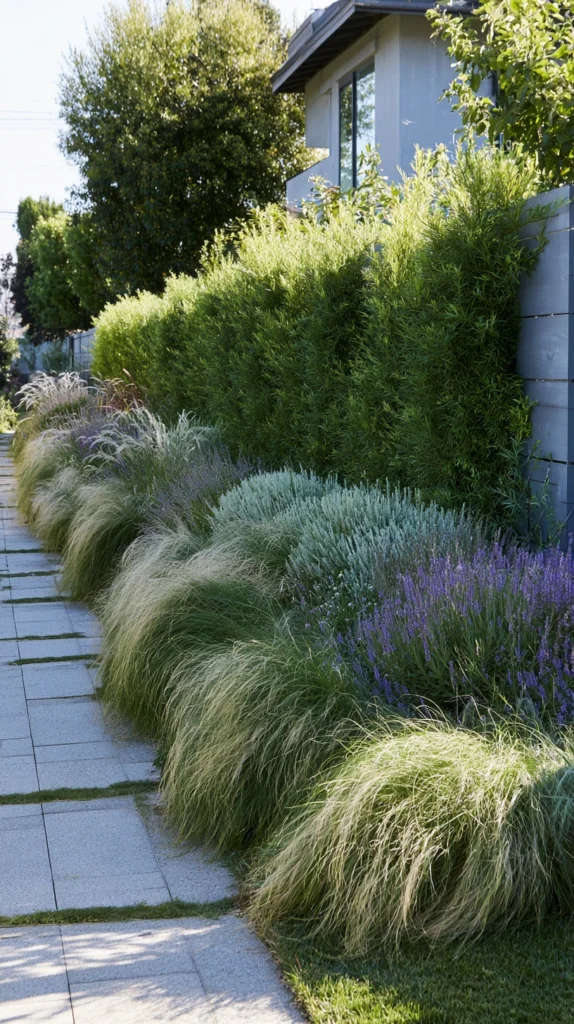
A native hedge planted immediately inside the fence — hawthorn, blackthorn, field maple, dog rose — is the fence landscaping treatment with the greatest ecological value of any approach on this list. A native hedge is a wildlife motorway: it provides nesting habitat for birds, a food source for insects, fruiting food for birds and small mammals in autumn, and the specific ecological richness of a genuinely native plant community that exotic ornamental plants, however beautiful, cannot replicate.
Native hedging plants on bare root — available in the dormant season from November to March — cost $0.50–$2 each. A 6-metre hedge at three plants per metre requires eighteen plants — $9–$36 in plant material. Bare root native hedging plants at this cost are the most economical planting available to any garden. Mulch the base of the new hedge with a 5-centimetre bark chip layer to conserve moisture and suppress weed competition during the establishing season.
Style tip: Manage the native hedge as a layered structure rather than as a clipped surface — allowing some stems to grow as standards, some as shrub-form, and maintaining the base as a dense thicket. The layered native hedge provides the maximum ecological value because each structural layer provides different habitat for different species; the clipped native hedge provides neat privacy screening with a fraction of the ecological richness.
7. The Painted Fence With Planting
Budget: $60 – $250
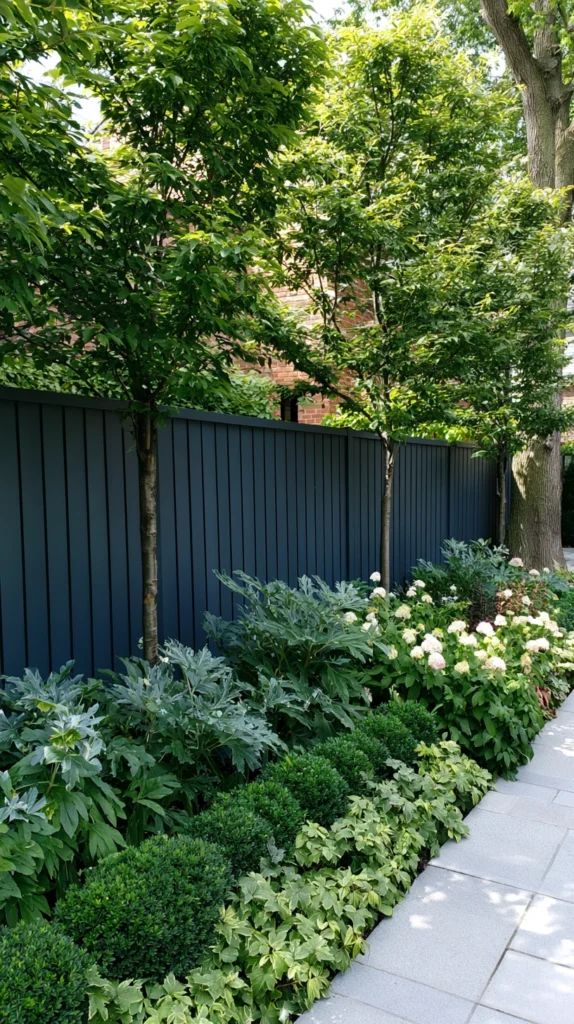
A fence painted in a specific, considered colour — charcoal, forest green, deep navy, warm black — creates the planted border backdrop that most dramatically improves the reading of every plant in the border in front of it. The painted fence is not merely a background; it is an active element of the garden’s colour composition, and the colour chosen for the fence is as important to the border’s visual quality as the colour chosen for the plants. A forest green fence makes every flower colour more vivid; a charcoal fence gives every silver and grey foliage plant its maximum visual impact.
Fence paint in quality exterior formulation costs $25–$60 per tin. A 6-metre fence run requires approximately one tin per coat. A border of 4 by 0.6 metres planted specifically for the painted fence backdrop — the plants chosen for the colour contrast they provide against the specific fence colour — costs $60–$150 in plant material.
Style tip: Paint the fence before planting the border in front of it. A fence painted with the border already in situ requires careful masking of every plant within the splash zone and produces a less complete paint application at the border edge. Painted first, the fence can receive the full and careful application that the colour quality requires, and the border planted into the backdrop of the completed painted fence allows the colour relationships to be assessed as the planting is established.
8. The Sweet Pea Annual Fence Display
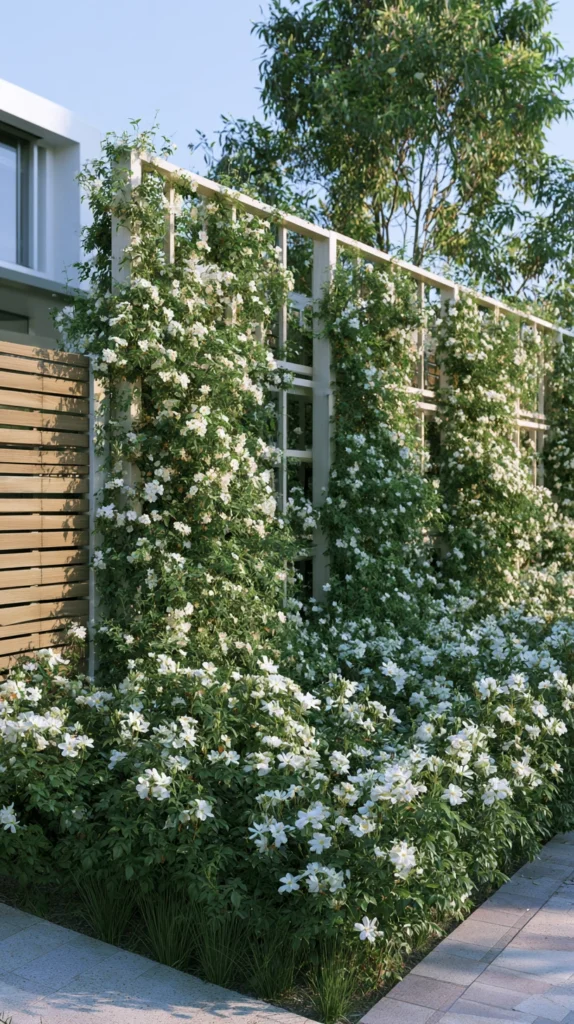
Budget: $5 – $30
Sweet peas sown at the base of the fence in March — allowed to scramble up horizontal wires or through a trellis panel fixed to the fence — create the most fragrant and most consistently beautiful of all the annual fence displays. The sweet pea fence produces its maximum display from June through to September when regularly cut — the more sweet peas are cut for the house, the more the plants produce, and a fence of sweet peas cut twice a week is flowering more prolifically in August than it was in June.
Sweet pea seeds cost $2–$4 per packet — enough for 3 metres of fence. Two packets provide the full 6-metre fence planting at a total cost of $4–$8. Supporting wires or trellis for the fence run cost $10–$20. Sow the seeds in October for the strongest plants, or in March for a standard display — the autumn-sown sweet pea produces taller, stronger plants that flower earlier and for longer than the spring-sown equivalent.
Style tip: Deadhead the sweet peas every two to three days rather than allowing seed pods to form. A sweet pea plant that has been allowed to set seed stops flowering — the production of flowers is the plant’s mechanism for achieving pollination and seed production, and once the seed is formed, the mechanism stops. A sweet pea fence that is deadheaded consistently in June continues to produce flowers in September; one allowed to set seed in June is finished by August.
9. The Herb Border Fence
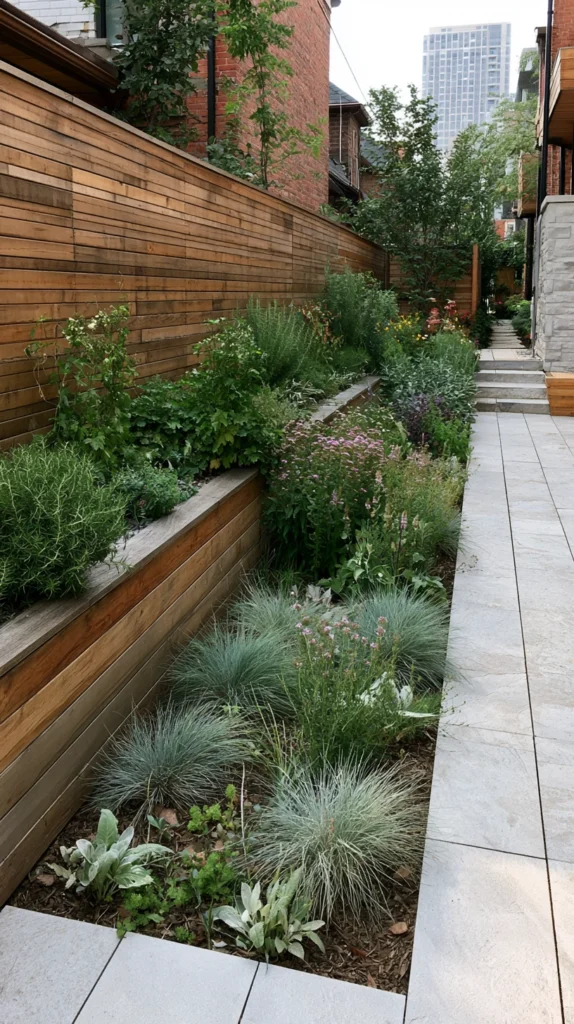
Budget: $30 – $150
A herb border along the base of the fence — planted with rosemary, sage, thyme, oregano, lemon verbena, and fennel — creates the fence landscaping that is most directly useful to the daily life of the household rather than merely beautiful to observe. The herb border communicates that the garden is genuinely productive, that the cooking of the household is connected to the growing of the garden, and it provides the most intense fragrance of any fence planting in warm weather when the herbs are touched or when the sun heats the volatile oils in the foliage.
Herb plants cost $2–$5 each. A 6-metre herb border with seven species at two plants each requires fourteen plants — $28–$70. A well-drained soil in full sun produces the most intensely fragrant and the most productive herb border — Mediterranean herbs in poorly drained soil produce weak growth and poor fragrance regardless of how well they were established.
Style tip: Plant the tallest herbs — fennel, rosemary, lemon verbena — at the back against the fence and the lowest — thyme, oregano — at the front border edge. The height graduation gives the herb border the visual structure of a designed planting rather than a collection of herbs placed wherever they fitted, and the taller herbs against the fence provide the soft screening of the fence face that the low front herbs cannot achieve.
10. The Ivy and Evergreen Ground Cover Fence
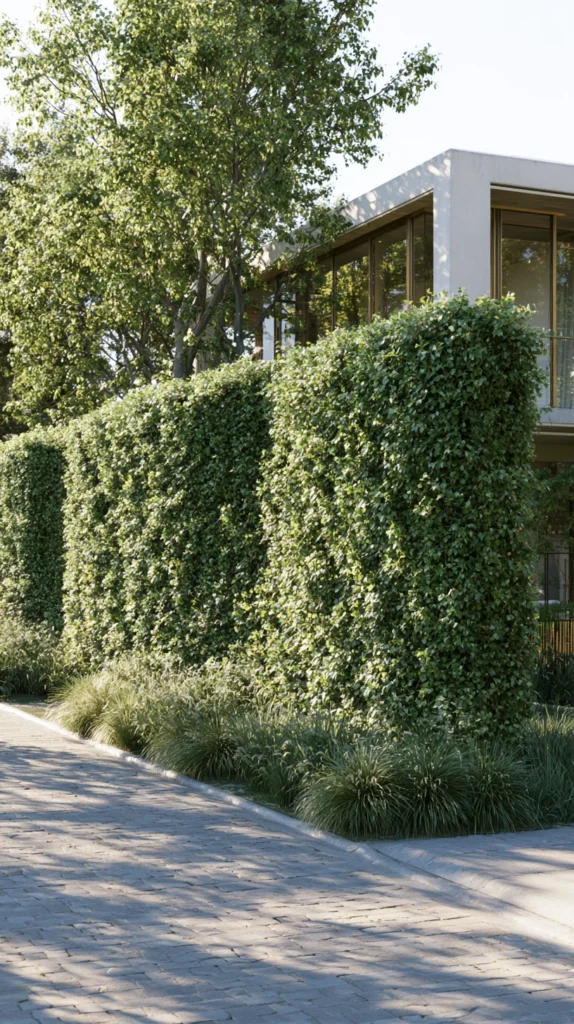
Budget: $20 – $100
Ivy trained up the fence from a ground cover planting — Hedera helix in a self-clinging form, allowed to colonise the fence surface from the base upward — creates the most maintenance-free and the most wildlife-rich of all the fence coverings. A fully established ivy fence is home to nesting birds, feeding insects, overwintering butterflies, and the specific community of invertebrates that evergreen climbing cover consistently supports. It provides year-round privacy, year-round green, and the specific acoustic absorption of dense vegetation that no fence material can match.
Ivy plants in a 9-centimetre pot cost $3–$6 each. A 6-metre fence at one plant per metre requires six plants — $18–$36. Ivy requires no training wires or trellis — its aerial rootlets attach directly to timber, brick, and rendered surfaces. The ivy fence requires one management action per year — cutting back the ivy from windows, gutters, and the fence top — and nothing more.
Style tip: Choose a variegated ivy variety for the fence rather than the standard green Hedera helix. A variegated ivy — Hedera helix Glacier or Hedera colchica Sulphur Heart — provides the same ecological value as the plain green species while producing a fence covering of considerably more visual interest. The cream and grey-green variegation reflects light and gives the fence covering a luminous quality that plain green ivy lacks.
11. The Pleached Tree Line Against the Fence
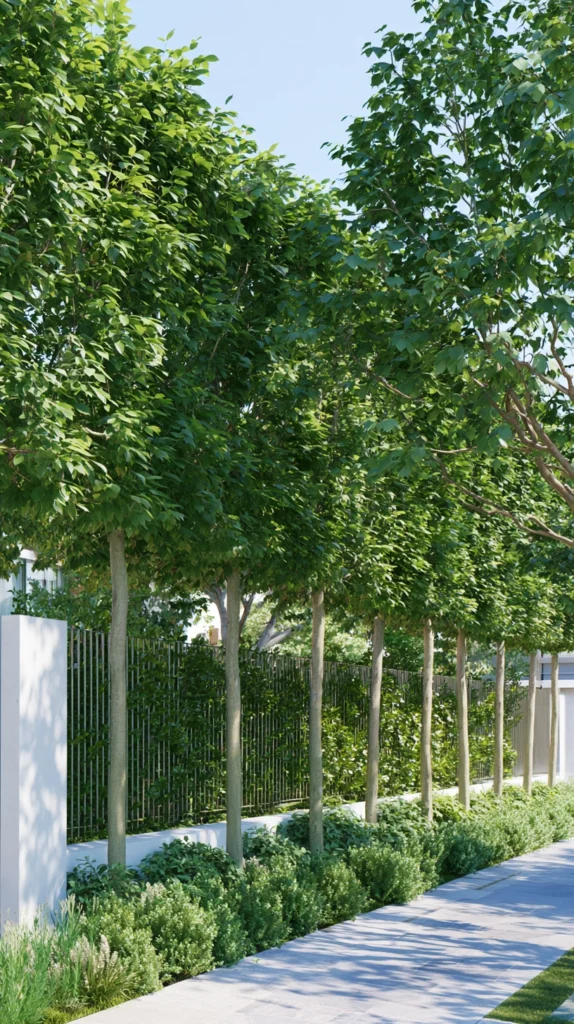
Budget: $400 – $2,000
Pleached trees planted at intervals along the inside face of the fence — hornbeam, lime, or beech, with their canopies trained flat and horizontal at fence-top height — create a raised privacy screen above the fence that provides the upper-level screening that the fence below cannot achieve, while the clear trunks below preserve the garden openness at eye level. The pleached line is the fence landscaping treatment that addresses the most common backyard privacy problem — overlooking from upper-floor windows of adjacent properties — with the most specifically designed and most visually beautiful solution.
Pleached hornbeam trees cost $80–$200 each. A row of five along a 6-metre fence run costs $400–$1,000 in plant material plus $100–$300 in supporting stakes and ties. The pleached trees require annual maintenance — tying in new growth to the horizontal framework in late summer, clipping the flat canopy once per year — that takes twenty minutes per tree.
Style tip: Plant the pleached trees at a spacing of 1.5 metres rather than the 2-metre spacing that most nursery advice recommends. The closer spacing achieves the continuous screen of foliage that makes the pleached line effective as a privacy treatment within the first growing season; the wider spacing leaves visible gaps for two to three seasons while the canopies grow together. The additional plant cost of the closer spacing is modest relative to the years of earlier privacy it produces.
12. The Trellis Extension With Jasmine
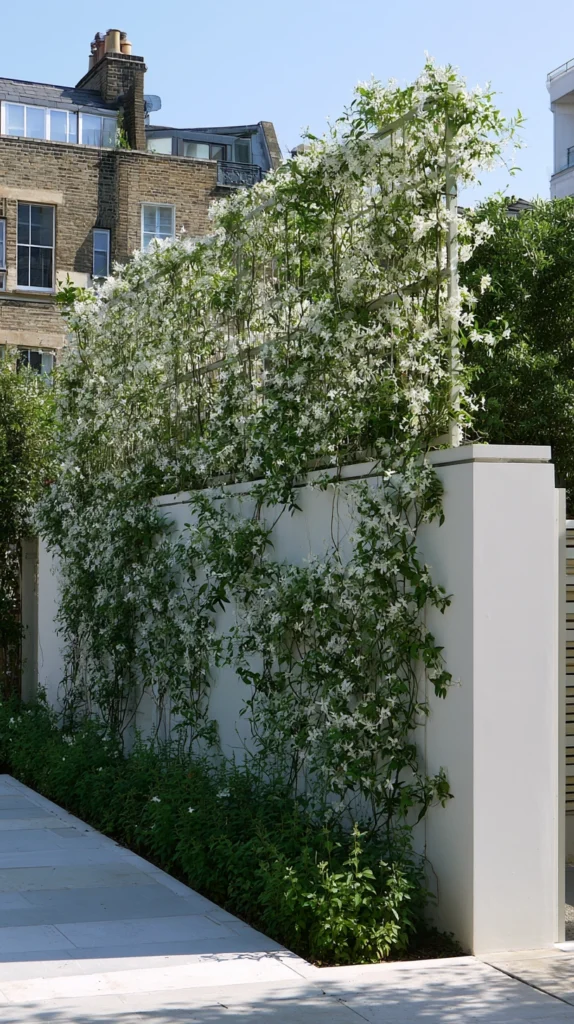
Budget: $50 – $200
A trellis panel fixed to the top of an existing fence — extending the total height by 30–60 centimetres — with a jasmine trained across it creates one of the most fragrant and most immediately effective fence height extensions available. Star jasmine or common jasmine trained across a trellis extension provides dense, evergreen or semi-evergreen coverage, white flowers of extraordinary fragrance in June and July, and the specific quality of a fence boundary that softens at its upper edge into planting rather than terminating in a hard horizontal line.
Trellis panels of 30 by 180 centimetres cost $8–$20 each. Star jasmine in a 2-litre pot costs $10–$20. Common jasmine runs $8–$15. A 6-metre fence with a trellis extension and three jasmine plants costs $60–$150 in total. The jasmine fragrance is released most intensely on warm evenings and in still air — a fence planted with jasmine that faces the primary outdoor seating area provides the fragrance in exactly the position where it is most appreciated.
Style tip: Fix the trellis extension to the fence post faces rather than to the fence board tops. A trellis fixed to the post face transfers its wind loading to the post structure; one fixed to the fence board tops transfers loading to the board edges, which are the weakest part of the fence assembly. The post-fixed trellis extension is more stable and more durable than the board-top-fixed version.
13. The Ornamental Grass Border
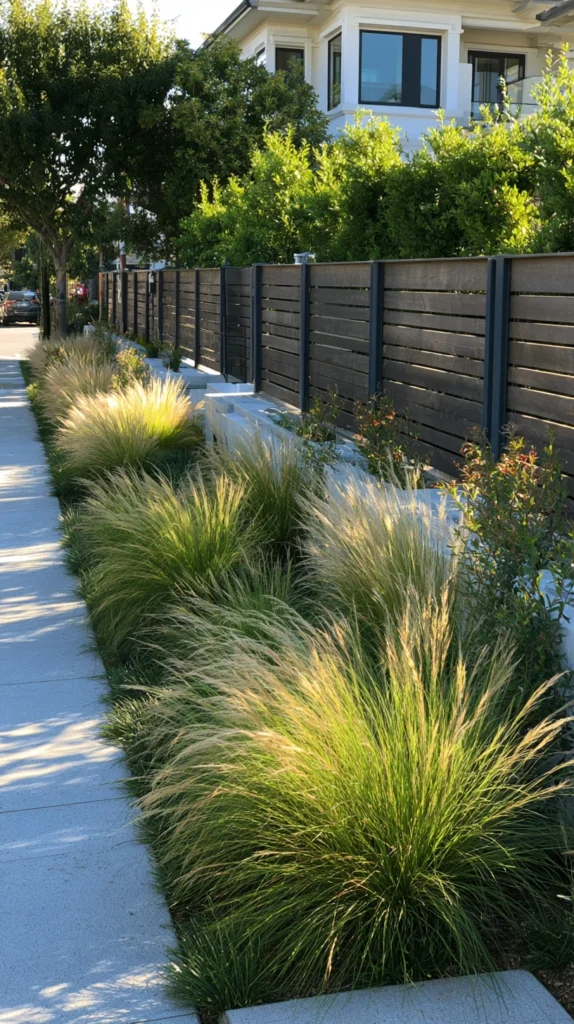
Budget: $60 – $250
A border of ornamental grasses along the fence base — Miscanthus, Pennisetum, Calamagrostis, or Stipa in a single species drift — creates the most movement and the most specifically seasonal of all the fence border treatments. Ornamental grasses are at their best in the second half of the year: their seed heads emerging in July and developing through August and September before the winter light gives the bleached, skeletal form its specific graphic quality against the fence behind. The ornamental grass border rewards being looked at most completely at the time of year when most other plants are declining.
Ornamental grass plants in a 2-litre pot cost $8–$20 each. A drift of five for a standard fence section costs $40–$100. A 6-metre ornamental grass border of one species in drifts of five costs $120–$300 in total. Leave the grasses standing through the winter rather than cutting them back in autumn — the winter form of the ornamental grass is as beautiful as its summer form, and the cut-back grass loses the specific skeletal quality that winter light produces in the standing stem.
Style tip: Plant ornamental grasses at the correct spacing for their mature size — the planting label’s stated width rather than the gap that produces the quickest coverage. An ornamental grass at the correct spacing develops into a full, complete clump that reads as a plant at its designed scale; one planted too closely becomes congested within three seasons, loses its form, and requires lifting and dividing at exactly the moment when the border was becoming established.
14. The Wisteria Trained Fence
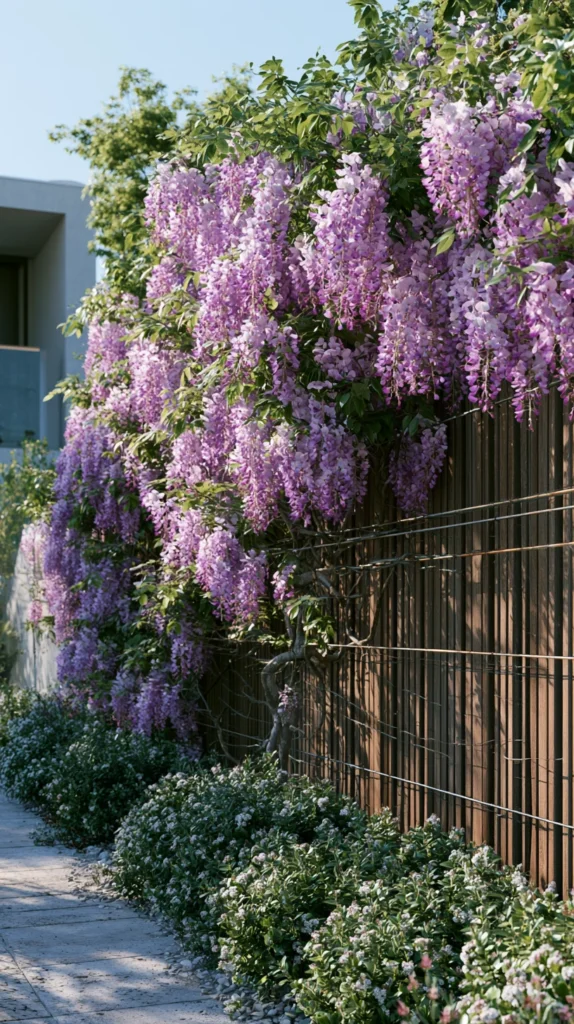
Budget: $40 – $200
Wisteria trained along horizontal wires on a south or west-facing fence — the long, vigorous stems tied annually to the wire framework, the flowering spurs developed through the summer pruning of new growth — creates the fence that is most spectacular in flower of any climber in temperate gardening. A mature wisteria fence in May, with the flower racemes hanging in dense cascades of purple-blue or white from the horizontal framework, is one of the genuinely beautiful seasonal experiences available to any garden, and the twenty minutes of summer pruning each year that produces this display is the best investment of maintenance time in the garden.
A wisteria in a 3-litre pot costs $15–$40. Horizontal wires at 30-centimetre intervals cost $10–$20. A wisteria requires patience — most plants take three to five years from planting to their first significant flowering display — and the summer pruning that produces the flowering spur system must be established from the first growing season regardless of whether the plant is flowering or not.
Style tip: Prune the wisteria twice each year rather than once — once in July or August, cutting all new growth back to five or six leaves from the base, and again in January or February, cutting the same growth back further to two or three buds. The twice-yearly pruning produces the dense flowering spur system that a once-yearly pruning never achieves, and the quality of the May flowering display is directly proportional to the consistency and the timing of the two-cut pruning system.
15. The Mixed Seasonal Border Against the Fence
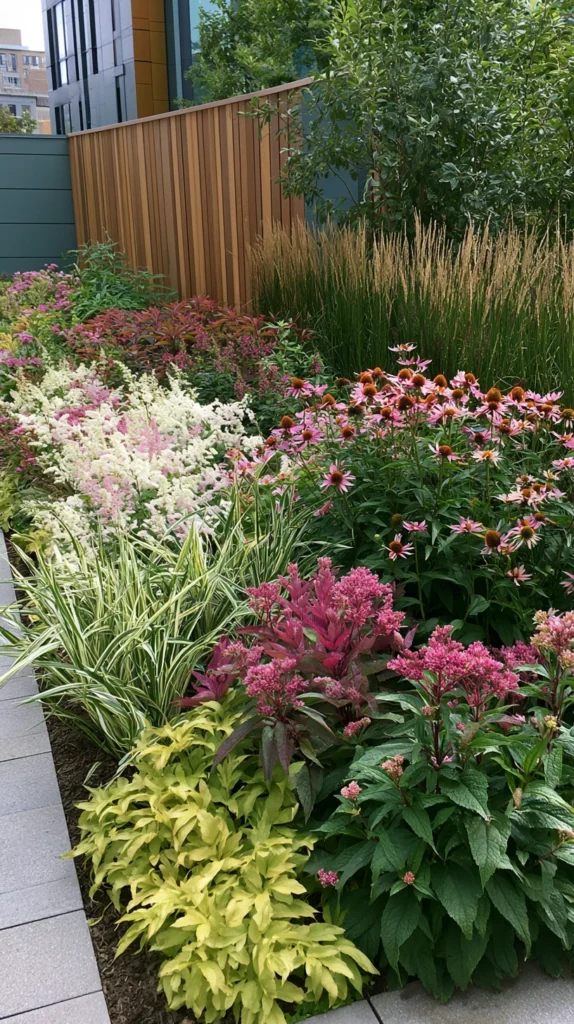
Budget: $100 – $500
A mixed border planted in front of the fence — with structural evergreen shrubs, spring bulbs, summer perennials, autumn-interest grasses, and winter structural plants in a layered arrangement — creates the most complete and most specifically garden-quality fence landscaping available. The mixed seasonal border treats the fence as the backdrop of a designed planting rather than as the end of the garden, and the fence painted in the correct colour is as much a part of the border’s composition as the plants in front of it.
Structural evergreen shrubs cost $15–$40 each. Spring bulbs run $0.30–$1 each. Summer perennials cost $6–$15 each. Ornamental grasses for autumn interest run $8–$20 each. A complete mixed border of 4 by 1.2 metres costs $200–$500 in plant material. Design the border for year-round interest rather than for a single season — the border visible from the house is visible in every month and deserves planting that provides something worth observing in each.
Style tip: Mulch the mixed border annually with a 5-centimetre bark chip layer in late autumn or early spring. The annual mulch reduces water loss from the soil surface, suppresses weed competition, improves soil structure as it decomposes, and gives the border the neat, maintained appearance that bare soil in a planted border consistently lacks. The mulch application takes thirty minutes for a standard border and produces visible improvement to the border’s quality at every level simultaneously.
The fence that has been landscaped well is the fence that has been forgotten — absorbed into the garden’s identity so completely that it communicates the quality of being a designed garden rather than the quality of being a fenced one.
The climbing rose that covers the fence panels, the lavender that softens the base, the trellis that extends the height into fragrant jasmine — these are the interventions that convert the fence from the boundary of the garden into a part of it, and the part of it that provides the greatest return on the investment of planting and attention that the fence landscape requires.
Begin with the fence colour. Paint it before planting anything in front of or on it, and choose the colour for the specific plants that will grow against it. Then plant the base border, then the climbers, then the height extensions — in the sequence that establishes the permanent elements before the variable ones, and builds the fence landscape as an incrementally considered garden feature rather than an incrementally improved boundary.