14 Relaxing Backyard Water Feature Ideas for a Calm Vibe
14 Relaxing Backyard Water Feature Ideas for a Calm Vibe
There is a quality that water brings to a garden that no planted border, no sculpture, no lighting scheme, and no piece of outdoor furniture can replicate. It is the quality of continuous, undemanding presence — the sound of water moving or falling or simply being still and reflective, present at every moment without requiring attention or producing the feeling of anything being demanded of the person nearby.
It is the quality of genuine rest, and it is available to any garden at almost any budget through the specific and irreplaceable contribution of water in the outdoor space.
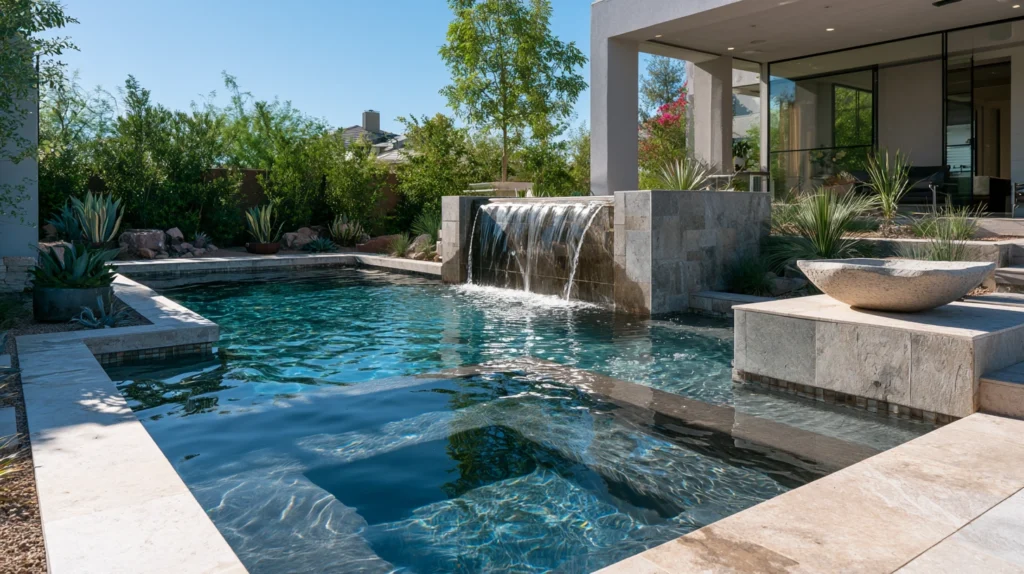
Water in the garden is not decorative in the conventional sense. It does not beautify the garden in the way that a planted border or a piece of sculpture beautifies it. It changes the quality of the experience of being in the garden — the acoustic environment, the visual depth, the specific quality of the air near moving water that is measurably more pleasant to breathe.
These are the qualities that make the garden with a water feature genuinely more calming than the garden without one, and they are worth designing for with the same intention that any other element of the garden receives.
Each idea below is a specific approach to one type of relaxing backyard water feature. Each includes what you will need, what it will cost, and a practical tip to make the whole thing work as well as the calm, restorative garden it is designed to support.
1. The Still Reflecting Pool
Budget: $150 – $1,000
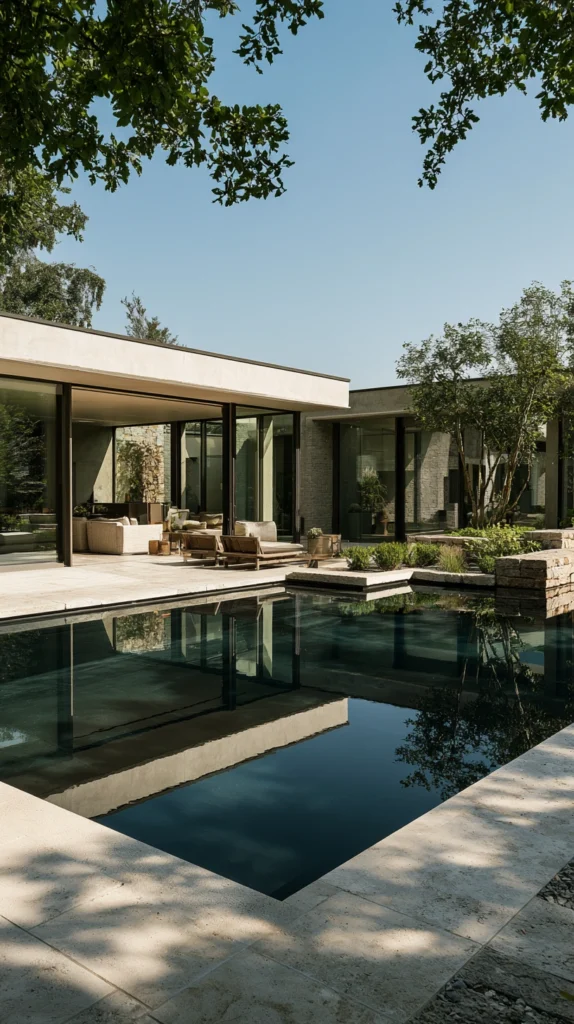
A still pool — with no moving water, no pump, no fountain — creates the most serene and most specifically meditative of all water feature types through the single quality of perfect reflection. A still pool reflects the sky, the surrounding planting, and the quality of the light at every hour of the day in a way that changes continuously and that rewards the sustained attention of the person sitting beside it. The still pool is the water feature of the Japanese garden tradition for exactly this reason — it is not the spectacle of water but the contemplation of it.
A preformed fibreglass pool in a formal rectangular shape costs $150–$400. A liner-based pool of 1.5 by 1 metres costs $60–$150 in liner and edging materials. Paint or line the pool interior in black or very dark blue rather than the standard pale blue of conventional water features — the dark surface produces the mirror quality that pale surfaces absorb rather than reflect. No pump, no planting, no fish — the still pool requires only stillness, and stillness requires nothing beyond the decision to leave the water alone.
Style tip: Position the still pool where it reflects the most interesting element of the garden’s sky view — the morning light from the east, the evening sky from the west, the silhouette of a significant tree against the sky. A pool that reflects the sky of the hour when the garden is most used is a pool that is performing at its maximum quality at exactly the moment it is most observed.
2. The Naturalistic Wildlife Pond
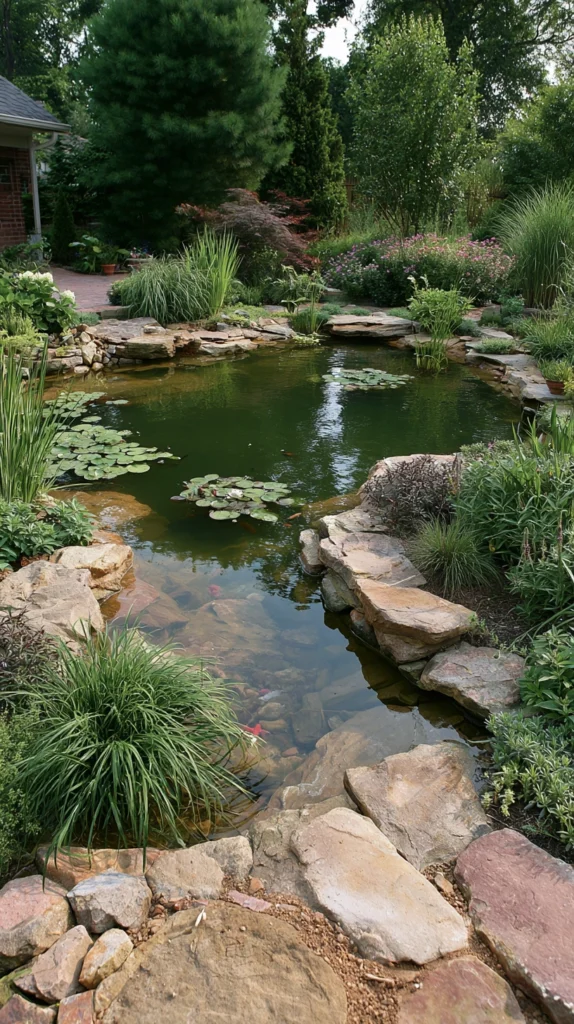
Budget: $100 – $600
A wildlife pond — informally shaped, with shallow margins for wildlife access, planted with native aquatic species, positioned in partial sun — is the most ecologically valuable and most genuinely alive of all the water feature types. The wildlife pond does not merely reflect the sky or produce a pleasing sound — it creates a living community. Frogs, newts, dragonflies, water beetles, and birds arrive within weeks of the water being filled, and the ongoing life of the pond community provides a quality of continuous, changing, genuinely natural interest that no mechanical water feature can replicate.
A flexible pond liner for a 2 by 1.5-metre pond costs $30–$80. Native aquatic plants — marsh marigold, water mint, water iris, oxygenating hornwort — cost $5–$12 each. A pond of this size requires five to eight plants — $25–$96 in native planting. No pump is required for a wildlife pond — the biological balance of native planting and wildlife maintains the water clarity without mechanical filtration.
Style tip: Create at least one genuinely shallow area — 5–10 centimetres of water depth — at one end of the wildlife pond. This shallow zone allows birds to bathe, small mammals and hedgehogs to drink safely, and amphibians to enter and exit the pond without the risk of the vertical pond wall that deeper water beside a steep edge creates. The shallow zone is the specific design detail that makes the pond genuinely wildlife-accessible rather than wildlife-adjacent.
3. The Millstone Fountain
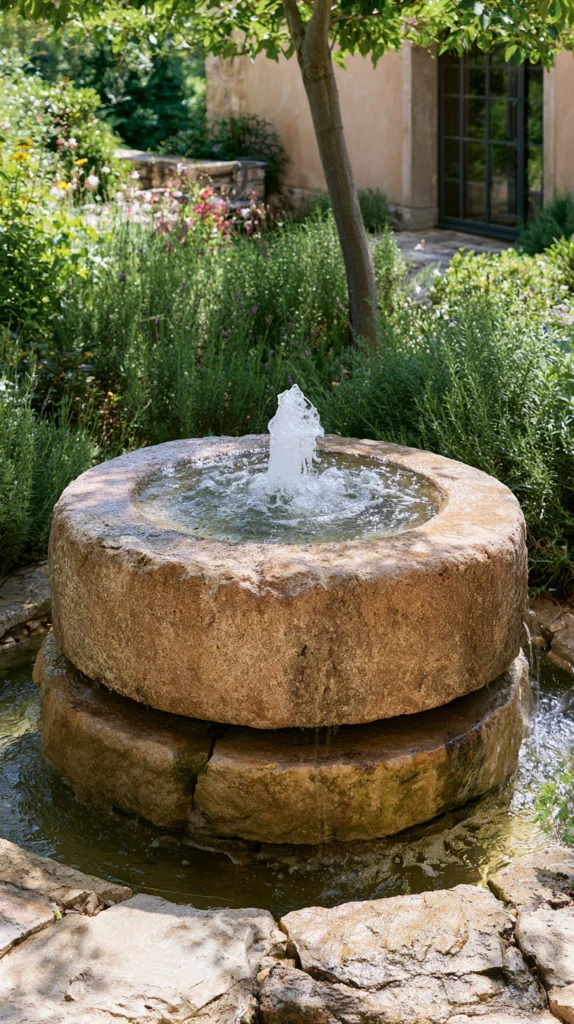
Budget: $100 – $500
A millstone fountain — a genuine reclaimed millstone or a high-quality reconstituted version, with water welling up through the central hole and flowing across the textured surface before draining into a hidden reservoir below — provides the most visually grounded and most tactilely satisfying of all the self-contained fountain formats. The millstone sits at patio level, requires no raised structure, and produces a sound of water that is specifically the sound of water flowing across stone — a sound with its own quality of age and material honesty.
A reclaimed millstone costs $100–$300. A reconstituted stone version runs $80–$200. A complete millstone fountain kit — reservoir, pump, and connections — costs $100–$300. Level the reservoir box in the ground before installing — a millstone that tilts even fractionally produces an uneven flow that concentrates water on one side and leaves the other dry, reducing both the visual and the acoustic quality of the feature.
Style tip: Plant moisture-tolerant ground cover immediately around the base of the millstone — creeping jenny, mind-your-own-business, or baby tears — and allow it to grow gradually into the surrounding area. The planted millstone base gives the feature the quality of something that has been in the garden long enough for the planting to have grown around it, which is the quality that makes a water feature feel genuinely part of the garden rather than recently placed in it.
4. The Recirculating Stream
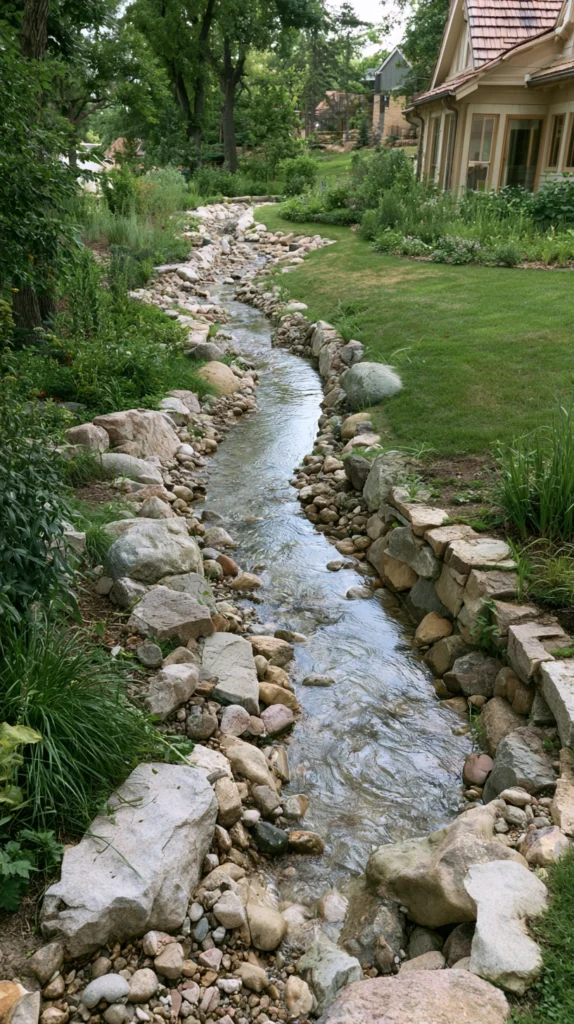
Budget: $200 – $1,500
A recirculating stream — a naturalistic channel of water that flows from an upper reservoir through a planted and stoned watercourse to a lower pond, where a pump returns the water to the upper reservoir — creates the most complete and most immersive of all the garden water experiences. A stream provides the sound of moving water across its full length, creates multiple ecological habitats at different water depths and flow speeds, and gives the garden the quality of a landscape that has a watercourse running through it rather than a water feature installed beside a border.
A recirculating stream of 4 metres in length costs $150–$400 in liner, pump, and stone. Native planting alongside the stream costs $40–$120. A cascade pump rated for the length and the head height of the stream costs $30–$100. Build the stream channel with a slight gradient of 2–3 centimetres of fall per metre of run — sufficient to produce a visible and audible flow without the excessive speed that erodes the stream banks and disturbs the planted margins.
Style tip: Plant the stream banks asymmetrically — dense planting on one side and more open planting on the other — rather than with identical planting on each bank. An asymmetrically planted stream reads as naturally evolved; identically planted banks read as deliberately installed. The asymmetry communicates the naturalistic quality of the water feature rather than the designed quality of a garden installation.
5. The Zen Dry River Bed
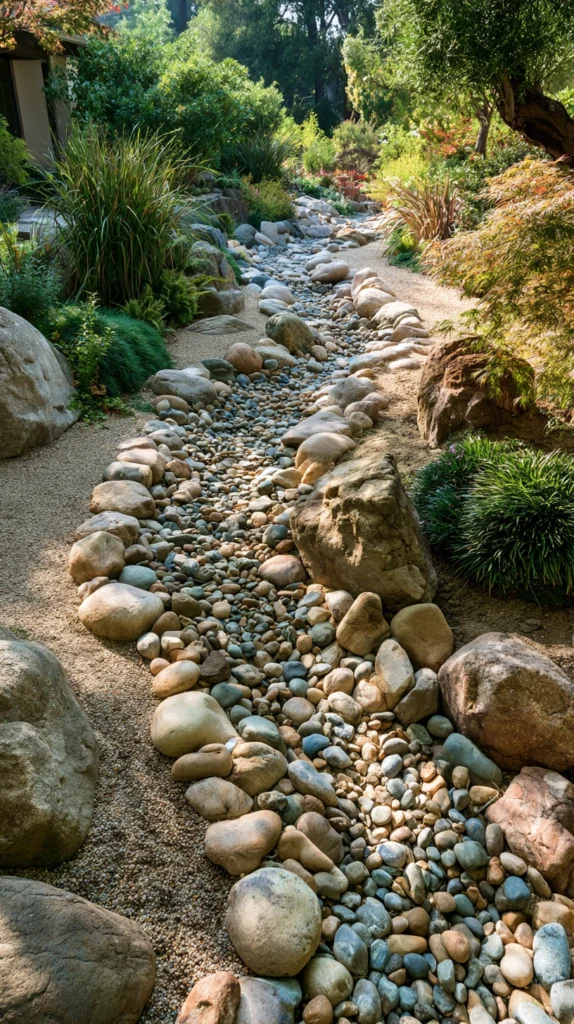
Budget: $80 – $400
A dry river bed — a channel of smooth pebbles and river stones that suggests the presence and the path of water without containing any — creates the most specifically meditative of all the garden water references. The dry river bed is the Japanese garden’s representation of water in stone, and it communicates the quality of a watercourse — the direction of flow, the sorting of stone from large to small, the specific beauty of water-worn material — without the management requirements of an actual water feature.
Fine granite gravel or pale pebbles for the dry stream bed cost $10–$20 per bag. Smooth river cobbles of 5–15 centimetres cost $8–$15 per kilogram. Flat stepping stones across the stream cost $5–$15 each. A weed-suppressing membrane beneath the stone prevents the management problem of weeds growing through the carefully arranged stone surface and disturbing the specific patterning that gives the dry river bed its quality of representation.
Style tip: Rake the fine gravel of the dry river bed in the direction of flow — parallel lines suggesting laminar movement in the straight sections, curved lines suggesting the movement of water around larger stones at the bends. The raking pattern is the expressive element of the dry river bed and should be refreshed after rain or wind disturbs the surface. A raked dry river bed communicates the Japanese garden tradition of representation; an unraked one communicates a gravel area with some stones in it.
6. The Wall-Mounted Water Blade
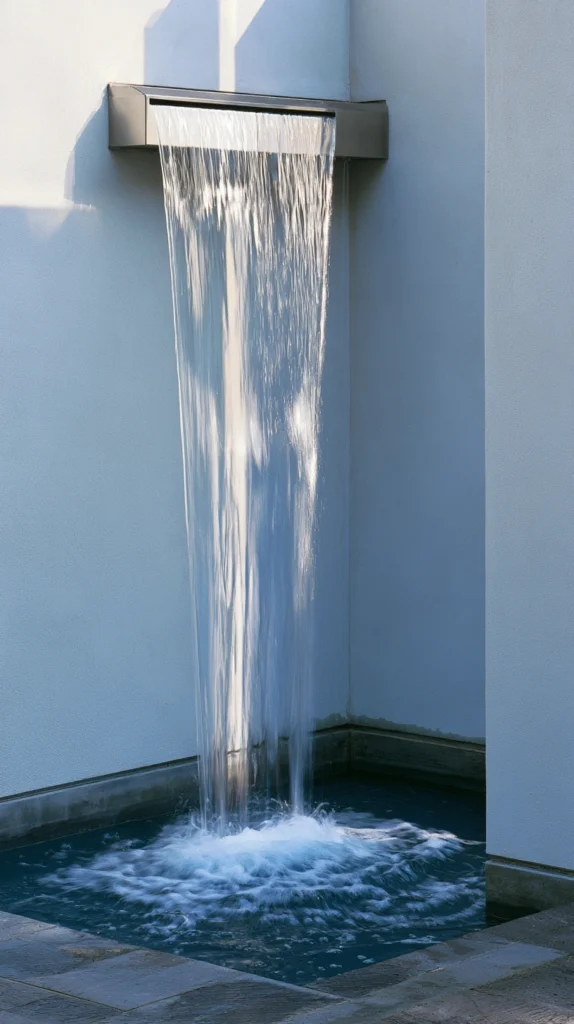
Budget: $150 – $600
A water blade — a sheet of water falling from a wall-mounted stainless steel or copper slot, dropping into a trough or pool below, and recirculating continuously — produces the most dramatically visual and the most specifically contemporary of all the water feature effects. The water blade is a curtain of water in the most literal sense — a continuous, slightly luminous sheet that catches the light at every angle and produces a specific sound that is neither the trickle of a fountain nor the rush of a waterfall but something between the two.
A stainless steel water blade of 60 centimetres in width costs $80–$200. A copper version runs $100–$300. A receiving trough below the blade costs $60–$150. A circulation pump to return water from the trough to the blade costs $30–$80. The water blade requires a wall mounting that is structurally capable of supporting the water weight and the pump mechanism — a hollow wall or a lightweight fence is inadequate; solid masonry or a purpose-built framework is the correct mounting substrate.
Style tip: Light the water blade from below the receiving trough with a submersible LED uplight — the upward light through the falling water sheet produces the most visually spectacular of all the water blade effects, and the warmth of the light colour communicates warmth from the water feature that the daytime version alone cannot achieve. The lit water blade at dusk is categorically different from the same feature in daylight.
7. The Bubble Jet Fountain
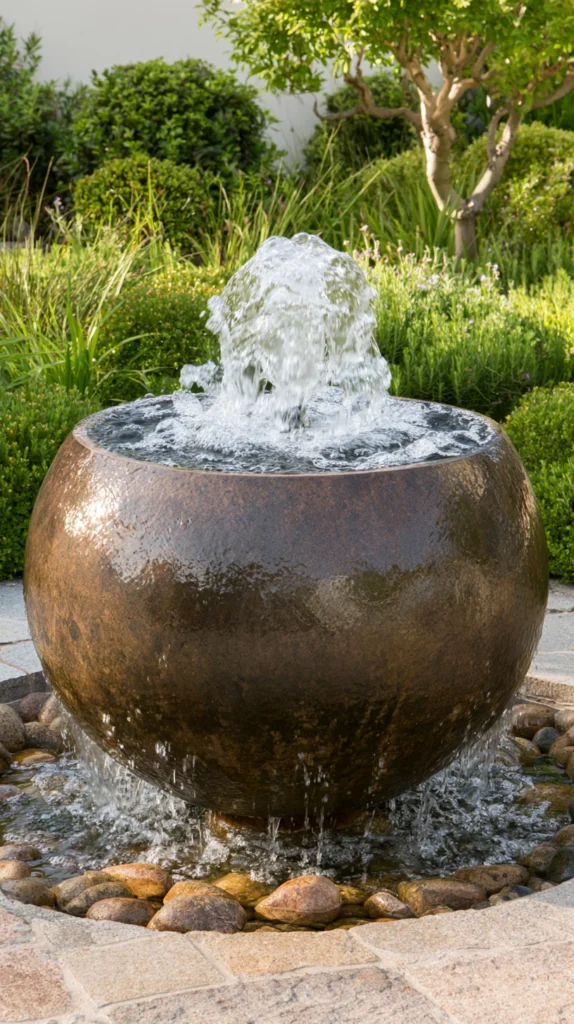
Budget: $80 – $350
A bubble jet fountain — water welling upward from a sealed reservoir through a stone, ceramic, or metal surface, tumbling quietly over the feature and returning to the reservoir below — is the safest, the most compact, and the most placement-flexible of all the self-contained water features. It requires no open water, presents no hazard to children or pets, needs no specialist installation, and can be positioned anywhere a standard outdoor electrical socket can supply a pump — which is virtually any position in any garden.
A complete bubble jet fountain kit in granite or slate costs $80–$200. A ceramic pot fountain runs $100–$300. A stainless steel sphere fountain costs $100–$350. Position on a level, firm surface in partial shade — a bubble fountain in full afternoon sun loses water to evaporation at a rate that requires daily topping-up; one in partial shade requires only weekly attention.
Style tip: Surround the reservoir base with a bed of the same stone type as the feature surface — river pebbles around a river pebble fountain, slate chips around a slate feature — so the installed water feature reads as a material moment of the garden rather than as an object placed on the garden surface. The material continuity between the feature and its immediate surroundings is the installation detail that most determines whether the fountain looks designed or delivered.
8. The Swimming Pond
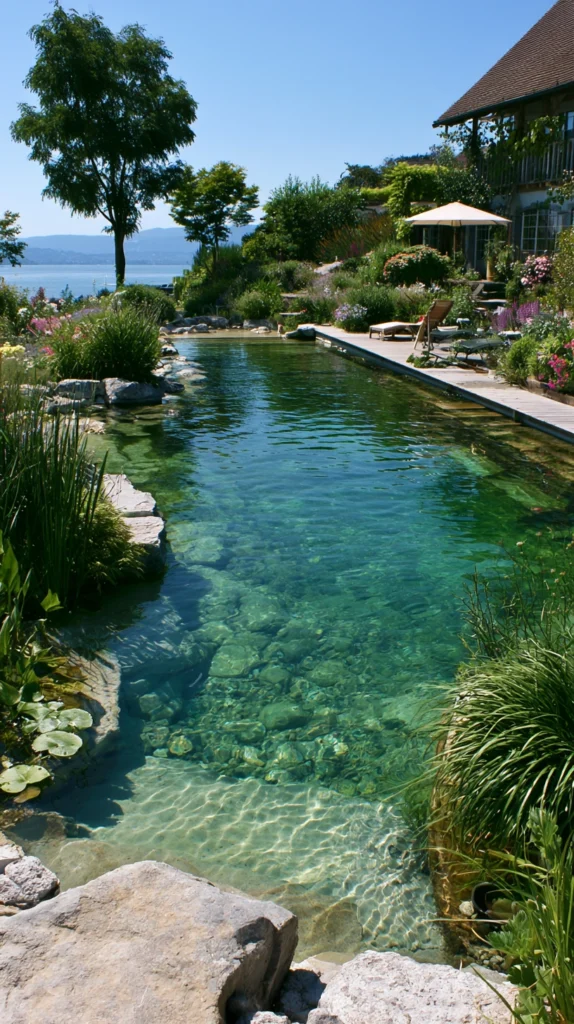
Budget: $5,000 – $30,000
A natural swimming pond — a pool for human bathing with an adjacent regeneration zone of aquatic planting that filters the water biologically rather than chemically — is the most complete and most comprehensively calming of all the backyard water features. The swimming pond is not merely looked at or listened to; it is entered, and the specific quality of swimming in naturally filtered water beside living planting, surrounded by the garden rather than the interior of a concrete tank, is one of the most genuinely restorative experiences available to the domestic garden.
A basic swimming pond of 40 square metres costs $8,000–$20,000 installed by a specialist. The water clarity in a correctly planted swimming pond improves every season as the regeneration zone planting matures — a three-year-old swimming pond is typically clearer and more balanced than a one-year-old one.
Style tip: Position the regeneration planting zone on the south-facing side of the swimming pond so the sun promotes the aquatic plant growth that powers the biological filtration. The regeneration zone that receives maximum sunlight grows more densely and filters more effectively than one positioned in partial shade, and the improved filtration produces the water clarity that the swimming pond’s quality of use depends on.
9. The Raised Formal Pool
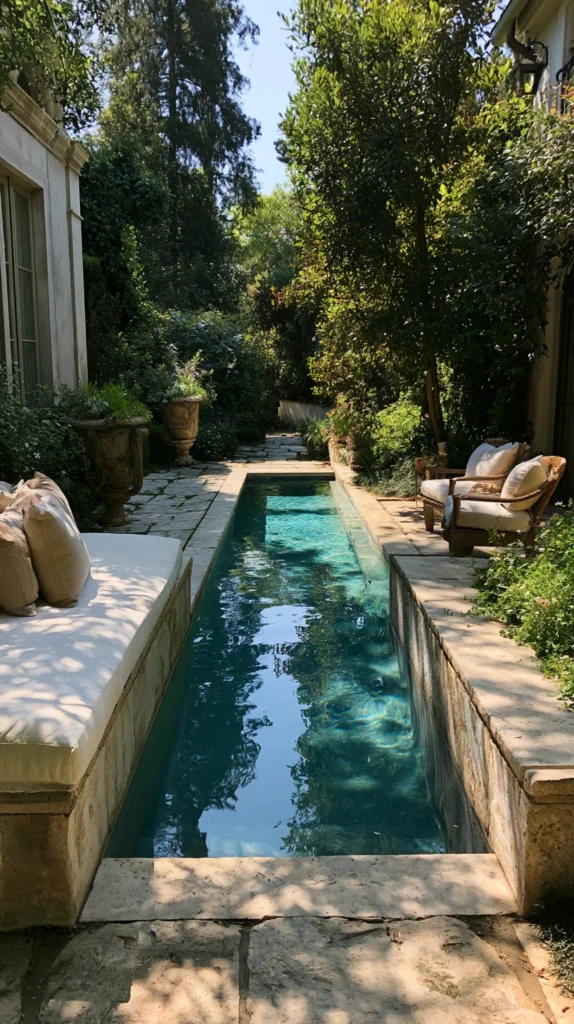
Budget: $300 – $2,000
A raised formal pool — constructed from brick, stone, or rendered concrete, elevated 40–60 centimetres above the surrounding ground or patio level, with a coping stone wide enough to sit on — combines the calming quality of still water with the useful function of garden seating. The raised pool is the water feature that earns its position twice: visually as a formal garden element, and physically as the seat from which the garden is most intimately observed at the water’s edge.
A rendered block raised pool of 1.5 by 1 metres costs $300–$800 in materials and basic construction. A stone-faced version runs $500–$1,500. A submersible pump for a gentle bubble or fountain element costs $30–$80. The coping stone should be in a smooth, comfortable material — polished granite, smooth limestone, or a quality buff sandstone — rather than the rough-textured stone that is uncomfortable to sit on for any extended period.
Style tip: Plant the raised pool with one or two water lilies rather than filling it with multiple aquatic species. A raised formal pool with a single water lily in flower — the clean geometry of the open bloom on the still water surface — is one of the most specifically beautiful garden compositions available at any scale. Multiple aquatic species in a small formal pool produce a planted aquarium quality rather than the composed simplicity that the raised formal pool is specifically suited to.
10. The Rain Chain Feature
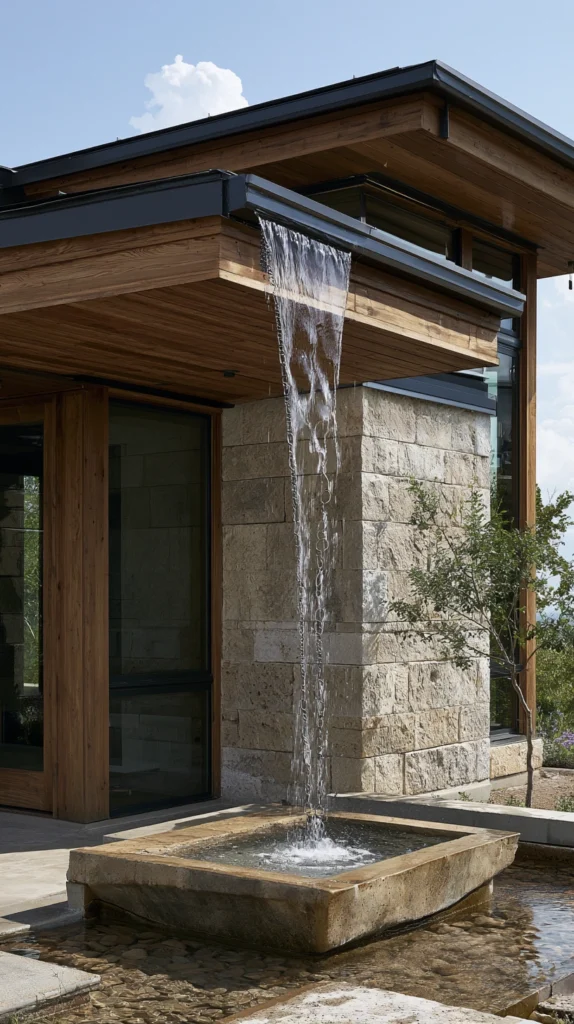
Budget: $30 – $150
A rain chain — a length of linked cups, rings, or decorative elements that replaces a conventional downpipe, guiding rainwater visibly and audibly from the roof gutter to a collection vessel or a garden bed below — creates a water feature that is active only when it rains and that is specifically beautiful in the weather condition most garden features are designed to survive rather than to celebrate. The rain chain transforms the sound of rain on the roof from ambient background noise into a specific and specifically beautiful water sound at garden level.
A copper or aluminium rain chain of 2 metres in length costs $25–$80. A stone or ceramic collection vessel below the rain chain runs $20–$60. The rain chain requires a gutter outlet of the correct diameter for the chain’s hanging fitting — standard gutter outlets of 68–75 millimetres accommodate most rain chain hanging brackets without modification.
Style tip: Position the collection vessel below the rain chain so it slightly overflows in heavy rain — the overflow visible at the vessel edge and the sound of the overflow hitting the surrounding pebble bed add an additional water element to the rain chain’s performance. The slightly undersized vessel that overflows in moderate rain creates a more complete rain feature than the correctly sized vessel that contains all the water without overflow.
11. The Bog Garden Water Feature
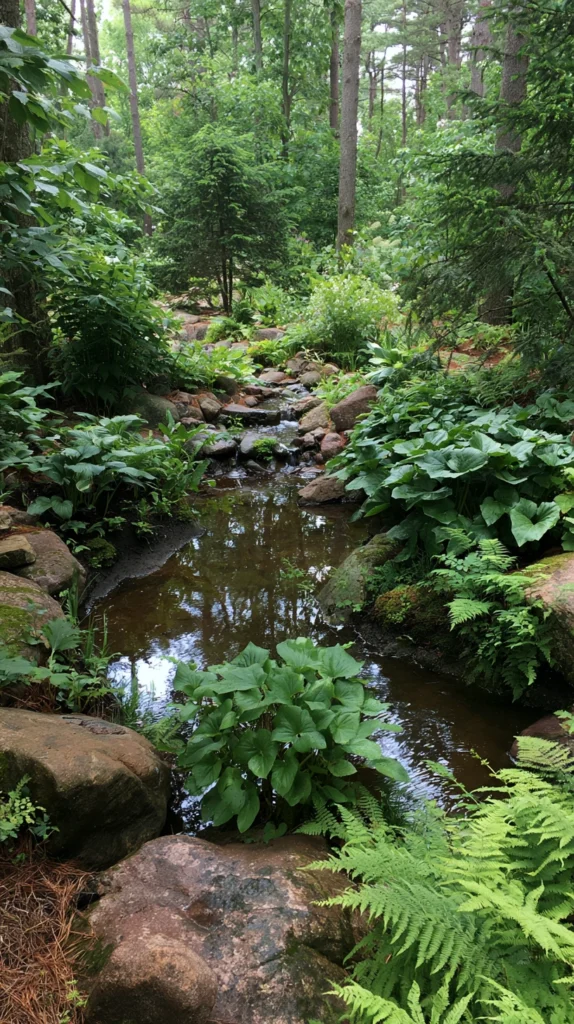
Budget: $80 – $350
A bog garden — a permanently moist planted area created by lining a shallow excavation with a punctured pond liner and filling with moisture-retentive compost — provides the lush, moisture-loving planting that creates the most verdant and most tropically abundant garden environment without requiring an open water surface. Gunnera, astilbe, rodgersia, marsh marigold, and iris all produce extraordinary foliage and flower in bog conditions, and the quality of the planting communicates water — the presence of moisture, the abundance of water-fed growth — without requiring the management of an open pond.
A bog garden liner — a standard pond liner punctured every 30 centimetres — costs $30–$80. Moisture-loving plants cost $8–$20 each. A bog garden of 2 by 1.5 metres planted with five species costs $120–$200 in total. Position beside an existing pond or as a standalone feature with a hose connection for supplementary watering during dry periods.
Style tip: Edge the bog garden with the same stone or gravel as the surrounding garden path or border rather than leaving a raw soil edge. A bog garden with a defined edge — a ring of river pebbles, a course of flat stone — reads as a designed planting feature; one with a raw soil boundary reads as a waterlogged area of the garden. The edging is the installation detail that distinguishes the designed bog from the drainage problem.
12. The Solar Fountain Feature
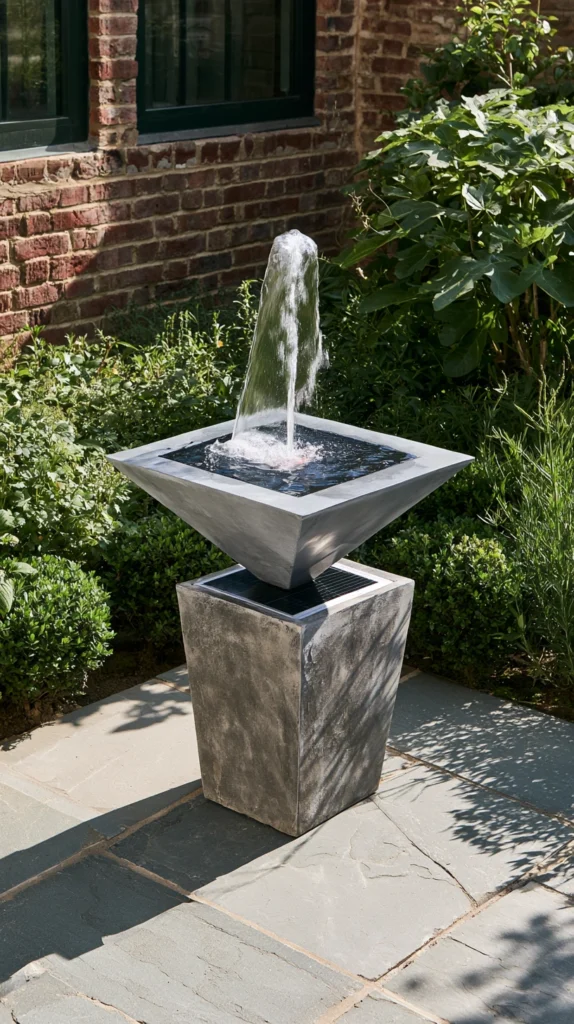
Budget: $30 – $150
A solar-powered fountain — a submersible pump attached to a floating or adjacent solar panel that circulates water whenever sunlight is available — is the water feature that requires no electrical installation, no mains connection, and no running cost. It operates automatically on the days when the garden is most used, producing the sound and the visual quality of moving water from the energy of the sun rather than the mains supply.
A complete solar fountain kit with pump and panel costs $25–$80. A solar fountain for a larger existing pond runs $40–$150. Position the solar panel in the sunniest available garden position — even a panel in partial shade produces a weaker, more intermittent flow than one in full sun. A battery backup version maintains the fountain through brief cloud cover and costs $10–$20 more than a direct-drive version.
Style tip: Choose a solar fountain with multiple interchangeable fountain heads at different heights and spray patterns — the specific spray pattern produces a dramatically different acoustic and visual effect, and the ability to change the pattern without replacing the pump is the practical quality that allows the solar fountain to be calibrated to the specific garden and the specific seating position that most enjoys it.
13. The Courtyard Water Bowl
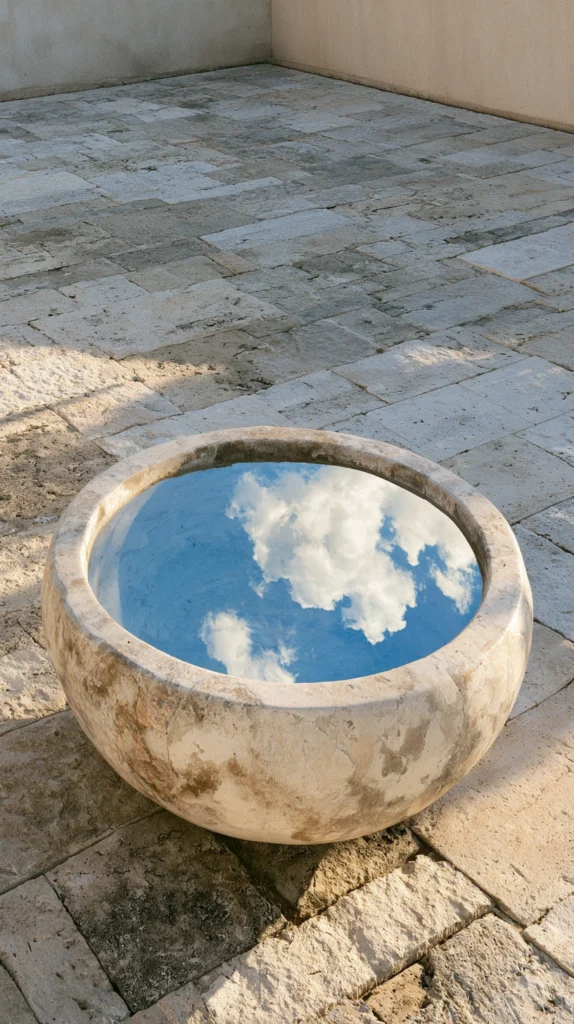
Budget: $30 – $200
A large, beautiful ceramic or stone bowl — filled with water, placed at the centre of a small courtyard or on the primary patio surface, containing a few floating flowers or leaves — creates the most minimal and most easily achievable of all the garden water features. The water bowl is the water feature reduced to its essence: the surface of still water, the reflection of the sky, the specific quality of depth that even a small volume of water contained in a beautiful vessel communicates.
A large ceramic bowl of 50 centimetres in diameter costs $30–$80. A stone basin of the same size runs $40–$120. Floating flowers — a few cut rose heads, a waterlily bloom if a pond is nearby, or simply the first flowers the garden offers — cost nothing. Change the water weekly and clean the bowl monthly — stagnant water in a courtyard water bowl develops algae and loses the clarity that is the specific quality the water feature is providing.
Style tip: Add a single smooth stone to the bottom of the water bowl — large enough to be visible through the water surface, small enough not to fill the bowl. The stone beneath the water creates the impression of greater depth than the bowl actually contains, and the water surface above it reflects the light at a slightly different angle to the surrounding water, creating the specific visual complexity of a pool with a floor rather than simply a container of water.
14. The Waterfall Rock Feature
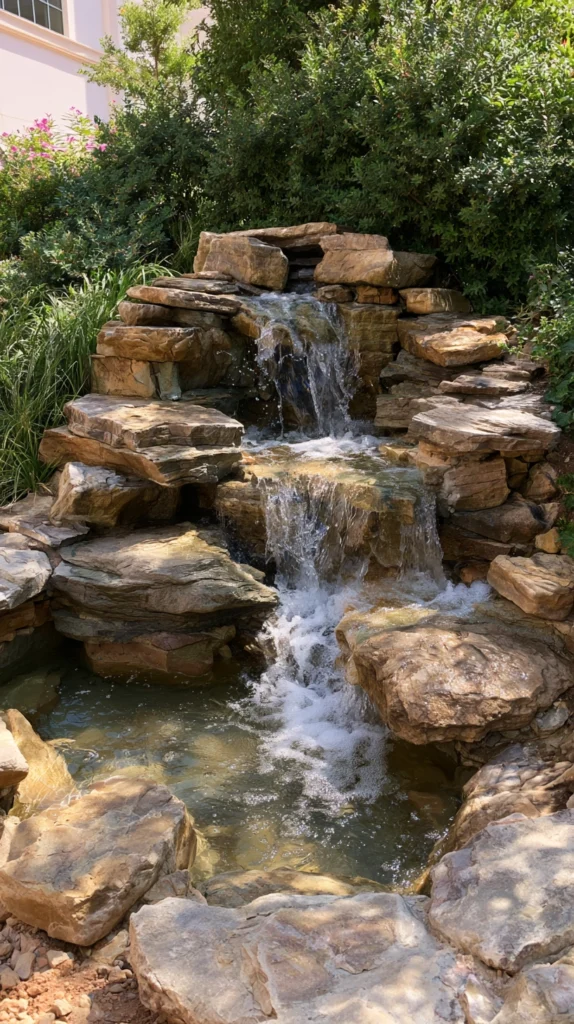
Budget: $150 – $1,500
A waterfall feature — water flowing over a stack of flat stones or a sculpted rock face into a receiving pool, with a pump returning the water continuously — provides the most dramatic sound and the most specifically geological visual quality of all the garden water features. A well-designed waterfall sounds like a garden that has a geological past — like a place where water has been flowing over stone for long enough for the stone to carry the evidence. A poorly designed one sounds like a garden hose.
Natural stone for the waterfall cascade — flat sandstone or limestone in varying sizes — costs $40–$120 for a small feature. A submersible pump rated for the height of the cascade costs $30–$100. A liner for the receiving pool costs $20–$50. Overlap each flat stone so it slightly overhangs the one below — the overhang produces the free-falling water quality of a natural waterfall; flush-stacked stones produce a sliding quality that reads as a water feature rather than as something geological.
Style tip: Plant moisture-tolerant ferns and native grasses in the pockets between the cascade stones — the shaded, moisture-retentive environment between large rocks is the natural habitat of the plants that make a waterfall feature read as a genuine landscape element. The planted pockets give the rock cascade its quality of belonging to the garden’s plant community rather than sitting in it as an installed feature.
The water feature that genuinely calms is the one that was chosen for the specific quality of water it produces in the specific garden it serves — the still pool for the garden of contemplation, the wildlife pond for the garden of ecological engagement, the recirculating stream for the garden of immersive experience, the dry river bed for the garden of representation and restraint. The wrong water feature in the right garden does not produce calm; the right water feature in a garden that was designed to support it does.
Choose the water honestly — for the garden’s acoustic needs, its ecological context, its scale, and the specific quality of rest that the people who use it are seeking. Install it with the care that water requires — the correct pump specification, the correct waterproofing, the correct planting at its margins. And then sit beside it and allow the specific quality of water in the garden to do what it has always done: make the time spent beside it feel different from — and in some ways better than — almost any other time the outdoor space provides.