14 Mudroom Alternatives for Homes Without an Entry Space
14 Mudroom Alternatives for Homes Without an Entry Space
There is a specific domestic problem that the home without a mudroom creates and that most interior design advice addresses inadequately. It is not simply the problem of where to put the coats — that problem has obvious solutions.
It is the problem of the threshold. The moment of transition between the outside world and the inside life of the house, and the chaos that accumulates at that moment when there is no specific space designed to manage it. The shoes that were not put away. The bags that landed on the floor. The keys that are somewhere. The children’s school bags that are everywhere.

The dedicated mudroom solves this problem architecturally — by providing a room specifically designed for the transition between outside and inside, with storage for every category of object that arrives with a person at the door.
Most homes do not have this room. What they have is a hallway, a corner of a kitchen, the back of a front door, or a landing at the base of a staircase — spaces that were designed for other purposes and that are being asked to perform the mudroom function without any of the mudroom’s architectural provisions.
The ideas below are specific, buildable solutions for the mudroom function in homes that do not have a dedicated mudroom space. Each is designed for the specific constraints of a real domestic setting, each includes what you will need and what it will cost, and each includes a practical tip to make it work as well as the dedicated room it is replacing.
1. The Hallway Bench and Hook System
Budget: $100 – $500
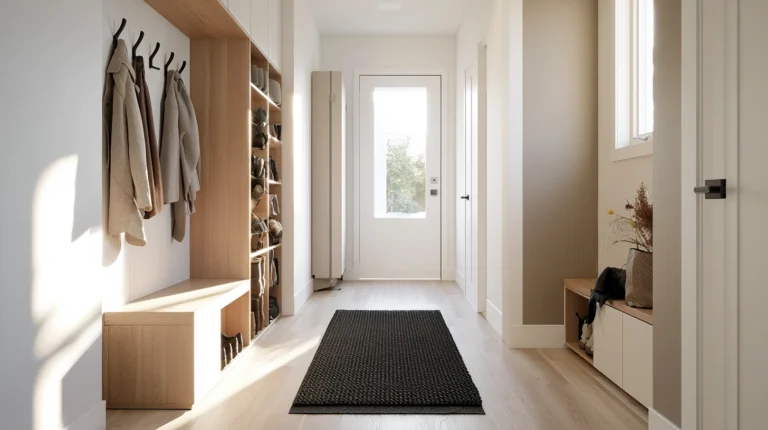
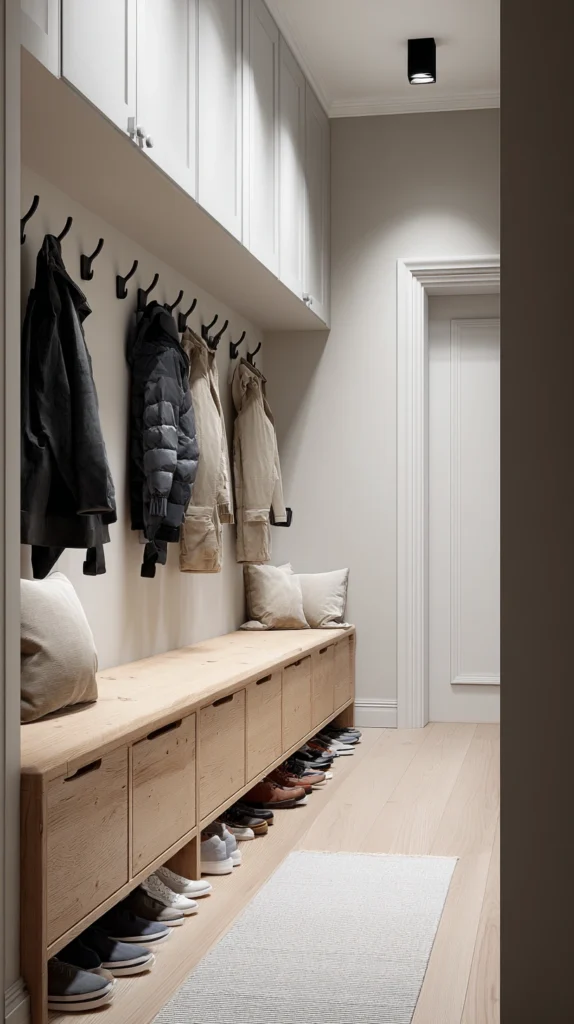
A hallway bench with storage beneath — a hinged lid above a deep box section — combined with a row of hooks above it creates the mudroom function at the most immediate entry position of the home without requiring any structural change to the existing space. The bench provides the surface for sitting while removing shoes, storage beneath for the shoes once removed, and hooks above for the coats and bags that arrive with every person who enters the house.
A quality timber storage bench of 120 centimetres costs $80–$200. A set of five hooks on a timber rail above the bench runs $20–$60. A shoe storage system within the bench box costs $15–$40. The bench should be positioned so it does not block the hallway at its narrowest — the clear circulation width of 80 centimetres must be maintained on the passage side of the bench for the hallway to function without the bench becoming an obstacle.
Style tip: Choose a bench that is the full width of the hallway wall it occupies rather than a narrower bench on a wider wall. A bench that runs wall to wall reads as a designed element of the hallway; one that sits in the middle of a wall reads as furniture placed in the hallway. The full-width bench is the installation detail that most distinguishes the designed entry system from the approximate one.
2. The Coat Closet Conversion
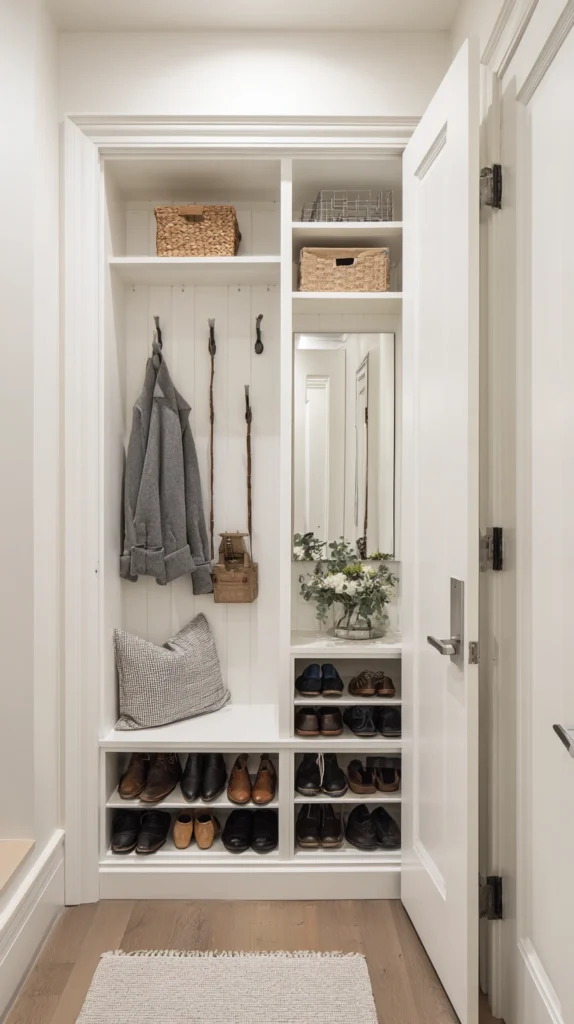
Budget: $100 – $600
A coat closet — an existing or newly built narrow closet at or near the front or back entrance — converted specifically for the mudroom function with a shoe rack at the floor, hooks at the mid-level, a shelf above the hooks for hats and bags, and a mirror on the inside of the door creates the most complete mudroom alternative available within a standard domestic footprint. The coat closet conversion addresses all the mudroom functions simultaneously within a space that can be closed, hiding the functional contents from the visible hallway when the door is shut.
A fitted closet interior with hooks, shelf, and shoe rack costs $80–$300 in shelving components. A full bespoke closet conversion in quality timber runs $300–$800. A mirror on the inside of the door costs $20–$60. The closet should be positioned at the entrance rather than further into the house — a coat closet at the entry point captures coats and shoes at the moment of arrival; one further into the house requires the occupant to carry outdoor items through the home before storing them.
Style tip: Install a small basket or a tray on the shelf above the hooks specifically for keys, phone, sunglasses, and the small items that are lost when they have no designated home. The small items tray is the mudroom detail that most directly addresses the experience most consistently associated with the absent mudroom — the lost key, the missing card, the phone that was left somewhere.
3. The Kitchen Entrance Zone
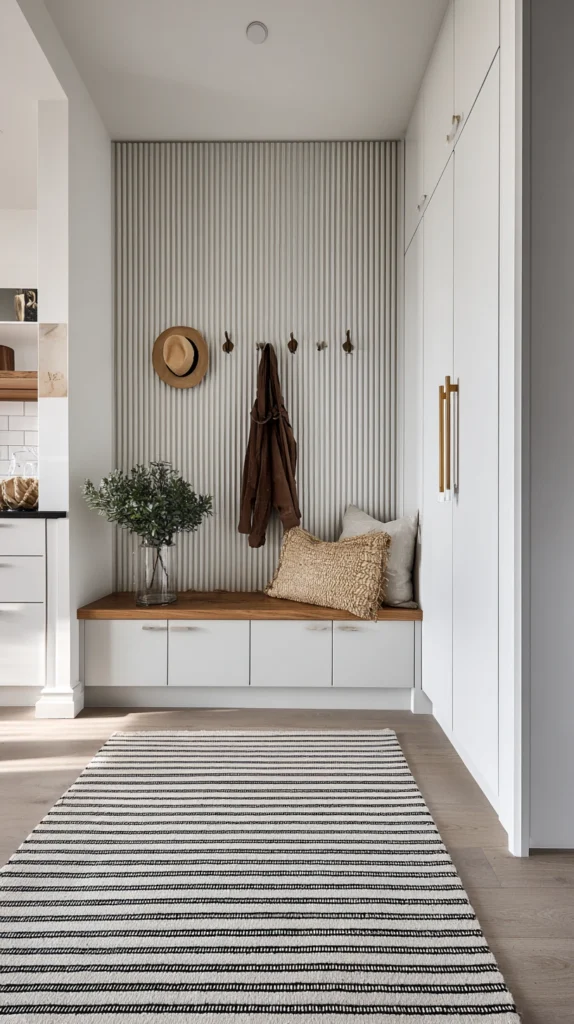
Budget: $80 – $400
In homes where the primary entrance is through the kitchen — through the back door directly into the kitchen space — a dedicated entry zone at the kitchen door, created with a wall-mounted hook rail, a narrow bench or a shoe storage unit against the adjacent wall, and a basket or bin for school bags and work bags, creates the mudroom function at the position it is most needed without extending into the kitchen circulation or the cooking area.
A wall-mounted hook rail of five hooks costs $20–$60. A narrow bench of 40-centimetre depth runs $60–$180. A basket for bags costs $15–$40. The kitchen entrance zone requires a defined visual boundary between the entry function and the kitchen function — a change of flooring material, a small area rug, or a change in wall treatment communicates the zone identity without any structural division.
Style tip: Install a floor mat or a specific floor tile in the entry zone that is different from the kitchen floor. The material boundary at the floor level communicates the threshold between the outdoor transition zone and the kitchen in the clearest and most practical way — the mat catches the dirt from outdoor footwear at the specific point of transition rather than allowing it to be carried through the full kitchen floor.
4. The Under-Staircase Storage System
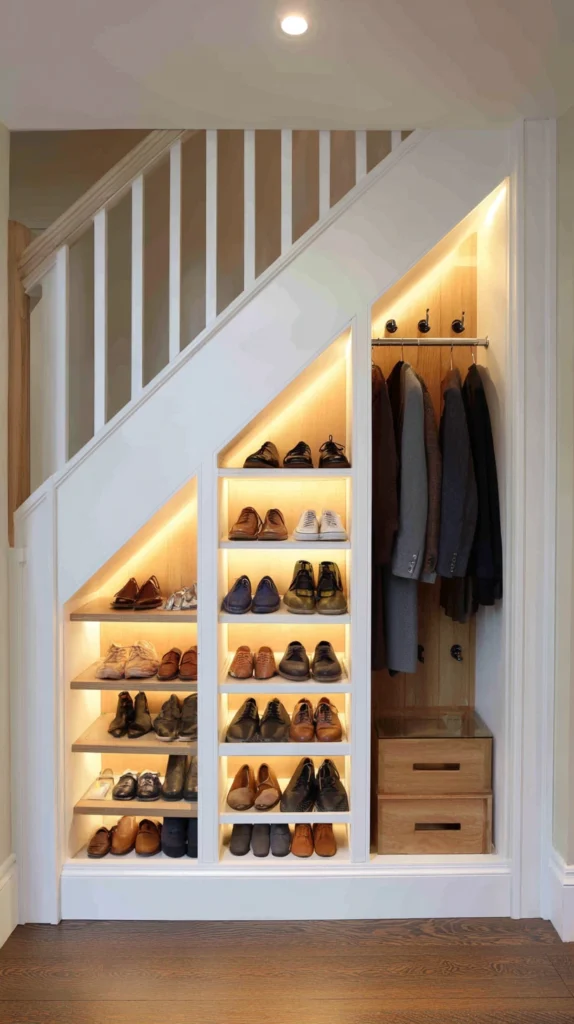
Budget: $200 – $1,500
The space beneath a staircase — typically used for miscellaneous storage at the cost of its accessibility and its organisation — converted specifically for the mudroom function creates the most spatially generous mudroom alternative available in most standard homes. The under-stair space provides depth for hanging coats, height for tall boots, and the volume of storage that no wall-mounted system can match, and its proximity to the front door in most terraced and semi-detached homes places it at exactly the right position in the house for the entry transition function.
A bespoke under-stair storage system with hooks, shelves, and shoe drawers costs $500–$1,500. A DIY version using off-the-shelf components fitted to the specific dimensions of the under-stair space costs $200–$600. The under-stair conversion requires accurate measurement of the sloped ceiling profile and the specific internal dimensions before any component is purchased — no two under-stair spaces are identical and the components must be fitted to the specific space rather than to a standard dimension.
Style tip: Install a light within the under-stair storage space — a battery-operated motion-sensing LED strip costs $10–$25 and activates automatically when the door opens. An under-stair mudroom alternative without internal lighting is an under-stair storage space that is used minimally because the items stored at the back of the space are invisible; one with internal lighting is a storage space used to its full depth consistently.
5. The Freestanding Wardrobe Entry System
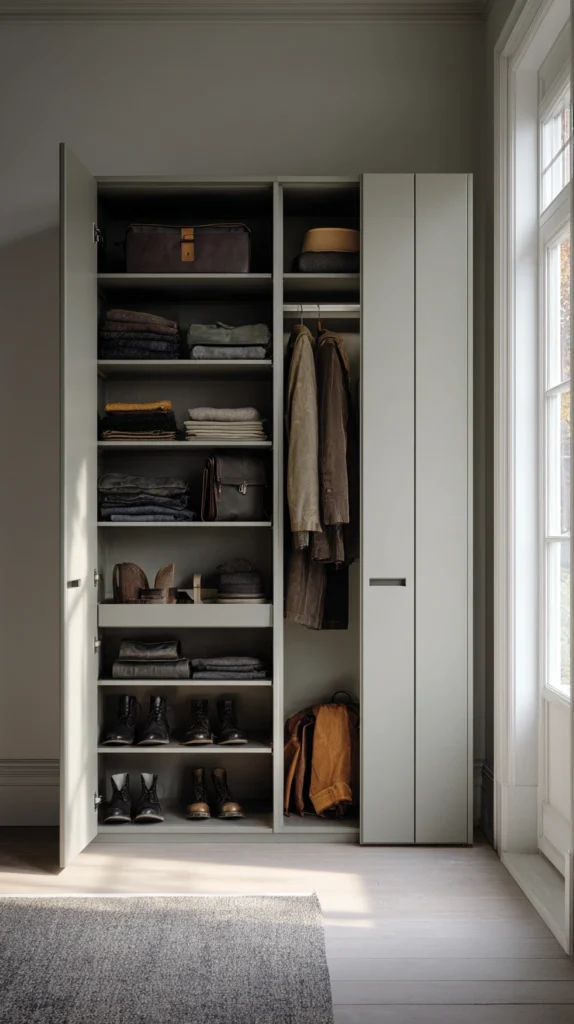
Budget: $150 – $800
A freestanding wardrobe — positioned in the hallway or in the most accessible room adjacent to the entrance, fitted internally with hooks, shelves, and a shoe rack — provides the mudroom storage function within a closed, self-contained piece of furniture that can be placed in any position without structural work and removed or relocated if the household’s needs change. The freestanding wardrobe mudroom is the most flexible and the most immediately implementable of all the mudroom alternatives.
A timber freestanding wardrobe with internal fitting potential costs $150–$500. An IKEA Pax system configured for mudroom use runs $200–$600. Internal fittings — hook bars, additional shelves, shoe racks — cost $50–$150 additional. Choose a wardrobe with a depth of at least 50 centimetres — a shallower wardrobe does not accommodate the depth of hanging coats and large bags that the mudroom function requires.
Style tip: Paint the freestanding wardrobe in the hallway’s accent colour rather than leaving it in the standard white or timber finish it arrives in. A wardrobe painted to match the hallway palette reads as a designed element of the entry space; the standard white wardrobe reads as furniture placed in the hallway. The paint cost is $15–$30 and produces a significantly more considered entry space.
6. The Pegboard Entry Wall
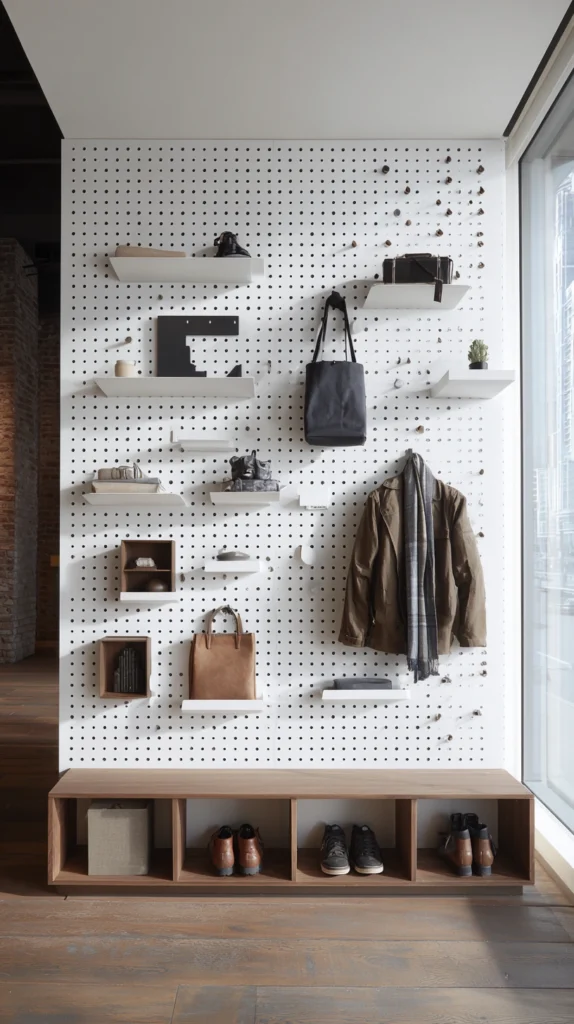
Budget: $40 – $200
A wall of pegboard — the perforated hardboard panel system with interchangeable hooks, shelves, and baskets — installed at the entry point of the home creates a fully customisable and completely visible storage system for the everyday objects that the mudroom is designed to manage. The pegboard is the most flexible and the most immediately adaptable of all the mudroom storage solutions because its hook and shelf positions can be changed without tools as the household’s storage needs evolve.
A pegboard sheet of 120 by 60 centimetres costs $15–$30. A complete set of hooks, shelves, and baskets runs $30–$80. A timber frame to mount the pegboard 2 centimetres from the wall — the gap that allows the hooks to engage fully with the holes — costs $10–$25. Paint the pegboard in the wall colour for a seamless, considered appearance or in a contrasting colour for a graphic, feature-wall quality.
Style tip: Mount the pegboard on a batten frame rather than flat against the wall. The 2-centimetre gap between the pegboard and the wall surface is not optional — a pegboard mounted flat against the wall does not allow the hooks to engage with the perforations from the back, which is the mechanical principle on which the entire system depends. The batten frame is the installation requirement, not an option.
7. The Rear Kitchen Utility Corner
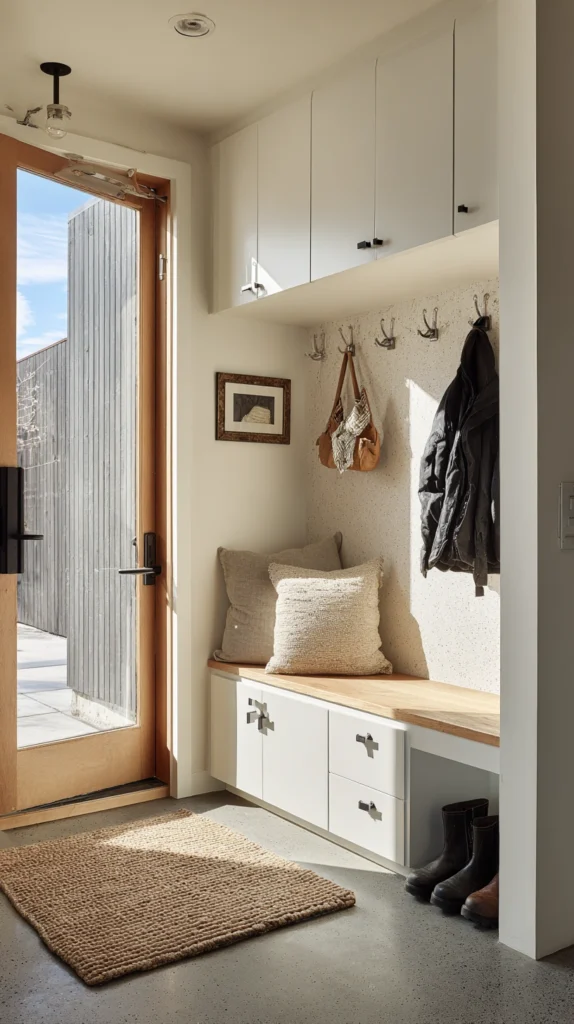
Budget: $100 – $600
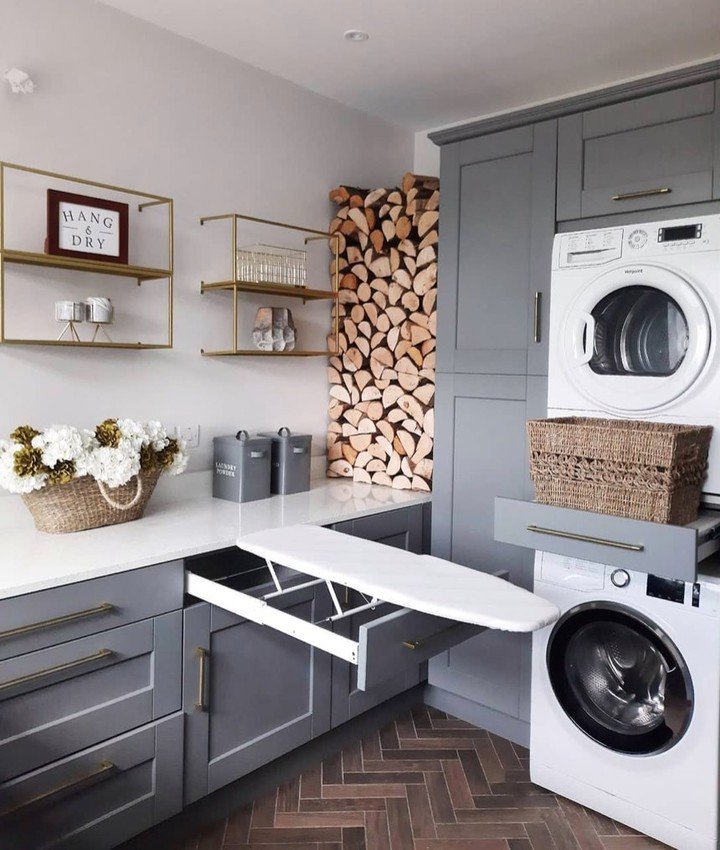
In homes where the utility room connects to the kitchen and the outdoor access is through the utility, the utility room itself can be configured as a complete mudroom alternative — with hooks on the wall beside the external door, a boot rack at the floor, a shelf above for hats and bags, and a narrow bench if the dimensions allow. The utility room mudroom uses an existing room for the entry transition function without any change to the primary living spaces.
Hook rail installation costs $20–$60. A boot rack or shoe storage unit runs $20–$80. A wall shelf above the hooks costs $20–$60. A narrow bench in the utility costs $60–$150. The utility room mudroom requires the utility function and the entry function to be separated within the room — the washing machine, the boiler, and the utility storage are the utility room’s primary function, and the mudroom zone should be clearly defined at the external door position without conflicting with the utility circulation.
Style tip: Install a utility sink in the utility room mudroom zone if one is not already present — the sink provides the hand-washing facility that is the mudroom’s most directly hygienic contribution to the household routine. A utility sink costs $60–$150 plus plumbing and is the utility room addition that most completely produces the mudroom function within an existing room.
8. The Bedroom Landing Solution
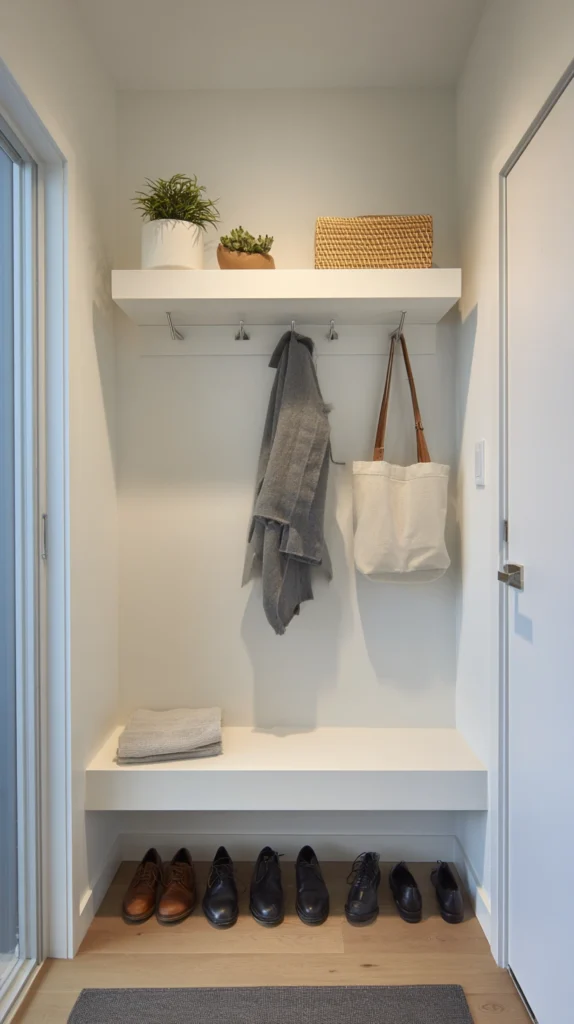
Budget: $80 – $300
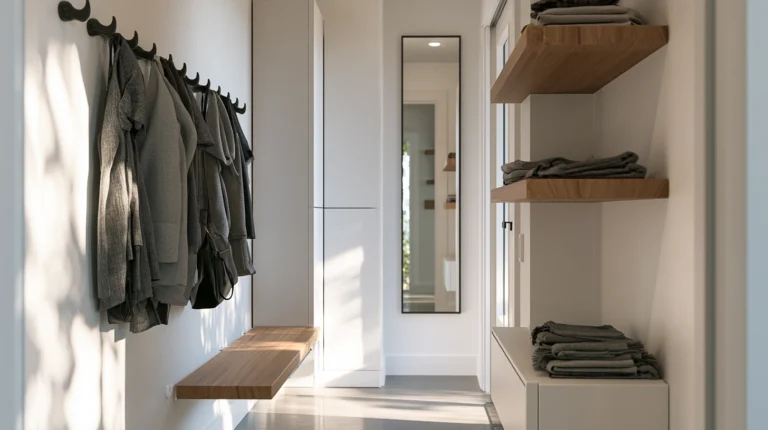
In apartments or maisonettes where the entrance opens directly onto a bedroom landing without a dedicated hallway, a wall-mounted entry system — a floating shelf at shoulder height for bags, a hook rail below for coats, and a shoe storage bench or a stacked shoe rack at the floor — creates the mudroom function at the bedroom threshold without encroaching on the bedroom itself. The bedroom landing mudroom uses the transitional space between the entrance door and the bedroom as the entry management zone.
A floating shelf of 80 centimetres costs $20–$50. A hook rail of four hooks runs $15–$40. A compact shoe rack for six pairs costs $20–$60. The bedroom landing system requires the hooks and the shelf to be mounted on the wall that is most immediately accessible on entry — typically the wall directly opposite or adjacent to the entrance door — rather than on the wall that is most convenient from a drilling perspective.
Style tip: Use a consistent basket or container material for the landing storage — all the same woven seagrass, or all the same metal wire — rather than mixed containers from different sources. A landing mudroom using consistent containers reads as a designed entry zone; one with mixed containers reads as miscellaneous storage items placed at the landing. The material consistency communicates intention in the most visible entry space of the home.
9. The Back Door Boot Room
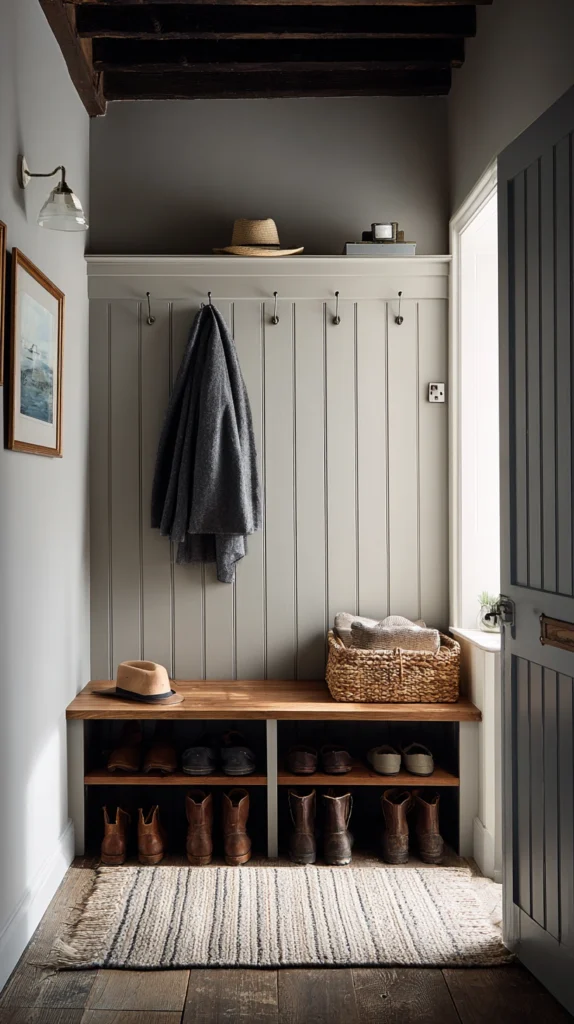
Budget: $150 – $800
A back door boot room — the most traditional British version of the mudroom alternative, a small area at the back door of a house configured specifically for outdoor clothing, boots, and garden equipment — uses the specific tradition of the British working house where the back door was always the main working entrance and the area beside it was always the space for outdoor kit. The boot room at the back door is the mudroom alternative that most honestly acknowledges the different character of the front door and the back door entrance.
A boot room hook system for four to six people costs $40–$100 in hooks and rails. A boot rack for eight to twelve pairs of boots and shoes costs $30–$80. A wicker or seagrass basket collection for gloves, hats, and small items runs $15–$40 each. A boot room bench for sitting to remove boots costs $60–$200. The back door boot room can be as simple as a hook rail and a boot rack beside the door or as complete as a fitted system with dedicated storage for every person in the household.
Style tip: Install a boot scraper and a door mat outside the back door as well as inside — the external scraper removes the bulk of the mud before entry, the internal mat removes the remainder, and the boot room manages what passes both. The three-layer approach — scraper, mat, boot room — is the system that prevents outdoor mud from reaching the internal floor surfaces, which is the functional purpose of the mudroom that the boot room is designed to fulfil.
10. The Garage Entry System
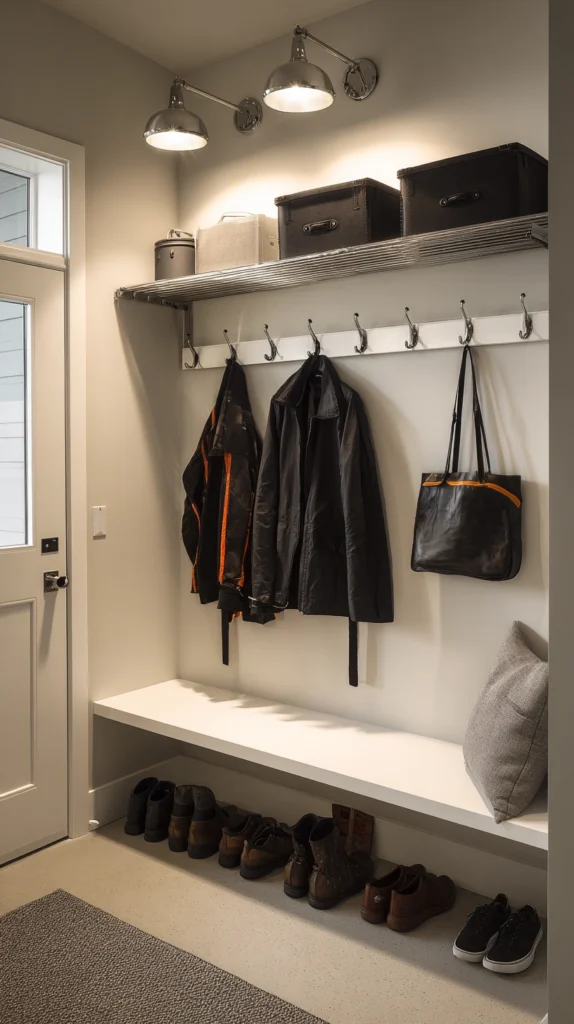
Budget: $100 – $500
In homes where the primary entry is through an integral garage, the wall beside the door from the garage to the house — typically a dead wall with no existing storage provision — can be converted into a complete mudroom wall with hooks, shelves, baskets, and a bench. The garage entry system is the most concealed and the most complete of all the mudroom alternatives because the garage provides more wall area, more floor space, and more tolerance for outdoor mess and muddy equipment than any interior room.
A complete garage entry wall system with hooks, shelves, and baskets costs $100–$400 in off-the-shelf components. A bespoke fitted version runs $400–$1,200. The garage entry system should include a floor mat or a specific floor zone for the transition from the garage floor to the house floor — the garage floor carries more outdoor contamination than any other entry surface, and the transition zone at the door to the house is the critical barrier between the garage environment and the interior.
Style tip: Illuminate the garage entry system with a dedicated light rather than relying on the garage’s general lighting. A well-lit entry system — one where every hook, every shelf, and every basket is visible when the garage door is closed — is a system that is used consistently because using it requires no additional effort; a dimly lit system is used inconsistently because finding the correct hook or the correct basket in poor light is more effort than simply depositing items wherever they land.
11. The Hallway Alcove Conversion
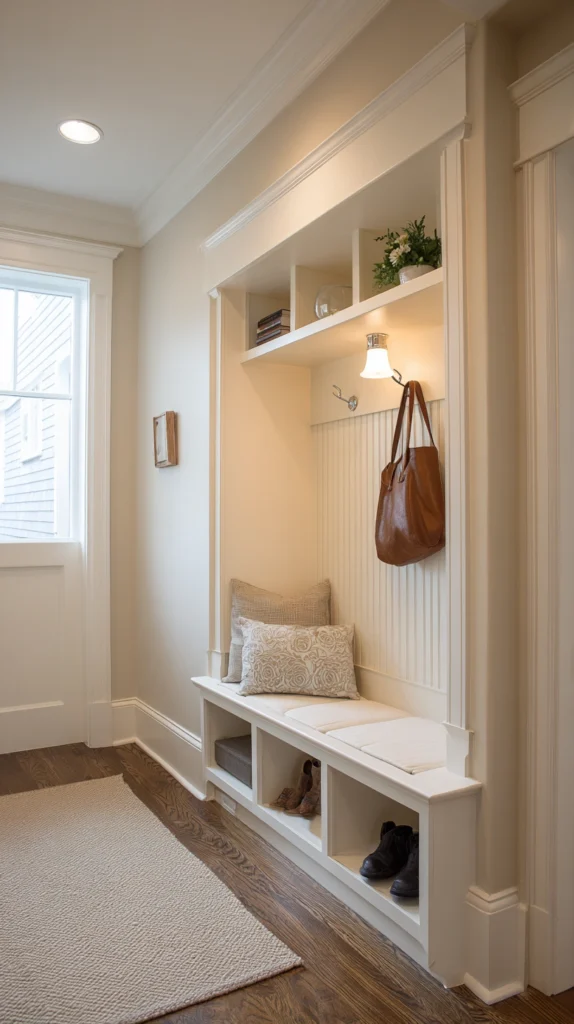
Budget: $200 – $1,000
A hallway alcove — the recess beside a chimney breast, the gap between a staircase and a wall, the space behind an opening door — converted into a dedicated entry storage alcove with built-in hooks, shelves, and a bench creates the most architecturally integrated mudroom alternative available. The alcove conversion uses the existing geometry of the house rather than adding new furniture or new structure, and the built-in quality of a fitted alcove system communicates the design intelligence of a mudroom that was always meant to be there.
A fitted alcove system in MDF with hooks, shelves, and a bench seat costs $200–$600 in materials and basic carpentry. A bespoke timber version runs $400–$1,200. The alcove conversion requires accurate measurement and a fitted design rather than off-the-shelf components — the specific dimensions of the alcove determine the design, and the design must be made for the specific alcove rather than adapted from a standard.
Style tip: Paint the interior of the alcove in a colour that contrasts slightly with the surrounding hallway wall — two tones deeper in the same colour family, or a complementary tone from the hallway palette. The slightly different interior colour communicates the alcove as a designed zone within the hallway rather than simply a section of wall with storage installed in it.
12. The Apartment Entrance Organisation System
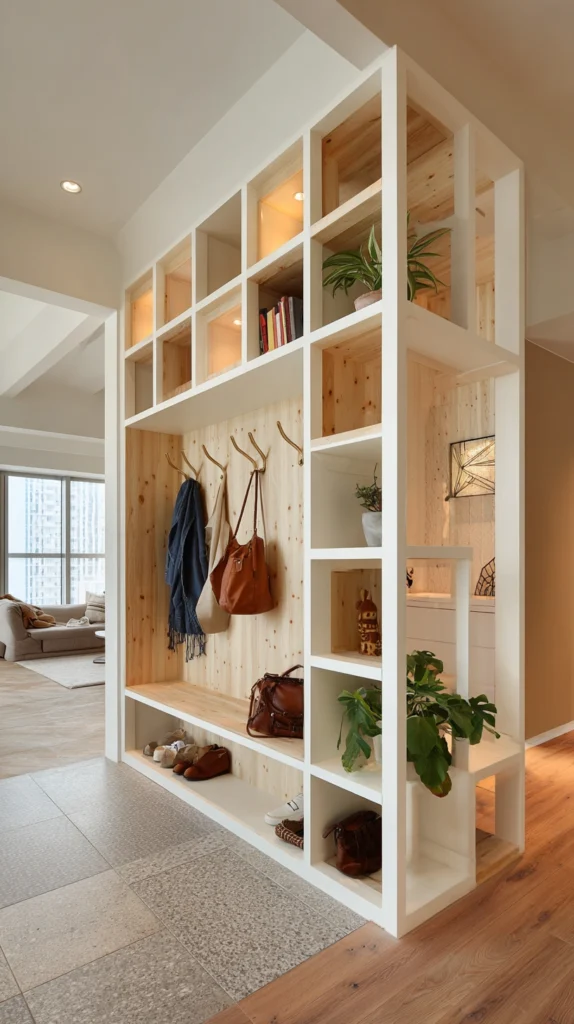
Budget: $60 – $300
In apartments where the entrance door opens directly into the living space without any transitional hallway, a specifically designed entry zone — created using a room divider, a tall bookshelf, or a freestanding wardrobe positioned perpendicular to the entrance wall to create a visual and functional separation between the entry function and the living function — provides the mudroom’s zone identity within an open-plan space that has no architectural provision for it.
A room divider of 180 centimetres in height costs $80–$200. A tall open bookshelf used as a room divider runs $100–$300. The entry-side face of the divider serves the mudroom function — hooks, baskets, a shoe rack at the floor — and the living-room face serves the display or storage function of the living room. The divider is the spatial device that creates the threshold the apartment lacks architecturally.
Style tip: Fix the freestanding divider to the wall with a single L-bracket at the top to prevent it from toppling — a freestanding room divider of 180 centimetres is a safety hazard in an apartment with children or active daily use unless it is stabilised. The L-bracket fix costs $5–$10 and converts the divider from a potential hazard to a permanent functional element of the apartment entry.
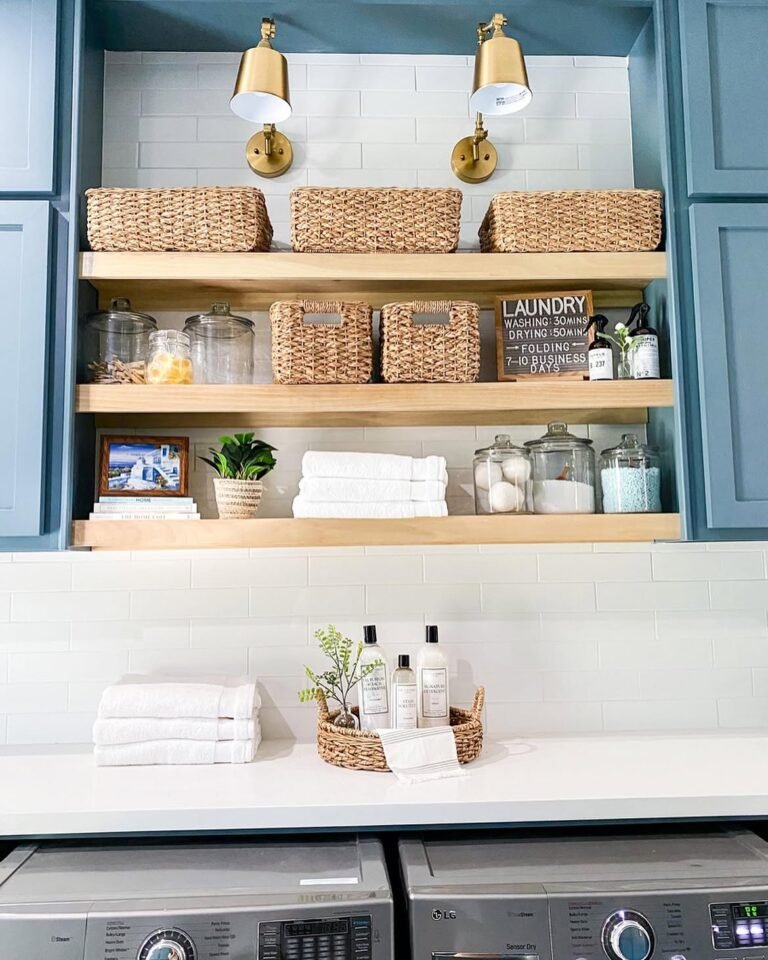
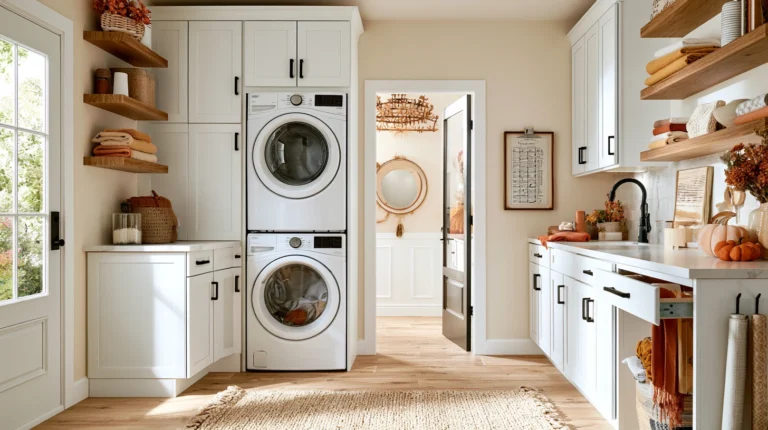
13. The Laundry Room Entry Function
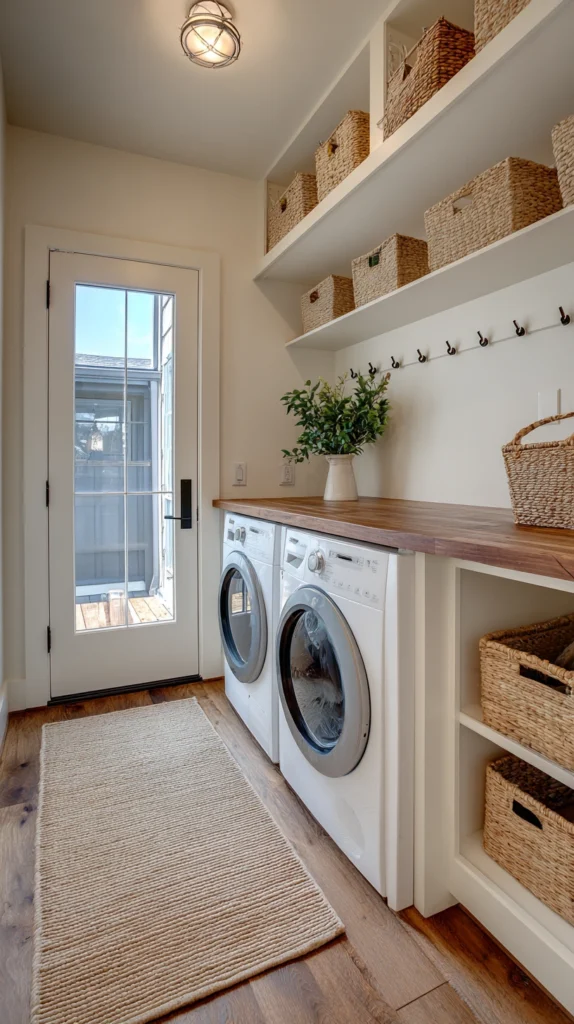
Budget: $80 – $400
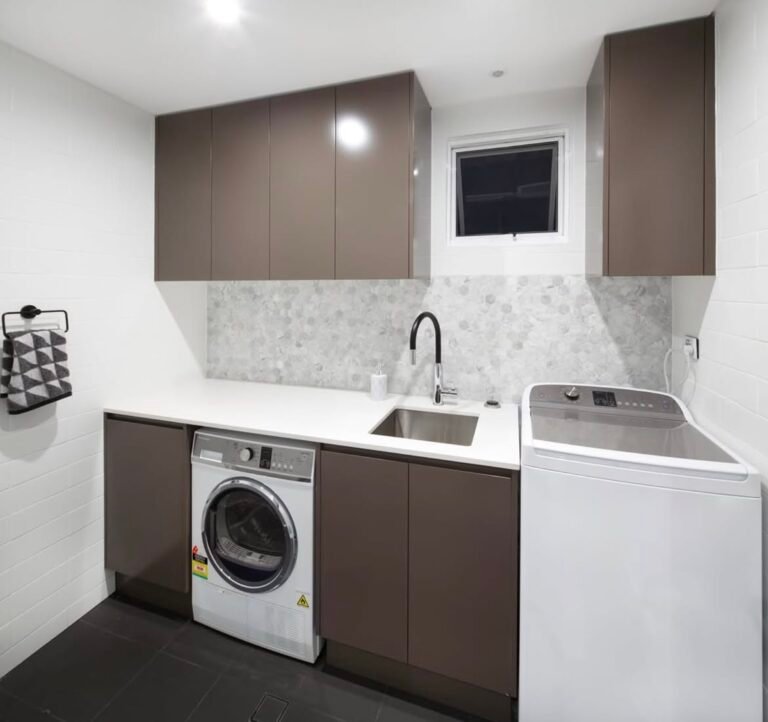
In single-storey homes, bungalows, and some apartment configurations where the laundry room is positioned near the entrance, a laundry room that also serves the entry function — with hooks beside the door for coats, a shoe rack at the floor, and a shelf for bags — uses an existing room for the mudroom function without any additional construction. The laundry room entry function is a practical rather than a stylistic solution, but its proximity to the washing machine means that outdoor clothing moves directly from the hook to the wash rather than through the house first.
Hook installation beside the laundry room door costs $15–$40. A shoe rack at the floor costs $20–$60. A shelf above the hooks runs $20–$50. A small basket for hats and gloves costs $10–$25. The laundry room mudroom requires the hooks and the shoe storage to be positioned at the external wall rather than the internal wall — the entry organisation closest to the door is the organisation that is used; the storage furthest from the door is the storage that is bypassed.
Style tip: Install a second hook rail at child height as well as the adult height rail. The household mudroom alternative that provides only adult-height hooks consistently fails for households with children because the child who cannot reach the hook does not use it. Two hook heights — one at 130–140 centimetres and one at 80–90 centimetres — address the full height range of the typical household.
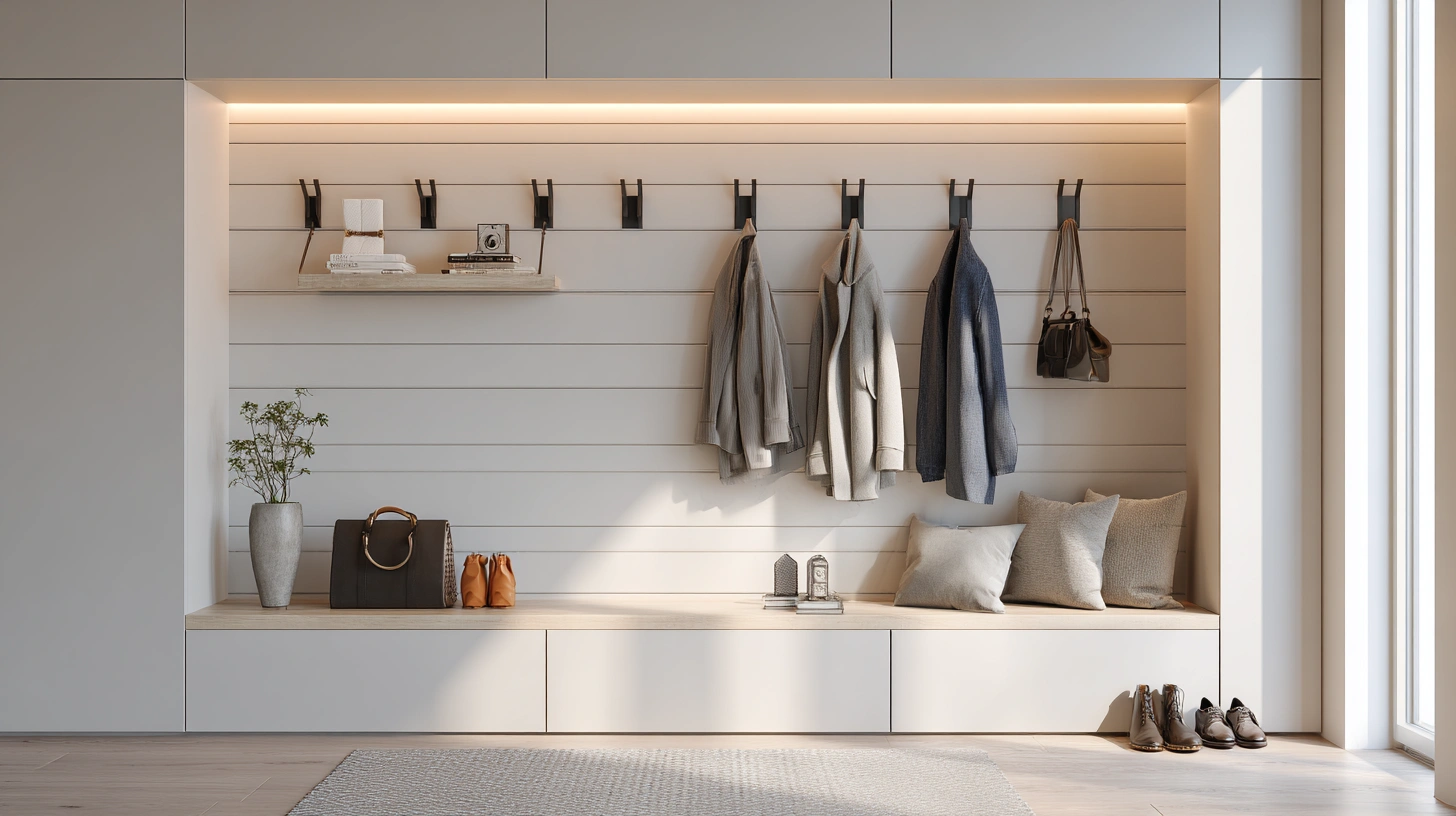
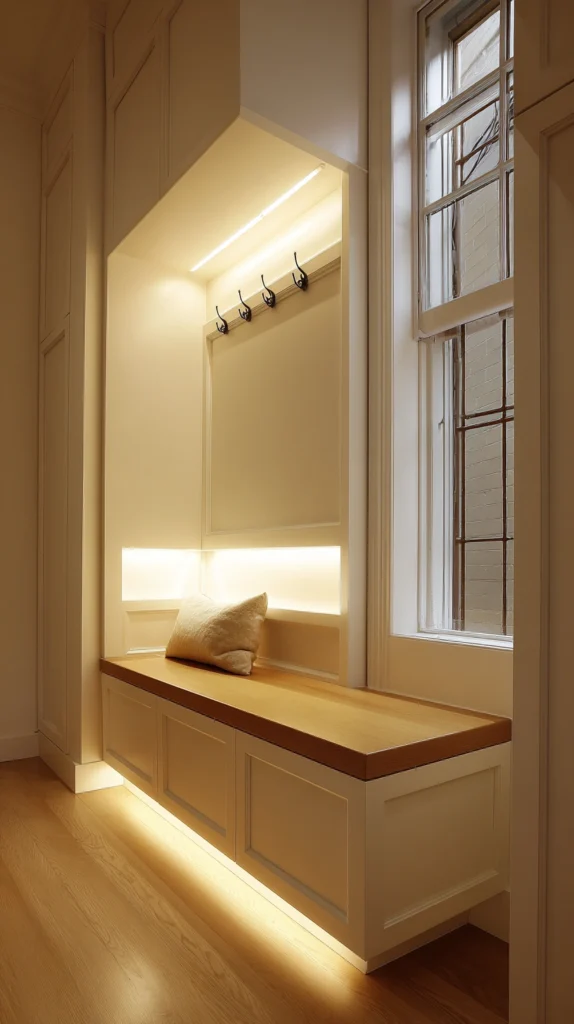
14. The Built-In Banquette Entry Bench
Budget: $300 – $1,500
A built-in banquette bench — constructed in the hallway or at the entry wall, with storage drawers or a hinged seat lid beneath, a built-in back with hooks at the correct heights for coats, and a shelf above for hats and bags — creates the most custom and most architecturally considered of all the mudroom alternatives. The built-in banquette is not furniture placed in the hallway; it is a piece of the hallway’s architecture, and its quality communicates the design intelligence of a home where the entry transition was considered as carefully as any other domestic function.
A bespoke built-in banquette entry bench in MDF or timber costs $400–$1,200 in materials and carpentry. A DIY version from flat-pack components fitted together and finished to appear built-in costs $200–$600. The built-in appearance requires the bench to be fitted precisely to the wall dimensions on both sides — a bench that fits exactly wall to wall reads as architectural; one that leaves gaps at each end reads as furniture of the wrong size placed in the hallway.
Style tip: Include a charging station within the built-in bench — a small recess in the shelf above the hooks with a concealed cable outlet allows phones, tablets, and keys with Bluetooth trackers to charge at the entry position rather than on kitchen worktops or bedroom surfaces. The charging station at the entry bench creates the household routine of depositing and collecting devices at the transition between outside and inside that the mudroom’s management function is specifically designed to support.
The mudroom alternative that works is not the most elaborate or the most expensively specified. It is the one that addresses the specific chaos of the specific household at the specific entry point where the chaos consistently accumulates.
A household with four children, sports equipment, and a dog has different requirements from a household of two adults in an apartment. The solution in each case begins with the honest assessment of what arrives at the door, what volume of storage that arrival requires, and what position in the existing home is most appropriate for the management of that specific arrival.
Begin with the observation. Stand at the front or back door and look at what accumulates there through a normal week. Count the coats, the bags, the shoes, the hats, the keys, the sports equipment, the umbrellas. Design the storage for those specific items at the position where they most consistently land. That is the mudroom alternative — not a room, but a system designed for the specific domestic life of the specific household, and a system that works is worth more than a room that was designed for someone else’s life.