15 Cozy Reading Nook Ideas for Fall Evenings
15 Cozy Reading Nook Ideas for Fall Evenings
A reading nook is one of the smallest design projects a home can take on and one of the most disproportionately rewarding. It doesn’t need a spare room, a renovation, or even much furniture — just one corner, one comfortable seat, and enough warmth and light to make sitting down in it for an hour feel like the obvious choice on a dark evening rather than an afterthought.
Fall is the season a reading nook earns its place more than any other. The light changes, evenings arrive earlier, and the instinct to curl up somewhere warm with a book instead of scrolling through something on a screen gets stronger. A nook that sits unused all summer, when the whole house or the whole yard is an option, often becomes the most-used corner in the home once the weather turns.
The nook that actually gets used isn’t necessarily the most elaborately styled one. It’s the one solving the same few problems well: a genuinely comfortable seat, good light that doesn’t strain the eyes, real warmth, and everything needed for a reading session within arm’s reach. Here are 15 ways to build one.
Why Some Reading Nooks Look Nice but Never Get Used
The comfort-over-time problem:
Without genuine seating comfort:
- A chair or bench chosen for its appearance rather than how it feels after twenty minutes of actual sitting
- No back support suited to a reclined, book-in-hand reading posture
- The result: a beautiful nook abandoned after the first sit, in favour of the sofa or bed instead
With genuine seating comfort:
- A deep-seated chair or a well-cushioned bench, tested for actual extended sitting before being finalized
- Back and arm support that suits reading specifically, not just general seating
- The result: a nook that gets chosen over the sofa, because it’s genuinely more comfortable for the specific activity
The single-light-source problem:
- Overhead light only, or no dedicated light at all, relying on whatever ambient light happens to reach the corner
- The result: eye strain during evening reading, which quietly discourages the nook’s use without anyone quite identifying why
The everything-out-of-reach problem:
- Books, a drink, glasses, and a throw all stored or placed elsewhere in the room
- Every reading session requiring several trips to gather what’s needed
- The result: the friction of setup outweighs the appeal of sitting down, so the nook gets used less and less over time
The Five Fall Reading Nook Essentials
Before choosing any individual idea below, these five categories account for nearly every genuinely well-used reading nook:
A seat tested for real comfort, not just appearance:
- Deep enough to curl into, supportive enough to sit in for an hour
- The single factor most responsible for whether a nook actually gets used
Dedicated task lighting, not ambient light alone:
- A lamp positioned specifically for reading, at a warm colour temperature
- General room lighting is rarely sufficient or well-angled for actual reading
Layered textiles within arm’s reach:
- A throw, a cushion, and something soft underfoot
- The tactile warmth that makes a corner feel like a retreat rather than just a chair
Everything needed stored at the nook itself:
- A small table or shelf for a current book, a mug, and glasses
- Removes the friction between deciding to read and actually settling in
A genuine heat source nearby, if the space runs cold:
- A radiator, a small heater, or simply proximity to the home’s warmest zone
- No amount of styling compensates for a physically cold corner
1. The Window Bench Nook
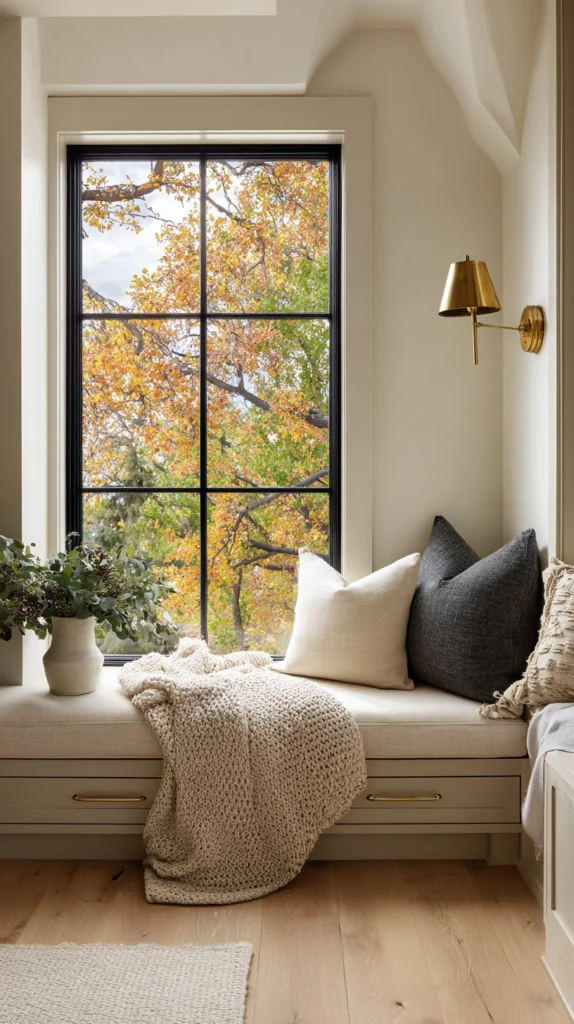
A built-in or freestanding bench positioned beneath a window, layered with cushions and a deep back bolster for genuine reading comfort.
Why a window seat suits fall reading specifically
Natural light through the window supports daytime reading, while the deep sill and enclosed feeling of a window nook creates a natural sense of retreat as evenings darken earlier through autumn. The window itself also becomes part of the experience — watching the weather change while reading inside it.
Sizing and cushioning
- Bench depth: at least 20 inches, deep enough to sit with legs drawn up rather than only feet-on-floor
- Cushion thickness: 4–5 inches minimum, with a back bolster or large cushions stacked against the window frame for lumbar support
Cost breakdown
- Bench cushion and back bolster: $60–120
- Total (assuming an existing window seat structure): $60–120
2. A Deep Armchair With a Matching Ottoman
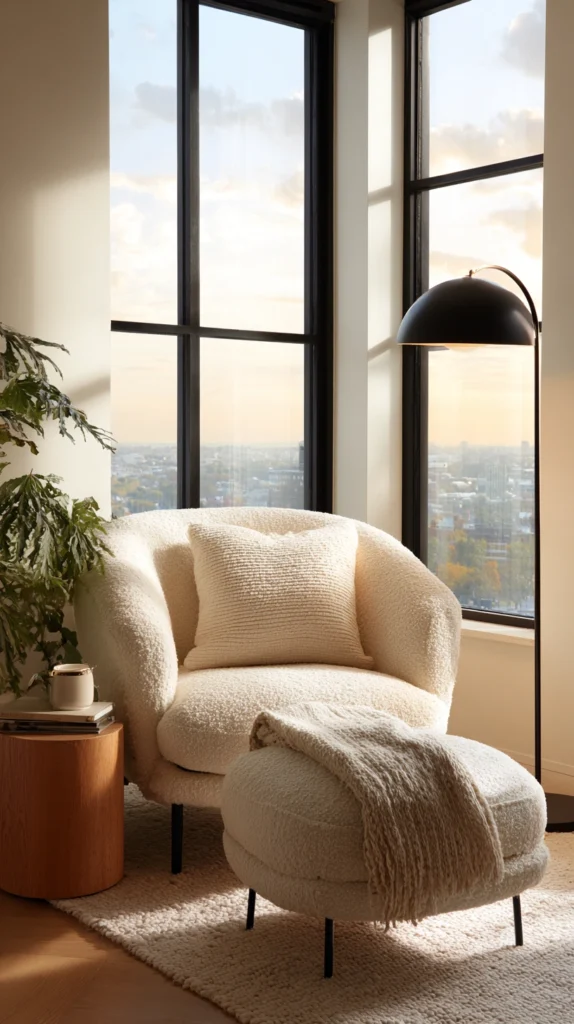
A single oversized, deep-seated armchair paired with an ottoman, positioned in an underused corner — the most flexible reading nook setup, requiring no built-in structure.
Why a chair-and-ottoman pairing outperforms a chair alone
An ottoman allows a fully reclined, feet-up reading posture that a chair alone doesn’t provide, and this specific posture is what most people actually associate with extended, comfortable reading. The pairing also works in any room shape or corner, unlike a window seat, which requires a specific architectural feature already in place.
Selection
- A chair deep enough to sit cross-legged in, roughly 38–42 inches deep from front to back
- An ottoman matched in height to the chair’s seat, so the legs rest level rather than angled up or down
Cost breakdown
- Deep armchair: $300–650
- Matching ottoman: $100–220
- Total: $400–870
3. Layered Throws in Varied Weights
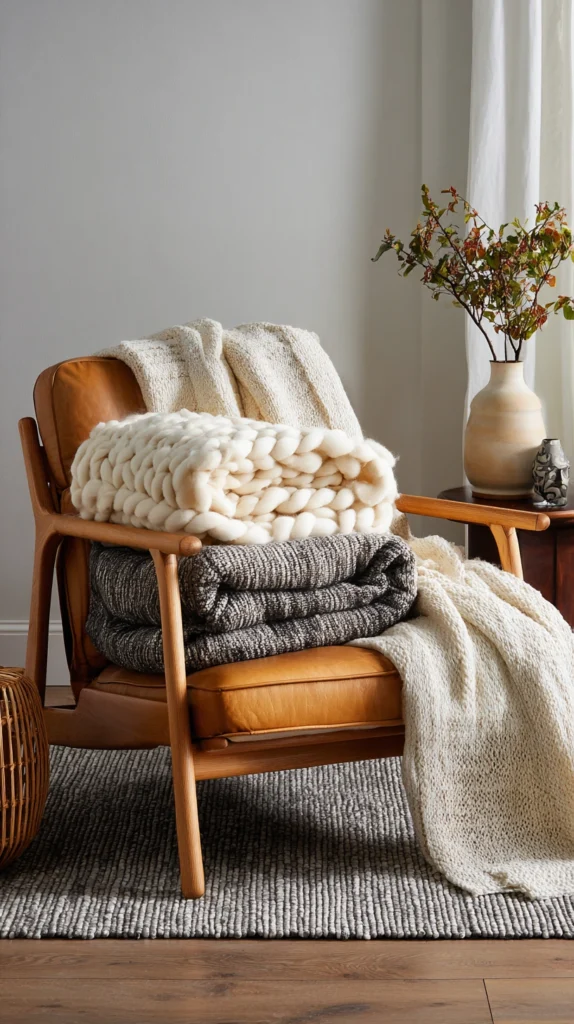
Two or three throws in different weights and textures — a lighter cotton weave, a heavier wool or chunky knit — draped and layered over the reading seat rather than a single blanket.
Why layering matters more than any single throw’s quality
Autumn evening temperatures vary more than a single blanket can account for, and having a lighter and a heavier option within reach means the right level of warmth is always available without needing to leave the nook to find another blanket partway through a reading session.
Layering approach
- The heaviest throw draped over the back or arm of the chair, ready to pull over immediately
- A lighter throw folded nearby as a secondary option for a milder evening
Cost breakdown
- Heavy knit throw: $40–70
- Lighter woven throw: $25–45
- Total: $65–115
4. A Dedicated Reading Floor Lamp
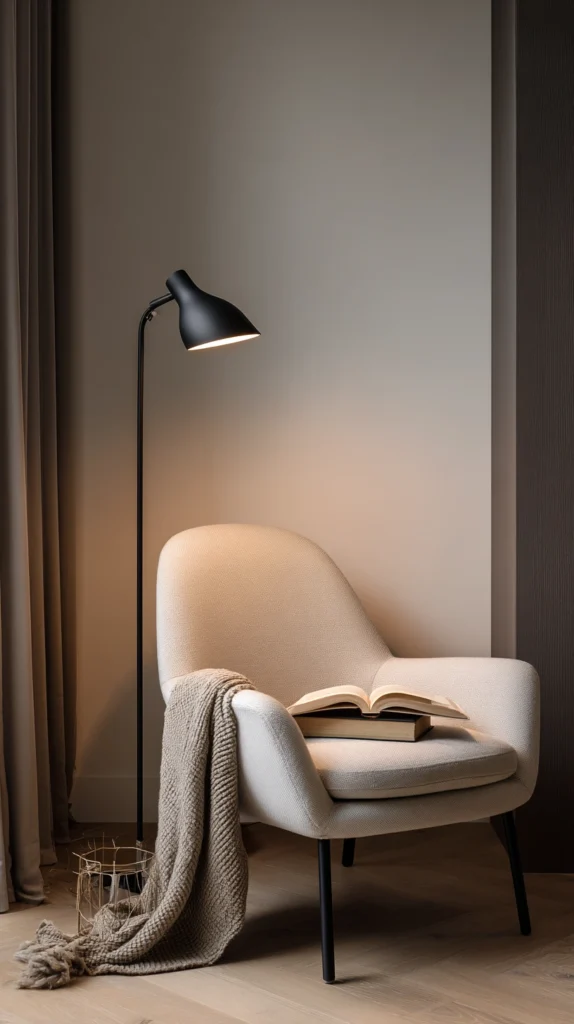
A floor lamp positioned specifically beside the reading seat, angled to illuminate a book without glare, using a warm 2700K bulb.
Why dedicated lighting matters more than any other single addition
Reading in poor or improperly angled light causes eye strain within a short period, which quietly discourages a nook’s use even when every other element is comfortable and well-styled. A lamp positioned and angled specifically for reading solves a problem most people don’t consciously identify but feel anyway.
Placement and specification
- Positioned beside and slightly behind the shoulder, so light falls onto the page without shining directly into the eyes
- An adjustable arm or shade angle allows fine-tuning once the seat and lamp are both in their final position
Cost breakdown
- Adjustable floor lamp: $50–120
- Total: $50–120
5. A Small Side Table Within Arm’s Reach
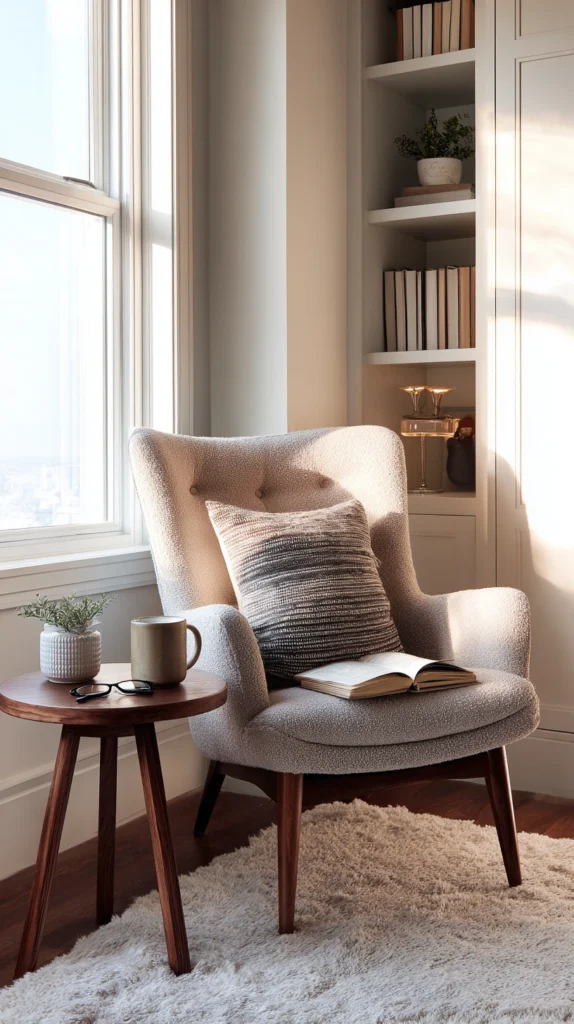
A small table beside the reading chair, sized for a mug, a book, and a pair of glasses, positioned close enough to use without leaning or standing.
Why proximity matters more than the table’s style
A side table positioned even a foot too far away breaks the ease of a reading session, requiring a small reach or a brief pause to retrieve a drink or set down a book. The table’s exact style matters far less than its placement directly within comfortable arm’s reach of the seated position.
Sizing
- Height: matched to the arm height of the chair, typically 20–24 inches
- Surface size: at least 12×12 inches, enough for a mug and a book simultaneously
Cost breakdown
- Small side table: $30–70
- Total: $30–70
6. A Built-In Corner Nook With Flanking Shelving
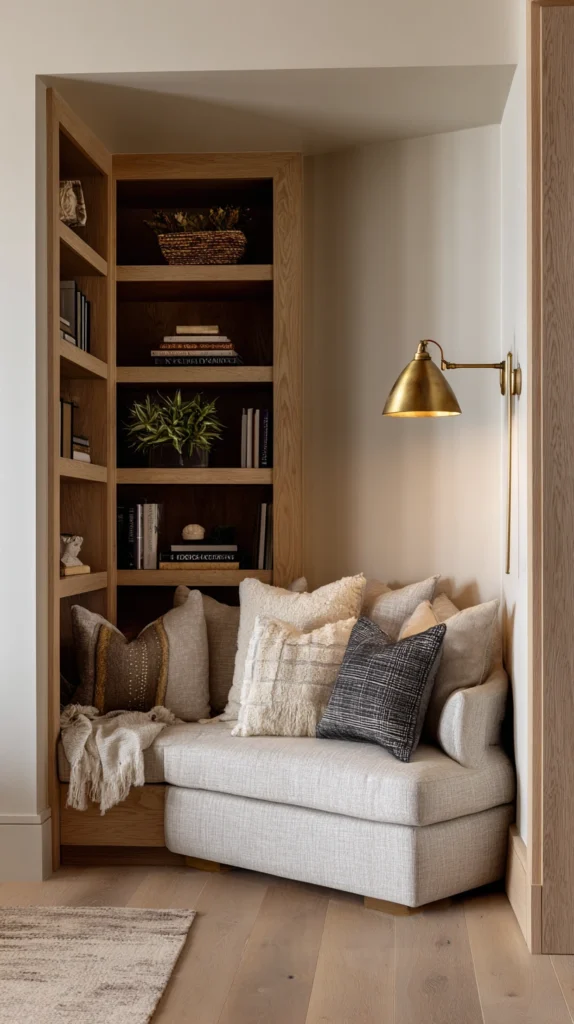
A reading chair positioned into a corner, flanked on one or both sides by built-in or freestanding bookshelves, creating a partially enclosed, retreat-like feeling.
Why flanking shelving adds to the sense of retreat
Shelving on either side of a reading chair creates a partial visual and physical boundary, giving the nook a more defined, enclosed quality than an open chair placed in the middle of a larger room. It also puts a rotating selection of books within immediate reach, reinforcing the space’s specific purpose.
Design considerations
- Shelving depth: 8–10 inches, standard for book storage
- Positioned so the shelves partially wrap the seating area without fully blocking the light source (a window or lamp) needed for reading
Cost breakdown
- Freestanding bookshelf (if not already owned): $100–250
- Total: $0–250 depending on existing furniture
7. A Faux Fur or Sheepskin Accent Throw
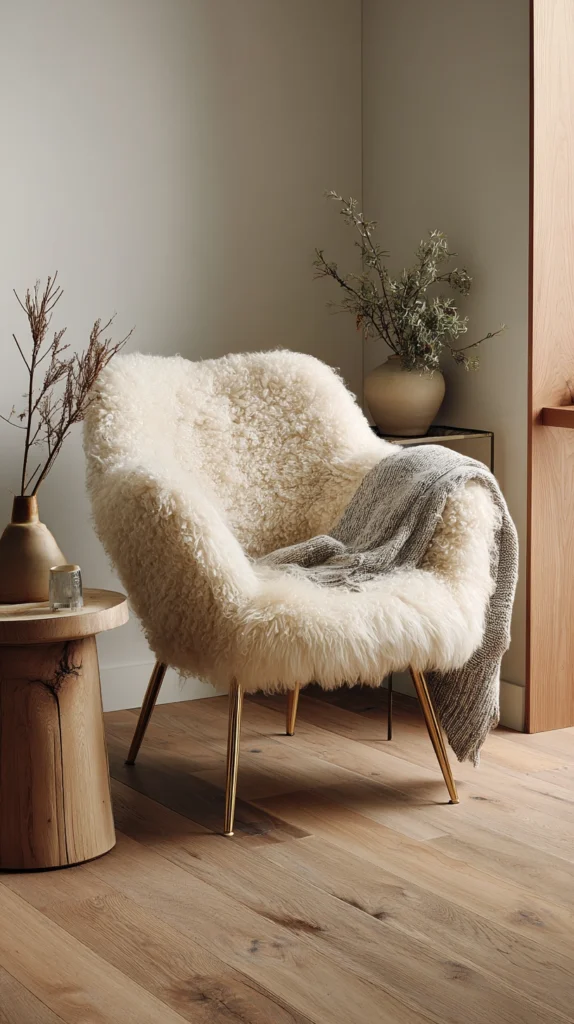
A faux fur or genuine sheepskin throw, draped over the seat itself or the chair’s back, adding a distinct, high-texture layer beyond a standard woven throw.
Why this specific texture suits a reading nook particularly well
A sheepskin or faux fur throw provides a different tactile experience than a woven blanket — something to sit directly on or wrap around bare skin — which suits a nook meant for settling in for an extended period more than a throw meant only to be pulled over the lap.
Placement
- Draped directly over the seat cushion, beneath where someone would actually sit, rather than only over the back or arm of the chair
- One piece is generally sufficient; more than one competes for the same visual and functional role
Cost breakdown
- Faux fur or sheepskin throw: $40–90
- Total: $40–90
8. A Clip-On Task Reading Light
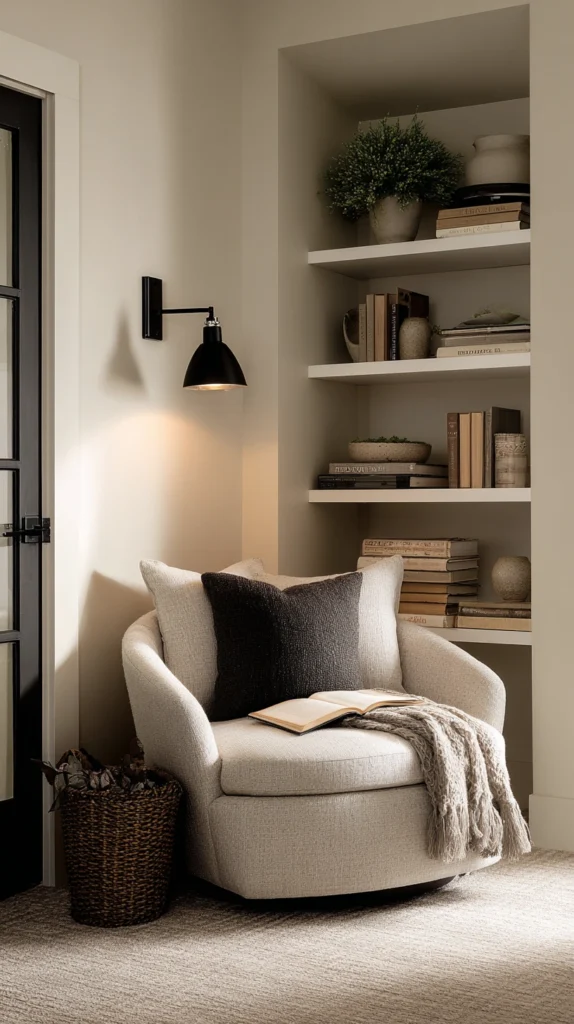
A small clip-on or clamp-mounted task light, attached directly to a nearby shelf or the chair itself, for a nook where a full floor lamp isn’t practical.
Why this suits a smaller or more space-constrained nook
Not every reading nook has room for a floor lamp, particularly in a tucked-in corner or a small apartment. A clip-on light delivers the same dedicated, angled task lighting in a fraction of the footprint, attaching directly to an existing shelf, headboard, or chair frame.
Placement and bulb specification
- Clamped at a height roughly level with or slightly above the shoulder when seated
- A warm 2700K bulb, consistent with the lighting principle used throughout any considered reading space
Cost breakdown
- Clip-on task light: $20–45
- Total: $20–45
9. A Curtain-Draped Nook
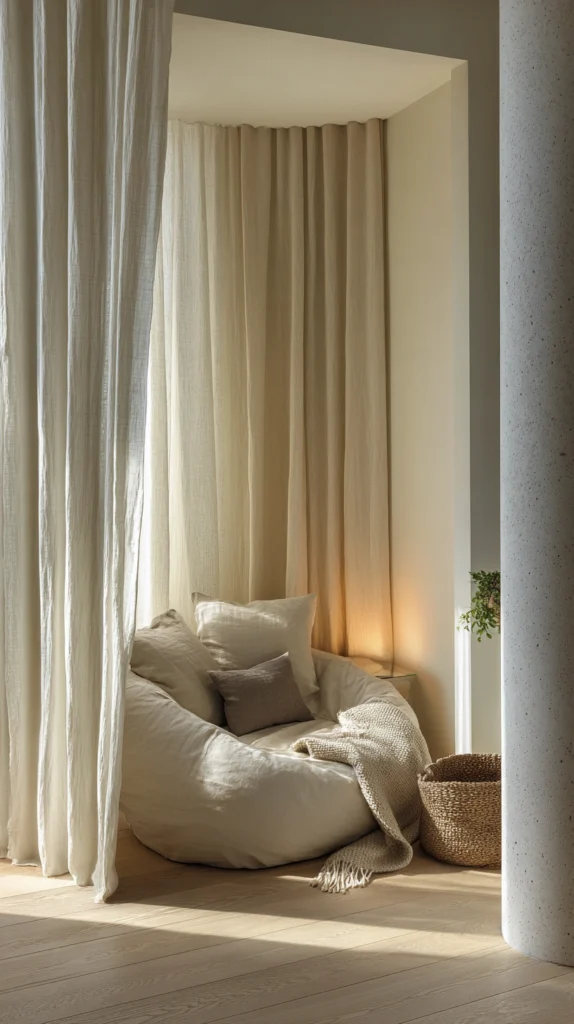
A single curtain panel or a small canopy of fabric, hung to partially enclose the reading chair, creating a sense of a room within a room.
Why a curtain adds enclosure without construction
For a nook positioned in an otherwise open area — a corner of a bedroom or living room without walls to naturally enclose it — a hung curtain panel creates a soft, adjustable boundary. It can be drawn closed for a fully private reading session or left open when not in use, without any structural change to the room.
Installation
- A curtain rod mounted to the ceiling or a nearby wall, positioned to allow the panel to be drawn around at least one open side of the chair
- A heavier fabric (velvet or a lined cotton) adds both visual weight and a genuine sense of enclosure when drawn
Cost breakdown
- Curtain panel and rod: $50–100
- Total: $50–100
10. A Low Floor Cushion Nook
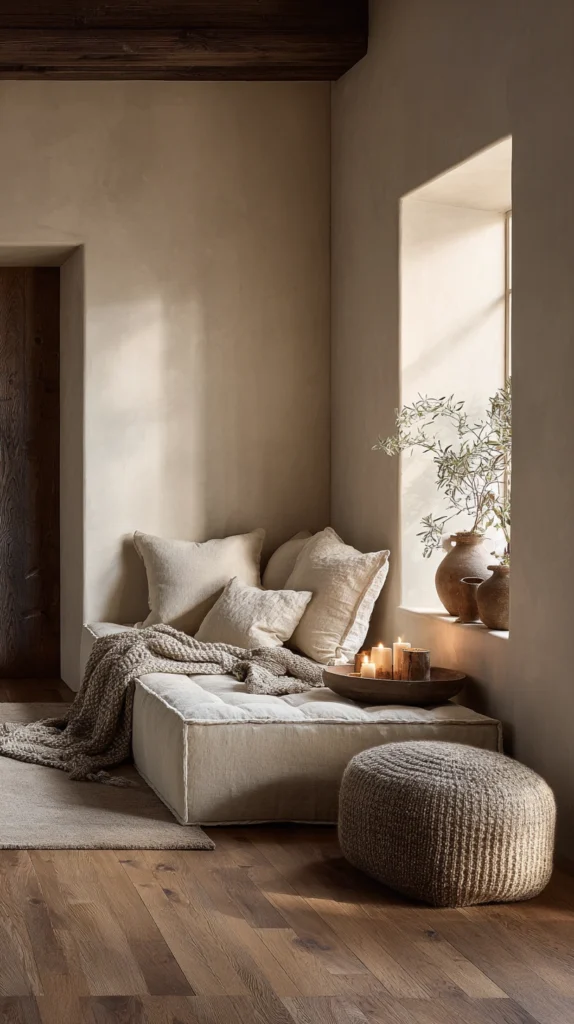
A grouping of floor cushions and a low pouf, rather than a raised chair, for a more casual, ground-level reading setup suited to a smaller space or a more relaxed reading style.
Why floor seating suits certain spaces and habits better than a chair
A floor cushion nook requires significantly less floor footprint than a chair and ottoman, making it well suited to a small bedroom corner or a shared space where a large piece of furniture isn’t practical. It also suits anyone who reads more comfortably cross-legged or reclined at floor level than upright in a chair.
Assembly
- 2–3 floor cushions layered for height and back support, positioned against a wall or the side of a piece of furniture for lumbar support
- A low pouf or ottoman nearby for a drink or a stack of books
Cost breakdown
- Floor cushions (2–3): $60–110
- Low pouf: $40–80
- Total: $100–190
11. Positioning the Nook Near an Existing Heat Source
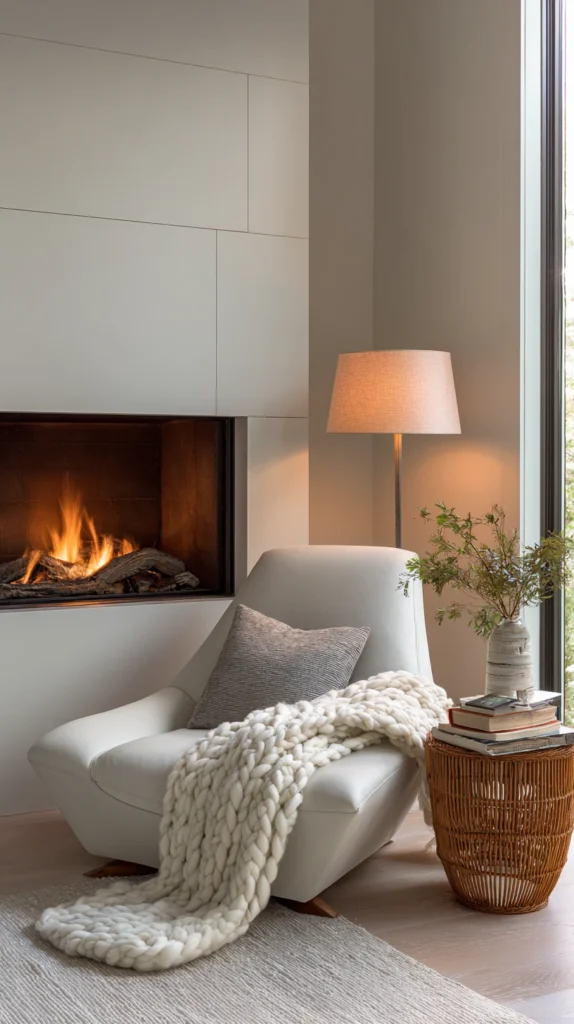
Locating the reading nook near a radiator, a fireplace, or a room’s warmest existing zone, rather than styling a nook first and discovering afterward that the spot runs cold.
Why heat source proximity should be decided before furniture placement
A beautifully styled nook in a genuinely cold corner of the house gets used far less than a more modestly styled one in a warm spot, regardless of how much throw and cushion layering is added afterward. Checking which corners of a room actually stay warm through a fall evening, before committing to a specific location, prevents this problem entirely.
Practical considerations
- A radiator or heating vent nearby provides passive, no-maintenance warmth
- If no natural heat source is available nearby, a small space heater (see the same principle applied to a she shed makeover) can serve the same function
Cost breakdown
- Small space heater, if needed: $40–90
- Total: $0–90 depending on existing heat source availability
12. A Personal Gallery Wall Behind the Nook
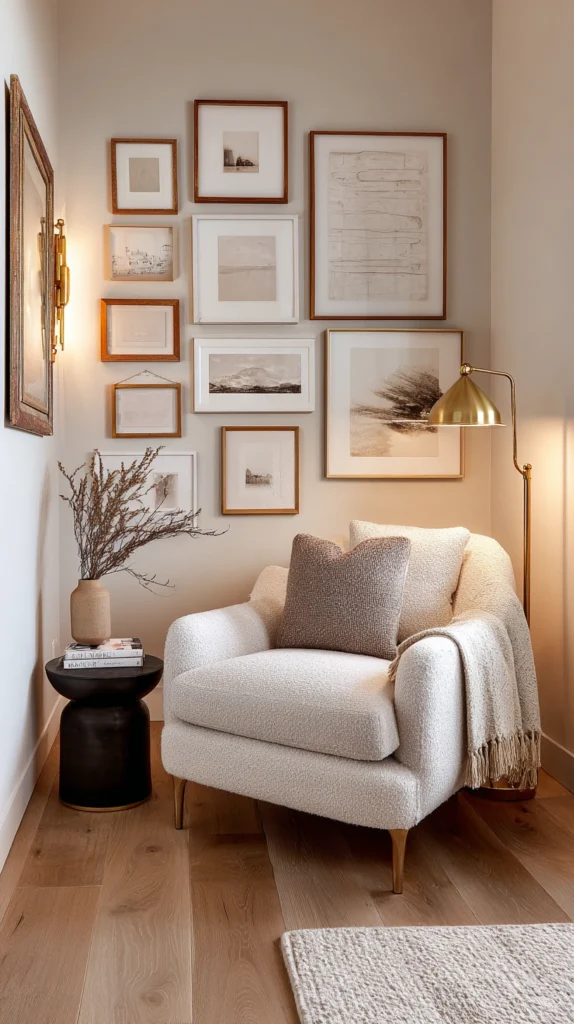
A small cluster of personally meaningful art, photos, or prints arranged on the wall directly behind or beside the reading chair, visible during the brief moments spent looking up from a book.
Why this detail matters specifically in a reading nook
A reading nook is used for extended, relatively still periods, giving the eye more opportunity to take in its immediate surroundings than in a room passed through quickly. A personally curated gallery wall reinforces the nook’s function as a genuine personal retreat, not just a functional reading spot.
Layout guidance
- 4–6 pieces, positioned within easy sightline of the seated position, following the same gallery wall principles used in any home
- Kept relatively low-contrast and calm in subject matter, so the wall doesn’t compete with the quiet, focused activity the nook supports
Cost breakdown
- Frames for existing personal items (4–6): $25–55
- Total: $25–55
13. A Basket for Current Reads
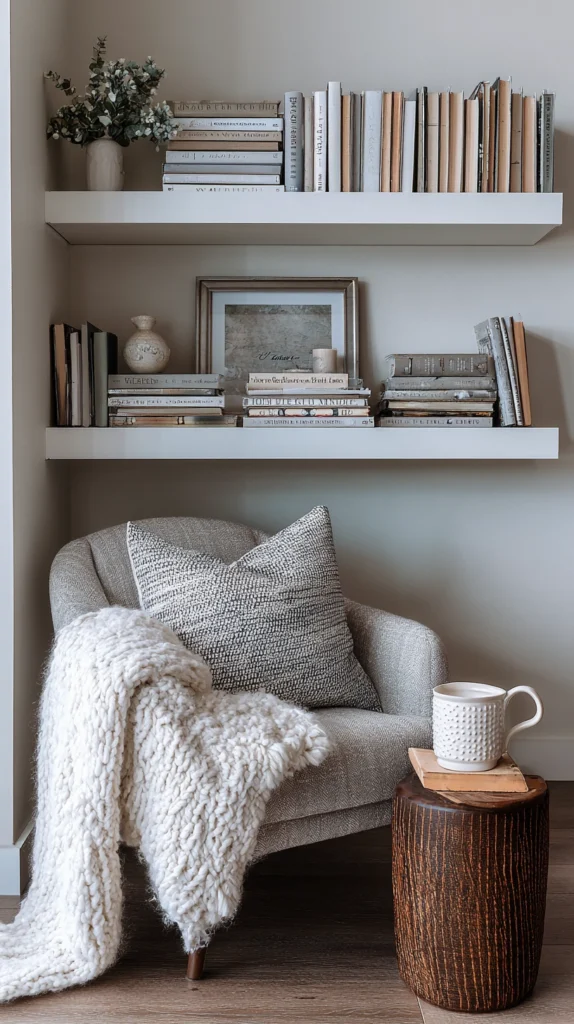
A small basket or crate beside the chair, holding the current book in progress along with one or two others queued up next, rather than books scattered across the house or stacked precariously on the side table.
Why a dedicated book basket keeps the nook in active use
Books left in multiple locations around the house — a nightstand, a kitchen counter, a bag — make settling into the nook to read a matter of first tracking down the right book. A single basket at the nook itself removes that friction, keeping every current read exactly where the reading actually happens.
Sizing
- Small to medium basket, 10–14 inches, sized for 3–5 books at a time
- Positioned on the floor beside the chair or on the lower shelf of the side table
Cost breakdown
- Small woven basket: $18–35
- Total: $18–35
14. A Candle or Diffuser Station

A candle or reed diffuser in a warm, autumnal scent, positioned on the side table, adding a sensory layer to the reading experience beyond sight and touch.
Why scent supports the nook’s retreat function
A consistent, pleasant scent associated specifically with the reading nook can help signal, almost like a ritual, that it’s time to settle in and slow down — the same association many people already have with a particular tea, coffee, or environment. A candle also adds a small amount of warm, flickering light that complements the reading lamp rather than competing with it.
Placement and safety
- Positioned on the side table, away from any fabric or the throw collection, if lit rather than using a flameless diffuser
- A reed diffuser is a safer, lower-maintenance option for a nook without direct supervision during use
Cost breakdown
- Candle or reed diffuser: $20–40
- Total: $20–40
15. The Complete Fall Reading Nook
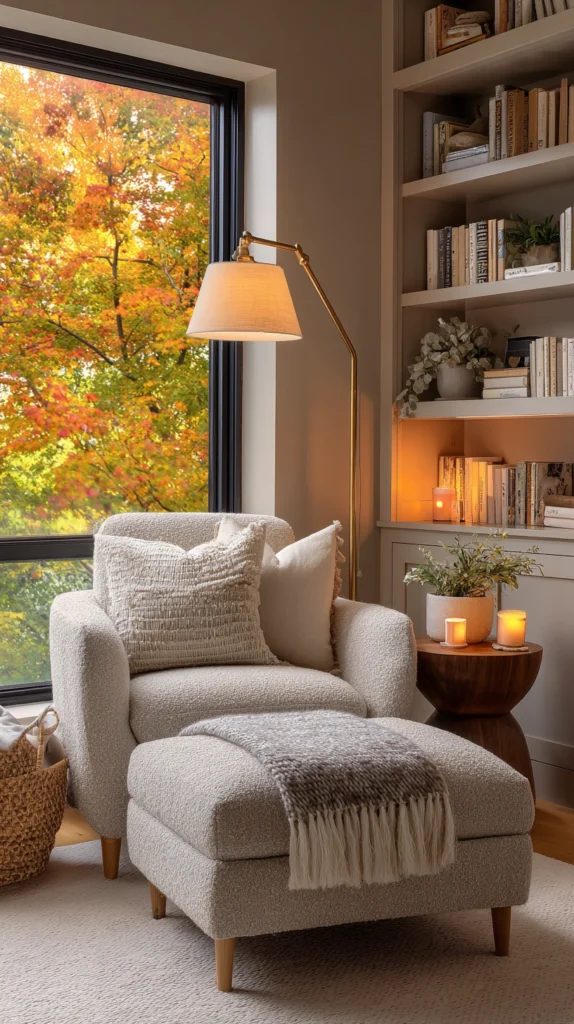
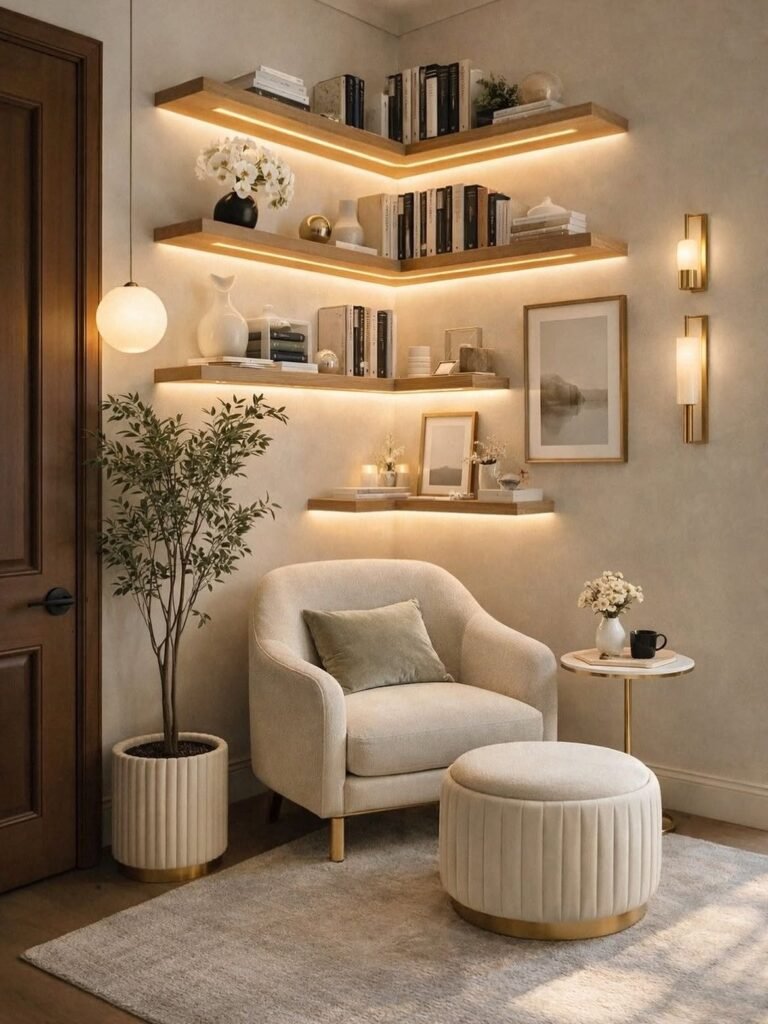
A reading nook built with every principle above applied together — the definitive version of a small corner that reads as genuinely inviting and actually gets used through the darker evenings of fall.
What separates the complete nook from a nice chair in a corner
A beautiful chair with no dedicated light, no nearby book storage, and no heat source nearby still won’t get chosen over the sofa on a cold October evening. The complete version resolves every functional and sensory layer at once — comfort, light, warmth, texture, and easy access to everything needed — so the nook wins out against the more obvious, easier default of the main living space.
The elements of the complete nook
The seating:
- A deep armchair and ottoman, or a cushioned window bench, whichever suits the space (Idea #1 or #2)
- A faux fur or sheepskin throw layered directly on the seat (Idea #7)
The warmth:
- Layered throws in varied weights (Idea #3)
- Positioned near an existing or added heat source (Idea #11)
The light:
- A dedicated floor lamp or clip-on task light (Idea #4 or #8)
The essentials within reach:
- A small side table for a drink and glasses (Idea #5)
- A basket for current reads (Idea #13)
The atmosphere:
- A candle or diffuser station (Idea #14)
- A personal gallery wall nearby (Idea #12)
The enclosure, if space allows:
- Flanking bookshelves or a hung curtain panel, for an added sense of retreat (Idea #6 or #9)
The nook on an ordinary fall evening:
The lamp is already angled correctly from the last reading session, the current book sitting in the basket exactly where it was left. The throw comes off the chair back without needing to be searched for, and the candle beside the side table adds a small, warm glow alongside the lamp. Nothing about settling in requires a decision or a search — every piece of the nook has already solved the problem of what’s needed for the next hour of reading.
Cost breakdown for the complete nook
Assuming a starting point of an empty corner:
- Chair and ottoman: $400–870
- Sheepskin or faux fur throw: $40–90
- Layered throws: $65–115
- Floor lamp: $50–120
- Side table: $30–70
- Basket for books: $18–35
- Candle or diffuser: $20–40
- Gallery wall: $25–55
- Space heater, if needed: $0–90
Total: $648–1,485
Phased over two stages:
Stage one ($200–400):
- A single comfortable chair (secondhand if needed)
- One throw
- A basic lamp
Stage two ($450–1,100):
- Ottoman
- Additional throws and the sheepskin layer
- Side table, book basket, candle, and gallery wall
The complete fall reading nook: not a chair placed in a corner, but a small, fully solved system built around exactly what an hour of evening reading actually requires.
The Question Before Any Reading Nook Project
Before buying a single piece:
Which corner of the home actually stays warm and gets good evening light?
If the answer is: near a window with afternoon sun and evening lamp access — the window bench nook makes the most of both natural and artificial light through the day.
If the answer is: a corner with no natural light source, but warm and quiet — prioritise the floor lamp and candle layer heavily, since all the light will need to be added rather than borrowed from a window.
If the answer is: a smaller apartment with no truly spare corner — the floor cushion nook or a single chair with a clip-on light requires the least footprint of any option on this list.
If the answer is: unsure, and several corners seem plausible — sit in each one for ten minutes with a book before committing; comfort and warmth are felt, not just seen, and the right corner is often not the most visually obvious one.
The nook’s location follows where it will actually feel good to sit for an hour, not the most photogenic corner of the room. A nook in the right spot, modestly furnished, gets used far more than an elaborate one in the wrong corner.
Getting Started This Weekend
The immediate reading nook fix:
Choose one corner and test it by sitting there with a book for ten minutes.
Confirms warmth and comfort before any purchase is made.
Add one comfortable seat, even a borrowed chair from elsewhere in the house.
The foundation everything else builds around.
Position one lamp specifically for reading, angled to avoid glare.
The single most overlooked functional requirement.
Add one throw and a small basket for the current book.
Removes the friction between deciding to read and actually settling in.
The rest of the nook: the elaboration of this weekend.
The corner: the beginning. The reading nook: what an unused space becomes once it’s actually built for the hour someone wants to spend in it.