15 Foyer Decorating Ideas for Welcoming Entryways
15 Foyer Decorating Ideas for Welcoming Entryways
Most homeowners spend their decorating energy on the rooms guests actually sit in — the living room sofa, the dining table, the kitchen backsplash — and treat the foyer as whatever space is left between the front door and the rest of the house. A console table inherited from a previous owner. A pile of shoes. Whatever flat-panel light fixture came with the builder package.

That instinct wastes the one room in the house that every guest, every delivery, and every member of the household passes through multiple times a day, and that forms an impression before anyone has seen anything else.
The foyer is not the leftover space between outside and inside. It is its own room, with its own scale, its own rules, and its own job to do. A decorating approach that works beautifully in a living room often falls flat in an entry — and a few of the best entry ideas would look strange anywhere else in the house.
Here are 15 ideas for turning a foyer into a space that earns its place at the front of the house.
Why the Foyer Plays by Different Rules
The rules are not the same for every room in the house:
Living Room Advantages:
- Long dwell time (people notice details slowly, over an evening)
- Large square footage (room for multiple seating zones and a slow visual reveal)
- Forgiving sightlines (you see one wall at a time, rarely the whole room at once)
The living room comparison: a slow reveal, not a single glance
Foyer Advantages:
- Total visual impact registers in ten seconds or less
- One sightline does almost all the work (the eye takes in most of the room from the doorway)
- The highest impact-per-square-foot of any room in the house
- The lowest furniture commitment in the house — a console and a mirror can be the entire plan
The key insight:
- Most living room design rewards patience and editing over time
- Most foyer design rewards committing early and going slightly bolder than feels comfortable
- These are different design problems, not the same room at a different size
The Measurement Reality
The most important number in foyer design:
The clearance width:
- Every entryway needs a minimum amount of walkable floor space
- Most designers recommend at least 36 inches of clear path for foot traffic
- A door that swings inward needs its full arc accounted for before any furniture goes against a wall
- Know this number — it governs every other decision in the room
The “scale before style” calculation:
- A console table is typically 14–18 inches deep; subtract this from the wall-to-clearance distance before buying anything
- Add a few extra inches for breathing room — furniture pushed flush to a wall always looks more cramped in person than it did on a floor plan
- A mirror leaned against a console needs at least 4–6 inches of surface depth to stand safely
- Most foyer mistakes happen because the furniture was chosen before the space was measured
Foyer styling happens in layers, not all at once:
- This surprises most homeowners
- The elements that read as “finished” rarely arrive together
- Furniture first, then lighting, then the smaller layers — rug, art, greenery, scent
- The work is sequential; the impact is cumulative
1. The Console Table (The Foyer’s Foundation Piece)
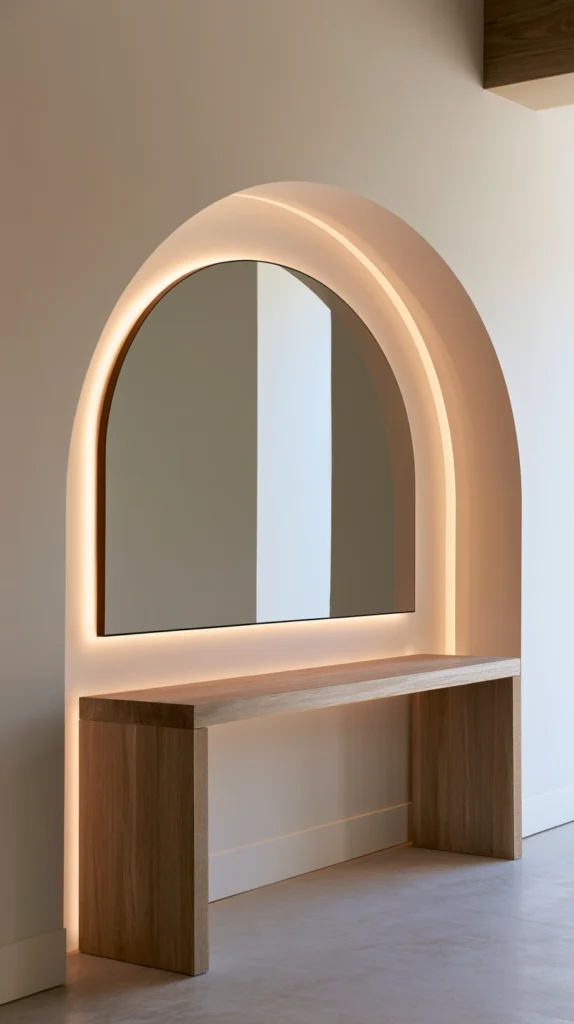
A single, well-proportioned console table — the piece of furniture that does more to define a foyer’s character than anything else in the room.
Why the console table is the entryway’s most important decision
- The anchor point: every other choice in the room — mirror, lamp, vignette — gets sized and placed in reference to this table, not before it
- The first furniture decision: most foyer design conversations start and end with this single piece
- The function-meets-form requirement: it has to hold keys and mail without looking like a drop zone
The styles
- Demilune (half-moon) console — the best option for narrow hallways, since the curved front takes up less visual space
- Console with drawers — hides everyday clutter behind a clean front
- Slim console (12–14 inches deep) — built specifically for tight entries
- Vintage or antique chest — more character, less uniformity, often a better price than new furniture of comparable quality
The sizing
- Length: shouldn’t exceed roughly two-thirds of the wall it sits against
- Depth: 14–18 inches is standard, leaving the clearance discussed above
- Height: 34–36 inches, which pairs naturally with most mirror and lamp placements
Cost breakdown
- Budget console (assembled, big-box): $80–150
- Mid-range solid wood console: $250–450
- Vintage or antique find: $100–600, depending on condition and source
- Total: $80–600 depending on direction
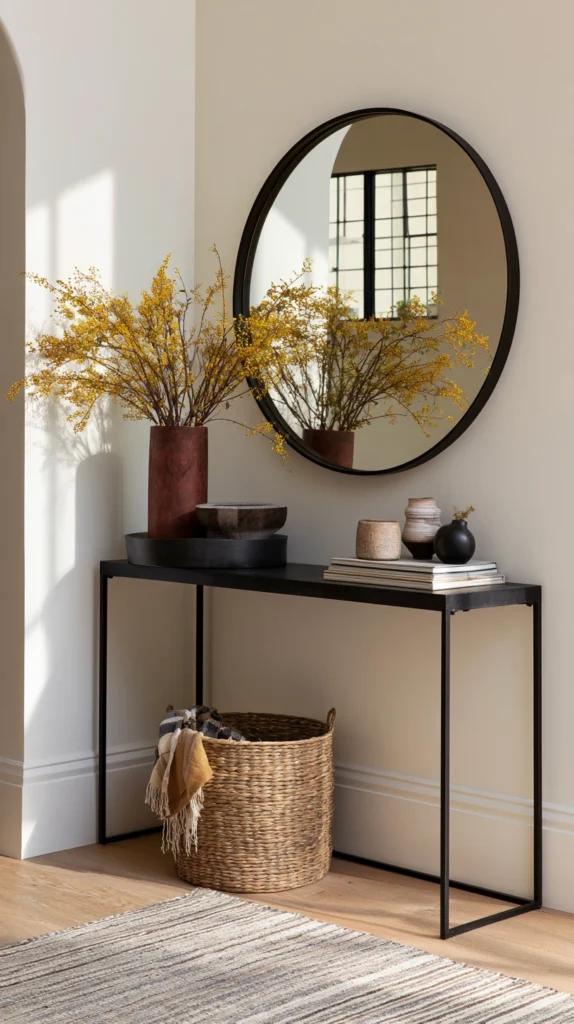
The console table in a finished foyer: the surface every other decision in the room quietly refers back to.
2. The Statement Mirror (Light, Space, and the First Glance)
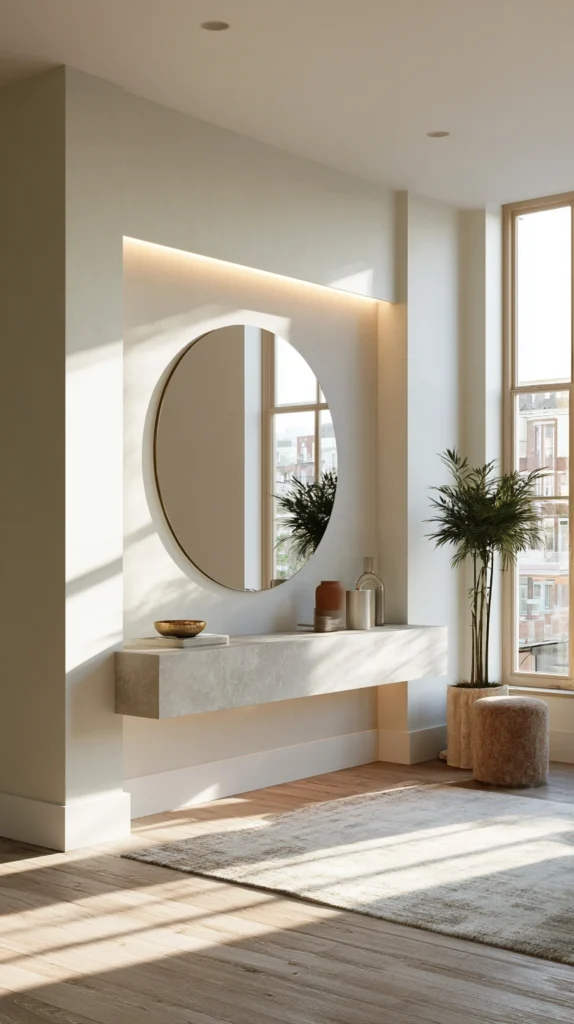
A large mirror hung above or leaned beside the console — the single object that does more to make a small foyer feel larger than any paint color or light fixture.
Why a mirror matters more here than almost anywhere else
- The light-bounce effect: foyers often have no windows, and a mirror doubles whatever light does reach the room
- The size illusion: a mirror at the right height visually doubles the perceived depth of a narrow entry
- The function bonus: a genuinely useful last-look-before-leaving spot, which most other rooms don’t need to provide
The shapes and placements
- Arched mirror — softens a boxy or square entry
- Round mirror — pairs well with a rectangular console and breaks up straight lines
- Leaning floor mirror — the right choice when there’s no wall space above the console
- Mirror grouping — several small mirrors instead of one large piece, a more eclectic and more demanding option
The sizing rule
- Width: roughly two-thirds the width of the console beneath it
- Height: center the mirror at eye level for an average adult, around 57–60 inches from the floor
- Clearance: leave 4–8 inches between the top of the console and the bottom of the mirror
Cost breakdown
- Budget mirror: $40–90
- Mid-range statement mirror: $150–350
- Large oversized or leaning mirror: $300–700
- Total: $40–700
3. The Layered Rug (Grounding the Entry Underfoot)
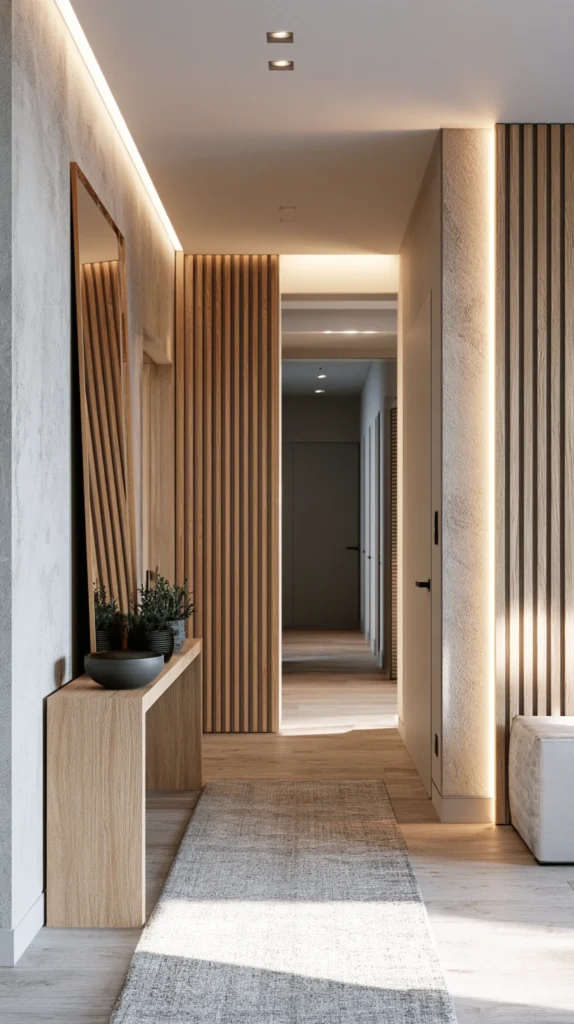
A rug or runner chosen specifically for the entry — the element that defines the walking path and absorbs wear no other rug in the house has to survive.
Why entry rugs need their own rules
- The traffic factor: more foot contact per square foot than almost any other rug in the home
- The weather factor: tracked-in moisture, mud, and salt, depending on climate
- The visual function: a runner draws the eye, and the visitor, down the hallway
The materials that hold up
- Flatweave wool or wool-blend — durable and forgiving of dirt
- Indoor-outdoor synthetic (polypropylene) — washable, the right choice in muddy climates
- Vintage or distressed-look rug — already forgiving of visible wear, so new wear looks intentional rather than careless
- Jute or sisal — natural texture, but less forgiving of moisture than the other options
The sizing and layering
- A runner should leave 4–6 inches of floor visible on each side of the hallway
- A rug under a console should extend a few inches beyond the table’s footprint on the front-facing side
- Layering a small patterned rug over a jute base adds texture without committing fully to one pattern
Cost breakdown
- Budget entry rug or runner: $40–90
- Mid-range wool or wool-blend: $150–350
- Vintage or designer runner: $300–900
- Total: $40–900
4. The Storage Bench (Function Disguised as Furniture)
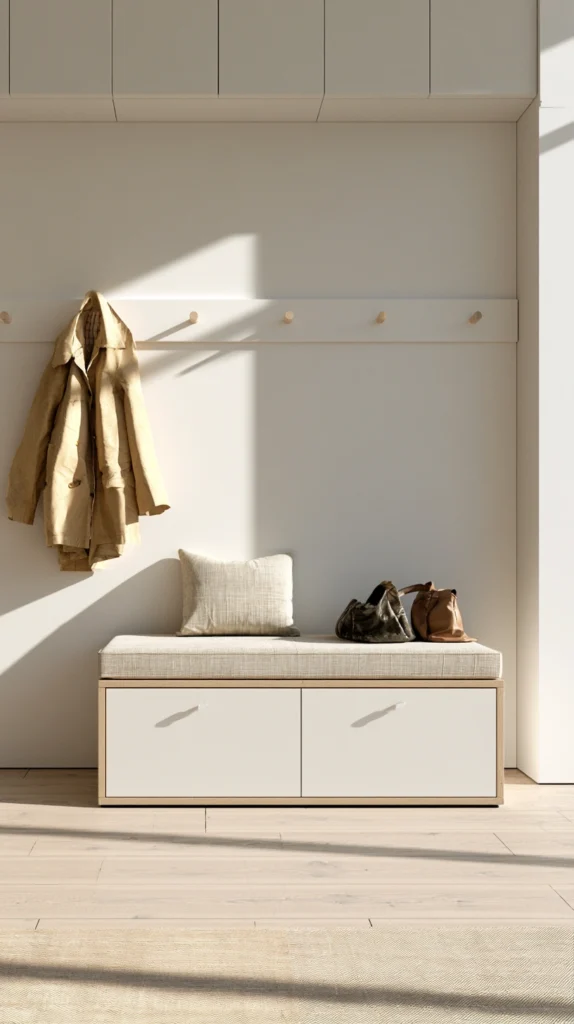
A bench with a lid, drawers, or baskets underneath — the piece that gives an entry somewhere to sit while solving the shoe pile problem at the same time.
Why a bench earns its place even in a small foyer
- The seated-task value: putting on shoes or pulling off boots is genuinely easier sitting down
- The hidden-storage value: a bench with storage absorbs clutter that would otherwise sit out in view
- The flexible-use value: doubles as a surface for bags or packages during a busy moment
The styles
- Upholstered bench with lift-top storage
- Open shelf bench with cubbies underneath for baskets
- Bench with hooks built into the back, combining two ideas on this list into one piece
- Slim entry bench, under 12 inches deep, for the tightest spaces
The placement
- Against the wall opposite the console, if the room can support two anchor pieces
- Under a window, if the foyer has one
- Length should respect the same 36-inch clearance rule as any other foyer furniture
Cost breakdown
- Budget bench: $60–120
- Storage bench with baskets: $150–300
- Built-in or custom bench: $400–1,200
- Total: $60–1,200
5. The Hook and Hall Tree Wall (Where Coats and Bags Actually Go)
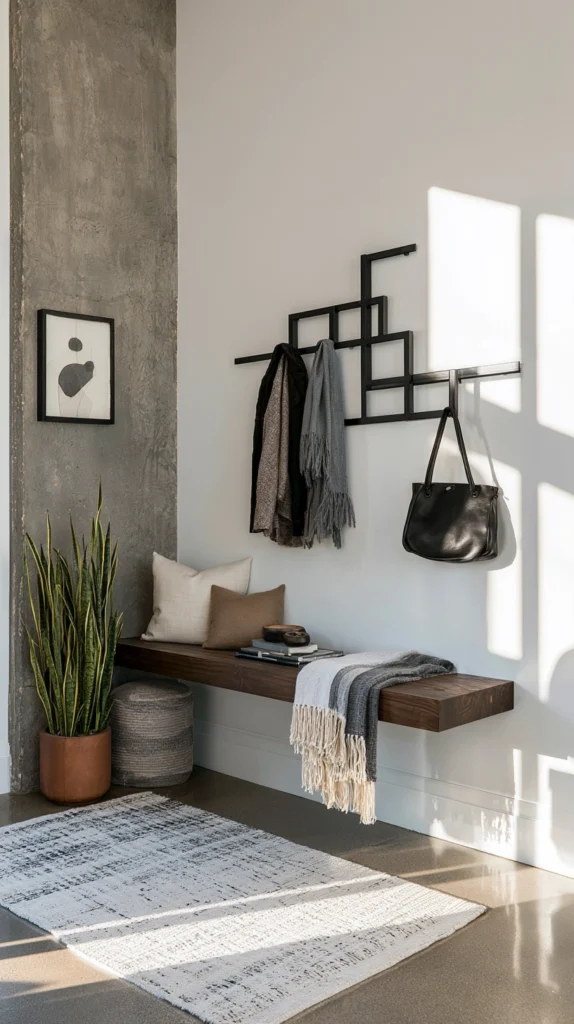
A dedicated wall of hooks, pegs, or a freestanding hall tree — the system that finally gives coats, bags, and leashes a real home instead of the back of a chair.
Why hooks solve what closets cannot
- The visibility advantage: a coat hung on a visible hook gets put away; a coat that has to be carried to a closet often doesn’t
- The daily-use logic: the things used every single day deserve to be the most accessible, not the most hidden
- The capacity problem: most entry closets aren’t actually sized for a busy household’s real volume of coats and bags
The configurations
- A row of evenly spaced wall hooks — simplest and most flexible
- A hall tree — a standing coat rack, often with a small bench and shoe storage built in
- A pegboard system — adjustable for a household whose needs change often
- Labeled hooks for a household with kids, each person assigned a spot
The placement
- Hook height: 48–60 inches from the floor for adult coats, with a lower row at 30–36 inches for kids or bags
- Spacing: 6–8 inches between hooks keeps coats from competing for the same patch of wall
- Weight rating matters more than style for anything holding a wet winter coat
Cost breakdown
- Set of wall hooks (5–6): $20–40
- Hall tree: $80–200
- Custom pegboard or built-in mudroom wall: $200–800
- Total: $20–800
6. The Lighting Layer (Pendant, Sconce, and Lamp Working Together)
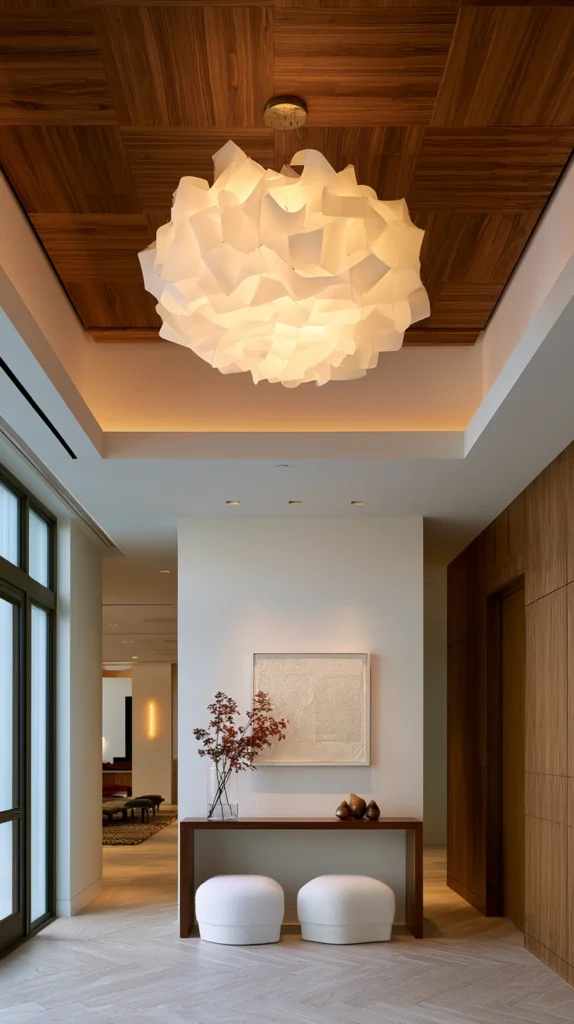
Overhead, wall, and table lighting used together, rather than relying on a single builder-grade fixture — the change that does more to make a foyer feel finished than almost any other single decision.
Why one light fixture is rarely enough
- The single-source problem: one overhead light creates flat, even illumination with no warmth or depth
- The layering principle: ambient (overhead), task (a console lamp), and accent (a sconce or picture light) working together create dimension a single source cannot
- The mood factor: a foyer lit only by a harsh overhead fixture reads as utilitarian; the same room with a warm lamp added reads as styled
The fixtures that make the difference
- Statement pendant or chandelier — the single biggest visual upgrade for a foyer with the ceiling height to support one
- Wall sconces flanking a mirror — adds symmetry and warmth without using any surface space
- A small lamp on the console — the easiest, lowest-cost layer to add first
- Picture light above art — an optional final layer for a fully styled wall
The practical execution
- Pendant height: hang so the bottom sits at least 7 feet above the floor in a walkway, to avoid head clearance issues
- Bulb temperature: warm white (2700–3000K) reads as inviting; cool white reads as clinical
- A dimmer is worth the small added cost on a fixture used at every hour of the day
Cost breakdown
- Small console lamp: $30–70
- Wall sconces (pair): $60–150
- Statement pendant: $150–500
- Total: $30–500, depending on how many layers go in at once
7. The Console Vignette (Styling the Surface That Greets Every Guest)
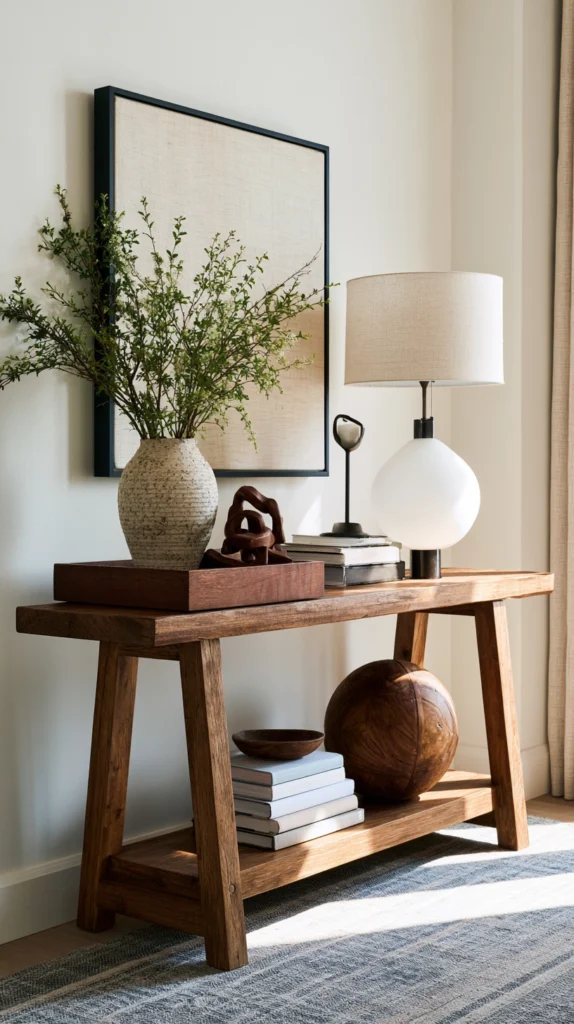
The intentional arrangement of objects on top of the console — the smallest-footprint decorating decision in the house, and one of the highest-impact.
Why the vignette matters disproportionately
- The first-surface effect: it’s the first flat surface a guest’s eye lands on, before the rest of the room even registers
- The daily-function tension: it also has to hold the things actually used every day — keys, mail — without looking like a junk drawer exploded onto a tabletop
- The editing requirement: a vignette with too many objects reads as clutter; the same objects, edited down, read as styled
The components of a working vignette
- A tray, which corrals small daily items so they look intentional rather than dropped
- A lamp or candle for height and warmth (see Idea #6)
- A small stack of books or a bowl, adding texture without adding function
- A single piece of art leaned against the wall behind the console, for height variation at a lower cost than hanging a mirror
The arrangement principle
- Vary height: at least one tall element and one low element in every grouping
- Group in odd numbers — three or five objects reads more natural than an even, symmetrical arrangement
- Leave negative space: a console covered edge to edge looks busy no matter how nice each individual object is
Cost breakdown
- Tray: $15–35
- Small decorative objects (bowl, books, vase): $20–60
- Total: $35–95 — one of the lowest-cost, highest-visibility upgrades on this entire list
8. The Wallpaper Moment (Color and Pattern in a Forgiving Small Space)
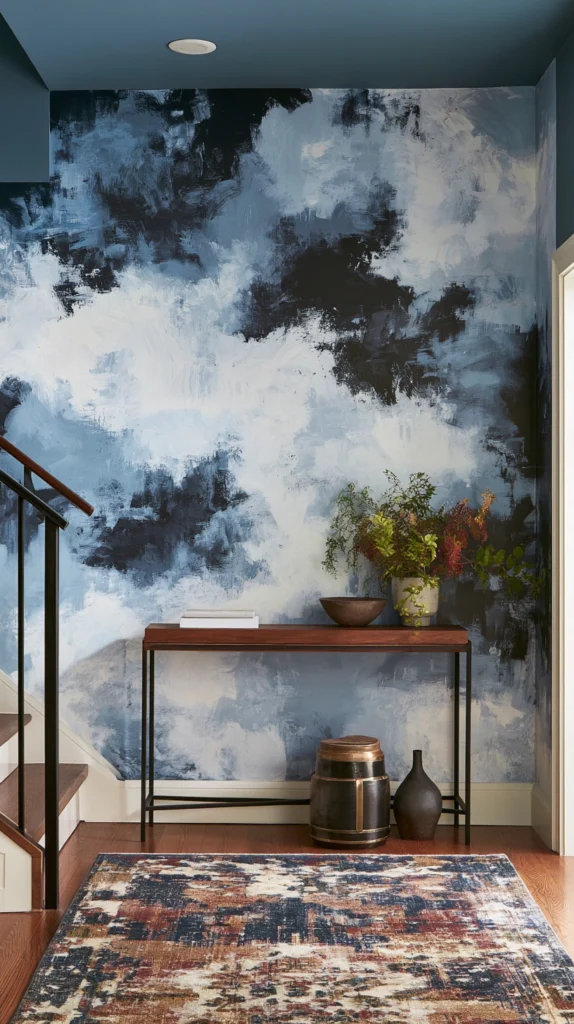
A bold wallpaper or paint color applied specifically to the foyer — the design risk that a small, enclosed room can absorb in a way a large open-plan space cannot.
Why the foyer is the right room to take a wallpaper risk
- The small-room logic: a pattern that would overwhelm a large living room reads as intentional and contained in a small foyer
- The enclosed-room logic: because the foyer often has no sightline into the rest of the house, a bold choice here doesn’t have to coordinate with every other room
- The reversibility factor: the smallest square footage in the house to redo if the choice ever stops working
The directions that work
- A large-scale botanical or mural-style paper, which makes a small room feel like a destination rather than a pass-through
- A deep, saturated paint color — navy, forest green, terracotta — that creates the same cocooning effect as wallpaper at a fraction of the cost
- A painted ceiling or “fifth wall,” which finishes the room from every angle, especially useful in foyers with a visible stairwell ceiling
- Wainscoting with a contrasting paint color above, a lower-commitment alternative to full wallpaper
The practical execution
- Measure twice: foyer walls are often broken up by doors, stairs, and closets, leaving less continuous wall than expected
- Test any color or paper sample at the time of day the foyer is actually lit — many entries have little to no natural light
- Budget for trim touch-up alongside any wall treatment
Cost breakdown
- Paint for one foyer (walls or an accent wall): $40–100
- Wallpaper, mid-range, small foyer: $150–400 in materials
- Professional wallpaper installation: $200–600 additional
- Total: $40–1,000, depending on DIY versus professional installation
9. The Gallery Wall (Art That Tells Guests Who Lives Here)
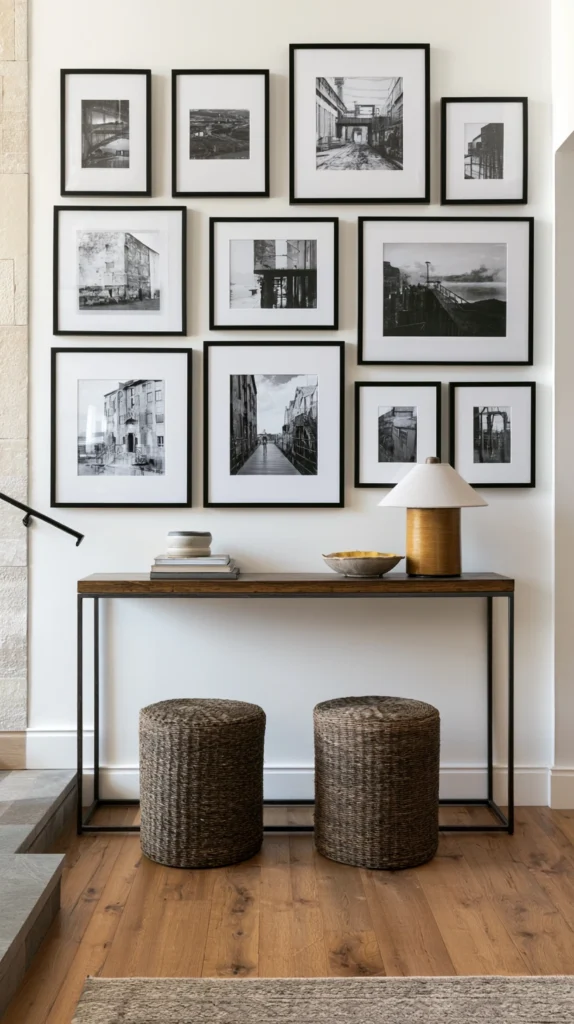
A curated arrangement of framed art, photos, or prints — the wall treatment that turns a foyer from a hallway into a room with a point of view.
Why a gallery wall belongs in the entry specifically
- The introduction function: it’s the first piece of personality a guest encounters, before any conversation has happened
- The narrow-wall solution: gallery walls work especially well on the tight, oddly-shaped walls foyers often have, where a single large piece wouldn’t fit
- The growable format: unlike one statement piece, a gallery wall can be added to over years without ever looking unfinished
The layout approaches
- Grid layout — uniform frame sizes and spacing, the most formal and symmetrical option
- Salon-style cluster — mixed frame sizes and a mix of art, photos, and small objects, more forgiving of imperfect spacing
- A single row at eye level — the simplest version, works well above a console or bench
- Mixed media — art combined with small mirrors or shelves, adding dimension beyond flat frames
The practical execution
- Lay the arrangement out on the floor, or trace frame outlines on paper and tape it to the wall, before drilling a single hole
- Center the visual middle of the whole arrangement at eye level, roughly 57–60 inches, not the top or bottom edge
- Keep spacing consistent (2–3 inches) in a grid; spacing can vary intentionally in a salon-style cluster
Cost breakdown
- Frames, assorted budget options: $10–25 each
- A gallery wall of 6–9 pieces: $80–250 total
- Professional framing for a few statement pieces: $50–150 each
- Total: $80–400+, depending on framing choices
10. The Potted Greenery (Life at the Threshold)
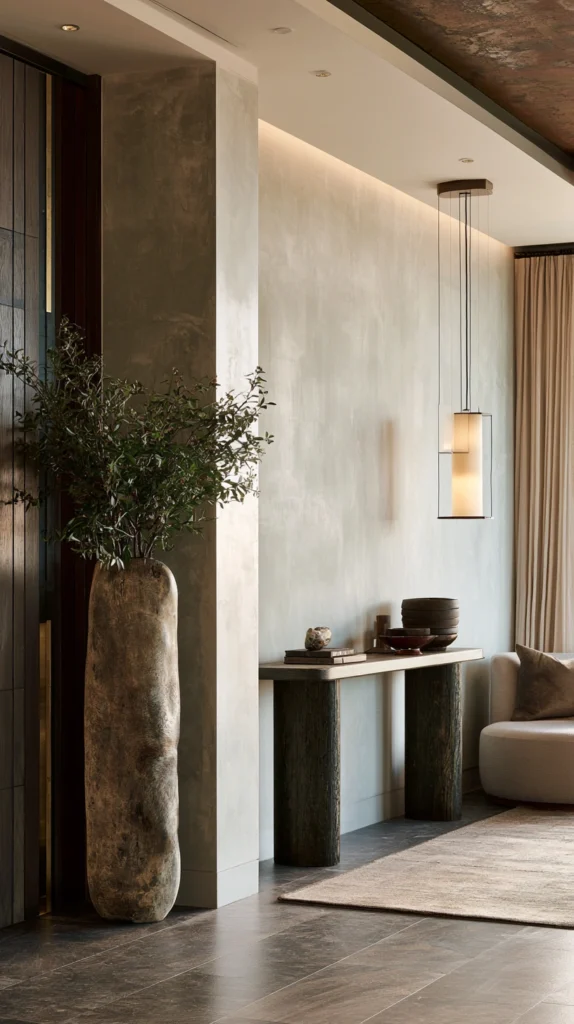
A plant placed at the entry — the single object most likely to make a foyer feel alive rather than staged.
Why a plant changes how an entry feels
- The living-object effect: everything else in a foyer is static; a plant is the one element that visibly changes day to day
- The low-light reality: most foyers have little natural light, which narrows the plant options without eliminating them
- The scale opportunity: a foyer is often the one spot in the house with enough floor space for a genuinely large plant, since it isn’t competing with seating or a dining table
The plants that tolerate foyer conditions
- Snake plant — extremely tolerant of low light and irregular watering
- ZZ plant — similarly low-light tolerant, with glossy leaves that read as more polished
- Faux olive or fiddle leaf tree — for entries too dark for anything living, a well-made faux tree at the right scale reads as real from a few feet away
- A simple branch arrangement in a floor vase — the lowest-maintenance “living” option, needing only an occasional water change
The placement
- Floor plants belong in the corner opposite the console, clear of the 36-inch traffic path
- Tabletop plants should be small enough to leave room for the vignette from Idea #7
- Match pot height to ceiling height — a tall, narrow entry can support a taller plant than a low-ceilinged one
Cost breakdown
- Small tabletop plant: $15–35
- Floor plant (snake plant or ZZ plant, larger pot): $40–100
- High-quality faux tree: $80–250
- Total: $15–250
11. The Scent Layer (The Invisible First Impression)
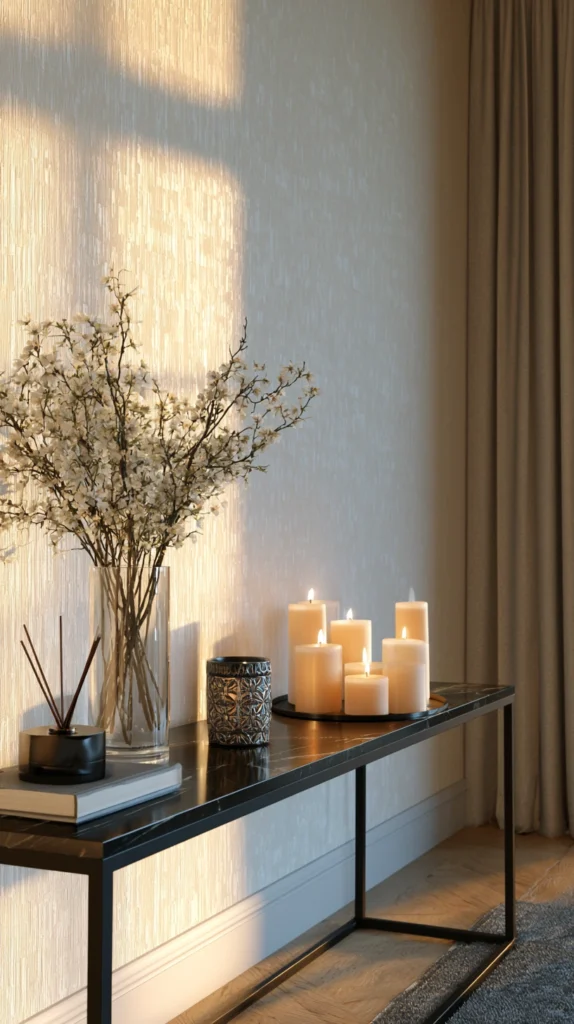
A candle, diffuser, or fresh flowers placed at the entry — the sensory layer that registers before a guest has consciously looked at anything else in the room.
Why scent matters more here than anywhere else in the house
- The timing advantage: smell registers before sight has fully processed the room, especially in the few seconds it takes to walk from the door to the console
- The transition signal: a consistent, pleasant scent at the entry tells a guest they’ve crossed into a cared-for space
- The low cost of high impact: scent is one of the cheapest layers on this entire list relative to the impression it makes
The options
- A reed diffuser — no flame, no daily maintenance, ideal for an entry that isn’t supervised
- A candle in a vessel that matches the console styling, adding warmth even unlit
- Fresh flowers or a flowering branch — scent and visual life together, though shorter-lived than a diffuser
- A bowl of dried citrus or cinnamon sticks — no flame, no electricity, the lowest-maintenance option of all
The practical execution
- Choose one scent and stay consistent — an entry isn’t the place to introduce three competing fragrances at once
- Avoid anything too strong for a small, enclosed space; what reads as pleasant in an open room can overwhelm a foyer
- Refresh on a schedule rather than waiting for it to be noticeably gone
Cost breakdown
- Reed diffuser: $20–45
- Candle: $15–40
- Fresh flowers, weekly: $10–25 per arrangement
- Total: $20–90, depending on the option chosen
The entry that smells intentional before a guest has registered a single object in the room: the impression that arrives first and lingers longest.
12. The Stair Landing Treatment (Where the Foyer Meets the Rest of the House)
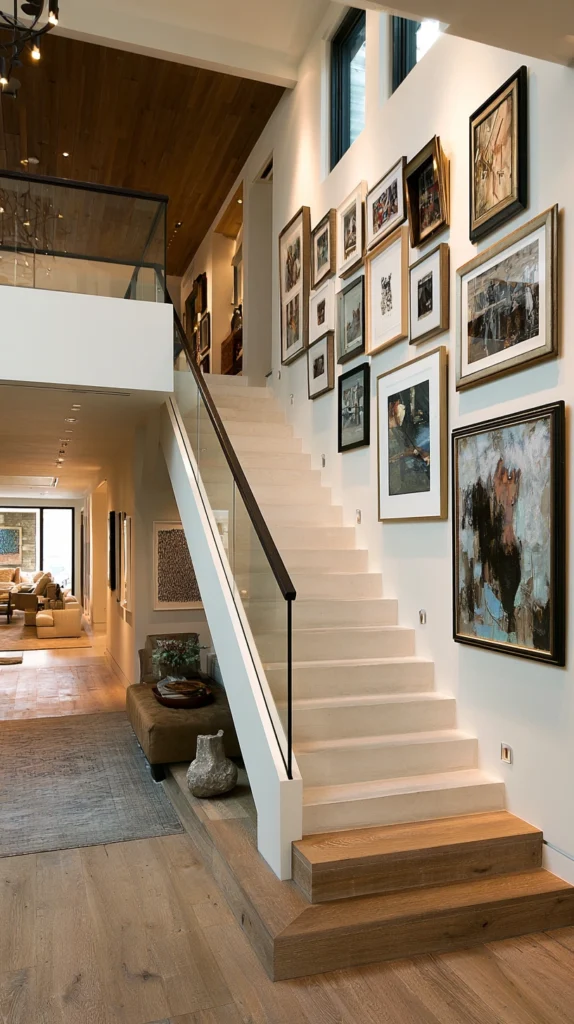
The bottom few steps, newel post, and landing of a staircase opening directly into the foyer — the transition zone most homeowners decorate last, if at all.
Why the stair landing deserves its own attention
- The sightline reality: in many homes, the staircase is the first thing visible from the front door, competing directly with whatever else has been styled in the entry
- The vertical opportunity: a staircase gives a foyer height that a flat hallway doesn’t have, and that height goes to waste if left undecorated
- The connective function: the landing is the visual bridge between the entry below and the hallway or rooms above
The treatments that work
- A stair runner, extending the rug treatment from Idea #3 upward and tying the two levels together visually
- Garland or greenery wrapped around the newel post or banister, seasonal or permanent depending on the material
- A piece of art, or a small gallery wall, running alongside the stair wall to fill the otherwise-empty vertical space
- A statement light fixture hung in a stairwell void, taking advantage of the one place in the house with enough vertical clearance for real drama
The practical execution
- Stair runners should leave 3–4 inches of wood visible on each side, secured with rods or tackless strips depending on the look
- Art on a stair wall should hang at a consistent angle relative to the stair pitch, not strictly level, or it will look crooked even when correctly measured
- Real garland on a banister needs seasonal replacing; faux holds up for years but should be high enough quality to avoid looking artificial up close
Cost breakdown
- Stair runner, materials and basic installation: $150–500 depending on stair count
- Garland or greenery for a banister: $30–80
- A small stairwell gallery wall: $80–250
- Total: $30–750, depending on how much of the staircase is addressed
13. The Drop Zone System (Mail, Keys, and the Daily Hustle, Organized)
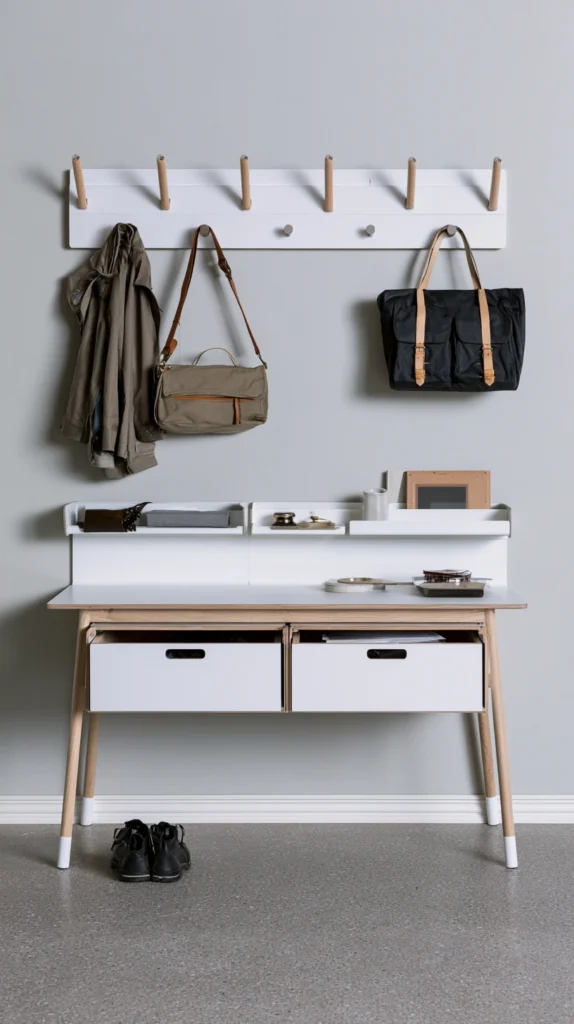
A small, deliberately organized system for mail, keys, and daily in-and-out items — the unglamorous infrastructure that determines whether the rest of the foyer’s styling survives contact with daily life.
Why a drop zone is the most underrated idea on this list
- The clutter-prevention logic: every other idea on this list gets undone within a week if there’s nowhere designated for keys, mail, and the small items that otherwise pile up on the console
- The invisible-when-working principle: a good drop zone is rarely noticed; only its absence is, in the form of clutter
- The household-specific design: a drop zone for one person looks different from one serving a family of five, and should be sized accordingly
The components
- A small tray or shallow dish for keys, the same tray from Idea #7 doing double duty
- A mail sorter or small file box, kept in a console drawer or basket if the surface needs to stay clean for styling
- A charging station — a small dish or drawer insert with a discreet outlet — for phones dropped at the door
- Labeled baskets, one per household member, the single most effective clutter solution for larger households
The practical execution
- Keep the drop zone within arm’s reach of the door, not across the room — a system that requires extra steps gets skipped
- Empty mail sorters and baskets on a fixed weekly schedule rather than letting them become permanent storage
- Match baskets and trays to the existing console styling so the functional system doesn’t visually compete with the decorative one
Cost breakdown
- Small tray and key dish: $15–30
- Mail sorter or file box: $15–40
- Labeled baskets (set of 3–4): $30–70
- Total: $15–140 — the lowest-cost idea on this list relative to how much it protects everything else
14. The Seasonal Door Display (The Entry That Changes With the Year)
A wreath, console swap, or small display rotated through the seasons — the layer that keeps a foyer from looking static year-round.
Why a seasonal layer matters even in a permanently styled room
- The lived-in-versus-showroom distinction: a foyer that never changes starts to read as staged rather than lived in; small seasonal swaps signal an actively cared-for home
- The low-stakes experimentation: a seasonal wreath or display is the lowest-commitment place to test a color or style direction before introducing it permanently elsewhere
- The guest-facing timing: holidays and seasons are exactly when a household has the most visitors, making the entry’s seasonal presentation disproportionately visible
The elements that rotate easily
- A door wreath, the simplest and most traditional seasonal swap
- A console vignette swap, using the same tray and lamp from Idea #7 with smaller objects rotated around them
- A doormat swap, paired with the permanent layering approach in Idea #15
- A small seasonal arrangement on the entry table — branches, gourds, or flowers depending on the time of year
The practical execution
- Store seasonal items in clearly labeled bins, sorted by season, so the swap takes minutes rather than becoming a search
- Limit the seasonal layer to two or three objects rather than redecorating the entire foyer four times a year
- Keep the permanent pieces — console, mirror, lighting — neutral enough that any seasonal color works against them
Cost breakdown
- Door wreath, one per season, basic: $15–40 each
- Seasonal vignette additions: $10–30 per swap
- Storage bins for rotation: $15–30
- Total: $55–150 for a full year of seasonal rotation, after the first year’s storage investment
15. The Doormat Layering (The Entry’s First and Last Word)
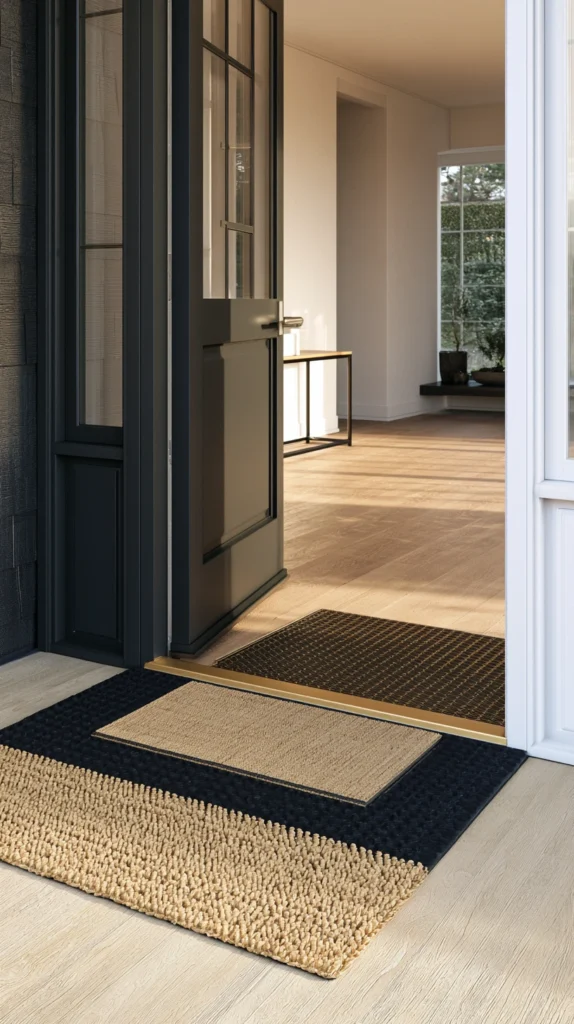
A doormat outside the door paired with a second mat or boot tray just inside it — the lowest-cost, highest-traffic idea on this entire list, and the one most often done with a single mismatched mat instead of two that actually work together.
Why the doormat deserves more thought than it usually gets
- The function-first reality: nothing else on this list takes more direct daily abuse — dirt, moisture, salt, and the literal weight of every person who enters
- The two-mat principle: an outdoor mat scrapes off the worst of the dirt; an indoor mat or boot tray catches what’s left before it ever reaches the rug from Idea #3
- The personality opportunity: a doormat is one of the few decorating choices visible from the street, setting an expectation before a guest has even reached the door
The pairing that works
- Outdoor: a coarse coir or rubber-backed mat, sized to fully cover the step or landing
- Indoor: a thinner, washable mat or a boot tray, sized to sit just inside the threshold without blocking the door’s swing
- A monogram or pattern on the outdoor mat, a small, low-cost way to make the entry feel specifically like this house
- A fully washable indoor mat in a busy household, far more practical than a delicate one that shows every mark
The practical execution
- Size the outdoor mat to the full width of the door, not narrower — an undersized mat looks like an afterthought
- Replace coir mats roughly every 1–2 years; they wear out faster than most homeowners expect given the abuse they take
- Choose an indoor mat that can be machine washed or hosed off, given how much moisture and dirt it’s designed to absorb
Cost breakdown
- Outdoor coir or rubber mat: $20–50
- Indoor washable mat or boot tray: $20–60
- Monogrammed or custom outdoor mat: $40–100
- Total: $40–160
The doormat outside the door and the second one just inside it: the cheapest idea on this list, and the one every single guest steps on before they see anything else.
The Foyer Decorating Roadmap
The work, sequenced:
Phase One (the furniture commitment):
- The console table (#1) — the single decision everything else refers back to
- The statement mirror (#2) — chosen against the console’s finished size and height
- The storage bench (#4), if the layout supports a second anchor piece
Phase Two (the walls and lighting):
- The wallpaper or paint moment (#8) — easier to do before furniture is sitting against the wall
- The gallery wall (#9), once the wall color is settled
- The lighting layer (#6) — pendant and sconces, ideally installed before the rug goes down
Phase Three (the layers):
- The layered rug (#3)
- The console vignette (#7)
- The potted greenery (#10)
- The hook and hall tree wall (#5)
Phase Four (the finishing touches):
- The scent layer (#11)
- The drop zone system (#13)
- The stair landing treatment (#12), if applicable
- The seasonal door display (#14)
- The doormat layering (#15)
Getting Started This Weekend
The immediate-impact entry refresh:
One weekend, three changes:
- Edit the console down to a tray, a lamp, and one or two objects (Idea #7)
- Add a plant in the corner opposite the console (Idea #10)
- Swap in a new outdoor and indoor doormat pairing (Idea #15)
Total cost: $50–90. Time: about two hours. The entry will look different by Sunday night, without a single piece of new furniture.
The structural foyer investment (the next big purchase):
The console table (Idea #1) is the single most important purchase on this list. Once it’s in place at the right scale, every other idea — the mirror above it, the lamp on top of it, the rug beneath it — has something to refer back to. A foyer built around the wrong console fights itself in a dozen small ways; a foyer built around the right one falls into place almost on its own.
What a finished foyer provides that no other room does:
The impression that arrives before a single conversation does:
- A mirror that makes a narrow space feel generous
- A scent that registers before the eye has settled on anything
- A console that looks intentional rather than incidental
The function that disappears into the design:
- A drop zone that means the console never collects the day’s clutter
- Hooks that mean coats never end up on the back of a chair
- A doormat system that means the rug inside never carries in what the mat outside should have stopped
The connection to the rest of the house:
- A stair landing that bridges the entry to everything above it
- A rug that sets the tone for the flooring choices beyond it
- A seasonal layer that keeps the room moving with the rest of the year, instead of standing still
The foyer is not the warm-up act for the rest of the house. It is the room with the least space and the most responsibility — the one place every visitor, delivery, and homecoming has to pass through, decorated or not. Every console chosen at the right scale is a decision that holds up for years. Every hook on the wall is one less coat draped over a chair in the room beyond it. The entry doesn’t wait for the rest of the house to be finished. It makes its impression first.