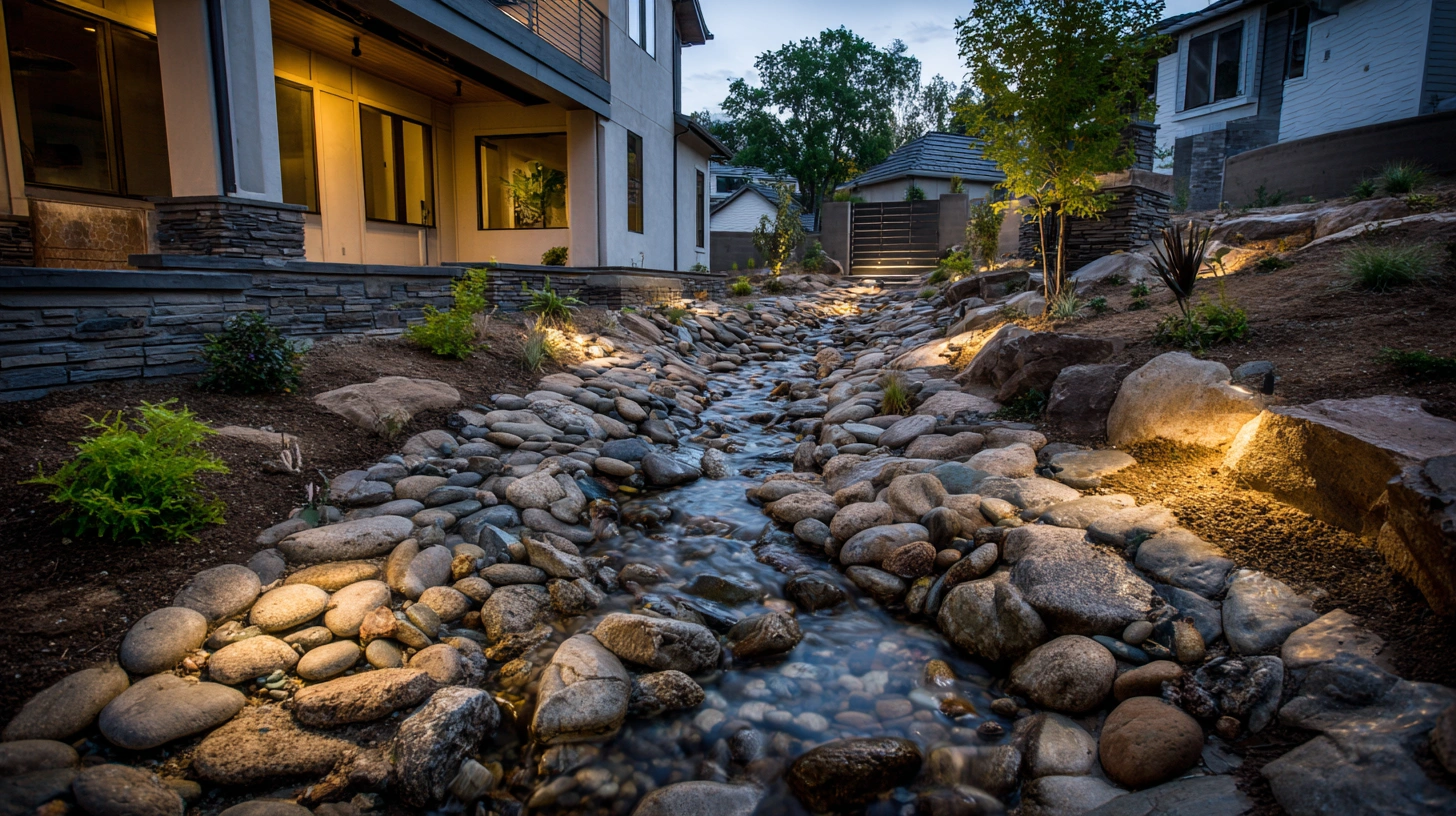
15 Dry River Bed Landscaping Ideas That Turn Problem Yards Into Stunning Features
15 Dry River Bed Landscaping Ideas That Turn Problem Yards Into Stunning Features
There is a specific yard problem that conventional landscaping consistently fails to solve. The low-lying area that collects water after every rain. The slope erodes a little more each season. The section of garden where grass refuses to establish, where the soil sits wet for days after a shower, where every planting attempt ends in the same slow decline. Conventional solutions — drainage pipes, retaining walls, resown grass — address the symptom without addressing the underlying aesthetic problem, which is that the difficult area looks like a difficult area.
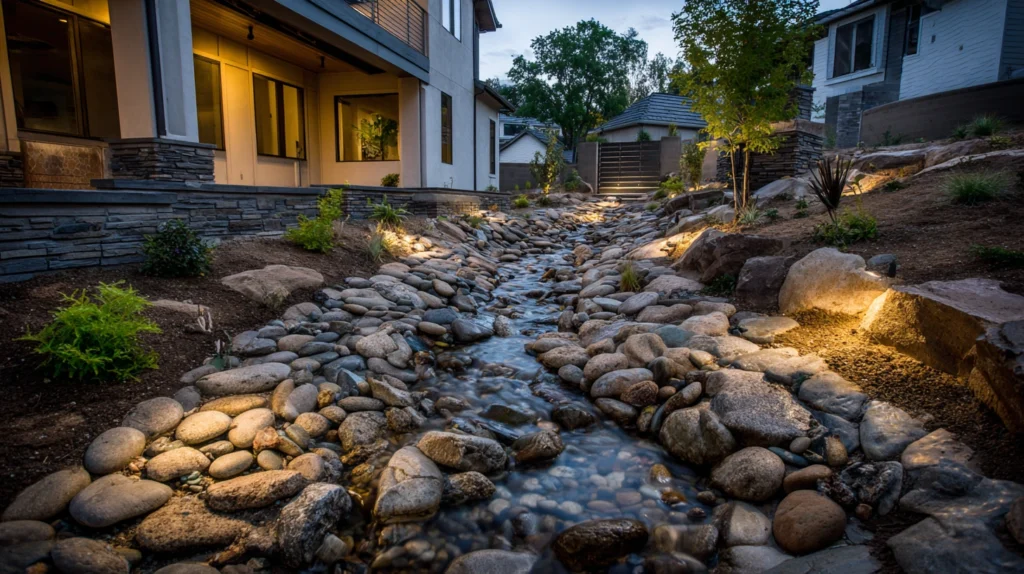
A dry river bed turns the problem into a feature. The same low-lying channel that was collecting water and looking neglected becomes a designed watercourse — a naturalistic arrangement of river stone, boulders, gravel, and carefully chosen planting that looks as if a stream ran here once and left its mark. It solves the drainage problem, eliminates the maintenance of a difficult grass area, and produces a landscape feature of genuine beauty that improves with every season as the surrounding planting matures.
Each idea below is a specific approach to one aspect of the dry river bed. Each includes what you will need, what it will cost, and a practical tip to make the whole thing work as well as the landscape it is imitating.
1. The Natural Meandering Channel
Budget: $150 – $600
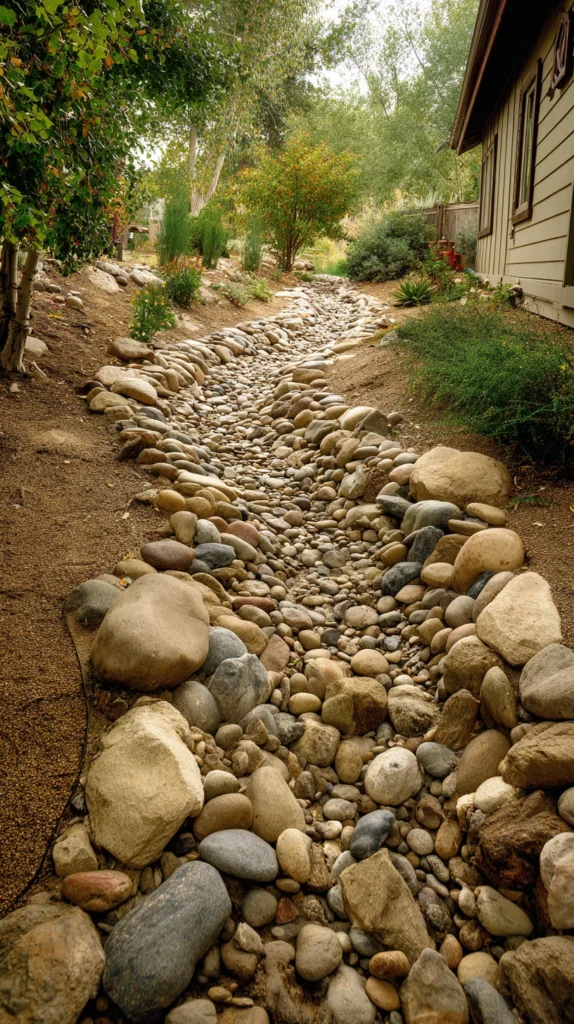
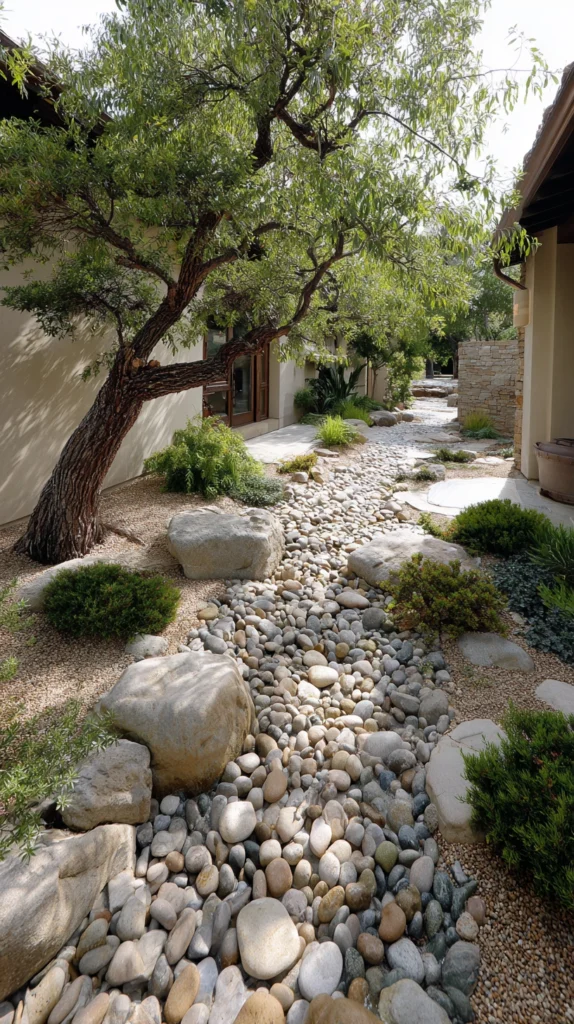
A dry river bed that curves gently through the yard — following the natural low points of the ground rather than running in a straight line — creates the most convincing imitation of a genuine watercourse available to a domestic landscape. Water never runs straight in nature; it finds the path of least resistance, which is always a curve. A straight dry river bed looks designed; a curved one looks discovered.
Excavate a channel of 40–60 centimetres in depth and 60–90 centimetres in width, following the natural drainage line of the yard. Line with a weed-suppressing membrane ($10–$20 per roll). Fill with a combination of larger river boulders at the edges and progressively smaller smooth river stones toward the channel centre — $50–$150 in stone for a 5-metre run. The graduated stone size from edge to centre replicates the hydraulic sorting that moving water performs naturally.
Style tip: Vary the channel width along its length rather than maintaining a consistent width throughout. Real rivers widen in flat sections and narrow in steeper ones, and a dry river bed that is slightly wider at the bottom of a slope and narrower at the top reads as geologically honest in a way that a consistent-width channel does not.
2. The Boulder and Cobble Combination
Budget: $200 – $800
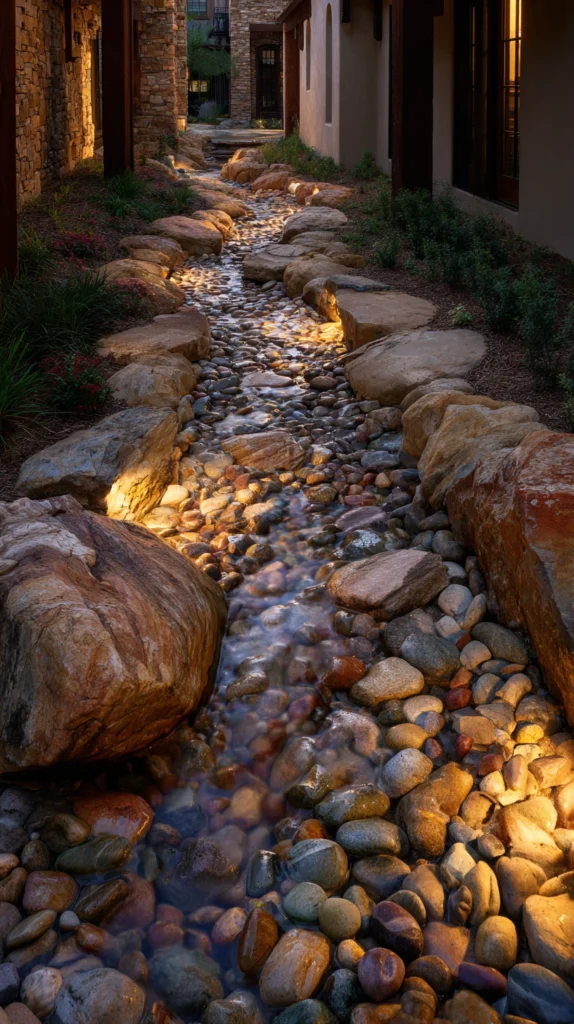
Large statement boulders — placed at the outside of curves, at the channel’s beginning and end, and at intervals along its length — combined with smaller cobbles and pea gravel in the channel bed create the layered geological quality of a genuine river environment. The boulders are what the channel was shaped around; the smaller stones are what the current deposited between them.
Landscape boulders of 30–60 centimetres in diameter cost $20–$80 each depending on type and source. A selection of five to seven boulders for a 6-metre channel runs $100–$400. River cobbles of 5–15 centimetres cost $8–$15 per 25-kilogram bag. Pea gravel for the channel centre runs $6–$12 per bag. Bury the boulders to between one-third and one-half of their depth so they appear to be emerging from the ground rather than resting on top of it.
Style tip: Source boulders of the same geological type — all sandstone, all granite, all flint — rather than mixing stone types in the same channel. A dry river bed with consistent geology reads as a place; one with mixed stone types reads as a collection of available materials. The geological consistency is the naturalistic detail that most convincingly imitates a real watercourse.
3. The Rain Garden Dry Bed
Budget: $100 – $500
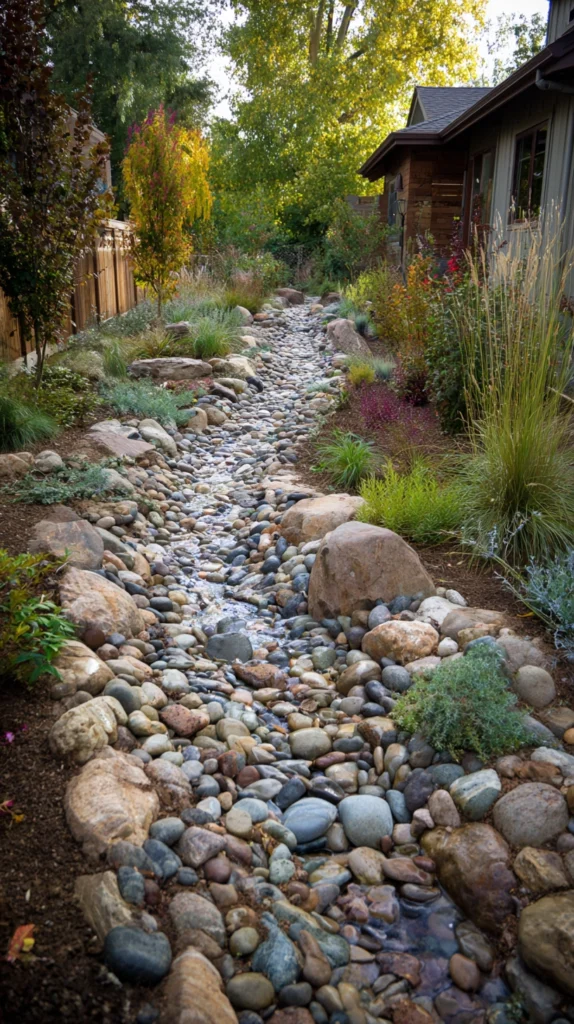
A dry river bed that directs roof runoff from a downpipe across the yard to a planted rain garden at its terminus creates a genuinely functional drainage system as well as a decorative landscape feature. The water that would otherwise run off the paving or sit in a low area is channelled through the stone bed to a planted depression where it percolates slowly into the ground. The dry bed is dry most of the time and carries water only when it rains — which is exactly the behaviour of a real seasonal stream.
A length of flexible drainage pipe connecting the downpipe to the start of the channel costs $20–$50. River stone for the channel runs $50–$150 for a standard run. A planted rain garden at the terminus — planted with moisture-tolerant species that handle both wet and dry conditions — costs $40–$120 in plants. The rain garden plants absorb the arriving water; the channel directs it there without erosion.
Style tip: Install a length of perforated drainage pipe beneath the stone bed rather than relying on the channel surface alone to move water. The perforated pipe ensures that heavy rainfall events — more water than the surface channel can move — drain effectively rather than overwhelming the channel and causing erosion of the surrounding landscape.
4. The Hillside Cascade Effect
Budget: $200 – $900
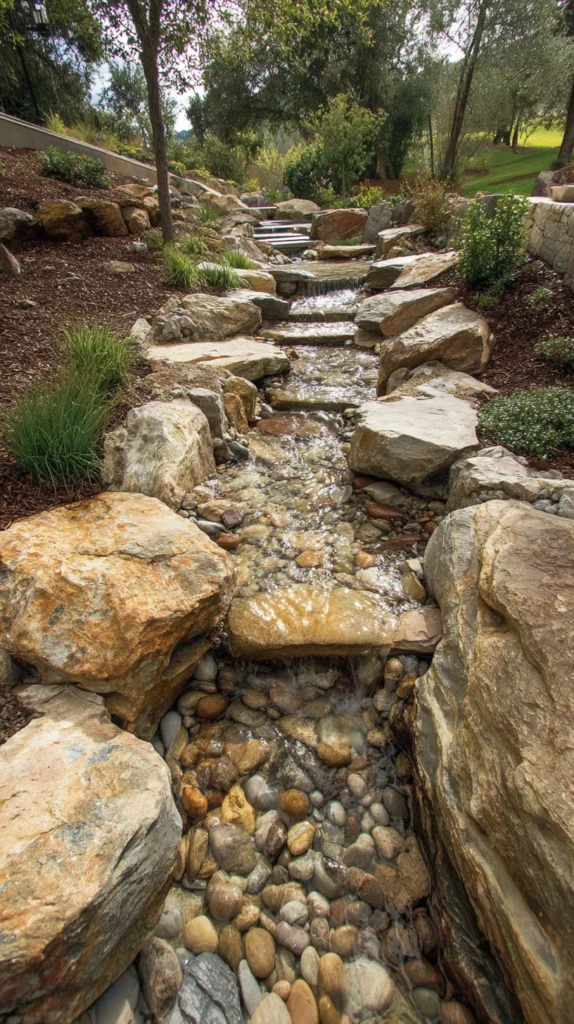
A dry river bed on a slope — with larger boulders placed to create the visual effect of waterfalls and cascades at intervals along the descent — produces a dry landscape feature of considerable drama that turns an awkward sloped yard into its most interesting design opportunity. The cascade boulders are positioned perpendicular to the channel direction, creating level sections between them that catch the eye at each drop point.
Cascade boulders of 40–80 centimetres in diameter cost $30–$100 each. A sloped channel with three cascade points requires three principal boulders plus the channel stone — $250–$600 in stone material. Position each cascade boulder so it is partially buried and angled slightly backward — the backward angle and the burial depth are what make the boulder read as a geological feature rather than a placed rock.
Style tip: Plant moisture-loving ferns or grasses in the pockets between the cascade boulders — the shaded, slightly more moisture-retentive areas that form between large stones are the natural habitat of the plants that make a hillside cascade read as a genuine landscape feature rather than a stone installation.
5. The Desert Wash Style Bed
Budget: $100 – $500
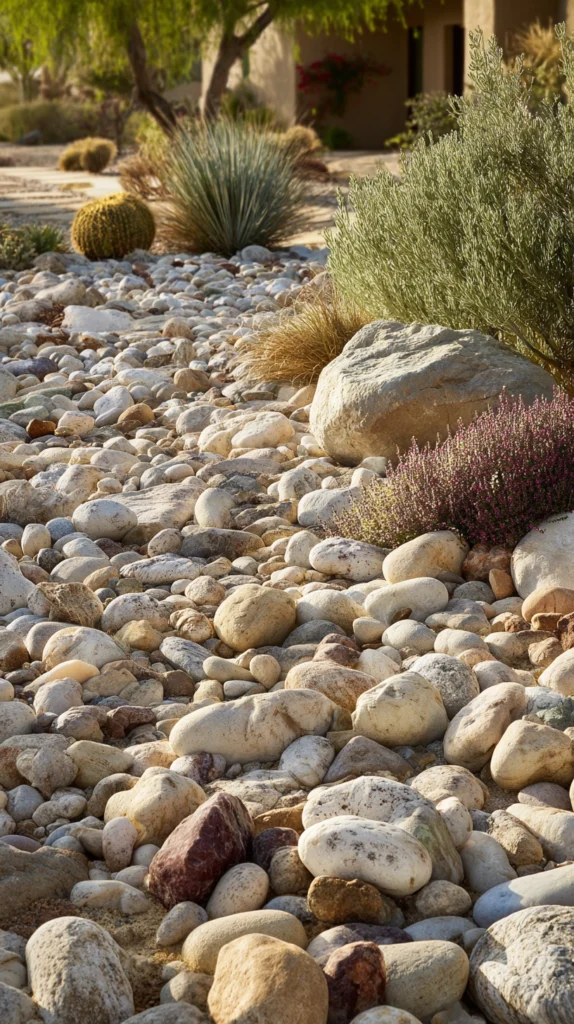
A desert wash — wider, shallower, and more generously planted than the woodland stream style of dry river bed — suits hot, dry climates and Mediterranean gardens specifically. The desert wash is wider than it is deep, uses paler, more angular stone than river-rounded cobble, and is planted on both banks with drought-tolerant species: agave, ornamental grasses, cistus, lavender, rosemary, and euphorbia.
Pale angular gravel or decomposed granite costs $8–$15 per bag. Angular limestone or sandstone chips run $6–$12 per bag. Drought-tolerant plants for the banks cost $5–$20 each — five plants per bank for a standard wash gives immediate density. The desert wash requires no irrigation once established and no maintenance beyond an annual clearing of debris from the stone channel.
Style tip: Use a single pale stone type throughout the desert wash rather than mixing pale and dark stone. A desert wash in consistent warm buff or pale grey stone reads as a geological feature of the landscape; one that mixes stone colours reads as a designed installation. The palette unity of the stone is what gives the desert wash its convincing naturalistic quality.
6. The Japanese Inspired Dry Stream
Budget: $150 – $700
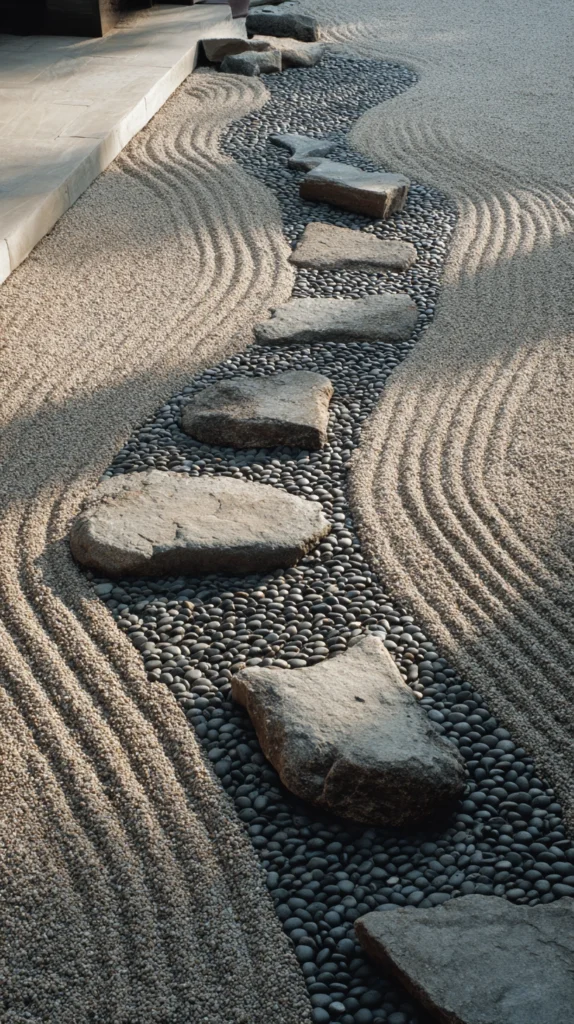
A karesansui-influenced dry stream — using carefully raked gravel to suggest the movement of water, with larger flat stones suggesting stepping points across the stream, and moss or low ground cover on the banks — brings the Japanese garden tradition of representing water through stone into the domestic landscape. The Japanese dry stream is the most meditative and most precisely designed of all the dry river bed styles.
Fine granite gravel or light grey crushed stone for the stream bed costs $10–$20 per bag. Flat stepping stones cost $5–$15 each. Moss plants for the banks cost $5–$10 per tray. A simple bamboo rake ($10–$20) maintains the gravel surface. The raking pattern — parallel lines suggesting laminar flow, curves suggesting eddies around the stepping stones — is the expressive element of the Japanese dry stream and should be renewed after rain or wind disturbs the surface.
Style tip: Edge the Japanese dry stream with a precise, clean boundary — a timber board, a metal edge, a row of carefully placed flat stones — rather than allowing a gradual transition between the stream gravel and the surrounding garden. The precise edge is the design decision that distinguishes the Japanese dry stream from a gravel path; it communicates that the stone represents water, and that the boundary between water and land is deliberate.
7. The Woodland Stream Bed
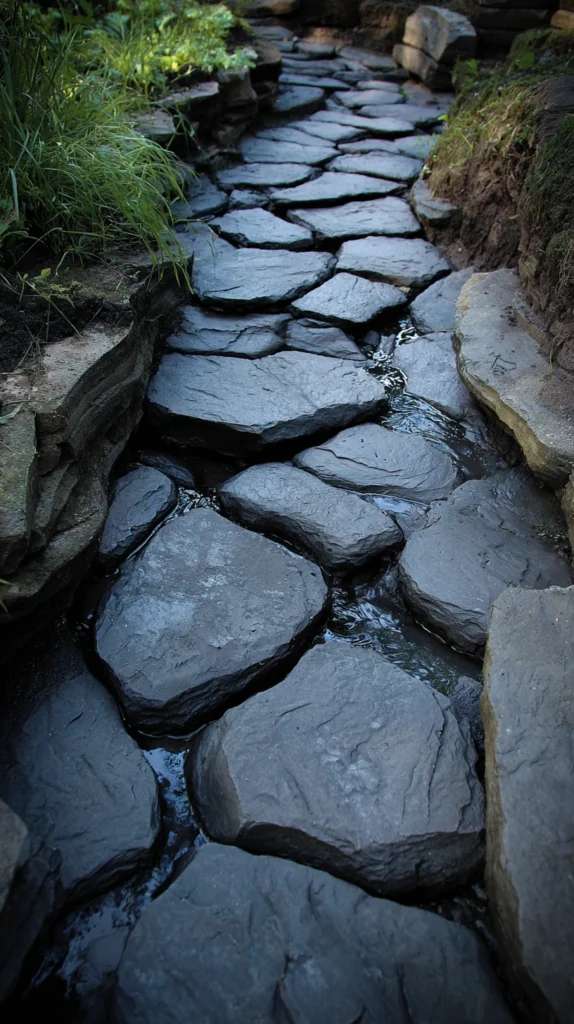
Budget: $120 – $500
A woodland-style dry stream bed — running between established trees or through a shaded part of the garden, planted on both banks with ferns, hostas, astilbes, and shade-tolerant ground covers — creates the specific quality of a shaded forest floor through which a seasonal stream runs. The woodland stream bed is the most botanically interesting of all the dry river bed styles because the planting does as much work as the stone.
Dark river stone — basalt cobble or dark granite — costs $8–$15 per bag and suits the woodland setting better than pale stone. Shade-tolerant ferns cost $5–$12 each. Hostas run $8–$20 each. Astilbes cost $6–$15 each. Plant the bank species densely enough that the planting appears to grow into the channel at its edges — the slight encroachment of fern fronds and hosta leaves over the stone edge is the naturalistic detail that makes the woodland stream read as genuinely grown rather than installed.
Style tip: Mulch the bank planting with a fine dark bark mulch rather than leaving the soil bare. Dark bark mulch beside dark river stone creates a consistent dark-toned base that makes the green planting read as vivid and fresh; bare soil beside stone creates an unfinished quality that the planting never fully overcomes regardless of how well it establishes.
8. The Front Yard Curb Appeal Dry Bed
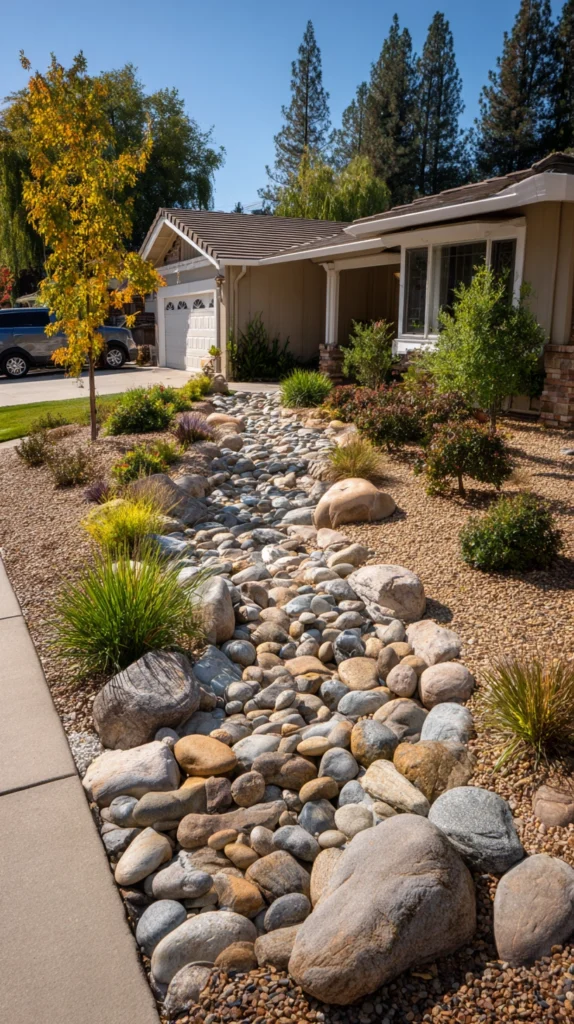
Budget: $150 – $600
A dry river bed running through the front yard — replacing a struggling lawn strip between the path and the street, or creating a designed drainage solution for the sloped front garden — provides the most immediate and most visible landscape transformation available to a domestic property at a modest cost. A front yard dry river bed improves the curb appeal of the property, eliminates the most difficult area of lawn to maintain, and communicates a landscape that was designed with environmental awareness.
The front yard channel follows the drainage line of the existing slope. River cobble and small boulders cost $80–$250 for a standard front yard run. Drought-tolerant architectural plants for the banks — agave, ornamental grasses, lavender — cost $40–$150. The front yard dry bed requires no irrigation, no mowing, and no seasonal replanting — it is the lowest maintenance front yard treatment available and the most dramatically improved from the neglected lawn alternative it replaces.
Style tip: Extend the dry bed planting to include one specimen plant of significant height — a large ornamental grass, a small architectural shrub — at the most visible point of the front yard channel. The specimen plant gives the dry bed a focal element that the eye finds first and from which it reads the rest of the landscape feature. Without the specimen plant, the dry bed reads as a stone drainage feature; with it, it reads as a landscape design.
9. The Pathway Crossing Feature
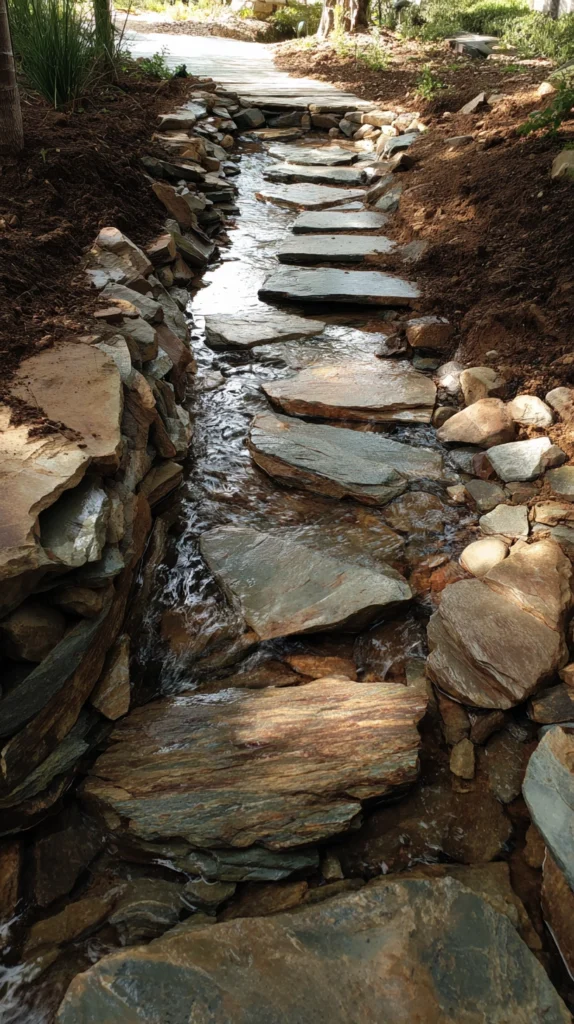
Budget: $80 – $350
A dry river bed that crosses a garden path — requiring the path to bridge or step across the stone channel — creates a landscape narrative that makes moving through the garden a series of designed transitions rather than a single continuous surface. The crossing point is the moment of engagement with the dry bed: the step across the stone, the pause to look up and down the channel, the awareness of the landscape feature as something that has its own direction and momentum.
Flat stepping stones of 40–60 centimetres in width cost $8–$20 each. A three-stone crossing across a 60-centimetre channel costs $24–$60 in stepping stones plus $50–$150 in channel stone. Position the stepping stones at slightly irregular intervals — not equally spaced — and at slightly different heights, so the crossing requires attention and care rather than being automatic. The crossing that requires engagement is the crossing that is remembered.
Style tip: Plant the channel banks at the crossing point with taller, more densely planted species than elsewhere along the run — so the crossing feels enclosed by vegetation on both sides and the pathway beyond it feels like an emergence rather than a continuation. The sense of passing through something at the crossing point is the experiential quality that makes the pathway crossing the most memorable element of the dry river bed landscape.
10. The Backyard Focal Point Bed
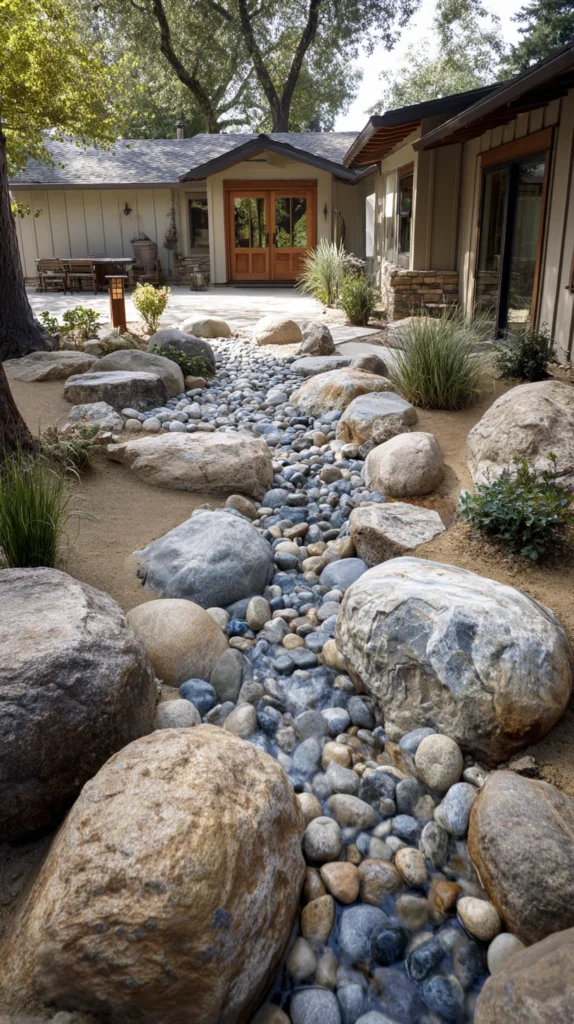
Budget: $200 – $900
A large, generous dry river bed positioned as the backyard’s primary landscape feature — 3–4 metres wide at its widest, running from one side of the yard to the other, with significant boulders, varied stone, and substantial planting on both banks — creates the most dramatic and most complete dry river bed treatment available. The focal point dry bed is not a drainage solution; it is a landscape statement that the rest of the yard is arranged in relation to.
Large landscape boulders of 50–80 centimetres cost $40–$120 each. A significant channel of 4 by 1.5 metres requires approximately ten boulders — $400–$1,200 in stone. Perennial planting for the banks — ornamental grasses, agapanthus, salvias, and sedges — costs $100–$300. The total investment for a significant focal point dry bed runs $600–$2,000 and produces a landscape feature that requires no annual maintenance beyond a seasonal clear of debris and an occasional top-up of channel stone.
Style tip: Design the focal point dry bed so it terminates at a visual destination at each end — a significant planted specimen, a large boulder group, the fence line with climbing planting behind it — rather than ending abruptly at the garden boundary. A dry river bed that ends at a destination reads as a landscape with a beginning and an end; one that stops arbitrarily reads as incomplete regardless of how well the central section is executed.
11. The Edible Landscape Dry Bed
Budget: $150 – $600
A dry river bed whose banks are planted with edible species — fruit-bearing shrubs, culinary herbs, edible ground covers, and fruiting trees as the canopy — creates a productive as well as decorative landscape feature. The dry channel provides the drainage that many edible plants prefer, and the well-draining bank conditions suit the Mediterranean herbs, berry shrubs, and stone fruit trees that perform best in conditions of good drainage.
Rosemary planted as a bank ground cover costs $4–$8 each. Blueberry bushes run $10–$20 each. A dwarf apple or pear tree on a dwarfing rootstock costs $25–$60. Strawberry plants for the channel edges run $2–$4 each. An edible dry bed planting for both banks of a 5-metre channel costs $80–$200 in plants and produces a harvest as well as a landscape feature — the most productive return available on any landscaping investment.
Style tip: Plant edible species in drifts of the same variety along the bank rather than alternating species at every position. A bank of rosemary followed by a bank of blueberries followed by a bank of strawberry reads as three distinct edible zones; individual plants alternated along the full bank length produce a visual complexity that prevents any single species from reading clearly. The drift planting is the productive principle as well as the aesthetic one.
12. The Gravel and Ornamental Grass Combination
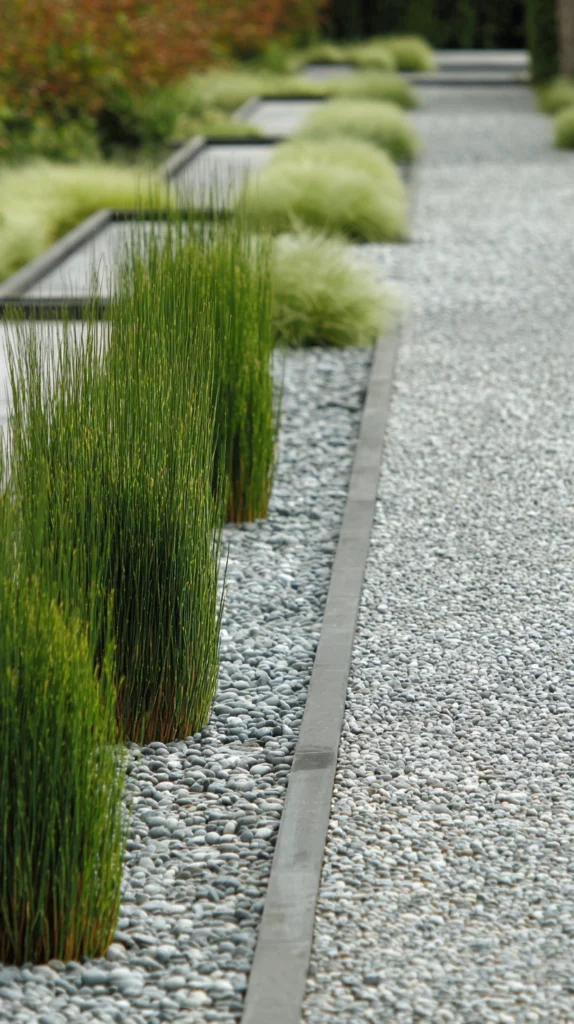
Budget: $100 – $450
A dry river bed in fine grey or buff gravel — without boulders, with the channel planted densely on both banks with a single variety of ornamental grass — creates the most graphic and most contemporary of all the dry bed styles. The gravel channel is the negative space; the grasses are the positive form; and the repetition of a single grass variety on both banks gives the feature the disciplined, designed quality of a landscape architect’s scheme rather than a naturalistic imitation.
Fine decorative gravel in grey or buff costs $8–$15 per bag. A single ornamental grass variety planted repeatedly — Stipa tenuissima, Pennisetum, or Miscanthus depending on the scale required — costs $8–$20 each. Planting the same grass in both banks, in a staggered arrangement that allows the channel to be seen between them, creates the graphic striped quality that this style requires.
Style tip: Choose a grass variety that moves expressively in the wind rather than one that holds a static upright form. A dry river bed planted with grasses that respond to the lightest breeze — that wave and catch the light continuously — has a dynamic quality in a still garden that is worth more than the most elaborate static composition. The movement is the contribution that grasses make to the dry bed landscape.
13. The Night-Lit Dry River Feature
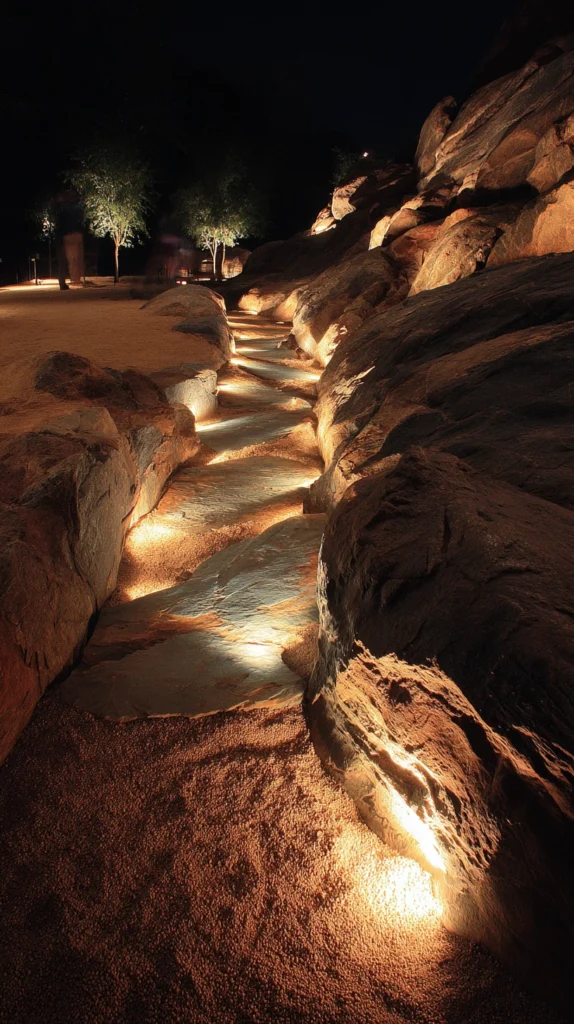
Budget: $200 – $800
A dry river bed fitted with low-voltage ground lighting — waterproof LED uplights positioned at the base of key boulders, in-ground lights along the channel edges, or solar stake lights placed among the bank planting — becomes an entirely different landscape feature after dark. The lit dry bed is the garden’s most dramatic evening feature because the uplighting from within the stone channel creates the impression of actual water illuminated from below.
Waterproof ground uplights cost $15–$40 each. A solar stake light runs $5–$15 each. Six uplights positioned at the principal boulders and channel edges of a 5-metre dry bed cost $90–$240. Connect to a timer or a dusk-to-dawn sensor so the lighting activates automatically rather than requiring manual switching — a landscape lighting system that is activated manually is used less than one that appears at the right moment without effort.
Style tip: Aim the uplights so they illuminate the stone rather than the sky. An uplight aimed directly upward produces light pollution and a beam rather than a stone feature illuminated from below; one aimed at a 45-degree angle toward the nearest boulder or channel edge produces the warm, ground-level glow that makes the dry bed read as water after dark.
14. The Native Plant Dry Bed
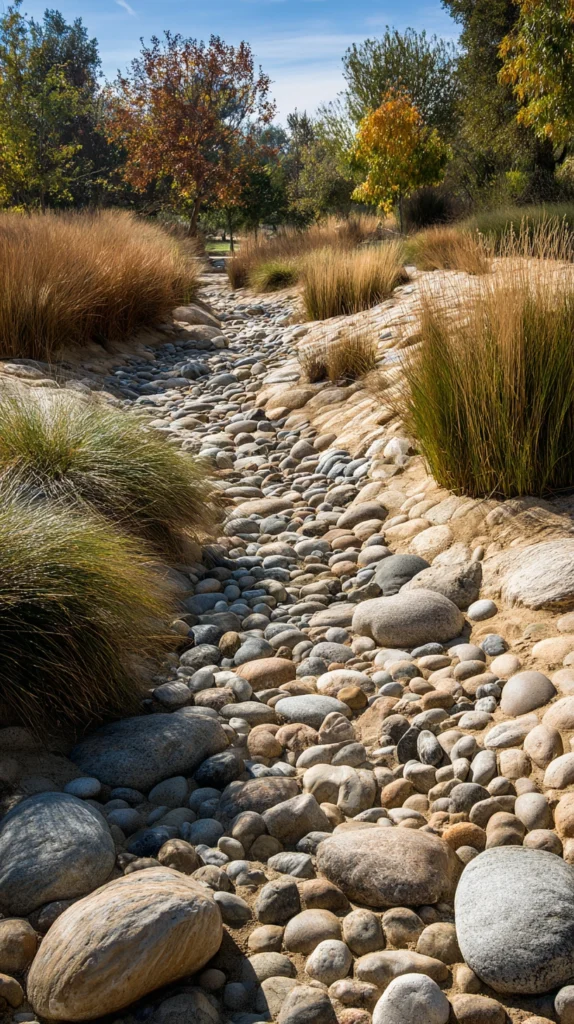
Budget: $100 – $450
A dry river bed planted exclusively with native species — native grasses, native shrubs, native wildflowers, and native ground covers appropriate to the local climate — creates a landscape feature that has ecological value as well as aesthetic quality. Native plants require no irrigation once established, provide habitat for local wildlife, and age in a direction of increasing naturalness that non-native species cannot replicate.
Native plants cost $4–$15 each from specialist native plant nurseries. A fully native dry bed planting for a standard 5-metre channel costs $60–$150 in plants. Research the native plant palette for the specific local climate before purchasing — a native plant from the wrong climate zone performs as poorly as any non-native species regardless of its geographical origin. The local nursery is the most reliable source of native plant advice for the specific region.
Style tip: Leave the seed heads of native plants standing through winter rather than cutting the planting back in autumn. The seed heads of native grasses and wildflowers provide winter bird food, self-sow new plants into the channel edges, and create the naturalistic winter silhouette that a cut-back planting cannot produce. The winter-standing dry bed is at its most ecologically productive and at its most graphically beautiful in the low winter light.
15. The Children’s Play Dry Stream
Budget: $100 – $400
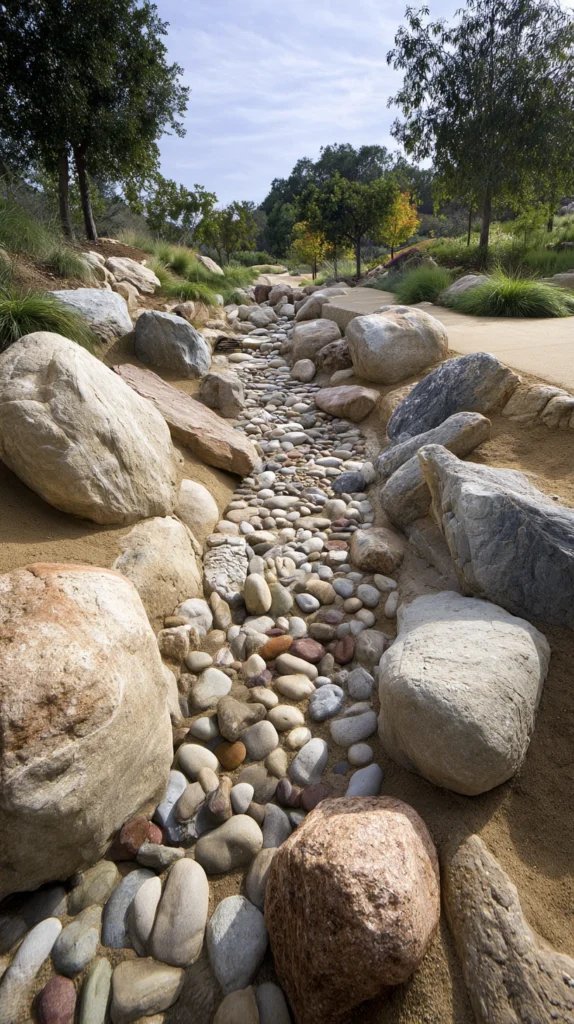
A dry river bed designed specifically for children’s engagement — with large smooth boulders for sitting on and jumping between, shallow areas of fine sand alongside the river stone, and selected smooth pebbles that are appropriate for handling — creates a play landscape that is simultaneously a genuine garden feature and a dedicated outdoor play environment. Children engage instinctively with stone and water environments, and a dry stream bed provides the geological interest of water-formed stone with the safety advantage of no actual water.
Large smooth boulders suitable for sitting — 40–60 centimetres, flat-topped — cost $30–$80 each. Fine sand for the play zones runs $5–$10 per bag. A selection of smooth pebbles for handling costs $8–$15 per bag. The children’s play dry stream requires smooth-edged stone throughout — no sharp-edged crushed stone or angular gravel that could cause injury to bare feet or falling children. River-rounded cobble and smooth boulders are the appropriate stone types.
Style tip: Install the children’s play dry stream in a position visible from the primary indoor living or kitchen area so the play space can be supervised without requiring the supervising adult to be outdoors. A play dry stream that is always within the sightline of the house is a play feature that is used with the confidence and the frequency that visibility enables — and the used play landscape is always better than the unused decorative one.
The dry river bed is the landscape feature that most honestly acknowledges the reality of the garden it is built in — the specific drainage patterns, the specific areas of difficulty, the specific opportunities that the land’s own topography provides. A dry river bed that follows the natural drainage line of the yard is not a design imposed on the landscape; it is a design derived from it, and the difference between the two produces the quality of naturalism that makes the very best dry beds look as if they have always been there.
Work with the land rather than against it, choose stone that belongs to the local geology wherever possible, and plant with species that suit the conditions the channel creates. The dry bed that grows from these principles becomes one of those garden features that visitors ask about first — not because it is the most elaborate element in the yard, but because it is the one that looks most completely as if it belongs.