16 Above Couch Wall Decor Ideas That Transform the Most Overlooked Space in Your Living Room
16 Above Couch Wall Decor Ideas That Transform the Most Overlooked Space in Your Living Room
There is a wall in almost every living room that receives more daily attention than any other surface in the house and less deliberate thought than almost any other design decision. The wall above the sofa is seen from every seated position in the room, from the entrance on arrival, from the kitchen, or the dining area when looking through. It is the backdrop of every conversation, every film, every evening spent in the room. And yet it is, in the majority of living rooms, either completely bare or occupied by something that was placed there years ago and has not been reconsidered since.
The wall above the sofa is not a difficult design problem. It is a specific one — with specific scale requirements, specific hanging height rules, and a specific relationship to the furniture below it that makes some approaches work beautifully and others fail regardless of the quality of the individual pieces. Getting it right changes the entire character of the room because it changes the room’s primary visual surface.
Each idea below is a specific, buildable approach to the above-sofa wall. Each includes what you will need, what it will cost, and a practical tip to make it work as well as it deserves.
1. The Single Large Statement Canvas
Budget: $100 – $2,000
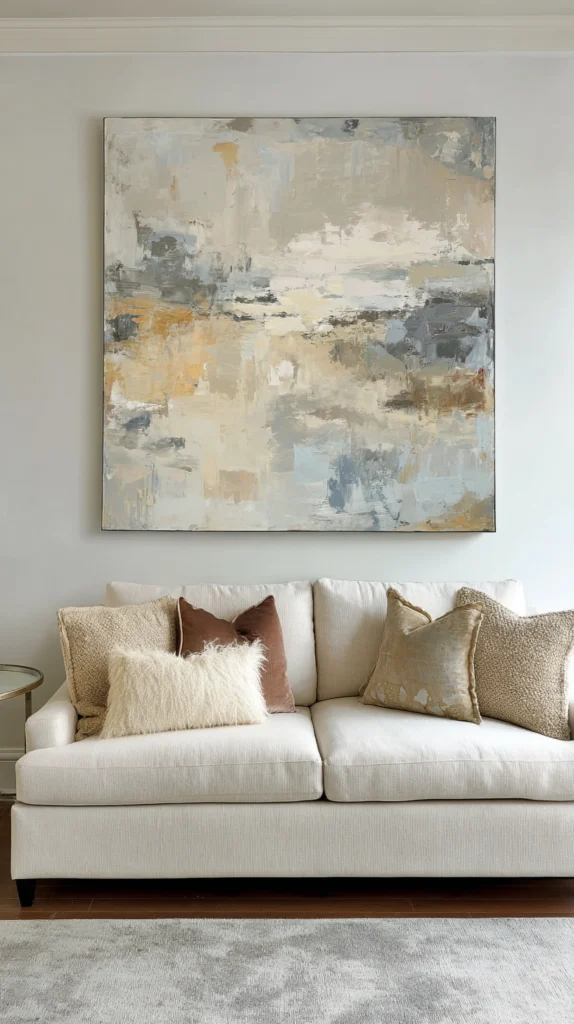
One large canvas — genuinely large, at least two-thirds the width of the sofa below it — positioned at the correct hanging height is the most resolved and most confident treatment available to the above-sofa wall. The single canvas does not compete with itself, does not require the spatial reasoning of a gallery arrangement, and communicates its intention clearly from across the room. It is the approach that most consistently produces the impression that the room was designed rather than assembled.
A large canvas print at 120 by 90 centimetres from a quality art print supplier costs $100–$400. An original painting of equivalent scale runs $300–$2,000. Hang the canvas so its centre sits at 145–150 centimetres from the floor — the standard gallery height — rather than at whatever height seemed right when standing on a stepladder. The centre at 145–150 centimetres places the artwork at the eye level of a standing person and at the eye level of a seated person looking slightly upward, which is the viewing position from the sofa.
Style tip: Choose a canvas that is at least 10 centimetres narrower than the sofa on each side rather than one that matches the sofa width exactly or extends beyond it. A canvas that is slightly narrower than the sofa has visual breathing room on each side; one that exactly matches the sofa width reads as measured rather than chosen, and one that is wider than the sofa creates a visual imbalance where the wall seems to extend beyond the furniture it is anchored to.
2. The Curated Gallery Wall
Budget: $80 – $500
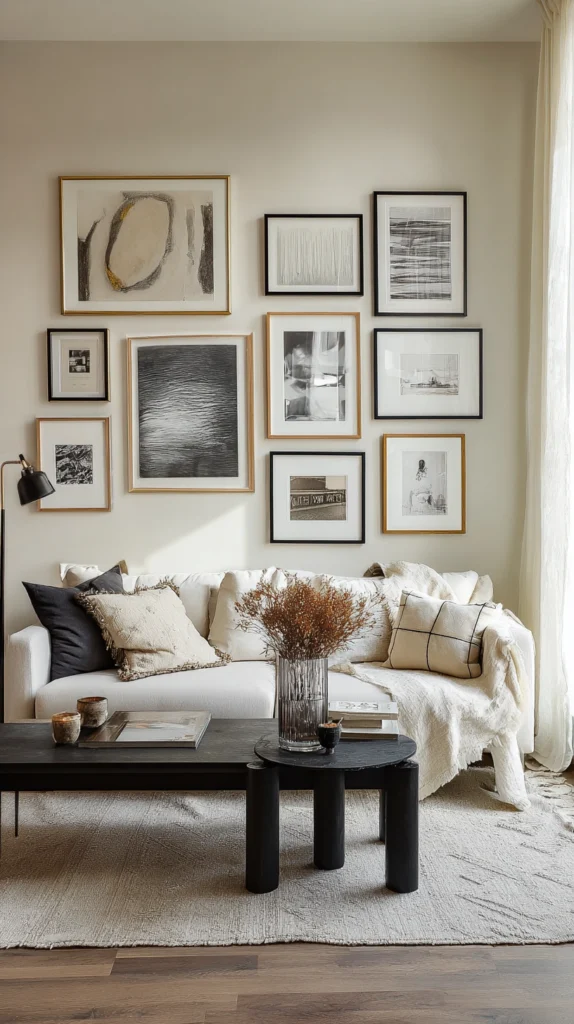
A gallery arrangement of multiple framed pieces — prints, photographs, artwork, and mirrors — assembled on the above-sofa wall creates the most personal and most visually complex treatment available. The gallery wall communicates the specific taste, the specific travels, and the specific visual interests of the people who live in the room in a way that any single purchased piece cannot.
Prints at A4 and A3 size cost $0.50–$3 each to produce at a print shop. Frames in a consistent finish — all black, all white, all natural timber — cost $5–$25 each. A gallery of eight frames in a standard mix of sizes costs $40–$200 in frames plus $10–$30 in prints. Plan the arrangement on the floor before hanging a single nail — lay the frames on the floor in the approximate space of the wall area, adjust until the arrangement is resolved, then transfer the positions to the wall using the floor layout as the reference.
Style tip: Maintain a consistent gap between all frames in the gallery — 6–8 centimetres between each piece — rather than varying the spacing across the arrangement. Consistent spacing gives the gallery a visual unity that irregular spacing undermines; the frames read as a group rather than as individual pieces placed in proximity. Mark the centres of each frame position on the wall with a pencil dot before hammering a single nail.
3. The Oversized Mirror
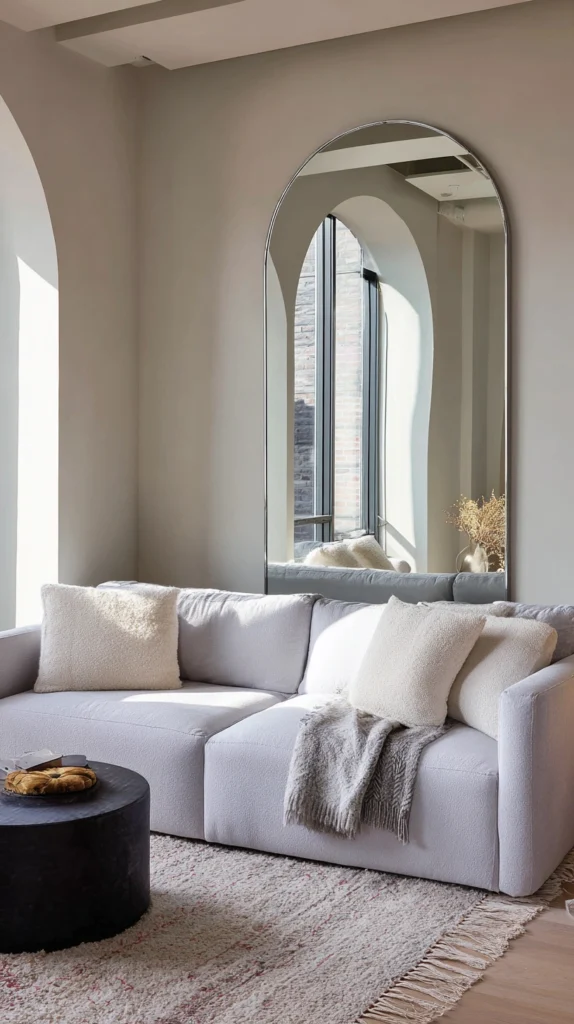
Budget: $80 – $600
A large mirror — at least 80 centimetres wide, positioned directly above the sofa in the centre of the wall — doubles the apparent depth of the room and reflects the light from the windows opposite. A mirror above a sofa performs the same function as a window on a wall that has none: it opens the wall visually and brings a quality of light to a surface that would otherwise be static. It is the best above-sofa treatment for a room that needs more perceived space and more light.
A large rectangular mirror in a simple frame costs $80–$300. A round mirror of 80–100 centimetres in diameter runs $100–$400. An arched mirror — the arch form that suits the above-sofa position particularly well because its curved top relates to the horizontal of the sofa back below it — costs $120–$500. Hang the mirror so its bottom edge sits 15–20 centimetres above the sofa back — close enough to feel visually connected to the sofa, far enough to avoid a seated person’s head appearing at the mirror’s bottom edge.
Style tip: Choose a mirror frame that relates to the existing metal finishes in the room — the lamp base, the coffee table legs, the cushion trim — rather than introducing a new metal finish specifically for the mirror. A mirror frame in the room’s established metal palette reads as part of the material scheme; one in a new finish reads as a new element that requires the rest of the room to accommodate it.
4. The Floating Shelf Display
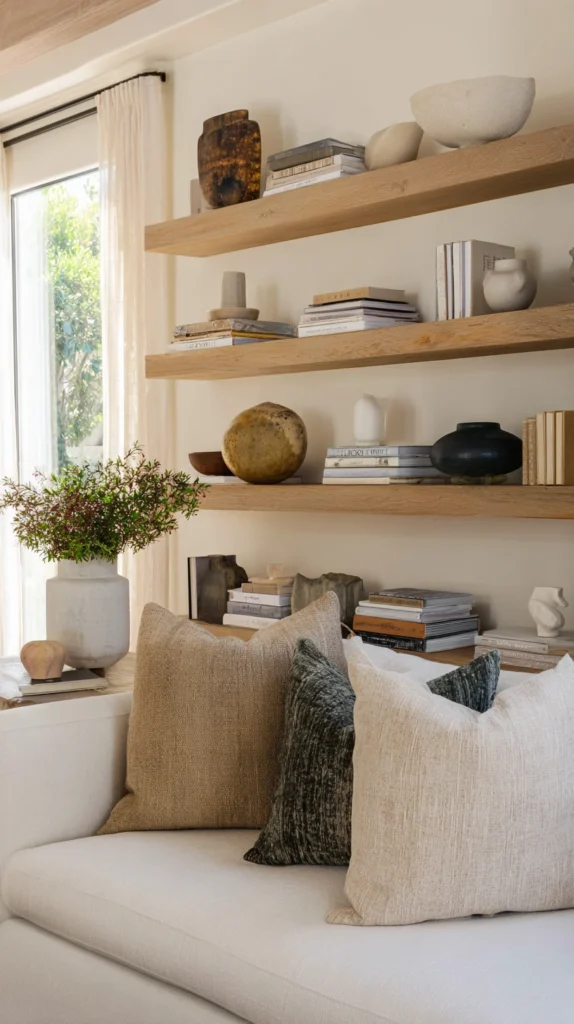
Budget: $60 – $300
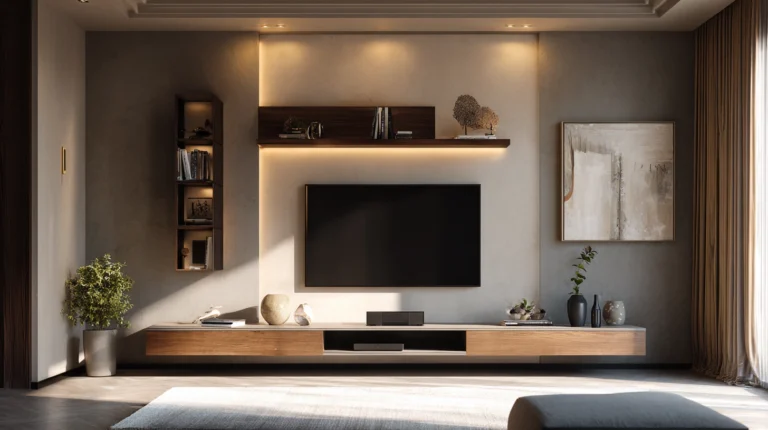
One or two floating shelves above the sofa — styled with a considered arrangement of books, plants, ceramics, and one framed piece — create a dimensional treatment of the above-sofa wall that a flat hanging arrangement cannot provide. The shelf brings depth as well as decoration to the wall and provides a platform that changes the wall from a flat display surface to a three-dimensional zone of the room.
A floating shelf of 100–120 centimetres in length costs $30–$80 including brackets. Two shelves stacked at different heights above the sofa run $60–$160. Style the shelf with a mix of objects at different heights — a tall vase, a medium ceramic, a small stacked books — rather than a uniform row of similar-height objects. The height variation on the shelf creates the visual interest that a flat row of identical objects lacks.
Style tip: Position the lower shelf no less than 25 centimetres above the highest point of the sofa back — above the cushions when they are in their natural, pushed-back position. A shelf positioned too close to the sofa back becomes a hazard for anyone sitting back suddenly and a visual intrusion that makes the sofa feel enclosed rather than backed. The 25-centimetre clearance is the minimum; 30–40 centimetres is the more comfortable and more visually resolved position.
5. The Woven Textile Wall Hanging
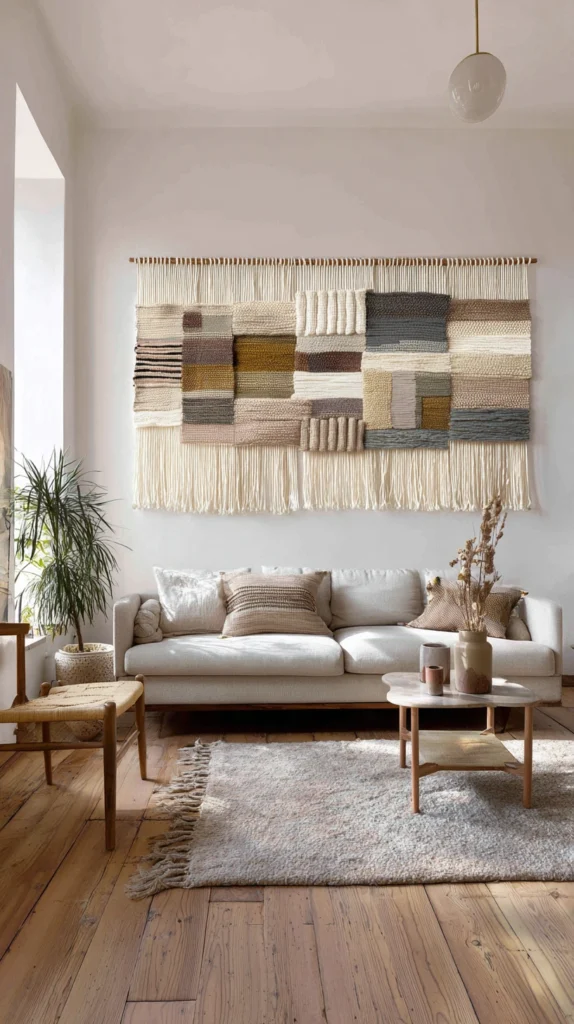
Budget: $40 – $300
A large woven textile — a tapestry, a kilim, a hand-knotted wall piece, a macramé panel, or a flat-woven cotton hanging — above the sofa introduces texture and warmth to the wall at a scale that framed artwork cannot match. A textile wall hanging contributes visual weight at the same scale as a large painting while introducing the dimensional quality of fabric — the way it moves slightly in air movement, the way it casts its own shadows, the way it changes in appearance as the light shifts through the day.
A large woven tapestry costs $60–$250. A kilim used as a wall hanging runs $80–$300. A hand-made macramé panel of appropriate width costs $80–$200. Hang from a timber dowel rod fed through the top hem rather than from individual fixings — the dowel distributes the weight of the textile evenly and produces a hang that is even across the full width. A heavy textile hung from two or three individual fixings develops an uneven sag between the fixing points that worsens over time.
Style tip: Choose a textile whose width is within 20 centimetres of the sofa width in either direction — slightly narrower or slightly wider — rather than a textile that is dramatically different in scale from the furniture below it. A textile that is very much narrower than the sofa reads as undersized; one that is very much wider extends the visual weight of the wall beyond the grounding of the furniture below it. The proportional relationship between the textile and the sofa is the scale decision that most determines whether the hanging looks right.
6. The Leaning Artwork Collection
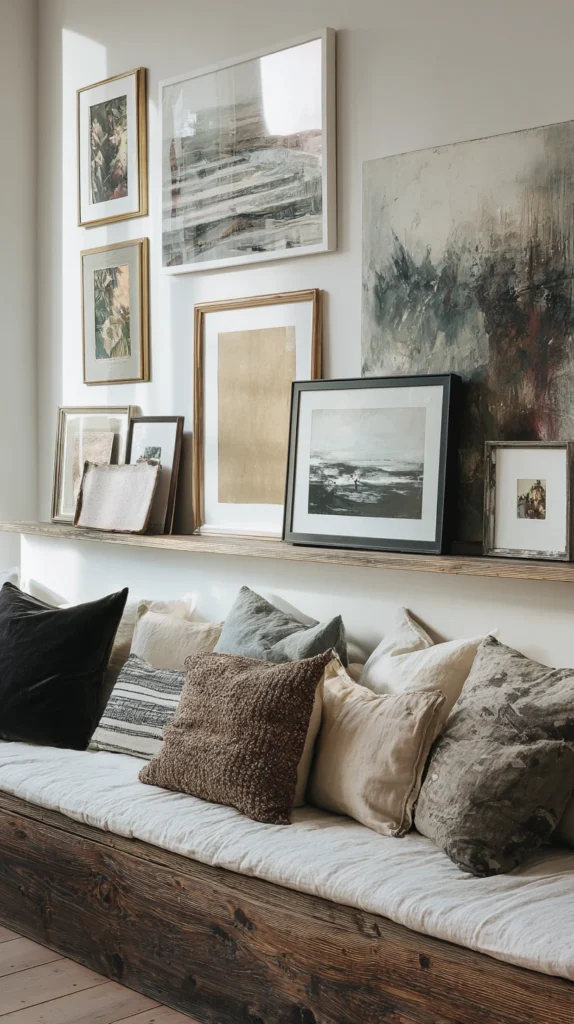
Budget: $60 – $400
A collection of framed pieces leaned against the wall on a floating shelf or a picture ledge above the sofa — rather than hung directly on the wall — creates a casually considered, art-gallery-storage quality that communicates genuine engagement with collected artwork rather than designed installation. Leaned artwork reads as living with art rather than installing it, and the ability to rearrange and add to the collection without rehanging makes it the most flexible of all above-sofa treatments.
Picture ledges in timber cost $20–$60 each. A double ledge arrangement — two at different heights — provides room for pieces at two levels. Frames leaned at a slight forward angle (the natural leaning angle when placed on a ledge) read as casually positioned rather than carefully hung. Mix frame sizes — one large piece, two medium, two small — rather than using frames of similar size across the whole ledge. The size variation creates the collected quality that uniform sizing lacks.
Style tip: Weight the ledge arrangement toward the centre of the sofa rather than distributing pieces evenly across the full width of the ledge. The visual weight of the above-sofa display should centre over the sofa’s midpoint — which is also the room’s visual focal point — rather than extending evenly beyond the sofa’s sides where it is not anchored by the furniture below.
7. The Architectural Niche or Alcove Treatment
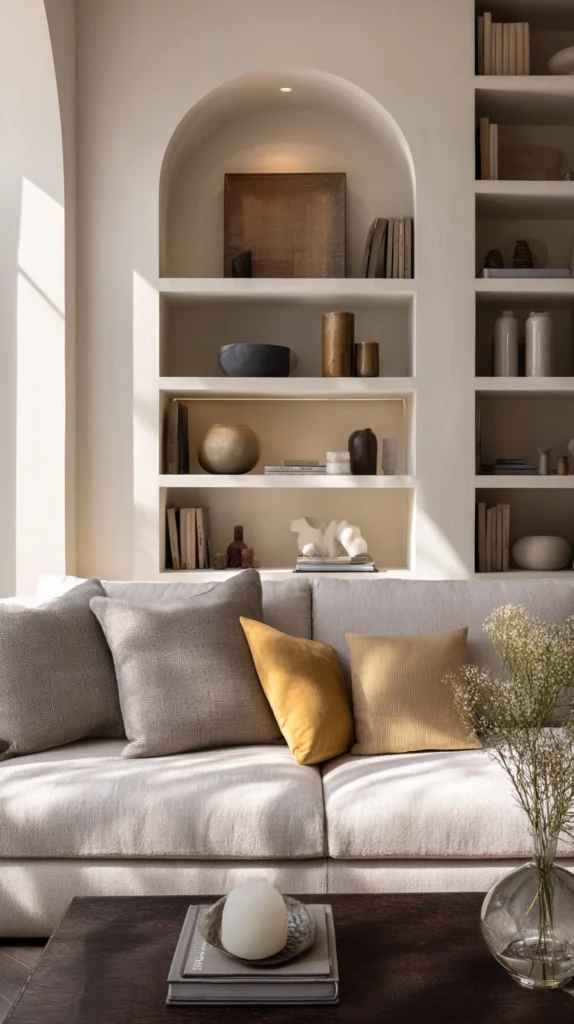
Budget: $200 – $2,000
Where the above-sofa wall contains a chimney breast, a recess, or an alcove, treating the recess as a dedicated display zone — with painted interior walls in a contrasting or deeper colour, built-in shelving, and dedicated lighting — creates the most architecturally resolved treatment available to a living room with existing wall geometry. The recess above a sofa positioned in a fireplace alcove is one of the most naturally suited positions for a considered display in any room.
Painting the alcove interior in a contrasting colour costs $20–$50 in paint. Built-in shelving within an alcove runs $200–$600. LED strip lighting inside the alcove costs $20–$60. The painted alcove interior with spot lighting and a considered arrangement of objects is more resolved than any hung artwork in the same position because it uses the three-dimensional quality of the recess — the depth, the contained colour, the shadow — as the primary design element rather than relying on a flat surface treatment alone.
Style tip: Paint the back wall of the alcove in a colour two to three shades deeper than the surrounding wall colour rather than in a contrasting colour from a different palette. The deeper tone of the same colour creates depth within the alcove that reads as architectural — as if the recess goes further back than it physically does — while maintaining the colour coherence of the room. A contrasting colour in the alcove creates a separate focal point that competes with the room rather than enriching it.
8. The Botanical Print Series
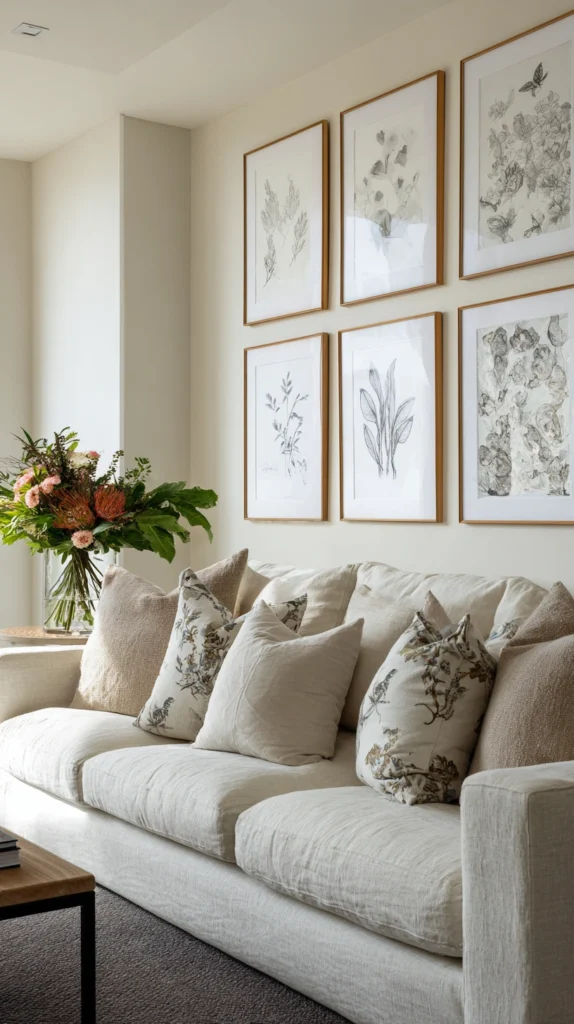
Budget: $30 – $200
A series of botanical prints — all from the same source, all in the same format, all in matching frames — arranged in a horizontal row above the sofa creates one of the most restful and most enduringly appropriate above-sofa treatments for a room with a natural, organic palette. A botanical series communicates the seasonal and the natural in a way that abstract or architectural imagery does not, and the row format — three or four prints in a line — gives the above-sofa wall a horizontal emphasis that reinforces the horizontal of the sofa below.
Botanical prints from public domain archives cost nothing to download. Printing at A4 size runs $0.50–$2 per print at a print shop. Frames in a consistent finish cost $8–$20 each. A horizontal series of four matching-format botanical prints in identical frames costs $40–$100 in total and produces a wall treatment of considerable elegance at minimal cost. The matching format is the decision that elevates a series of prints into a considered installation.
Style tip: Choose botanical prints that share a colour palette — all warm-toned illustrations, or all cool grey studies, or all full-colour on a cream ground — rather than mixing different illustration styles and colour approaches. A series with consistent colour treatment reads as a curated set; one with mixed illustration styles and mixed colour approaches reads as prints that were collected from different sources without a unifying principle.
9. The Neon or LED Light Installation
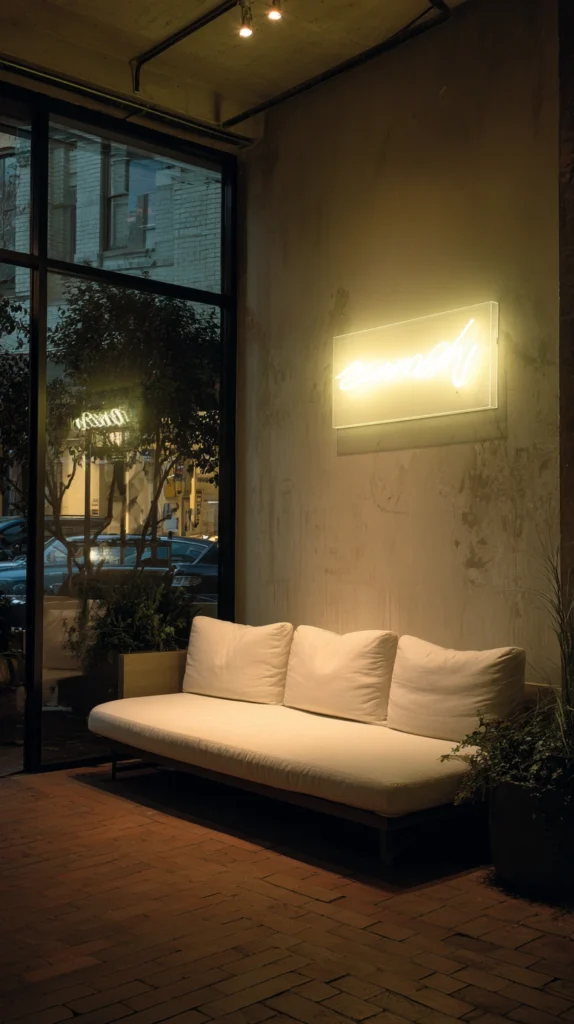
Budget: $80 – $400
A neon sign or an LED neon flex installation — either a meaningful word or phrase, a simple shape, or a botanical or geometric outline — above the sofa creates the above-sofa treatment with the most contemporary sensibility and the most evening presence. A neon installation that is switched off during the day reads as a sculptural object; switched on in the evening it becomes the room’s primary light source at that wall, casting a warm, coloured glow over the sofa and the people on it.
A custom LED neon sign in a single colour costs $80–$300 depending on length and complexity. A standard pre-made neon phrase or shape runs $60–$200. Mount on a piece of treated timber or a painted MDF backing rather than directly on the wall — the backing gives the neon installation a defined border and prevents the fixing wires from being visible against the wall surface.
Style tip: Choose a neon colour that relates to the room’s palette rather than contrasting with it sharply. A warm white or amber neon in a warm-toned room reads as an extension of the room’s light quality; a vivid blue neon in the same room creates a colour that the rest of the room has not prepared for. The neon colour that reads best in the above-sofa position is the one that, when lit, looks as if the room’s own light has been concentrated and given a slightly more visible form.
10. The Framed Fabric Panel
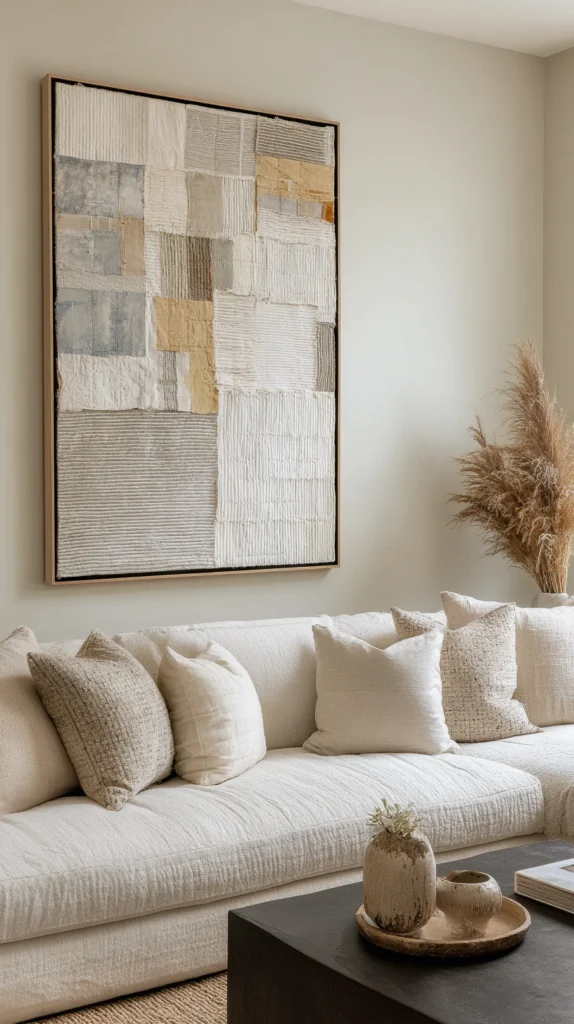
Budget: $40 – $250
A section of beautiful fabric — a vintage kimono textile, a length of William Morris print, a hand-block-printed cotton, a section of embroidered or woven textile — stretched over a canvas frame or mounted behind glass and hung above the sofa creates a textile artwork at the scale and format of a painting. Framed fabric combines the visual complexity of pattern and the material warmth of textile with the graphic presence of a framed piece.
A canvas stretcher frame in a large size costs $20–$50. Fabric to cover it runs $15–$60 per metre for standard quality and $40–$200 per metre for quality vintage or artisan fabric. Staple the fabric to the back of the stretcher frame using a staple gun ($10–$20 if not owned) for a flat, taut surface with no visible fixings. A framed fabric panel of 100 by 70 centimetres costs $50–$150 in total and can be changed by reupholstering the same frame with different fabric when the room’s palette changes.
Style tip: Choose a fabric with a scale of pattern appropriate to the size of the frame — a small repeat pattern in a large frame reads as texture rather than pattern and loses the design quality that makes the fabric interesting; a large pattern in a small frame clips the design before it can be read. The relationship between pattern scale and frame size is the selection decision that determines whether the framed fabric reads as a deliberate choice or a coincidence of what was available.
11. The Dramatic Wallpaper Panel
Budget: $80 – $400
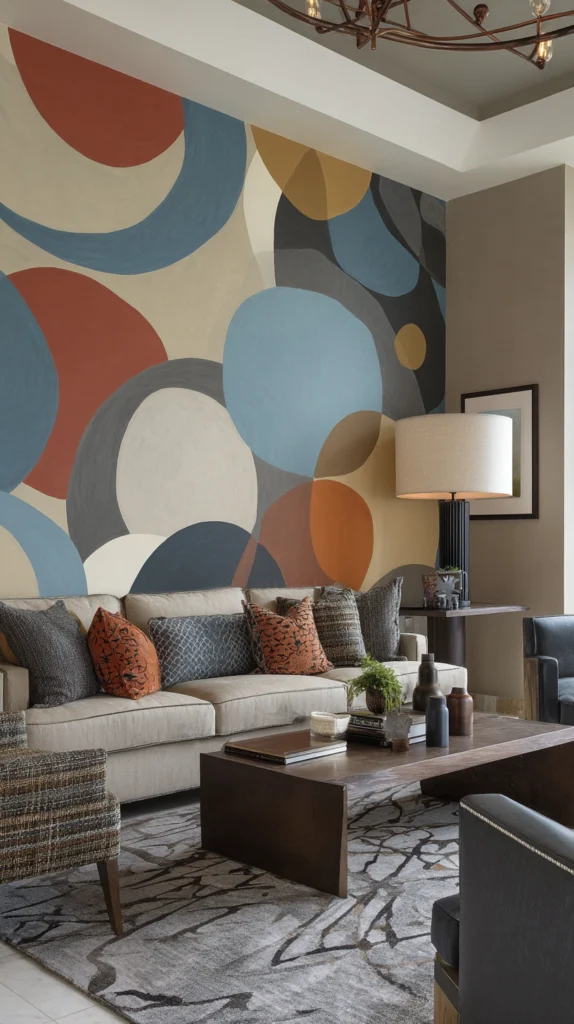
A panel of wallpaper — applied to the above-sofa wall only, contained within the wall space above the furniture rather than extending to the full room — creates a graphic treatment of the above-sofa wall that is more architectural than a hung piece and more temporary than a full room wallpaper application. A wallpaper panel above the sofa reads as a large-format artwork in pattern and colour rather than as a wallpapered room, and the contained application makes it removable without the commitment of full-room papering.
A bold botanical or geometric wallpaper in a standard roll costs $40–$120 per roll. Two to three rolls cover a standard above-sofa wall area. A peel-and-stick version for rental properties or for those wanting reversibility runs $30–$80 per roll. Apply with a precise vertical edge on each side — using a plumb line rather than measuring from the wall corner, which is almost never perfectly vertical — so the panel has clean, straight sides that read as intentional rather than roughly applied.
Style tip: Choose a wallpaper with a large-scale pattern for the above-sofa panel rather than a small repeat. A large-scale pattern — a botanical with full-size leaves, a geometric with large blocks — reads as a statement at the scale of the above-sofa wall. A small repeat pattern in the same position reads as texture rather than design and has the visual quality of a large area of patterned wrapping paper rather than a considered wall treatment.
12. The Sculptural Wall Object Collection
Budget: $80 – $500
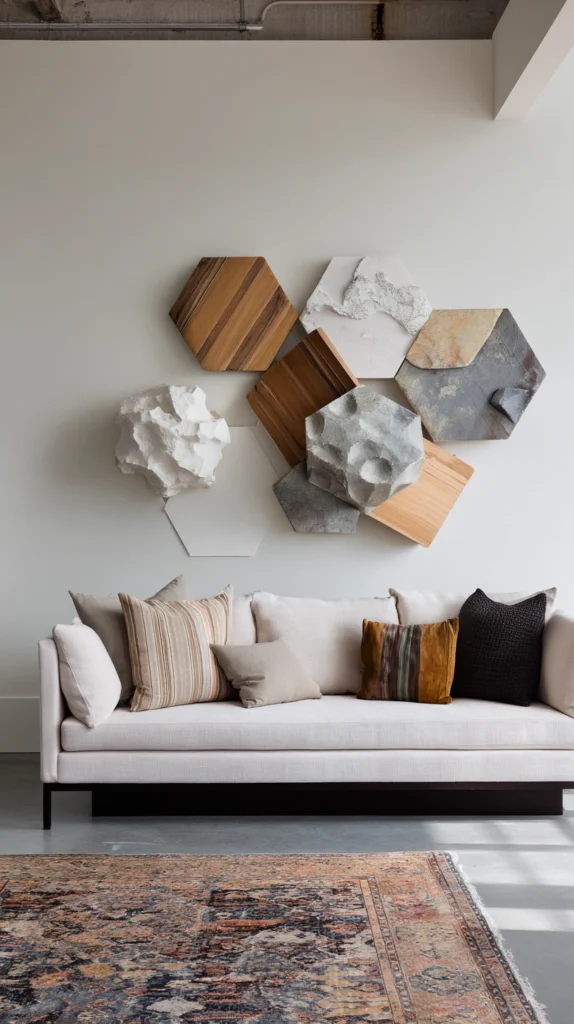
A collection of three-dimensional wall objects — ceramic wall dishes, carved wooden forms, sculptural plaster pieces, woven wall baskets, cast metal objects — arranged on the above-sofa wall creates a treatment of genuine tactile and sculptural quality that framed flat artwork cannot provide. Three-dimensional wall objects cast their own shadows, change in appearance with the movement of light through the day, and give the wall a quality of depth and materiality that flat surfaces lack.
Ceramic wall plates and dishes cost $15–$60 each. Carved wooden wall panels run $30–$100. Woven wall baskets cost $20–$60 each. A collection of seven to nine three-dimensional objects arranged in a loose organic grouping above the sofa costs $140–$500 in total. Arrange the collection so the objects overlap slightly in the visual field rather than sitting in a neat grid — the slight overlap and the organic arrangement give the collection the quality of something that grew on the wall rather than was installed on it.
Style tip: Mix the projection depth of the objects within the collection rather than using all objects of similar depth. A shallow ceramic dish beside a deeper carved panel beside a three-dimensional sculptural form creates a collection with genuine spatial depth; all objects of the same projection produce a surface that reads as flat despite its three-dimensional material. The depth variation is the physical quality that makes a sculptural wall collection genuinely sculptural.
13. The Map or Graphic Print Statement
Budget: $30 – $300
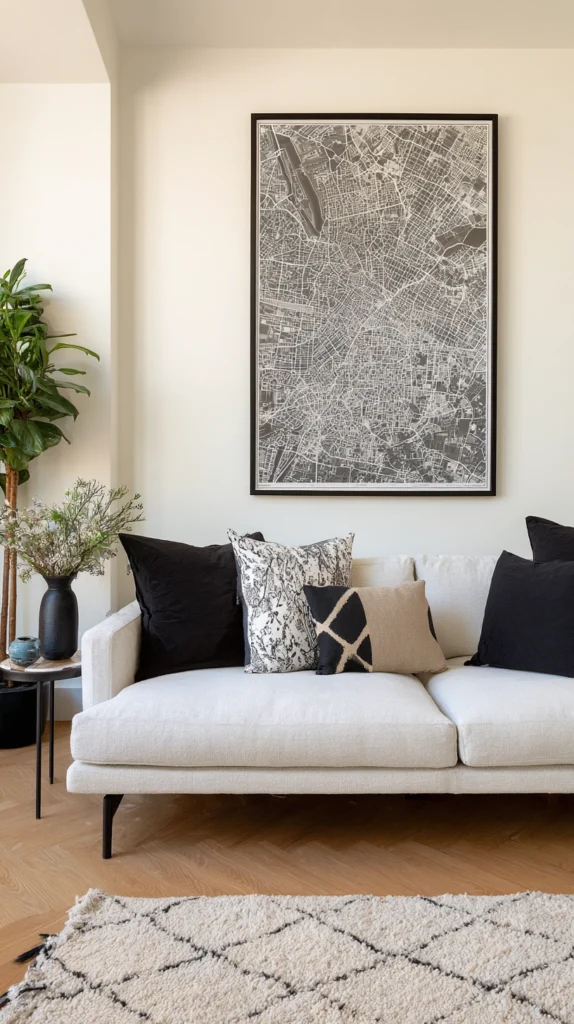
A large-format map — of a city that matters, a coastline that was walked, a mountain range that was climbed, a country that changed something — printed and framed at statement scale above the sofa creates an above-sofa treatment that is simultaneously graphic, personal, and endlessly detailed enough to reward close reading. A map is not just decoration; it is a document, and a map that was chosen because of what it represents rather than because of how it looks produces an above-sofa wall with genuine meaning.
A large-format vintage map print at A1 size costs $20–$80 from online print archives. A custom-printed contemporary map runs $40–$150. A simple frame at A1 scale costs $30–$100. A vintage map with its aged colour and its obsolete geography has a warmth and a particularity that a contemporary map can lack — the cartographic conventions of a different era, the names of places that no longer exist, the handmade quality of pre-digital mapmaking.
Style tip: Frame the map without a mat — flush to the frame edge rather than with a white card border — to maximise the visible map area and to give the framed piece the quality of a document in a frame rather than an artwork in a frame. The document quality is the distinguishing characteristic of a map as above-sofa art, and the mat undermines it by giving the map the presentation of a print.
14. The Painted Mural Panel
Budget: $100 – $1,500
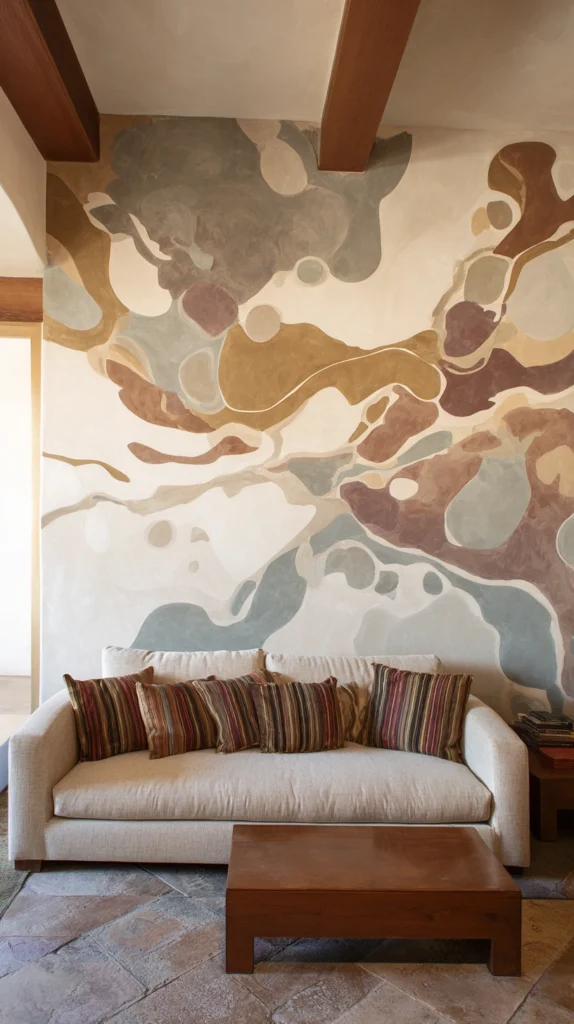
A hand-painted mural — either painted directly on the above-sofa wall or painted on a large wooden panel that is then hung — creates the most dramatic and most personalised above-sofa treatment available. A mural above the sofa is the one treatment that is entirely specific to the room it occupies and entirely impossible to replicate elsewhere, and that specificity is the quality that makes it the most remembered and most discussed element of any living room that contains one.
A professional mural artist charges $100–$500 per square metre. A self-painted botanical or abstract mural using chalk paint costs $30–$80 in paint materials. A large MDF panel primed and painted as a mural panel costs $50–$150 in materials and provides a removable mural option for rented spaces. The mural’s scale should fill the full above-sofa wall zone rather than occupying only part of it — a mural that does not extend to the edges of its designated wall area reads as a large painting rather than as an architectural treatment.
Style tip: Use a matte paint finish for the mural rather than a satin or gloss. A matte mural in the above-sofa position reads as part of the wall — as if the wall itself is painted with imagery — while a satin or gloss mural reads as a surface applied to the wall. The matte finish is the application decision that makes the mural feel built-in rather than added, and the feeling of being built-in is the quality that distinguishes a mural from a very large painting.
15. The Vintage Poster Collection
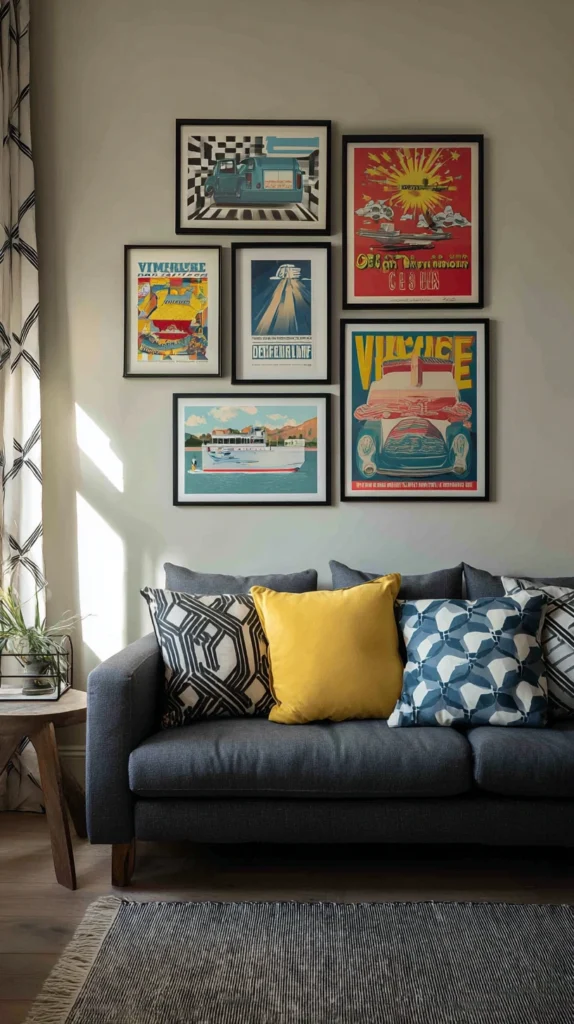
Budget: $30 – $200
A carefully assembled collection of vintage posters — travel, exhibition, film, botanical, typographic — in matching frames above the sofa creates a display of graphic history that communicates genuine knowledge of and engagement with the visual culture of the twentieth century. Vintage poster art is among the most graphically sophisticated and most accessible of all collected image types, and a considered collection of four to six above the sofa gives the room an intellectual and visual richness that contemporary art prints rarely achieve.
Original vintage posters in good condition cost $20–$200 each depending on age, rarity, and condition. High-quality reproduction prints of iconic vintage posters cost $10–$40 each. Frames in a consistent simple profile — all black, all white, or all dark timber — run $10–$30 each. A collection of five vintage travel or exhibition posters in matching frames costs $80–$250 in total and provides an above-sofa wall treatment of genuine graphic quality.
Style tip: Choose posters that belong to the same graphic era — all mid-century modern, or all Art Deco, or all 1970s — rather than mixing graphic styles from different periods. A collection from a single era reads as a graphic-era collection; a mixed-period collection reads as a selection of whatever vintage posters were available. The period consistency is the curatorial decision that gives the collection its identity.
16. The Mixed Media Art Wall
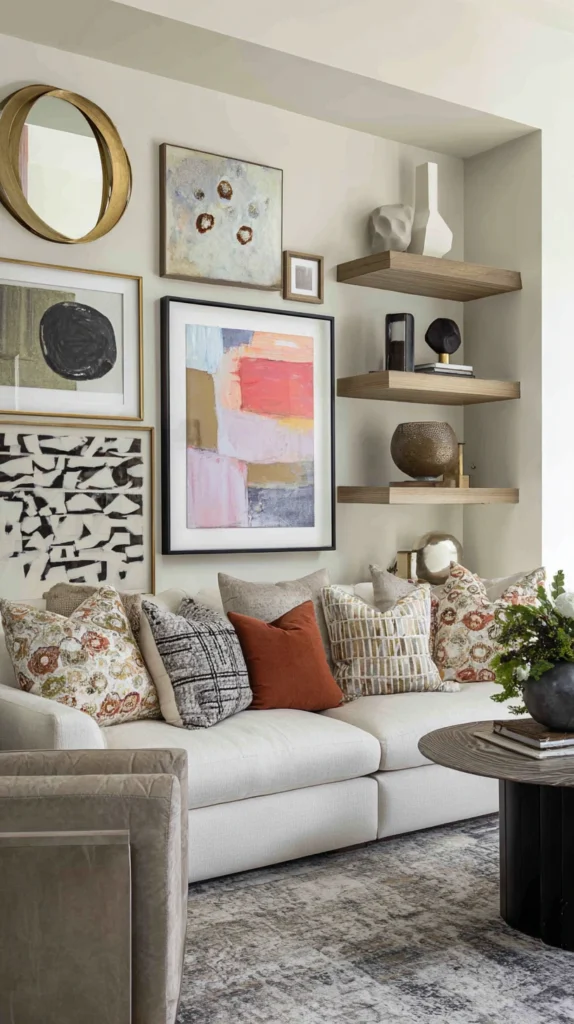
Budget: $100 – $600
A mixed media above-sofa installation — combining framed prints, three-dimensional objects, a small shelf with objects, a mirror, and one significant painted piece — in a considered arrangement that uses all of these elements as a single composed display creates the most complete and most visually complex above-sofa treatment available. The mixed media wall is the most ambitious of all the options here and the most rewarding when it is executed with genuine compositional thought rather than simply assembled from available pieces.
The individual components vary in cost — a framed print at $20–$80, a small shelf at $20–$50, a mirror at $50–$200, three-dimensional objects at $15–$60 each. A fully realised mixed media above-sofa installation costs $150–$500 in total. The composition requires a unifying principle — a consistent colour in all frames, a consistent material in all three-dimensional objects, a size relationship between the largest and smallest pieces — that gives the varied collection its coherence.
Style tip: Identify one piece as the compositional anchor of the mixed media wall — the largest piece, the most visually significant one, the one that everything else is arranged in relation to — before placing any other element. An above-sofa wall where every piece is of equal visual weight produces visual competition rather than visual composition. The anchor piece is the one that the eye finds first, and from which it moves outward to discover everything else.
The above-sofa wall is the living room’s primary design opportunity and the one that most directly determines the character and the quality of the room it belongs to. It does not require the most expensive treatment or the most elaborate one — it requires the most considered one. The right scale, the right height, the right relationship between the wall display and the sofa below it: these are the decisions that make the above-sofa wall the room’s most resolved surface or its most persistent missed opportunity.
Choose one approach and execute it with genuine commitment — the right scale, the correct hanging height, the consistent framing — rather than compromising between two approaches and achieving neither. The above-sofa wall treated with this level of intention becomes the reason the living room is a room rather than a space, and the reason guests feel, without knowing why, that they have walked into somewhere that was genuinely thought about.