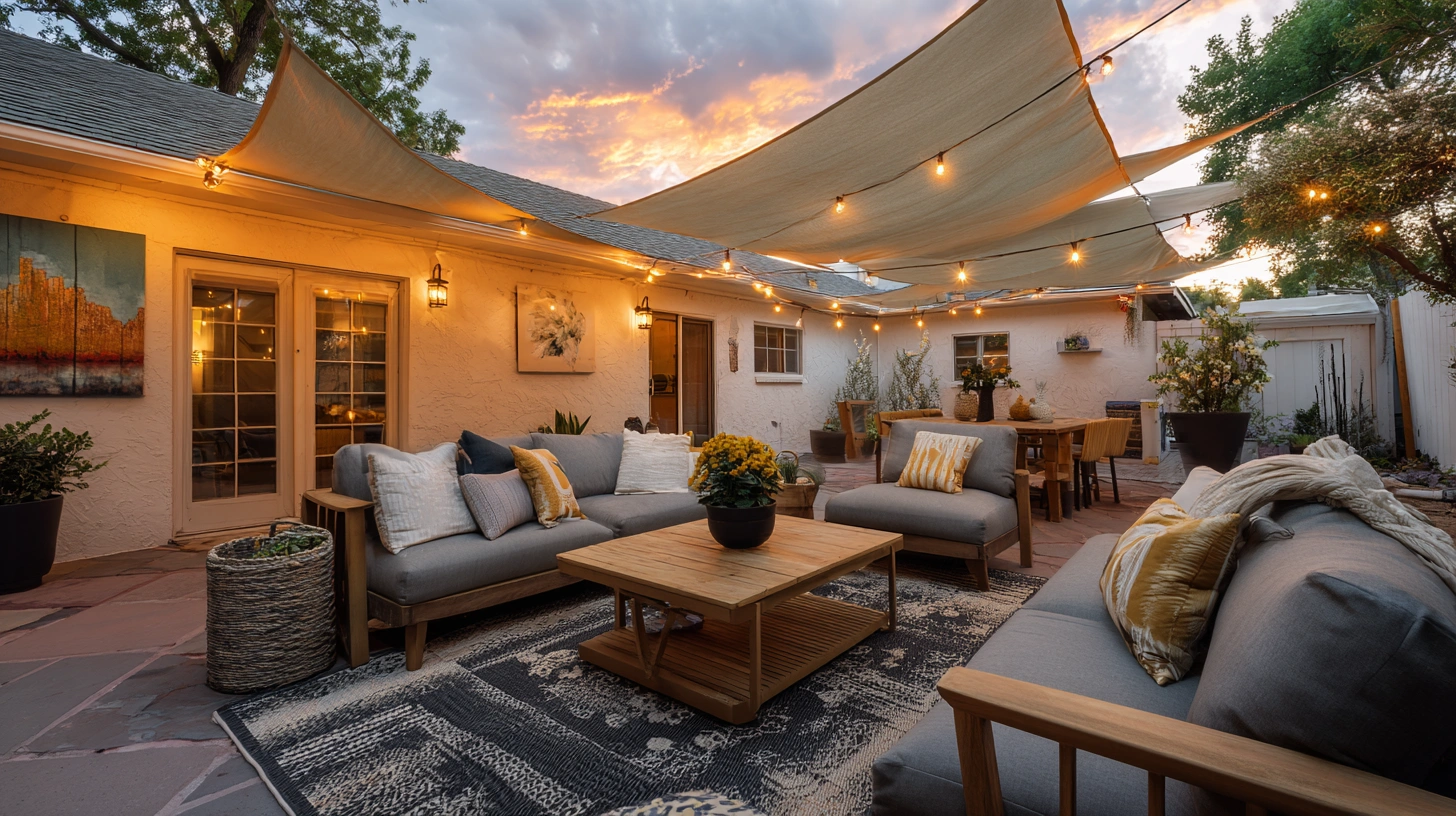
15 Patio Decor Ideas to Extend Your Living Space Outdoors
15 Patio Decor Ideas to Extend Your Living Space Outdoors
There is a room most houses have that nobody counts when they list the rooms. It has no ceiling, or a partial one. It has a floor of some kind — stone, timber, concrete, tile — and at least one wall, usually the back of the house. It might be 10 square metres or it might be 40. It is almost certainly underused, underdecorated, and underestimated as a place to actually live rather than simply to occasionally occupy.
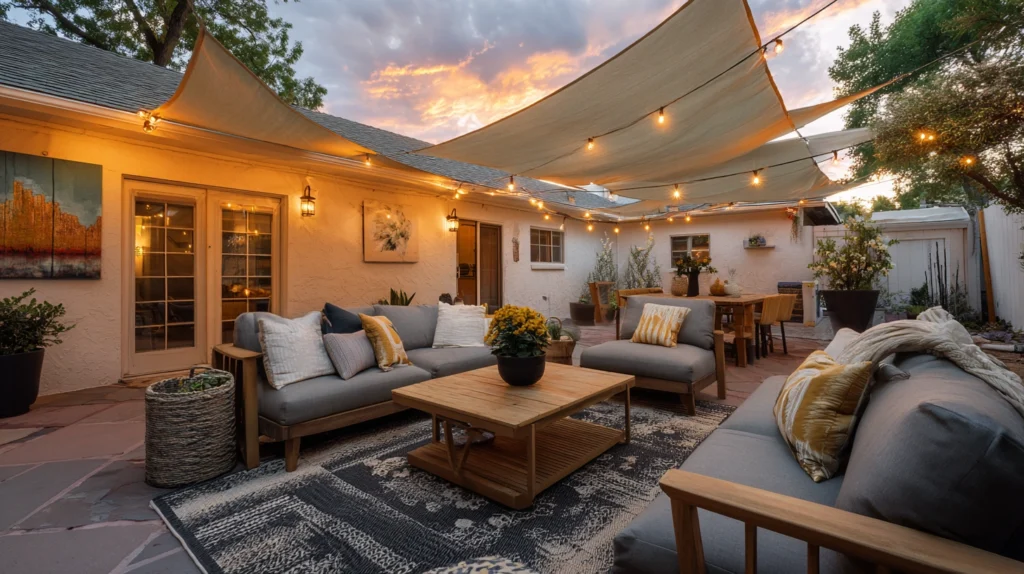
The patio, treated as an extension of the house rather than an appendage to the garden, becomes one of the most valuable rooms in the building. It does not require a renovation to get there. It requires the same thinking that goes into any room — what is the furniture arrangement, where is the light, what does it smell like, what happens when it rains, what makes it feel like somewhere to stay rather than somewhere to pass through.
Each idea below includes what you will need, what it will cost, and a practical tip to make the whole thing work as well as the room it is meant to extend.
1. The Outdoor Sofa and Coffee Table Setup
Budget: $150 – $800
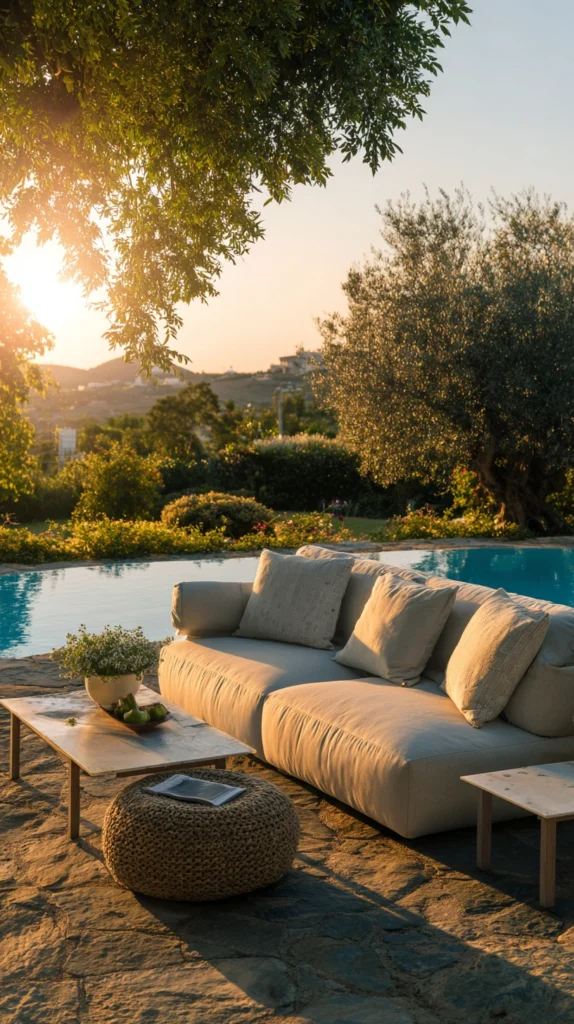
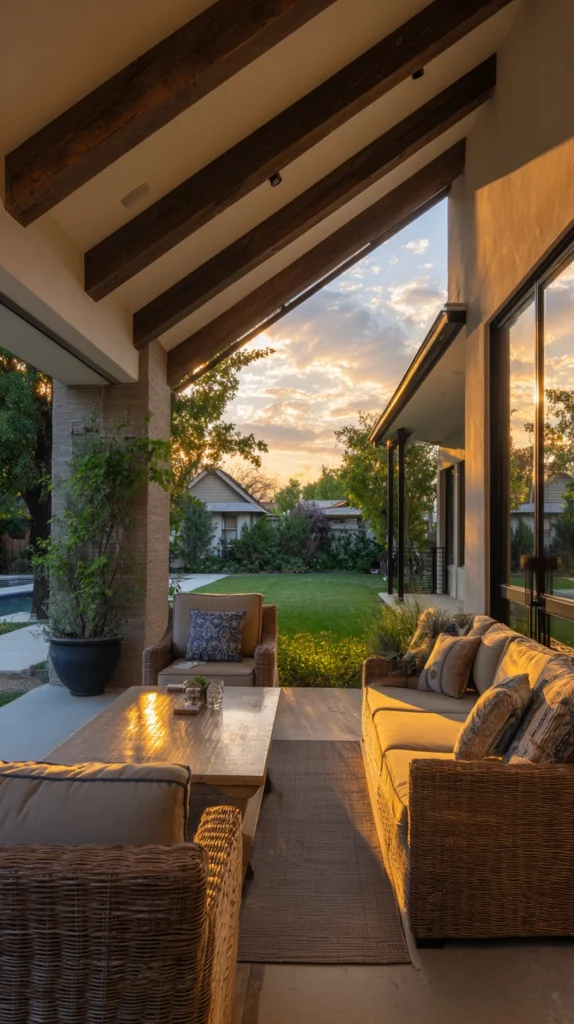
A proper outdoor sofa — not a garden bench with cushions, not a pair of chairs facing each other, but an actual sofa — changes the patio from outdoor seating to an outdoor living room in a way that no other single piece of furniture manages. The sofa signals that this is a place to settle rather than perch, that the hour can be spent here rather than endured, and guests who would not linger on a garden chair will sink into a sofa and stay for the evening.
A synthetic rattan outdoor sofa costs $150–$400. An all-weather wicker version runs $300–$600. A low outdoor coffee table of matching height — 35–40 centimetres — costs $60–$150. Position the sofa facing the garden rather than the house wall and place the coffee table close enough that seated guests can reach it without leaning forward uncomfortably — 35–40 centimetres between the sofa front and the table edge is the distance that makes a coffee table genuinely usable rather than decorative.
Style tip: Add an outdoor side table at each end of the sofa as well as the central coffee table. A sofa without armrest-height surfaces beside it requires guests at each end to reach across the sofa or to the coffee table for their glass — the side tables cost $15–$30 each and remove the most persistent small frustration of outdoor sofa seating.
2. The Defined Outdoor Rug Zone
Budget: $40 – $180
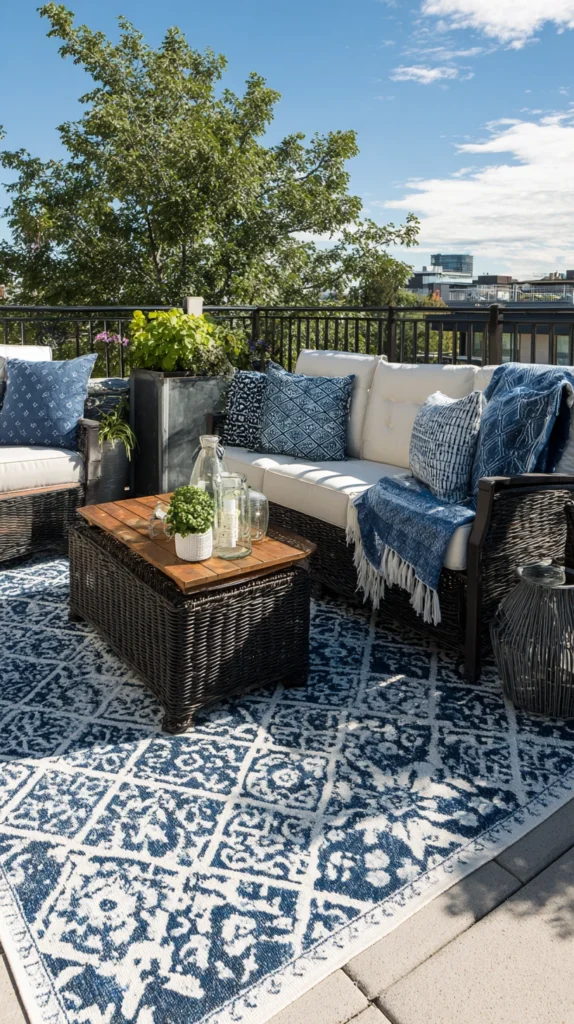
An outdoor rug laid beneath the seating arrangement — large enough that all furniture legs sit on it — is the single change that most reliably transforms a collection of outdoor furniture into a room. The rug does what a rug always does: it defines a space, anchors the furniture within it, and signals that this is not a terrace with chairs on it but a living area that happens to be outside.
An outdoor polypropylene rug in a 180 by 270 centimetre size costs $40–$120. A 240 by 340 centimetre version — large enough for a full seating group — runs $80–$180. Secure the corners with outdoor rug tape ($8–$15) or weighted pots at each corner. Hose clean twice a season and allow to dry fully in the sun before replacing — a damp rug beneath outdoor furniture develops mould on its underside within days and the smell it produces is considerably worse than the inconvenience of bringing it inside to dry properly.
Style tip: Choose a rug pattern rather than a plain colour for the patio. A patterned rug hides the inevitable marks, footprints, and slight discolouration that accumulate on any outdoor surface through a season of use; a plain rug makes every imperfection visible. The pattern is not purely aesthetic — it is practical camouflage for the evidence of a well-used outdoor room.
3. The Outdoor Lighting Plan
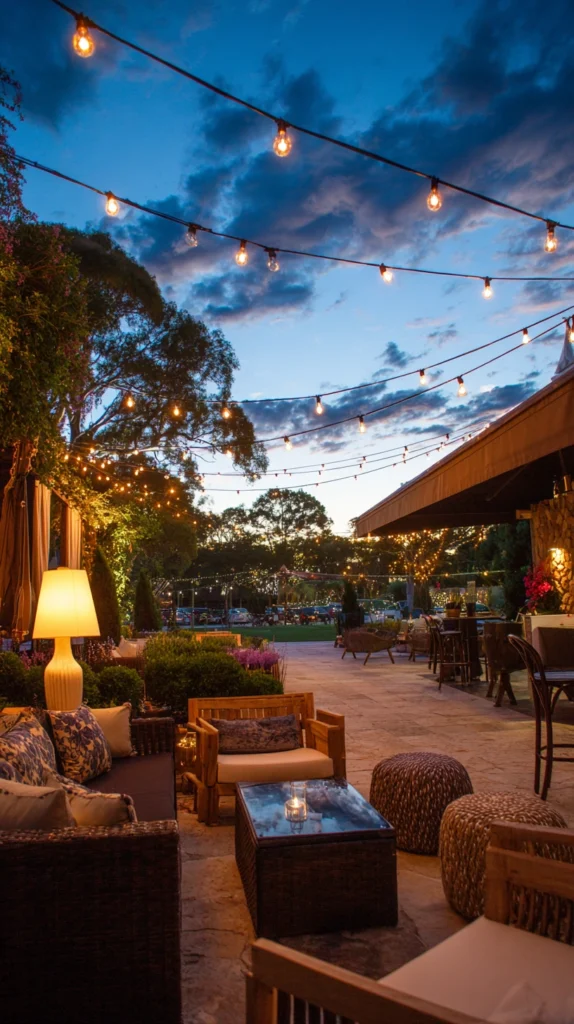
Budget: $30 – $200
A patio without a considered lighting plan is a daytime room that closes at dusk. One with layered outdoor lighting — overhead festoon lights, candles on the table, a floor lamp or a lantern at the seating area boundary — is a room that comes into its best version of itself after dark, when the garden beyond it disappears and the patio becomes the entire world. The lighting plan is not optional if the patio is to function as an extension of the living room rather than a fair-weather appendage.
Outdoor festoon lights on a 10-metre reel cost $20–$50. A weatherproof outdoor floor lamp runs $40–$100. Lanterns at the patio perimeter cost $8–$25 each. Connect permanent lights to a timer or a dusk-to-dawn sensor ($10–$20) so they come on automatically rather than requiring manual switching — lights that must be consciously activated each evening are activated less reliably than lights that simply appear.
Style tip: Install the lighting before the furniture is finalised. It is considerably easier to run a cable along a fence or thread a festoon light string through a pergola frame before a sofa is positioned beneath it, and the lighting plan often reveals that the furniture arrangement assumed during daylight planning does not take the light sources into account in a way that daytime planning cannot predict.
4. The Outdoor Dining Table
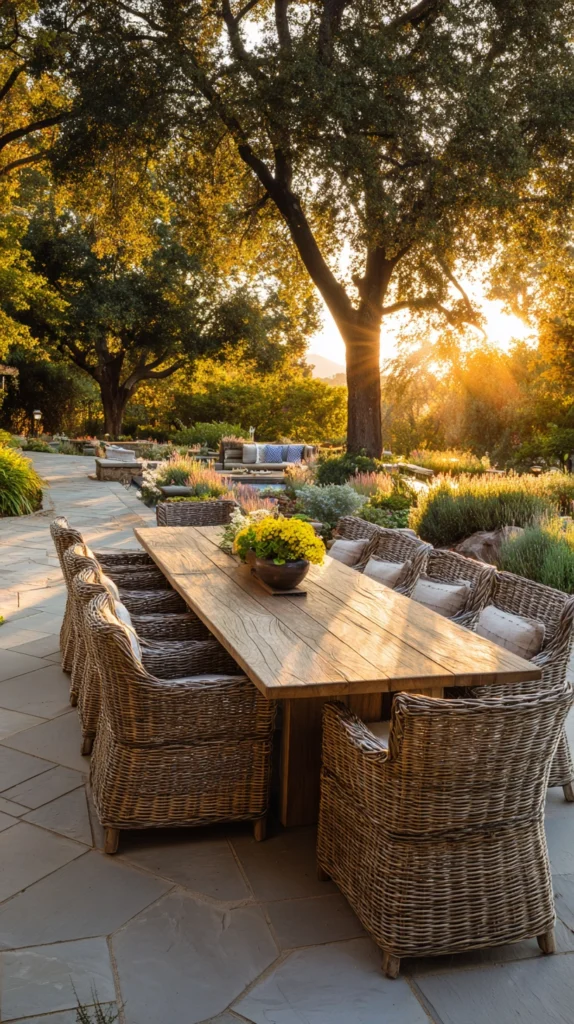
Budget: $80 – $600
A proper outdoor dining table — large enough for the number of people who regularly use the patio, positioned so it does not crowd the seating area, with chairs that can be pulled back without catching on a step or a planter — is the piece of furniture that most directly turns a patio into a room where life happens. People who eat outside together stay outside. A dining table makes the patio a reason to be outdoors rather than simply an option.
A teak or hardwood outdoor dining table for six costs $200–$600. An aluminium version runs $150–$400. A concrete-topped table on a powder-coated frame — the most weather-resistant combination available — costs $200–$500. Choose a table length that leaves at least 90 centimetres of clear patio space on all sides when chairs are pulled out — a table that fills the patio to its edges has nowhere for guests to approach from and nowhere for the host to serve from.
Style tip: Position the dining table so the prevailing wind — if there is one — comes from the side rather than directly into the faces of seated guests. A meal eaten while squinting into a headwind is a meal people remember for the wrong reasons; one eaten with the breeze at shoulder height is one where the weather is part of the pleasure rather than the obstacle to it.
5. The Outdoor Curtain Room Divider
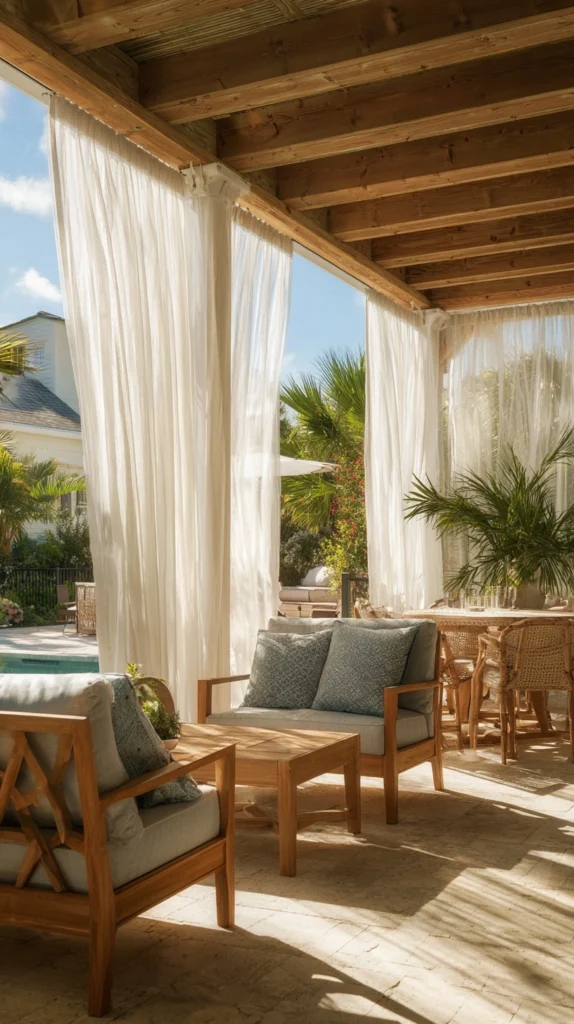
Budget: $30 – $150
Outdoor curtain panels hung from a rod or wire between two posts — or from a pergola beam to the floor — divide the patio into distinct zones without enclosing either one. A dining zone on one side and a lounging zone on the other, with a sheer panel between them that can be drawn open or closed, gives the patio the room-within-a-room quality that makes a large living room feel more intimate and a small patio feel more thoughtfully organised.
Outdoor curtain panels in a 250-centimetre drop cost $20–$50 each. A tension wire and fixings run $10–$20. The divider curtain does not need to reach from post to post with no gaps — a single wide panel or two narrower panels that leave the sides slightly open creates a visual division without physical enclosure, which suits an outdoor space considerably better than a fully closed partition.
Style tip: Choose a sheer or semi-sheer fabric for a divider curtain rather than an opaque one. A sheer panel divides the patio visually while allowing both zones to feel part of the same space — light and air and conversation pass through a sheer panel in a way they cannot through canvas or heavy polyester, and the outdoor room retains its openness even when divided.
6. The Vertical Garden Wall
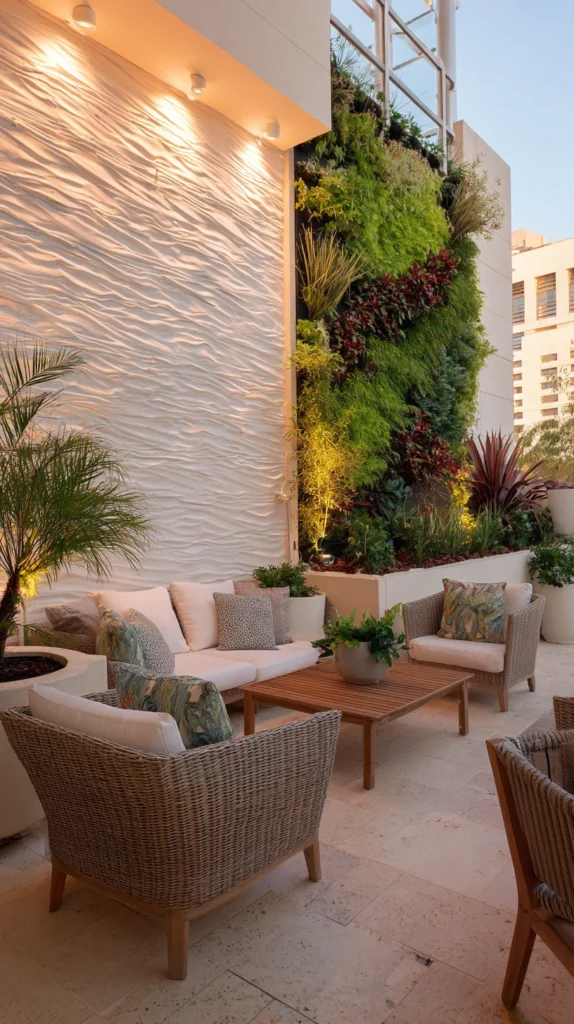
Budget: $30 – $150
A wall of the patio — particularly an ugly brick or concrete wall that faces the seating area — planted with climbing plants, pocket felt planters, or a modular wall planter system becomes the most living surface in the outdoor room. A vertical garden on the wall the patio seating faces most directly gives the room a view inward as well as outward and softens the hard surfaces of a paved patio in a way that potted plants at ground level alone cannot achieve.
A pocket felt planter system costs $25–$70. Modular wall planters run $40–$150 for a full wall section. Trailing plants and ferns suitable for a vertical installation cost $3–$8 each. Water the vertical garden before guests arrive rather than during the gathering — a dripping wall planter above a sofa is an atmosphere problem that a brief afternoon watering session in advance prevents entirely.
Style tip: Plant the vertical garden with a mix of trailing plants, upright plants, and one or two plants with fragrant foliage — lemon thyme, scented geranium, mint. A fragrant vertical garden beside a seating area releases its scent whenever the foliage moves in a breeze, and that scent contributes more to the atmosphere of the outdoor room than any candle or diffuser placed beside it.
7. The Outdoor Bookshelf
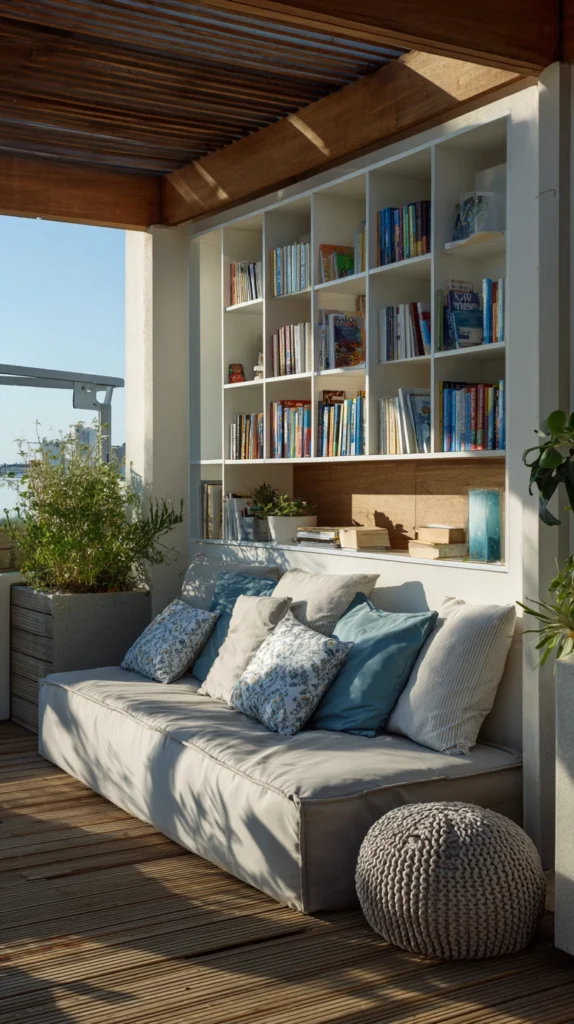
Budget: $20 – $100
A waterproofed bookshelf on a covered patio — stocked with paperbacks, a set of cards, a backgammon board, a pair of binoculars — turns the patio from somewhere to sit into somewhere to spend time. The bookshelf signals that the outdoor room is fully equipped for an afternoon, not just a coffee break, and the presence of books and games in a space communicates that the expectation is to stay rather than to visit briefly and return inside.
A second-hand bookshelf treated with exterior paint or wood sealant costs $10–$30. A dedicated outdoor storage cabinet for books and games in a weatherproof format runs $50–$150. Keep the outdoor book collection separate from the indoor one — rotate titles seasonally, stock it with beach reads and paperbacks rather than hardbacks, and accept that outdoor books accumulate a slight warp and a particular smell that is entirely appropriate to where they live.
Style tip: Include one reference book about the garden — a wildflower identification guide, a bird field guide, a book about the local landscape — alongside the fiction and the games. The reference book that is actually about the outdoor world is the one that gets picked up most consistently and gives the outdoor room a purposefulness that a shelf of novels alone does not quite achieve.
8. The Outdoor Kitchen Counter
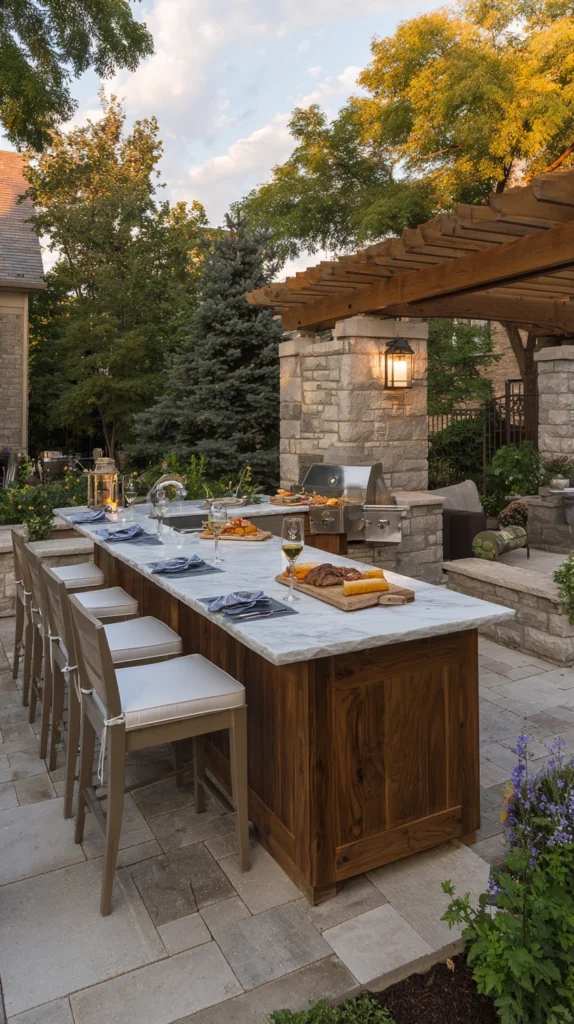
Budget: $60 – $300
A dedicated outdoor kitchen counter — even a simple one, even a repurposed element — positioned on the patio with everything needed for outdoor food preparation and serving within reach of where guests are sitting removes the most persistent obstacle to genuinely outdoor living: the constant return to the indoor kitchen. A patio with a counter, a small fridge, and a sink or at minimum a water connection is a room that can host a meal without requiring its host to disappear.
A weatherproof outdoor counter built from cinder blocks and a timber or tile top costs $40–$100. A freestanding outdoor kitchen unit costs $100–$300. A small countertop fridge for the patio ($80–$150) makes the difference between an outdoor counter that requires frequent indoor trips for cold items and one that is genuinely self-contained. The counter does not need to include cooking — a preparation and serving surface alone changes the function of the patio significantly.
Style tip: Position the outdoor counter so the host faces the seating area while working rather than away from it. A counter that requires the host to turn their back on guests to prepare food is a counter that isolates the host from the party at exactly the moments when being part of it matters most. The orientation of the work surface is a social decision as much as a practical one.
9. The Weather Protection Canopy
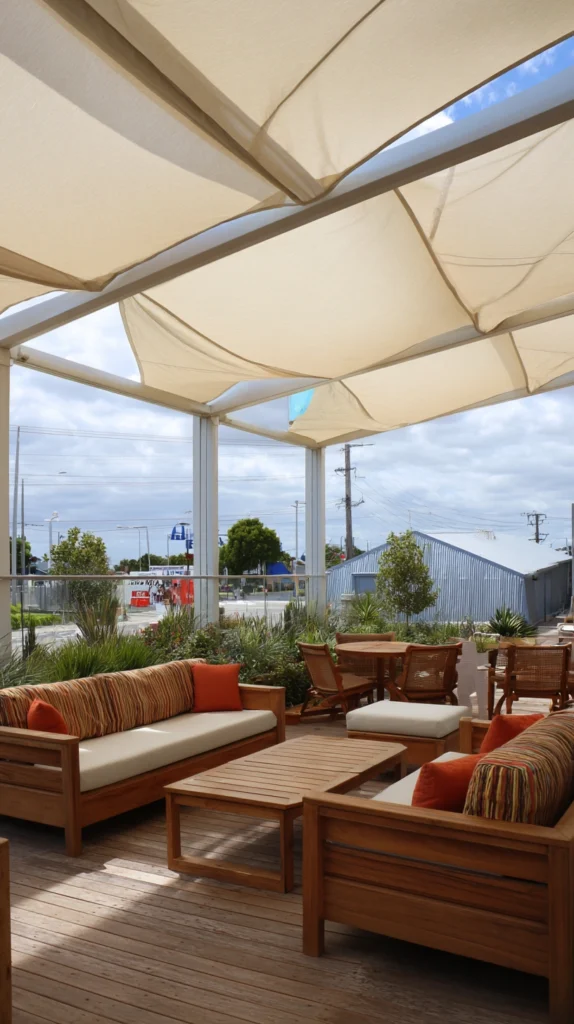
Budget: $80 – $500
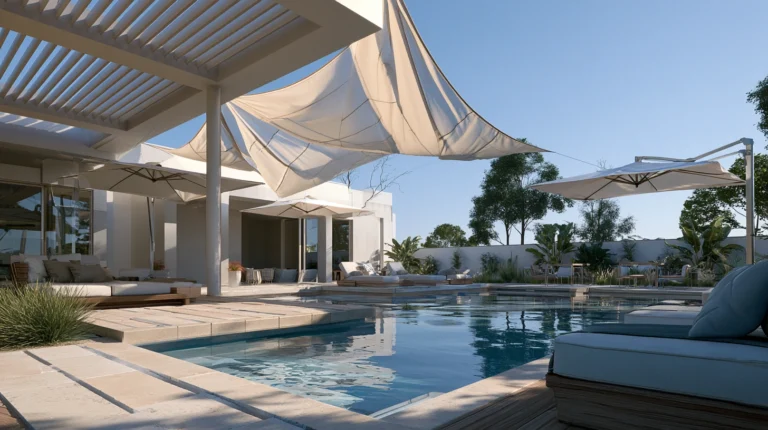
A patio without weather protection is a room that closes every time the sky changes. A patio with a canopy — retractable, fixed, louvred, or fabric — is a room that stays open in light rain, in bright sun, and in the transitional weather of early and late summer that accounts for most of the year’s usable outdoor hours. Weather protection is not a luxury addition to an outdoor room; it is the element that determines how many days of the year the room can be used.
A retractable sail canopy costs $80–$200. A fixed timber pergola with a canopy kit runs $200–$600. A louvred aluminium roof system costs $500–$2,000. Choose weather protection appropriate to the climate rather than the best-case scenario — a sail canopy that is adequate for dry climates with occasional sun showers requires supplementing in wetter climates, and a solution chosen for the average day rather than the worst day is a solution that fails when it is most needed.
Style tip: Install rain guttering along the lower edge of any fixed canopy or pergola roof rather than allowing rainwater to drip from the leading edge onto the patio surface below. A gutter with a downpipe directed to a drain or a water butt ($15–$30 in materials) keeps the patio surface dry during rain and extends the conditions under which the space is usable — a patio where you stay dry under the canopy but get wet when you stand up to reach something is a patio that is not quite fully resolved.
10. The Potted Plant Collection
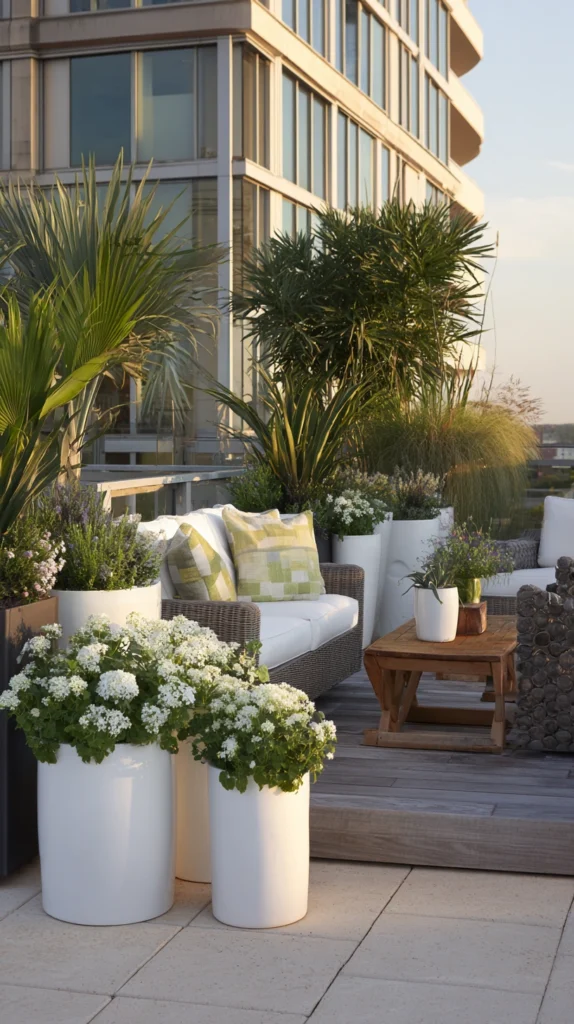
Budget: $40 – $200
A considered collection of potted plants — chosen for the light conditions of the specific patio, planted in containers that share a material and a scale, and positioned to create height variation across the space — gives the outdoor room its equivalent of artwork, soft furnishings, and natural light combined. Plants do more than any other single element to make a paved patio feel like a garden rather than a car park with furniture in it.
Architectural plants suitable for containers — phormium, agapanthus, olive trees, standard bay — cost $20–$60 each. Matching containers in a consistent material cost $15–$50 each. A plant in the wrong position — a sun-lover in deep shade, a drought-tolerant plant in a position that collects standing water — declines visibly within weeks regardless of the care it receives. Match the plant to the actual conditions of the patio rather than the conditions you wish the patio had.
Style tip: Group pots in odd-numbered clusters — three, five, or seven — rather than distributing them evenly across the patio perimeter. An evenly distributed border of individual pots reads as a row of objects; clustered groups of varying heights read as a composition. Move the same pots into different groupings before deciding on a final arrangement — the difference between a good grouping and an average one is often simply the position of a single pot within the cluster.
11. The Outdoor Artwork
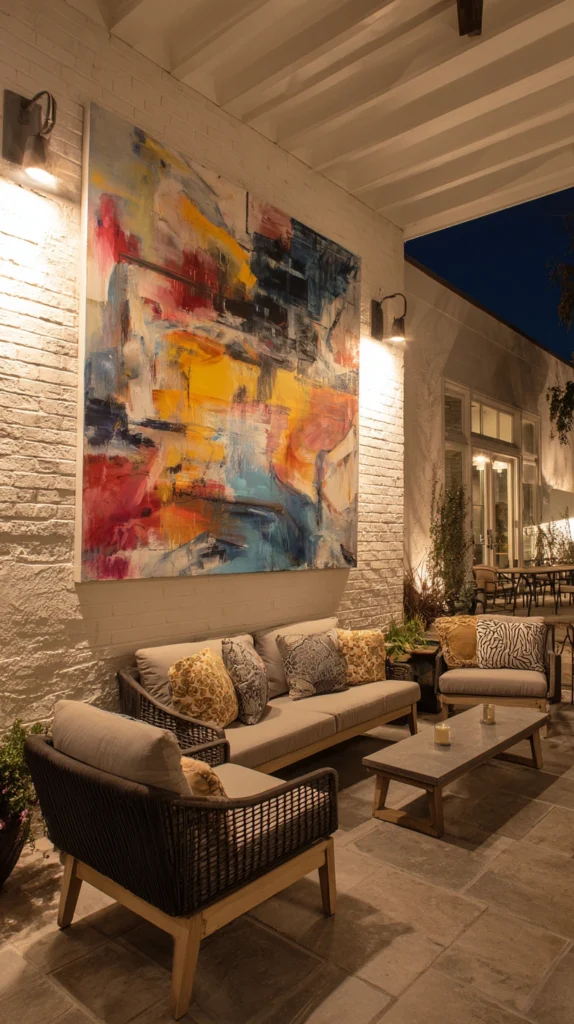
Budget: $20 – $150
A piece of artwork fixed to the patio wall — a ceramic tile arrangement, a metal sculpture, a mosaic, a large painted canvas treated with outdoor varnish — gives the outdoor room a focal point and a sense of permanence that furniture and plants, moveable as they are, cannot provide. Artwork on a patio wall says that this is a room rather than a terrace, and that the person who lives here thinks about how it looks rather than simply whether it functions.
A ceramic wall plaque or tile arrangement costs $20–$80. A steel or iron wall sculpture runs $30–$150. A canvas painting sealed with outdoor varnish ($10–$15 per can) can be created for the cost of the canvas and paint ($20–$40). Fix artwork to a covered wall rather than an exposed one — UV light, rain, and freeze-thaw cycles degrade almost every outdoor artwork material faster than a covered position does, and a patio artwork that deteriorates in its first season is an investment in disappointment.
Style tip: Choose artwork at a scale that suits the wall rather than the piece in isolation. A small artwork on a large patio wall looks unconvinced about its own presence; a large artwork that fills most of a wall reads as a considered choice. The general rule for outdoor artwork is the same as for interior artwork — err toward larger rather than smaller, and centre the piece at seated eye level rather than standing, since the patio is a room that is mostly experienced from a chair.
12. The Outdoor Speaker System
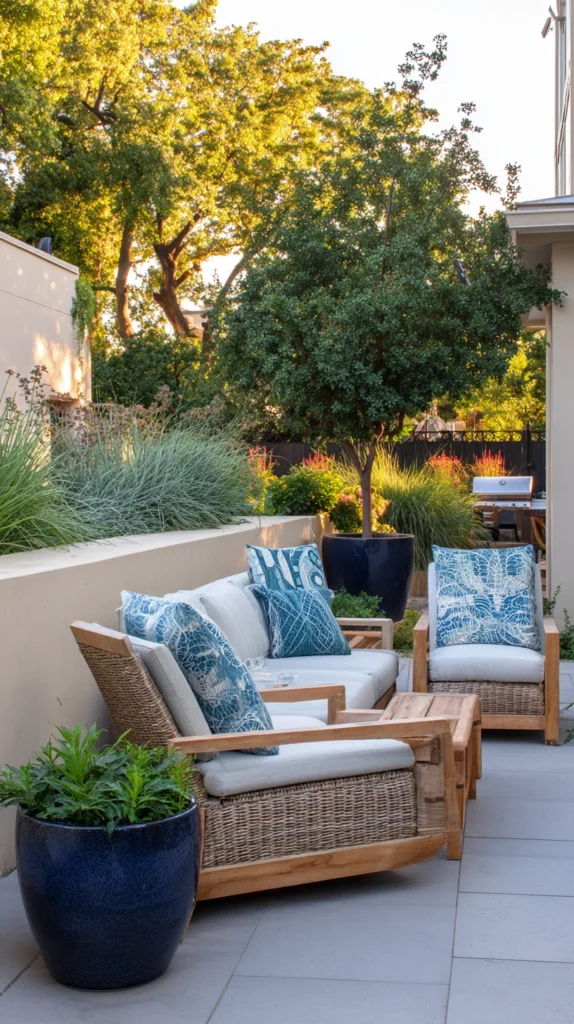
Budget: $30 – $200
Sound is the element of room design most consistently forgotten in outdoor spaces and most immediately felt when it is done well. A patio with music — at the right volume, coming from a source that is not a phone on a table — has an atmosphere that the same patio without music cannot recreate regardless of the furniture, the lighting, or the planting. The outdoor speaker is not an accessory; it is an infrastructure element of the outdoor living room.
A weatherproof Bluetooth speaker costs $30–$80. Permanently installed outdoor speakers ($80–$200 for a pair) provide better sound coverage and eliminate the need to remember to bring a speaker outside. A speaker positioned at shoulder height rather than on the ground or at ceiling height distributes sound across the seating area more evenly — a speaker on the floor projects sound at knee level and a speaker fixed to the pergola beam projects it downward; one at shoulder height disperses it horizontally through the space where people actually are.
Style tip: Set the volume so conversation is possible without raising the voice before guests arrive and resist adjusting it upward as the party progresses. Music that requires raised voices to be heard across a table is music that is competing with the conversation rather than supporting it, and a party where people have to shout to be heard is a party that is working against itself regardless of how good the playlist is.
13. The Outdoor Throw and Cushion Collection
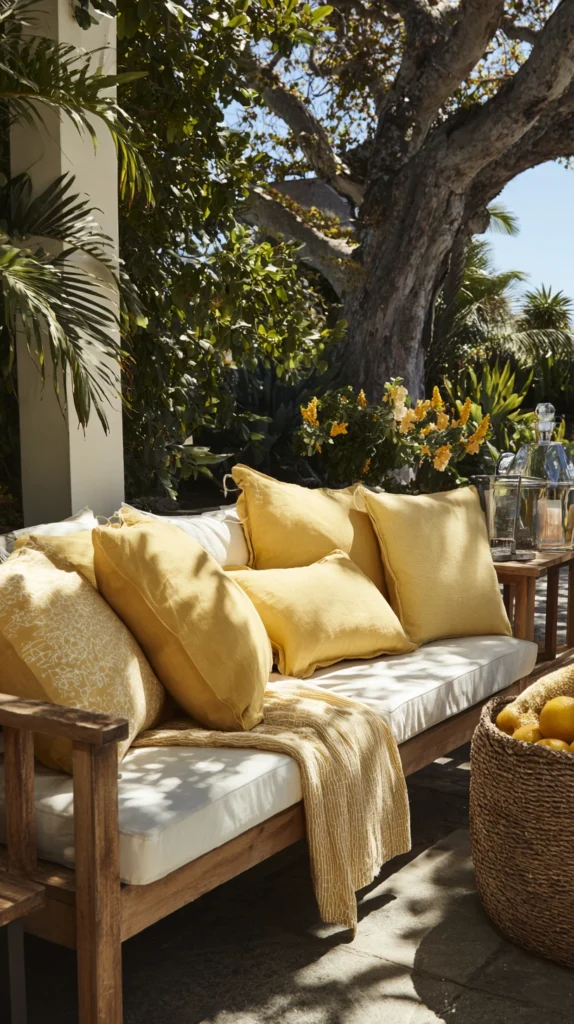
Budget: $30 – $150
A basket of outdoor throws and cushions kept permanently on the patio — available without going inside, replenished when depleted, stored in a weatherproof box between uses — extends the hours during which the outdoor room is comfortable into the cooler evenings of early and late summer that account for some of its most pleasant potential. A patio that is comfortable until eight o’clock in August is a patio; one that is comfortable until ten, with throws and a fire pit, is a room.
Outdoor throws in weather-resistant acrylic cost $15–$40 each. Outdoor cushions run $15–$35 each. A weatherproof storage box for both ($40–$80) keeps them clean, dry, and accessible between uses. Keep the throws in a basket that is part of the patio décor rather than a utilitarian box that is hidden — a basket of folded throws visible from the sofa is an invitation to stay later; the same throws accessible only by lifting a storage box lid are used less.
Style tip: Choose throws in a weight appropriate to late summer evenings rather than midsummer ones. A thin throw that is adequate in July is not adequate in September, and the outdoor room used into autumn — which is often when it is most pleasant — requires genuine warmth from its textiles rather than the token warmth of a decorative throw folded over an arm.
14. The Herb and Scent Garden Border
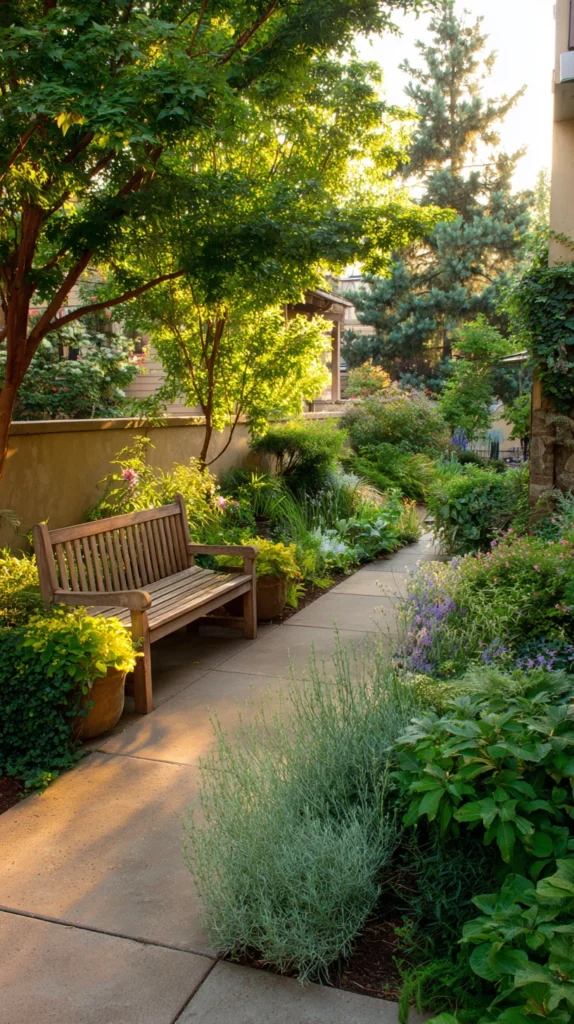
Budget: $25 – $80
A border of fragrant plants along the edge of the patio — lavender, rosemary, scented-leaf geraniums, night-scented stock — creates an olfactory dimension to the outdoor room that no interior room can replicate. The particular quality of sitting on a patio in the evening with lavender to one side and jasmine on the wall behind is one that is easy to create and impossible to manufacture artificially, and it makes the outdoor room a sensory experience rather than simply a visual and functional one.
Lavender plants cost $4–$8 each — a border of five to seven plants along one patio edge costs $20–$56. Night-scented stock seeds cost $2–$4 per packet. Rosemary and scented geraniums run $3–$6 each. Plant fragrant species in the border closest to the seating area rather than at the far edge of the patio — the scent from plants that are brushed against, or that release their fragrance in the warmth that accumulates near a wall, reaches seated guests more reliably than fragrance from plants at the open edge of the space.
Style tip: Include at least one plant that releases its fragrance in the evening rather than during the day. Night-scented stock, tobacco plant, and jasmine all perform in the hours when the patio is most used in summer, and a scent that intensifies after dusk is the olfactory equivalent of the lighting plan — it makes the outdoor room at its best when the outdoor room is most occupied.
15. The Outdoor Mirror
Budget: $20 – $150
A large weatherproof mirror fixed to the patio wall — or a treated interior mirror kept on a covered wall where rain cannot reach it — doubles the visual space of the patio and reflects the garden back into the seating area in a way that makes the outdoor room feel simultaneously larger and more verdant. A mirror on a shaded wall reflects the sunlit garden beyond, bringing light into the part of the patio where light would not otherwise reach.
A purpose-built outdoor mirror with a weatherproof frame costs $40–$150. A large interior mirror sealed with outdoor varnish around the frame joints and kept on a covered wall costs $20–$60. Fix the mirror so it reflects the most interesting view from the seating area — the garden, the planting, the sky — rather than reflecting another wall or the back of the furniture. A mirror that reflects the garden brings the outside in; one that reflects another wall brings nothing.
Style tip: Position the mirror at seated eye level rather than standing eye level — approximately 100–110 centimetres from the floor to the centre of the mirror. A mirror hung at standing eye level is most visible to people moving past it; one at seated eye level is most visible to people sitting in the outdoor room, which is where it earns its place. The same principle applies to outdoor artwork and the same seated eye level applies — the patio is experienced from a chair more than from a standing position and every element hung on its walls should reflect that.
The best patio is not the most decorated one or the most furnished one — it is the one that makes going outside feel like going into a room rather than going outside. The one where the chair is comfortable enough to stay in, the light is warm enough to stay up for, the throws are within reach when the evening cools, and the plants beside you are fragrant enough to make you notice them.
It does not require a renovation or a significant budget. It requires the same intention that goes into any room — an understanding of how the space is used, what it lacks, and what small additions will make it genuinely liveable rather than merely available. Make those additions, and the patio becomes the room the house was missing.