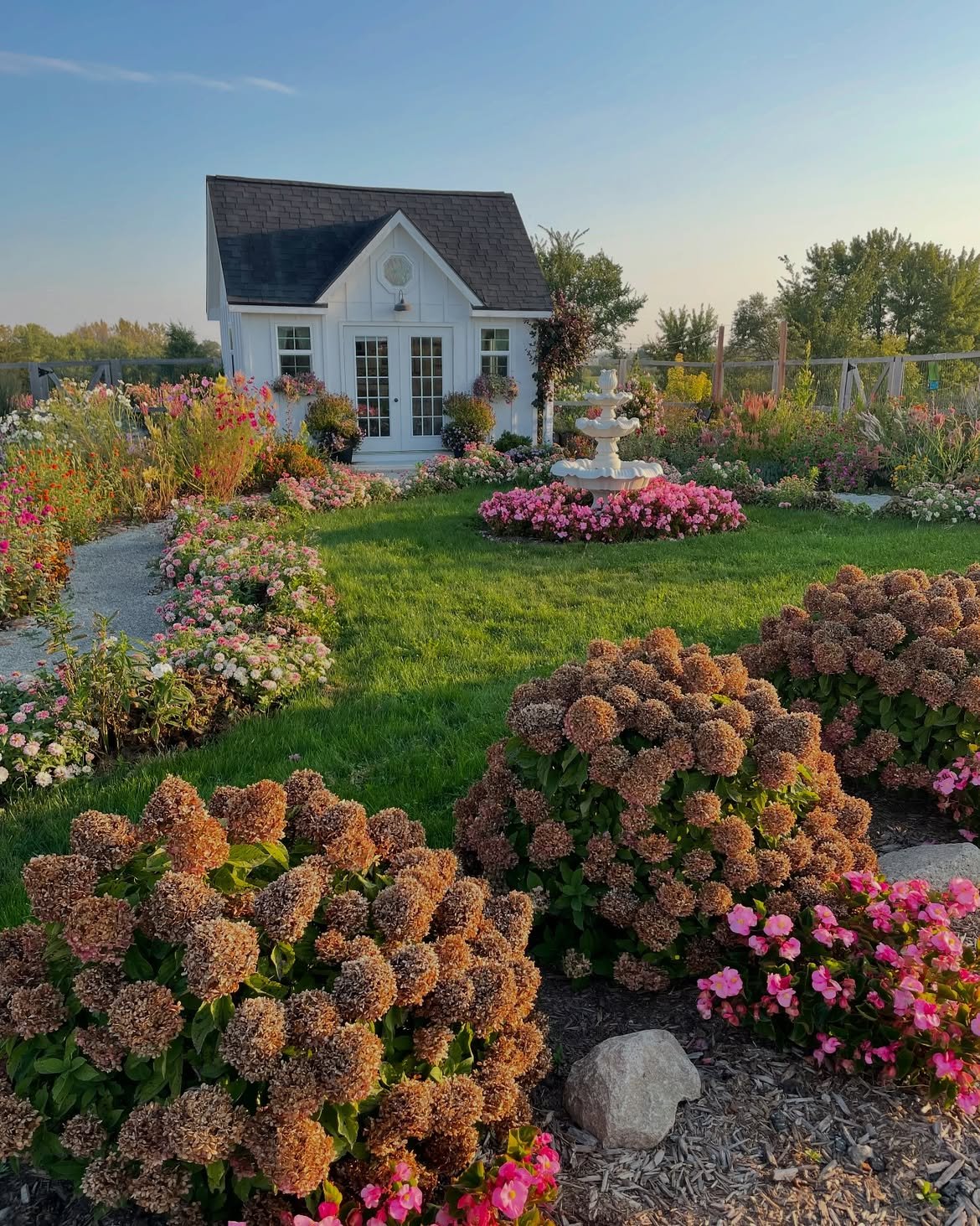
14 Cottage Garden Ideas That Feel Romantic and Effortless
14 Cottage Garden Ideas That Feel Romantic and Effortless
Most garden design advice points toward the same general outcome: control. Straight edges, defined zones, plants spaced exactly according to the tag, nothing permitted to grow beyond its designated area. The result is a garden that looks correct on paper and feels, in person, like a well-organized spreadsheet someone has decided to water.
A cottage garden works from the opposite premise. Rather than imposing a structure on the plants and asking them to fill it in, the cottage approach lets the plants make most of the decisions — sprawling where they want to, self-seeding into the cracks between paving stones, and blooming in combinations that no garden plan would have predicted but that work precisely because nobody designed them to.
The effortlessness isn’t an accident. It’s the result of making a few structural decisions well and then getting out of the way.
The paradox of a truly romantic cottage garden is that it requires real horticultural knowledge and early planning to look unplanned. A garden that’s genuinely just wild and unattended looks neglected. A garden that looks effortlessly abundant has usually been carefully stocked with the right plants — the ones that fill in generously, that self-seed, that bloom across an extended season, and that drape and climb and cascade in exactly the ways the eye expects a cottage garden to — and then given the specific kind of hands-off management that preserves the looseness rather than tidying it away.
Here are 14 ideas for building a cottage garden that earns both adjectives: romantic and effortless.
Why Cottage Garden Design Plays by Different Rules Than Formal Garden Design
The rules are not the same for a cottage garden as for a more structured one:
Formal Garden Advantages:
- Predictable, controllable outcomes once the design is executed
- Easy to photograph and easy to explain to a visitor in terms of what was intended
- Low ongoing design decision-making, since the structure largely maintains itself once established
The formal garden comparison: structure first, plants arranged within it
Cottage Garden Advantages and Realities:
- A sense of abundance and layering that formal spacing and single-variety beds cannot achieve
- The ability to look better the longer it’s left alone, rather than needing constant intervention to prevent chaos
- A planting density and variety that hosts significantly more biodiversity — insects, birds, beneficial organisms — than sparsely planted formal beds
The key insight:
- A formal garden rewards structural control and consistent maintenance to its edges and lines
- A cottage garden rewards the initial right plant choices and the restraint to let those plants do what they naturally do
- These are different garden philosophies, not the same plants simply left untrimmed
The Plant Selection and Succession Reality
The most important principle in building a cottage garden:
The self-seeding selection:
- A cottage garden that needs to be replanted entirely each year from nursery transplants requires far more ongoing effort than it looks — the effortless effect comes specifically from plants that return on their own, self-seed into adjacent gaps, and gradually colonize open soil
- Choosing the right mix of perennials, self-seeding annuals and biennials, and true hardy perennials is the most important early decision in building a cottage garden
- Know this — it determines whether the garden gets easier and more abundant over time, or whether it requires the same level of effort every season just to maintain its population
The “bloom succession” calculation:
- A cottage garden that blooms all at once in June and goes bare in July looks impressive for three weeks and neglected for five months
- True cottage-style abundance requires planning for succession: early bulbs giving way to late spring perennials, summer bloomers overlapping with late summer varieties, and a few autumn-specific plants extending the display into October
- Work backward from the longest possible blooming window and stock backward — what blooms in April, in May, in June through September, and into October — choosing varieties that connect those periods into a continuous tapestry
Most cottage gardens build over two or three seasons, not one:
- The first season establishes the bones: the shrubs, the perennials, and the first-year biennials
- The second season sees the real cottage character emerge as plants grow into each other, self-seeding begins, and the combinations the first year couldn’t predict start appearing
- The third season and beyond is when a cottage garden starts to look like it’s always been there
1. The Mixed Perennial and Annual Planting (Abundance That Self-Renews)
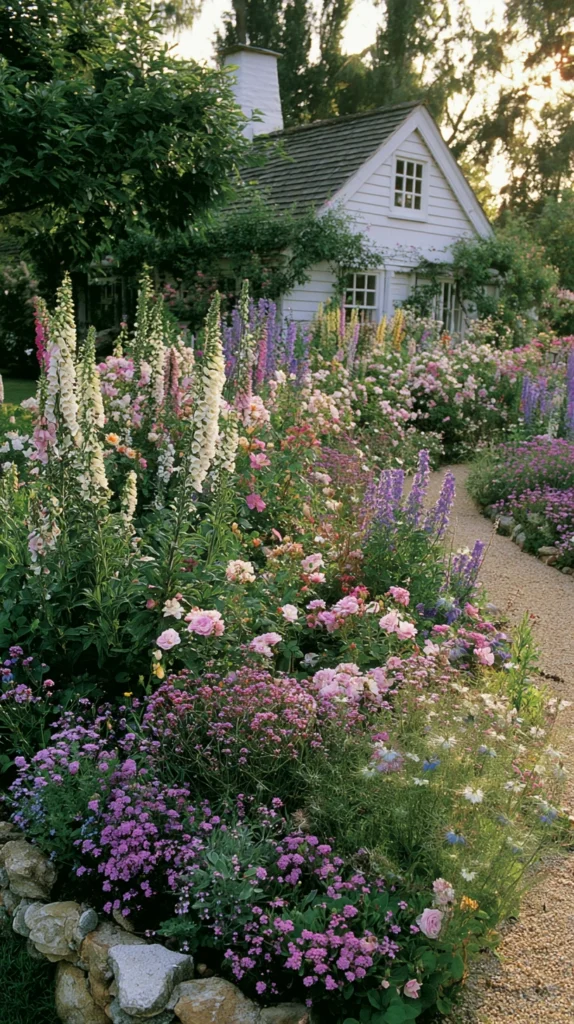
A planting bed combining long-lived perennials with annual and biennial self-seeders, so the garden’s flower population replenishes itself from within rather than depending entirely on annual nursery purchases.
Why the perennial-annual mix is the structural secret of most successful cottage gardens
- The renewable abundance it creates year over year: a bed dominated entirely by perennials typically looks a bit sparse until established and gaps appear as they divide and reset; a bed that allows annuals and biennials to self-seed into those gaps fills continuously and changes character each season
- The spontaneous combination-making that self-seeding enables: when foxglove seeds itself next to a rose and in front of a lavender, the combination is often more interesting than any deliberately composed planting, because it arrived at exactly the spacing and scale the plants naturally prefer
- The lower long-term cost relative to pure annual bedding: once the self-seeding population is established, the garden largely restocks itself, reducing the nursery budget substantially from year two onward
The options
- Foxglove as a biennial self-seeder, pairing with roses, delphiniums, and geraniums for the classic cottage combination
- Nigella (Love-in-a-Mist), a self-seeding annual that scatters through a bed with a blue-and-white ethereal quality
- Verbena bonariensis, a tall, transparent self-seeder that weaves through lower plants without blocking them
- Aquilegia (Columbine), a short-lived perennial that self-seeds prolifically into shady gaps where other plants struggle
The practical execution
- Allow the first generation of self-seeded biennials and annuals to set seed rather than deadheading everything, since the next generation’s plants come specifically from seeds dropped in the bed
- Thin self-seeded seedlings selectively rather than removing all volunteers, retaining ones in gaps and positions that look promising while editing out ones in inconvenient locations
- Top-dress with compost in autumn rather than digging and cultivating, since heavy soil disturbance in a self-seeding garden buries seeds at depths they can’t germinate from
Cost breakdown
- Perennial plants, a full bed (10–15 plants): $80–200
- Self-seeding annual and biennial seed packets (5–8 varieties): $20–40
- Total: $100–240 in year one, with significantly lower restocking costs in subsequent seasons
2. The Climbing Rose as a Structural Backbone (Height, Fragrance, and the Single Most Romantic Plant Available)
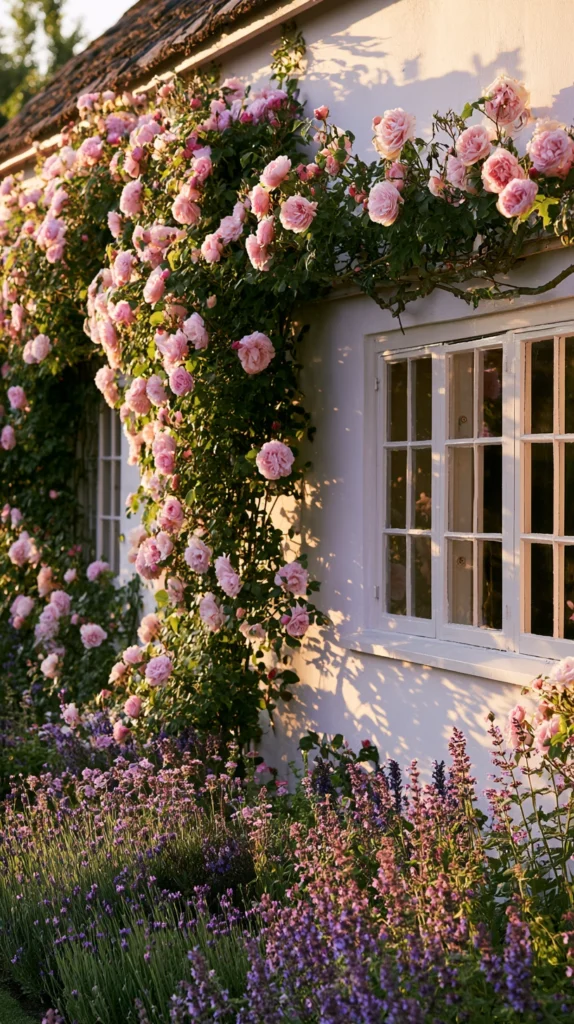
A climbing rose trained along a wall, an arch, a fence, or a pergola — the single plant most associated with the cottage garden aesthetic, providing both real height and the specific combination of fragrance and visual abundance that defines the style.
Why climbing roses do more structural work than any other single plant in the cottage garden
- The vertical dimension they add that ground-level planting can’t: a cottage garden built only at ground and mid height lacks the upper register of bloom and foliage that a trained climber provides, and the silhouette of a rose in full flower against a wall or arch is one of the most reproduced images in garden photography for exactly this reason
- The connection to the surrounding architecture that a climber creates: unlike a freestanding shrub, a climbing rose trained against a house wall, garden shed, or gate integrates the garden with whatever structure it grows on, blurring the line between building and planting in the way a cottage garden is meant to do
- The fragrance contribution at the scale of a whole garden: a climbing rose in full flower scents the surrounding area with enough reach that visitors smell the garden before they see the full extent of it, creating exactly the kind of total sensory experience the cottage style builds toward
The options
- ‘Cecile Brunner’, with small, perfectly formed deep-pink blooms and a natural climbing habit, considered one of the most reliably repeat-flowering climbing roses for cottage use
- ‘New Dawn’, a vigorous climber with large, pale pink flowers, notably disease-resistant, suited to any large structure it can grow into
- ‘Madame Alfred Carrière’, one of the most shade-tolerant climbing roses, unusually useful for a north-facing wall where most climbers struggle
- ‘Generous Gardener’, a modern climber with old-rose character, cupped blooms, and a strong fragrance available in a range of situations
The practical execution
- Train horizontal branches rather than allowing the rose to grow simply upward, since horizontally tied stems produce far more flowering laterals than vertical ones do
- Prune in late winter, cutting the current season’s laterals back to two or three buds while leaving the main framework canes intact until they need replacing
- Mulch generously at the base to retain moisture, since climbing roses benefit from consistent soil moisture more than most other garden plants given the sheer volume of growth they need to support
Cost breakdown
- Bare root climbing rose: $15–30
- Container-grown established plant: $25–60
- Total: $15–60 — the best long-term value per decade of bloom on this entire list
3. The Arch or Arbor as an Entry Point (A Structure That Earns Its Footprint in a Small Garden)
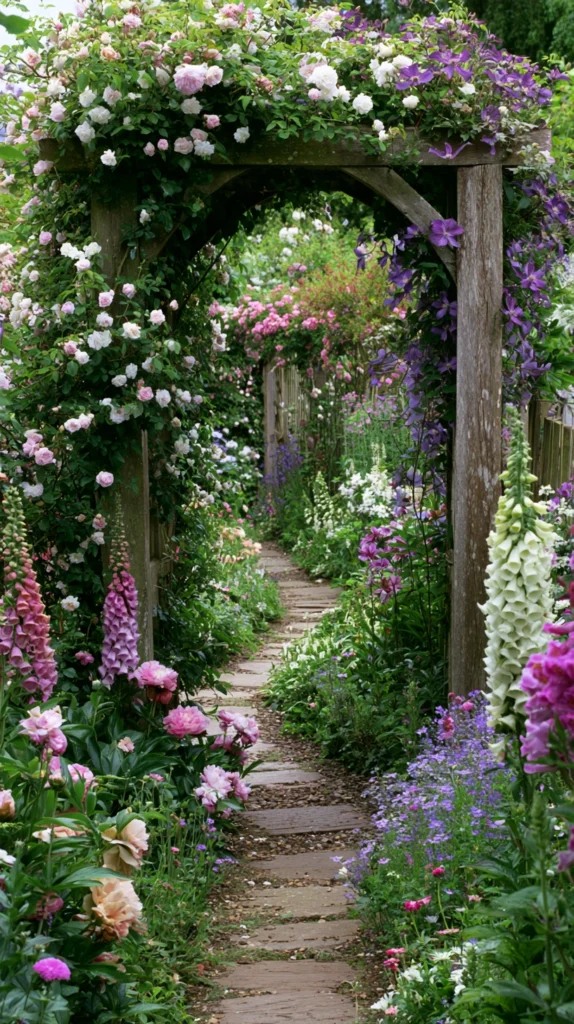
A simple arch or wooden arbor positioned at a garden entrance or path transition, planted with climbing roses, clematis, or both — the structure that creates a threshold between spaces and provides the vertical growing surface that makes climbing plants look inevitable rather than improvised.
Why a garden arch changes the experience of the whole garden
- The threshold experience it creates: walking under an arch is a different experience from walking past a flat garden bed, since the arch frames the space beyond it and makes arriving somewhere feel deliberate
- The vertical growing surface it provides without requiring a wall: not every garden has the wall surface for a climbing rose, but an arch or arbor can be placed anywhere in the garden’s layout, bringing vertical bloom to a freestanding space
- The combination-planting opportunity it naturally accommodates: an arch planted with both a rose and a clematis simultaneously provides multiple bloom times, colors, and textures from a single structure, and the combination of the two plants growing through each other is one of the more reliably striking effects available in a small garden
The options
- A simple wooden arch, either purchased as a kit or built from timber for a more bespoke version
- A metalwork arch, for a more delicate visual frame that allows the planting growing over it to read more clearly against the sky
- A pergola walk, for a garden with the depth to support a longer covered walkway rather than a single-width arch
- A rosette-top arch, with a rounded-top rather than a flat-top frame, for a more directly romantic silhouette
The practical execution
- Install with posts concreted into the ground at a minimum depth of 24 inches, since an arch heavily laden with flowering plants in full growth is considerably heavier than an empty frame
- Plant one rose and one late-flowering clematis on the same arch, timing them so the clematis blooms in the rose’s quieter period and vice versa for as continuous a flowering display as possible
- Train plants across the full width of the arch from their first season, since a climber that grows straight up without lateral training produces flower only at the very top rather than over the whole structure
Cost breakdown
- Wooden arch kit: $80–250
- Metalwork arch: $100–350
- Climbing rose and clematis to plant it: $40–100
- Total: $120–450
4. The Lavender Edging (A Sensory Border Along Every Path)
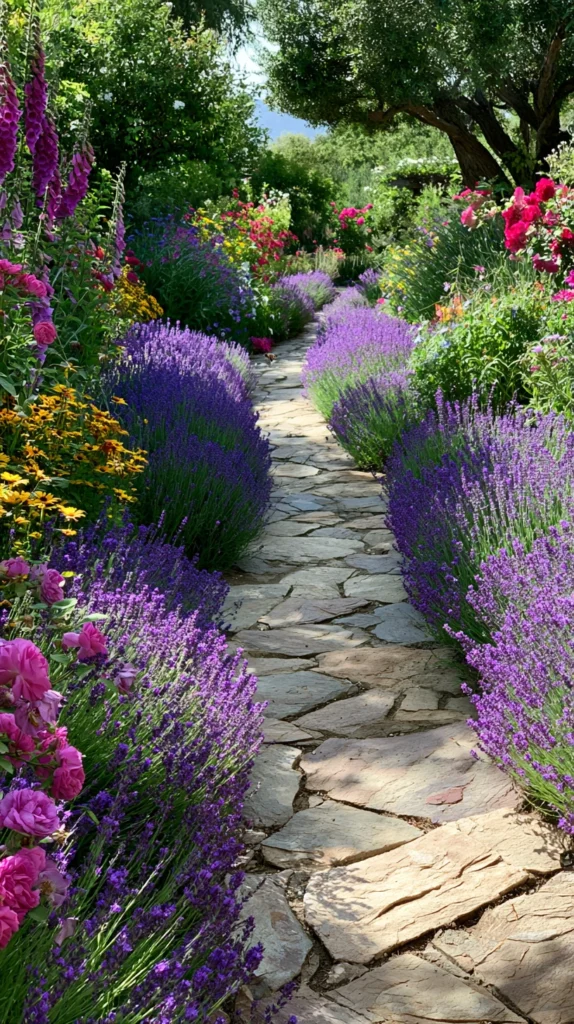
Lavender planted in informal drifts or loose rows along path edges — the planting choice that gives the cottage garden its most distinctive sensory combination of color, fragrance, and the texture of silver-grey foliage against almost any bloom color.
Why lavender specifically belongs at path edges rather than in the middle of beds
- The brushing contact that generates fragrance on demand: lavender’s essential oils are released most generously when the foliage is touched or brushed, and path-edge planting ensures that every person who walks the garden generates this effect simply by moving through it
- The visual edge-defining function it serves without the rigidity of a formal hedge: lavender spills slightly over a path’s edge in a way that softens the boundary between the walking surface and the planting behind it, contributing to the cottage garden’s general preference for blurred rather than hard transitions
- The bee-and-pollinator traffic it brings to the garden at the most visible, accessible level: lavender in full flower attracts bees visibly and audibly, adding movement and the garden-busy quality that characterizes the best cottage displays
The options
- ‘Hidcote’, a compact English lavender with deep purple flowers, the most widely planted path-edge variety
- ‘Munstead’, slightly more compact than ‘Hidcote’ with a paler flower, better suited to smaller gardens where scale matters
- ‘Grosso’, a larger, more vigorous lavender with a long flower season, appropriate for wider paths where more visual mass is needed
- White lavender varieties, for a lighter, more restrained color note beside a path lined with strong bloom colors elsewhere
The practical execution
- Plant in groups of three to five plants along a path rather than in a single-file row, for a more generous, naturally billowing edge than a line of individual plants creates
- Cut back by roughly one-third immediately after flowering rather than into old wood, since lavender doesn’t regenerate from very old wood and over-cutting is the most common cause of lavender plants becoming woody and unproductive
- Resist the urge to edge too neatly between the lavender and the path surface, since a small amount of lavender leaning onto the path reinforces the cottage character that deliberate containment would undermine
Cost breakdown
- Lavender plants, each: $6–12
- A generous path edging (10–15 plants): $60–180
- Total: $60–180
5. The Foxglove Column (Height From a Biennial That Manages Itself)
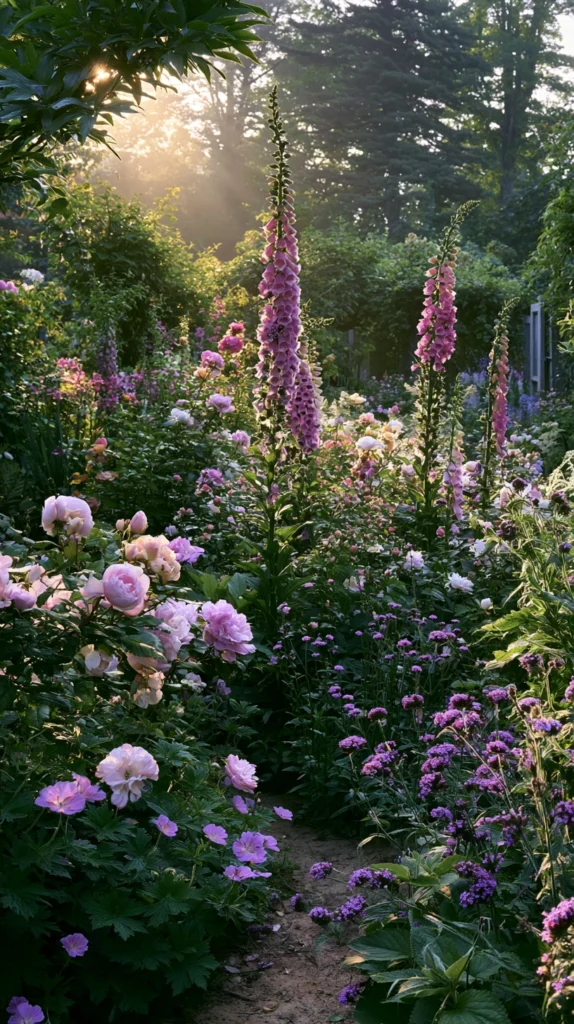
Foxgloves planted in clusters among perennial beds, allowed to self-seed and move around the garden as they choose — the tall, spire-like flowering plant that provides the most dramatic vertical presence of any soft-stemmed plant in the cottage garden.
Why foxgloves earn a dedicated place on this list despite being biennials
- The dramatic height they deliver in their second year: at 4–6 feet, a foxglove spike towering above the lower perennials around it creates exactly the height variation that makes a cottage garden look layered rather than flat
- The self-seeding habit that makes them perpetually present once established: foxgloves scatter seeds so generously that a single original planting eventually produces a continuous presence throughout the garden, appearing in unexpected combinations with other plants without any deliberate placement
- The semi-shaded tolerance they offer: foxgloves thrive in the dappled shade beneath a rose or in the gap between larger shrubs, filling positions that many other flowering plants find challenging
The options
- Digitalis purpurea, the classic cottage foxglove in purple-pink with spotted throats, the most generously self-seeding variety
- ‘Camelot Series’ foxglove, with larger, more densely packed bells than the straight species
- White foxgloves, for a luminous, ghost-like quality in a shaded spot that colored varieties don’t quite achieve
- Digitalis lutea, a smaller-flowered yellow species, for more understated height than the large-flowered varieties provide
The practical execution
- Leave flower spikes to set seed fully before removing them, since cutting foxgloves before seed dispersal prevents the next generation from establishing
- Thin self-seeded foxglove rosettes in autumn, retaining the ones in most interesting positions while removing any that have seeded where they’ll be inconvenient or where they’re so densely clustered that competition will weaken all of them
- Plant the first generation in autumn as young rosettes or in spring as established plants, since foxgloves need a full growing season before their first dramatic flowering season
Cost breakdown
- Foxglove plants (6–8 to start), each: $4–8
- Seed packets for scatter-planting: $3–6
- Total: $25–70 for first-year establishment, with minimal restocking needed thereafter
6. The Peony as a Structural Perennial (Decades of Bloom From a Single Investment)
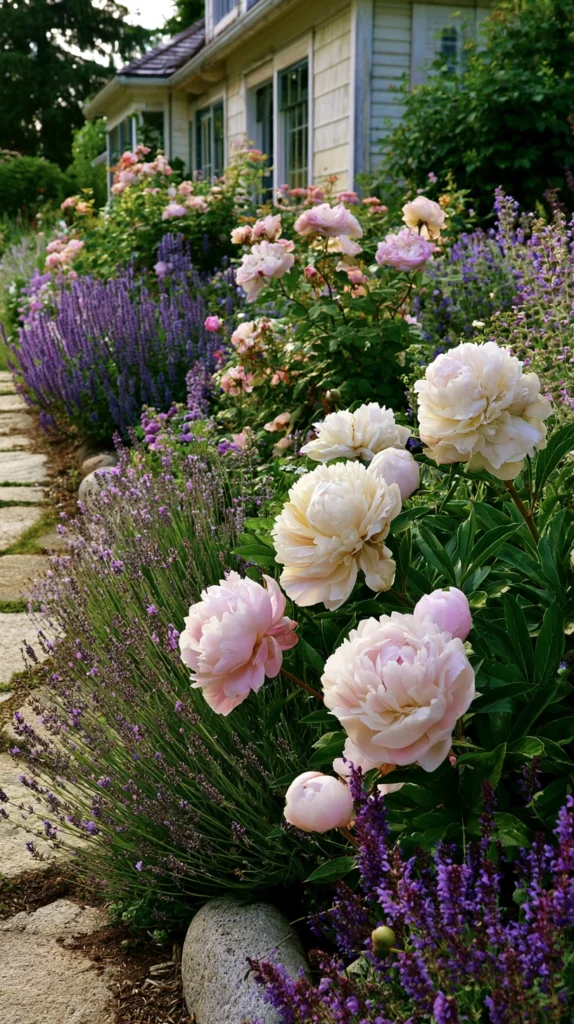
A peony — or a small group of peonies — planted as structural anchors in the cottage bed, providing two to three weeks of enormous, fragrant flowers in late spring and then a neat, glossy foliage that earns its place in the garden through the entire growing season.
Why peonies belong specifically in a cottage garden rather than in other planting styles
- The scale of bloom that has no equivalent in the cottage garden’s flower palette: a mature peony in full flower produces flowers so large and so fully double that the plant reads as a small floral event rather than a single flower, in a way that creates the visual abundance cottage gardens aim for from a single plant
- The genuine longevity that makes the initial investment genuinely worthwhile: peonies resent disturbance and are known to live productively in the same spot for decades, with some historic plantings documented over fifty years — a plant that will outlive any garden renovation is worth considering as infrastructure rather than decoration
- The fragrance that adds to the garden’s sensory layering: peony fragrance is one of the most complex and most celebrated in the flowering plant world, and a few peonies alongside lavender, roses, and sweet peas create a total fragrance environment that defines the best cottage gardens at close approach
The options
- ‘Sarah Bernhardt’, the most widely planted peony, with large, perfectly double pale pink flowers and strong fragrance
- ‘Festiva Maxima’, an antique variety with white blooms marked with crimson flecks, among the most intensely fragrant peonies grown
- ‘Karl Rosenfield’, a rich, deep crimson double, providing the strongest color contrast in a cottage bed dominated by pinks and purples
- A tree peony, for a more structural, shrubby form that blooms several weeks earlier than herbaceous types
The practical execution
- Plant with the “eyes” (reddish buds) no more than one to two inches below the soil surface, since peonies planted too deeply fail to flower year after year
- Be patient through the first two seasons, since peonies invest energy in root establishment before producing their first full bloom and flowering in years one and two is rarely representative of the plant’s eventual output
- Never move an established peony unless absolutely necessary, since division and disturbance sets a peony back several years and should be a last resort rather than routine garden management
Cost breakdown
- Bare root peony: $12–25
- Container-grown established peony: $25–60
- Total: $12–60 per plant, with value measured over decades rather than seasons
7. The Sweet Pea Trellis or Wigwam (Fragrance From a Single Annual That Fills the Air)
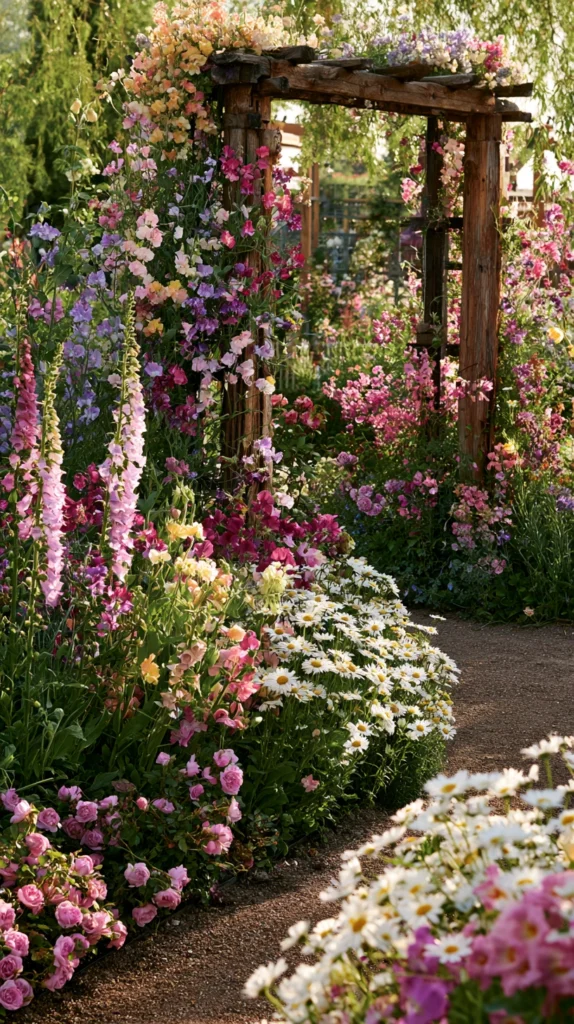
Sweet peas trained up a simple bamboo wigwam or a low trellis within the cottage bed — the most fragrant of all the climbing annuals and one that can be grown from a packet of seed each year for a fraction of the cost of any other plant on this list.
Why sweet peas earn a specific structural support rather than simply being scattered
- The concentrated, upward growth that a support enables: sweet peas without a trellis sprawl across neighboring plants in a way that ultimately damages both the sweet pea and whatever it falls on, while sweet peas on a well-built wigwam or trellis grow clean, strong, and continuously productive
- The season-extension that regular cutting provides: sweet peas produce more flowers the more they are cut, making them the ideal cut flower source within the cottage garden — taking from them actively increases rather than decreases their contribution
- The bamboo wigwam’s own visual contribution before the plants have fully climbed it: a tripod of canes in the middle of a cottage bed adds height and structure even when the sweet peas are still seedlings, participating in the garden’s visual composition before the flowers arrive
The options
- Spencer-type sweet peas, the largest-flowered type, available in every color from white through every shade of pink, mauve, blue, and deep burgundy
- Grandiflora types, older varieties with smaller flowers but often stronger fragrance than the Spencer types
- Annual sweet peas in a single color family, for a more cohesive color note within the wider cottage planting palette
- Perennial sweet pea (Lathyrus latifolius), for a lower-maintenance, returning version that trades some of the annual’s fragrance for genuine perennial reliability
The practical execution
- Sow seed in autumn in mild climates or in early spring otherwise, since sweet peas started early develop strong root systems before the summer heat that shortens their season
- Pinch out the growing tips when the plants reach 6–8 inches tall, since this single early pinch produces a bushier, more flower-productive plant than one allowed to grow straight from the seedling stage
- Cut flowers regularly and without sentiment, since leaving flowers to set seed triggers the plant’s natural end-of-season wind-down; picking regularly extends the season by weeks
Cost breakdown
- Sweet pea seed packet: $2–5
- Bamboo canes for a wigwam: $5–10
- Total: $7–15 per year — the most affordable flowering annual on this list
8. The Hardy Geranium Ground Layer (The Plant That Holds the Cottage Bed Together)
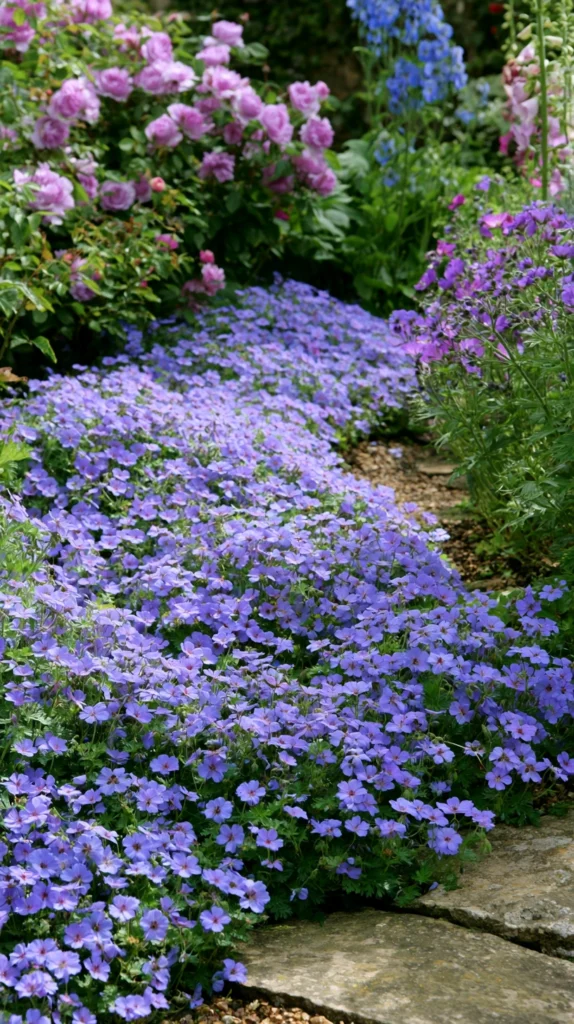
Hardy geraniums — cranesbills — planted in between and beneath taller perennials, filling the mid-to-low level of the cottage bed with a long-flowering, largely self-sufficient carpet that prevents bare soil showing through while providing color through much of the season.
Why hardy geraniums are the single most useful plant for achieving the cottage garden’s full-ground effect
- The gap-filling role they play between larger, later-filling perennials: the first few years of a cottage bed can look bare between plants, and hardy geraniums grow fast enough to fill those gaps in a single season while the longer-lived perennials are still establishing
- The season-length they provide through a combination of blooming and foliage: most hardy geraniums bloom for six weeks or more, and some varieties rebloom if cut back after their first flowering, while their foliage provides ground cover and often autumn color into October
- The self-maintaining quality that aligns perfectly with the cottage garden’s philosophy: hardy geraniums need almost no care beyond an occasional cut-back, spread gradually to fill available space, and never become invasive in a way that requires aggressive management
The options
- Geranium ‘Rozanne’, the most widely recommended variety for sustained bloom, flowering from May until frost
- Geranium ‘Johnson’s Blue’, with a gentler blue than many geraniums and a clean, open flower that works in almost any color combination
- Geranium macrorrhizum, for shade under trees and shrubs where almost nothing else will establish, semi-evergreen and reliably fragrant foliage
- Geranium psilostemon, with vivid magenta-pink flowers and a dramatic black centre, providing more color intensity than the softer-toned varieties
The practical execution
- Plant at 18–24 inch centers rather than the closer spacing sometimes recommended, since hardy geraniums spread reliably to fill in, and closer planting simply wastes plants
- Cut the whole plant back to ground level after its first flowering, since most varieties regrow quickly and produce a second flush of both foliage and flowers that carries through the rest of the season
- Divide clumps every three to four years when they begin to have a bare center, using the divisions to extend the planting into adjacent areas rather than discarding them
Cost breakdown
- Hardy geranium plants, each: $8–15
- A bed’s worth (8–12 plants): $65–180
- Total: $65–180
9. The Cottage Garden Path (Irregularity as a Design Decision)
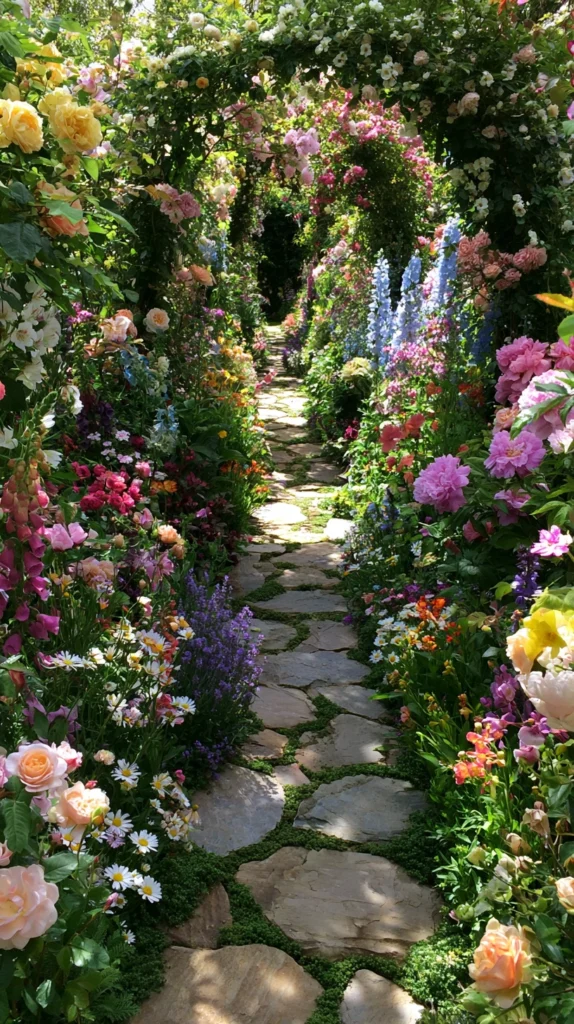
A path made from irregular flagstone, reclaimed brick, or stepping stones, with gaps allowed to fill with creeping thyme, moss, or self-seeded plants rather than being kept clear — the walkway that looks like it grew through the garden rather than was laid through it.
Why the path’s surface and treatment are as important as the planting around it
- The mood it sets for the whole garden before a visitor has reached any of the plants: a perfectly straight, cleanly jointed, weed-free path enters a cottage garden with the wrong energy entirely, while an irregular, slightly planted-between flagstone path reads as belonging in the space it moves through
- The additional planting opportunity its gaps provide: Thymus serpyllum, Corsican mint, and creeping chamomile all thrive in paving gaps and release fragrance when stepped on, adding a ground-level sensory layer to the path that bare mortar or gravel joints can’t provide
- The low-maintenance reality that a planted path-gap actually creates: a gap planted with a vigorous ground-covering plant takes far less ongoing attention than a gap that needs to be weeded regularly to prevent unwanted colonization
The options
- Irregular limestone or sandstone flags, set with deliberately wide gaps
- Reclaimed brick in a herringbone or random pattern, for a path that reads as having been laid some time ago
- Gravel between larger stepping stones, for a path that allows easy walking without the expense of fully paving the route
- Mown grass paths, the most traditional and most genuinely effortless option in a larger garden
The practical execution
- Lay the first generation of path gaps planted with creeping thyme or similar, transplanting from plugs rather than waiting for self-seeding which can take longer
- Avoid pointing the gaps with mortar or sand, since the empty joint is what allows the planted material to take hold
- Accept some irregularity in the path’s level, since slightly uneven flagstone reads as established rather than just laid, and a perfectly level new path in an otherwise informal garden looks incongruous
Cost breakdown
- Reclaimed or irregular flagstone, per square foot: $3–10
- Creeping thyme plug plants for gaps: $5–15 for a generous planting
- Total: $100–500+ for a path, depending on length and material source
10. The Cutting Flower Zone (Annuals Grown Specifically to Be Harvested)
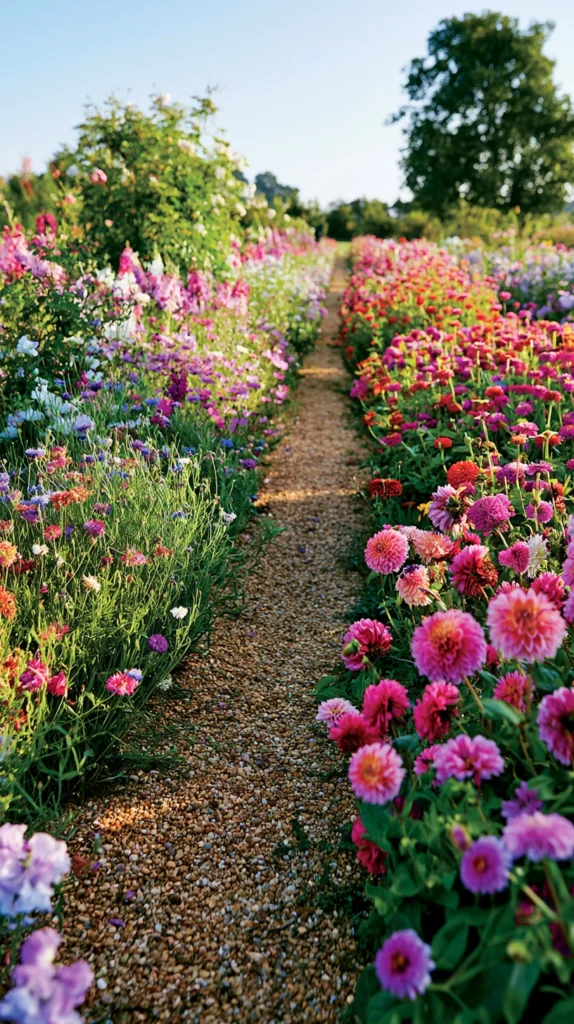
A small dedicated area within or adjacent to the cottage garden specifically planted for cut flowers — zinnias, cosmos, dahlias, sweet Williams, and cornflowers — treated as part of the productive kitchen garden rather than purely as decorative planting.
Why a cutting patch makes the whole garden feel more actively used
- The visual abundance a densely planted cutting zone adds to the garden’s overall output: a small area planted wall-to-wall with annual cut flowers in high summer reads as genuinely overflowing, contributing to the cottage garden’s abundance aesthetic as much as any perennial display
- The interior connection it creates between the garden and the house: a garden that supplies cut flowers to the kitchen table, the bathroom windowsill, and the guest bedroom feels more integral to household life than one that is purely outdoor decoration
- The weekly engagement it requires that keeps the garden actively maintained: a cutting patch needs picking every few days to keep the plants productive, which creates a regular garden visit that ensures other issues are noticed and addressed while they’re small
The options
- Cosmos ‘Purity’ or ‘Dazzler’, tall, transparent, and self-seeding after the first year in mild climates
- Annual dahlias grown from seed, for summer-into-autumn flower at a fraction of the tuber-bought cost
- Sweet Williams, biennials that self-seed reliably and provide early summer cut flowers at a moment when other annual cutting flowers haven’t yet begun
- Ammi majus (Bishop’s Lace), a white-flowered annual that provides the same frothy backdrop function as gypsophila but at a larger, more useful scale
The practical execution
- Plant densely, since cutting flowers grown close together support each other and produce longer stems than widely spaced plants
- Cut flowers in the early morning when stems are fully turgid and last longest in the vase, rather than during the heat of the afternoon
- Sow successive small batches of fast-growing annuals like cosmos and zinnia two or three weeks apart through spring, rather than one large sowing, to extend the cutting season through gaps between each batch’s peak
Cost breakdown
- Cutting flower seed packets, 5–8 varieties: $15–35
- Total: $15–35 per season — one of the least expensive lines in the cottage garden’s overall budget
11. The Wildlife-Supporting Planting (The Layer That Makes the Garden Feel Alive)
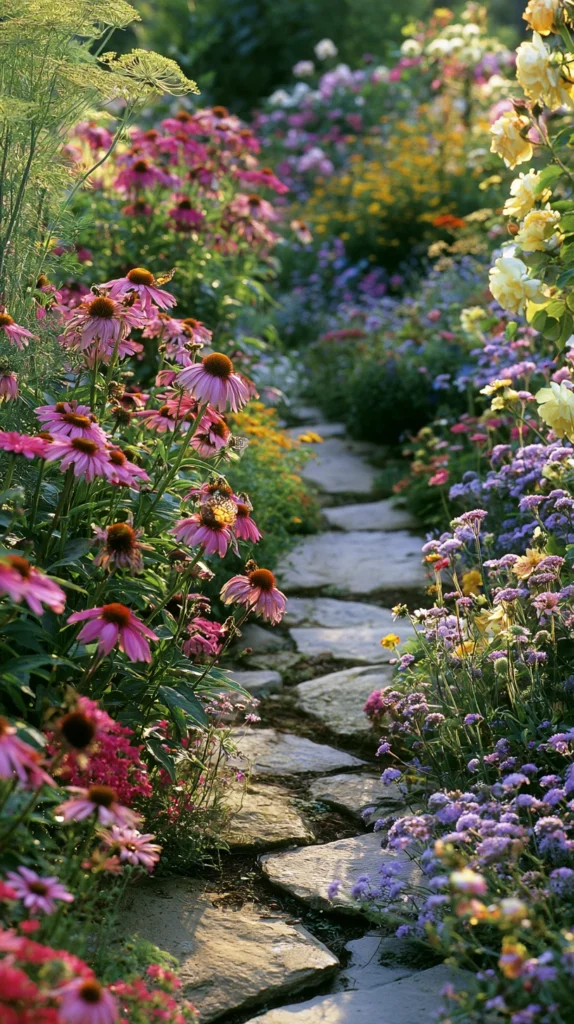
A deliberate inclusion of plants chosen specifically for their value to pollinators, beneficial insects, birds, and other wildlife — echinacea, verbena, fennel, single-flowered roses, and seed-heads left standing through winter — the layer that transforms a beautiful garden into a genuinely functioning ecosystem.
Why wildlife value aligns directly with cottage garden aesthetics
- The movement and sound that wildlife brings to the garden at every hour: a garden actively visited by bees, butterflies, and hoverflies is a living, moving space in a way that a purely ornamental planting isn’t, contributing exactly the kind of ambient activity that makes a cottage garden feel inhabited
- The overlap between wildlife-supporting plants and cottage-appropriate plants: single-flowered roses, fennel, scabious, verbena, and knapweed — all genuinely excellent wildlife plants — are also all visually at home in a cottage garden in a way that their wildlife credentials are essentially free additions to plants that would be chosen for appearance alone
- The seed-head aesthetic that a wildlife-conscious approach produces in winter: leaving ornamental seed-heads standing rather than cutting them back in autumn extends the cottage garden’s visual interest into the colder months while simultaneously providing food and habitat for birds and overwintering insects
The options
- Echinacea (coneflower), providing late summer colour and then highly ornamental seed-heads that finches visit through winter
- Fennel, a tall, bronze or green-leaved herbaceous perennial that provides nectar for hoverflies and hosts their larvae, and that self-seeds in a well-mannered, cottage-appropriate way
- Scabiosa, with its pincushion flowers beloved by bumblebees, providing a long season of bloom from midsummer onward
- Single-flowered climbing roses, which provide accessible nectar and pollen that fully double roses’ tightly packed petals conceal from pollinators
The practical execution
- Leave seed-heads and dead stems standing through winter and into early spring, since many overwintering beneficial insects use hollow stems and leaf litter as overwinter habitat that disappearing by cutting back removes
- Avoid using insecticides in the cottage garden, since the same broadly effective products that eliminate pest species also eliminate the beneficial predator insects that would manage those pests naturally given time
- Add a source of water — a shallow dish or a small birdbath — since water is often the limiting resource for wildlife in a garden that already provides food and shelter
Cost breakdown
- Echinacea plants: $10–18 each
- Scabiosa plants: $8–15 each
- Fennel seed packet: $3–5
- Total: $30–80 for a generous first-year wildlife planting
12. The Kitchen Herb Integration (Aromatic Plants as Part of the Flower Garden)
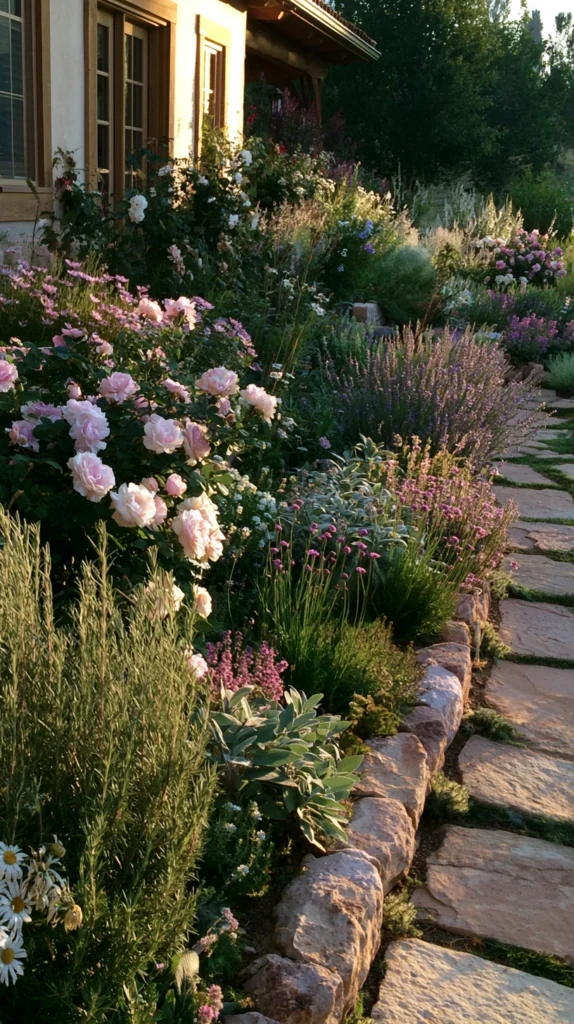
Herbs — rosemary, sage, bronze fennel, lemon verbena, chives — grown within the flower beds rather than in a separate kitchen garden, contributing texture, fragrance, and the blue and purple flowers that many culinary herbs provide in their own season.
Why herbs belong in a cottage flower bed specifically
- The historical accuracy it reflects: the original cottage garden was a productive growing space that mixed vegetables, herbs, and flowers together because the gardener grew everything that was useful and everything that was beautiful without strict separation between the two
- The fragrance dimension that aromatic herbs introduce at a different level from flowering plants: where roses and lavender scent the air when you approach them, rosemary and sage release their fragrance when brushed, touched, or moved past, adding a different kind of olfactory experience to the garden
- The structural contribution herbs make in the gaps between flowering seasons: rosemary, sage, and fennel are visually interesting plants in their own right, with strong architectural form and distinctive foliage that holds the garden’s composition together even in the weeks when fewer flowers are open
The options
- Rosemary, a genuinely shrubby plant that flowers blue in early spring and provides evergreen structure year-round
- Bronze fennel, for its extraordinary combination of copper-coloured ferny foliage, yellow umbellifera flowers beloved by pollinators, and self-seeding habit that places new plants into unexpected, often excellent combinations elsewhere in the bed
- Chives, for their spherical purple flower heads in early summer and for their ability to self-seed into gaps in a bed with the same generous abandon as ornamental annuals
- Lemon verbena, for the extraordinary fragrance its leaves release when touched, a scent available from no other garden plant
The practical execution
- Harvest culinary herbs regularly but not ruthlessly, since a herb in active culinary use produces fresh growth continuously and looks more vigorous than one rarely touched
- Allow a proportion of culinary herbs to flower rather than cutting flower buds off, since the flowering stage is when most herbs provide maximum pollinator value and many of them — chives, basil, thyme — produce attractive flowers alongside their more famous foliage
- Plant shrubby herbs like rosemary near the bed’s front or edge rather than centrally, since they grow into substantial permanent plants that work better at a border’s edge than they do surrounded by taller perennials
Cost breakdown
- Rosemary plant: $8–15
- Bronze fennel plant or seed packet: $3–12
- Chives, lemon verbena, and additional herbs: $5–12 each
- Total: $25–75 for a useful range of integrated herbs
13. The Seat or Bench Integrated Into the Garden (Somewhere to Sit Within the Planting, Not Just Beside It)
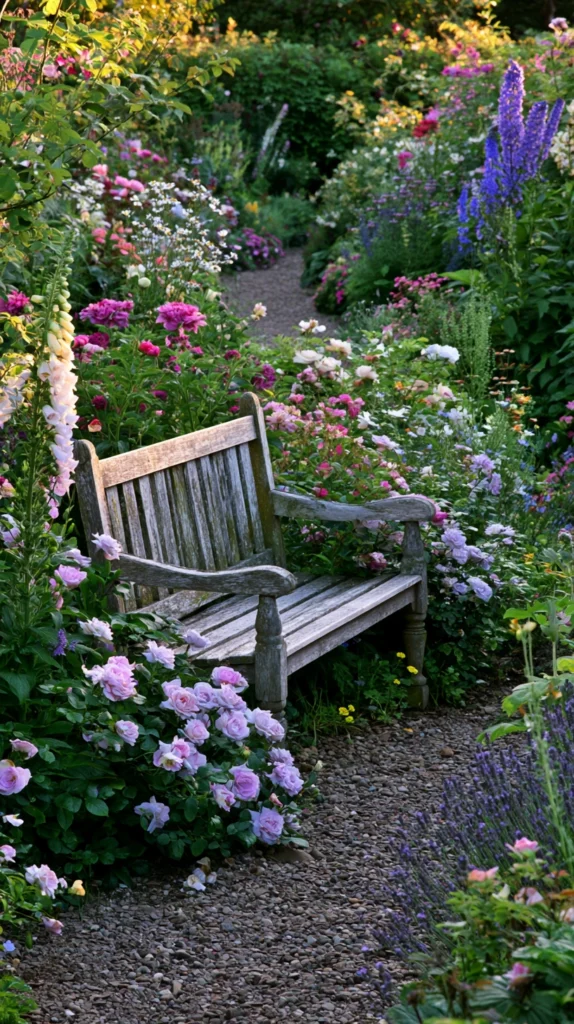
A simple bench, a mossy garden seat, or a pair of chairs placed within or at the edge of the planting rather than on a separate paved terrace, inviting sitting inside the garden’s experience rather than observing it from a separate hard-surface area.
Why a seat placed within the garden is a fundamentally different experience from one placed beside it
- The perspective it provides from inside the planting: sitting at bench height surrounded by roses and lavender offers a genuinely different relationship with the garden than looking across it from a distance, allowing the fragrance, the insect life, and the detailed texture of individual plants to be experienced rather than simply viewed
- The functional destination a seat creates within the garden’s layout: a cottage garden that is purely beautiful to look at but provides no invitation to enter and stay within it is incomplete, and a bench at the garden’s heart gives the space an evident purpose beyond display
- The moss and lichen accumulation that a long-placed bench or seat eventually develops, contributing its own patina to the garden’s sense of established age
The options
- A simple wooden bench, painted or unpainted, positioned where the surrounding planting will eventually begin to lean in around it
- A stone or cast-iron garden bench, for a more permanent object with inherent weight and permanence that works better than timber in a very wet garden
- A teak or hardwood seat, for a material that weathers naturally without painting and eventually acquires a silver-grey patina that reads as genuinely old
- A pair of chairs rather than a bench, if the seat is intended to serve as a social gathering spot rather than a solitary retreat
The practical execution
- Position the seat facing away from the main house, since a seat that looks back at the house faces away from the garden and away from the view the garden creates
- Allow surrounding planting to grow close and over the seat’s edges rather than maintaining a cleared zone around it, since the cottage character comes specifically from the garden closing in around human-made objects rather than keeping them separate
- Visit the intended seat position at different times of day before finalizing its placement, since the quality of light, the direction of the prevailing breeze, and the view at each position changes substantially between morning and late afternoon
Cost breakdown
- Simple wooden bench: $80–200
- Stone or cast-iron garden bench: $200–600
- Total: $80–600
14. The Controlled Chaos of the September Garden (Planning for Late-Season Beauty)
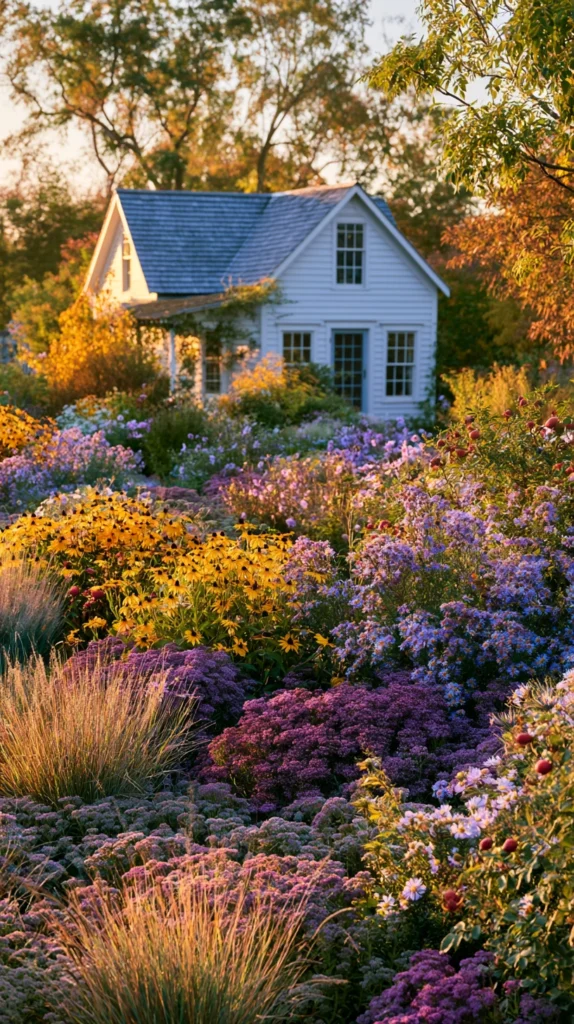
A deliberate selection of late-season perennials and shrubs that keep the cottage garden interesting and abundant through September and October, when most gardens begin to look tired — asters, sedums, Japanese anemones, rudbeckia, and rose hips that make the final weeks of the season as rewarding as the height of summer.
Why the season’s end deserves deliberate planning from the garden’s beginning
- The abandonment that most cottage gardens suffer from August onward: a garden stocked primarily with early and midsummer bloomers winds down by late August and looks sparse and overgrown through September, which is a problem that only deliberate late-season planting resolves rather than compensates for
- The specific plants that thrive in exactly this late period: asters, Japanese anemones, rudbeckia, and sedum are genuinely excellent, long-blooming plants that happen to peak when most other plants have finished, and the cottage garden that includes them extends its appeal by six to eight weeks beyond the standard summer display
- The rose hip and seed-head display that makes a thoughtful late-season garden genuinely different from a tired midsummer one: the garden in October, with rose hips against low autumn light, dried echinacea seed-heads, and asters still blue against a grey sky, has a distinctive beauty that is not a lesser version of June’s abundance but a different kind of abundance entirely
The options
- Japanese anemones, with their white or pink flowers on tall wiry stems, filling the exact niche that foxgloves occupied in early summer and self-seeding reliably
- Asters (Symphyotrichum), for vast quantities of small daisy flowers in purple, pink, and white through September and October that are heavily visited by late-season pollinators
- Rudbeckia, with its strong yellow flowers and dark centres, providing warm-toned colour during the garden’s autumnal shift
- Rosa moyesii and other hip-producing roses, for the brilliant red hip display that comes after the last flowers and persists into winter, providing bird food alongside extraordinary visual impact
The practical execution
- Plant late-season perennials in groups of three or five, since single specimens of these late bloomers can look sparse when surrounded by the dried and faded material of earlier-season plants
- Avoid cutting back any plant before it has fully finished its seasonal contribution — many late-season plants provide seed-head interest well into winter that premature tidying eliminates
- Make late-season planting an explicit part of the original garden plan, ordering and installing plants in autumn of the garden’s first year so they’re established and ready to perform in September of the second
Cost breakdown
- Japanese anemone, aster, and rudbeckia plants (3 each of 3 varieties): $70–150
- Total: $70–150
The garden still full in October, with asters and rose hips and the last anemones: the proof that the cottage garden’s season was planned from the beginning with its ending in mind.
The Cottage Garden Roadmap
The work, sequenced:
Phase One (the structural bones, planted first):
- The climbing rose as structural backbone (#2)
- The arch or arbor as entry point (#3)
- The cottage garden path (#9)
- The peony as structural perennial (#6)
Phase Two (the mid-layer and ground-filling planting):
- The mixed perennial and annual planting (#1)
- The hardy geranium ground layer (#8)
- The lavender edging (#4)
- The kitchen herb integration (#12)
Phase Three (the height and season-extending planting):
- The foxglove column (#5)
- The sweet pea trellis or wigwam (#7)
- The wildlife-supporting planting (#11)
- The late-season beauty (#14)
Phase Four (the productive and structural additions):
- The cutting flower zone (#10)
- The seat or bench integrated into the garden (#13)
Getting Started This Weekend
The immediate-impact cottage garden start:
For a new or partly established garden, one weekend’s planting:
- Order a bare-root climbing rose and plant it against the wall or fence with the best sun exposure (Idea #2)
- Buy 8–10 hardy geraniums and plant them in drifts through any existing beds (Idea #8)
- Scatter foxglove, nigella, and verbena bonariensis seed across any open soil in the beds (Ideas #5 and #1)
Total cost: $80–200. Time: one afternoon. By the following season, the climbing rose will have made its first growth, the geraniums will have filled in considerably, and the self-seeded annuals and biennials will be beginning to make their first appearance.
The structural investment (the next big project):
A well-chosen arch with a rose and clematis (Idea #3) is the single most transformative investment available in a cottage garden, because it introduces both vertical structure and the two plants most associated with the style simultaneously. Once an arch is in place, the entire garden layout can develop in reference to it, which is easier than trying to fit an arch into a garden already full of established planting.
What a properly established cottage garden provides that a newer or more formal garden can’t:
The accumulation that only years of self-seeding can build:
- Foxgloves appearing in exactly the right unexpected gaps
- Sweet pea successors returning in soil disturbed by last year’s stems
- Hardy geraniums filling in the spaces between longer-lived plants with no replanting needed
The sensory environment that no single plant creates alone:
- The combination of rose fragrance and lavender and sweet pea and lemon verbena, all layered in the same space
- The sound of bees through the lavender in July and through the asters in October
- The visual richness of bloom at every height from the path thyme to the climbing rose’s crown
The specific, established character that years of growing in one place creates:
- Climbing roses trained across ten feet of wall that took a decade to achieve
- Peonies in their fifteenth year, now producing more flowers than in their first five combined
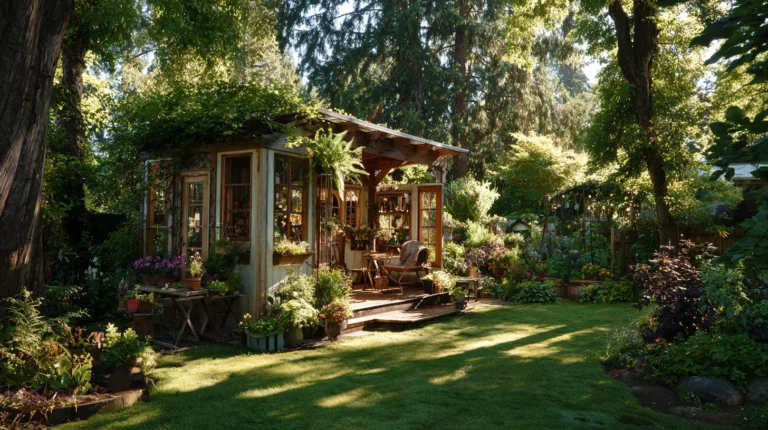
- A bench whose arms have moss at the joints and whose surrounding planting has gradually closed in around it as if it had always been there
A cottage garden was never going to emerge fully formed from a single season’s planting. The gardens that deserve the adjective take time, and the best of them were started by people who understood they were planting for a future version of the garden rather than for an immediate one. The climbing rose planted against a wall in spring does not look like a cottage garden feature until its third summer.
The foxglove scattered in autumn does not look like a reliable biennial until the second June. The bench placed at the garden’s heart does not look inevitable until the planting around it has grown close enough to make it look like it was always meant to sit in exactly that spot. The effortlessness comes eventually. The planning for it comes first.