15 Enchanting Bedroom Ideas for a Witchy, Mystical Sanctuary
15 Enchanting Bedroom Ideas for a Witchy, Mystical Sanctuary
There is a version of a bedroom that exists somewhere between the gothic and the botanical, between candlelight and moonlight, between the ancient and the deeply personal. It is not a costume or a theme park — it is a room that takes the natural world seriously, that treats darkness as something beautiful rather than something to be eliminated, that fills its surfaces with the things that matter: crystals, dried herbs, old books, the smell of something burning slowly in a corner.
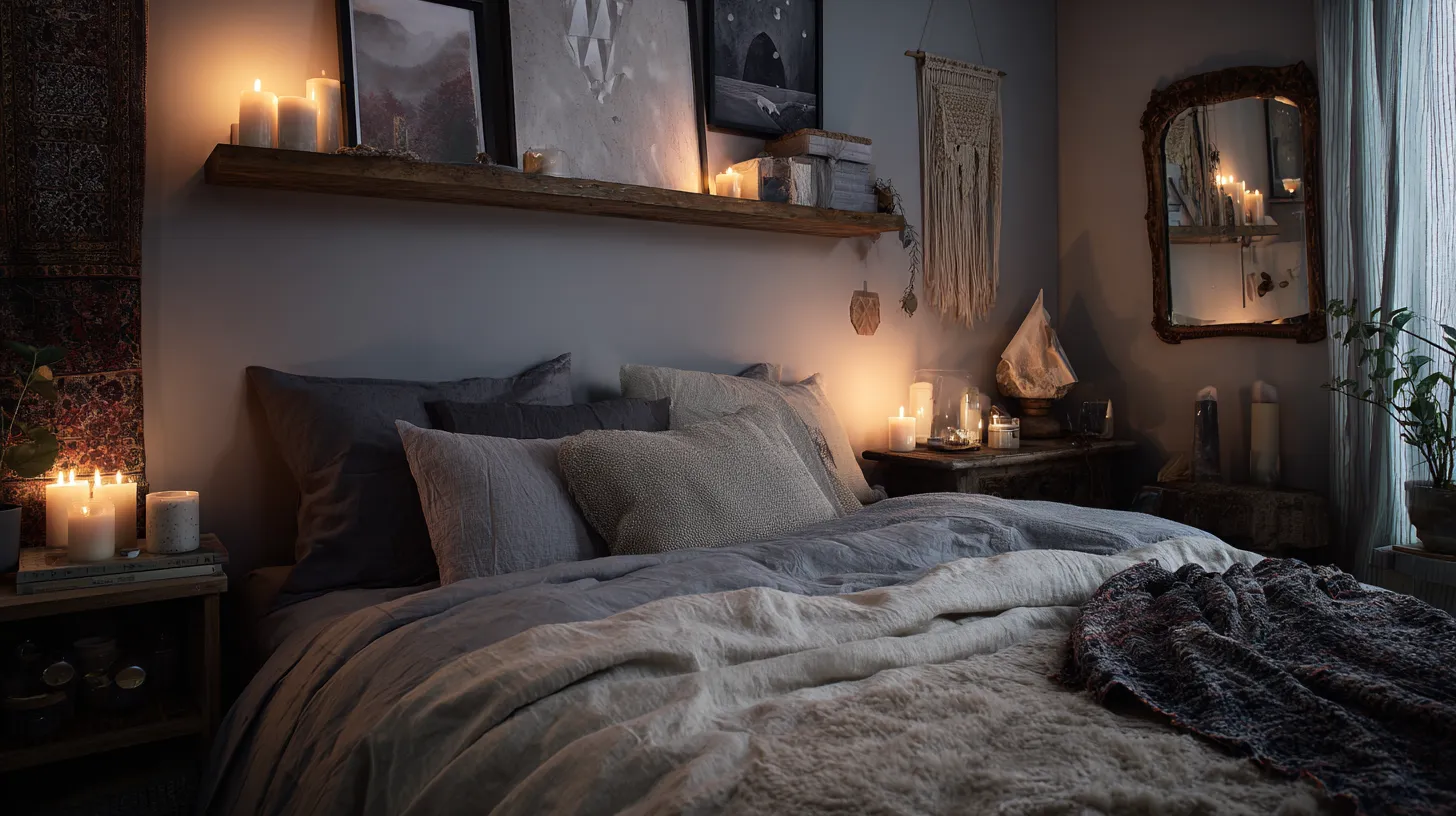
The witchy bedroom at its best is not a collection of purchased aesthetics. It is a room that was assembled over time from things that were found, inherited, grown, and chosen with genuine feeling rather than interior design logic. It has the quality of a room that knows what it is and is entirely unapologetic about it.
Each idea below is a specific, buildable approach to one element of the witchy bedroom. Each is visually grounded rather than cartoonish, each is achievable without specialist purchasing, and each includes a practical tip to make it work as well as it deserves.
1. The Dried Herb and Botanical Ceiling Bundles
Budget: $10 – $60
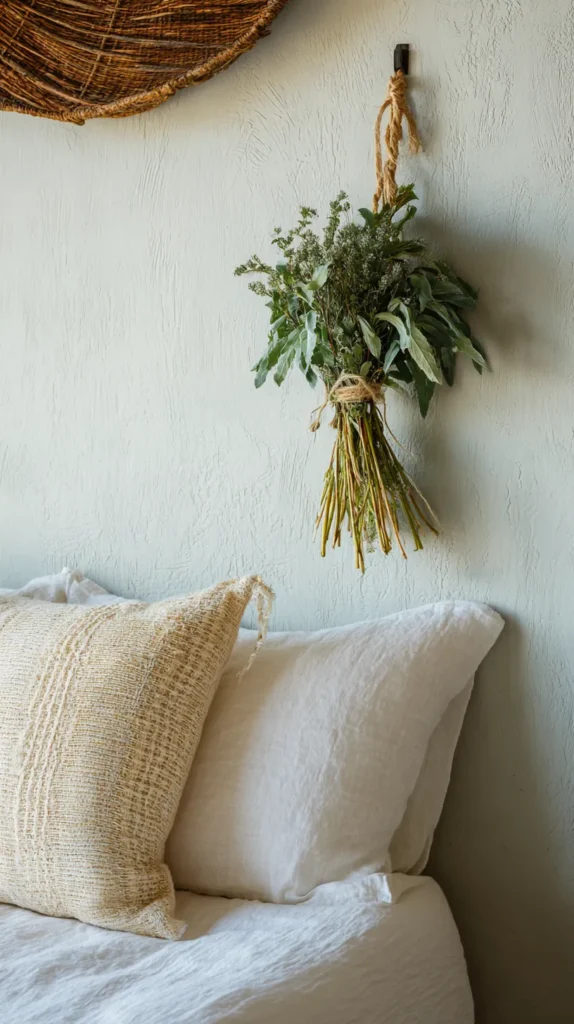
Bundles of dried herbs and botanical stems — lavender, rosemary, sage, dried roses, eucalyptus, mugwort, yarrow — hung from the ceiling above the bed or from a timber rod fixed near the window create the most immersive botanical atmosphere available to a bedroom at minimal cost. The bundles move slightly in the air from an open window, they release fragrance when warm air moves through them, and they develop a more complex and more beautiful dried form over weeks as the colour deepens and the stems become sculptural.
Fresh herb bundles from a garden or a market cost $2–$8 each. Dried herb and botanical bundles from specialist suppliers run $5–$20. A timber dowel rod to hang them from costs $3–$8. Jute twine for hanging runs $3–$6 per reel. Tie bundles with twine at the stem end and hang from the dowel at different lengths — the varying heights create a layered botanical ceiling that reads as accumulated over time rather than installed in an afternoon.
Style tip: Combine functional herbs with purely visual botanicals — bundle rosemary for its fragrance and its associations alongside dried lunaria for the translucent silver seed pods, or sage alongside preserved eucalyptus for its blue-grey tones. The combination of the useful and the beautiful, the familiar and the slightly strange, is what gives a botanical ceiling bundle installation its witchy quality rather than simply its herb-shop one.
2. The Altar Surface
Budget: $0 – $80
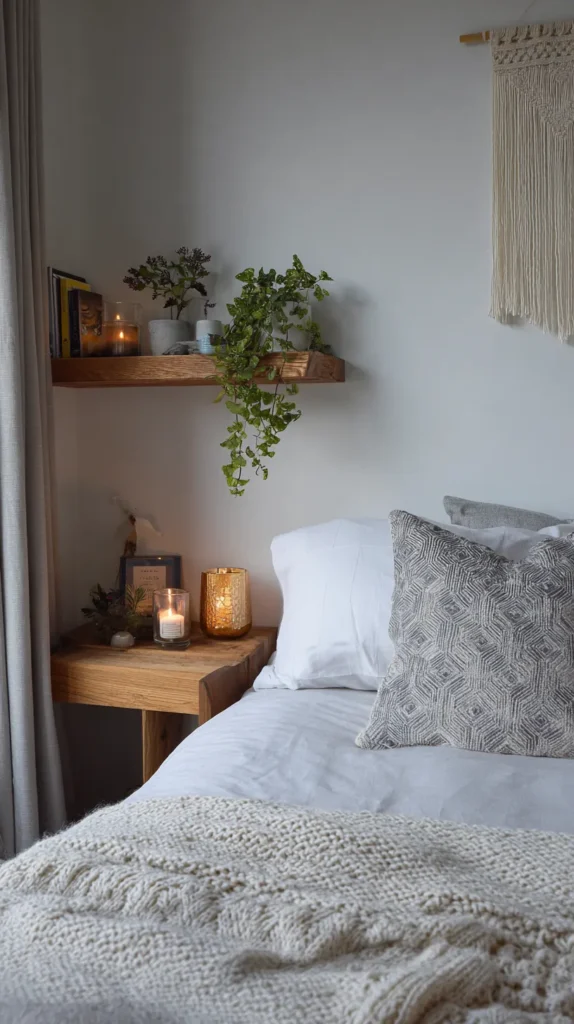
A dedicated altar surface — a small table, a shelf, the top of a chest of drawers, or a wooden crate — arranged with meaningful objects in a considered composition is the most personally significant element a witchy bedroom can contain. It is not a decorative display but a functional one: a surface for candles, crystals, a bowl of salt or water, dried herbs, a small plant, a found object from a meaningful walk, a card from a tarot deck pulled that morning.
The surface itself costs nothing if a shelf or a small table already exists. A dedicated wooden crate as an altar surface costs $5–$15. Objects for the altar are almost entirely sourced rather than purchased — a crystal from a rock shop costs $3–$20, but the pebble from a beach, the feather from the garden, the sprig of rosemary from the kitchen, the candle stub that has been burned through many evenings all cost nothing and carry more meaning than anything purchased specifically for the purpose.
Style tip: Arrange the altar in layers of height — a tall candle at the back, a medium crystal or vessel at the middle, a small bowl or flat stone at the front — so the composition reads as three-dimensional rather than flat. An altar surface arranged at a single height looks like a shelf of objects; one arranged in graduating heights looks like a considered composition that has a visual logic of its own.
3. The Moon Phase Wall Installation
Budget: $15 – $80
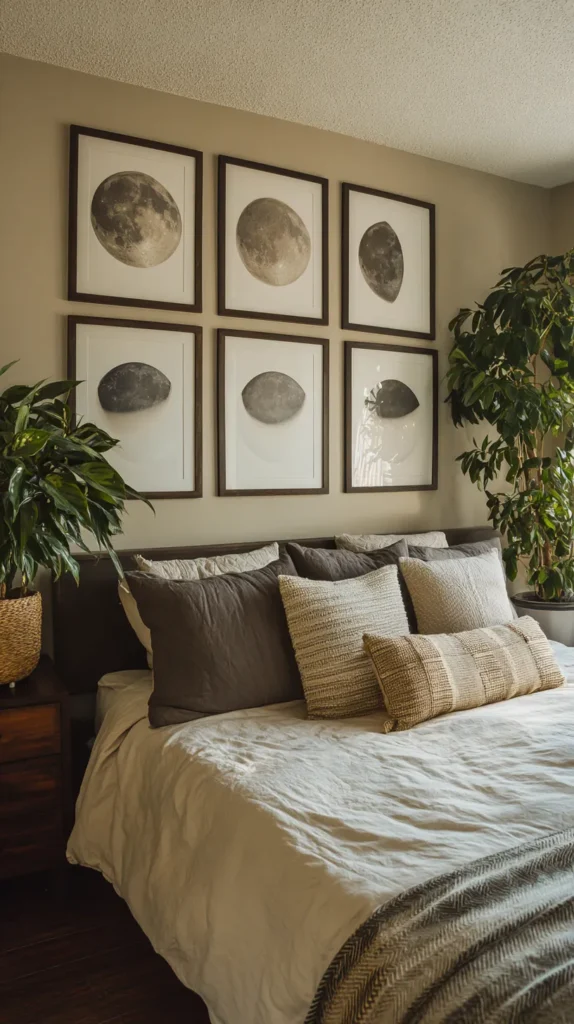
A series of moon phase illustrations — either purchased as a set or printed at home from the many available public domain astronomical illustrations — arranged in a horizontal line above the bed creates one of the most visually striking and most thematically resonant elements available to the witchy bedroom. The moon phase sequence has its own visual logic — the waxing crescent, the half moon, the full moon, the waning gibbous — that reads as a complete composition rather than a series of individual images.
A printed moon phase set at A4 size costs $0.50–$2 per print at a print shop. Simple frames in black, dark timber, or raw wood run $5–$15 each. A set of eight moon phases in matching frames mounted in a horizontal line above the headboard costs $20–$60 in total. Choose astronomical illustration prints rather than graphic or stylised versions for a result that is genuinely beautiful and visually sophisticated rather than decorative.
Style tip: Leave a deliberate space between the new moon print and the full moon print at the centre of the sequence rather than spacing all eight phases equally. The gap at the centre creates a compositional pause that reads as intended, and it gives the full moon — the climax of the lunar sequence — a visual prominence within the arrangement that equal spacing does not achieve.
4. The Candlelit Atmosphere
Budget: $20 – $80
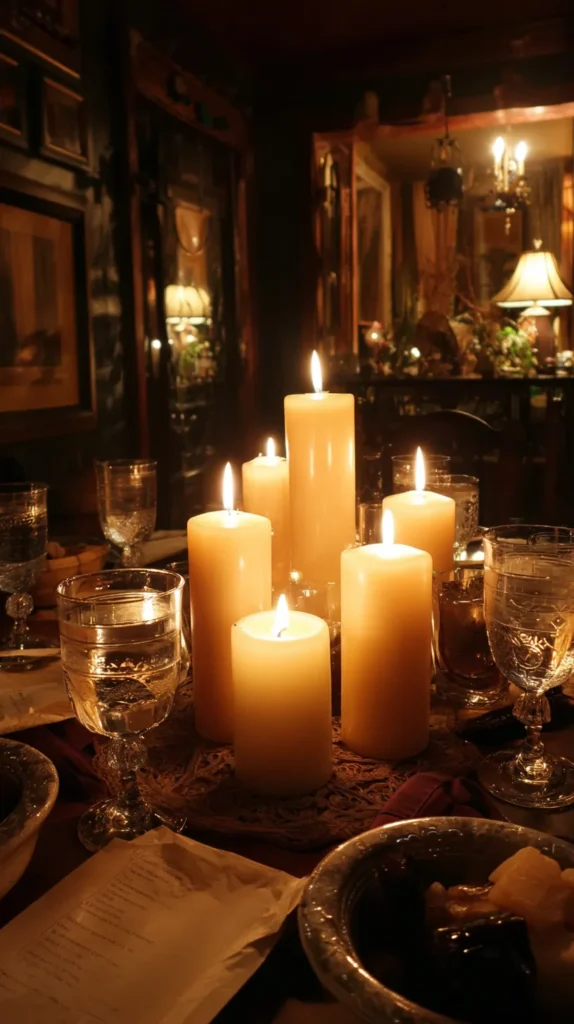
A bedroom lit primarily by candles in the evening — pillar candles on varying-height candleholders, tea lights in dark glass holders, taper candles in brass or iron holders — creates an atmosphere that no electric light source can replicate. Candlelight flickers, creates moving shadows, produces warmth at exactly the height of the sleeping body, and has the particular quality of something that requires tending rather than simply switching on.
Pillar candles in black or dark tones cost $5–$15 each. Brass candlesticks run $10–$40 each. Dark glass votives cost $3–$8 each. Tea lights in bulk cost $5–$10 for a box of fifty. Use unscented or lightly beeswax-scented candles in the bedroom rather than strongly fragrant ones — the bedroom candle is contributing atmosphere rather than scent, and a candle that is too fragrant in a small sleeping space becomes overpowering rather than ambient.
Style tip: Never leave candles burning unattended and position all candle holders on a stable, non-flammable surface well away from fabric. The witchy bedroom is atmospheric rather than hazardous, and the difference between the two is entirely in the care with which candles are positioned and extinguished. A snuffer rather than blowing out the candles is both the safer and the more ceremonially satisfying option.
5. The Crystal and Stone Collection
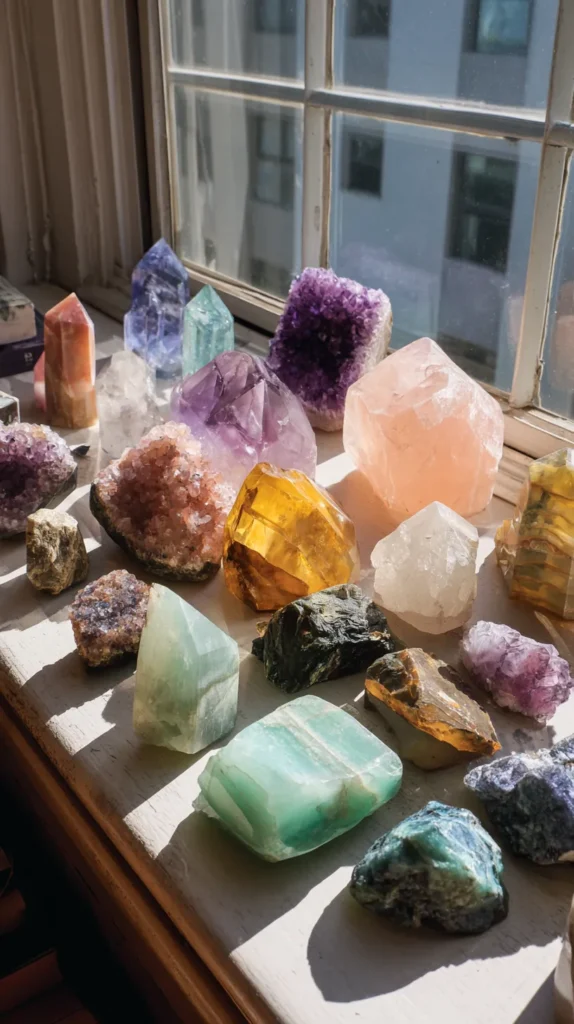
Budget: $20 – $150
A collection of crystals and stones — arranged on the altar surface, on the windowsill where they catch the light, on the bedside table, or in a shallow bowl at the corner of the room — brings the specific beauty of mineral and geological material into the bedroom at every scale, from the large amethyst geode that commands a shelf to the single tumbled obsidian on the bedside table.
Individual crystals cost $3–$30 depending on type and size. Amethyst clusters run $15–$80. A selenite tower costs $10–$30. Clear quartz points are $5–$20 each. The crystal collection is not purchased all at once — it is built over time, each piece added when it is found or when it calls attention to itself in a shop or at a market, and the accumulation over months produces a collection with a personal history that a single shopping trip cannot.
Style tip: Place at least one crystal on the windowsill where the morning sun will pass through it and cast light into the room. A clear quartz point or a piece of selenite in direct morning sun produces the specific quality of scattered crystal light on the bedroom wall that is one of the most beautiful and most characteristic visual experiences of a witchy bedroom — and it costs nothing beyond the positioning.
6. The Dark Botanical Wallpaper Accent Wall
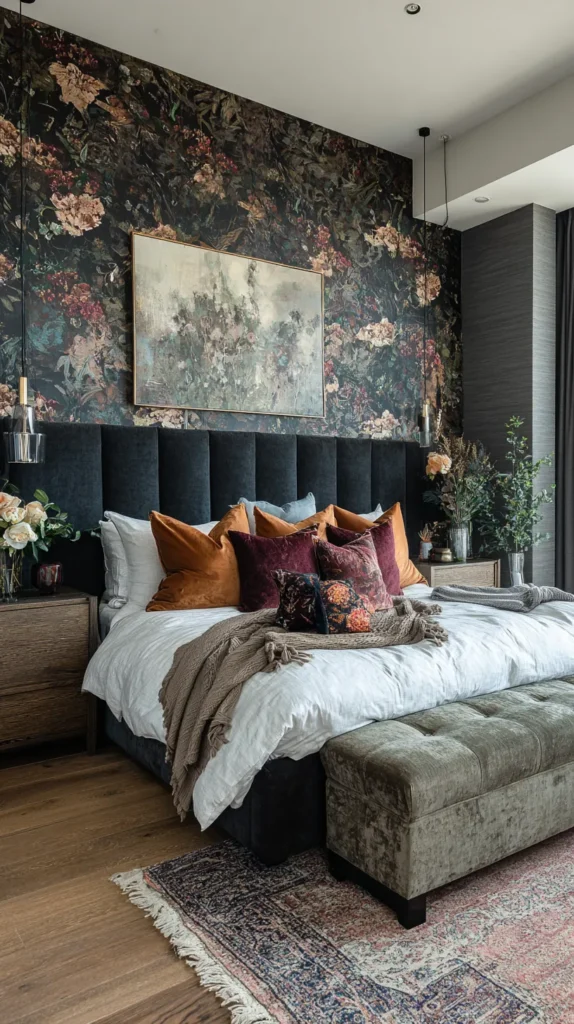
Budget: $40 – $200
One wall of the bedroom — the wall behind the bed, visible from every position in the room — papered in a dark botanical wallpaper: deep green or near-black with botanical illustration, fern patterns, moonflowers, or dense foliage in the William Morris or Victorian naturalist tradition. The dark botanical wall creates the forest-interior quality that the witchy bedroom reaches for without requiring the entire room to be dark.
Dark botanical wallpaper costs $30–$80 per roll — a standard double bed feature wall requires two to three rolls. Paste and application tools run $10–$20. Choose a botanical design with genuinely detailed illustration rather than a simple repeated leaf motif — the complexity of the illustration is what gives the wall its depth and its ability to be looked at repeatedly without becoming visually exhausted.
Style tip: Keep the remaining three walls in a colour pulled from the darkest tone of the wallpaper — a deep sage, a warm charcoal, or a muted forest green — rather than in white or a contrasting colour. A dark botanical wall against a stark white room produces a theatrical rather than an atmospheric effect; the same wall against a deeply toned complementary colour produces an immersive quality that surrounds the sleeping person rather than presenting itself to them from one direction.
7. The Velvet and Layer Bedding Scheme

Budget: $60 – $300
Bedding assembled from multiple layers of dark, rich, textured textiles — a velvet throw in deep plum or forest green, a linen duvet cover in charcoal or slate, cotton pillowcases in midnight blue, and a patchwork quilt folded at the foot — creates the layered, gathered quality of bedding that has been collected rather than purchased as a set. The witchy bedroom bed is not coordinated in the interior design sense; it is accumulated in the personal sense.
A velvet throw in a jewel tone costs $30–$80. A dark linen duvet cover runs $60–$150. Cotton pillowcases in a complementary dark tone cost $15–$40 per pair. A vintage or secondhand patchwork quilt runs $20–$80. The colours do not need to match — they need to be from the same dark, rich, saturated family: the deep greens and purples and burgundies and blues that belong to the same atmospheric palette without being identical.
Style tip: Choose bedding textures that look different from each other — the velvet throw against the linen duvet, the cotton pillowcase against the velvet — rather than multiple versions of the same texture. The contrast between textures at the same dark tone produces the rich complexity that the layered witchy bedroom needs; the same texture repeated in different colours produces coordination rather than atmosphere.
8. The Forest Floor Terrarium
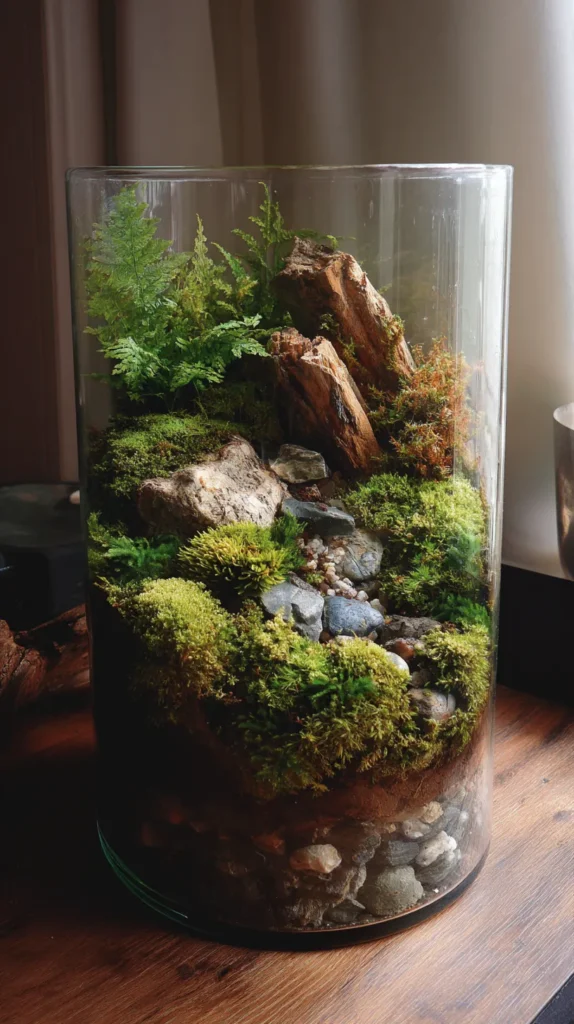
Budget: $25 – $120
A glass terrarium — a large bell jar, a geometric glass case, or an old apothecary bottle — planted with moss, small ferns, lichen-covered twigs, and miniature woodland plants creates a contained forest floor environment on the bedside table or the dresser. The forest terrarium brings the specific quality of the woodland floor — damp, green, ancient, alive — into the bedroom at a scale that is entirely manageable.
A large geometric terrarium costs $25–$60. A bell jar runs $15–$35. Cushion moss costs $5–$15 per bag. Small ferns suitable for enclosed terrariums — Asplenium, miniature Adiantum — cost $4–$8 each. Lichen-covered twigs from the garden cost nothing. Close the terrarium loosely rather than sealing it — a completely sealed terrarium develops condensation that obscures the interior; a loosely covered or open terrarium maintains the moisture that moss requires while remaining visible.
Style tip: Add one small found object to the terrarium — a quartz pebble, a small dried seed pod, a fragment of interestingly shaped bark — to give it the quality of a miniature world with its own history rather than a planted arrangement. The found object is the detail that distinguishes a terrarium that was made with intention from one that was assembled from a planting guide.
9. The Antique and Inherited Mirror
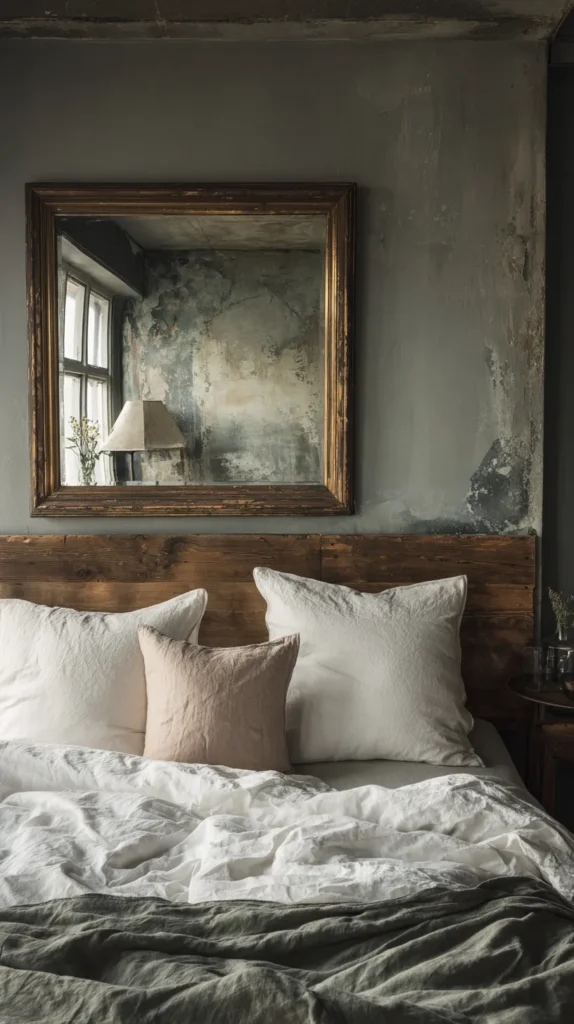
Budget: $10 – $100
An old mirror — framed in tarnished gilt, in dark timber with carved detail, in wrought iron or in a frame that has aged in a way that cannot be manufactured — leaned against the bedroom wall rather than hung produces the witchy bedroom’s most characterful surface. Old mirrors have a quality of imperfection — slight cloudiness, slight distortion, the silver backing showing through at the edges — that makes them do something a new mirror does not: they look as if they have been looked into many times.
Secondhand antique or vintage mirrors cost $10–$80 from charity shops, antique markets, and online listings. A tarnished gilt frame or a darkened timber frame is more appropriate than a clean modern frame regardless of the mirror’s size. Lean rather than hang — a leaned mirror reads as found and placed rather than installed, and the slight forward angle of a leaned mirror reflects the floor and the lower portion of the room rather than the ceiling, which is the more interesting and more immersive reflection angle for a bedroom.
Style tip: Position the mirror so it reflects the most atmospheric element of the room — the candle cluster, the botanical ceiling bundles, the crystal on the windowsill — rather than simply reflecting the door or the wardrobe. A mirror that shows the room’s best element in its reflection is a mirror that participates in the atmosphere rather than simply occupying wall space.
10. The Constellation Ceiling
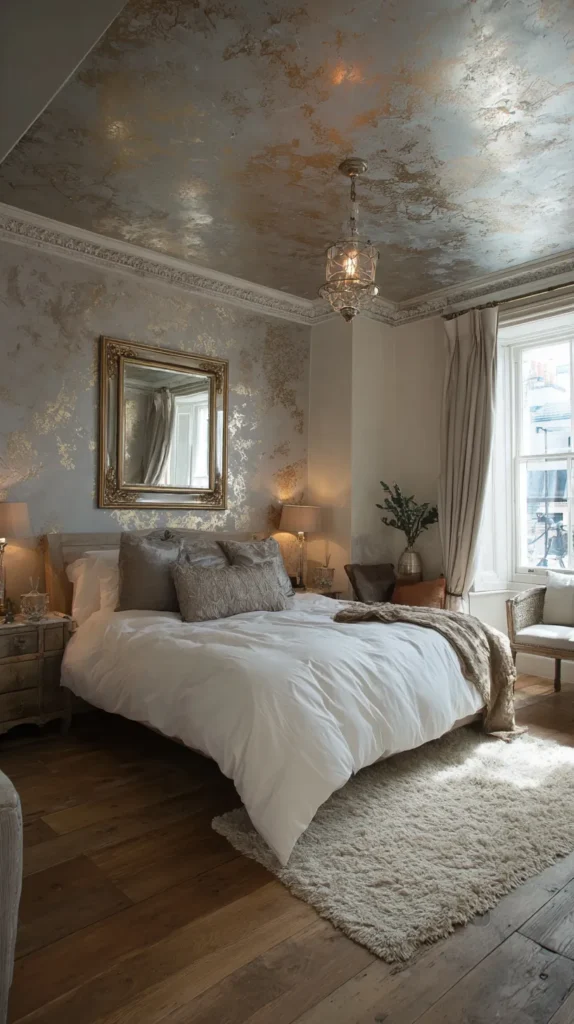
Budget: $15 – $60
A constellation map painted or transferred onto the bedroom ceiling — in white or gold paint on a dark painted ceiling, or as a decal set on a standard white ceiling — creates the specific quality of sleeping under the night sky that the witchy bedroom aspires to. The ceiling is the surface looked at most consistently from the bed and the one most consistently ignored in bedroom design; a constellation ceiling resolves both problems simultaneously.
Ceiling star decals in a constellation format cost $15–$40 for a full set. Gold or white ceiling paint for a hand-painted version runs $10–$25. A dark painted ceiling — deep navy, charcoal, or near-black — as the base for a painted constellation costs $20–$50 in additional paint. Choose a specific night sky — the sky as it appeared on a meaningful date, in a meaningful place — rather than a generic star arrangement. The specific sky has personal significance that a generic arrangement lacks.
Style tip: Paint or apply the constellations in the positions they would actually occupy relative to the bed — the constellation that rises in the east on the wall above the head, the southern sky at the foot of the bed — rather than placing them decoratively across the ceiling surface. The cosmographically accurate arrangement is more interesting than the decorative one and produces the sense of actually lying under the sky rather than under a representation of it.
11. The Dark Botanical Shelf Collection
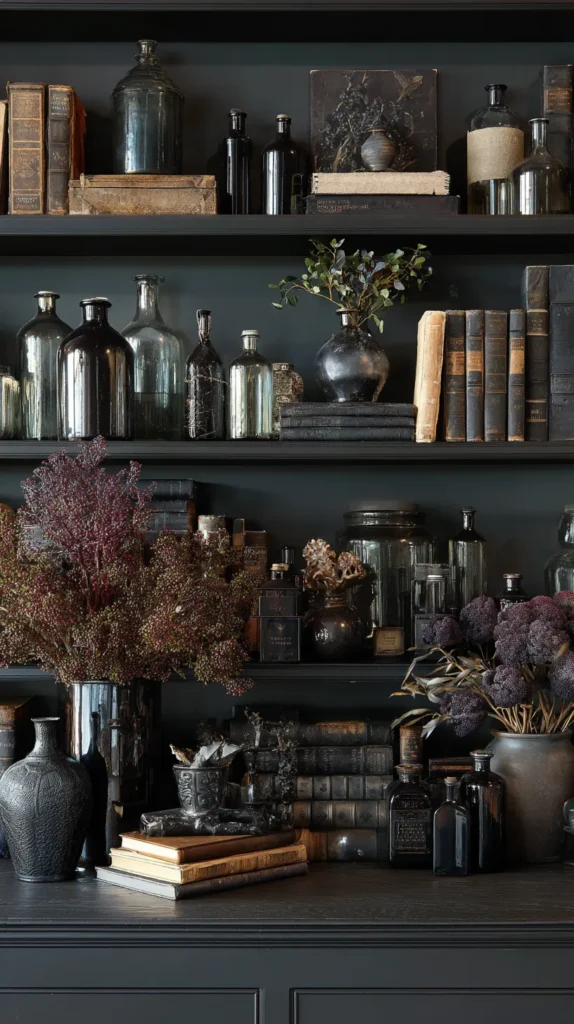
Budget: $30 – $150
Open shelving arranged with dark botanical objects — skulls (animal, resin, or ceramic), apothecary bottles filled with dried herbs and labelled in a botanical hand, dark ceramic vessels containing crystals or dried flowers, preserved specimens in glass domes, antique botanical books with their spines facing outward — creates the most distinctive interior display surface available to the witchy bedroom at every budget level.
Resin or ceramic skull objects cost $8–$30. Apothecary bottles from a charity shop or market run $2–$10 each. Dark ceramic vessels cost $10–$30. A glass dome for display runs $15–$40. Antique botanical books — field guides, herbalists’ manuals, natural history volumes — cost $3–$20 from second-hand bookshops. The shelf reads as authentic when it contains things that were found, used, and kept rather than purchased for the purpose of display.
Style tip: Label the apothecary bottles by hand in a botanical script rather than printing labels — the handwritten label is the detail that gives the collection the quality of something assembled by the person who lives in the room rather than ordered as a set. A handwritten label on a glass bottle of dried lavender reads as personal and as genuinely witchy; a printed label on the same bottle reads as purchased.
12. The Indigo and Tie-Dye Textile Layer

Budget: $20 – $100
Textiles in indigo, resist-dyed, or tie-dyed natural cotton — wall hangings, pillow covers, throw blankets, or a draped fabric panel over the bed’s headboard — bring the ancient textile craft of plant dyeing into the bedroom in the form that suits the witchy aesthetic most precisely. Indigo-dyed fabric has a quality that no synthetic blue can replicate — the particular depth and variation of vegetable dye in natural cotton — and it ages in a direction that makes it more beautiful rather than less.
Indigo-dyed cotton pillow covers cost $15–$40 each. A resist-dyed wall textile runs $30–$100. A tie-dye throw in indigo costs $20–$60. A length of naturally dyed fabric draped over the bed frame runs $15–$40 for a metre of fabric from a natural dye supplier. The indigo textile is more powerful when it appears in multiple positions in the room — the pillow, the wall textile, and a throw — at different depths of the same dye tone rather than as a single statement piece.
Style tip: Mix naturally dyed textiles with solid-coloured dark textiles rather than with patterned or printed fabrics. Indigo against dark linen reads as collected; indigo against a busy print reads as competing. The naturally dyed textile needs the quiet of a solid dark background to show its own variation and depth.
13. The Window Moon Viewing Position
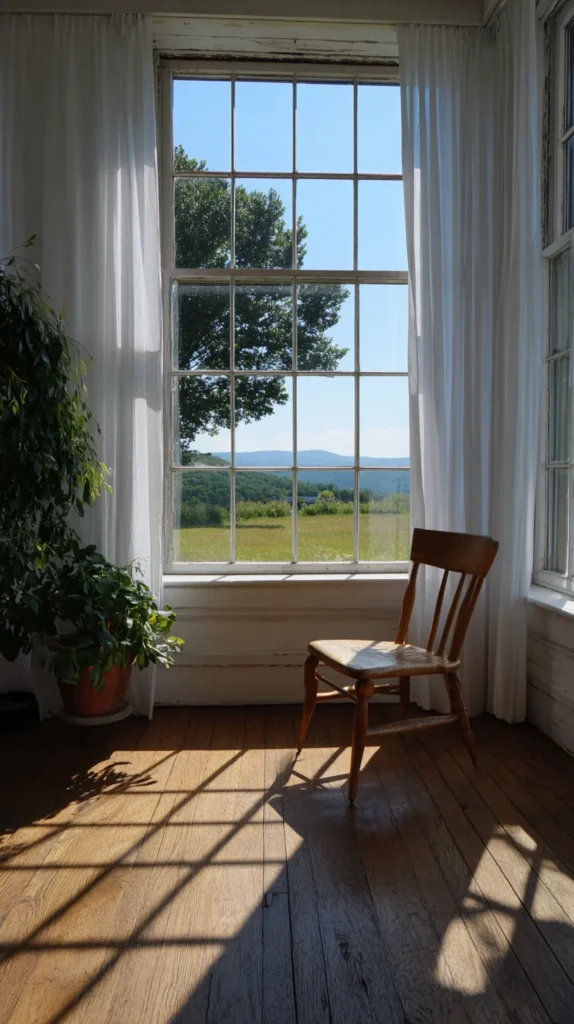
Budget: $0 – $60
Position a single chair — a worn velvet armchair, a bentwood chair with a cushion, any chair with character — beside the bedroom window and designate it as the moon viewing position: the place to sit at night with the lights off and the curtain drawn back, watching whatever the sky is doing. It costs nothing beyond the chair and the habit of using it, and it produces the specific quality of a room that was arranged for night as well as for day.
A secondhand velvet armchair costs $20–$80 from a charity shop or a secondhand furniture market. A cushion for an existing chair runs $15–$35. Pull the chair close enough to the window that the view is the sky rather than the garden — the high view from a chair positioned close to a window is the moon viewing position, not the low view from a chair positioned a metre from the glass.
Style tip: Keep the moon viewing chair clear of other uses — no clothes draped over it, no books piled on the seat — so that it always reads as a chair that is available for sitting in rather than a surface that is being used for storage. A chair that is always ready to be used is a chair that gets used; one that requires clearing before sitting becomes furniture rather than furniture with a purpose.
14. The Herb and Smoke Bundle Collection
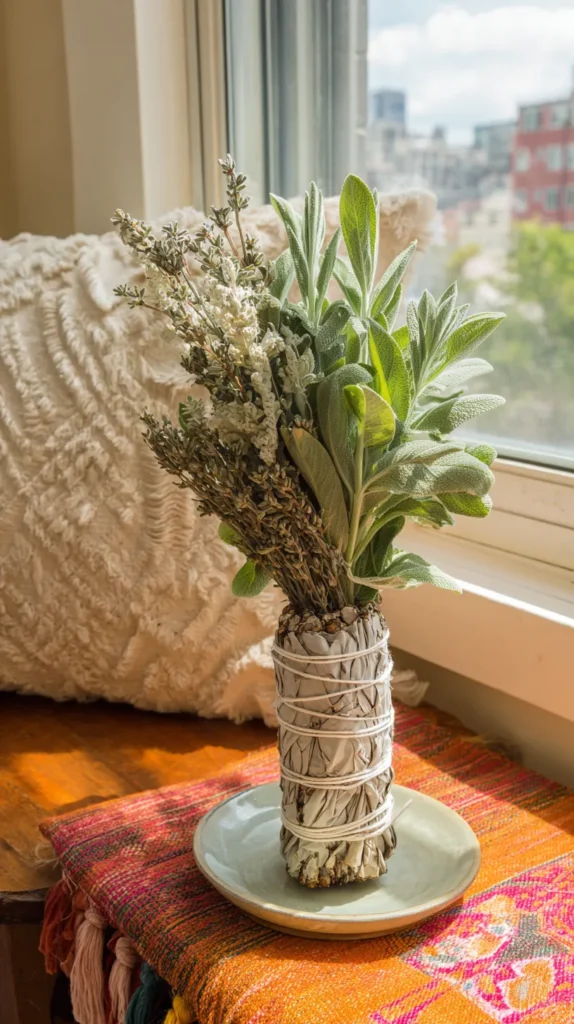
Budget: $10 – $50
A collection of smoke bundles — white sage, cedar, rosemary, lavender, mugwort, palo santo — arranged in a ceramic bowl or a wooden tray on the altar surface or the bedside table, with a fireproof dish for burning and a feather or a fan for directing the smoke, is the most ritually specific element available to the witchy bedroom at the lowest cost. The smoke bundle collection communicates a room where practice happens, not merely where things are displayed.
White sage bundles cost $5–$15 each. Palo santo sticks run $3–$8 each. A ceramic bowl for holding the bundles costs $8–$20. A small abalone shell or fireproof dish for burning costs $8–$25. Dried rosemary or lavender bundled at home costs nothing. Use smoke bundles with windows open and smoke detectors considered — the witchy bedroom is a space of genuine practice, and genuine practice requires genuine safety awareness.
Style tip: Include smoke bundles that were gathered or grown rather than only purchased ones. A bundle of dried rosemary from the garden, tied with garden twine and placed among the purchased sage bundles, gives the collection a personal dimension that changes its meaning from a purchased aesthetic to a practiced ritual. The homegrown or home-gathered element is always the most significant object in any witchy collection.
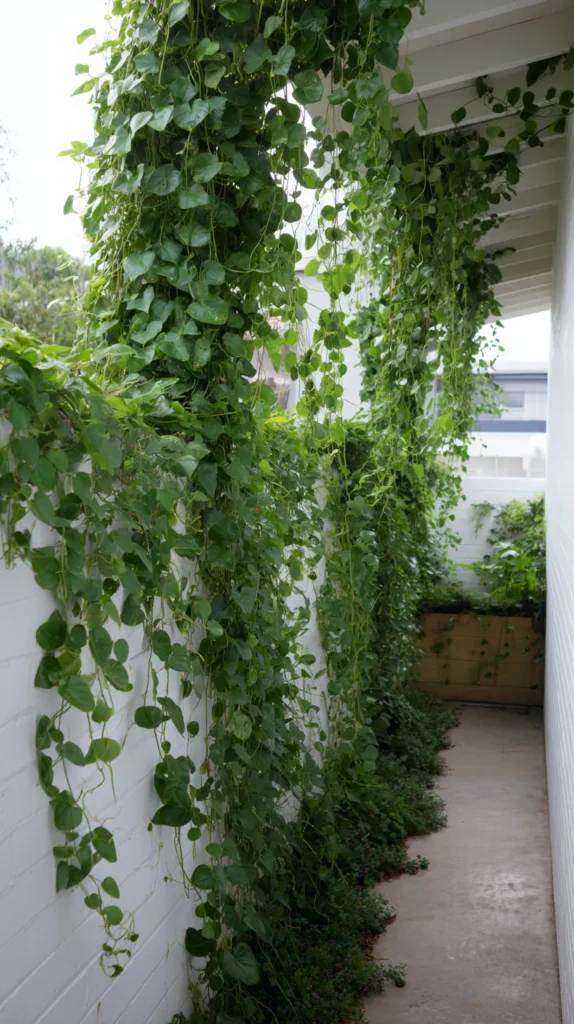
15. The Living Wall of Climbing Plants
Budget: $30 – $120
A wall of climbing or trailing plants — pothos trained along a string trellis fixed to the bedroom wall, a heartleaf philodendron allowed to trail down from a high shelf, a devil’s ivy threading through a grid of wire fixed between two hooks — creates the most alive and most genuinely botanical atmosphere available to a bedroom that cannot accommodate a full planted interior. The living wall requires no specialist installation and costs almost nothing beyond the plant and a few hooks.
Pothos or philodendron plants in a 12-centimetre pot cost $8–$20. A string trellis of natural jute strung between hooks costs $3–$8 in materials. Small cup hooks for the wall run $3–$6 for a pack. Train the vine by tucking new growth behind the nearest string — the plant will attach itself gradually over weeks, filling the trellis section by section, and the progress of the climbing plant across the bedroom wall through a summer is its own visual record of time passing.
Style tip: Choose plants with leaf shapes that have their own botanical character — the heart-shaped leaf of the philodendron, the variegated irregular leaf of the pothos — rather than generic uniform foliage. The character of the individual leaf contributes to the witchy botanical quality of the wall; a plant with characterless uniform foliage provides greenery without the specific interest that makes the living wall worth having.
The best witchy bedroom is not assembled in an afternoon or ordered from a single supplier. It accumulates — the crystal found on a market stall, the mirror carried home from a house clearance, the herbs hung to dry from a garden harvest, the candle that has been burning at the same time every evening for a month. It is a room that shows evidence of a specific person with a specific practice living in it, and that evidence is what no interior design brief can produce and no purchased aesthetic can replicate.
Find one element from this list that feels genuinely meaningful rather than aesthetically appealing and begin there. The room will find the rest of its character in the way that all good rooms do — slowly, specifically, through the accumulation of things that were kept because they mattered.